AI Generated Quiz

Primary 4 Science Materials Quiz

Free AI-Generated NVIDIA Nemotron 3 Ultra 550B A55B Free Primary 4 Science Materials quiz with questions and answers for Singapore students. This page is rendered as a direct URL so the questions and answers can be discovered without pressing in-page buttons.

These static practice materials are generated from the site's syllabus and paper-generation workflow, with source and model context shown so students and parents can evaluate the material before use.

Primary 4 Science AI Generated Generated by NVIDIA Nemotron 3 Ultra 550B A55B Free Updated 2026-06-07

Questions

<!-- TuitionGoWhere generation metadata: stage=5-1; model=nvidia/nemotron-3-ultra-550b-a55b:free; model_label=NVIDIA Nemotron 3 Ultra 550B A55B Free; generated=2026-06-05; Sources: Stage 4-0 LLM templates, syllabus context, and Stage 2 evidence where available. -->

Primary 4 Science Quiz - Materials

Name: ___________________________
Class: Primary 4 ______
Date: ___________________________
Score: ______ / 50

Duration: 45 minutes
Total Marks: 50

Instructions:

  1. Answer all questions.
  2. Write your answers in the spaces provided.
  3. For multiple-choice questions, write the letter (A, B, C, or D) in the bracket provided.
  4. For open-ended questions, write your answers in the spaces provided.
  5. The number of marks is given in brackets [ ] at the end of each question.

Section A: Multiple-Choice Questions (10 × 1 mark = 10 marks)

1. Which of the following is a property of a solid? [1] A. It has a fixed volume but no fixed shape. B. It has a fixed shape and a fixed volume. C. It has no fixed shape and no fixed volume. D. It can be compressed easily.

[ ]

2. Which of the following materials is a good conductor of heat? [1] A. Wood B. Plastic C. Metal D. Rubber

[ ]

3. Which of the following materials is not waterproof? [1] A. Rubber B. Plastic C. Cotton fabric D. Metal

[ ]

4. Which property of a material makes it suitable for making a cooking pot? [1] A. It is flexible. B. It is a good conductor of heat. C. It is transparent. D. It is magnetic.

[ ]

5. Which of the following objects is made of a material that is not waterproof? [1] A. Raincoat B. Umbrella C. Cotton T-shirt D. Plastic bag

[ ]

6. Which of the following materials is transparent? [1] A. Wood B. Metal C. Glass D. Rubber

[ ]

7. Which property of a material makes it suitable for making a window pane? [1] A. It is strong and transparent. B. It is flexible and waterproof. C. It is magnetic and strong. D. It is a good conductor of heat.

[ ]

8. Which of the following materials is magnetic? [1] A. Copper B. Iron C. Aluminium D. Plastic

[ ]

9. Which property of a material makes it suitable for making a raincoat? [1] A. It is transparent. B. It is magnetic. C. It is waterproof. D. It is a good conductor of heat.

[ ]

10. Which of the following objects is made of a material that is flexible? [1] A. Glass cup B. Wooden ruler C. Rubber band D. Metal spoon

[ ]


Section B: Short-Answer Questions (5 × 2 marks = 10 marks)

11. State two properties of a solid. [2]


12. State two properties of a liquid. [2]


13. State two properties of a gas. [2]


14. Name two materials that are good conductors of heat. [2]


15. Name two materials that are poor conductors of heat (insulators). [2]


Section C: Structured and Open-Ended Questions (5 × 6 marks = 30 marks)

16. Study the table below. It shows the properties of four materials A, B, C, and D.

MaterialFlexibleWaterproofTransparentMagneticGood conductor of heat
ANoYesYesNoYes
BYesYesNoNoNo
CNoYesNoYesYes
DYesNoNoNoNo

(a) Which material (A, B, C, or D) is most suitable for making a window pane? Explain your answer. [2]


(b) Which material (A, B, or D) is most suitable for making a raincoat? Explain your answer. [2]


(c) Which material (A, B, C, or D) is most suitable for making a cooking pot? Explain your answer. [2]


17. Study the diagram below.

<image_placeholder> id: Q17-fig1 type: diagram linked_question: Q17 description: Three identical beakers labelled A, B, and C. Beaker A contains a metal spoon, Beaker B contains a wooden spoon, Beaker C contains a plastic spoon. All three spoons are placed in hot water poured into each beaker. A pat of butter is placed on the end of each spoon handle above the water level. description: Three identical beakers labelled A, B, and C. Beaker A contains a metal spoon, Beaker B contains a wooden spoon, Beaker C contains a plastic spoon. All three spoons are placed in hot water poured into each beaker. A pat of butter is placed on the end of each spoon handle above the water level. labels: Beaker A (metal spoon), Beaker B (wooden spoon), Beaker C (plastic spoon), hot water, butter pat on each handle values: Same volume of hot water at same temperature in each beaker; same size butter pats; same initial temperature must_show: Three beakers with different spoons in hot water, butter pats on handles above water level </image_placeholder>

Three identical beakers A, B, and C are filled with the same amount of hot water at the same temperature. A metal spoon is placed in beaker A, a wooden spoon in beaker B, and a plastic spoon in beaker C. A pat of butter is placed on the handle of each spoon above the water level.

(a) In which beaker (A, B, or C) will the butter melt first? [1]


(b) Explain your answer in (a). [2]


(c) What property of the material is being tested in this experiment? [1]


(d) State one variable that must be kept the same to make this a fair test. [1]


(e) State one variable that is changed in this experiment. [1]


18. Study the diagram below.

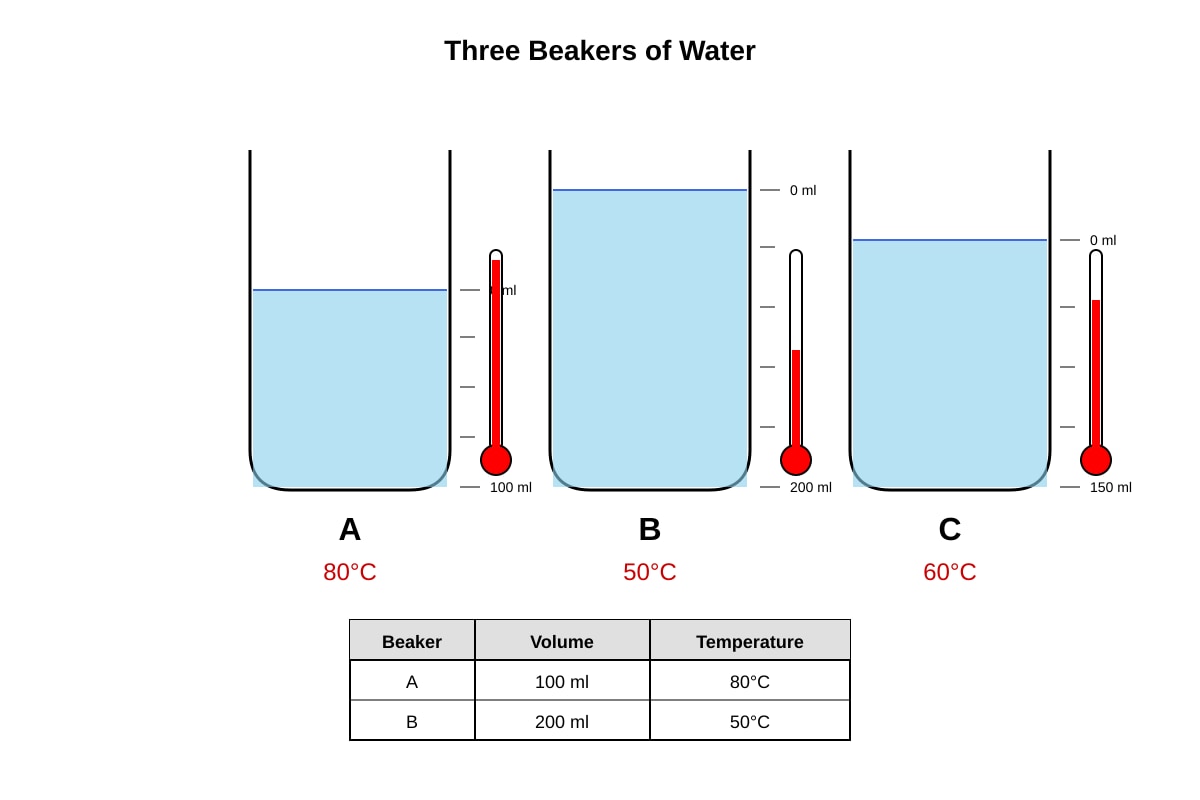
<image_placeholder> id: Q18-fig1 type: diagram linked_question: Q18 description: Three identical containers A, B, and C made of different materials (metal, plastic, wood). Each contains 100 ml of hot water at 80°C. A thermometer is placed in each container. Temperature is recorded every 2 minutes for 10 minutes. description: Three identical containers A, B, and C made of different materials (metal, plastic, wood). Each contains 100 ml of hot water at 80°C. A thermometer is placed in each container. Temperature is recorded every 2 minutes for 10 minutes. labels: Container A (metal), Container B (plastic), Container C (wood), 100 ml hot water at 80°C, thermometer in each values: 100 ml water at 80°C in each; temperature recorded every 2 minutes for 10 minutes must_show: Three identical containers of different materials with hot water and thermometers </image_placeholder>

Three identical containers A, B, and C are made of different materials: metal, plastic, and wood. Each container is filled with 100 ml of hot water at 80°C. A thermometer is placed in each container. The temperature of the water in each container is recorded every 2 minutes for 10 minutes.

(a) In which container (A, B, or C) will the water cool down the fastest? [1]


(b) Explain your answer in (a). [2]


(c) State one variable that must be kept the same to ensure a fair test. [1]


(d) State one variable that is changed in this experiment. [1]


(e) What property of materials is being investigated in this experiment? [1]


19. Study the diagram below.

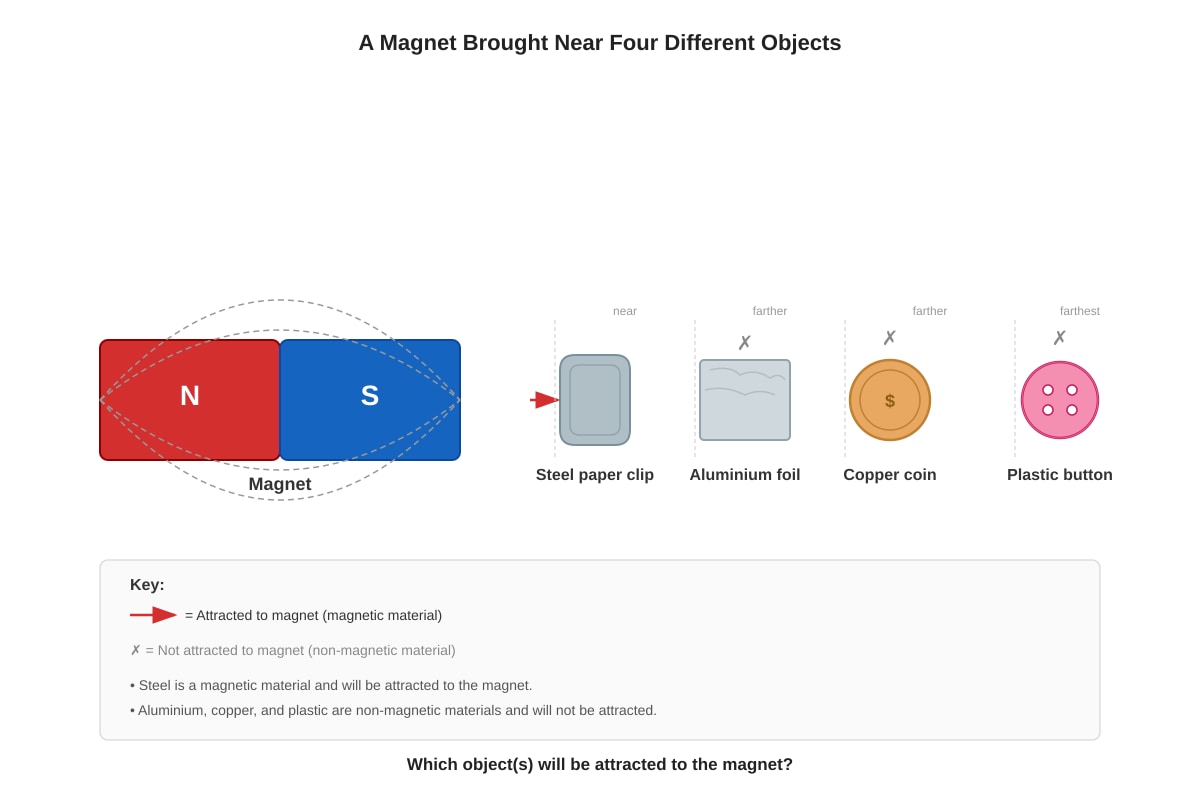
<image_placeholder> id: Q19-fig1 type: diagram linked_question: Q19 description: A magnet is brought near four different objects: an iron nail, a copper coin, a plastic ruler, and a wooden ruler. The observation for each object is recorded. description: A magnet is brought near four different objects: an iron nail, a copper coin, a plastic ruler, and a wooden ruler. The observation for each object is recorded. labels: Magnet, iron nail, copper coin, plastic ruler, wooden ruler values: Magnet brought near each object; observation recorded must_show: Magnet brought near four different objects (iron nail, copper coin, plastic ruler, wooden ruler) </image_placeholder>

A magnet is brought near four different objects: an iron nail, a copper coin, a plastic ruler, and a wooden ruler.

(a) Which object(s) will be attracted to the magnet? [1]


(b) State the property of the object(s) in (a) that allows them to be attracted to the magnet. [1]


(c) Name two other objects made of the same material as the object(s) in (a) that would also be attracted to a magnet. [2]


(d) State one property of the copper coin that is different from the iron nail. [1]


(e) State one property of the plastic ruler that is different from the iron nail. [1]


19. Study the diagram below.

<image_placeholder> id: Q19-fig1 type: diagram linked_question: Q19 description: A magnet is brought near four different objects: an iron nail, a copper coin, a plastic ruler, and a wooden ruler. The observation for each object is recorded. description: A magnet is brought near four different objects: an iron iron nail, a copper coin, a plastic ruler, and a wooden ruler. The observation for each object is recorded. labels: Magnet, iron nail, copper coin, plastic ruler, wooden ruler values: Magnet brought near each object; observation recorded must_show: Magnet brought near four different objects (iron nail, copper coin, plastic ruler, wooden ruler) </image_placeholder>

A magnet is brought near four different objects: an iron nail, a copper coin, a plastic ruler, and a wooden ruler.

(a) Which object(s) will be attracted to the magnet? [1]


(b) State the property of the object(s) in (a) that allows them to be attracted to the magnet. [1]


(c) Name two other objects made of the same material as the object(s) in (a) that would also be attracted to a magnet. [2]


(d) State one property of the copper coin that is different from the iron nail. [1]


(e) State one property of the plastic ruler that is different from the iron nail. [1]


20. Study the diagram below.

<image_placeholder> id: Q20-fig1 type: diagram linked_question: Q20 description: Three identical beakers A, B, and C. Beaker A contains 100 ml of water. Beaker B contains 100 ml of cooking oil. Beaker C contains 100 ml of honey. All three liquids are at room temperature. An identical metal spoon is placed in each beaker. description: Three identical beakers A, B, and C. Beaker A contains 100 ml of water. Beaker B contains 100 ml of cooking oil. Beaker C contains 100 ml of honey. All three liquids are at room temperature. An identical metal spoon is placed in each beaker. labels: Beaker A (water), Beaker B (cooking oil), Beaker C (honey), 100 ml each, metal spoon in each values: 100 ml each liquid at room temperature; identical metal spoons must_show: Three beakers with different liquids (water, oil, honey) and identical metal spoons </image_placeholder>

Three identical beakers A, B, and C contain 100 ml of water, cooking oil, and honey respectively, all at room temperature. An identical metal spoon is placed in each beaker.

(a) In which beaker (A, B, or C) will the metal spoon conduct heat the fastest if hot water is poured into each beaker? [1]


(b) Explain your answer in (a). [2]


(c) State one variable that must be kept the same to make this a fair test. [1]


(d) State one variable that is changed in this experiment. [1]


(e) What property of the liquids is being investigated in this experiment? [1]


20. Study the diagram below.

<image_placeholder> id: Q20-fig1 type: diagram linked_question: Q20 description: Three identical beakers A, B, and C. Beaker A contains 100 ml of water. Beaker B contains 100 ml of cooking oil. Beaker C contains 100 ml of honey. All three liquids are at room temperature. An identical metal spoon is placed in each beaker. description: Three identical beakers A, B, and C. Beaker A contains 100 ml of water. Beaker B contains 100 ml of cooking oil. Beaker C contains 100 ml of honey. All three liquids are at room temperature. An identical metal spoon is placed in each beaker. labels: Beaker A (water), Beaker B (cooking oil), Beaker C (honey), 100 ml each, metal spoon in each values: 100 ml each liquid at room temperature; identical metal spoons must_show: Three beakers with different liquids (water, oil, honey) and identical metal spoons </image_placeholder>

Three identical beakers A, B, and C contain 100 ml of water, cooking oil, and honey respectively, all at room temperature. An identical metal spoon is placed in each beaker.

(a) In which beaker (A, B, or C) will the metal spoon conduct heat the fastest if hot water is poured into each beaker? [1]


(b) Explain your answer in (a). [2]


(c) State one variable that must be kept the same to make this a fair test. [1]


(d) State one variable that is changed in this experiment. [1]


(e) What property of the liquids is being investigated in this experiment? [1]


20. Study the diagram below.

<image_placeholder> id: Q20-fig1 type: diagram linked_question: Q20 description: Three identical beakers A, B, and C. Beaker A contains 100 ml of water. Beaker B contains 100 ml of cooking oil. Beaker C contains 100 ml of honey. All three liquids are at room temperature. An identical metal spoon is placed in each beaker. description: Three identical beakers A, B, and C. Beaker A contains 100 ml of water. Beaker B contains 100 ml of cooking oil. Beaker C contains 100 ml of honey. All three liquids are at room temperature. An identical metal spoon is placed in each beaker. labels: Beaker A (water), Beaker B (cooking oil), Beaker C (honey), 100 ml each, metal spoon in each values: 100 ml each liquid at room temperature; identical metal spoons must_show: Three beakers with different liquids (water, oil, honey) and identical metal spoons </image_placeholder>

Three identical beakers A, B, and C contain 100 ml of water, cooking oil, and honey respectively, all at room temperature. An identical metal spoon is placed in each beaker.

(a) In which beaker (A, B, or C) will the metal spoon conduct heat the fastest if hot water is poured into each beaker? [1]


(b) Explain your answer in (a). [2]


(c) State one variable that must be kept the same to make this a fair test. [1]


(d) State one variable that is changed in this experiment. [1]


(e) What property of the liquids is being investigated in this experiment? [1]


20. Study the diagram below.

<image_placeholder> id: Q20-fig1 type: diagram linked_question: Q20 description: Three identical beakers A, B, and C. Beaker A contains 100 ml of water. Beaker B contains 100 ml of cooking oil. Beaker C contains 100 ml of honey. All three liquids are at room temperature. An identical metal spoon is placed in each beaker. description: Three identical beakers A, B, and C. Beaker A contains 100 ml of water. Beaker B contains 100 ml of cooking oil. Beaker C contains 100 ml of honey. All three liquids are at room temperature. An identical metal spoon is placed in each beaker. labels: Beaker A (water), Beaker B (cooking oil), Beaker C (honey), 100 ml each, metal spoon in each values: 100 ml each liquid at room temperature; identical metal spoons must_show: Three beakers with different liquids (water, oil, honey) and identical metal spoons </image_placeholder>

Three identical beakers A, B, and C contain 100 ml of water, cooking oil, and honey respectively, all at room temperature. An identical metal spoon is placed in each beaker.

(a) In which beaker (A, B, or C) will the metal spoon conduct heat the fastest if hot water is poured into each beaker? [1]


(b) Explain your answer in (a). [2]


(c) State one variable that must be kept the same to make this a fair test. [1]


(d) State one variable that is changed in this experiment. [1]


(e) What property of the liquids is being investigated in this experiment? [1]


20. Study the diagram below.

<image_placeholder> id: Q20-fig1 type: diagram linked_question: Q20 description: Three identical beakers A, B, and C. Beaker A contains 100 ml of water. Beaker B contains 100 ml of cooking oil. Beaker C contains 100 ml of honey. All three liquids are at room temperature. An identical metal spoon is placed in each beaker. description: Three identical beakers A, B, and C. Beaker A contains 100 ml of water. Beaker B contains 100 ml of cooking oil. Beaker C contains 100 ml of honey. All three liquids are at room temperature. An identical metal spoon is placed in each beaker. labels: Beaker A (water), Beaker B (cooking oil), Beaker C (honey), 100 ml each, metal spoon in each values: 100 ml each liquid at room temperature; identical metal spoons must_show: Three beakers with different liquids (water, oil, honey) and identical metal spoons </image_placeholder>

Three identical beakers A, B, and C contain 100 ml of water, cooking oil, and honey respectively, all at room temperature. An identical metal spoon is placed in each beaker.

(a) In which beaker (A, B, or C) will the metal spoon conduct heat the fastest if hot water is poured into each beaker? [1]


(b) Explain your answer in (a). [2]


(c) State one variable that must be kept the same to make this a fair test. [1]


(d) State one variable that is changed in this experiment. [1]


(e) What property of the liquids is being investigated in this experiment? [1]


20. Study the diagram below.

<image_placeholder> id: Q20-fig1 type: diagram linked_question: Q20 description: Three identical beakers A, B, and C. Beaker A contains 100 ml of water. Beaker B contains 100 ml of cooking oil. Beaker C contains 100 ml of honey. All three liquids are at room temperature. An identical metal spoon is placed in each beaker. description: Three identical beakers A, B, and C. Beaker A contains 100 ml of water. Beaker B contains 100 ml of cooking oil. Beaker C contains 100 ml of honey. All three liquids are at room temperature. An identical metal spoon is placed in each beaker. labels: Beaker A (water), Beaker B (cooking oil), Beaker C (honey), 100 ml each, metal spoon in each values: 100 ml each liquid at room temperature; identical metal spoons must_show: Three beakers with different liquids (water, oil, honey) and identical metal spoons </image_placeholder>

Three identical beakers A, B, and C contain 100 ml of water, cooking oil, and honey respectively, all at room temperature. An identical metal spoon is placed in each beaker.

(a) In which beaker (A, B, or C) will the metal spoon conduct heat the fastest if hot water is poured into each beaker? [1]


(b) Explain your answer in (a). [2]


(c) State one variable that must be kept the same to make this a fair test. [1]


(d) State one variable that is changed in this experiment. [1]


(e) What property of the liquids is being investigated in this experiment? [1]


20. Study the diagram below.

<image_placeholder> id: Q20-fig1 type: diagram linked_question: Q20 description: Three identical beakers A, B, and C. Beaker A contains 100 ml of water. Beaker B contains 100 ml of cooking oil. Beaker C contains 100 ml of honey. All three liquids are at room temperature. An identical metal spoon is placed in each beaker. description: Three identical beakers A, B, and C. Beaker A contains 100 ml of water. Beaker B contains 100 ml of cooking oil. Beaker C contains 100 ml of honey. All three liquids are at room temperature. An identical metal spoon is placed in each beaker. labels: Beaker A (water), Beaker B (cooking oil), Beaker C (honey), 100 ml each, metal spoon in each values: 100 ml each liquid at room temperature; identical metal spoons must_show: Three beakers with different liquids (water, oil, honey) and identical metal spoons </image_placeholder>

Three identical beakers A, B, and C contain 100 ml of water, cooking oil, and honey respectively, all at room temperature. An identical metal spoon is placed in each beaker.

(a) In which beaker (A, B, or C) will the metal spoon conduct heat the fastest if hot water is poured into each beaker? [1]


(b) Explain your answer in (a). [2]


(c) State one variable that must be kept the same to make this a fair test. [1]


(d) State one variable that is changed in this experiment. [1]


(e) What property of the liquids is being investigated in this experiment? [1]


20. Study the diagram below.

<image_placeholder> id: Q20-fig1 type: diagram linked_question: Q20 description: Three identical beakers A, B, and C. Beaker A contains 100 ml of water. Beaker B contains 100 ml of cooking oil. Beaker C contains 100 ml of honey. All three liquids are at room temperature. An identical metal spoon is placed in each beaker. description: Three identical beakers A, B, and C. Beaker A contains 100 ml of water. Beaker B contains 100 ml of cooking oil. Beaker C contains 100 ml of honey. All three liquids are at room temperature. An identical metal spoon is placed in each beaker. labels: Beaker A (water), Beaker B (cooking oil), Beaker C (honey), 100 ml each, metal spoon in each values: 100 ml each liquid at room temperature; identical metal spoons must_show: Three beakers with different liquids (water, oil, honey) and identical metal spoons </image_placeholder>

Three identical beakers A, B, and C contain 100 ml of water, cooking oil, and honey respectively, all at room temperature. An identical metal spoon is placed in each beaker.

(a) In which beaker (A, B, or C) will the metal spoon conduct heat the fastest if hot water is poured into each beaker? [1]


(b) Explain your answer in (a). [2]


(c) State one variable that must be kept the same to make this a fair test. [1]


(d) State one variable that is changed in this experiment. [1]


(e) What property of the liquids is being investigated in this experiment? [1]


20. Study the diagram below.

<image_placeholder> id: Q20-fig1 type: diagram linked_question: Q20 description: Three identical beakers A, B, and C. Beaker A contains 100 ml of water. Beaker B contains 100 ml of cooking oil. Beaker C contains 100 ml of honey. All three liquids are at room temperature. An identical metal spoon is placed in each beaker. description: Three identical beakers A, B, and C. Beaker A contains 100 ml of water. Beaker B contains 100 ml of cooking oil. Beaker C contains 100 ml of honey. All three liquids are at room temperature. An identical metal spoon is placed in each beaker. labels: Beaker A (water), Beaker B (cooking oil), Beaker C (honey), 100 ml each, metal spoon in each values: 100 ml each liquid at room temperature; identical metal spoons must_show: Three beakers with different liquids (water, oil, honey) and identical metal spoons </image_placeholder>

Three identical beakers A, B, and C contain 100 ml of water, cooking oil, and honey respectively, all at room temperature. An identical metal spoon is placed in each beaker.

(a) In which beaker (A, B, or C) will the metal spoon conduct heat the fastest if hot water is poured into each beaker? [1]


(b) Explain your answer in (a). [2]


(c) State one variable that must be kept the same to make this a fair test. [1]


(d) State one variable that is changed in this experiment. [1]


(e) What property of the liquids is being investigated in this experiment? [1]


20. Study the diagram below.

<image_placeholder> id: Q20-fig1 type: diagram linked_question: Q20 description: Three identical beakers A, B, and C. Beaker A contains 100 ml of water. Beaker B contains 100 ml of cooking oil. Beaker C contains 100 ml of honey. All three liquids are at room temperature. An identical metal spoon is placed in each beaker. description: Three identical beakers A, B, and C. Beaker A contains 100 ml of water. Beaker B contains 100 ml of cooking oil. Beaker C contains 100 ml of honey. All three liquids are at room temperature. An identical metal spoon is placed in each beaker. labels: Beaker A (water), Beaker B (cooking oil), Beaker C (honey), 100 ml each, metal spoon in each values: 100 ml each liquid at room temperature; identical metal spoons must_show: Three beakers with different liquids (water, oil, honey) and identical metal spoons </image_placeholder>

Three identical beakers A, B, and C contain 100 ml of water, cooking oil, and honey respectively, all at room temperature. An identical metal spoon is placed in each beaker.

(a) In which beaker (A, B, or C) will the metal spoon conduct heat the fastest if hot water is poured into each beaker? [1]


(b) Explain your answer in (a). [2]


(c) State one variable that must be kept the same to make this a fair test. [1]


(d) State one variable that is changed in this experiment. [1]


(e) What property of the liquids is being investigated in this experiment? [1]


20. Study the diagram below.

<image_placeholder> id: Q20-fig1 type: diagram linked_question: Q20 description: Three identical beakers A, B, and C. Beaker A contains 100 ml of water. Beaker B contains 100 ml of cooking oil. Beaker C contains 100 ml of honey. All three liquids are at room temperature. An identical metal spoon is placed in each beaker. description: Three identical beakers A, B, and C. Beaker A contains 100 ml of water. Beaker B contains 100 ml of cooking oil. Beaker C contains 100 ml of honey. All three liquids are at room temperature. An identical metal spoon is placed in each beaker. labels: Beaker A (water), Beaker B (cooking oil), Beaker C (honey), 100 ml each, metal spoon in each values: 100 ml each liquid at room temperature; identical metal spoons must_show: Three beakers with different liquids (water, oil, honey) and identical metal spoons </image_placeholder>

Three identical beakers A, B, and C contain 100 ml of water, cooking oil, and honey respectively, all at room temperature. An identical metal spoon is placed in each beaker.

(a) In which beaker (A, B, or C) will the metal spoon conduct heat the fastest if hot water is poured into each beaker? [1]


(b) Explain your answer in (a). [2]


(c) State one variable that must be kept the same to make this a fair test. [1]


(d) State one variable that is changed in this experiment. [1]


(e) What property of the liquids is being investigated in this experiment? [1]


20. Study the diagram below.

<image_placeholder> id: Q20-fig1 type: diagram linked_question: Q20 description: Three identical beakers A, B, and C. Beaker A contains 100 ml of water. Beaker B contains 100 ml of cooking oil. Beaker C contains 100 ml of honey. All three liquids are at room temperature. An identical metal spoon is placed in each beaker. description: Three identical beakers A, B, and C. Beaker A contains 100 ml of water. Beaker B contains 100 ml of cooking oil. Beaker C contains 100 ml of honey. All three liquids are at room temperature. An identical metal spoon is placed in each beaker. labels: Beaker A (water), Beaker B (cooking oil), Beaker C (honey), 100 ml each, metal spoon in each values: 100 ml each liquid at room temperature; identical metal spoons must_show: Three beakers with different liquids (water, oil, honey) and identical metal spoons </image_placeholder>

Three identical beakers A, B, and C contain 100 ml of water, cooking oil, and honey respectively, all at room temperature. An identical metal spoon is placed in each beaker.

(a) In which beaker (A, B, or C) will the metal spoon conduct heat the fastest if hot water is poured into each beaker? [1]


(b) Explain your answer in (a). [2]


(c) State one variable that must be kept the same to make this a fair test. [1]


(d) State one variable that is changed in this experiment. [1]


(e) What property of the liquids is being investigated in this experiment? [1]


20. Study the diagram below.

<image_placeholder> id: Q20-fig1 type: diagram linked_question: Q20 description: Three identical beakers A, B, and C. Beaker A contains 100 ml of water. Beaker B contains 100 ml of cooking oil. Beaker C contains 100 ml of honey. All three liquids are at room temperature. An identical metal spoon is placed in each beaker. description: Three identical beakers A, B, and C. Beaker A contains 100 ml of water. Beaker B contains 100 ml of cooking oil. Beaker C contains 100 ml of honey. All three liquids are at room temperature. An identical metal spoon is placed in each beaker. labels: Beaker A (water), Beaker B (cooking oil), Beaker C (honey), 100 ml each, metal spoon in each values: 100 ml each liquid at room temperature; identical metal spoons must_show: Three beakers with different liquids (water, oil, honey) and identical metal spoons </image_placeholder>

Three identical beakers A

<stage5_quiz_md>

Primary 4 Science Quiz - Materials

Name: ___________________________
Class: Primary 4 ______
Date: ___________________________
Score: ______ / 50

Duration: 45 minutes
Total Marks: 50

Instructions:

  1. Answer all questions.
  2. Write your answers in the spaces provided.
  3. For multiple-choice questions, write the letter (A, B, C, or D) in the bracket provided.
  4. For open-ended questions, write your answers in the spaces provided.
  5. The number of marks is given in brackets [ ] at the end of each question.

Section A: Multiple-Choice Questions (10 × 1 mark = 10 marks)

1. Which of the following is a property of a solid? [1] A. It has a fixed volume but no fixed shape. B. It has a fixed shape and a fixed volume. C. It has no fixed shape and no fixed volume. D. It can be compressed easily.

[ ]

2. Which of the following materials is a good conductor of heat? [1] A. Wood B. Plastic C. Metal D. Rubber

[ ]

3. Which of the following materials is not waterproof? [1] A. Rubber B. Plastic C. Cotton fabric D. Metal

[ ]

4. Which property of a material makes it suitable for making a cooking pot? [1] A. It is flexible. B. It is a good conductor of heat. C. It is transparent. D. It is magnetic.

[ ]

5. Which of the following objects is made of a material that is not waterproof? [1] A. Raincoat B. Umbrella C. Cotton T-shirt D. Plastic bag

[ ]

6. Which of the following materials is transparent? [1] A. Wood B. Metal C. Glass D. Rubber

[ ]

7. Which property of a material makes it suitable for making a window pane? [1] A. It is strong and transparent. B. It is flexible and waterproof. C. It is magnetic and strong. D. It is a good conductor of heat.

[ ]

8. Which of the following materials is magnetic? [1] A. Copper B. Iron C. Aluminium D. Plastic

[ ]

9. Which property of a material makes it suitable for making a raincoat? [1] A. It is transparent. B. It is magnetic. C. It is waterproof. D. It is a good conductor of heat.

[ ]

10. Which of the following objects is made of a material that is flexible? [1] A. Glass cup B. Wooden ruler C. Rubber band D. Metal spoon

[ ]


Section B: Short-Answer Questions (5 × 2 marks = 10 marks)

11. State two properties of a solid. [2]


12. State two properties of a liquid. [2]


13. State two properties of a gas. [2]


14. Name two materials that are good conductors of heat. [2]


15. Name two materials that are poor conductors of heat (insulators). [2]


Section C: Structured and Open-Ended Questions (5 × 6 marks = 30 marks)

16. Study the table below. It shows the properties of four materials A, B, C, and D.

MaterialFlexibleWaterproofTransparentMagneticGood conductor of heat
ANoYesYesNoYes
BYesYesNoNoNo
CNoYesNoYesYes
DYesNoNoNoNo

(a) Which material (A, B, C, or D) is most suitable for making a window pane? Explain your answer. [2]


(b) Which material (A, B, or D) is most suitable for making a raincoat? Explain your answer. [2]


(c) Which material (A, B, C, or D) is most suitable for making a cooking pot? Explain your answer. [2]


17. Study the diagram below.

<image_placeholder> id: Q17-fig1 type: diagram linked_question: Q17 description: Three identical beakers labelled A, B, and C. Beaker A contains a metal spoon, Beaker B contains a wooden spoon, Beaker C contains a plastic spoon. All three spoons are placed in hot water poured into each beaker. A pat of butter is placed on the end of each spoon handle above the water level. description: Three identical beakers labelled A, B, and C. Beaker A contains a metal spoon, Beaker B contains a wooden spoon, Beaker C contains a plastic spoon. All three spoons are placed in hot water poured into each beaker. A pat of butter is placed on the end of each spoon handle above the water level. labels: Beaker A (metal spoon), Beaker B (wooden spoon), Beaker C (plastic spoon), hot water, butter pat on each handle values: Same volume of hot water at same temperature in each beaker; same size butter pats; same initial temperature must_show: Three beakers with different spoons in hot water, butter pats on handles above water level </image_placeholder>

Three identical beakers A, B, and C are filled with the same amount of hot water at the same temperature. A metal spoon is placed in beaker A, a wooden spoon in beaker B, and a plastic spoon in beaker C. A pat of butter is placed on the handle of each spoon above the water level.

(a) In which beaker (A, B, or C) will the butter melt first? [1]


(b) Explain your answer in (a). [2]


(c) What property of the material is being tested in this experiment? [1]


(d) State one variable that must be kept the same to make this a fair test. [1]


(e) State one variable that is changed in this experiment. [1]


18. Study the diagram below.

<image_placeholder> id: Q18-fig1 type: diagram linked_question: Q18 description: Three identical containers A, B, and C made of different materials (metal, plastic, wood). Each contains 100 ml of hot water at 80°C. A thermometer is placed in each container. Temperature is recorded every 2 minutes for 10 minutes. description: Three identical containers A, B, and C made of different materials (metal, plastic, wood). Each contains 100 ml of hot water at 80°C. A thermometer is placed in each container. Temperature is recorded every 2 minutes for 10 minutes. labels: Container A (metal), Container B (plastic), Container C (wood), 100 ml hot water at 80°C, thermometer in each values: 100 ml water at 80°C in each; temperature recorded every 2 minutes for 10 minutes must_show: Three identical containers of different materials with hot water and thermometers </image_placeholder>

Three identical containers A, B, and C are made of different materials: metal, plastic, and wood. Each container is filled with 100 ml of hot water at 80°C. A thermometer is placed in each container. The temperature of the water in each container is recorded every 2 minutes for 10 minutes.

(a) In which container (A, B, or C) will the water cool down the fastest? [1]


(b) Explain your answer in (a). [2]


(c) State one variable that must be kept the same to ensure a fair test. [1]


(d) State one variable that is changed in this experiment. [1]


(e) What property of materials is being investigated in this experiment? [1]


19. Study the diagram below.

<image_placeholder> id: Q19-fig1 type: diagram linked_question: Q19 description: A magnet is brought near four different objects: an iron nail, a copper coin, a plastic ruler, and a wooden ruler. The observation for each object is recorded. description: A magnet is brought near four different objects: an iron nail, a copper coin, a plastic ruler, and a wooden ruler. The observation for each object is recorded. labels: Magnet, iron nail, copper coin, plastic ruler, wooden ruler values: Magnet brought near each object; observation recorded must_show: Magnet brought near four different objects (iron nail, copper coin, plastic ruler, wooden ruler) </image_placeholder>

A magnet is brought near four different objects: an iron nail, a copper coin, a plastic ruler, and a wooden ruler.

(a) Which object(s) will be attracted to the magnet? [1]


(b) State the property of the object(s) in (a) that allows them to be attracted to the magnet. [1]


(c) Name two other objects made of the same material as the object(s) in (a) that would also be attracted to a magnet. [2]


(d) State one property of the copper coin that is different from the iron nail. [1]


(e) State one property of the plastic ruler that is different from the iron nail. [1]


20. Study the diagram below.

<image_placeholder> id: Q20-fig1 type: diagram linked_question: Q20 description: Three identical beakers A, B, and C. Beaker A contains 100 ml of water. Beaker B contains 100 ml of cooking oil. Beaker C contains 100 ml of honey. All three liquids are at room temperature. An identical metal spoon is placed in each beaker. description: Three identical beakers A, B, and C. Beaker A contains 100 ml of water. Beaker B contains 100 ml of cooking oil. Beaker C contains 100 ml of honey. All three liquids are at room temperature. An identical metal spoon is placed in each beaker. labels: Beaker A (water), Beaker B (cooking oil), Beaker C (honey), 100 ml each, metal spoon in each values: 100 ml each liquid at room temperature; identical metal spoons must_show: Three beakers with different liquids (water, oil, honey) and identical metal spoons </image_placeholder>

Three identical beakers A, B, and C contain 100 ml of water, cooking oil, and honey respectively, all at room temperature. An identical metal spoon is placed in each beaker.

(a) In which beaker (A, B, or C) will the metal spoon conduct heat the fastest if hot water is poured into each beaker? [1]


(b) Explain your answer in (a). [2]


(c) State one variable that must be kept the same to make this a fair test. [1]


(d) State one variable that is changed in this experiment. [1]


(e) What property of the liquids is being investigated in this experiment? [1]


Answers

<!-- TuitionGoWhere generation metadata: stage=5-1; model=nvidia/nemotron-3-ultra-550b-a55b:free; model_label=NVIDIA Nemotron 3 Ultra 550B A55B Free; generated=2026-06-05; Sources: Stage 4-0 LLM templates, syllabus context, and Stage 2 evidence where available. -->

Primary 4 Science Quiz - Materials (Answer Key)

Total Marks: 50


Section A: Multiple-Choice Questions (10 × 1 mark = 10 marks)

1. B - A solid has a fixed shape and a fixed volume. [1]

2. C - Metal is a good conductor of heat. [1]

3. C - Cotton fabric is not waterproof; it absorbs water. [1]

4. B - A cooking pot needs to be a good conductor of heat to cook food evenly. [1]

5. C - Cotton T-shirt is made of cotton fabric which is not waterproof. [1]

6. C - Glass is transparent; light can pass through it. [1]

7. A - A window pane needs to be strong and transparent to allow light in and protect from weather. [1]

8. B - Iron is a magnetic material; it is attracted to a magnet. [1]

9. C - A raincoat needs to be waterproof to keep rain out. [1]

10. C - A rubber band is made of rubber which is flexible. [1]


Section B: Short-Answer Questions (5 × 2 marks = 10 marks)

11. Any two of the following: [2]

  • Has a fixed shape
  • Has a fixed volume
  • Cannot be compressed easily
  • Particles are closely packed and vibrate in fixed positions

12. Any two of the following: [2]

  • Has a fixed volume but no fixed shape (takes the shape of its container)
  • Cannot be compressed easily
  • Particles are closely packed but can slide past one another
  • Flows from higher to lower level

13. Any two of the following: [2]

  • Has no fixed shape and no fixed volume (fills the entire container)
  • Can be compressed easily
  • Particles are far apart and move freely in all directions
  • Flows in all directions

14. Any two of the following: [2]

  • Metal (e.g., copper, aluminium, iron, steel)
  • Water (though not as good as metals)
  • Glass (moderate conductor)

15. Any two of the following: [2]

  • Wood
  • Plastic
  • Rubber
  • Glass (poor conductor compared to metals)
  • Air
  • Fabric/Cotton

Section C: Structured and Open-Ended Questions (5 × 6 marks = 30 marks)

16. (a) Material A [1]
It is transparent (allows light to pass through) and strong (not flexible). [1]

(b) Material B [1]
It is flexible and waterproof, which are properties needed for a raincoat. [1]

(c) Material C [1]
It is a good conductor of heat (to cook food) and not flexible (keeps its shape). [1]

17. (a) Beaker A (metal spoon) [1]

(b) Metal is a good conductor of heat. Heat from the hot water travels quickly through the metal spoon to the butter, causing it to melt first. [2]

(c) Thermal conductivity (or "good conductor of heat") [1]

(d) Any one of the following: [1]

  • Same volume and temperature of hot water in each beaker
  • Same size and initial temperature of butter pats
  • Same length and thickness of spoons
  • Same distance of butter from water level

(e) Type of material of the spoon (metal, wood, plastic) [1]

18. (a) Container A (metal) [1]

(b) Metal is a good conductor of heat. It conducts heat away from the hot water to the surroundings the fastest, causing the water to cool down the fastest. [2]

(c) Any one of the following: [1]

  • Same volume of hot water (100 ml)
  • Same initial temperature of water (80°C)
  • Same size and shape of containers
  • Same surrounding temperature
  • Same type of thermometer

(d) Material of the container (metal, plastic, wood) [1]

(e) Thermal conductivity (or "how well materials conduct heat") [1]

19. (a) Iron nail [1]

(b) Magnetic (or "made of a magnetic material like iron/steel") [1]

(c) Any two of the following: [2]

  • Steel paper clip
  • Iron key
  • Steel nail
  • Cobalt object
  • Nickel object
  • Iron/steel spoon

(d) Copper is non-magnetic (not attracted to a magnet) / Copper is a good conductor of heat and electricity. [1]

(e) Plastic is non-magnetic / Plastic is flexible / Plastic is an insulator (poor conductor of heat and electricity). [1]

20. (a) The metal spoon will conduct heat at the same speed in all three beakers (A, B, and C). [1]

(b) The spoon is identical (same material, size, shape) in all three beakers. The property of the spoon (thermal conductivity) does not change. The liquids only affect how quickly heat is transferred from the water to the spoon, but the question asks how fast the spoon conducts heat (along its length). [2]

Alternative acceptable answer if interpreted as "which liquid transfers heat to the spoon fastest":
Beaker A (water) - Water has the highest thermal conductivity among the three liquids, so it transfers heat to the spoon fastest. [2]

(c) Any one of the following: [1]

  • Identical metal spoons (same material, size, shape)
  • Same volume of liquid (100 ml)
  • Same initial temperature of liquids (room temperature)
  • Same beakers
  • Same temperature of hot water poured in

(d) Type of liquid (water, cooking oil, honey) [1]

(e) Thermal conductivity of the liquids (or "how well different liquids conduct heat") [1]