AI Generated Quiz
Primary 4 Science Materials Quiz
Free P4 Science Materials quiz, Kimi2.6 AI version, with questions, answers, and syllabus-aligned practice for Singapore students.
These static practice materials are generated from the site's syllabus and paper-generation workflow, with source and model context shown so students and parents can evaluate the material before use.
Questions
Free quiz and exam paper access
Enter your details to view this paper
Your access is remembered on this device.
Answers
Primary 4 Science Quiz - Materials: Answer Key
Total Marks: 40 marks
Duration: 40 minutes
Section A: Multiple Choice (8 marks)
1. B) They have a fixed volume (1 mark)
Teaching note: This tests the fundamental property of solids. Solids have a fixed shape and fixed volume because their particles are tightly packed in regular arrangements. Option A describes liquids and gases; C describes liquids/fluids; D describes gases. The particles in solids vibrate but do not move freely, so the shape and volume remain constant.
2. B) Evaporation (1 mark)
Teaching note: Evaporation is the process where a liquid changes to gas at temperatures below boiling point (like water drying from a puddle). Condensation (A) is gas → liquid; freezing (C) is liquid → solid; melting (D) is solid → liquid. Common mistake: confusing evaporation with boiling—boiling happens at a specific temperature throughout the liquid, while evaporation happens at any temperature from the surface.
3. C) Metal is a better conductor of heat than wood (1 mark)
Teaching note: This demonstrates thermal conductivity. Metal conducts heat from the surroundings to the ice faster than wood, so more heat energy reaches the ice cube on the metal spoon. Key concept: Conductors allow heat to pass through easily; insulators do not. The metal does not "absorb cold" (D is a common misconception—cold is the absence of heat, not a substance that moves).
4. C) Plastic (1 mark)
Teaching note: A pot handle needs to be an insulator so it does not transfer heat from the hot pot to your hand. Plastic is a poor conductor (good insulator). Copper (A), aluminium (B), and stainless steel (D) are all metals and good conductors—they would transfer heat quickly and burn your hand.
5. C) A copper coin (1 mark)
Teaching note: Magnets attract materials made of iron, steel, nickel, or cobalt. An iron nail (A) and steel paperclip (B) contain iron; a tin can (D) is often steel coated with tin. Copper is not magnetic—it is a non-magnetic metal. This tests the distinction between "metal" and "magnetic material."
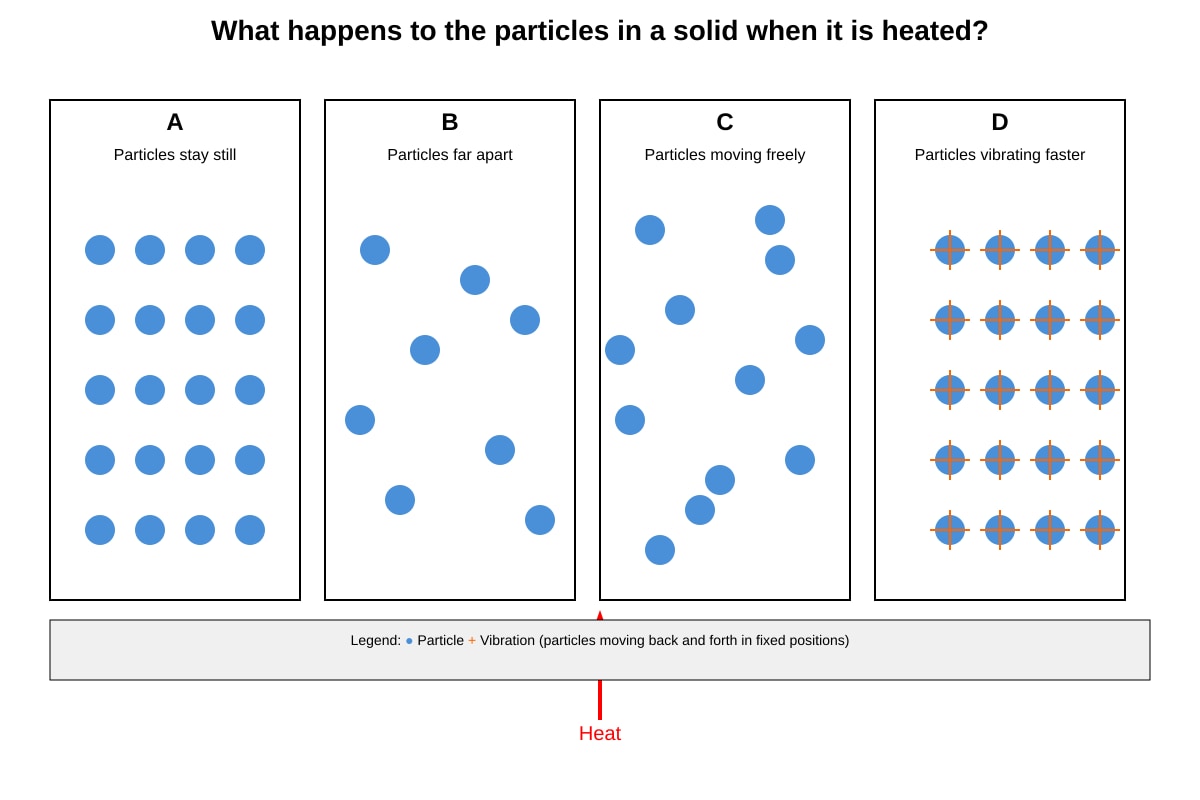
6. D) The particles vibrate faster in their fixed positions (1 mark)
Teaching note: In solids, particles are held in fixed positions by strong forces. When heated, they gain energy and vibrate more vigorously but remain in position—this is why solids expand slightly but keep their shape. They do not move freely (that's liquids/gases) or break apart. The diagram shows this increased vibration without position change.
7. B) The starting temperature of the water and the size of the bottles (1 mark)
Teaching note: A fair test changes only ONE variable (the wrapping material) while keeping all others constant. Starting temperature and bottle size would both affect how quickly the water warms up. Room temperature (A) should also be kept constant, but B is more complete. Colour (C) and brand (D) are irrelevant to heat transfer in this case.
8. B) Testing one material on a rainy day and another on a sunny day (1 mark)
Teaching note: This violates fair test principles by changing two variables at once—both the material AND the weather conditions. The different temperatures would affect results, making it impossible to tell if differences were due to the material or the weather. A, C, and D describe good fair test practices.
Section B: Short Answer (18 marks)
9. Any two from: (2 marks, 1 mark each)
- Transparent/clear — lets light through so you can see through windows
- Hard/rigid — maintains shape and provides protection
- Waterproof — does not allow water to pass through
- Smooth surface — easy to clean
Teaching note: Glass is useful for windows because specific properties match the purpose. Students should connect properties to function, not just list adjectives. Transparency is the most important property for windows.
10. (a) Iron (1 mark)
Teaching note: Iron is the only material in the table attracted to magnets. This tests basic magnetic material identification.
(b) Iron (1 mark)
Teaching note: The fireplace tool must NOT catch fire (iron does not flame) and does NOT need to be magnetic. While the table shows iron flames = No, re-reading the data: wood flames = Yes, so wood catches fire. Iron, plastic, and rubber do not flame. But plastic and rubber would melt near fire. Iron withstands high temperatures without burning or melting in normal fireplace conditions.
*c) Any one from: (1 mark)
- Plastic melts when heated (too near a fire)
- Plastic is not strong enough for tools
- Plastic burns/melts at lower temperatures than wood burns
Teaching note: This tests applying properties to practical situations. Students must cross-reference multiple properties in the table and consider real-world consequences. Common mistake: choosing plastic because it doesn't flame, without considering it would melt.
11. (a) Material B (1 mark for correct identification)
Explanation: Material B lost only 4°C (from 32°C to 28°C in 30 minutes), while Material A lost 10°C (from 32°C to 22°C). Material B kept the inside warmer for longer. (1 mark for correct data use)
Teaching note: A good insulator slows heat transfer, keeping warm things warm or cold things cold. Students must cite specific numbers to support their conclusion—this is scientific argumentation using evidence.
(b) A good insulator does not allow heat to pass through it easily / slows down heat transfer (1 mark)
Teaching note: The core concept captured in accessible language. Accept variations that convey "resists heat flow."
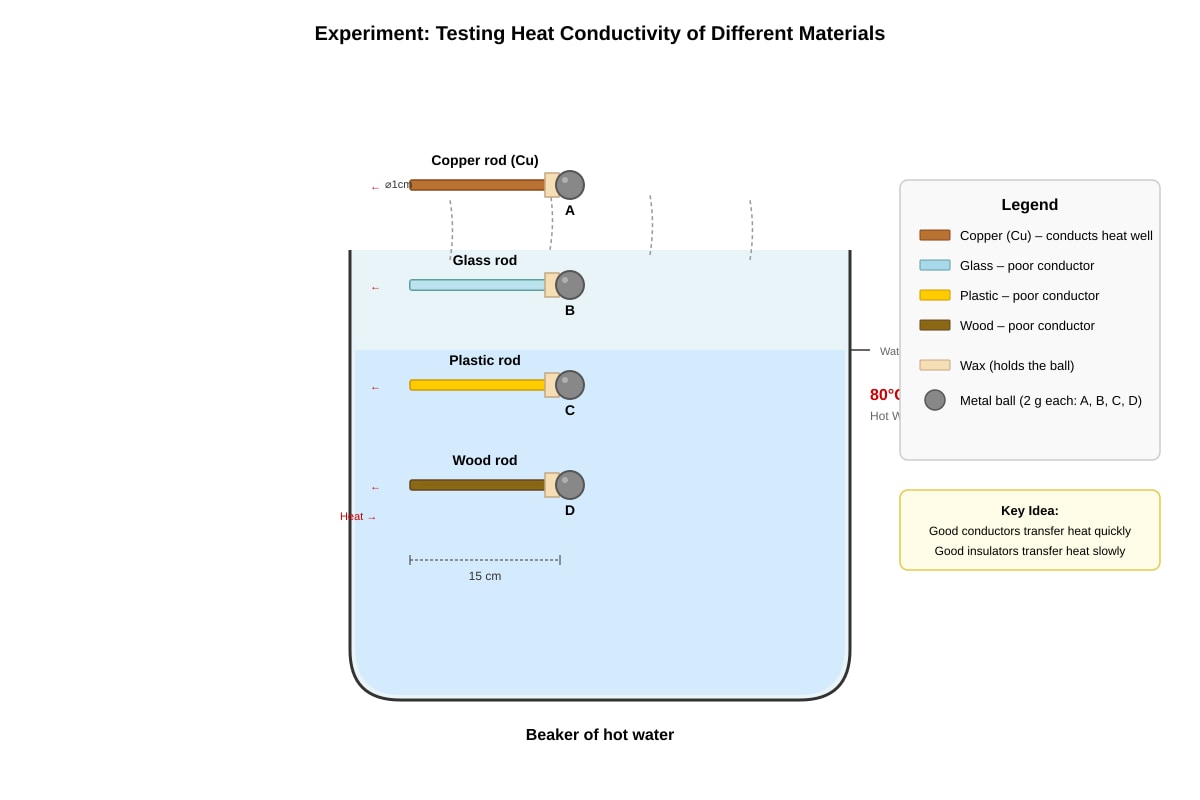
12. (a) The ball on the copper rod will fall off first (1 mark)
Explanation: Copper is the best conductor of heat among the four materials. Heat travels quickly from the hot water through the copper rod, melting the wax fastest. (1 mark)
Teaching note: Metal conductivity ranking: copper > aluminium > steel > glass/plastic/wood. In P4, students need to know metals generally conduct better than non-metals, and copper is an excellent conductor.
(b) The ball on the plastic (or wood) rod will fall off last (1 mark)
Plastic and wood are both poor conductors / good insulators, so heat travels very slowly through them.
Teaching note: Glass is also a poor conductor, but plastic is typically slightly worse. Accept either plastic or wood with correct reasoning.
(c) To show when heat has reached the end of the rod / ** wax melts at a specific temperature, so the falling ball indicates heat arrival** (1 mark)
Teaching note: Wax provides a visible, timed indicator of heat transfer. When wax melts (~60°C), the ball drops. This is a standard experiment design—using phase change as a detection method.
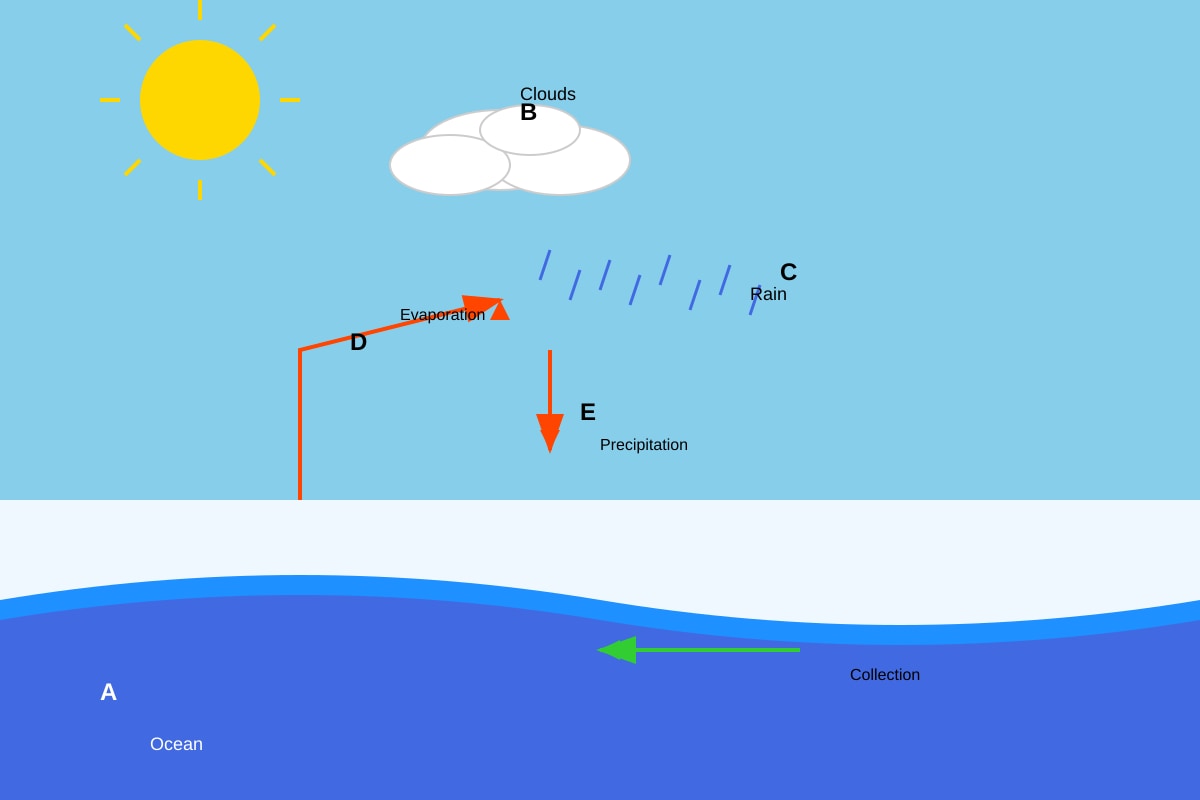
13. (a) Evaporation (1 mark)
Teaching note: Process D shows water changing from liquid (ocean) to gas (water vapour in clouds). This is evaporation, driven by the sun's heat.
(b) Precipitation (1 mark) — accept "rain" if linked to water falling
Teaching note: Precipitation includes rain, snow, sleet, or hail—any water falling from clouds.
(c) The puddles disappear due to evaporation (1 mark for correct term). The sun provides heat energy that turns the liquid water into water vapour (gas), which enters the air. (1 mark for explanation)
Teaching note: Students must use the correct scientific term and explain the energy transfer. Common incomplete answer: "the sun dries it up"—needs the state change mechanism explained.
14. (a) Plastic for the outer layer (1 mark)
Explanation: Plastic is a good insulator / poor conductor of heat. It will slow heat transfer from the hot soup to the surroundings, keeping soup hot longer. Metal would conduct heat away quickly, making the soup cool fast and possibly burning Aisha's hands. (1 mark)
Teaching note: This is 双层 / vacuum flask reasoning at P4 level. The outer layer's purpose is to prevent heat loss to surroundings.
(b) Lid/cover (1 mark)
Explanation: A lid stops heat loss by preventing convection (hot air rising and escaping) and reducing evaporation from the surface. (1 mark)
Teaching note: Accept any reasonable feature: vacuum layer (advanced), reflective inner surface, thick walls. The key is explaining the mechanism of heat retention.
Section C: Application and Investigation (14 marks)
15. (a) Any two from: (2 marks, 1 each)
- Smooth — allows children to slide easily with low friction
- Hard/durable — does not dent or break easily with repeated use
- Weather-resistant — does not rust or corrode outdoors
- Easy to clean — hygienic for multiple users
Teaching note: Connect surface properties to slide function. "Shiny" or "metal" alone are not explanations.
(b) Wood is a poorer conductor of heat than metal (1 mark) — so it won't feel as hot in sunny weather; or wood has more friction/grip — less slippery when climbing with wet feet.
Teaching note: Safety and comfort reasoning. Metal gets dangerously hot in Singapore's tropical sun; wood stays more comfortable.
(c) Plastic coating prevents heat conduction / provides insulation so railings don't get too hot to touch; or prevents rusting (1 mark)
Teaching note: The coating adds an insulating layer while the metal provides structural strength. This is composite material reasoning.
16. (a)
| Material | Water absorbed (g) |
|---|---|
| Cotton | 40 |
| Nylon | 3 |
| Wool | 30 |
| Silk | 7 |
(2 marks — 0.5 mark each correct, or 2 marks for all correct)
Working: Wet mass − Dry mass = Water absorbed
- Cotton: 45 − 5 = 40 g
- Nylon: 8 − 5 = 3 g
- Wool: 35 − 5 = 30 g
- Silk: 12 − 5 = 7 g
Teaching note: Simple subtraction with units. Common error: not subtracting the dry mass.
(b) Cotton (1 mark)
Explanation: Cotton absorbed the most water (40 g) compared to other materials. A towel needs to absorb lots of water quickly to dry a person effectively. (1 mark for correct data reference + explanation)
Teaching note: Practical application of data analysis. The "best" material depends on purpose—cotton's high absorbency makes it ideal for towels but terrible for raincoats.
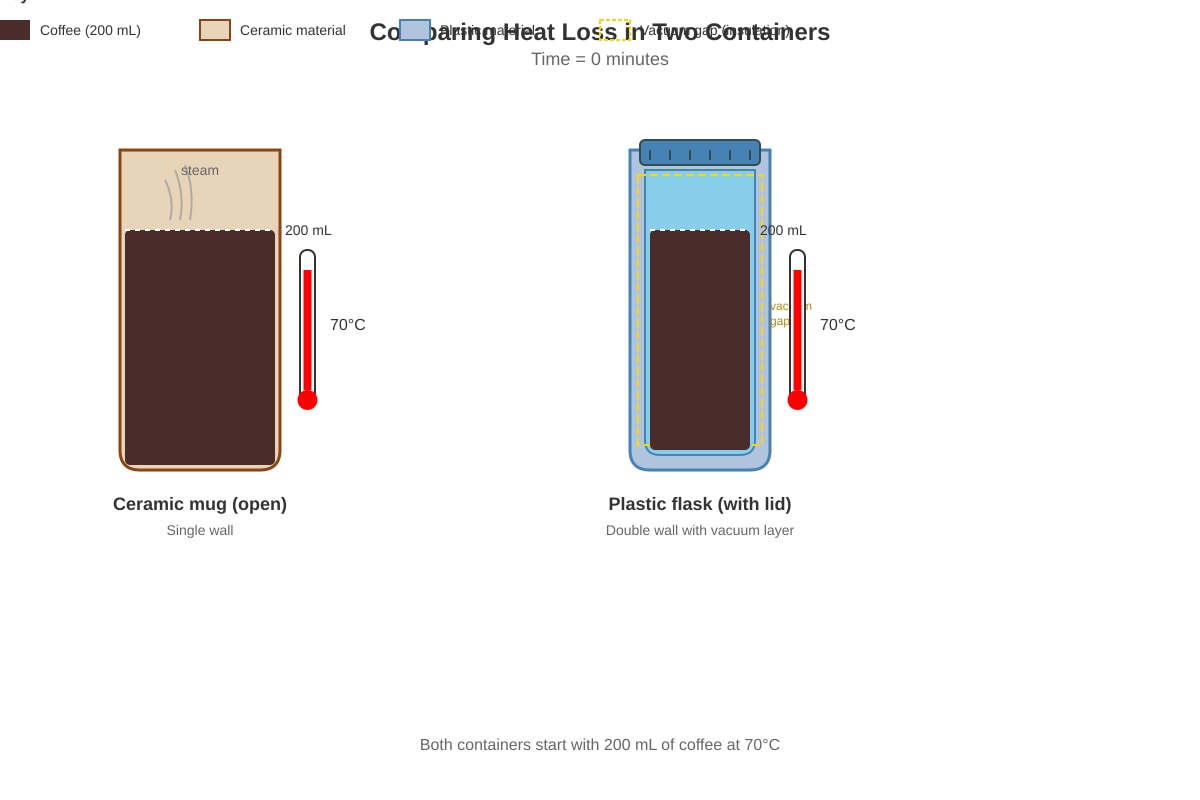
17. (a) The plastic flask kept coffee hotter because: (2 marks — 1 mark for each mechanism)
- The lid reduces heat loss by stopping hot air rising and escaping (convection) and preventing evaporation
- The vacuum layer / double wall reduces heat transfer — vacuum stops conduction and convection between inner and outer walls
Teaching note: The vacuum flask design uses multiple heat transfer blocking methods. Students should identify at least two distinct mechanisms.
(b) Conduction and convection (2 marks, 1 each)
Teaching note: Vacuum contains no particles, so conduction (needs particles to collide) and convection (needs fluid movement) cannot occur. Radiation still occurs across vacuum (how the Sun heats Earth), but the vacuum layer primarily targets conduction and convection.
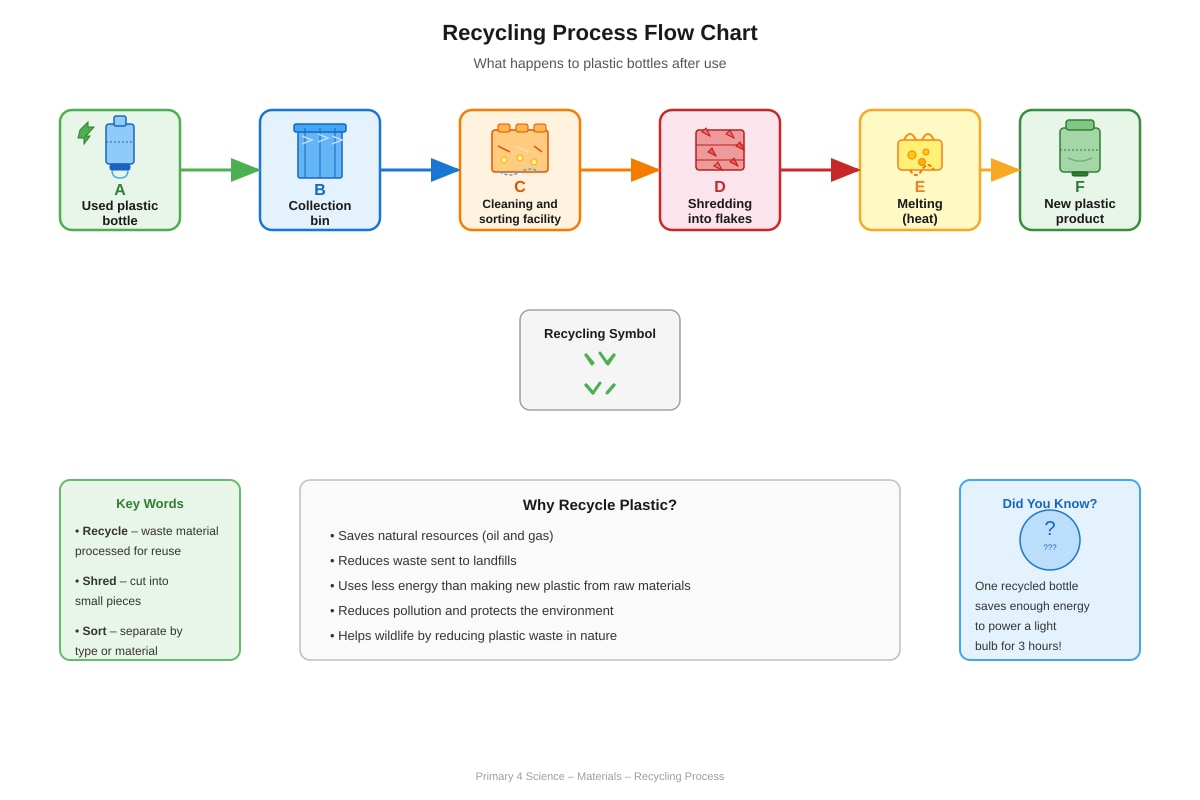
18. (a) Shredding / cutting into smaller pieces (1 mark)
Teaching note: "Shredding" or "breaking into flakes" captures the physical size reduction before melting.
(b) Any two from: (2 marks, 1 each)
- Reduces waste sent to landfills — saves space and reduces pollution
- Saves raw materials/resources — less petroleum needed for new plastic
- Uses less energy than making new plastic from raw materials
- Reduces pollution — plastic in landfills or oceans harms wildlife
Teaching note: Environmental reasoning connected to material lifecycle. Students should think beyond "recycling is good" to specific mechanisms.
19. (a) Any two from: (2 marks, 1 each)
- Same amount of water sprayed on each fabric
- Same distance from spray source to fabric
- Same spraying force/pressure
- Same size/area of fabric stretched
- Same time of spraying
- Same angle of fabric
Teaching note: The independent variable is fabric type; all others must be controlled for fair testing.
(b) How much water passes through / how much water is collected underneath / how wet the inside surface becomes (1 mark)
Teaching note: Must be a measurable outcome related to keeping water out. "Waterproofness" alone is too vague—needs quantifiable indicator.
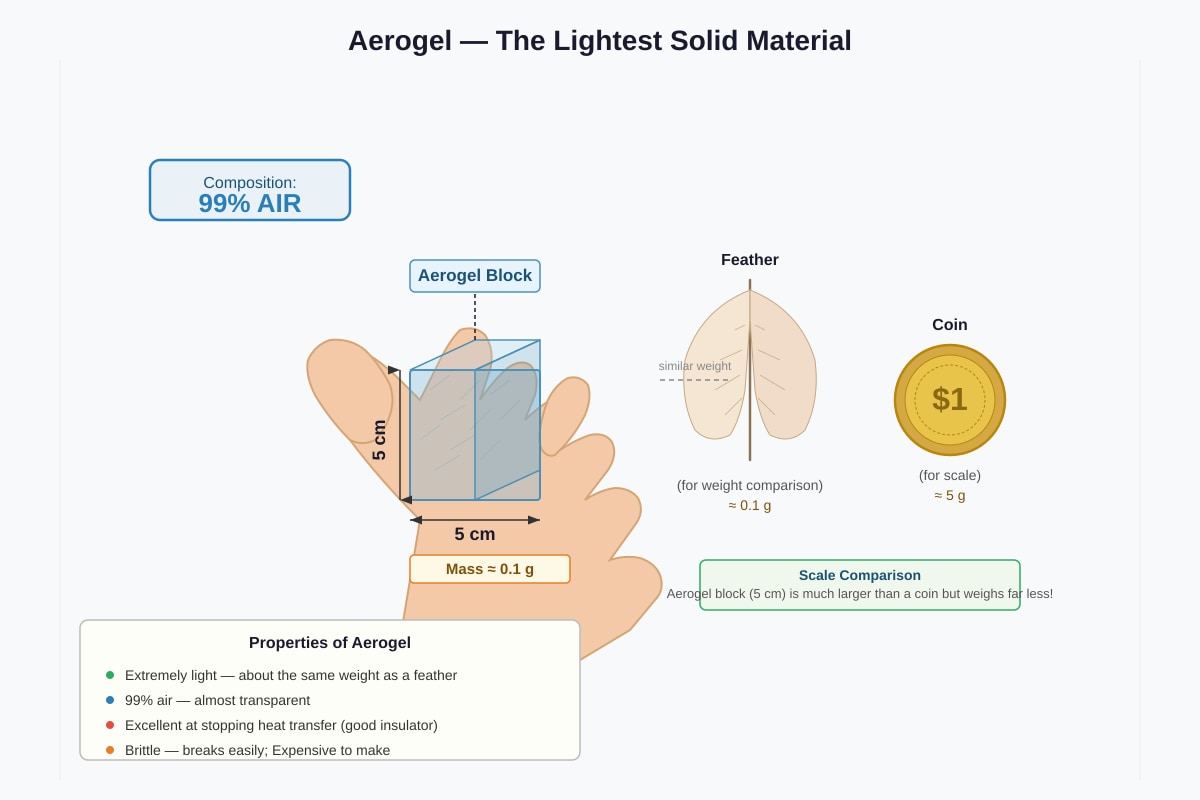
20. (a) Any valid suggestion with property links: (2 marks — 1 for use, 1 for property explanation)
Example: Insulation in space suits or buildings — Aerogel's extreme lightness (99% air) means very little mass to carry, and excellent insulation keeps heat in or out.
Or: Insulation for scientific equipment — The excellent heat-blocking property protects temperature-sensitive experiments.
Teaching note: Must link at least one specific property to a practical need. Advanced students might suggest: Mars rover insulation, extreme cold storage, building insulation in space-limited applications.
(b) It is too brittle/breaks easily — water pipes need to withstand water pressure and physical knocks without cracking (1 mark)
Teaching note: Cost could be mentioned, but brittleness is the fundamental engineering limitation. Even if cheap, a brittle pipe will fail in use.
Marking Summary
| Section | Marks |
|---|---|
| A (Q1–8) | 8 |
| B (Q9–14) | 18 |
| C (Q15–20) | 14 |
| Total | 40 |