AI Generated Quiz
Primary 4 Science Magnets Quiz
Free AI-Generated Qwen3.7 Plus Primary 4 Science Magnets quiz with questions and answers for Singapore students. This page is rendered as a direct URL so the questions and answers can be discovered without pressing in-page buttons.
These static practice materials are generated from the site's syllabus and paper-generation workflow, with source and model context shown so students and parents can evaluate the material before use.
Questions
Primary 4 Science Quiz - Magnets
Name: __________________________
Class: __________________________
Date: __________________________
Score: ______ / 30
Duration: 45 minutes
Total Marks: 30
Instructions to Candidates:
- This quiz consists of 20 questions.
- Answer all questions.
- Write your answers in the spaces provided.
- For multiple-choice questions, write the number of the correct option (1, 2, 3, or 4) in the brackets provided.
Section A: Multiple Choice Questions (10 marks)
Questions 1 to 10 carry 1 mark each. Choose the correct answer and write its number in the brackets provided.
1. Which of the following objects will be attracted to a magnet? (1) Plastic ruler (2) Copper coin (3) Steel paperclip (4) Aluminium foil
Answer: ( )
2. A bar magnet is suspended freely from a string. It comes to rest pointing in a North-South direction. Which end of the magnet points towards the Earth's North Pole? (1) The South-seeking pole (2) The North-seeking pole (3) The middle of the magnet (4) Both ends equally
Answer: ( )
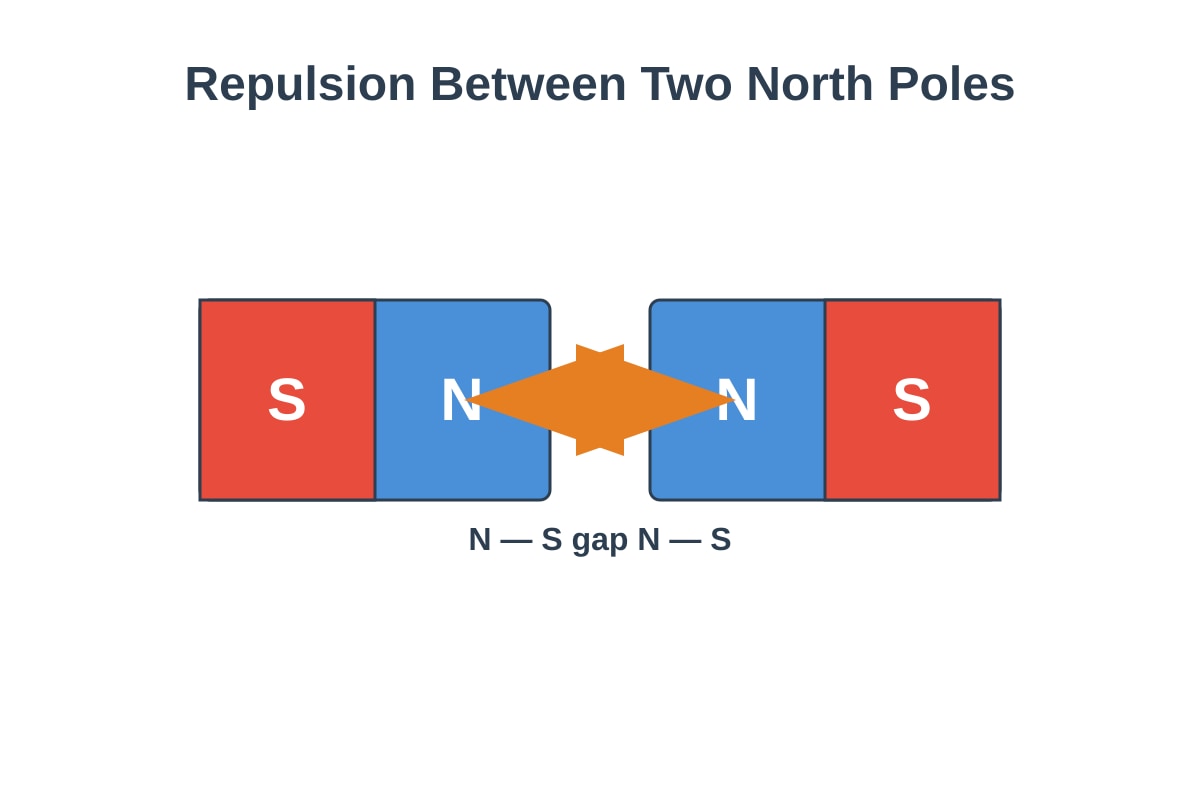
3. Two bar magnets are placed close to each other as shown below.
<image_placeholder> id: Q3-fig1 type: diagram linked_question: Q3 description: Two bar magnets placed end-to-end with a small gap. The left magnet has its North pole (N) on the right end. The right magnet has its North pole (N) on the left end. Arrows indicate the magnets are pushing away from each other. labels: N, S, N, S values: N-S gap N-S must_show: Repulsion arrows between the two North poles facing each other. </image_placeholder>
What will happen to the two magnets? (1) They will attract each other. (2) They will repel each other. (3) They will stick together side-by-side. (4) Nothing will happen.
Answer: ( )
4. Which of the following materials is a magnetic material? (1) Wood (2) Glass (3) Nickel (4) Rubber
Answer: ( )
5. John has a mixture of iron nails and plastic beads. What is the fastest way to separate the iron nails from the plastic beads? (1) Use a sieve. (2) Use a magnet. (3) Use water to float the beads. (4) Pick them out by hand.
Answer: ( )
6. Where is the magnetic force of a bar magnet the strongest? (1) At the centre of the magnet. (2) At the North pole only. (3) At the South pole only. (4) At both the North and South poles.
Answer: ( )
7. Which of the following statements about magnets is true? (1) All metals are attracted to magnets. (2) A magnet can attract a magnetic material without touching it. (3) Breaking a magnet into two pieces destroys its magnetism. (4) Like poles attract each other.
Answer: ( )
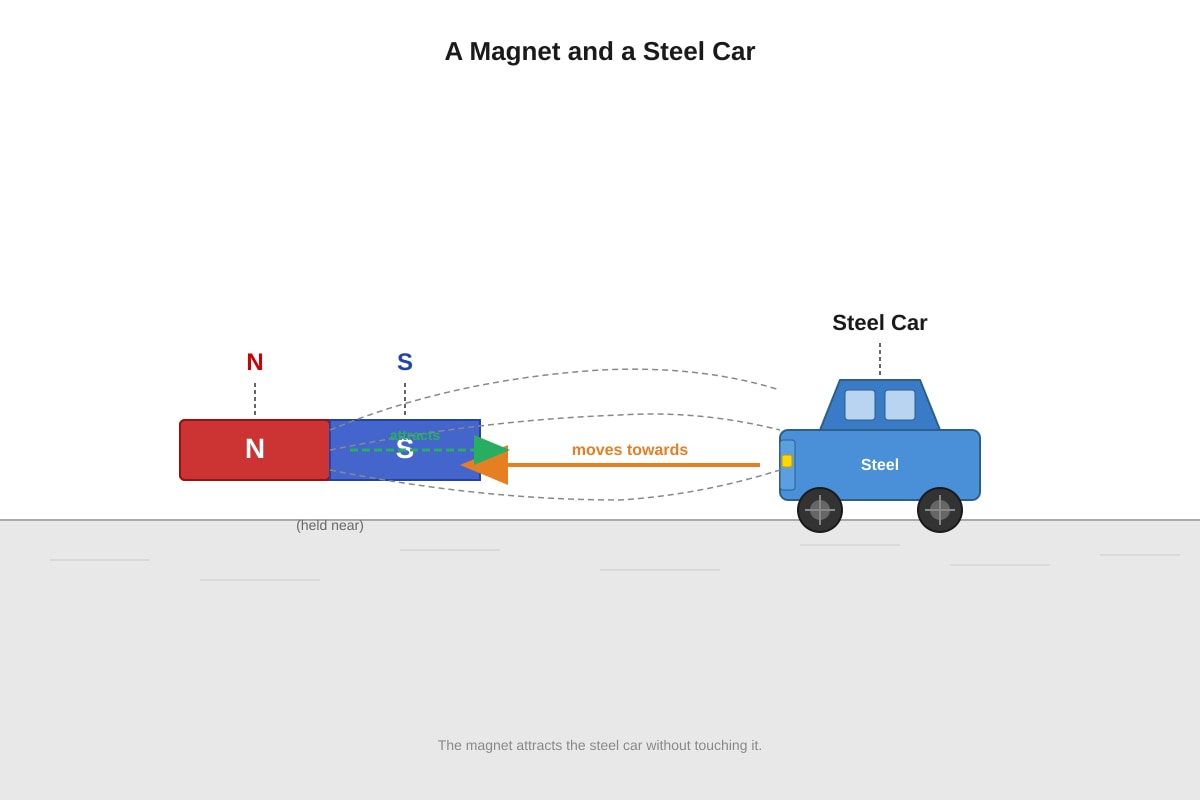
8. Look at the diagram below. A magnet is brought near a toy car made of steel.
<image_placeholder> id: Q8-fig1 type: diagram linked_question: Q8 description: A toy car made of steel is on a flat surface. A bar magnet is held near the front of the car. The North pole of the magnet is facing the car. labels: N, S, Steel Car values: Magnet approaching car must_show: The car moving towards the magnet. </image_placeholder>
Why does the car move towards the magnet? (1) The magnet pushes the air. (2) The steel car is a magnetic material and is attracted to the magnet. (3) The steel car becomes a magnet permanently. (4) Gravity pulls the car towards the magnet.
Answer: ( )
9. Which of the following items does NOT use a magnet in its working? (1) Magnetic door catch (2) Compass (3) Electric fan motor (4) Glass window
Answer: ( )
10. How can you make a temporary magnet from an iron nail? (1) Heat the iron nail in a fire. (2) Hit the iron nail with a hammer. (3) Stroke the iron nail with a magnet in one direction repeatedly. (4) Soak the iron nail in water.
Answer: ( )
Section B: Structured Questions (20 marks)
Answer all questions in the spaces provided.
11. Study the table below which shows the results of an experiment. Four objects (A, B, C, and D) were brought near a magnet.
| Object | Material | Attracted to Magnet? |
|---|---|---|
| A | Iron | Yes |
| B | Plastic | No |
| C | Steel | Yes |
| D | Copper | No |
(a) Based on the table, name two materials that are magnetic materials. [2]
(b) Object D is made of copper. Copper is a metal. Explain why Object D was not attracted to the magnet even though it is a metal. [1]
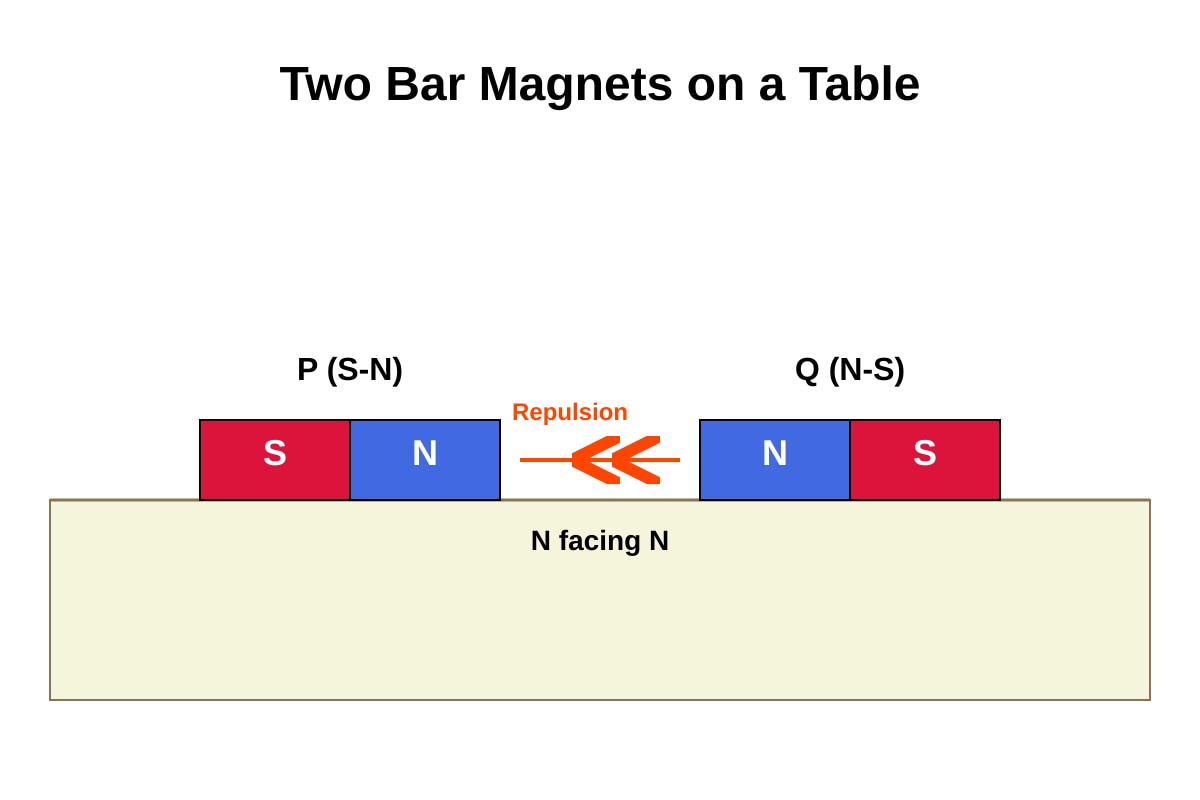
12. The diagram below shows two bar magnets, P and Q, placed on a smooth table.
<image_placeholder> id: Q12-fig1 type: diagram linked_question: Q12 description: Two bar magnets on a table. Magnet P is on the left with poles S-N. Magnet Q is on the right with poles N-S. The North pole of P is facing the North pole of Q. labels: P (S-N), Q (N-S) values: N facing N must_show: Repulsion force arrows pointing outwards from the gap. </image_placeholder>
(a) State what will happen to magnets P and Q when they are released. [1]
(b) Explain your answer in (a) using the concept of magnetic poles. [2]
(c) If Magnet Q is turned around so that its South pole faces Magnet P's North pole, what will happen? Explain why. [2]
13. Sarah wants to find out which part of a bar magnet is the strongest. She uses a bar magnet and some paper clips.
<image_placeholder> id: Q13-fig1 type: diagram linked_question: Q13 description: A bar magnet lying horizontally. Paper clips are hanging from different parts of the magnet. Many paper clips are clustered at the two ends (poles), and very few or none are hanging from the middle. labels: N, S, Paper clips values: Clusters at ends, empty middle must_show: Dense cluster of clips at N and S poles, sparse/none in center. </image_placeholder>
(a) Look at the diagram above. Which part(s) of the magnet attracted the most paper clips? [1]
(b) What does this tell you about the magnetic force at the poles compared to the centre of the magnet? [1]
(c) Sarah repeats the experiment with a stronger magnet. Predict whether the number of paper clips attracted will increase, decrease, or stay the same. Explain your answer. [2]
14. A student made a simple compass using a sewing needle, a cork, and a bowl of water.
(a) Before placing the needle on the cork, the student rubbed the needle with a magnet 20 times in one direction. Why did the student do this? [1]
(b) When the compass is placed in the water, in which direction will the needle eventually point? [1]
(c) Why is it important for the needle to float freely on the water? [1]
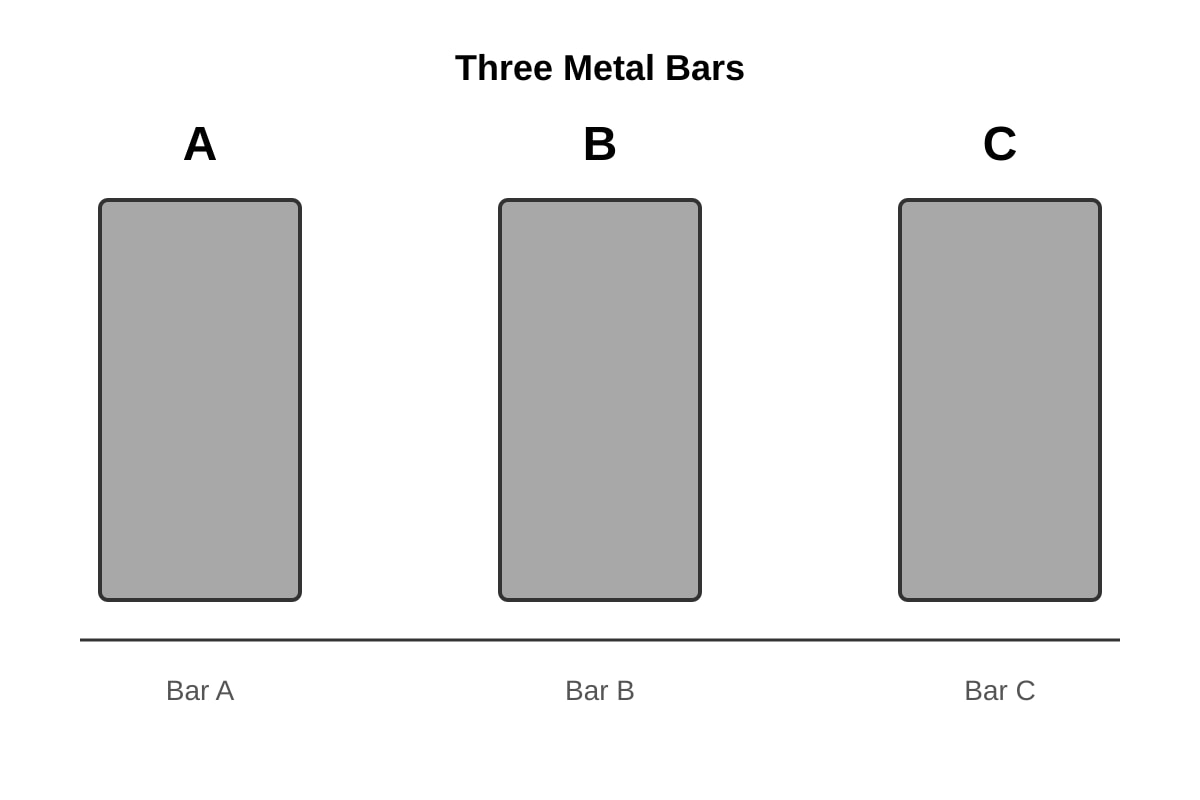
15. Look at the three bars below. One is a magnet, one is an iron bar, and one is a copper bar. You are not allowed to use another magnet to test them.
<image_placeholder> id: Q15-fig1 type: diagram linked_question: Q15 description: Three identical-looking rectangular bars labeled A, B, and C. labels: A, B, C values: Identical appearance must_show: No visual difference between bars. </image_placeholder>
(a) Can you identify the copper bar just by looking at them? Explain your answer. [1]
(b) Describe a method using only these three bars to identify which one is the magnet. (Hint: Think about how magnets attract magnetic materials). [2]
16. Tom has a box of mixed screws. Some are made of steel and some are made of brass (a non-magnetic metal alloy). He wants to separate them.
(a) Suggest a tool Tom can use to separate the steel screws from the brass screws. [1]
(b) Explain how this tool works to separate the screws. [2]
17. The diagram below shows a magnetic door catch.
<image_placeholder> id: Q17-fig1 type: diagram linked_question: Q17 description: A door frame with a metal plate attached. The door has a magnet attached opposite the plate. The door is closed, and the magnet is touching the metal plate. labels: Magnet, Metal Plate, Door, Frame values: Closed position must_show: Magnet and plate in contact holding the door shut. </image_placeholder>
(a) Why does the door stay closed when it is pushed shut? [1]
(b) The metal plate is usually made of steel. Why is steel used instead of plastic? [1]
18. Jane dropped her magnet on the floor, and it broke into two pieces.
(a) Will each piece still have a North pole and a South pole? Circle the correct answer. [1] Yes / No
(b) Explain your answer. [1]
19. A company wants to design a new toy train that uses magnets to connect the carriages.
(a) Should the magnets on the connecting ends of the carriages have like poles or unlike poles facing each other? Explain why. [2]
(b) If the train goes over a very bumpy track, the carriages might disconnect. Suggest one way to make the magnetic connection stronger without changing the magnets. [1]
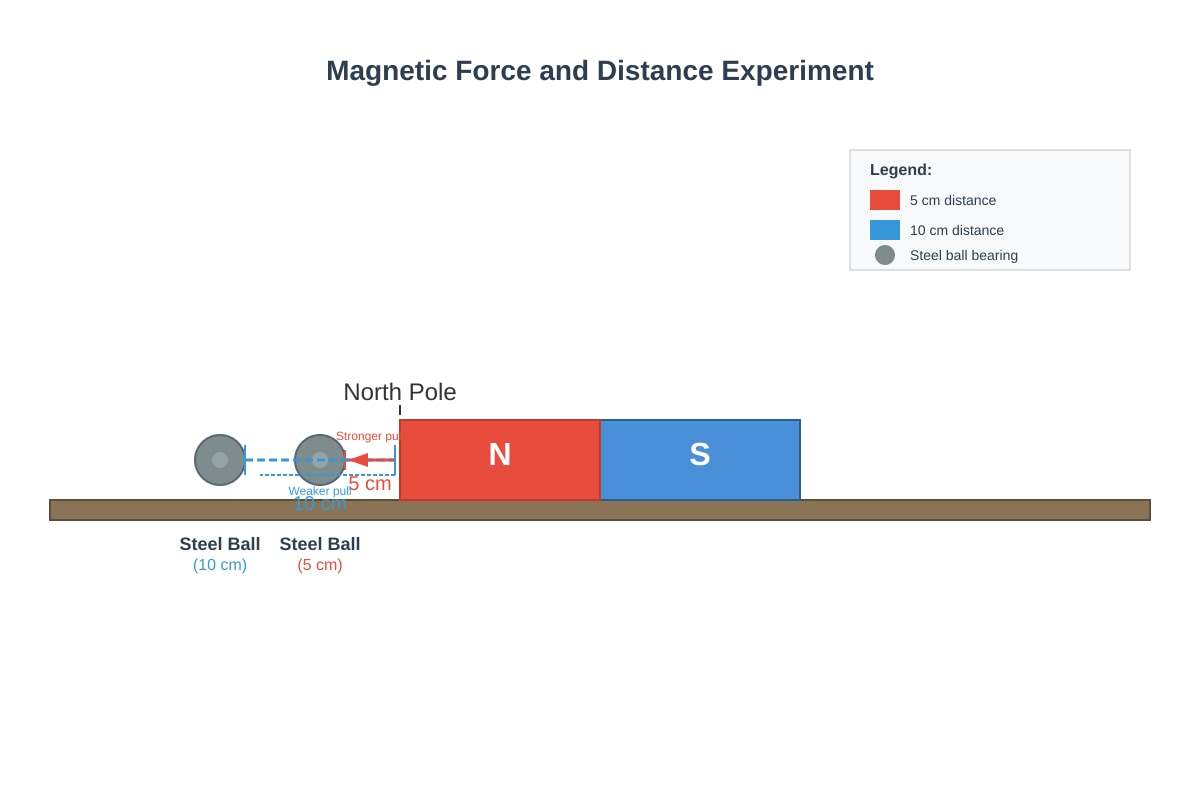
20. Study the experimental setup below.
<image_placeholder> id: Q20-fig1 type: diagram linked_question: Q20 description: A bar magnet is placed on a table. A steel ball bearing is placed 5 cm away from the North pole. Another steel ball bearing is placed 10 cm away from the North pole. labels: N, S, Steel Ball (5cm), Steel Ball (10cm) values: Distances 5cm and 10cm must_show: Two balls at different distances from the same pole. </image_placeholder>
(a) Which steel ball will experience a stronger pull from the magnet? The one at 5 cm or the one at 10 cm? [1]
(b) What does this tell you about the relationship between distance and magnetic force? [1]
(c) If the magnet was replaced with a weaker magnet, would the ball at 5 cm still be attracted? Explain. [1]
*** End of Quiz ***
Answers
Primary 4 Science Quiz - Magnets (Answer Key)
Section A: Multiple Choice Questions
1. (3)
- Explanation: Steel is a magnetic material because it contains iron. Plastic, copper, and aluminium are non-magnetic materials.
2. (2)
- Explanation: The North-seeking pole (North pole) of a magnet points towards the Earth's geographic North Pole.
3. (2)
- Explanation: Like poles repel each other. Since the North pole of one magnet is facing the North pole of the other, they will push away (repel).
4. (3)
- Explanation: Nickel is a magnetic material. Wood, glass, and rubber are non-magnetic.
5. (2)
- Explanation: Iron is magnetic, while plastic is not. Using a magnet will attract the iron nails, leaving the plastic beads behind. This is faster than picking them by hand.
6. (4)
- Explanation: The magnetic force is strongest at the poles (both North and South) of a magnet. It is weakest at the centre.
7. (2)
- Explanation: Magnetic force is a non-contact force, meaning it can act over a distance without touching. Not all metals are magnetic (e.g., gold, copper). Breaking a magnet creates two smaller magnets. Like poles repel.
8. (2)
- Explanation: Steel is a magnetic material. The magnet exerts a magnetic force on the steel car, pulling it closer.
9. (4)
- Explanation: Glass windows do not use magnets. Door catches, compasses, and electric motors all rely on magnets to function.
10. (3)
- Explanation: Stroking a magnetic material (like an iron nail) with a magnet in one direction aligns the magnetic domains, turning it into a temporary magnet. Heating or hitting usually demagnetizes it.
Section B: Structured Questions
11. (a) Iron and Steel. [2]
- Marking: 1 mark for each correct material. (b) Copper is a non-magnetic material. [1]
- Explanation: Being a metal does not automatically make a material magnetic. Only iron, steel, nickel, and cobalt are common magnetic materials.
12. (a) They will move away from each other (repel). [1] (b) The North pole of Magnet P is facing the North pole of Magnet Q. Like poles repel each other. [2]
- Marking: 1 mark for identifying like poles, 1 mark for stating they repel. (c) They will attract each other. This is because the North pole of P will face the South pole of Q, and unlike poles attract. [2]
- Marking: 1 mark for "attract", 1 mark for "unlike poles attract".
13. (a) The two ends (poles) of the magnet. [1] (b) The magnetic force is stronger at the poles than at the centre. [1] (c) Increase. A stronger magnet has a stronger magnetic force, so it can attract more paper clips. [2]
- Marking: 1 mark for "increase", 1 mark for explanation linking strength to number of clips.
14. (a) To magnetize the needle (turn it into a magnet). [1] (b) North-South direction. [1] (c) To allow the needle to rotate freely so it can align with the Earth's magnetic field without friction stopping it. [1]
15. (a) No. All three bars look identical, and copper is non-magnetic but looks like other metals. [1] (b) Take Bar A and touch one end to the middle of Bar B. If they attract, Bar A might be a magnet or Bar B is magnetic. Then touch the end of Bar A to the middle of Bar C. The magnet will attract the iron bar strongly at its poles but weakly or not at all at the middle of the iron bar. Alternatively, suspend each bar. The one that always points North-South is the magnet. [2]
- Note for Teacher: A simpler P4 answer: "Touch the end of one bar to the middle of another. A magnet attracts strongly at its poles. An iron bar is attracted but does not attract strongly at its own middle. If Bar A attracts Bar B's middle, Bar A is likely the magnet. If Bar A does not attract Bar B's middle, Bar B might be the magnet or both are non-magnetic. Repeat to find the one that attracts the others."
- Accepted Answer: "Use one bar to touch the middle of the other two. The magnet will attract the iron bar. The copper bar will not be attracted. The magnet will also attract the iron bar. To distinguish magnet from iron: Suspend them. The magnet will point North-South."
16. (a) A magnet. [1] (b) The magnet will attract the steel screws because steel is a magnetic material. The brass screws are non-magnetic and will not be attracted, allowing them to be separated. [2]
17. (a) The magnet on the door attracts the steel plate on the frame, holding the door closed. [1] (b) Steel is a magnetic material, so it can be attracted to the magnet. Plastic is non-magnetic. [1]
18. (a) Yes. [1] (b) When a magnet is broken, each piece becomes a new, smaller magnet with its own North and South pole. [1]
19. (a) Unlike poles. Unlike poles attract each other, which will hold the carriages together. [2]
- Marking: 1 mark for "unlike poles", 1 mark for "attract". (b) Bring the magnets closer together (reduce the gap) or use a stronger magnet. [1]
- Note: The question asks "without changing the magnets", so "reduce the gap" or "ensure better alignment" is the intended answer.
20. (a) The one at 5 cm. [1] (b) The closer the object is to the magnet, the stronger the magnetic force. [1] (c) Yes. Steel is a magnetic material. Even a weak magnet will attract a magnetic material, although the force might be weaker. [1]