AI Generated Quiz
Primary 4 Science Magnets Quiz
Free P4 Science Magnets quiz, AI version, with questions, answers, and syllabus-aligned practice for Singapore students.
These static practice materials are generated from the site's syllabus and paper-generation workflow, with source and model context shown so students and parents can evaluate the material before use.
Questions
Free quiz and exam paper access
Enter your details to view this paper
Your access is remembered on this device.
Answers
Answer Key: Primary 4 Science Quiz - Magnets
Total Marks: 20
Section A: Multiple-Choice Questions (Questions 1 – 5)
1 mark each.
1. B) Iron nail
- Explanation: Magnetic materials are those that are attracted to a magnet. Iron, steel, nickel, and cobalt are common magnetic materials. Plastic, wood, and glass are non-magnetic materials.
- Marking: 1 mark for correct answer.
- Common Mistake: Choosing plastic or wood because they are common materials. Remember, only metals containing iron, steel, nickel, or cobalt are magnetic.
2. D) Both the north and south poles
- Explanation: The magnetic force is strongest at the poles (both north and south) of a magnet. The middle of the magnet has the weakest magnetic force.
- Marking: 1 mark for correct answer.
- Common Mistake: Choosing only one pole. Both poles have equally strong magnetic force.
3. B) The magnets will attract each other.
- Explanation: Unlike poles of magnets attract each other. A north pole and a south pole are unlike poles, so they will attract.
- Marking: 1 mark for correct answer.
- Common Mistake: Choosing "repel". Remember: Unlike poles attract, like poles repel.
4. C) With its north pole pointing towards the Earth's North Pole
- Explanation: A freely suspended magnet acts like a compass. The north pole of the magnet is attracted to the Earth's magnetic south pole, which is located near the geographic North Pole. So, the north pole of the magnet points towards the Earth's North Pole.
- Marking: 1 mark for correct answer.
- Common Mistake: Choosing D. The Earth's magnetic field causes the north pole of a magnet to point north.
5. B) Hitting a magnet with a hammer repeatedly
- Explanation: Hitting, heating, or dropping a magnet can cause it to lose its magnetism (demagnetize it). Stroking, placing near a magnet, and using an electric current are ways to make a temporary magnet.
- Marking: 1 mark for correct answer.
- Common Mistake: Choosing A or C. These are correct ways to make a temporary magnet.
Section B: Fill in the Blanks (Questions 6 – 10)
1 mark each.
6. poles
- Explanation: The two ends of a magnet where the magnetic force is strongest are called its poles. Every magnet has a north pole and a south pole.
- Marking: 1 mark for "poles". Accept "north and south poles".
7. magnetic
- Explanation: Materials that are attracted to a magnet are called magnetic materials. Examples include iron, steel, nickel, and cobalt.
- Marking: 1 mark for "magnetic".
8. attract
- Explanation: Unlike poles (north and south) attract each other. Like poles (north and north, or south and south) repel each other.
- Marking: 1 mark for "attract".
9. north-south
- Explanation: A freely suspended magnet will always come to rest pointing in the north-south direction. This is because the Earth itself acts like a giant magnet.
- Marking: 1 mark for "north-south". Accept "north and south".
10. magnet
- Explanation: The Earth has a magnetic field and acts like a giant magnet with a north and south magnetic pole. This is why a compass works.
- Marking: 1 mark for "magnet".
Section C: Short Answer Questions (Questions 11 – 15)
2 marks each.
11. Answer: She can try to pick up a metal object like a paperclip with each bar. The one that attracts the paperclip is the magnet. OR She can bring the two bars close to each other. If they attract or repel, then one of them is a magnet. If nothing happens, then one is a magnet and the other is not.
- Explanation: A magnet can attract magnetic materials. A non-magnetized metal bar cannot attract other metal objects. Alternatively, bringing the bars together can show attraction or repulsion if one is a magnet.
- Marking: 1 mark for describing a correct method. 1 mark for explaining why it works (the magnet attracts magnetic materials or causes attraction/repulsion).
- Common Mistake: Saying "touch them together". This is not specific enough. The method must show a clear test.
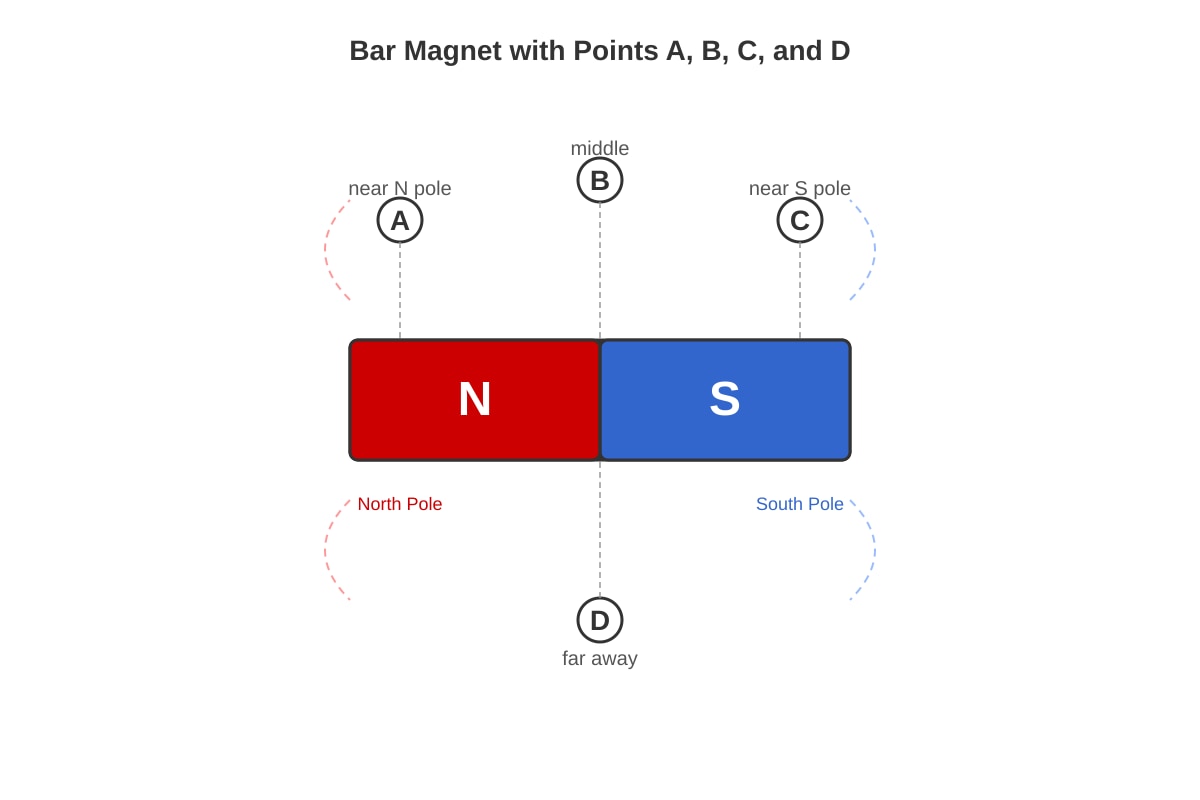
12. Answer: The magnetic force will be strongest at points A and C (the poles). The magnetic force is strongest at the poles of a magnet.
- Explanation: The magnetic field lines are most concentrated at the poles, meaning the magnetic force is strongest there. Point B is in the middle where the force is weakest. Point D is far away where the force is very weak.
- Marking: 1 mark for identifying A and C (or either one, with the understanding that both are correct). 1 mark for explaining that the magnetic force is strongest at the poles.
- Common Mistake: Choosing B (the middle). Many students think the middle is strongest because it's in the center.
13. Answer: The drawing should show iron filings concentrated at the two poles (north and south) of the bar magnet, forming a pattern that looks like curved lines going from one pole to the other. The north and south poles should be clearly labelled.
- Explanation: Iron filings align themselves along the magnetic field lines. The field lines are most concentrated at the poles, so more filings will cluster there. The lines curve from the north pole to the south pole.
- Marking: 1 mark for showing iron filings concentrated at the poles. 1 mark for showing curved lines connecting the poles and labelling north and south.
- Common Mistake: Drawing random patterns or not showing concentration at the poles.
14. Answer: When a steel paperclip is stroked with a bar magnet, the magnetic domains (tiny magnetic particles) inside the paperclip become aligned in the same direction. This alignment turns the paperclip into a temporary magnet.
- Explanation: Magnetic materials like steel have tiny regions called magnetic domains that act like small magnets. Normally, these domains point in random directions. Stroking with a magnet forces them to align, creating a net magnetic field.
- Marking: 1 mark for mentioning alignment of magnetic particles/domains. 1 mark for explaining that this makes the paperclip magnetic.
- Common Mistake: Saying "the magnetism rubs off". Magnetism is not a substance that can be transferred.
15. Answer: The magnets will repel each other. Like poles (north and north) repel each other.
- Explanation: The law of magnetism states that like poles repel and unlike poles attract. Since both are north poles, they will push away from each other.
- Marking: 1 mark for stating that they will repel. 1 mark for explaining that like poles repel.
- Common Mistake: Saying they will attract. Remember the rule: Like poles repel, unlike poles attract.
Section D: Application Questions (Questions 16 – 20)
2 marks each.
16. Answer: The coin is made of a magnetic material (like steel or iron). The magnet hidden in the magician's palm attracts the coin, making it appear to stick to his hand.
- Explanation: The trick works because the magnetic force can pass through the skin of the hand. The magnet attracts the magnetic coin, holding it in place.
- Marking: 1 mark for stating the coin is magnetic. 1 mark for explaining that the magnet attracts the coin.
- Common Mistake: Thinking the coin itself is magnetic. The coin is attracted to the magnet, not magnetic itself.
17. Answer: She can pass a magnet over the mixture. The iron filings will be attracted to the magnet and stick to it, while the sand will be left behind. She can then remove the iron filings from the magnet. This works because iron is magnetic and sand is not.
- Explanation: This is a simple separation technique that uses the property of magnetism. Only magnetic materials are attracted to a magnet.
- Marking: 1 mark for describing the method (passing a magnet over the mixture). 1 mark for explaining that iron is magnetic and sand is not.
- Common Mistake: Saying the magnet will attract both. Only magnetic materials are attracted.
18. Answer: The magnet on the train and the magnet on the track have like poles facing each other (e.g., both north poles). Like poles repel each other, so the train slows down and stops without touching.
- Explanation: This is an application of magnetic repulsion. The force of repulsion acts as a brake, slowing the train down. This is similar to how magnetic levitation (maglev) trains work.
- Marking: 1 mark for stating that like poles are facing each other. 1 mark for explaining that like poles repel.
- Common Mistake: Saying the magnets attract. Attraction would pull the train towards the magnet, not stop it.
19. Answer: When the steel nail touches the south pole of the magnet, it becomes a temporary magnet through magnetic induction. The nail's magnetic domains become aligned, giving it a north pole at the end that touched the magnet and a south pole at the other end. This allows it to attract the paperclip.
- Explanation: Magnetic induction is the process by which a magnetic material becomes magnetized when placed in a magnetic field. The nail becomes a temporary magnet and can attract other magnetic materials.
- Marking: 1 mark for stating the nail became a temporary magnet. 1 mark for explaining the process of magnetic induction (alignment of domains).
- Common Mistake: Thinking the nail "stole" some magnetism from the magnet. Magnetism is not a substance.
20. Answer: An electromagnet can be turned on and off. This allows the factory to pick up scrap metal when the electromagnet is on and release it when the electromagnet is turned off. A permanent magnet would always be magnetic and could not release the metal easily.
- Explanation: An electromagnet's magnetic field is created by an electric current. When the current is switched off, the magnetic field disappears, and the metal is released. This makes it much more useful for lifting and moving materials.
- Marking: 1 mark for stating that an electromagnet can be turned on and off. 1 mark for explaining how this is useful for the task (can release the metal).
- Common Mistake: Saying an electromagnet is stronger. While true, the key advantage for this task is the ability to control the magnetism.