AI Generated Quiz
Primary 4 Science Magnets Quiz
Free P4 Science Magnets quiz, AI version, with questions, answers, and syllabus-aligned practice for Singapore students.
These static practice materials are generated from the site's syllabus and paper-generation workflow, with source and model context shown so students and parents can evaluate the material before use.
Questions

Free quiz and exam paper access
Enter your details to view this paper
Your access is remembered on this device.
Answers
Answer Key: Primary 4 Science Quiz - Magnets
Section A
1. C) Iron nail
- Marks: 1
- Explanation: A magnet attracts materials that contain iron. An iron nail is made of iron, which is a magnetic material. Plastic, aluminium, and glass are not magnetic.
2. B) They repel each other.
- Marks: 1
- Explanation: Like poles (North-North or South-South) repel, or push away from each other. This is a key property of magnets: opposite poles attract, like poles repel.
3. D) Both B and C
- Marks: 1
- Explanation: The magnetic force is strongest at the poles of a magnet. A bar magnet has two poles: north and south. Paper clips will be attracted most strongly to either the north pole or the south pole, and the weakest attraction is in the middle.
4. C) An iron rod
- Marks: 1
- Explanation: An electromagnet becomes much stronger when a magnetic material is placed inside the coil of wire. Iron is magnetic, so it makes a good core. Wood, plastic, and copper are not magnetic and will not strengthen the electromagnet.
5. B) magnet
- Marks: 1
- Explanation: A compass contains a small, free-moving magnet. The Earth behaves like a giant magnet with a North and South Pole. The compass needle is a magnet that aligns itself with the Earth's magnetic field, so it points towards the North.
6. D) Melting ice
- Marks: 1
- Explanation: Magnets are used for holding things (like on a fridge), closing things (like a pencil case catch), and separating magnetic materials (like in recycling). Melting ice is a process that involves heat, not magnetism.
7. C) iron
- Marks: 1
- Explanation: Magnets attract iron and some types of steel (which contains iron). Pins are usually made of steel or iron, so they are attracted to a magnet. Aluminium, copper, and plastic are not attracted to magnets.
8. C) Magnetic braking
- Marks: 1
- Explanation: When a magnet moves near a conductor (like copper), it creates electric currents in the conductor. These currents create their own magnetic field that opposes the motion of the magnet, slowing it down. This is called magnetic braking.
- Teaching Note: This concept can be demonstrated by dropping a magnet through a copper or aluminium tube (found in some science kits).
9. B) Magnetic force can pass through some materials like paper.
- Marks: 1
- Explanation: Magnetic force can pass through non-magnetic materials. This is why a magnet can hold a paper clip on the other side of a piece of paper. Option A is false because metals like aluminium and copper are not magnetic. Option C is false because all magnets have at least two poles. Option D is false because breaking a magnet creates two smaller magnets, each with a north and south pole.
10. B) They will repel and move apart.
- Marks: 1
- Explanation: The North poles of two magnets are like poles. Like poles repel each other. So when placed with their North poles facing, they will push each other apart.
Section B
11. North pole and South pole.
- Marks: 1
- Explanation: Every magnet has two poles, a north-seeking pole (north pole) and a south-seeking pole (south pole).
- Common Mistake: Students may only name one pole. Both are required for the mark.
12. Magnetic field.
- Marks: 1
- Explanation: The area around a magnet where its magnetic force can be detected is called its magnetic field. This is an invisible force field.
- Acceptable Alternative: "Magnetic force area" if the student does not know the term "field."
13. Any two of the following (or similar):
- A refrigerator magnet
- A speaker
- A magnetic catch on a cupboard door
- A compass
- A magnetic screwdriver
- An MRI machine (if the student is aware of it)
- Marks: 1 mark for each correct object (2 marks total)
- Explanation: Magnets are used in many everyday items. Accept any reasonable answer that is likely to contain a magnet.
14. The student can bring a known magnet close to the coin. If the coin is attracted to the magnet, it is magnetic. If it is not attracted, it is not magnetic.
- Marks: 1
- Explanation: This is a simple test of magnetism. A known magnet is used to test an unknown material. The key is to bring the magnet close to the coin and observe if there is attraction.
15.
- Magnetic: Iron, steel, nickel, or cobalt. (Accept any one)
- Not magnetic: Aluminium, copper, plastic, wood, glass, paper, rubber. (Accept any one)
- Marks: 1 mark for correct magnetic material, 1 mark for correct non-magnetic material.
- Explanation: Magnetic materials are those that are attracted to a magnet. The most common magnetic materials are iron, steel, nickel, and cobalt.
16. Two poles (one North and one South).
- Marks: 1
- Explanation: Breaking a magnet does not destroy its magnetism. Each piece will still have its own North and South pole. This is because each piece has its own magnetic domains.
- Common Misconception: Students may think the two pieces have only one pole each.
Section C
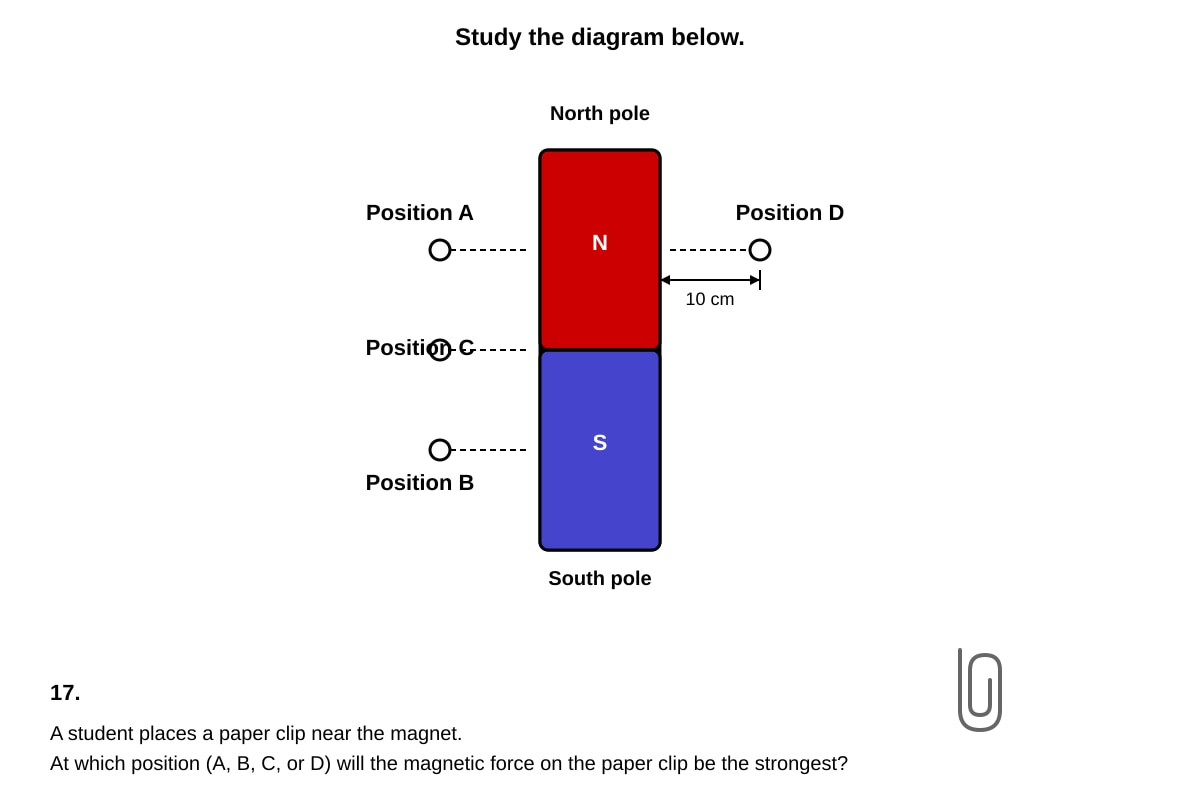
17. The magnetic force will be strongest at positions A and B (both at the poles). The question asks for the strongest position, so either A or B is acceptable.
- Marks: 2 (1 mark for correct position A or B, 1 mark for explanation)
- Explanation: The magnetic force of a magnet is strongest at its poles (North and South). The force is weakest at the middle of the magnet. Position D is further away from the magnet, so the force will be weaker there.
18. Object X (the iron nail) and Object Z (the steel paper clip) will be attracted to a magnet. Object Y (the gold ring) will not be attracted.
- Marks: 2 (1 mark for identifying X and Z, 1 mark for explanation)
- Explanation: Magnets only attract materials that are magnetic. Iron and steel (which contains iron) are magnetic materials. Gold is not magnetic (it is a non-magnetic metal).
- Marking Note: Accept partial marks if student identifies at least one magnetic object correctly.
19. (a) The end of the needle that points towards the North is the North-seeking pole (or simply the North pole) of the needle magnet.
- Marks: 1
- Explanation: A compass needle is a magnet. The end that points North is called the north-seeking pole, or the North pole of the needle.
(b) The North pole of the bar magnet will repel the North-pointing end of the needle, causing the needle to turn away.
- Marks: 1
- Explanation: Like poles repel. The North pole of the bar magnet and the North-pointing end of the needle are both North poles. They will push each other away.
20. (a) The paper clip may not be attracted, or will be attracted less strongly, when a thick piece of cardboard is used.
- Marks: 1
- Explanation: A thicker material is harder for the magnetic force to pass through. The magnetic force will be weaker on the other side of a thick piece of cardboard, so the paper clip might not be attracted at all.
(b) The magnetic force can pass through non-magnetic materials like cardboard, but it becomes weaker as it passes through more material. A thicker material blocks more of the magnetic force, so the paper clip is less attracted.
- Marks: 1
- Explanation: Magnetic force can travel through some materials (like paper, cardboard, wood, plastic), but its strength decreases with distance and with the thickness of the material it must travel through. This is why a magnet can hold a note on a fridge but cannot pick up a paper clip through a thick book.
- Teaching Note: This links to the concept of magnetic field strength decreasing with distance from the magnet, and also that some materials can "shield" a magnetic field.