AI Generated Quiz
Primary 4 Science Magnets Quiz
Free P4 Science Magnets quiz, AI version, with questions, answers, and syllabus-aligned practice for Singapore students.
These static practice materials are generated from the site's syllabus and paper-generation workflow, with source and model context shown so students and parents can evaluate the material before use.
Questions
Free quiz and exam paper access
Enter your details to view this paper
Your access is remembered on this device.
Answers
Primary 4 Science Quiz - Magnets: Answer Key
Total Marks: 30
Section A: Multiple Choice Questions (Questions 1 – 5)
Each question carries 1 mark.
1. Answer: C) An iron nail
- Marks: 1
- Explanation: Magnets attract only magnetic materials. Iron is a magnetic material, so an iron nail will be attracted to a magnet. Plastic, wood, and glass are non-magnetic materials and will not be attracted.
- Common Mistake: Students may think all metals are magnetic. Copper, aluminium, and gold are metals but are not magnetic.
2. Answer: A) They are made of a magnetic material.
- Marks: 1
- Explanation: Paper clips are typically made of steel (which contains iron), a magnetic material. The fact that they are attracted to the magnet shows they are made of a magnetic material.
- Common Mistake: Students may think the paper clips are magnets themselves. Being attracted to a magnet does not make an object a magnet; it only shows it is made of a magnetic material.
3. Answer: B) The poles
- Marks: 1
- Explanation: The magnetic force is strongest at the poles (north and south ends) of a magnet. The middle of the magnet has the weakest magnetic force.
- Common Mistake: Students may think the force is evenly spread across the magnet.
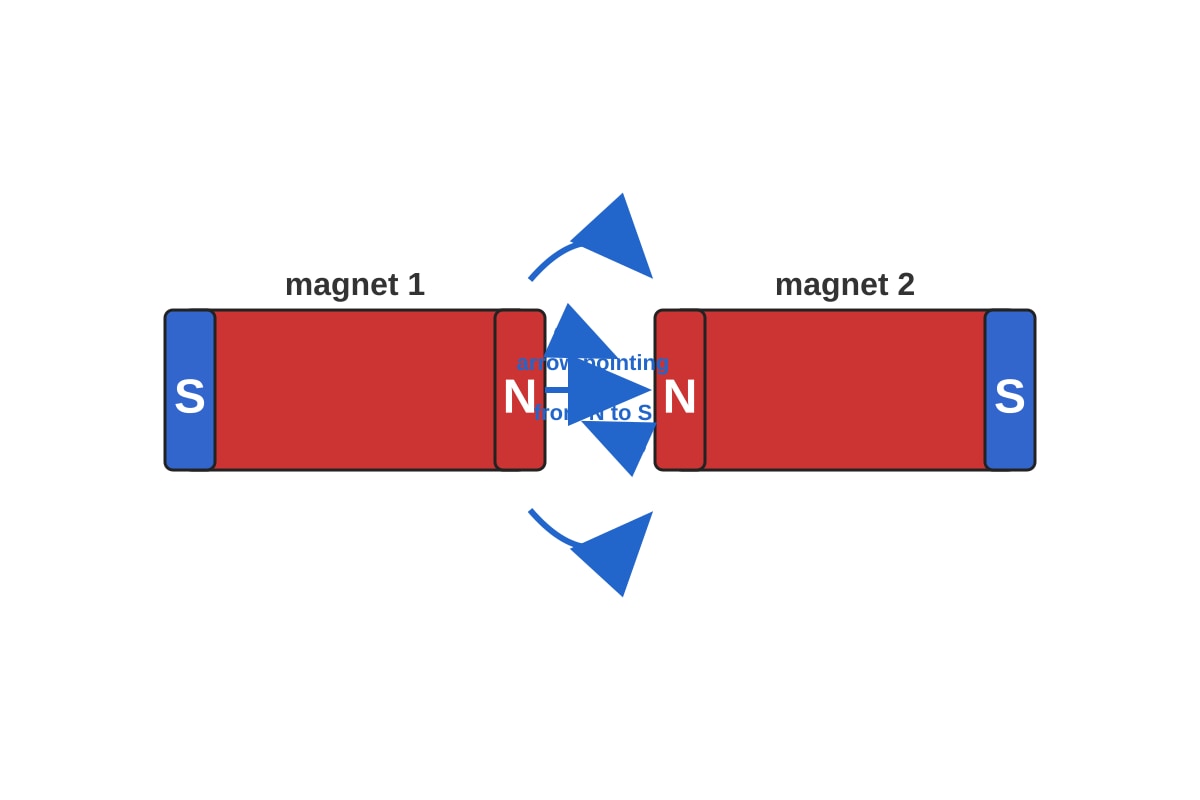
4. Answer: B) They will repel each other.
- Marks: 1
- Explanation: Like poles repel each other. Since both north poles are facing each other, they will push away from each other.
- Teaching Note: Remember the rule: "Like poles repel, unlike poles attract."
5. Answer: B) Towards the North Pole of the Earth
- Marks: 1
- Explanation: A freely suspended magnet will align itself with the Earth's magnetic field. The north pole of the magnet points towards the Earth's geographic North Pole (which is actually a magnetic south pole).
- Common Mistake: Students may think the north pole points south. The north pole of a magnet is attracted to the Earth's magnetic south pole, which is near the geographic North Pole.
Section B: Short Answer Questions (Questions 6 – 15)
Each question carries 2 marks.
6. Answer: Any two of the following: (a) steel paper clips, (b) iron nails, (c) steel scissors, (d) steel ruler, (e) fridge door (if made of steel).
- Marks: 1 mark for each correct material (total 2 marks)
- Explanation: Magnetic materials are those that contain iron, nickel, or cobalt. Steel is an alloy that contains iron, so many steel objects in a classroom are magnetic.
- Common Mistake: Students may list non-magnetic materials like plastic or wood.
7. Answer: Spoon: The metal spoon (if it is made of a magnetic metal like steel/iron). Reason: The metal spoon is made of a magnetic material (steel/iron), while plastic and wood are non-magnetic.
- Marks: 1 mark for identifying the correct spoon, 1 mark for the correct reason.
- Explanation: Not all metal spoons are magnetic. A stainless steel spoon may or may not be magnetic depending on its composition. However, the question expects the student to know that metal can be magnetic while plastic and wood are not.
- Teaching Note: Emphasise that "metal" is a broad category. Some metals (iron, steel, nickel, cobalt) are magnetic; others (copper, aluminium, gold, silver) are not.
8. Answer: Diagram should show:
- Two bar magnets.
- The north pole of one magnet facing the south pole of the other magnet.
- Arrows pointing from the north pole towards the south pole, indicating attraction.
- Marks: 1 mark for correct pole labels, 1 mark for correct arrows showing attraction.
- Explanation: Unlike poles attract. The north pole of one magnet pulls the south pole of the other magnet towards it.
- Common Mistake: Students may draw arrows pointing away from the magnets, which would indicate repulsion.
9. Answer: The magnetic force is strongest at the poles (ends) of the magnet, so the iron filings are attracted most strongly to the ends.
- Marks: 2 marks for a complete explanation.
- Explanation: The magnetic field is concentrated at the poles, so the force is strongest there. The middle of the magnet has a much weaker magnetic field.
- Common Mistake: Students may say the filings "stick to the ends because the ends are sticky" or give a non-scientific reason.
10. Answer: 2 poles (one north and one south).
- Marks: 2 marks for the correct answer.
- Explanation: Every magnet, no matter how small, always has two poles: a north pole and a south pole. Cutting a magnet in half creates two smaller magnets, each with its own north and south pole.
- Teaching Note: This is a key concept: magnetic poles always come in pairs. You cannot isolate a single pole.
11. Answer: Bring the coin close to a magnet. If the coin is attracted to the magnet, it is magnetic. If it is not attracted, it is non-magnetic.
- Marks: 2 marks for a clear and complete description.
- Explanation: This is a simple and direct test. The magnet is the testing tool.
- Common Mistake: Students may suggest using another coin or a paper clip to test, which is less direct.
12. Answer: Any one of the following: (a) Fridge magnets to hold notes, (b) Magnetic catch on a cupboard door, (c) Compass for navigation, (d) Magnetic strip on a credit card, (e) Speaker/magnet in a school bell.
- Marks: 2 marks for a clear and correct example.
- Explanation: Magnets are used in many everyday applications. The answer should be a specific use, not just "in a toy" or "in a game."
- Common Mistake: Students may give a vague answer like "in a machine" without specifying the use.
13. Answer: The pattern shows the magnetic field lines of the magnet. It shows the shape and direction of the magnetic force around the magnet.
- Marks: 2 marks for a complete explanation.
- Explanation: Iron filings align themselves along the magnetic field lines, making the invisible magnetic field visible. The pattern is denser (more filings) at the poles, showing the field is strongest there.
- Teaching Note: This is a classic experiment to visualise magnetic fields.
14. Answer: Hold one bar near the other. If they attract or repel each other, the bar you are holding is a magnet. If they only attract (and do not repel), the bar you are holding is not a magnet. OR: Hang each bar from a string. The one that aligns with the Earth's north-south direction is the magnet.
- Marks: 2 marks for a clear and correct method.
- Explanation: A magnet can attract or repel another magnet, but it can only attract a non-magnetised iron bar. A non-magnetised iron bar cannot repel anything.
- Common Mistake: Students may say "see which one picks up paper clips." This works, but the question says "without using any other equipment."
15. Answer: Magnetic force.
- Marks: 2 marks for the correct answer.
- Explanation: The magnetic force is the non-contact force that pulls the paper clip towards the magnet. It acts even without direct contact.
- Common Mistake: Students may say "gravity" or "pull." While "pull" is descriptive, the scientific term is "magnetic force."
Section C: Structured Questions (Questions 16 – 20)
Each question carries 3 marks.
16. (a) Answer: The steel paper clip.
- Marks: 1 mark
(b) Answer: The copper coin and aluminium foil ball are made of non-magnetic materials. Copper and aluminium are metals, but they do not contain iron, nickel, or cobalt, so they are not attracted to magnets.
- Marks: 2 marks for a complete explanation (1 mark for identifying non-magnetic, 1 mark for explaining why).
- Explanation: Only materials containing iron, nickel, or cobalt are magnetic. Steel contains iron, so it is magnetic. Copper and aluminium do not contain these elements, so they are non-magnetic.
- Common Mistake: Students may think all metals are magnetic. This is a very common misconception.
17. (a) Answer: The compass needle shows that there is a magnetic field around the bar magnet.
- Marks: 1 mark
(b) Answer: The compass needle is a small magnet. When it is brought near the bar magnet, the magnetic force from the bar magnet acts on the compass needle, causing it to move and align with the magnetic field of the bar magnet.
- Marks: 2 marks for a complete explanation (1 mark for identifying the compass needle as a magnet, 1 mark for explaining the interaction).
- Explanation: A compass works by aligning with magnetic fields. The Earth's magnetic field normally makes the compass point north-south. When a stronger magnet is nearby, the compass aligns with that magnet's field instead.
- Common Mistake: Students may think the compass is "confused" or "broken" rather than responding to the magnet's field.
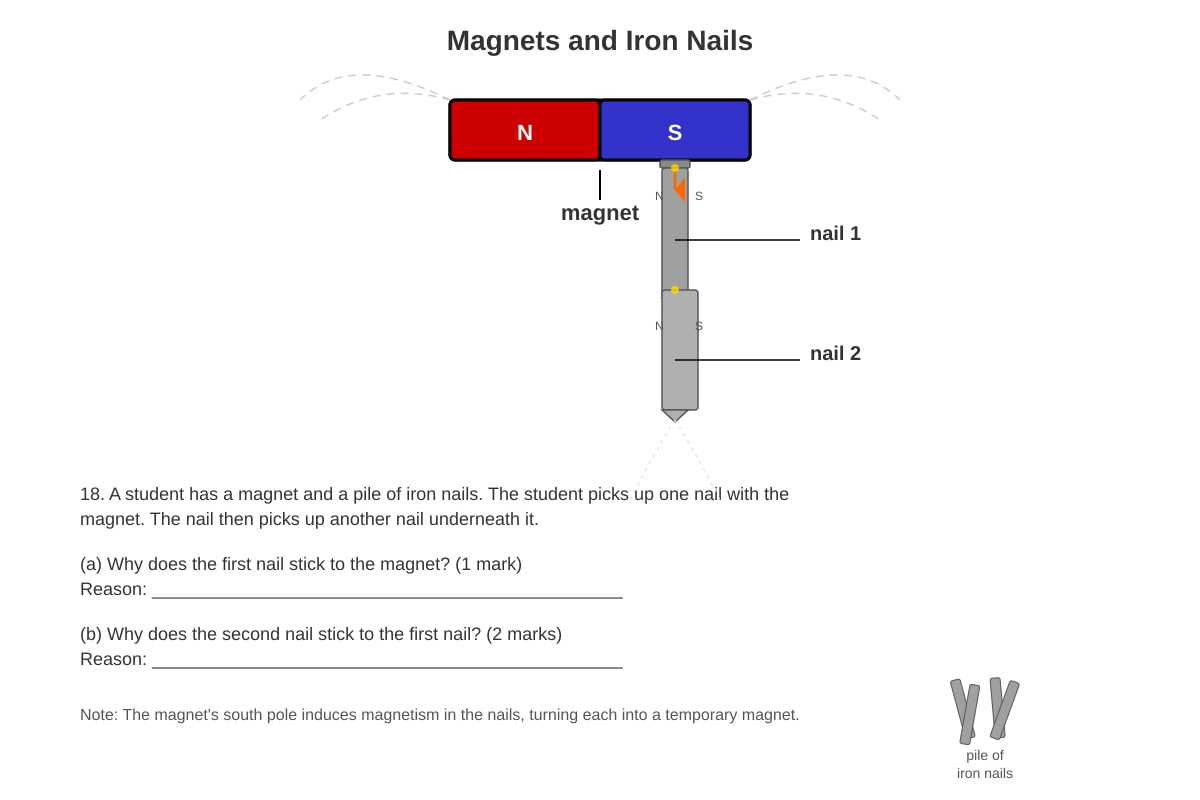
18. (a) Answer: The first nail sticks to the magnet because it is made of iron (a magnetic material) and is attracted by the magnetic force of the magnet.
- Marks: 1 mark
(b) Answer: When the first nail is in contact with the magnet, it becomes a temporary magnet itself (magnetic induction). It now has its own magnetic poles and can attract the second nail, which is also made of iron.
- Marks: 2 marks for a complete explanation (1 mark for the concept of temporary magnetisation, 1 mark for explaining the attraction).
- Explanation: This is called magnetic induction. A magnetic material placed in a magnetic field becomes temporarily magnetised. The nail acts like a magnet only while it is in contact with the permanent magnet.
- Common Mistake: Students may think the magnetic force "passes through" the first nail to reach the second nail. The correct explanation is that the first nail becomes a temporary magnet.
19. (a) Answer: Dip different parts of the magnet (one end, the middle, the other end) into the bowl of paper clips and count how many paper clips each part picks up. The part that picks up the most paper clips is the strongest.
- Marks: 2 marks for a clear and complete method (1 mark for the procedure, 1 mark for the measurement).
- Explanation: The number of paper clips picked up is a measure of the magnetic force at that part of the magnet. More paper clips = stronger magnetic force.
- Common Mistake: Students may suggest a vague method like "see which part feels strongest" without a measurable outcome.
(b) Answer: The ends (poles) of the magnet pick up more paper clips than the middle.
- Marks: 1 mark
- Explanation: This result shows that the magnetic force is concentrated at the poles, making them the strongest parts of the magnet.
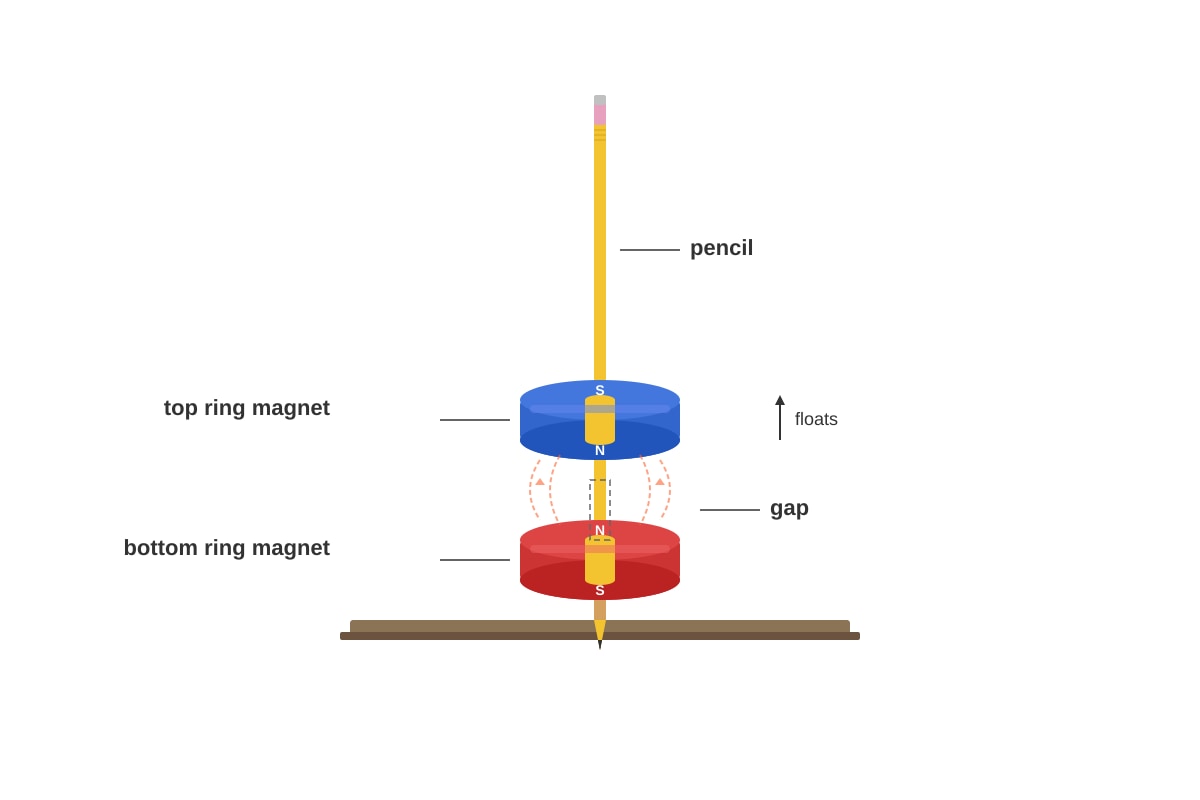
20. (a) Answer: The poles of the two magnets facing each other are the same (both north or both south).
- Marks: 1 mark
(b) Answer: Like poles repel each other. The top magnet floats because the magnetic repulsion force between the two magnets is strong enough to push the top magnet upwards, counteracting the force of gravity pulling it down.
- Marks: 2 marks for a complete explanation (1 mark for identifying like poles repel, 1 mark for explaining the balance of forces).
- Explanation: The upward magnetic repulsion force balances the downward gravitational force, causing the top magnet to float. This is a practical demonstration of magnetic levitation.
- Common Mistake: Students may say the magnets "don't like each other" or give a non-scientific explanation. Emphasise the scientific principle: "Like poles repel."
- Marking Note: Accept "the same poles are facing each other" as an alternative to "both north or both south."
End of Answer Key