AI Generated Quiz
Primary 4 Science Magnets Quiz
Free P4 Science Magnets quiz, AI version, with questions, answers, and syllabus-aligned practice for Singapore students.
These static practice materials are generated from the site's syllabus and paper-generation workflow, with source and model context shown so students and parents can evaluate the material before use.
Questions
Free quiz and exam paper access
Enter your details to view this paper
Your access is remembered on this device.
Answers
Answer Key: Primary 4 Science Quiz - Magnets
Section A: Multiple-Choice Questions (Questions 1 – 5)
1. C) Iron nail (1 mark)
- Explanation: Magnets attract magnetic materials. Iron is a magnetic material. Plastic, wood, and glass are non-magnetic materials and will not be attracted to a magnet.
- Common mistake: Students may think all metals are magnetic. Only iron, steel (which contains iron), nickel, and cobalt are magnetic. Aluminium and copper are metals but are not magnetic.
2. B) Poles (1 mark)
- Explanation: The two ends of a magnet are called its north pole and south pole. These are the points where the magnetic force is strongest.
- Common mistake: Students may think the ends are called "sides" or "tips." The correct scientific term is "poles."
3. A) Attract each other (1 mark)
- Explanation: Opposite poles attract. The north pole of one magnet attracts the south pole of another magnet. Like poles (north-north or south-south) repel each other.
- Key concept: "Opposites attract" is a useful rule to remember.
4. B) North-South (1 mark)
- Explanation: A freely suspended magnet acts like a compass. The Earth itself is a giant magnet. The north pole of the hanging magnet is attracted to the Earth's magnetic south pole (which is near the geographic North Pole), so the magnet aligns itself in the north-south direction.
- Common mistake: Students may think the magnet points in a random direction.
5. D) Aluminium (1 mark)
- Explanation: Aluminium is a metal but it is not magnetic. The three magnetic materials are iron, nickel, and cobalt. Steel is magnetic because it contains iron.
- Key concept: Not all metals are magnetic. Only iron, nickel, cobalt, and their alloys (like steel) are magnetic.
Section B: Fill in the Blanks (Questions 6 – 10)
6. magnetic force (1 mark)
- Explanation: A magnet exerts a force called magnetic force on magnetic materials. This force can act through some materials and can attract or repel other magnets.
7. north-south (1 mark)
- Explanation: A freely suspended magnet always points in the north-south direction because it aligns with the Earth's magnetic field. This is how a compass works.
8. north and south (1 mark for both correct)
- Explanation: Every magnet has two poles: a north pole and a south pole. The north pole is often marked with the letter N and the south pole with the letter S.
9. repel (1 mark)
- Explanation: Like poles (north-north or south-south) repel each other. This means they push each other away. Opposite poles attract.
10. magnetic (1 mark)
- Explanation: A material that is attracted to a magnet is called a magnetic material. Examples include iron, steel, nickel, and cobalt.
Section C: Short Answer Questions (Questions 11 – 15)
11. Answer: The student can stroke the piece of steel with one end of the bar magnet repeatedly in the same direction. (2 marks)
- Explanation: This process is called "magnetising by stroking." When you stroke a magnetic material like steel with a magnet, the tiny magnetic domains inside the steel align in the same direction, turning the steel into a temporary magnet.
- Marking scheme:
- 1 mark for mentioning stroking/rubbing with the magnet
- 1 mark for specifying stroking in one direction
- Common mistake: Students may think simply touching the steel with the magnet is enough. Stroking in one direction is needed to align the domains.
12. Answer: The magnetic force can pass through non-magnetic materials like paper. The magnet's force is strong enough to attract the iron paperclip through the paper. (2 marks)
- Explanation: Magnetic force can travel through many materials, including paper, plastic, wood, and even air. As long as the material is not a thick magnetic material, the force can pass through.
- Marking scheme:
- 1 mark for stating that magnetic force can pass through paper
- 1 mark for explaining that the force reaches the paperclip
- Common mistake: Students may think the magnet needs to touch the paperclip directly.
13. Answer: The iron filings will form a pattern of curved lines around the magnet, with the filings concentrated at the two poles (ends) of the magnet. (2 marks)
- Explanation: Iron filings are small pieces of iron that become temporary magnets when placed in a magnetic field. They align along the magnetic field lines, showing the shape of the magnetic field. The field is strongest at the poles, so more filings gather there.
- Marking scheme:
- 1 mark for describing curved lines/pattern around the magnet
- 1 mark for mentioning concentration at the poles/ends
- Common mistake: Students may think the filings spread evenly around the magnet.
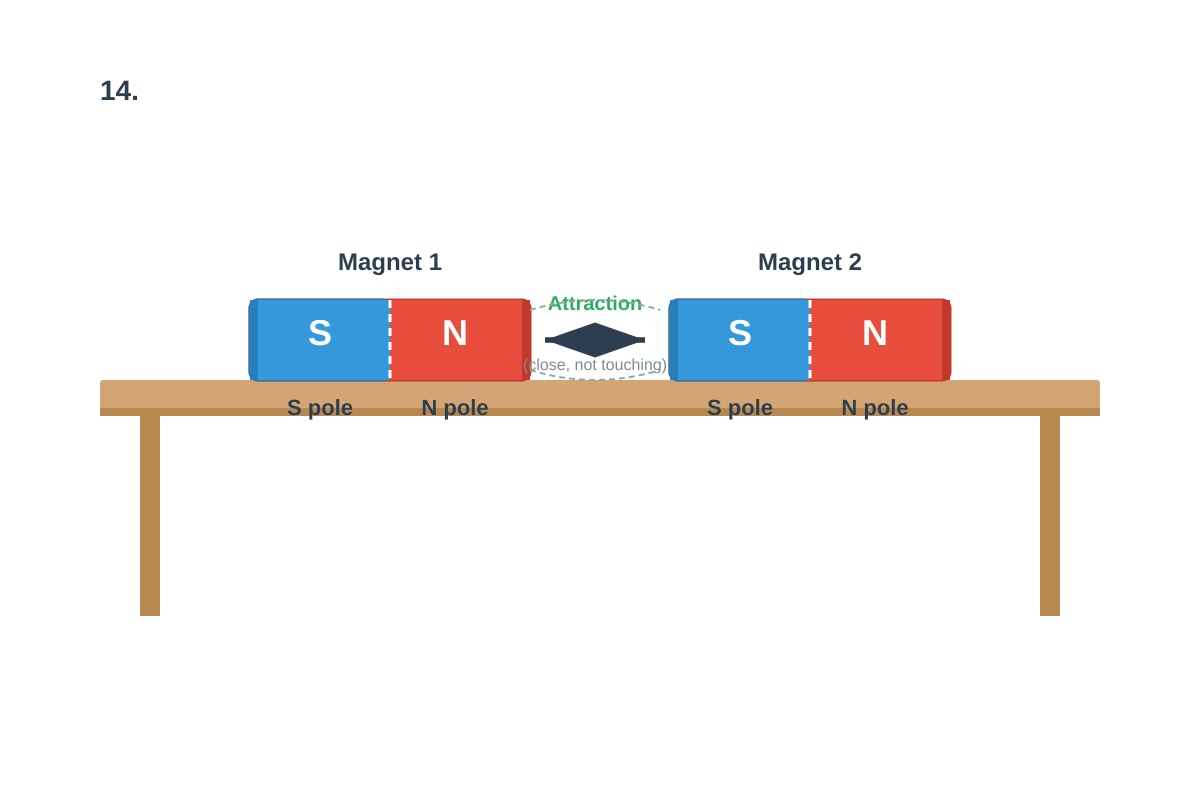
14. Answer: The two magnets will attract each other. This is because opposite poles attract. The north pole of the left magnet is facing the south pole of the right magnet. (2 marks)
- Explanation: The rule is: opposite poles attract, like poles repel. Since the north pole of one magnet is facing the south pole of the other, they will attract.
- Marking scheme:
- 1 mark for stating "attract"
- 1 mark for explaining that opposite poles attract (north and south)
- Common mistake: Students may confuse the rule and think like poles attract.
15. Answer: Only the iron rod will be attracted to the magnet. Iron is a magnetic material. Copper and aluminium are not magnetic materials. (2 marks)
- Explanation: Not all metals are magnetic. Iron, nickel, cobalt, and steel (which contains iron) are magnetic. Copper and aluminium are common metals but they are not attracted to magnets.
- Marking scheme:
- 1 mark for identifying the iron rod
- 1 mark for explaining that iron is magnetic while copper and aluminium are not
- Common mistake: Students may think all metals are magnetic.
Section D: Application and Explanation Questions (Questions 16 – 20)
16. Answer: When the iron nails are in contact with the magnet, they become temporary magnets themselves. This is because the magnetic domains inside the nails align in the same direction, giving the nails magnetic properties. (2 marks)
- Explanation: This process is called "magnetic induction." When a magnetic material touches a magnet, it becomes a temporary magnet. The nails can then attract other small iron pins because they have become magnetised.
- Marking scheme:
- 1 mark for stating that the nails become temporary magnets
- 1 mark for explaining that the nails can then attract other iron objects
- Common mistake: Students may think the nails steal magnetism from the magnet.
17. Answer: The student can bring one end of Bar A close to one end of Bar B. If they repel, then Bar A is the magnet. If they attract, the student should try the other end of Bar A. If both ends of Bar A attract Bar B, then Bar B is the magnet. (2 marks)
- Explanation: A magnet has two poles. If you bring a magnet near a piece of iron, the iron will always be attracted to the magnet. But if you bring two magnets near each other, they can either attract (opposite poles) or repel (like poles). Repulsion is the only sure test for magnetism because only two magnets can repel each other.
- Marking scheme:
- 1 mark for describing a test using repulsion
- 1 mark for correctly explaining how to interpret the results
- Common mistake: Students may think attraction alone proves something is a magnet. Attraction can happen between a magnet and a magnetic material.
18. Answer: The hanging magnet spins because the magnetic force from the other magnet acts on it. The hanging magnet is trying to align itself with the magnetic field of the other magnet. (2 marks)
- Explanation: A freely suspended magnet is free to move. When another magnet is brought near, its magnetic field exerts a force on the hanging magnet. The hanging magnet will turn so that its south pole faces the north pole of the other magnet (or vice versa), because opposite poles attract.
- Marking scheme:
- 1 mark for stating that the magnetic force from the other magnet causes the spinning
- 1 mark for explaining that the magnet is trying to align with the other magnet's field
- Common mistake: Students may think the magnet spins randomly.
19. Answer: The student can move the magnet over the mixture. The iron filings will be attracted to the magnet and stick to it, while the sand will be left behind. The student can then remove the iron filings from the magnet. (2 marks)
- Explanation: This method works because iron is a magnetic material and sand is not. The magnetic force attracts the iron filings but has no effect on the sand. This is a simple and effective way to separate a magnetic material from a non-magnetic material.
- Marking scheme:
- 1 mark for describing the method (moving magnet over mixture)
- 1 mark for explaining that iron is magnetic and sand is not
- Common mistake: Students may suggest using the magnet to pick up the sand.
20. Answer: Dropping the magnet on the floor causes the tiny magnetic domains inside the magnet to become misaligned. When the domains are not aligned in the same direction, the magnet's overall magnetic field becomes weaker. (2 marks)
- Explanation: A magnet is made up of many tiny regions called magnetic domains. In a strong magnet, these domains are all aligned in the same direction. When the magnet is dropped or hit, the domains get shaken out of alignment, reducing the magnet's strength. This is why magnets should be handled carefully.
- Marking scheme:
- 1 mark for stating that the domains become misaligned
- 1 mark for explaining that misalignment weakens the magnet
- Common mistake: Students may think the magnet "loses" its magnetism permanently or that the magnetism "leaks out."
Total Marks: 20