AI Generated Quiz

Primary 4 Science Light Quiz

Free AI-Generated Qwen3.7 Plus Primary 4 Science Light quiz with questions and answers for Singapore students. This page is rendered as a direct URL so the questions and answers can be discovered without pressing in-page buttons.

These static practice materials are generated from the site's syllabus and paper-generation workflow, with source and model context shown so students and parents can evaluate the material before use.

Primary 4 Science AI Generated Generated by Qwen3.7 Plus Updated 2026-06-04

Questions

<!-- TuitionGoWhere generation metadata: stage=5-1; model=qwen/qwen3.7-plus; model_label=Qwen3.7 Plus; generated=2026-06-04; Sources: Stage 4-0 LLM templates, syllabus context, and Stage 2 evidence where available. -->

Primary 4 Science Quiz - Light

Name: __________________________
Class: __________
Date: __________
Score: ______ / 20

Duration: 30 minutes
Total Marks: 20

Instructions:

  1. Read each question carefully.
  2. Answer all questions in the spaces provided.
  3. For multiple-choice questions, write the number of the correct option in the brackets.
  4. Draw diagrams neatly if required.

Section A: Multiple Choice Questions (10 marks)

Choose the correct answer and write its number in the brackets provided. Each question carries 1 mark.

  1. Which of the following is not a source of light? (1) The Sun (2) A lit candle (3) The Moon (4) A glowing light bulb Answer: (____)

  2. Light travels in ____________. (1) curved lines (2) straight lines (3) zig-zag lines (4) circles Answer: ()

  3. Which of the following materials allows light to pass through it clearly? (1) Clear glass window (2) Frosted glass (3) Wooden door (4) Aluminium foil Answer: (____)

  4. When an opaque object blocks light, a shadow is formed. Which part of the shadow is the darkest? (1) The edge of the shadow (2) The centre of the shadow (3) The area outside the shadow (4) There is no difference in darkness Answer: (____)

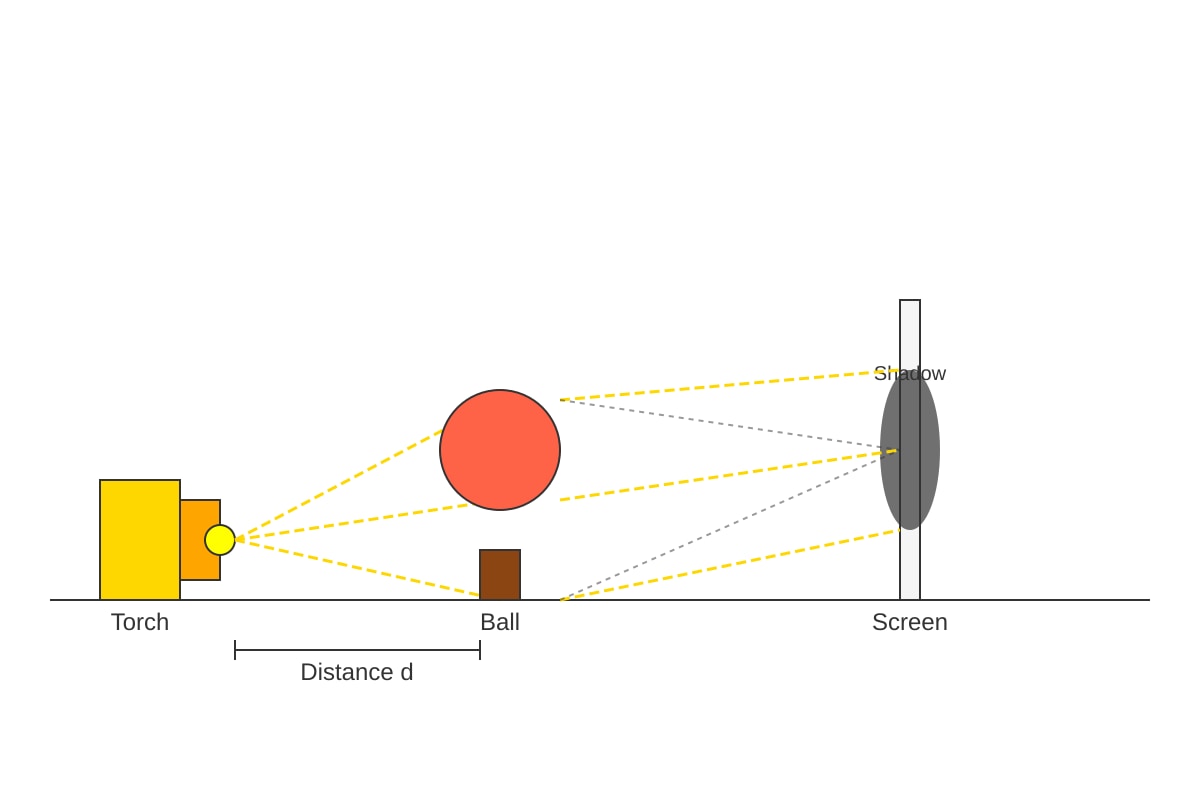
  5. Look at the diagram below showing a torch shining on a ball.

    <image_placeholder> id: Q5-fig1 type: diagram linked_question: Q5 description: A side-view diagram showing a torch on the left, a spherical ball in the middle, and a screen on the right. Light rays travel from the torch, hit the ball, and a shadow is cast on the screen. labels: Torch, Ball, Screen, Shadow values: None must_show: Straight lines representing light rays originating from the torch, hitting the ball, and the resulting shadow on the screen behind the ball. </image_placeholder>

    If the ball is moved closer to the torch, what happens to the size of the shadow on the screen? (1) It becomes smaller. (2) It becomes larger. (3) It stays the same size. (4) It disappears. Answer: (____)

  6. Which of the following objects is translucent? (1) A clear plastic ruler (2) A piece of tracing paper (3) A metal spoon (4) A mirror Answer: (____)

  7. Why can we see objects that do not give out their own light, such as a book? (1) The book produces its own light. (2) Light from a source reflects off the book into our eyes. (3) Our eyes send out light to the book. (4) The book absorbs all the light. Answer: (____)

  8. A student wants to make a shadow puppet show. Which material should he use for the puppets to create clear, dark shadows? (1) Transparent plastic sheet (2) Thick cardboard (3) Thin tissue paper (4) Clear cellophane Answer: (____)

  9. At what time of the day is your shadow usually the shortest? (1) 8:00 a.m. (2) 12:00 p.m. (Noon) (3) 4:00 p.m. (4) 7:00 p.m. Answer: (____)

  10. Which statement about light is true? (1) Light can bend around corners easily. (2) Light travels faster than sound. (3) Light cannot travel through a vacuum (empty space). (4) All objects allow light to pass through them. Answer: (____)


Section B: Structured Questions (10 marks)

  1. Study the table below which lists three materials.

    MaterialProperty of Light
    AAllows almost all light to pass through. Objects can be seen clearly.
    BAllows some light to pass through. Objects cannot be seen clearly.
    CDoes not allow any light to pass through.

    (a) Identify the type of material for A, B, and C. [3]

    Material A: __________________________

    Material B: __________________________

    Material C: __________________________

    (b) Give one example of an object made from Material C. [1]

    Example: __________________________

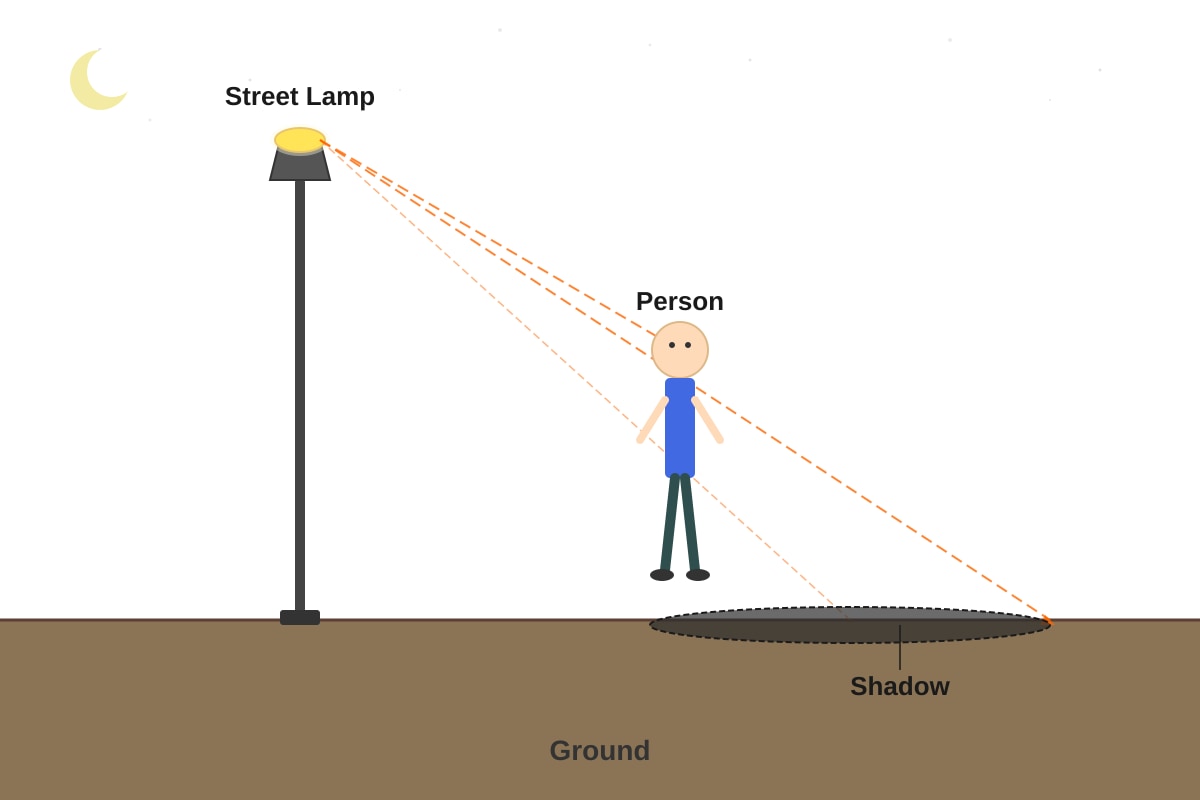
  2. The diagram below shows a person standing under a street lamp at night.

    <image_placeholder> id: Q12-fig1 type: diagram linked_question: Q12 description: A side view of a street lamp post with a light source at the top. A person is standing on the ground to the right of the lamp post. A shadow is cast on the ground to the right of the person. labels: Street Lamp, Person, Shadow, Ground values: None must_show: The light source, the person, and the shadow extending away from the light source. Light rays should be shown traveling in straight lines from the lamp, grazing the person's head, to the end of the shadow. </image_placeholder>

    (a) Draw the position of the shadow if the person moves closer to the street lamp. Label this new shadow X. [1]

    (Note: In your answer book, draw an arrow or label where the shadow would be if the person moved closer.)

    (b) Explain why the shadow is formed. [1]


  3. Ali performed an experiment to find out how the distance between the object and the light source affects the size of the shadow. He used a torch, a ball, and a screen.

    <image_placeholder> id: Q13-fig1 type: diagram linked_question: Q13 description: Experimental setup showing a torch, a ball on a stand, and a white screen. The distance between the torch and the ball is labeled 'd'. The shadow on the screen is visible. labels: Torch, Ball, Screen, Distance d, Shadow values: None must_show: The arrangement of the three items in a straight line. </image_placeholder>

    He recorded his results in the table below:

    Distance between Torch and Ball (cm)Size of Shadow on Screen (cm)
    1015
    2010
    307
    405

    (a) What is the aim of this experiment? [1]


    (b) Based on the results, what is the relationship between the distance of the object from the light source and the size of the shadow? [1]


    (c) Predict the size of the shadow if the distance between the torch and the ball is 50 cm. [1]

    The size of the shadow will be __________ cm (approximately).

    (d) Name one variable that must be kept constant (unchanged) in this experiment to make it fair. [1]


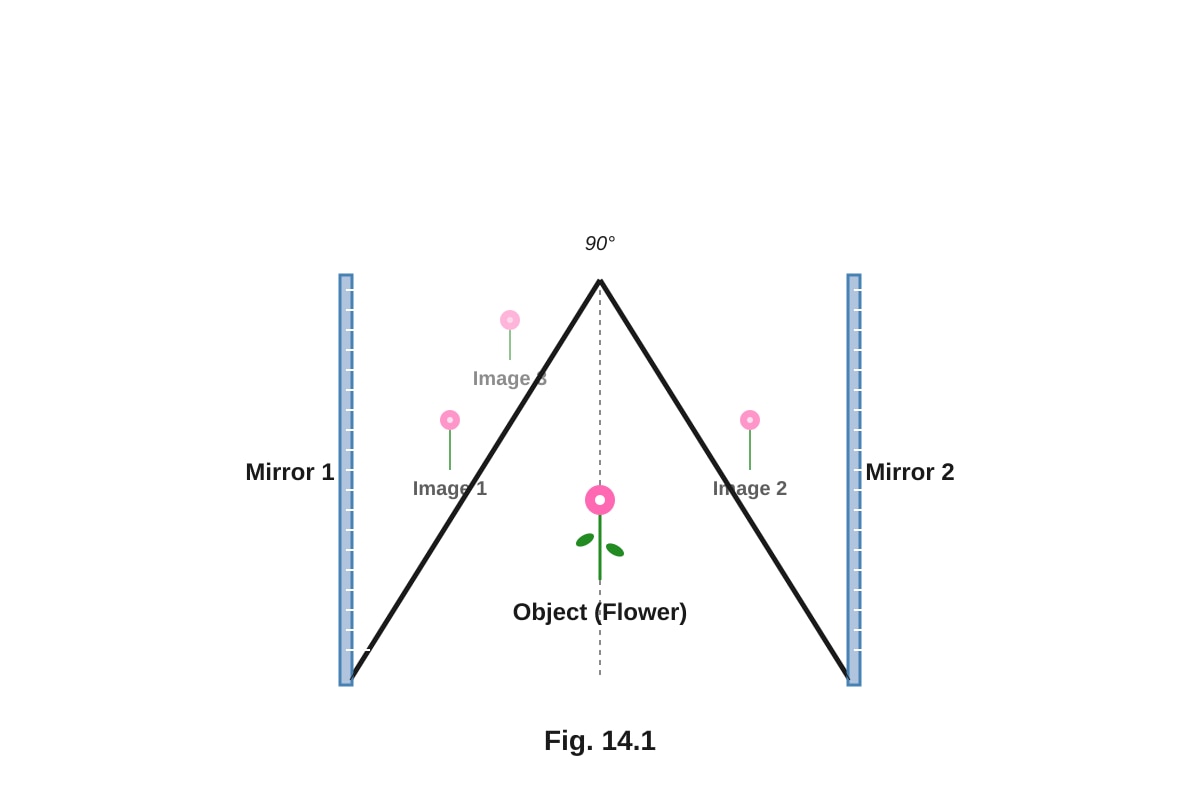
  4. Look at the diagram below showing two mirrors arranged at an angle.

    <image_placeholder> id: Q14-fig1 type: diagram linked_question: Q14 description: Two plane mirrors joined at one edge, forming a 'V' shape. An object (a small flower) is placed between the two mirrors. Multiple images of the flower are visible in the mirrors. labels: Mirror 1, Mirror 2, Object (Flower), Images values: Angle between mirrors is approximately 90 degrees. must_show: The object and at least two reflected images in the mirrors to demonstrate multiple reflections. </image_placeholder>

    (a) What property of light allows us to see the images in the mirrors? [1]


    (b) If the angle between the two mirrors is made smaller, will the number of images seen increase or decrease? [1]


  5. Sarah wants to see her reflection in a mirror.

    (a) What happens to the light when it hits the mirror? [1]


    (b) If Sarah moves further away from the mirror, what happens to the size of her reflection? [1]

    (1) It becomes larger. (2) It becomes smaller. (3) It stays the same size.

    Answer: (____)

  6. Ben is looking at a fish in a clear aquarium.

    (a) Why can Ben see the fish clearly? [1]


    (b) The glass of the aquarium is a ______________ material. [1]

    (1) transparent (2) translucent (3) opaque

    Answer: (____)

  7. During a solar eclipse, the Moon passes between the Sun and the Earth.

    (a) Why does a shadow fall on parts of the Earth? [1]


    (b) Is the Moon a luminous or non-luminous object? [1]


  8. A periscope is used by submarines to see above the water. It uses two mirrors.

    (a) How are the two mirrors arranged in a simple periscope? [1]


    (b) Does light travel in a straight line through the entire periscope tube? Explain your answer. [1]


  9. Tom shines a flashlight through a hole in a piece of cardboard onto a wall.

    (a) If Tom moves the cardboard closer to the flashlight, what happens to the size of the light spot on the wall? [1]

    (1) It becomes larger. (2) It becomes smaller. (3) It stays the same.

    Answer: (____)

    (b) Explain your answer in (a) using the property of light. [1]


  10. Jane places a red filter in front of a white light source.

    (a) What color of light passes through the red filter? [1]


    (b) If she places a blue filter after the red filter, will any light pass through? [1]

    (1) Yes, blue light. (2) Yes, red light. (3) No, almost no light.

    Answer: (____)

Answers

<!-- TuitionGoWhere generation metadata: stage=5-1; model=qwen/qwen3.7-plus; model_label=Qwen3.7 Plus; generated=2026-06-04; Sources: Stage 4-0 LLM templates, syllabus context, and Stage 2 evidence where available. -->

Primary 4 Science Quiz - Light (Answer Key)

Section A: Multiple Choice Questions

  1. (3) The Moon.

    • Reasoning: The Moon does not produce its own light; it reflects light from the Sun. The Sun, a lit candle, and a glowing bulb are all sources that emit light.
  2. (2) straight lines.

    • Reasoning: Light travels in straight lines. This is why shadows are formed when an opaque object blocks the path of light.
  3. (1) Clear glass window.

    • Reasoning: Transparent materials allow almost all light to pass through, so objects can be seen clearly. Frosted glass is translucent, while wood and foil are opaque.
  4. (2) The centre of the shadow.

    • Reasoning: The centre of the shadow (umbra) receives no light from the source, making it the darkest part. The edges may receive some scattered light or partial light (penumbra), making them lighter.
  5. (2) It becomes larger.

    • Reasoning: When the object (ball) is moved closer to the light source (torch), it blocks a wider angle of light rays, causing the shadow cast on the screen to become larger.
  6. (2) A piece of tracing paper.

    • Reasoning: Translucent materials allow some light to pass through but scatter it, so objects cannot be seen clearly. Clear plastic is transparent; metal and mirrors are opaque.
  7. (2) Light from a source reflects off the book into our eyes.

    • Reasoning: We see non-luminous objects because light from a source (like the Sun or a lamp) hits the object and bounces (reflects) into our eyes.
  8. (2) Thick cardboard.

    • Reasoning: To create a clear, dark shadow, the material must be opaque (block all light). Cardboard is opaque. Plastic, tissue, and cellophane are transparent or translucent, which would create faint or no shadows.
  9. (2) 12:00 p.m. (Noon).

    • Reasoning: At noon, the Sun is highest in the sky. The light rays come from almost directly above, resulting in the shortest shadow. In the morning or evening, the Sun is lower, creating longer shadows.
  10. (2) Light travels faster than sound.

    • Reasoning: Light travels extremely fast (approx. 300,000 km/s), much faster than sound (approx. 340 m/s). This is why we see lightning before we hear thunder. Light travels in straight lines, can travel through a vacuum, and is blocked by opaque objects.

Section B: Structured Questions

  1. (a) [3 marks]

    • Material A: Transparent
    • Material B: Translucent
    • Material C: Opaque

    (b) [1 mark]

    • Example: Wooden block / Metal spoon / Brick / Thick book (Any opaque object).
  2. (a) [1 mark]

    • Answer: The shadow X should be drawn shorter and closer to the person's feet than the original shadow.
    • Reasoning: As the person moves closer to the street lamp (the light source), the angle of the light hitting the person becomes steeper (more from above). This causes the shadow cast on the ground to become shorter. (Note: This differs from the fixed-screen experiment in Q5 because the "screen" here is the ground, and the geometry changes as the object moves relative to the elevated source).

    (b) [1 mark]

    • Answer: Light travels in straight lines and is blocked by the opaque person.
  3. (a) [1 mark]

    • Answer: To find out how the distance between the object and the light source affects the size of the shadow.

    (b) [1 mark]

    • Answer: The closer the object is to the light source, the larger the shadow. (Or: The further the object is from the light source, the smaller the shadow).

    (c) [1 mark]

    • Answer: 4 cm (or any value between 3 and 5 cm).
    • Reasoning: The trend shows the shadow size decreasing as distance increases. From 30cm to 40cm, it dropped by 2cm. From 40cm to 50cm, it should drop by a similar or smaller amount.

    (d) [1 mark]

    • Answer: Distance between the ball and the screen OR Brightness of the torch OR Size of the ball. (Any one valid constant variable).
  4. (a) [1 mark]

    • Answer: Reflection of light.

    (b) [1 mark]

    • Answer: Increase.
    • Reasoning: When the angle between two mirrors is smaller, light reflects back and forth between them more times, creating more images.
  5. (a) [1 mark]

    • Answer: The light is reflected (bounces off) the mirror.

    (b) [1 mark]

    • Answer: (3) It stays the same size.
    • Reasoning: The size of the image in a plane mirror is always the same as the object, regardless of the distance. (Note: It may appear smaller due to perspective, but the actual image size formed by the mirror is unchanged).
  6. (a) [1 mark]

    • Answer: Because the glass and water are transparent, allowing light to pass through clearly from the fish to Ben's eyes.

    (b) [1 mark]

    • Answer: (1) transparent
  7. (a) [1 mark]

    • Answer: The Moon is an opaque object that blocks the light from the Sun, casting a shadow on the Earth because light travels in straight lines.

    (b) [1 mark]

    • Answer: Non-luminous.
    • Reasoning: The Moon does not produce its own light; it reflects sunlight.
  8. (a) [1 mark]

    • Answer: They are arranged parallel to each other (or at 45-degree angles to the tube).

    (b) [1 mark]

    • Answer: No.
    • Reasoning: Light travels in straight lines, but it reflects off the mirrors, changing its direction inside the periscope.
  9. (a) [1 mark]

    • Answer: (1) It becomes larger.
    • Reasoning: This is similar to Q5. The cardboard acts as the object blocking/shaping the light. However, here it is a hole. Wait, if it is a hole, moving the cardboard closer to the source means the hole is closer to the source. The light rays spread out from the source. If the hole is closer to the source, the cone of light passing through is narrower at the source but spreads out over the same distance to the wall?
    • Correction: Let's re-evaluate. Source -> Cardboard (Hole) -> Wall.
    • If Cardboard moves closer to Source: The hole is closer to the point source. The light rays passing through the hole diverge from the source. The distance from the hole to the wall increases. Therefore, the light has more distance to spread out. The spot becomes larger.
    • If Cardboard moves closer to Wall: The distance from hole to wall decreases. The spot becomes smaller.
    • So, moving cardboard closer to flashlight (source) -> Larger spot on wall.

    (b) [1 mark]

    • Answer: Light travels in straight lines and spreads out from the source. Since the distance from the hole to the wall increases, the light spreads out more, making the spot larger.
  10. (a) [1 mark]

    • Answer: Red light.

    (b) [1 mark]

    • Answer: (3) No, almost no light.
    • Reasoning: The red filter only allows red light to pass. The blue filter only allows blue light to pass. Since there is no blue light in the red beam coming from the first filter, no light can pass through the second filter.