AI Generated Quiz
Primary 4 Science Light Quiz
Free Kimi AI-generated P4 Science Light quiz with questions, answers, and syllabus-aligned practice for Singapore students preparing for school assessments.
These static practice materials are generated from the site's syllabus and paper-generation workflow, with source and model context shown so students and parents can evaluate the material before use.
Questions
Primary 4 Science Quiz - Light
Name: _______________________ Class: __________ Date: __________
Score: ______ / 40 marks
Duration: 40 minutes
Instructions: Answer all questions. For multiple choice questions, circle the correct answer. For open-ended questions, write your answers in the spaces provided.
Section A: Multiple Choice (Questions 1–10)
Choose the correct answer. Each question carries 2 marks.
1. Light travels in a ____________ line.
(a) zig-zag
(b) straight
(c) curved
(d) spiral
Answer: _______________________
2. Which of the following is NOT a source of light?
(a) The Sun
(b) A candle flame
(c) The Moon
(d) A torch
Answer: _______________________
3. We are able to see objects around us because light ____________ from the objects into our eyes.
(a) travels
(b) reflects
(c) absorbs
(d) bends
Answer: _______________________
4. An object that allows all light to pass through it is called:
(a) opaque
(b) translucent
(c) transparent
(d) luminous
Answer: _______________________
5. What happens to a shadow when an object is moved closer to a light source?
(a) The shadow becomes smaller
(b) The shadow becomes larger
(c) The shadow stays the same size
(d) The shadow disappears
Answer: _______________________
6. Which material would be the best choice for making curtains in a bedroom if you want to block out morning sunlight?
(a) Clear plastic sheet
(b) Thin white cotton
(c) Thick black velvet
(d) Frosted glass
Answer: _______________________
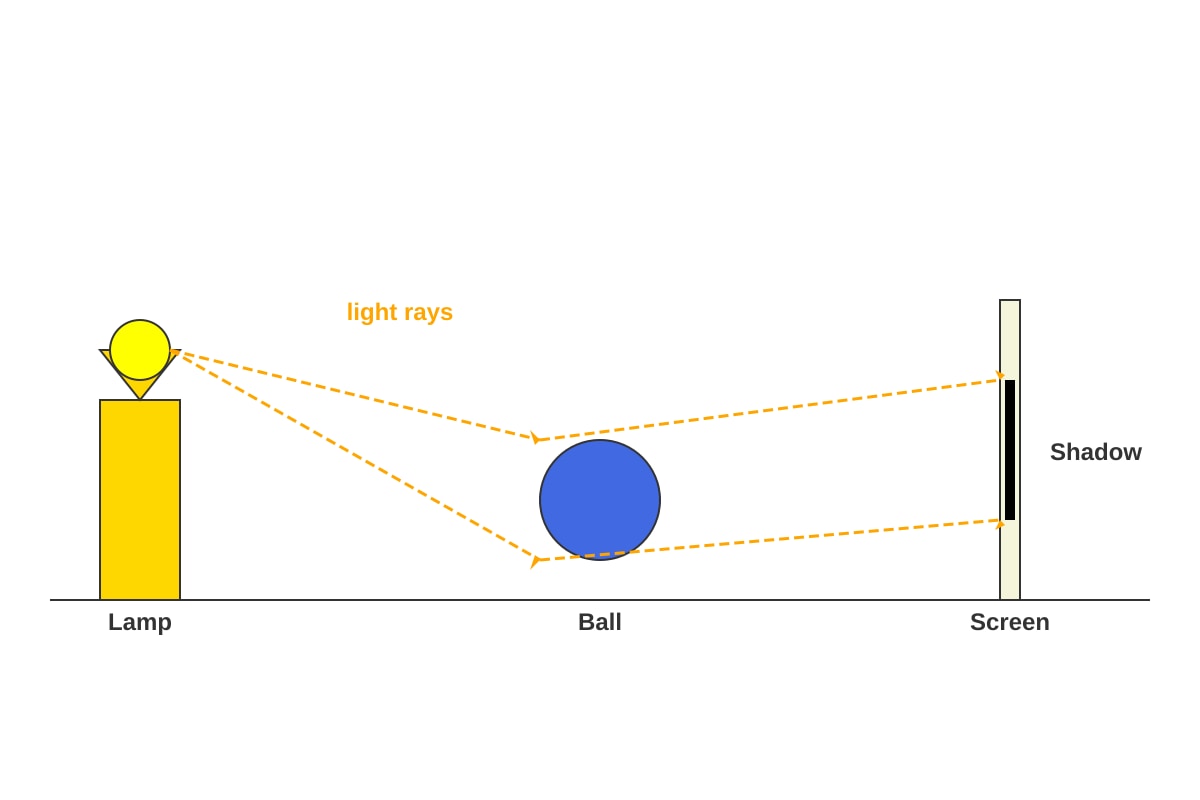
7. In the diagram below, a light source shines on a ball. What happens to the shadow if the ball is moved further away from the light source?
<image_placeholder> id: Q7-fig1 type: diagram linked_question: Q7 description: Side view showing a lamp on the left, a ball in the middle, and a screen on the right. Light rays travel from lamp past the ball to create a shadow on the screen. labels: Lamp, Ball, Screen, Shadow, light rays values: Ball positioned midway between lamp and screen must_show: Direction of light rays from lamp, shadow cast on screen, labels for all objects </image_placeholder>
(a) The shadow becomes smaller and sharper
(b) The shadow becomes larger and blurrier
(c) The shadow stays the same size
(d) The shadow disappears completely
Answer: _______________________
8. A student shines a torch at a mirror in a dark room. What will she observe?
(a) No light will come from the mirror
(b) Light will pass straight through the mirror
(c) Light will bounce off the mirror in a different direction
(d) The mirror will absorb all the light
Answer: _______________________
9. Which statement about shadows is TRUE?
(a) Shadows can form without a light source
(b) Shadows are always black regardless of the light source colour
(c) A shadow is formed when light is blocked by an opaque object
(d) Transparent objects cast dark shadows
Answer: _______________________
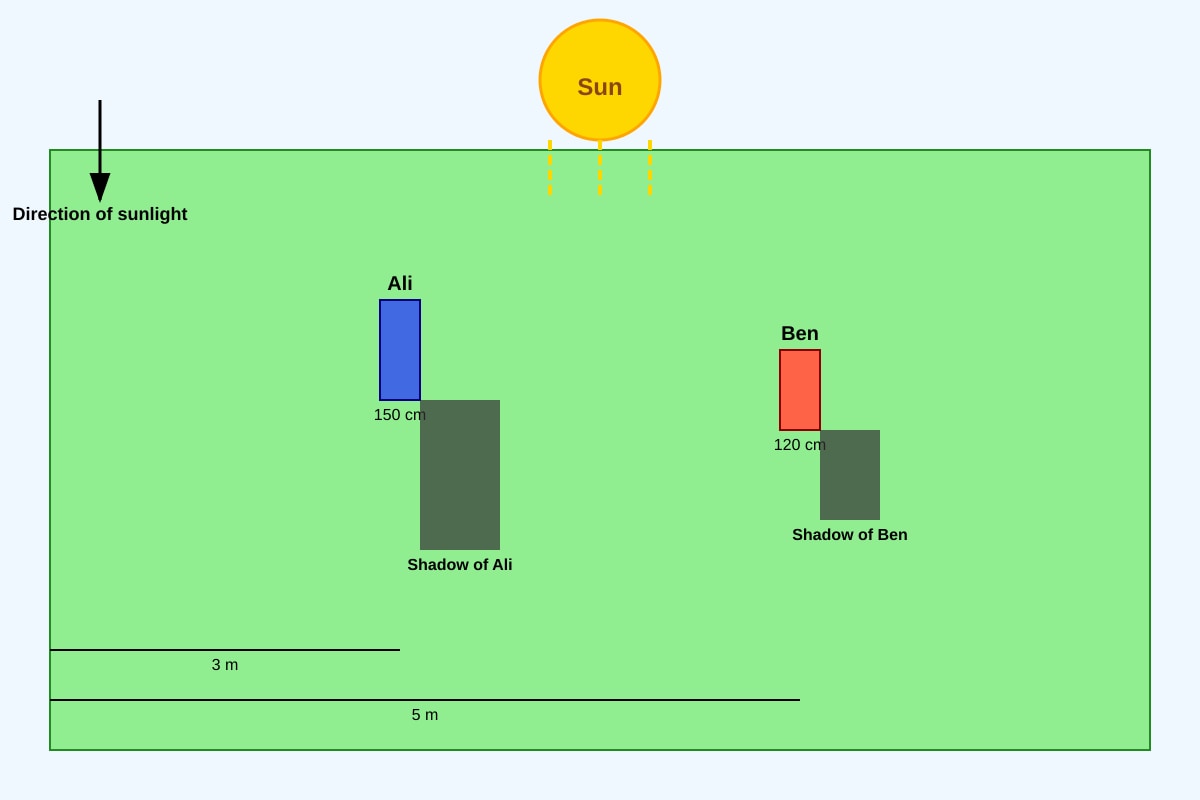
10. Two students, Ali and Ben, stand in the path of sunlight as shown below.
<image_placeholder> id: Q10-fig1 type: diagram linked_question: Q10 description: Overhead view of two students standing on a field with the Sun indicated above. Ali is taller and closer to the Sun's direction; Ben is shorter and further from the Sun's direction. Shadows extend away from the Sun. labels: Sun, Ali, Ben, Shadow of Ali, Shadow of Ben values: Ali's height 150 cm, Ben's height 120 cm, Ali 3 m from edge of field, Ben 5 m from edge must_show: Direction of sunlight, relative positions of students, shadow directions, height labels </image_placeholder>
Who will have the longer shadow, and why?
(a) Ben, because he is further from the light source
(b) Ali, because he is taller and closer to the light source
(c) They will have shadows of the same length
(d) It is impossible to tell without knowing the time of day
Answer: _______________________
Section B: Fill in the Blanks (Questions 11–14)
Complete each sentence with the correct word or phrase. Each blank carries 1 mark.
11. Objects that give out their own light are called ____________ objects. Objects that do not give out their own light are called ____________ objects.
[1 mark] [1 mark]
12. When light hits a smooth, shiny surface like a mirror, it ____________. When light hits a rough surface like a wall, it still ____________ but in many different ____________.
[1 mark] [1 mark] [1 mark]
13. A frosted glass window is ____________ because it lets some light through but objects cannot be seen clearly through it. A brick wall is ____________ because no light can pass through it.
[1 mark] [1 mark]
14. The shape and size of a shadow depends on:
- the ____________ of the light source,
- the ____________ of the object, and
- the distance between the object and the ____________.
[1 mark] [1 mark] [1 mark]
Section C: Short Answer (Questions 15–17)
Answer in the spaces provided. Show your reasoning clearly.
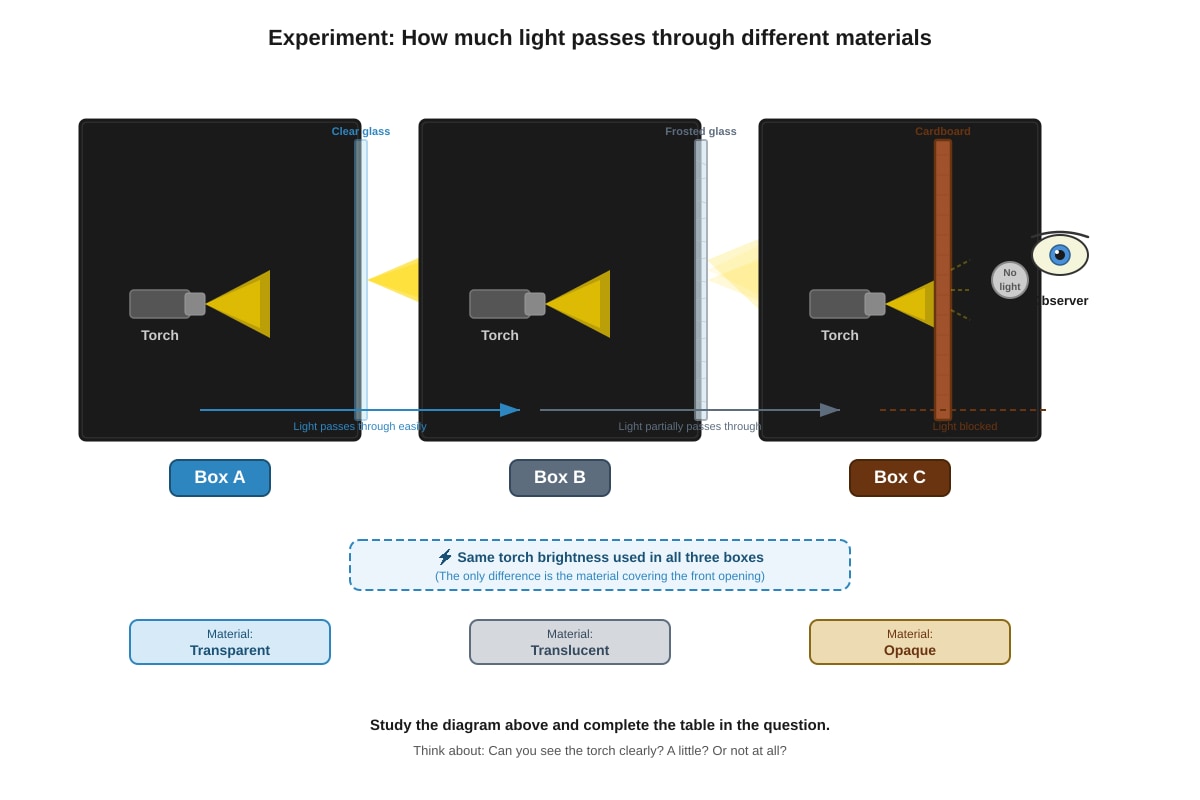
15. Mei Ling set up an experiment using three pieces of material to test how much light passes through each. She used a torch inside a dark box and observed what she could see from outside.
<image_placeholder> id: Q15-fig1 type: experimental_setup linked_question: Q15 description: Three identical dark boxes side by side, each with a torch inside shining towards the front. Box A has clear glass, Box B has frosted glass, Box C has cardboard covering the opening front. Observer icons shown outside each box. labels: Torch, Clear glass (Box A), Frosted glass (Box B), Cardboard (Box C), Observer eye symbols, Bright light, Dim light, No light indicators values: Same torch brightness in all boxes must_show: Three box setup, materials clearly labelled, light outcome indicators, observer position </image_placeholder>
(a) Complete the table to describe what the observer would see for each material. [3 marks]
| Material | What the observer sees |
|---|---|
| Clear glass (Box A) | |
| Frosted glass (Box B) | |
| Cardboard (Box C) |
(b) Explain why different materials allow different amounts of light to pass through. [2 marks]
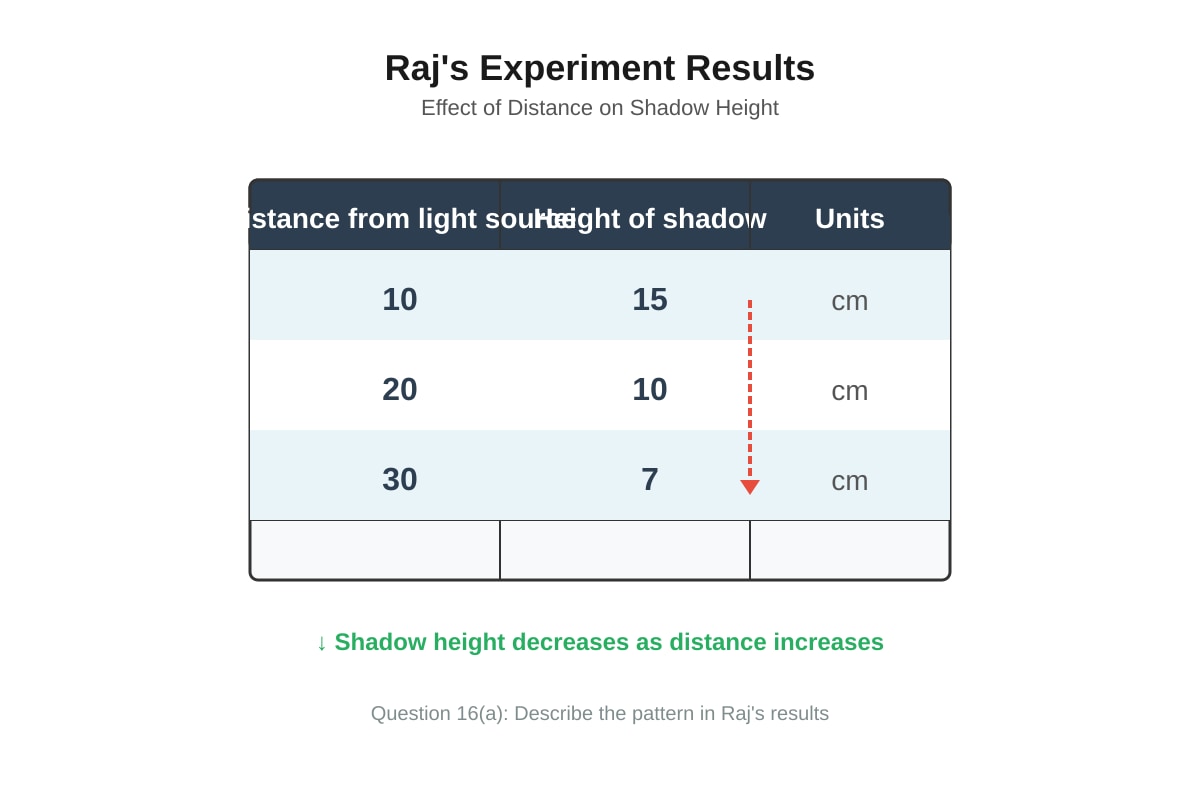
16. Raj conducted an experiment to investigate how the distance between an object and a light source affects the shadow size. He recorded his results in a table:
<image_placeholder> id: Q16-fig1 type: table linked_question: Q16 description: Data table with three columns and four rows showing experimental results labels: Distance from light source, Height of shadow, units (cm) values: 10 cm → 15 cm shadow, 20 cm → 10 cm shadow, 30 cm → 7 cm shadow must_show: All numerical values clearly, column headers, trend showing decreasing shadow height with increasing distance </image_placeholder>
| Distance from light source | Height of shadow |
|---|---|
| 10 cm | 15 cm |
| 20 cm | 10 cm |
| 30 cm | 7 cm |
(a) Describe the pattern you observe in Raj's results. [2 marks]
(b) Predict the height of the shadow if the object is placed 40 cm from the light source. Explain your prediction. [2 marks]
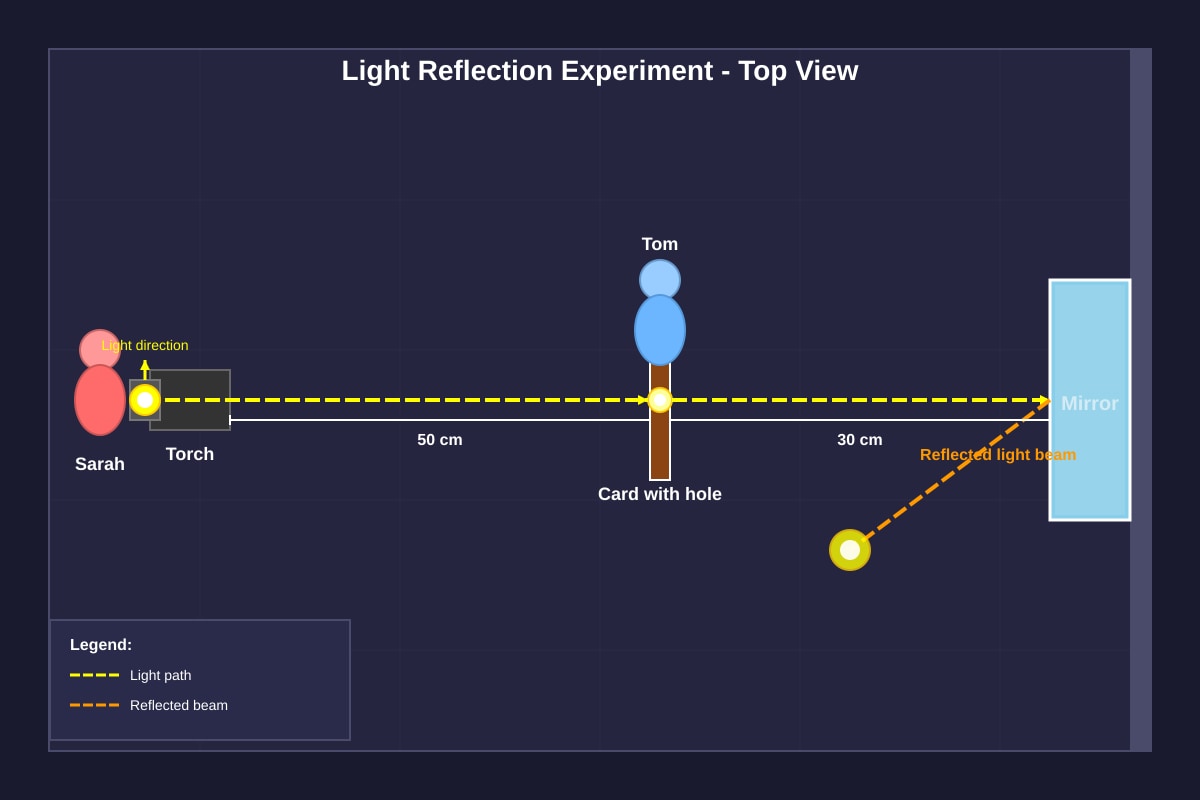
17. Sarah and Tom are playing with mirrors in a dark room with one torch. Sarah shines the torch at a mirror on the wall. Tom holds up a card with a small hole in it between the torch and the mirror.
<image_placeholder> id: Q17-fig1 type: experimental_setup linked_question: Q17 description: Top-down view of a dark room showing torch, card with hole, mirror on wall, and reflected light path. Sarah and Tom figures labelled. labels: Torch, Card with hole, Mirror, Reflected light beam, Sarah, Tom, Wall values: Torch 50 cm from card, card 30 cm from mirror, mirror at right wall must_show: Light path from torch through hole to mirror and reflected path, positions of all objects, labels, arrow showing light direction </image_placeholder>
(a) Explain what Tom will see on the wall behind the card if he looks at the mirror. [2 marks]
(b) What will happen to the light spot on the wall if Sarah tilts the mirror slightly upwards? Explain your answer. [2 marks]
Section D: Application and Thinking Questions (Questions 18–20)
These questions require you to apply what you know. Show your working and reasoning.
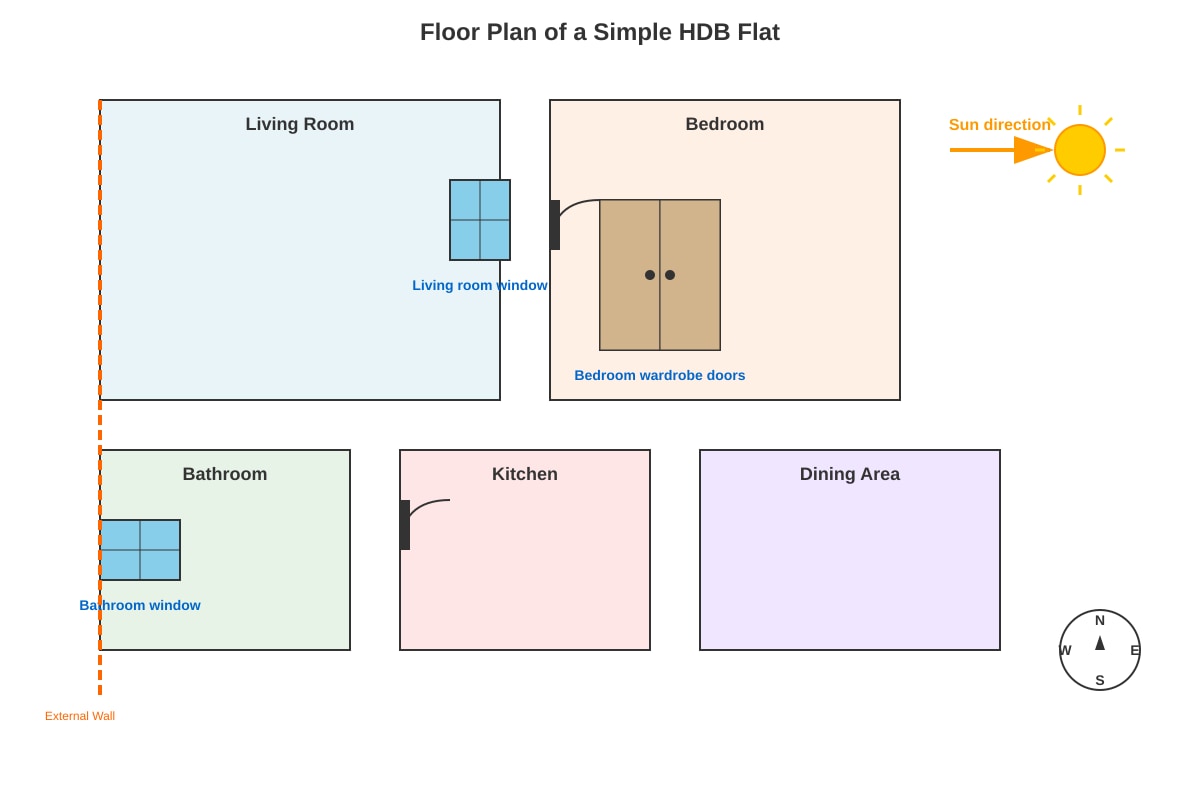
18. Mr. Tan is designing a new HDB flat. He needs to choose materials for different parts of the house. Explain which type of material (transparent, translucent, or opaque) would be most suitable for each of the following, and why:
<image_placeholder> id: Q18-fig1 type: diagram linked_question: Q18 description: Floor plan of a simple HDB flat showing three labelled areas: bathroom window, living room window, and bedroom wardrobe doors labels: Bathroom window, Living room window, Bedroom wardrobe doors, Sun direction arrow must_show: Three distinct areas with labels, simple room layout, indication of external wall for bathroom and living room windows </image_placeholder>
(a) The bathroom window — he wants privacy but still wants some natural light. [2 marks]
(b) The living room window — he wants to see the view outside clearly. [2 marks]
(c) The bedroom wardrobe doors — he wants to keep his clothes hidden from view. [2 marks]
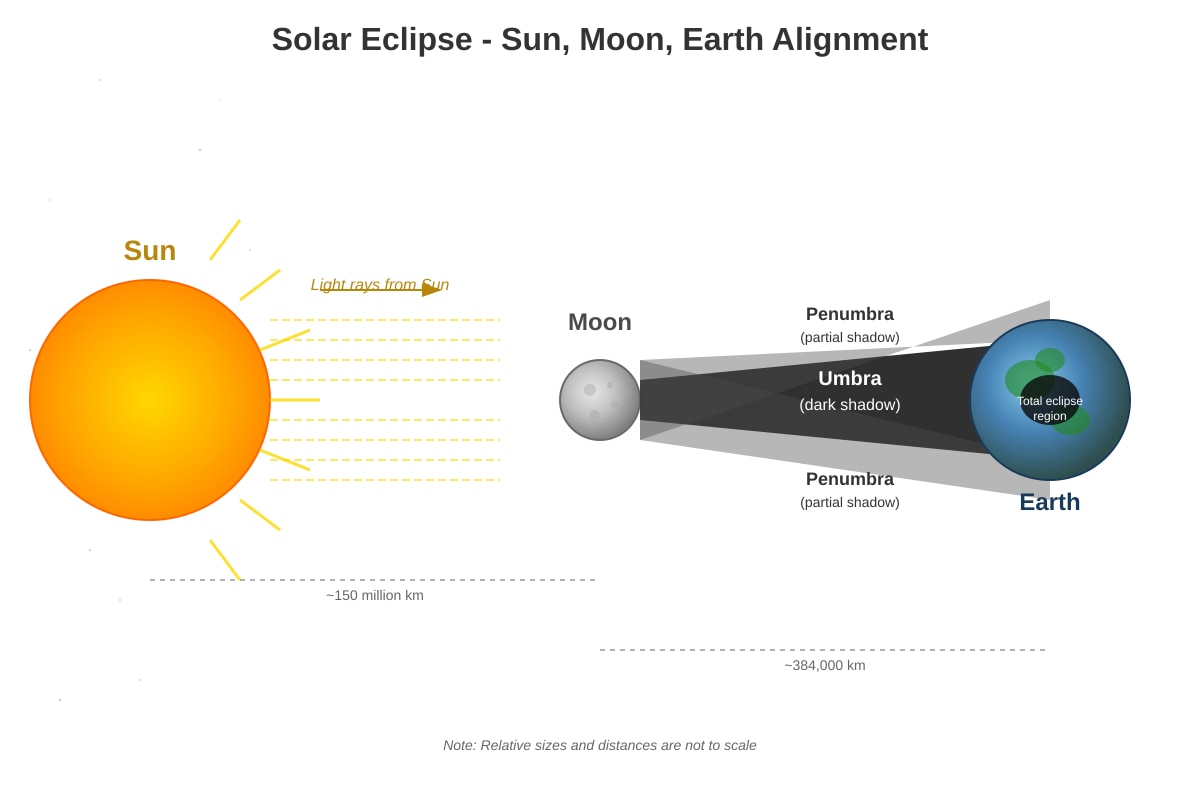
19. During a solar eclipse, the Moon passes between the Sun and Earth. Using what you know about shadows and light, explain:
<image_placeholder> id: Q19-fig1 type: diagram linked_question: Q19 description: Sun-Moon-Earth alignment diagram showing relative positions during solar eclipse, with shadow cone extending from Moon to Earth labels: Sun, Moon, Earth, Umbra (dark shadow), Penumbra (partial shadow), Light rays from Sun values: Sun largest, Moon smallest, Earth medium; shadow cone touches Earth surface at small region must_show: Relative sizes and positions, two shadow regions labelled, light rays showing blockage by Moon, path of shadow on Earth </image_placeholder>
(a) Why people in certain parts of Earth see a total solar eclipse (complete darkness during daytime). [2 marks]
(b) Why people in nearby regions might only see a partial solar eclipse. [2 marks]
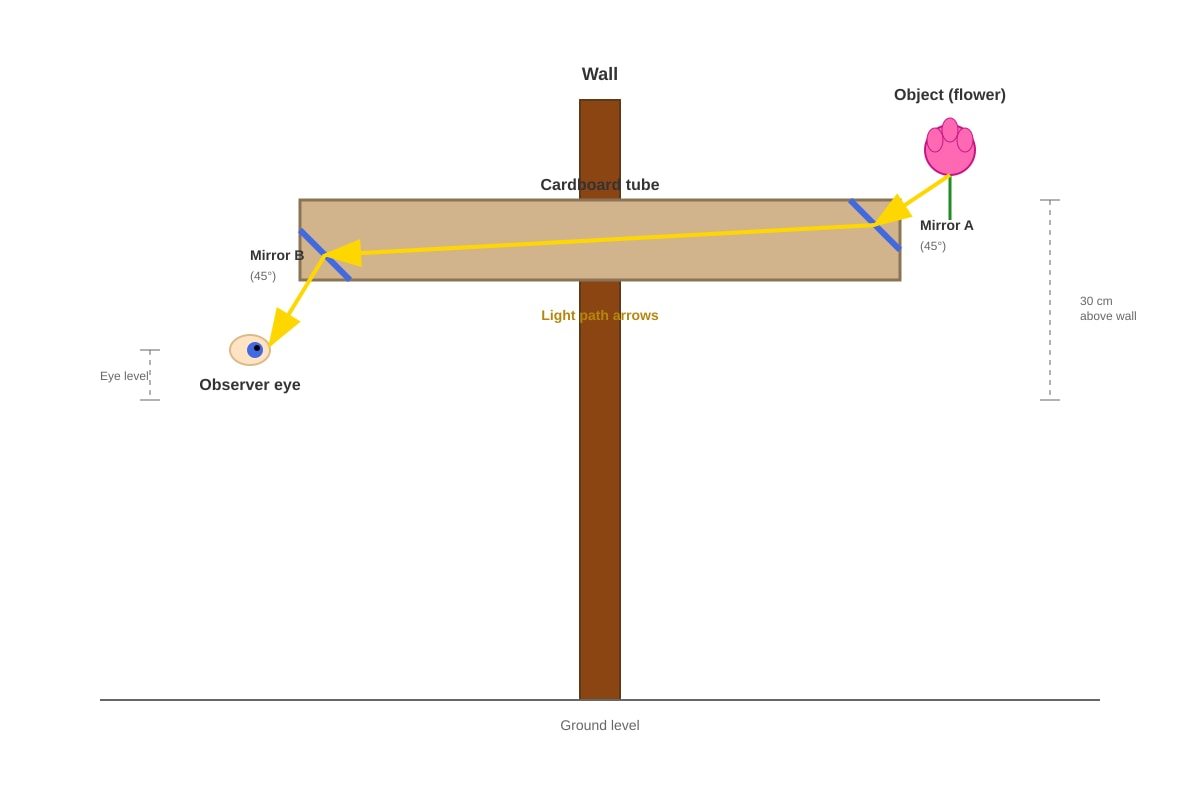
20. Jason wants to set up a simple periscope to see over a wall. He has two mirrors and a long cardboard tube. The diagram below shows his plan.
<image_placeholder> id: Q20-fig1 type: diagram linked_question: Q20 description: Cross-section of a periscope showing tube with mirrors at both ends, light path through tube, observer eye and object on opposite sides labels: Mirror A (top opening, 45 degrees), Mirror B (bottom opening, 45 degrees), Cardboard tube, Object (flower), Observer eye, Light path arrows, Wall values: Mirrors at 45 degree angles to horizontal tube, top opening 30 cm above wall, bottom opening at observer eye level must_show: Both mirrors angled correctly, light path with arrows showing two reflections, wall obstructing direct view, observer and object positions, tube construction </image_placeholder>
(a) On the diagram, draw arrows to show how light travels from the object (a flower) to Jason's eye. Describe the path in words. [3 marks]
(b) Why must the two mirrors be placed at 45° angles for the periscope to work properly? [2 marks]
END OF QUIZ
Answers
Primary 4 Science Quiz - Light: Answer Key
Total Marks: 40
Section A: Multiple Choice (2 marks each)
1. (b) straight
Explanation: Light travels in straight lines. This is why we cannot see around corners without a mirror. Light does not bend or curve on its own — it needs something to reflect it or change its direction. If light travelled in curves, shadows would not have sharp edges.
2. (c) The Moon
Explanation: The Moon is NOT a source of light. The Moon shines because it reflects sunlight — it does not produce its own light. The Sun (a star), a candle flame (burning wax produces light), and a torch (electric bulb) are all luminous objects that produce their own light. Remember: if you take away the Sun, the Moon would be dark.
3. (b) reflects
Explanation: Light from a luminous source (like the Sun or a lamp) reaches an object, then reflects (bounces off) that object into our eyes. This is how we see non-luminous objects. The light "travels" to the object, but the key process that lets us see is reflection into our eyes. "Absorbs" would mean the light is taken in by the object, and "bends" involves refraction (not covered in P4).
4. (c) transparent
Explanation:
- Transparent materials let all light pass through — you can see clearly through them (e.g., clear glass, clean water).
- Translucent materials let some light through but scatter it — you cannot see clearly (e.g., frosted glass, tracing paper).
- Opaque materials block all light — no seeing through them (e.g., wood, metal, brick).
- Luminous means the object produces its own light, not about light passing through.
5. (b) The shadow becomes larger
Explanation: When an object moves closer to the light source, the light rays spread out more behind the object, creating a larger shadow. Imagine standing close to a torch — your shadow on the wall grows huge. Move further away, and your shadow shrinks. The light source's rays diverge (spread apart), so less area is blocked when you're further away.
6. (c) Thick black velvet
Explanation: To block out morning sunlight completely, you need an opaque material. Thick black velvet is opaque and also dark-coloured, which absorbs light rather than reflecting it. Clear plastic (transparent) and thin white cotton (translucent) let light through. Frosted glass is translucent — it diffuses light but still lets plenty through.
7. (a) The shadow becomes smaller and sharper
Explanation: Moving the ball further from the light source means:
- The light rays have spread out more before reaching the ball, so the ball blocks a smaller angle of light → smaller shadow
- The ball is closer to the screen, so edges are less blurred → sharper shadow
The shadow also becomes less blurry because the "fuzzy" penumbra region shrinks as the object nears the screen.
8. (c) Light will bounce off the mirror in a different direction
Explanation: Mirrors are smooth, shiny surfaces that reflect light according to the law of reflection (angle in = angle out, though P4 students need only know that light bounces off). The reflected light changes direction. If the mirror is angled correctly, you can see the torch light in a different location — this is how periscopes work.
9. (c) A shadow is formed when light is blocked by an opaque object
Explanation:
- (a) is false — shadows need a light source; no light, no shadow.
- (b) is false — shadows can be coloured if the light source is coloured (e.g., red light makes red-tinged shadows).
- (d) is false — transparent objects let light through, so they cast very faint or no shadows.
- (c) is correct: opaque objects block light, creating a shadow in the region behind where light cannot reach.
10. (b) Ali, because he is taller and closer to the light source
Explanation: Shadow length depends on both height and distance from the light source. Ali is taller (150 cm vs 120 cm) AND closer to the light source (3 m vs 5 m from edge, closer to Sun direction). Both factors make his shadow longer:
- Taller objects cast longer shadows
- Objects closer to the light source have shadows that spread out more
Ben's shorter height and greater distance from the light source both reduce his shadow length.
Section B: Fill in the Blanks (1 mark each)
11. Objects that give out their own light are called luminous objects. Objects that do not give out their own light are called non-luminous objects.
Key idea: The Sun, stars, flames, and light bulbs are luminous. The Moon, tables, and people are non-luminous — we see them by reflected light.
12. When light hits a smooth, shiny surface like a mirror, it reflects (regularly). When light hits a rough surface like a wall, it still reflects but in many different directions.
Key idea: Smooth surfaces give regular (specular) reflection, creating clear images. Rough surfaces give diffuse reflection — light scatters, so no clear image forms, but the surface is still visible because light reaches our eyes from all over it.
13. A frosted glass window is translucent because it lets some light through but objects cannot be seen clearly through it. A brick wall is opaque because no light can pass through it.
14. The shape and size of a shadow depends on:
- the position/direction/size of the light source,
- the size/shape of the object, and
- the distance between the object and the screen/surface.
Key idea: A small light source (point source) gives sharp shadows. A large light source gives blurry-edged shadows with partial shadow regions. Moving the object closer to the screen makes the shadow sharper and smaller (relative to moving it toward the light).
Section C: Short Answer
15. (a)
| Material | What the observer sees |
|---|---|
| Clear glass (Box A) | Bright, clear light; can see the torch bulb clearly [1 mark] |
| Frosted glass (Box B) | Dim, diffused light; cannot see the torch bulb clearly [1 mark] |
| Cardboard (Box C) | No light at all; complete darkness [1 mark] |
(b) Different materials have different properties regarding light:
- Clear glass is transparent — its smooth, ordered structure lets light pass straight through without much scattering [1 mark]
- Frosted glass is translucent — its rough surface scatters light in many directions, so light passes through but images are blurred [0.5 mark]
- Cardboard is opaque — it absorbs or blocks light completely; no light can pass through its fibres [0.5 mark]
16. (a) As the distance from the light source increases, the height of the shadow decreases. [1 mark] The shadow gets smaller at a decreasing rate — from 10 to 20 cm distance, shadow drops 5 cm; from 20 to 30 cm, it drops only 3 cm. [1 mark for noting pattern detail or consistent trend description]
(b) Prediction: Approximately 5 cm (accept 4–6 cm) [1 mark] Explanation: Based on the pattern, each increase of 10 cm in distance gives a smaller decrease in shadow height. From 30 cm, the next decrease should be about 2 cm (following 5 cm, then 3 cm reduction trend), giving approximately 5 cm. Alternatively, following the decreasing trend, the shadow continues to get smaller. [1 mark for reasoning linked to data pattern]
17. (a) Tom will see a small, bright spot of light on the wall behind/beside him, corresponding to the hole in the card. [1 mark] Light travels in a straight line from the torch, through the hole in the card, to the mirror, then reflects off the mirror to the wall. [1 mark]
(b) The light spot will move upwards on the wall. [1 mark] When a mirror is tilted, the angle of reflection changes equally. Tilting the mirror upward means the reflected light beam angles upward, hitting a higher point on the wall. The law of reflection: if the mirror surface tilts by angle θ, the reflected ray changes direction by 2θ. [1 mark for explaining changed reflection direction]
Section D: Application and Thinking Questions
18. (a) Translucent material (e.g., frosted glass, textured glass). [1 mark] Reason: It lets some natural light into the bathroom for brightness during the day, but scatters the light so that people outside cannot see clearly in — providing privacy. [1 mark]
(b) Transparent material (e.g., clear glass). [1 mark] Reason: You need to see the view outside clearly, and transparent materials allow light to pass straight through without distortion, giving a clear image of the outside world. [1 mark]
(c) Opaque material (e.g., wood, laminate, metal). [1 mark] Reason: To keep clothes hidden from view, no light should pass through the wardrobe doors. Opaque materials block all light, ensuring privacy. [1 mark]
19. (a) People in the total eclipse zone are in the umbra — the darkest part of the Moon's shadow. [1 mark] The Moon completely blocks all direct sunlight from reaching these areas, so it becomes dark during daytime. The Moon's size and distance from Earth are just right for this complete blockage. [1 mark]
(b) People in nearby regions are in the penumbra — the partial shadow. [1 mark] In this region, the Moon only blocks part of the Sun, so some sunlight still reaches Earth. The Sun is much larger than the Moon, so light from the Sun's edges can still reach around the Moon, creating partial lighting. [1 mark]
20. (a) Light path description (with arrows on diagram): [3 marks total]
- Light travels from the flower (object) upwards through the top opening to Mirror A [1 mark]
- Light reflects off Mirror A (at 45°), travelling down the tube [1 mark]
- Light hits Mirror B (at 45°) and reflects again, travelling horizontally to Jason's eye [1 mark]
The two reflections change the light's direction by 90° each, allowing Jason to see over the wall.
(b) The 45° angle is essential because:
- When light hits a mirror at 45°, it reflects at 45° on the other side, making a 90° turn [1 mark]
- This 90° turn directs light straight down the horizontal tube, then straight out to the eye. If angles were different, light would hit the tube walls and be absorbed, or miss the second mirror entirely [1 mark]
END OF ANSWER KEY