AI Generated Quiz
Primary 4 Science Light Quiz
Free P4 Science Light quiz, HY3 AI version, with questions, answers, and syllabus-aligned practice for Singapore students.
These static practice materials are generated from the site's syllabus and paper-generation workflow, with source and model context shown so students and parents can evaluate the material before use.
Questions
Free quiz and exam paper access
Enter your details to view this paper
Your access is remembered on this device.
Answers
Primary 4 Science Quiz - Light (Answer Key)
Total Marks: 40
Caveat: Syllabus-first generated content. Not derived from past-year papers.
Section A Answers (1 mark each)
1. C
Teaching note: A glowing bulb produces its own light, so it is a light source. The Moon reflects sunlight (not a source), wall and bag do not produce light.
2. B
Teaching note: The apple is not a light source. It reflects light from a source (e.g., Sun or lamp) into our eyes, allowing us to see it.
3. B
Teaching note: Light travels in straight lines. This is why shadows have sharp edges when blocked.
4. B
Teaching note: Shadow forms when an object completely or partially blocks light travelling in straight lines.
5. C
Teaching note: Clear air does not block light, so no shadow is formed. All other objects block light.
6. B
Teaching note: Moving the ball closer to the torch makes the shadow larger because the object blocks more of the spreading light cone.
7. B
Teaching note: At noon, Sun is nearly overhead, so light hits objects from above, making shadows short.
8. C
Teaching note: The Sun is a natural light source. Mirror and paper reflect; window pane allows light through.
9. B
Teaching note: Shadow shows the shape of the object because light travels straight and is blocked by the object's outline.
10. B
Teaching note: To test object-screen distance effect, keep light source and object fixed, change only object-screen distance.
Section B Answers (2 marks each)
11. (1) The chair reflects light from the Sun or room lights into our eyes. (2) It is not a light source but is seen by reflected light.
Marking: 1 mark for "reflects light", 1 mark for naming a source or stating not a source.
12. The ball is round, so when light travelling in straight lines is blocked, the blocked area on the screen is a circle (shape of cross-section).
Marking: 1 mark light travels straight, 1 mark shape matches object.
13. The shadow becomes larger. Because the box is closer to the torch, it blocks a wider angle of light reaching the screen.
Marking: 1 mark larger, 1 mark correct reason (closer = bigger shadow).
14. Any two: (a) distance between light source and object, (b) distance between object and screen, (c) size of object, (d) position of object.
Marking: 1 mark each, max 2.
15. The book blocks light completely because it is solid and does not let light pass. The glass window lets some light pass through, so less is blocked.
Marking: 1 mark book solid/blocks all, 1 mark glass allows light through.
16. The shadow points east. At 5 PM Sun is in west, light travels straight from west to tree, so shadow falls opposite (east).
Marking: 1 mark east, 1 mark reason with light direction.
Section C Answers
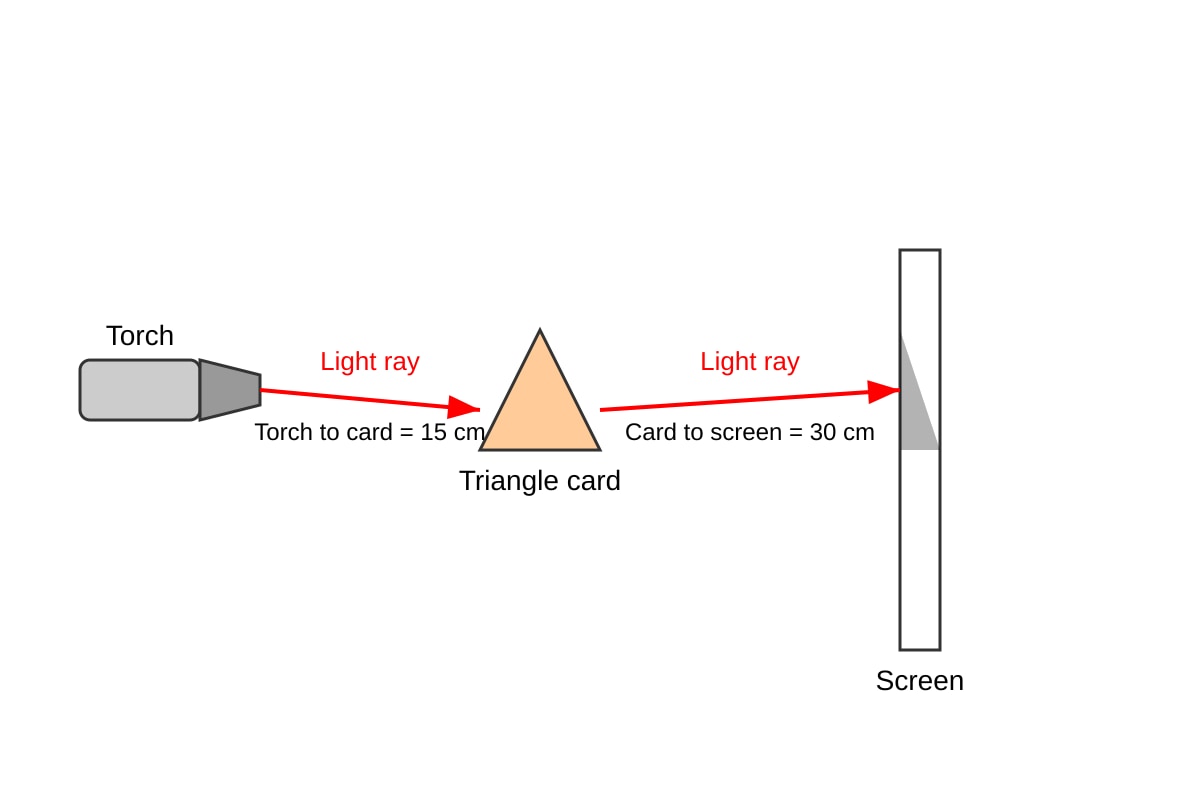
17.
(a) Triangle. (1 mark)
(b) Light travels in straight lines; the triangle card blocks light, so the shadow matches the card’s shape. (1 mark)
18.
(a) Distance between light source and object. (1 mark)
(b) Distance between object and screen (or size of object, or light source used). (1 mark)
19.
(a) Shadow length increases. (1 mark)
(b) As object moves farther from torch, it blocks light at a narrower angle relative to screen, but due to setup geometry the shadow stretches longer on screen. (1 mark)
Note: In given data, increasing distance torch–cup increases shadow length; accept "light spreads, shadow lengthens".
20.
(a) At noon Sun is overhead, light comes from above, so shadow is short. (1 mark)
(b) At 6 PM Sun is low near horizon, light comes at slant, so shadow is long. (1 mark)