AI Generated Quiz

Primary 4 Science Life Cycles Quiz

Free P4 Science Life Cycles quiz with questions, answers, and syllabus-aligned practice for Singapore students preparing for school assessments.

These static practice materials are generated from the site's syllabus and paper-generation workflow, with source and model context shown so students and parents can evaluate the material before use.

Primary 4 Science AI Generated Generated by Kimi K2.6 Free Updated 2026-06-09

Questions

<!-- TuitionGoWhere generation metadata: stage=5-1; model=moonshotai/kimi-k2.6:free; model_label=Kimi K2.6 Free; generated=2026-06-09; Sources: Stage 4-0 LLM templates, syllabus context, and Stage 2 evidence where available. -->

Primary 4 Science Quiz - Life Cycles

Name: _________________________ Class: _________ Date: ___________

Duration: 30 minutes

Total Marks: 40 marks

Instructions:

  • Answer all questions.
  • Write your answers in the spaces provided.
  • For multiple-choice questions, circle the correct answer.

Section A: Multiple Choice (Questions 1–10)

Choose the correct answer. Each question carries 2 marks.


1. Which of the following animals undergoes complete metamorphosis?

A. Grasshopper

B. Cockroach

C. Butterfly

D. Lizard

Answer: _________________


2. The young of a frog is called a __________.

A. nymph

B. larva

C. tadpole

D. pupa

Answer: _________________


3. In the life cycle of a mosquito, which stage lives in water and is often called a "wriggler"?

A. Egg

B. Larva

C. Pupa

D. Adult

Answer: _________________


4. Which stage is missing in incomplete metamorphosis compared to complete metamorphosis?

A. Egg

B. Larva

C. Pupa

D. Adult

Answer: _________________


5. A butterfly lays its eggs on a leaf. What is the most likely reason?

A. The leaf provides water for the eggs.

B. The leaf is where the young will find food.

C. The leaf protects the eggs from wind.

D. The leaf gives warmth to the eggs.

Answer: _________________


6. The diagram below shows the life cycle of an animal.

<image_placeholder> id: Q6-fig1 type: diagram linked_question: Q6 description: Circular life cycle diagram showing four stages with arrows: Stage P (round eggs on leaf), Stage Q (caterpillar eating leaf), Stage R (chrysalis hanging from branch), Stage S (butterfly flying) labels: P, Q, R, S with stage names to be filled in values: none must_show: Clear arrows showing progression P→Q→R→S→P; leaf background; chrysalis hanging; butterfly with wings open </image_placeholder>

Which of the following correctly identifies stages Q and R?

A. Q is the pupa; R is the larva

B. Q is the larva; R is the pupa

C. Q is the adult; R is the egg

D. Q is the egg; R is the adult

Answer: _________________


7. A grasshopper nymph looks like a small adult grasshopper but without wings. What type of metamorphosis does this show?

A. Complete metamorphosis

B. Incomplete metamorphosis

C. No metamorphosis

D. Reversible metamorphosis

Answer: _________________


8. Which of the following is a characteristic of the pupa stage in complete metamorphosis?

A. The animal eats a lot of food to grow.

B. The animal moves around to find a mate.

C. The animal does not eat and changes form inside a protective case.

D. The animal hatches from the egg.

Answer: _________________


9. The table below shows information about two animals X and Y.

FeatureAnimal XAnimal Y
Young looks like adult?NoYes
Stages in life cycle43
Has pupa stage?YesNo

Which statement is correct?

A. Animal X is a cockroach; Animal Y is a butterfly.

B. Animal X is a butterfly; Animal Y is a grasshopper.

C. Animal X is a frog; Animal Y is a mosquito.

D. Animal X is a grasshopper; Animal Y is a butterfly.

Answer: _________________


10. Why is it important for a caterpillar to eat a lot before becoming a pupa?

A. To make the pupa case strong

B. To store energy for the change into an adult

C. To attract a mate for reproduction

D. To protect itself from predators

Answer: _________________


Section B: Short Answer (Questions 11–16)

Answer in the spaces provided. Question marks are shown in brackets.


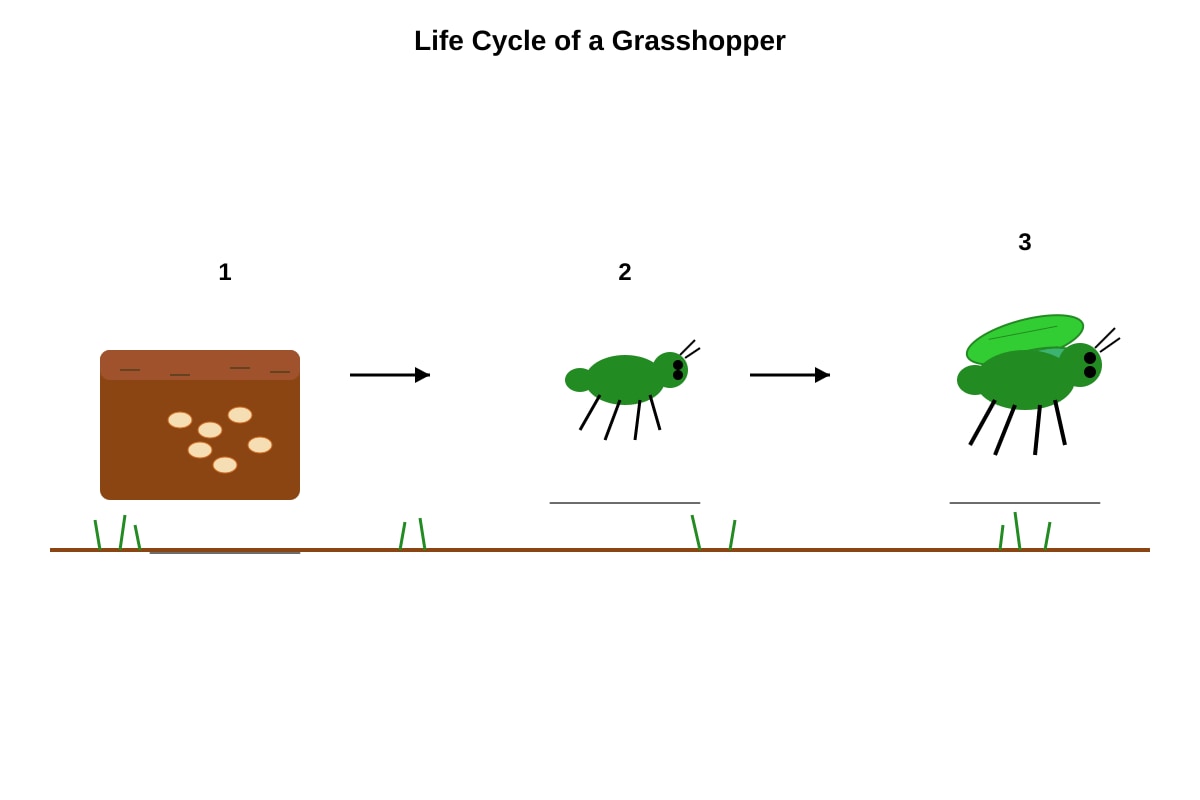
11. The diagram shows the life cycle of a grasshopper.

<image_placeholder> id: Q11-fig1 type: diagram linked_question: Q11 description: Linear life cycle diagram showing three stages with arrows: Stage 1 (small oval eggs in soil), Stage 2 (small wingless grasshopper), Stage 3 (large winged adult grasshopper) labels: 1, 2, 3 with blank lines for stage names values: none must_show: Soil background for eggs; nymph without wings; adult with fully developed wings; clear arrows showing progression </image_placeholder>

(a) Name stage 2. [1]


(b) Name the type of metamorphosis shown. [1]


(c) Give one way the nymph looks different from the adult grasshopper. [1]


(Total: 3 marks)


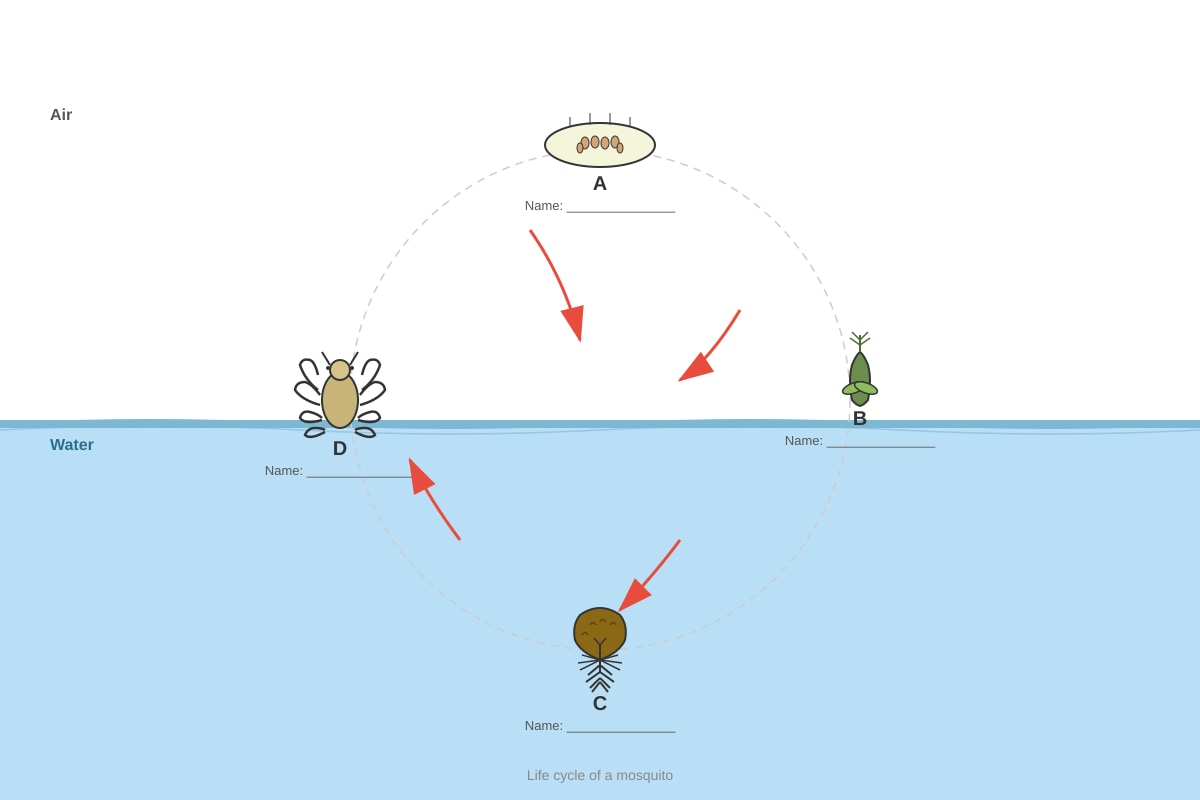
12. The diagram below shows the life cycle of a mosquito.

<image_placeholder> id: Q12-fig1 type: diagram linked_question: Q12 description: Circular life cycle diagram with four stages in water and air: eggs floating on water surface, larva in water, pupa in water, adult flying above water labels: Stages A, B, C, D with blank lines for names values: none must_show: Water surface for eggs; underwater larva with siphon tube; comma-shaped pupa; flying adult with long legs; arrows showing cycle progression </image_placeholder>

(a) Name stages A and D. [2]

A: _________________________________ D: _________________________________

(b) Why do you think mosquitoes lay their eggs on water? [1]


(c) Suggest one way to reduce the number of mosquitoes in your neighbourhood. [1]


(Total: 4 marks)


13. Ameera observed a frog pond and recorded the following information:

  • Day 1: Saw clusters of round jelly-like eggs floating on water
  • Day 10: Small black creatures with tails swimming; they have no legs
  • Day 20: Creatures now have back legs, shorter tails
  • Day 30: Creatures have front legs, very short tails, can hop onto land
  • Day 45: Adult frogs seen near pond

(a) What are the small black creatures called on Day 10? [1]


(b) Describe two changes that happen to the tail as the frog develops. [2]


(c) Why do you think the adult frog needs to live both in water and on land? [1]


(Total: 4 marks)


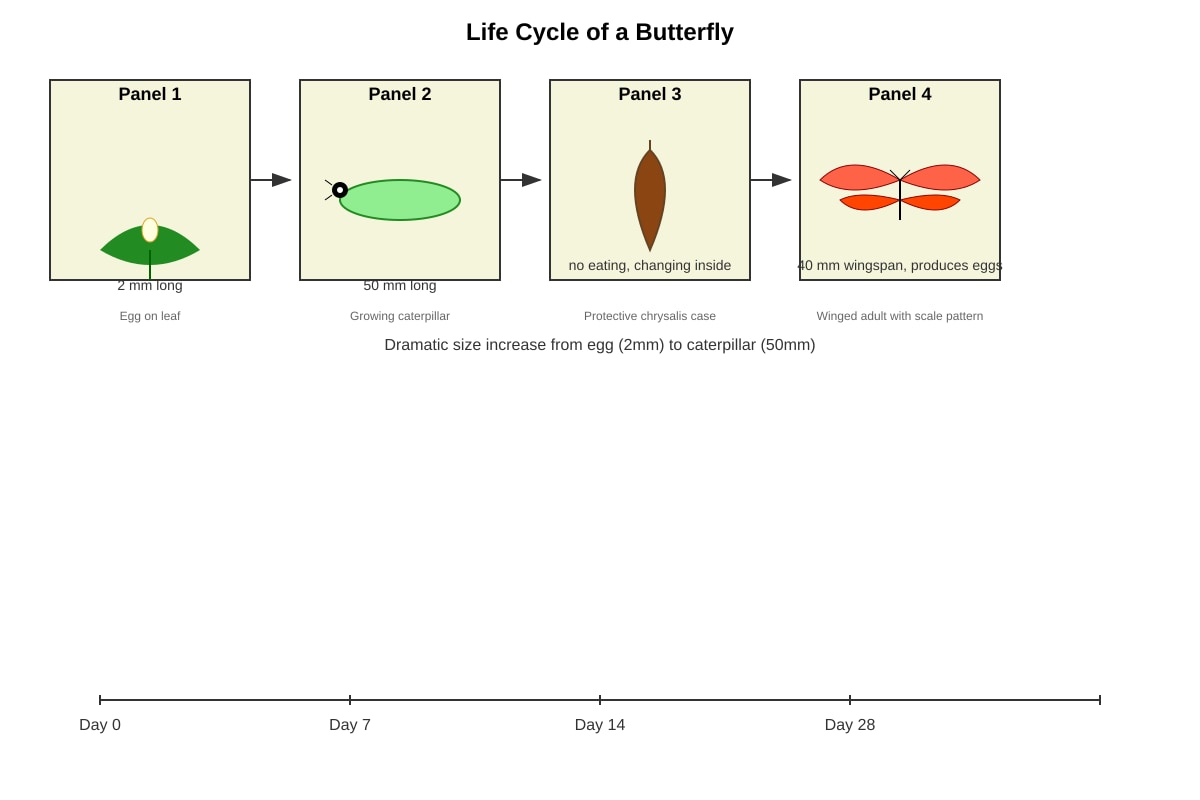
14. The diagram shows how a butterfly egg develops.

<image_placeholder> id: Q14-fig1 type: diagram linked_question: Q14 description: Four-panel development sequence showing transformation from small egg on leaf to large caterpillar to chrysalis to butterfly labels: Panel 1: 2 mm long; Panel 2: 50 mm long; Panel 3: no eating, changing inside; Panel 4: 40 mm wingspan, produces eggs values: Egg length 2mm, caterpillar length 50mm, adult wingspan 40mm; time labels: Day 0, Day 7, Day 14, Day 28 must_show: Dramatic size increase from egg to caterpillar; protective chrysalis case; winged adult with scale pattern; timeline progression with days </image_placeholder>

(a) How many times longer is the caterpillar than the egg? Show your working. [2]

Working: _________________________________________________________________

Answer: _________________ times longer

(b) Mary says the pupa is not alive because it does not move or eat. Is Mary correct? Explain your answer. [2]


(Total: 4 marks)


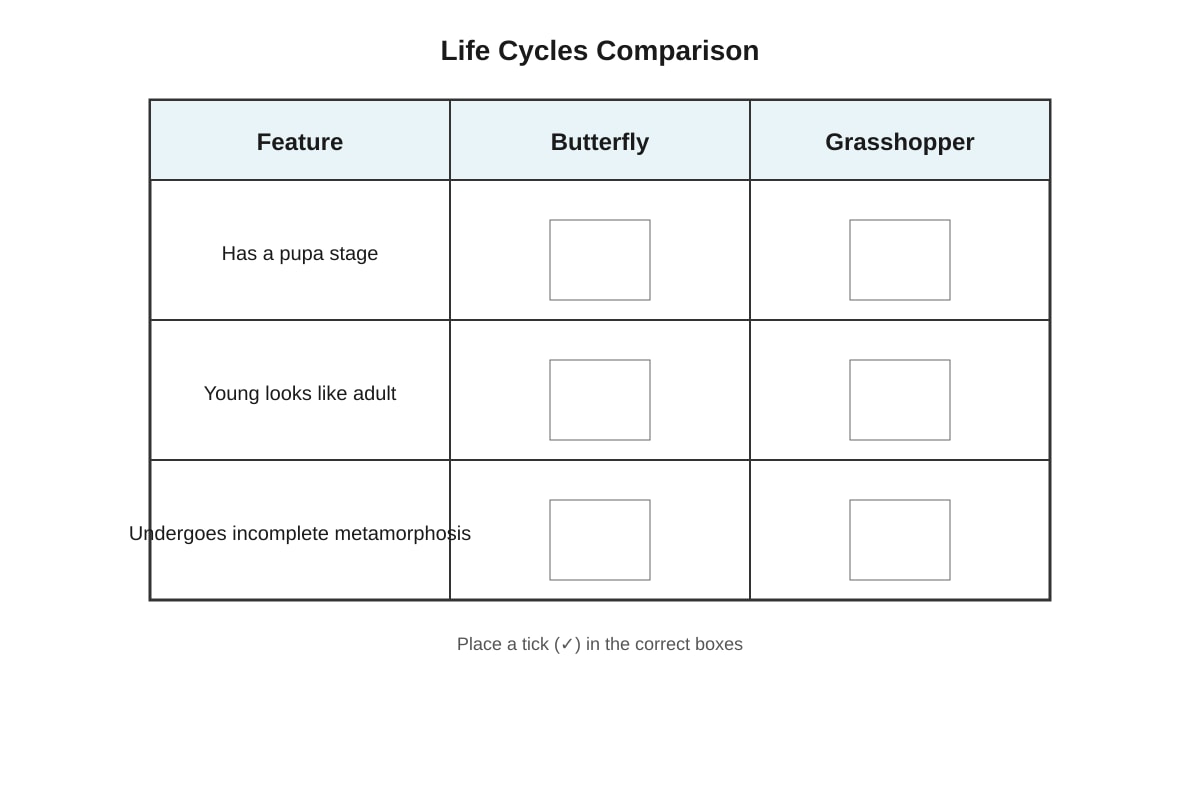
15. Compare the life cycles of a butterfly and a grasshopper using the table below. Place a tick (✓) in the correct boxes.

<image_placeholder> id: Q15-fig1 type: table linked_question: Q15 description: Comparison table with three rows and two columns for butterfly and grasshopper labels: Rows: Has a pupa stage, Young looks like adult, Undergoes incomplete metamorphosis; Columns: Butterfly, Grasshopper values: none must_show: Clear grid with checkboxes/tick spaces; all labels readable; equal column widths </image_placeholder>

FeatureButterflyGrasshopper
Has a pupa stage
Young looks like adult
Undergoes incomplete metamorphosis

(Total: 3 marks)


16. Jia Le found an insect in his garden. He noticed it had six legs, a hard outer covering, and was changing its appearance as it grew larger. The young insect looked very similar to the adult but had no wings.

(a) Is this insect more likely to be a cockroach or a butterfly? Give a reason for your answer. [2]


(b) The insect shed its hard outer covering four times before becoming an adult. What is this process called? [1]


(Total: 3 marks)


Section C: Application and Reasoning (Questions 17–20)

Show your thinking clearly. Marks are shown in brackets.


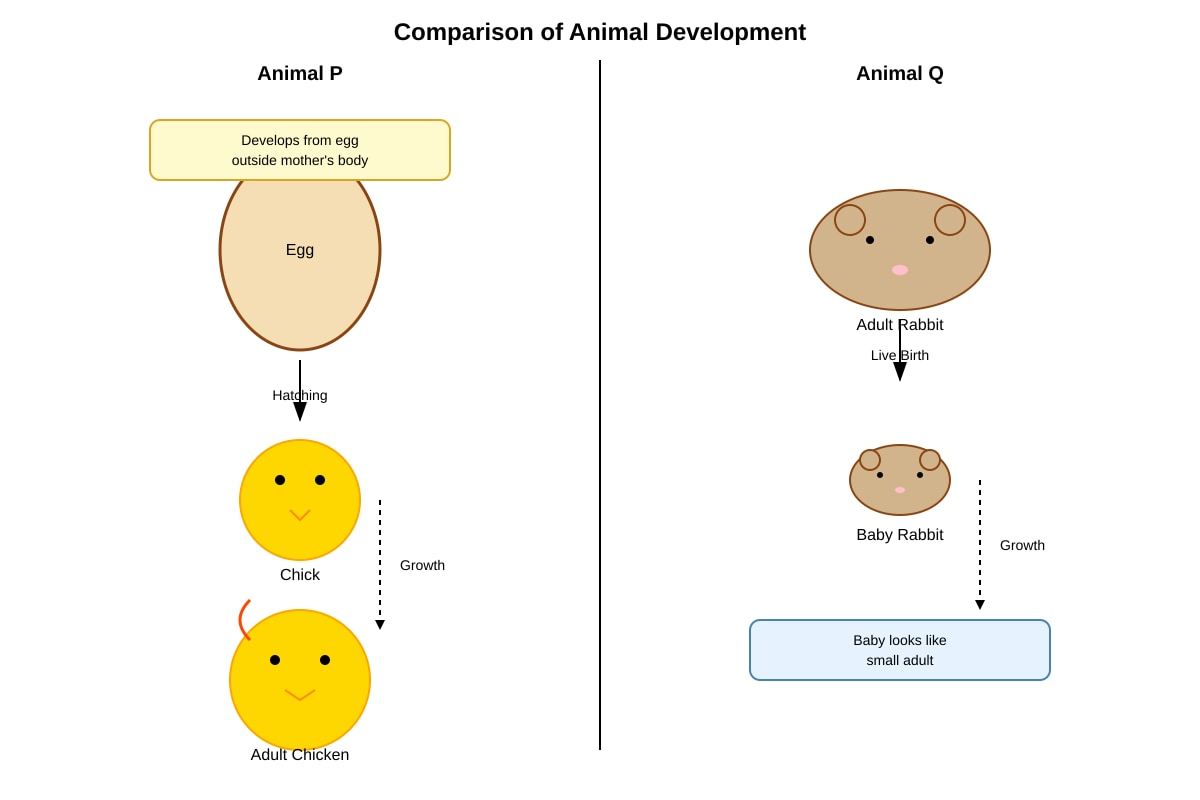
17. The diagram below shows two ways that animals reproduce and develop.

<image_placeholder> id: Q17-fig1 type: diagram linked_question: Q17 description: Two-panel comparison showing Animal P (chicken) with egg hatching into chick, and Animal Q (rabbit) with baby born looking like small adult labels: Animal P with oval egg and fluffy chick; Animal Q with small baby rabbit and adult rabbit; both with growth arrows values: none must_show: Hard eggshell for Animal P; live birth for Animal Q; young animals clearly smaller versions of adults; nurturing or protective context </image_placeholder>

(a) Animal P develops from an egg. Name one other animal that develops from an egg outside the mother's body. [1]


(b) Animal Q's young looks like a small adult. Name one other animal whose young looks like a small adult. [1]


(c) Describe one advantage for Animal P's young developing inside a hard egg. [1]


(Total: 3 marks)


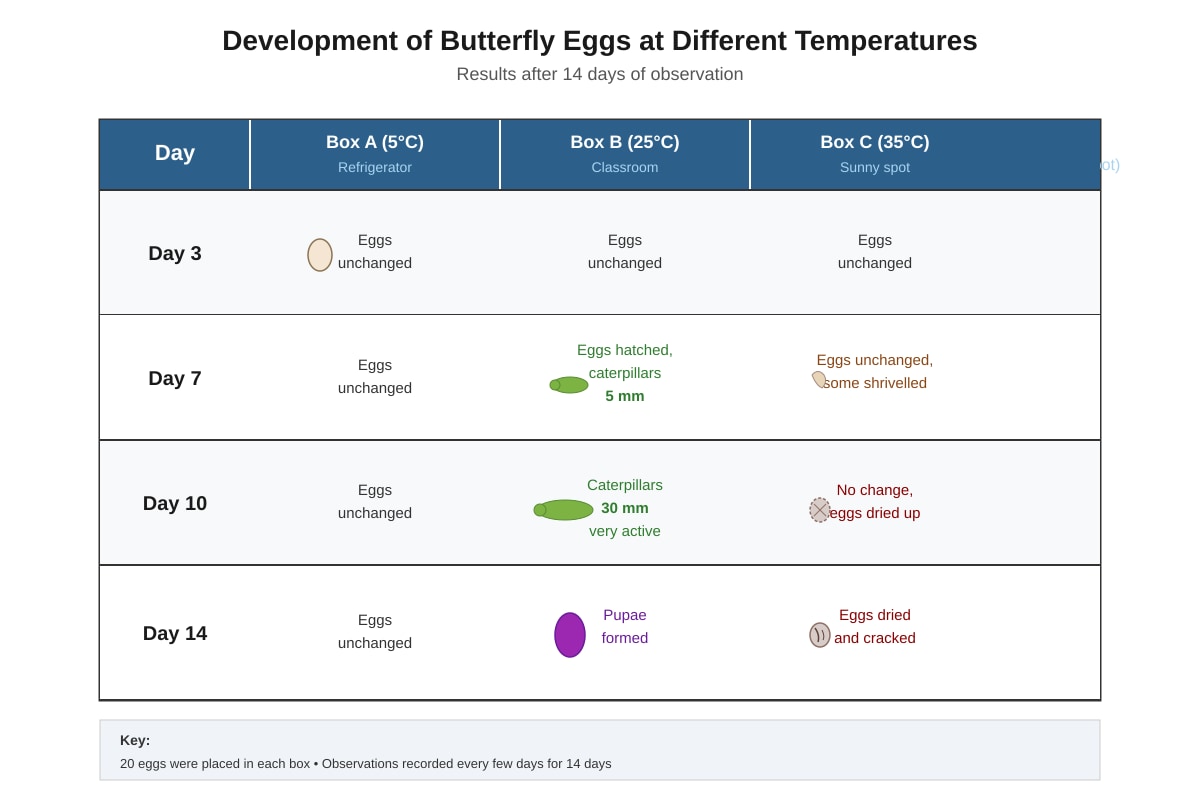
18. A group of students set up an investigation to observe how temperature affects the development of butterfly eggs. They put 20 eggs in three different locations:

  • Box A: In a refrigerator at 5°C
  • Box B: In the classroom at 25°C
  • Box C: In a sunny spot at 35°C

They checked the boxes every day for two weeks.

<image_placeholder> id: Q18-fig1 type: table linked_question: Q18 description: Results table showing development of butterfly eggs over 14 days at three temperatures labels: Rows: Day 3, Day 7, Day 10, Day 14; Columns: Box A (5°C), Box B (25°C), Box C (35°C) values: Day 3 - all boxes "eggs unchanged"; Day 7 - Box A "eggs unchanged", Box B "eggs hatched, caterpillars 5mm", Box C "eggs unchanged, some shrivelled"; Day 10 - Box A "eggs unchanged", Box B "caterpillars 30mm, very active", Box C "no change, eggs dried up"; Day 14 - Box A "eggs unchanged", Box B "pupae formed", Box C "eggs dried and cracked" must_show: Clear three-column comparison; progressive development in Box B; stalled development in A and C; specific measurements for caterpillar growth </image_placeholder>

(a) At which temperature did the eggs develop best? [1]


(b) Explain why the eggs in Box A did not hatch. [1]


(c) Suggest why some eggs in Box C shrivelled and dried up. [1]


(d) Based on this investigation, predict what would happen if butterfly eggs were laid in Singapore during a very hot dry season with temperatures above 38°C. [1]


(Total: 4 marks)


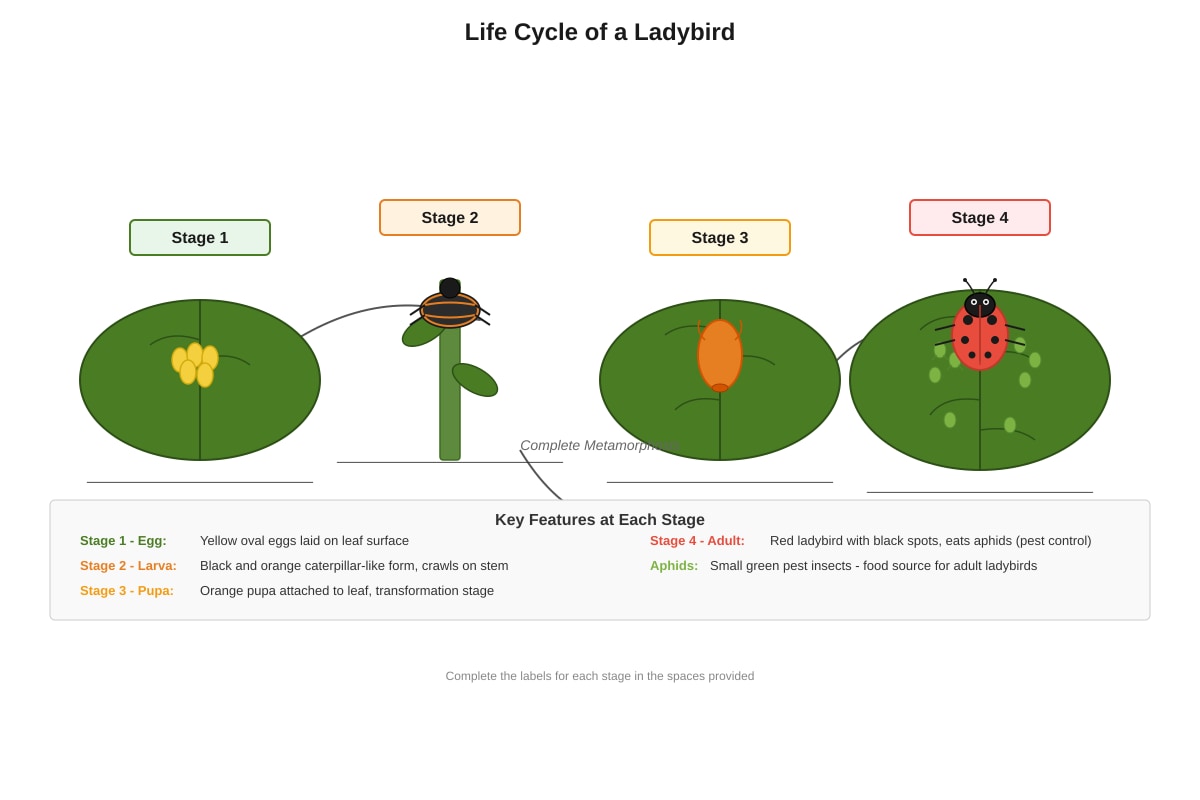
19. Ravi learned that some insects are helpful to farmers because they eat pest insects. He wants to attract ladybirds (which eat aphids) to his school's vegetable garden.

<image_placeholder> id: Q19-fig1 type: diagram linked_question: Q19 description: Life cycle diagram of a ladybird showing four stages: yellow oval eggs on leaf, black and orange larva crawling on stem, orange pupa attached to leaf, red adult ladybird with black spots on leaf with aphids labels: Stages 1, 2, 3, 4 with descriptions to be completed values: none must_show: Aphids on leaf as food source; characteristic ladybird colour patterns at each stage; attachment points for eggs and pupa; predatory adult near aphids </image_placeholder>

(a) The ladybird undergoes complete metamorphosis. Complete the labels for each stage:

Stage 1: _________________________________

Stage 2: _________________________________

Stage 3: _________________________________

Stage 4: _________________________________ [2]

(b) Explain why Ravi should not use chemical sprays to kill aphids if he wants ladybirds in his garden. [2]


(Total: 4 marks)


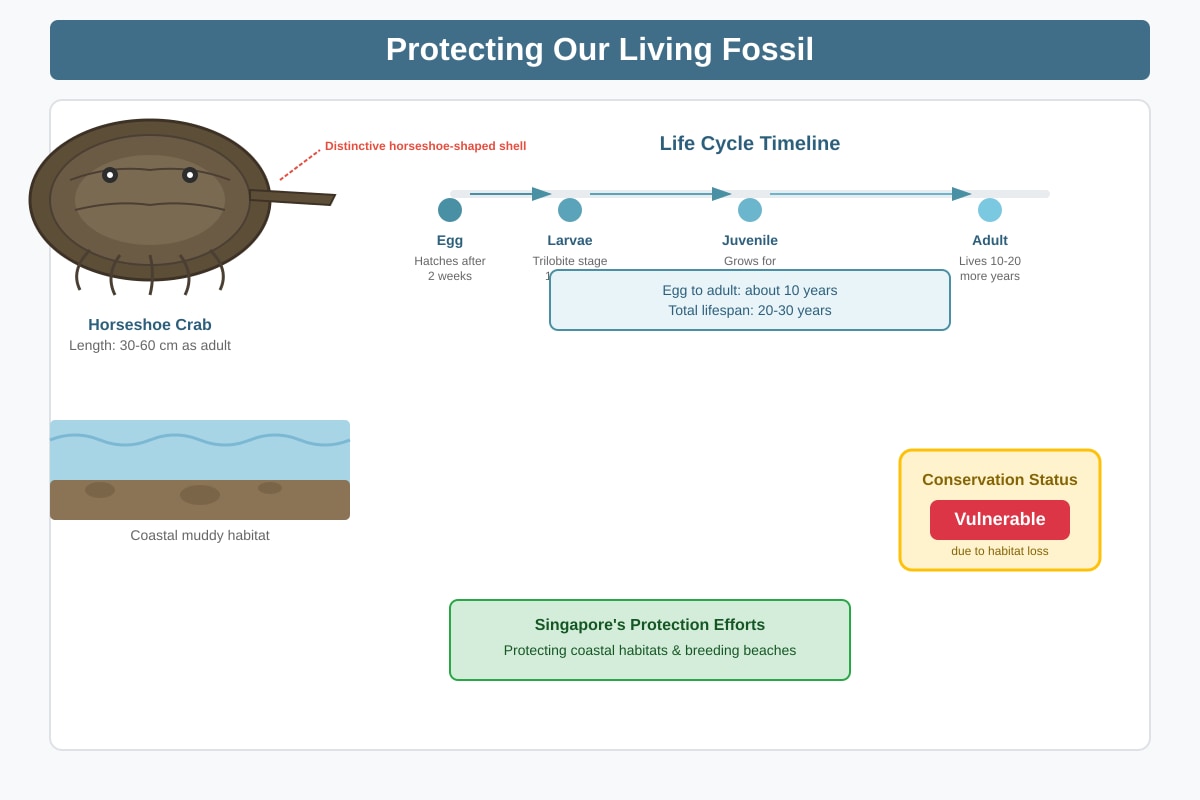
20. The passage below describes how scientists study animal life cycles to help endangered species.

<image_placeholder> id: Q20-fig1 type: source_image linked_question: Q20 description: Information panel showing Singapore's efforts to protect the Horseshoe Crab, an ancient species with a long life cycle labels: Title: "Protecting Our Living Fossil"; photo of horseshoe crab; timeline: eggs hatch after 2 weeks, larvae (trilobite stage) last 1-2 years, juvenile grows for 8-10 years, adult lives 10-20 more years; status: "Vulnerable due to habitat loss" values: Egg to adult: about 10 years; Total lifespan: 20-30 years; Length: 30-60 cm as adult must_show: Distinctive horseshoe-shaped shell; long timeline with specific year values; "Vulnerable" conservation status indicator; coastal muddy habitat illustration </image_placeholder>

The Horseshoe Crab has lived on Earth for over 450 million years. In Singapore, it lives in muddy coastal areas and goes through many moulting stages before becoming an adult. Because it takes about 10 years to mature from egg to adult, the population grows very slowly. If many adult Horseshoe Crabs are caught or if their breeding beaches are destroyed, the species cannot recover quickly.

(a) Why does the slow development from egg to adult make the Horseshoe Crab vulnerable to extinction? [2]


(b) The Horseshoe Crab moults many times. Explain what happens during moulting and why it is necessary for the animal to grow. [2]


(c) Suggest one way that people in Singapore can help protect the Horseshoe Crab's breeding areas. [1]


(Total: 5 marks)


END OF QUIZ


Check your answers carefully before handing in your paper.

Answers

<!-- TuitionGoWhere generation metadata: stage=5-1; model=moonshotai/kimi-k2.6:free; model_label=Kimi K2.6 Free; generated=2026-06-09; Sources: Stage 4-0 LLM templates, syllabus context, and Stage 2 evidence where available. -->

Primary 4 Science Quiz - Life Cycles: Answer Key

Total Marks: 40 marks


Section A: Multiple Choice (2 marks each)

QuestionAnswerExplanation
1C. ButterflyButterflies undergo complete metamorphosis (egg → larva/caterpillar → pupa/chrysalis → adult). Grasshoppers (A) and cockroaches (B) undergo incomplete metamorphosis. Lizards (D) do not undergo metamorphosis; they hatch as miniature adults.
2C. TadpoleFrogs undergo metamorphosis. The young that hatches from the frog's egg is called a tadpole. It lives in water, has gills for breathing underwater, and uses its tail for swimming. Nymphs (A) are young insects with incomplete metamorphosis. Larvae (B) are the young of insects with complete metamorphosis. Pupae (D) are the non-feeding transformation stage.
3B. LarvaMosquito larvae live in water and are commonly called "wrigglers" because of their swimming motion. They have a siphon tube to breathe air at the water surface. Eggs (A) are laid on water but are static. Pupae (C) are called "tumblers." Adults (D) fly.
4C. PupaIncomplete metamorphosis has three stages: egg → nymph → adult. Complete metamorphosis has four stages: egg → larva → pupa → adult. The pupa is the resting and transformation stage that is absent in incomplete metamorphosis.
5B. The leaf is where the young will find food.When butterfly eggs hatch, the caterpillars (larvae) immediately eat the leaf they were laid on. This ensures the young have food available from birth. While leaves may provide some protection (C) or warmth (D), the primary reason is food availability.
6B. Q is the larva; R is the pupaIn a butterfly's complete metamorphosis: P = egg (on leaf), Q = larva/caterpillar (eating leaf), R = pupa/chrysalis (hanging, transforming), S = adult (flying butterfly). The caterpillar is the feeding/growth stage; the chrysalis is the transformation stage.
7B. Incomplete metamorphosisIn incomplete metamorphosis, the nymph resembles a small adult but lacks fully developed wings and reproductive organs. The nymph grows through moulting (shedding its skin) until it reaches adult size. Complete metamorphosis (A) would involve a pupa stage and very different-looking young (like a caterpillar).
8C. The animal does not eat and changes form inside a protective case.The pupa is a non-feeding, transitional stage. Inside the protective case (chrysalis for butterflies, cocoon for moths), massive reorganisation occurs: larval tissues break down and reorganise into adult structures. This is why it does not move or eat—its body is completely restructuring.
9B. Animal X is a butterfly; Animal Y is a grasshopper.Animal X has 4 stages, a pupa stage, and young that doesn't look like the adult → complete metamorphosis (butterfly). Animal Y has 3 stages, no pupa, and young resembling the adult → incomplete metamorphosis (grasshopper). Frogs and mosquitoes both have aquatic young, so C is incorrect.
10B. To store energy for the change into an adultThe caterpillar's main job is eating and growing. It stores energy as fat and nutrients that will sustain it through the non-feeding pupa stage and fuel the dramatic transformation into an adult butterfly. Without this stored energy, the metamorphosis cannot complete successfully.

Section A Total: 20 marks


Section B: Short Answer

Question 11 (3 marks)

(a) Nymph [1 mark]

Key concept: In incomplete metamorphosis, the young stage between egg and adult is called a nymph. It resembles a smaller version of the adult.

(b) Incomplete metamorphosis [1 mark]

Key concept: This life cycle has three stages (egg → nymph → adult) with no pupal stage. The nymph gradually develops into the adult through moulting.

(c) Any one of: [1 mark]

  • The nymph has no wings (or small wing buds) while the adult has fully developed wings
  • The nymph is smaller in size than the adult
  • The nymph is not sexually mature (cannot reproduce) while the adult can
  • The nymph may be different in colour from the adult

Common mistake: Students sometimes say the nymph "looks completely different" from the adult—this is incorrect for incomplete metamorphosis. That description applies to complete metamorphosis (e.g., caterpillar vs. butterfly).


Question 12 (4 marks)

(a) [2 marks]

  • A: Egg [1]
  • D: Adult [1]

Key concept: Mosquito life cycle: Egg → Larva → Pupa → Adult (complete metamorphosis). All except the adult are aquatic stages.

(b) The eggs need water to develop / The larvae that hatch need to live in water [1 mark]

Reasoning: Mosquito eggs are laid on water because all immature stages (larva and pupa) are aquatic. Eggs may even be laid in dry areas that flood later, but typically they require water for the larvae to survive.

(c) Any sensible suggestion:** [1 mark]

  • Remove stagnant water from containers
  • Cover water tanks and containers
  • Clear clogged drains
  • Add larvicidal fish to ornamental ponds
  • Regularly change water in vases

Key concept: Mosquitoes need standing water for their immature stages. Eliminating breeding sites breaks the life cycle.


Question 13 (4 marks)

(a) Tadpole [1 mark]

Key concept: The earliest active stage of a frog after hatching from the egg is the tadpole (also called a polliwog). It is fully aquatic.

(b) Any two: [2 marks]

  • The tail becomes shorter (or shrinks)
  • The tail gradually disappears (is absorbed into the body)
  • The tail is reabsorbed to provide nutrients during metamorphosis

Biological detail: During frog metamorphosis, the tail is not simply lost—it is resorbed (broken down and recycled) by the body to provide energy and nutrients while the froglet cannot eat efficiently during transformation. This is why the tail gets progressively shorter.

(c) The adult frog needs to be in water to reproduce (lay eggs, sperm fertilises eggs externally) and on land to catch insects/food and avoid aquatic predators [1 mark]

Or acceptable alternative: Needs moist skin for breathing through skin; needs water for reproduction but land for food/foraging.


Question 14 (4 marks)

(a) [2 marks]

Working: 50 mm2 mm=25\frac{50 \text{ mm}}{2 \text{ mm}} = 25

Answer: 25 times longer [1 mark for correct working, 1 mark for correct answer]

Verification: The caterpillar grows from 2 mm to 50 mm—this is massive growth necessary to store enough energy for metamorphosis. If a student writes "50 - 2 = 48 times longer," this is incorrect (subtraction rather than division). The correct operation is division of lengths.

(b) No, Mary is not correct [1 mark]

Explanation: The pupa is alive even though it does not move or eat. Inside the pupa case, the body is actively changing and reorganising—breaking down larval tissues and building adult structures (wings, legs, antennae, reproductive organs). This requires energy and is a very active biological process [1 mark]

Teaching note: The pupa may look inactive externally, but internally there is massive cellular activity. The stored energy from the caterpillar's feeding powers this transformation.


Question 15 (3 marks)

FeatureButterflyGrasshopper
Has a pupa stage
Young looks like adult
Undergoes incomplete metamorphosis

Marking: 1 mark per correct row (both ticks/crosses must be correct for that row)

Key concept summary:

  • Butterfly (complete metamorphosis): 4 stages, pupa present, young (caterpillar) looks completely different from adult
  • Grasshopper (incomplete metamorphosis): 3 stages, no pupa, young (nymph) resembles small adult

Question 16 (3 marks)

(a) The insect is more likely to be a cockroach [1 mark]

Reason: The young looks like the adult but without wings—this is characteristic of incomplete metamorphosis, which cockroaches undergo [1 mark]

Butterflies would be incorrect because: Butterfly caterpillars look completely different from adult butterflies (complete metamorphosis).

(b) Moulting [1 mark]

Key concept: Moulting (also called ecdysis) is the process of shedding the hard outer covering (exoskeleton). Insects with exoskeletons must moult because the rigid exoskeleton does not grow with the animal. A new, larger exoskeleton forms underneath, and the insect expands before the new covering hardens.


Section C: Application and Reasoning

Question 17 (3 marks)

(a) Any one: [1 mark]

  • Duck
  • Fish (most species)
  • Tortoise/turtle
  • Crocodile/alligator
  • Snake (most species)
  • Most insects (e.g., ants, bees, butterflies)

Note: Must be an animal that lays eggs outside the mother's body (oviparous). Do not accept "bird" if Animal P is already a chicken/bird unless a specific different bird is named.

(b) Any one: [1 mark]

  • Human
  • Elephant
  • Dog/cat
  • Cow/goat
  • Monkey
  • Rabbit
  • Kangaroo

Note: Must be a mammal or other viviparous animal whose young resembles a small adult (not a larval stage).

(c) Any sensible answer:** [1 mark]

  • The hard shell protects the developing embryo from physical damage
  • The shell prevents drying out (desiccation) in air
  • The shell is semi-permeable, allowing gas exchange while protecting the contents
  • Parent does not need to carry the young, allowing mobility

Question 18 (4 marks)

(a) Box B at 25°C [1 mark]

Reading data: At 25°C, the eggs hatched, caterpillars grew actively, and pupae formed—showing complete, healthy development.

(b) The temperature was too low (5°C) for the eggs to develop [1 mark]

Biological explanation: Metabolic processes and enzyme activity needed for embryonic development are slowed or stopped at cold temperatures. The eggs are dormant but may remain viable if warmed.

(c) The temperature was too high (35°C) / The heat caused water to evaporate from the eggs, drying them out [1 mark]

Explanation: At high temperatures, eggs lose moisture. Unlike reptile eggs with leathery shells, insect eggs have protective coatings but can still desiccate. The proteins and enzymes also begin to denature (break down) at excessive heat.

(d) The eggs would likely not develop successfully / would dry out and die / have very low hatching success [1 mark]

Prediction based on pattern: Box C at 35°C showed drying/shrivelling. At 38°C+, this effect would be worse. The temperature exceeds the optimal range for butterfly egg development.


Question 19 (4 marks)

(a) [2 marks — 0.5 each]

StageCorrect Answer
Stage 1Egg
Stage 2Larva
Stage 3Pupa
Stage 4Adult

(b) [2 marks]

  • Chemical sprays would kill the ladybirds as well as the aphids [1]
  • Without ladybirds, the aphid population would grow again when the spray effect wears off / ladybirds are natural predators that provide long-term control [1]

Alternative valid answers:

  • Ladybirds are sensitive to pesticides
  • Chemicals might accumulate in the food chain
  • Natural biological control is more sustainable than repeated spraying

Key concept: This demonstrates biological pest control using natural predators rather than chemicals.


Question 20 (5 marks)

(a) [2 marks]

  • It takes about 10 years for a Horseshoe Crab to become adult and able to reproduce [1]
  • If many adults die, there are too few mature crabs to produce enough eggs to replace the population [1]
  • The species cannot recover quickly from population losses due to this slow replacement rate [1]

Any two points for full marks.

(b) [2 marks]

  • Moulting is when the animal sheds its hard outer shell (exoskeleton) [1]
  • The exoskeleton is rigid and cannot stretch or grow; moulting allows the animal to grow larger by forming a new, bigger shell [1]

Connect to concept: This is the same reason insects moult—arthropods with exoskeletons must periodically shed their restricted covering to increase in size.

(c) Any sensible suggestion:** [1 mark]

  • Protect coastal mudflats from development
  • Avoid polluting coastal waters where they live
  • Educate the public not to collect or disturb them
  • Create marine protected areas or nature reserves
  • Reduce coastal reclamation that destroys breeding beaches

Singapore context: Horseshoe Crabs are found at places like Kusu Island and the Mandai mudflats. Conservation efforts include habitat protection and public education.


Marking Summary

SectionMarks
A (Q1–10)20
B (Q11–16)17
C (Q17–20)13
Total40

Common errors to watch for in marking:

  • Confusing "nymph" with "larva" — nymphs resemble adults; larvae look completely different
  • Forgetting that the pupa is alive and active internally
  • Thinking all insects have the same type of metamorphosis
  • Misunderstanding that moulting occurs in incomplete metamorphosis, not just complete metamorphosis
  • Confusing the reasons for egg-laying locations (food vs. protection)