AI Generated Quiz
Primary 4 Science Life Cycles Quiz
Free P4 Science Life Cycles quiz, GLM5.3 AI version, with questions, answers, and syllabus-aligned practice for Singapore students.
These static practice materials are generated from the site's syllabus and paper-generation workflow, with source and model context shown so students and parents can evaluate the material before use.
Questions
Free quiz and exam paper access
Enter your details to view this paper
Your access is remembered on this device.
Answers
Primary 4 Science Quiz - Life Cycles: Answer Key
Total Marks: 40
Teaching notes are written for students new to the topic.
Answer 1.
(1) egg → larva → pupa → adult. [1]
Teaching note: The butterfly has a complete life cycle: egg → larva (caterpillar) → pupa (chrysalis) → adult. The larva hatches first and eats leaves; then it becomes a resting pupa before emerging as an adult. Common mistake: swapping the larva and pupa — remember the caterpillar must eat and grow before it can form a pupa.
Answer 2.
(a) Nymph. [1] (b) Any one: it is smaller; it has no wings; it will still moult as it grows. [1]
Teaching note: A nymph is the young of an insect with an incomplete life cycle. It already resembles the adult, so the only differences are size and missing features such as wings, which develop after several moults.
Answer 3.
(3) grasshopper. [1]
Teaching note: The grasshopper nymph looks like a small, wingless adult. The young of the butterfly, mosquito and housefly (larvae) look completely different from their adults.
Answer 4.
(a) Tadpole. [1] (b) Any one: it grows legs; its tail disappears (shortens); it develops lungs to breathe air; it moves from living in water to living mainly on land
<stage5_quiz_answers_md>
Primary 4 Science Quiz - Life Cycles: Answer Key
Total Marks: 40
Teaching notes are written for students new to the topic.
Answer 1.
(1) egg → larva → pupa → adult. [1]
Teaching note: The butterfly has a complete life cycle: egg → larva (caterpillar) → pupa (chrysalis) → adult. Common mistake: swapping the larva and pupa — remember the caterpillar must eat and grow before forming a pupa.
Answer 2.
(a) Nymph. [1] (b) Any one: it is smaller; it has no wings; it will still moult as it grows. [1]
Teaching note: A nymph is the young of an insect with an incomplete life cycle. It already resembles the adult, so differences are mainly size and missing wings.
Answer 3.
(3) grasshopper. [1]
Teaching note: The grasshopper nymph looks like a small, wingless adult. The young of the butterfly, mosquito and housefly look completely different from their adults.
Answer 4.
(a) Tadpole. [1] (b) Any one: it grows legs; its tail disappears (shortens); it develops lungs to breathe air; it changes from living fully in water to living mainly on land. [1]
Teaching note: This big change in form is called metamorphosis. The frog's life cycle is egg → tadpole → froglet → adult frog.
Answer 5.
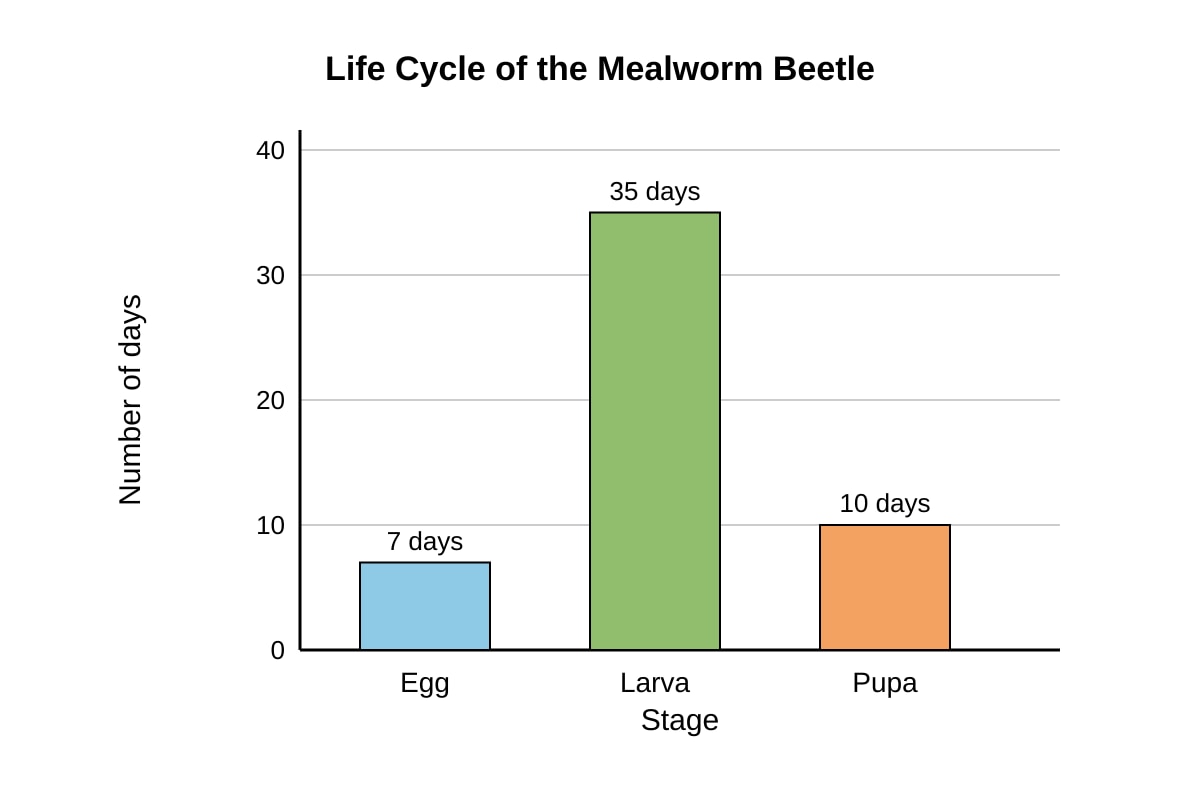
Working: 7 + 35 + 10 = 52 52 days. [2] (1 mark for correct working/addition, 1 mark for answer with unit.)
Teaching note: Add the lengths of all stages before the adult appears. There is no bar for the adult because its length is not counted.
Answer 6.
The larva (caterpillar) stage harms the crop. [1] The caterpillar hatches on the plant and has chewing mouthparts to eat leaves so it can grow quickly before becoming a pupa. Adult butterflies sip nectar from flowers instead. [1]
Answer 7.
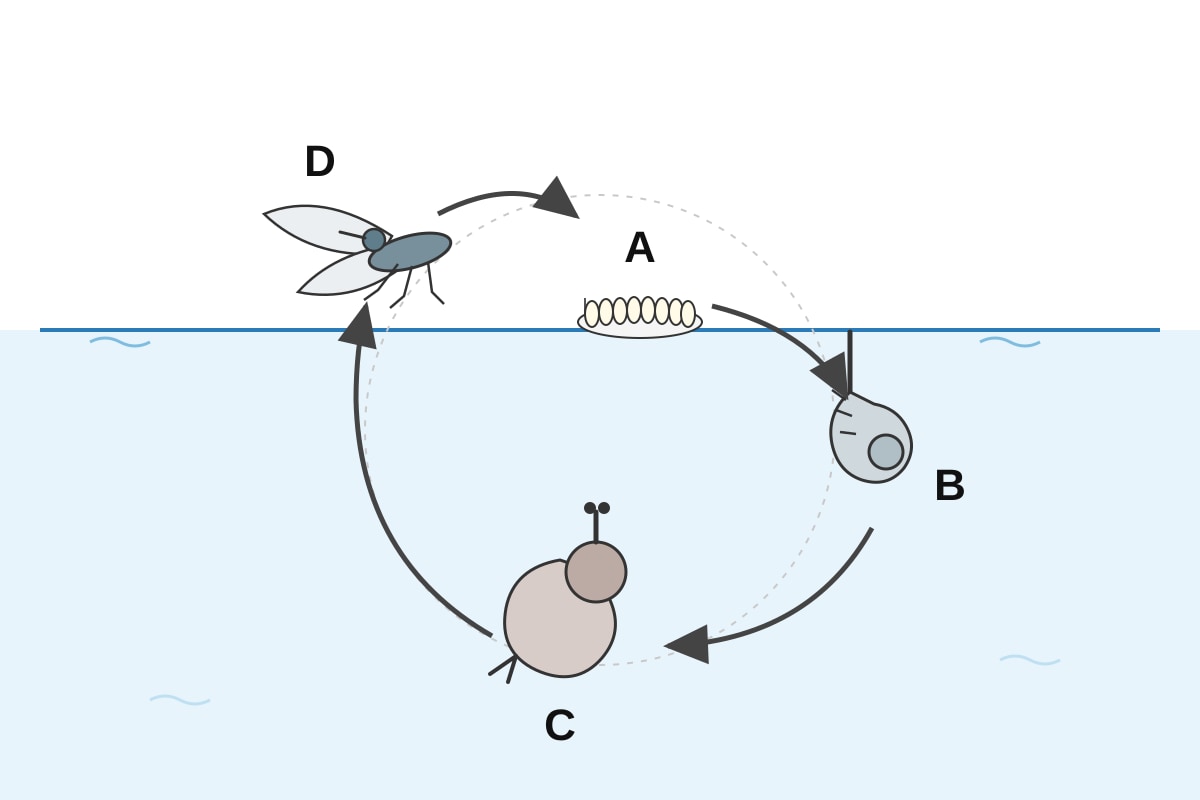
Egg, larva (wriggler) and pupa (tumbler). [2 — 1 mark for any two, 2 marks for all three]
Teaching note: Only the adult mosquito flies in the air; the other three stages develop in still water.
Answer 8.
Incomplete life cycle. [1] Reason: the young (nymph) looks similar to the adult and there is no pupa stage — the cycle goes egg → nymph → adult. [1]
Answer 9.
Any one: both begin as eggs laid by the adult; both young grow and moult several times; both end with an adult that can reproduce; both repeat the same cycle generation after generation. [2]
Answer 10.
(a) Its hard outer covering cannot stretch or grow, so it must be shed for the body inside to become bigger. [1] (b) Each time it moults, the nymph becomes larger, and its wings slowly develop until it becomes an adult. [1]
Answer 11.
B: Larva (wriggler) C: Pupa (tumbler) [2]
Teaching note: Stages A, B and C hang just below the water surface; only D (adult) flies above the water line shown in the diagram.
Answer 12.
Any one difference: the butterfly has a pupa stage but the grasshopper does not; the butterfly's young (caterpillar) looks completely different from the adult while the grasshopper's nymph looks like a small adult; the caterpillar eats leaves constantly while the nymph resembles the adult's feeding habits. [2]
Answer 13.
Working: 10 + 25 + 14 = 49 49 days. [2] (1 mark for working, 1 mark for answer with unit.)
Answer 14.
| Animal | Type of life cycle |
|---|---|
| Housefly | Complete |
| Cricket | Incomplete |
| Moth | Complete |
| Cockroach | Incomplete |
[2 — ½ mark each, accept all four correct for full marks]
Teaching note: Flies and moths pass through a pupa; crickets and cockroaches hatch as nymphs resembling adults.
Answer 15.
The tadpole lives fully in water and breathes through gills, while the adult frog breathes through lungs (and its moist skin) and can live mainly on land. [2]
Answer 16.
They are tadpoles (young frogs). [1] Their rounded bodies and long tails suit swimming, and they live in water; as they grow they will develop legs, lose their tails and become adult frogs. [1]
Answer 17.
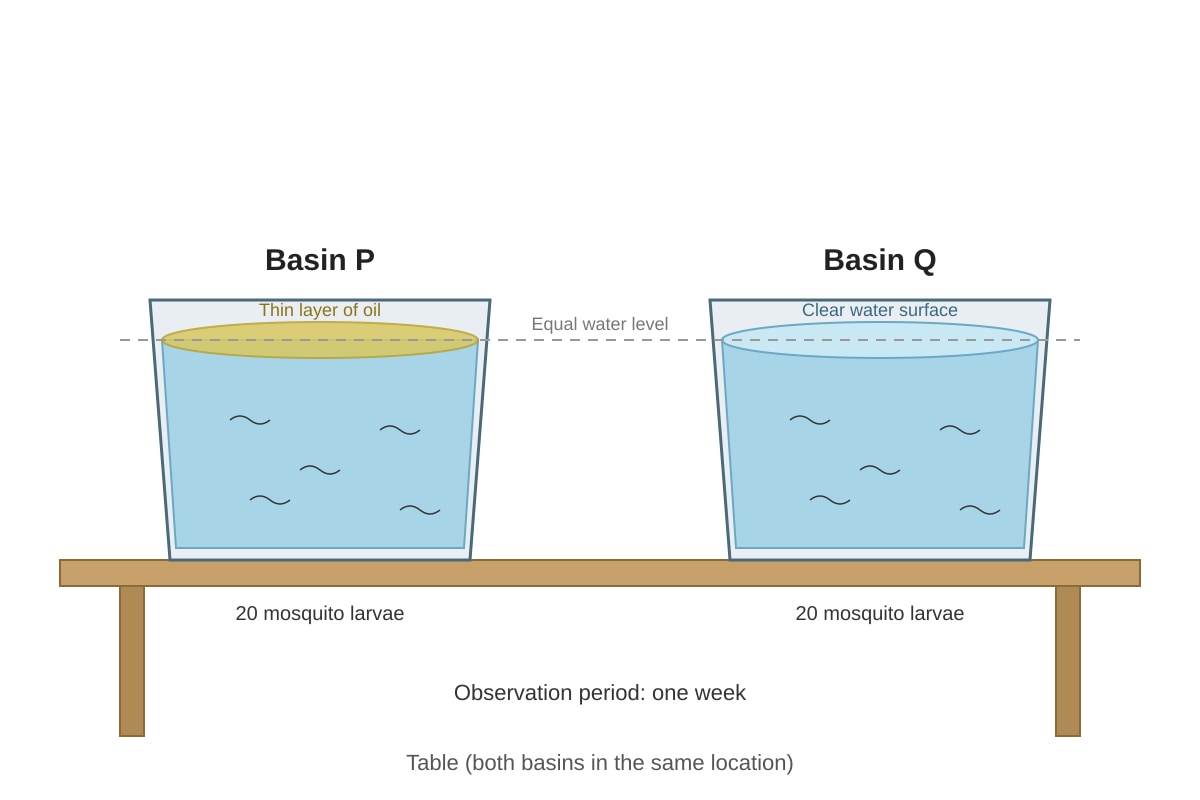
Basin P: the larvae will die. [1] The layer of oil blocks the larvae's breathing tubes from touching the air above the water, so they cannot breathe. [1] Basin Q: the larvae will survive and continue developing into pupae and adults because the water surface is open to the air. [1]
Answer 18.
(a) The larva (caterpillar) stage. [1] (b) Adult butterflies feed on nectar from flowers using a long proboscis; they do not chew leaves. [1] (c) Any one: cover the plants with fine netting; remove eggs/caterpillars by hand; use a suitable insecticide; encourage natural predators such as birds. [1]
Answer 19.
Any one difference: the frog's young (tadpole) lives in water and looks completely different from the adult, while the grasshopper's nymph lives on land and looks like a small adult; the frog passes through more obvious body changes than the grasshopper. [2]
Answer 20.
The mosquito's eggs, larvae and pupae must live in still water to develop. [1] Knowing this, we can stop breeding by removing stagnant water (emptying trays, clearing blocked drains) or covering/treating water surfaces with oil so the aquatic stages cannot breathe and grow into adults. [1]
END OF ANSWER KEY