AI Generated Quiz

Primary 4 Science Heat Quiz

Free AI-Generated Qwen3.7 Plus Primary 4 Science Heat quiz with questions and answers for Singapore students. This page is rendered as a direct URL so the questions and answers can be discovered without pressing in-page buttons.

These static practice materials are generated from the site's syllabus and paper-generation workflow, with source and model context shown so students and parents can evaluate the material before use.

Primary 4 Science AI Generated Generated by Qwen3.7 Plus Updated 2026-06-04

Questions

<!-- TuitionGoWhere generation metadata: stage=5-1; model=qwen/qwen3.7-plus; model_label=Qwen3.7 Plus; generated=2026-06-04; Sources: Stage 4-0 LLM templates, syllabus context, and Stage 2 evidence where available. -->

Primary 4 Science Quiz - Heat

Name: __________________________
Class: __________________________
Date: __________________________
Score: ________ / 30

Duration: 45 minutes
Total Marks: 30

Instructions:

  1. Answer all questions.
  2. Write your answers in the spaces provided.
  3. For multiple-choice questions, write the number (1, 2, 3, or 4) in the brackets provided.

Section A: Multiple-Choice Questions (10 marks)

For each question, four options are given. Choose the correct answer and write its number in the brackets provided. Each question carries 1 mark.

  1. Which of the following is a correct statement about heat? (1) Heat flows from a colder object to a hotter object. (2) Heat flows from a hotter object to a colder object. (3) Heat stays in the hotter object and does not move. (4) Heat flows from a larger object to a smaller object.

    Answer: ( ______ )

  2. John touched a metal spoon and a wooden spoon that had been left in a room at 25C25^\circ\text{C}. The metal spoon felt colder than the wooden spoon. Why? (1) The metal spoon is at a lower temperature than the wooden spoon. (2) The wooden spoon is a better conductor of heat than the metal spoon. (3) The metal spoon conducts heat away from John’s hand faster than the wooden spoon. (4) The wooden spoon absorbs heat from John’s hand faster than the metal spoon.

    Answer: ( ______ )

  3. Which of the following materials is the best insulator of heat? (1) Copper (2) Styrofoam (3) Steel (4) Glass

    Answer: ( ______ )

  4. Why are cooking pots usually made of metal, but their handles are made of plastic or wood? (1) Metal is a good insulator, and plastic is a good conductor. (2) Metal is a good conductor, and plastic is a good insulator. (3) Both metal and plastic are good conductors. (4) Both metal and plastic are good insulators.

    Answer: ( ______ )

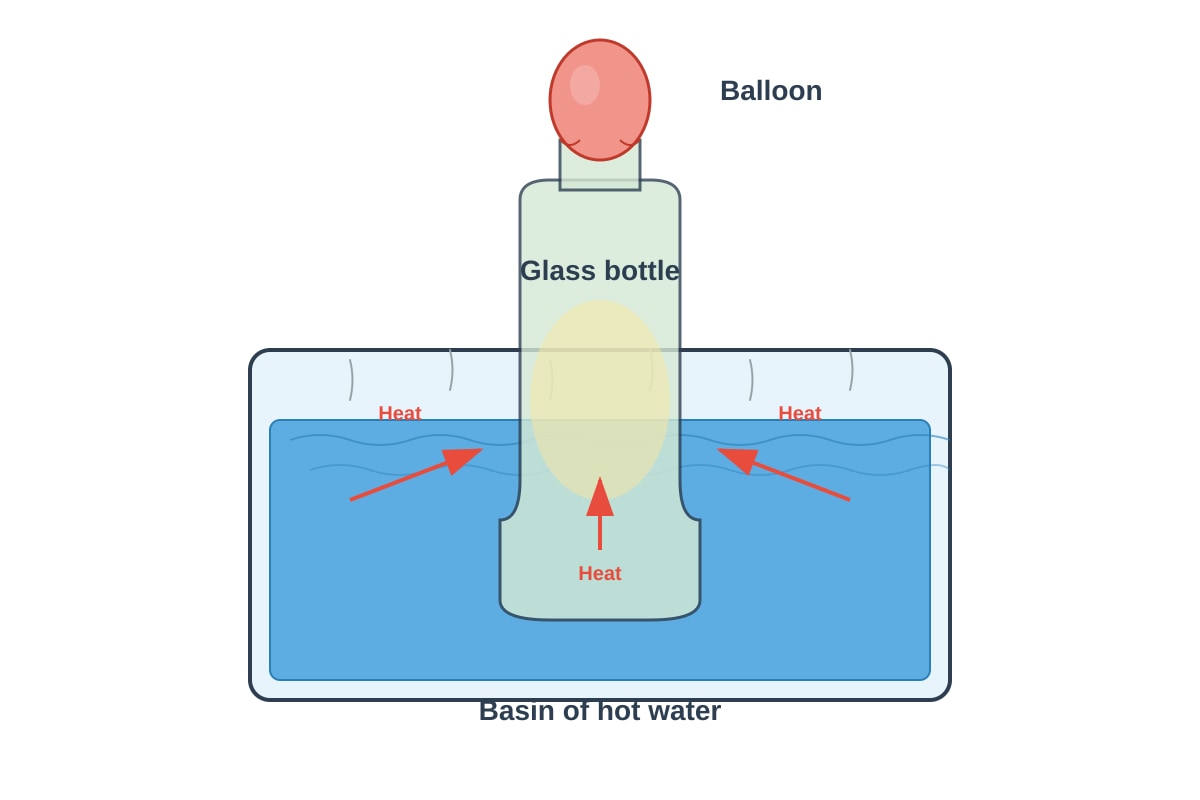
  5. Look at the diagram below showing a balloon placed over the mouth of a glass bottle. The bottle is placed in a basin of hot water.

    <image_placeholder> id: Q5-fig1 type: diagram linked_question: Q5 description: A glass bottle with a deflated balloon stretched over its mouth. The bottle is sitting inside a larger basin filled with hot water. Arrows indicate heat moving from the water to the bottle. labels: Basin of hot water, Glass bottle, Balloon values: None must_show: The balloon inflating slightly due to the air inside the bottle expanding. </image_placeholder>

    What happens to the air inside the bottle and why? (1) The air contracts, causing the balloon to shrink. (2) The air expands, causing the balloon to inflate. (3) The air gains heat and turns into liquid. (4) The air loses heat and becomes solid.

    Answer: ( ______ )

  6. Which of the following applications uses the principle of expansion of solids? (1) Using a thermometer to measure temperature. (2) Gaps left between railway tracks. (3) Using a woolen sweater to keep warm. (4) Double-glazed windows in houses.

    Answer: ( ______ )

  7. Sarah wants to keep her cold drink cold for as long as possible. Which container should she use? (1) A thin glass cup (2) A stainless steel mug (3) A vacuum flask (4) A paper cup

    Answer: ( ______ )

  8. Two identical metal rods, Rod A and Rod B, are heated. Rod A is heated for 2 minutes, and Rod B is heated for 5 minutes. Which statement is true? (1) Rod A will be longer than Rod B. (2) Rod B will be longer than Rod A. (3) Both rods will expand by the same amount. (4) Rod A will contract, while Rod B will expand.

    Answer: ( ______ )

  9. Why do electrical wires sag more on hot days than on cold days? (1) The wires contract in the heat. (2) The wires expand in the heat. (3) The poles move apart in the heat. (4) The wind blows harder on hot days.

    Answer: ( ______ )

  10. Which of the following is NOT a good conductor of heat? (1) Iron nail (2) Aluminum foil (3) Rubber band (4) Silver spoon

    Answer: ( ______ )


Section B: Structured Questions (20 marks)

Answer all questions in the spaces provided. The number of marks is indicated in brackets [ ] at the end of each question or part-question.

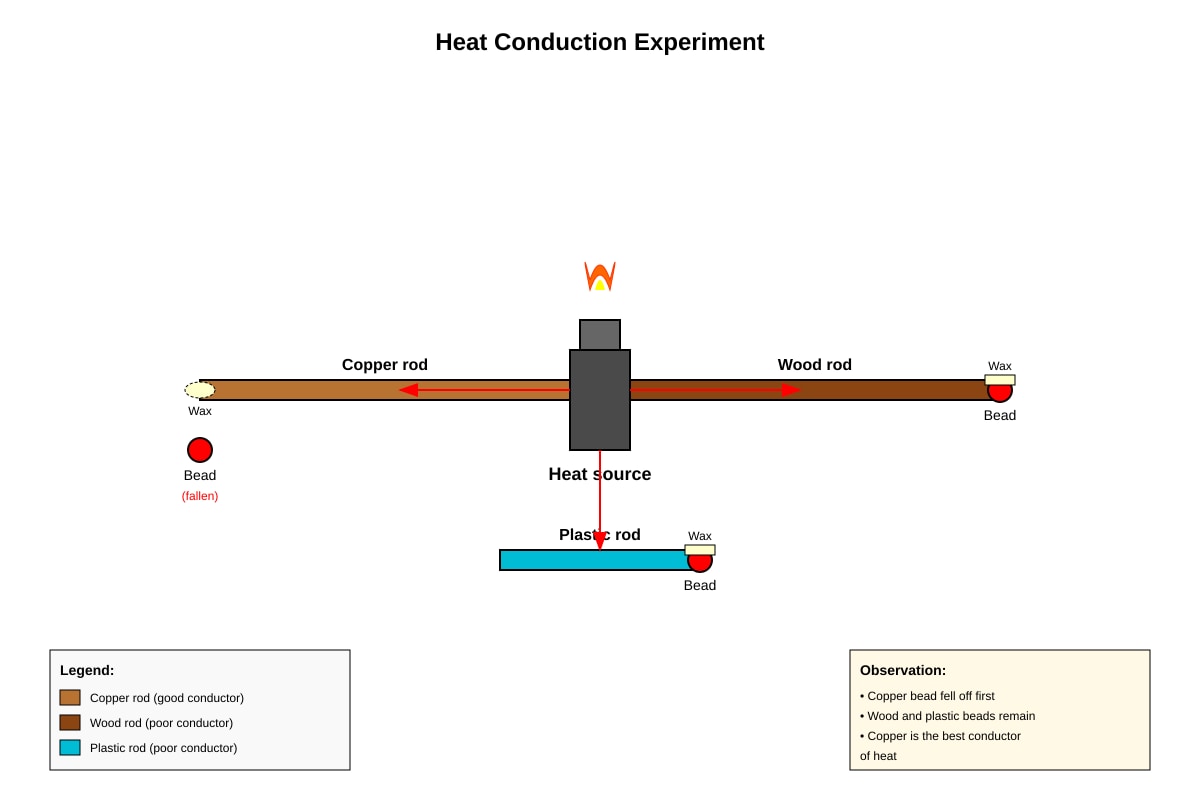
  1. Study the setup below. Three rods made of different materials (Copper, Wood, and Plastic) of the same length and thickness are joined together at a central point. A small bead is attached to the end of each rod using wax. The central point is heated with a Bunsen burner.

    <image_placeholder> id: Q11-fig1 type: experimental_setup linked_question: Q11 description: A central heating source with three rods radiating outwards. One rod is labeled 'Copper', one 'Wood', and one 'Plastic'. At the far end of each rod, a small bead is attached with wax. labels: Heat source, Copper rod, Wood rod, Plastic rod, Wax, Bead values: None must_show: The bead on the copper rod falling off first. </image_placeholder>

    (a) Predict the order in which the beads will drop off. Start with the first bead to drop. [2]


    (b) Explain your answer in (a). [2]


  2. Mr. Tan installed a tight metal lid on a glass jar. He could not open it. He ran hot water over the metal lid for a minute, and then he was able to open it easily.

    (a) What happened to the metal lid when hot water was poured over it? [1]


    (b) Explain why this made it easier to open the jar. [2]


  3. The table below shows the time taken for ice cubes to melt completely when placed in containers made of different materials. All ice cubes were of the same size and started at the same temperature. The room temperature was 30C30^\circ\text{C}.

    Material of ContainerTime taken for ice to melt completely
    P10 minutes
    Q25 minutes
    R40 minutes

    (a) Which material is the best conductor of heat? [1]


    (b) Explain your answer. [2]


  4. Look at the diagram of a railway track below.

    <image_placeholder> id: Q14-fig1 type: diagram linked_question: Q14 description: A section of railway track showing two metal rails joined together. There is a small visible gap between the ends of the two rails. labels: Metal rail, Gap values: None must_show: The gap between the rails clearly visible. </image_placeholder>

    (a) What is the purpose of the gap between the rails? [1]


    (b) What might happen if the gap was not present on a very hot day? [2]


  5. Jane has two cups of hot tea at 80C80^\circ\text{C}. She pours one cup into a ceramic mug and the other into a thin plastic cup. She leaves them on the table for 10 minutes.

    (a) After 10 minutes, which cup of tea will be cooler? [1]


    (b) Give a reason for your answer. [2]


  6. Explain why people wear woolen sweaters in cold weather. Is the sweater generating heat? [2]


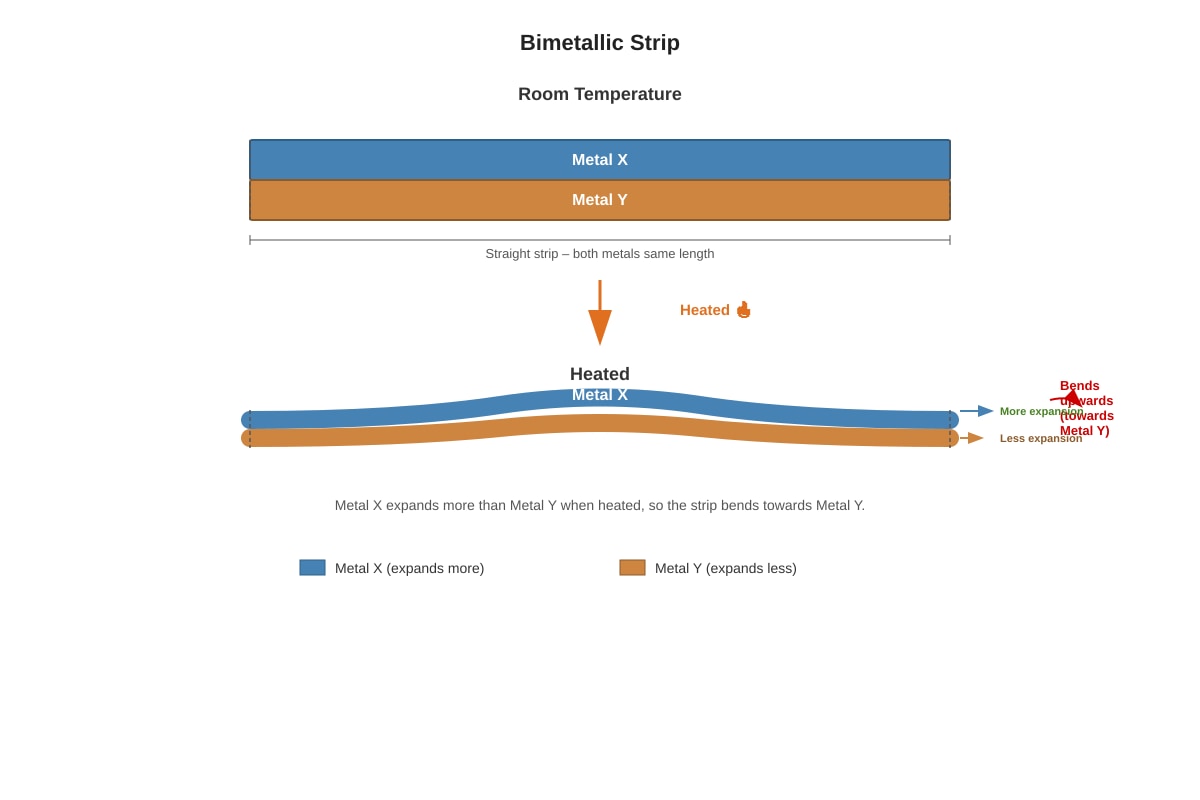
  7. A bimetallic strip is made of two different metals, Metal X and Metal Y, joined together. When heated, Metal X expands more than Metal Y.

    <image_placeholder> id: Q17-fig1 type: diagram linked_question: Q17 description: A straight bimetallic strip at room temperature. Below it, the same strip bent upwards after being heated. The top layer is labeled 'Metal X' and the bottom layer 'Metal Y'. labels: Metal X, Metal Y, Room Temperature, Heated values: None must_show: The strip bending towards Metal Y (the side that expanded less). </image_placeholder>

    (a) In which direction will the strip bend when heated? (Towards Metal X or Towards Metal Y?) [1]


    (b) Explain why it bends in that direction. [2]


  8. Tom wants to test if air is a good or poor conductor of heat. He sets up an experiment with two thermometers. One thermometer bulb is surrounded by still air (inside a large empty box), and the other is surrounded by cotton wool. He heats the outside of both setups equally.

    (a) Why did he use cotton wool in the second setup? [1]


    (b) If air is a poor conductor of heat, what would you expect to see in the thermometer surrounded by still air compared to the one in cotton wool? [2]


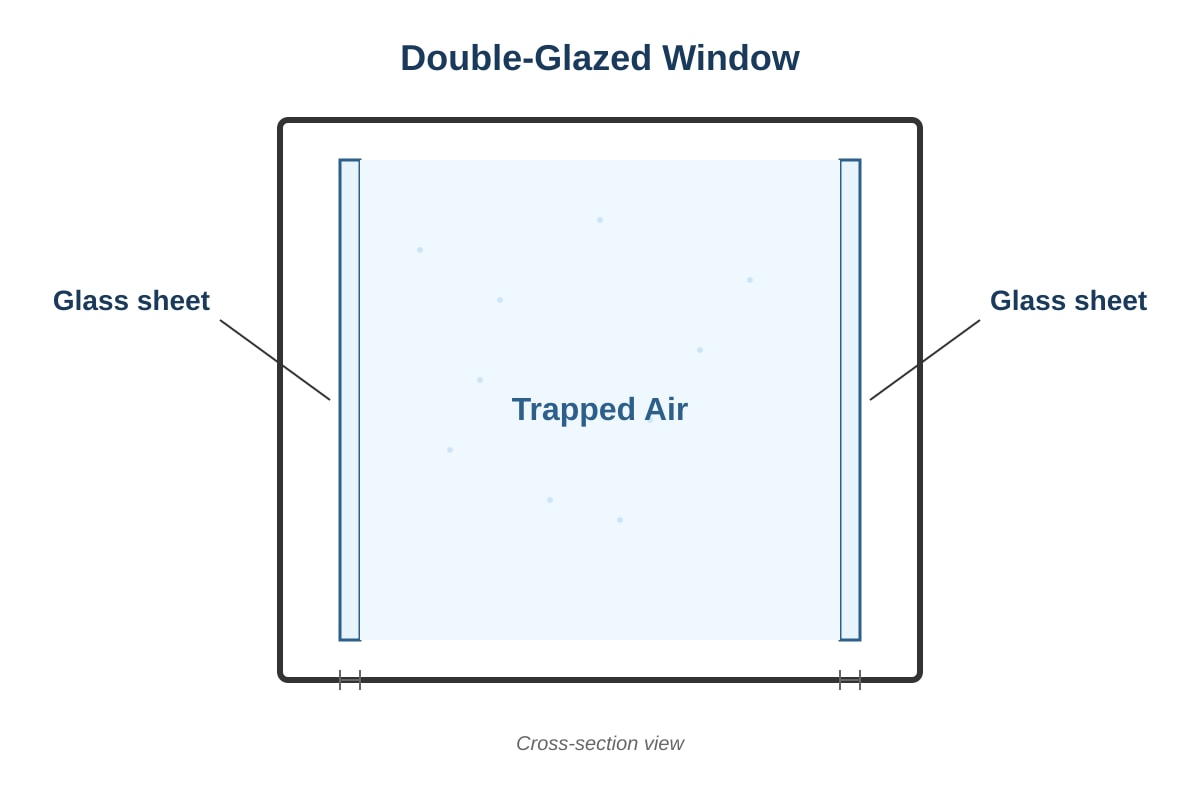
  9. Look at the picture of a double-glazed window below. It consists of two sheets of glass with a layer of air trapped in between.

    <image_placeholder> id: Q19-fig1 type: diagram linked_question: Q19 description: A cross-section of a window. Two parallel vertical lines represent glass sheets. The space between them is labeled 'Trapped Air'. labels: Glass sheet, Trapped Air values: None must_show: The air gap between the two glass panes. </image_placeholder>

    (a) Why is the layer of trapped air useful? [1]


    (b) How does this help keep a room cool in Singapore? [2]


  10. State whether the following statements are True or False. [2]

    (a) Heat can flow from a cold object to a hot object without any external help.

    Answer: ______________

    (b) All metals are good conductors of heat.

    Answer: ______________

Answers

<!-- TuitionGoWhere generation metadata: stage=5-1; model=qwen/qwen3.7-plus; model_label=Qwen3.7 Plus; generated=2026-06-04; Sources: Stage 4-0 LLM templates, syllabus context, and Stage 2 evidence where available. -->

Primary 4 Science Quiz - Heat (Answer Key)

Total Marks: 30

Section A: Multiple-Choice Questions

  1. (2) Heat always flows from a region of higher temperature (hotter) to a region of lower temperature (colder) until thermal equilibrium is reached.
  2. (3) Metal is a good conductor of heat. When John touches it, heat flows rapidly from his warmer hand to the cooler metal. Wood is a poor conductor (insulator), so heat flows slowly, making it feel warmer relative to the metal.
  3. (2) Styrofoam contains many air pockets. Air is a poor conductor of heat, making Styrofoam an excellent insulator. Copper, steel, and glass are better conductors than Styrofoam.
  4. (2) The pot body needs to conduct heat from the stove to the food quickly (conductor). The handle needs to prevent heat from reaching the hand (insulator) to avoid burns.
  5. (2) The air inside the bottle gains heat from the hot water. When air gains heat, it expands (takes up more space), pushing into the balloon and inflating it.
  6. (2) Railway tracks are made of metal, which expands when heated. Gaps are left to allow space for this expansion so the tracks do not bend or buckle.
  7. (3) A vacuum flask is designed with double walls and a vacuum (no air) between them. Since heat cannot travel well through a vacuum, it keeps cold things cold and hot things hot for a long time.
  8. (2) The more heat an object gains, the more it expands (assuming it stays in the same state). Since Rod B was heated for longer, it gained more heat and expanded more than Rod A.
  9. (2) Metal wires expand when they gain heat on hot days. This expansion causes them to become longer and sag between the poles.
  10. (3) Rubber is a non-metal and a poor conductor of heat (insulator). Iron, aluminum, and silver are metals and good conductors.

Section B: Structured Questions

  1. (a) Copper, then Plastic, then Wood. (Or Copper first, Wood/Plastic last depending on specific plastic type, but generally Copper is best conductor, Wood/Plastic are insulators. Note: In P4, usually Metal > Non-metal. Between Wood and Plastic, both are poor, but Copper is definitely first.) Correction for standard P4 expectation: Copper is a metal (good conductor). Wood and Plastic are non-metals (poor conductors). The bead on Copper drops first. The beads on Wood and Plastic may not drop or drop very late. Acceptable Answer: Copper first. (1 mark for correct order of Copper being first).

    (b) Copper is a good conductor of heat, so heat travels quickly from the source to the wax, melting it. Wood and Plastic are poor conductors (insulators), so heat travels slowly to the wax. (2 marks: 1 for identifying copper as good conductor, 1 for identifying others as poor conductors/insulators).

  2. (a) The metal lid expanded. (1 mark)

    (b) The metal lid expanded more than the glass jar because metal is a better conductor of heat and/or expands more than glass for the same temperature change. This made the lid looser and easier to twist off. (2 marks: 1 for expansion of lid, 1 for comparison with glass or loosening effect).

  3. (a) Material P. (1 mark)

    (b) The ice in Container P melted the fastest (10 mins). This means heat from the surroundings flowed through Material P into the ice fastest. Therefore, Material P is the best conductor of heat. (2 marks: 1 for linking fast melting to fast heat flow, 1 for concluding it is the best conductor).

  4. (a) To allow for the expansion of the metal rails on hot days. (1 mark)

    (b) If there were no gaps, the rails would expand and have nowhere to go. They would bend, buckle, or warp, which could cause a train accident. (2 marks: 1 for mentioning bending/buckling, 1 for linking to expansion/lack of space).

  5. (a) The tea in the thin plastic cup. (1 mark)

    (b) Thin plastic is a poorer insulator than thick ceramic (or ceramic is a better insulator/thicker). Correction: Actually, thin plastic conducts heat faster than thick ceramic which has more mass and insulating properties. Or, simply: Plastic is a thinner barrier, so heat escapes faster. Refined Answer: The thin plastic cup provides less insulation. Heat flows from the hot tea to the cooler surroundings faster through the thin plastic than through the thicker ceramic mug. (2 marks: 1 for identifying faster heat loss, 1 for reason related to material/thickness).

  6. No, the sweater is not generating heat. Woolen sweaters are poor conductors (insulators) of heat. They trap air (which is also a poor conductor) close to the body. This slows down the loss of body heat to the cold surroundings, keeping the person warm. (2 marks: 1 for stating it does not generate heat/is an insulator, 1 for explaining it reduces heat loss).

  7. (a) Towards Metal Y. (1 mark)

    (b) Metal X expands more than Metal Y when heated. Since they are joined together, the side that expands more (X) becomes longer, forcing the strip to bend towards the side that expanded less (Y). (2 marks: 1 for X expanding more, 1 for bending towards the shorter/less expanded side).

  8. (a) Cotton wool is a known good insulator (poor conductor). It is used as a control or comparison to show what happens when heat transfer is minimized. (1 mark)

    (b) If air is a poor conductor, the temperature in the "still air" setup should rise slowly, similar to the cotton wool setup. If air were a good conductor, the temperature would rise quickly. Note: This question tests the concept that still air is an insulator. Expected Answer: The thermometer in the still air will show a slower rise in temperature (or similar to cotton wool) compared to if it were in contact with a good conductor. This shows air does not conduct heat well. (2 marks: 1 for observation of slow temp rise, 1 for linking to poor conductivity).

  9. (a) Air is a poor conductor (insulator) of heat. (1 mark)

    (b) The trapped air layer prevents heat from the hot outside from flowing into the cool room. It reduces the rate of heat transfer, keeping the room cooler for longer. (2 marks: 1 for identifying air as insulator, 1 for explaining it blocks outside heat).

  10. (a) False (Heat flows from hot to cold naturally). (b) True (Metals are generally good conductors). (2 marks: 1 for each correct True/False).