AI Generated Quiz
Primary 4 Science Heat Quiz
Free AI-Generated NVIDIA Nemotron 3 Ultra 550B A55B Free Primary 4 Science Heat quiz with questions and answers for Singapore students. This page is rendered as a direct URL so the questions and answers can be discovered without pressing in-page buttons.
These static practice materials are generated from the site's syllabus and paper-generation workflow, with source and model context shown so students and parents can evaluate the material before use.
Questions
Primary 4 Science Quiz - Heat
Name: ___________________________
Class: Primary 4 _______
Date: _______________
Score: ______ / 40
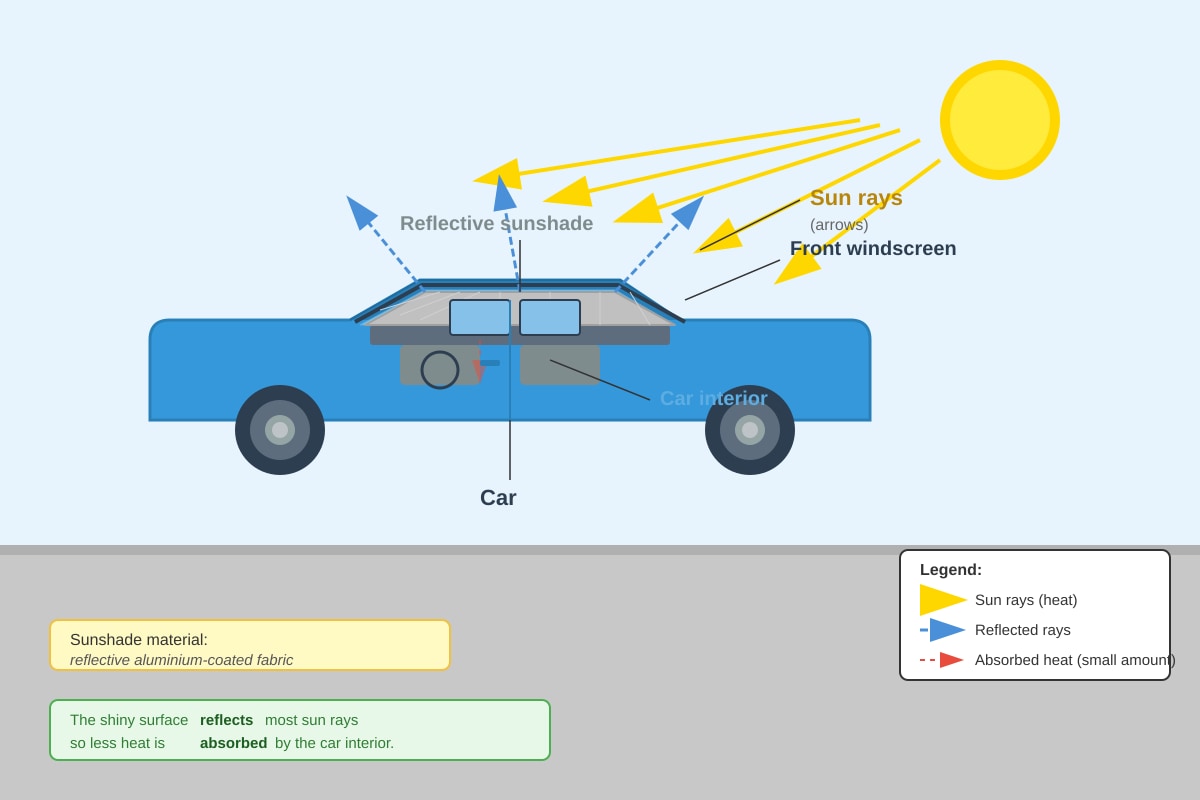
Duration: 45 minutes
Total Marks: 40
Instructions:
- Answer all questions.
- Write your answers in the spaces provided.
- For multiple-choice questions, write the letter (A, B, C, or D) in the bracket provided.
- For open-ended questions, write your answers clearly in complete sentences.
- Check your work before handing in.
Section A: Multiple-Choice Questions (10 × 1 mark = 10 marks)
1. Which of the following is a source of heat?
A. Ice cube
B. Burning candle
C. Mirror
D. Wooden spoon
[ ]
2. Heat travels from a ________ object to a ________ object.
A. hotter, colder
B. colder, hotter
C. larger, smaller
D. smaller, larger
[ ]
3. Which material is the best conductor of heat?
A. Plastic
B. Wood
C. Metal
D. Rubber
[ ]
4. A metal spoon feels colder than a wooden spoon at room temperature because metal ________.
A. is a poorer conductor of heat
B. conducts heat away from your hand faster
C. has a lower temperature
D. absorbs less heat
[ ]
5. When a metal ball is heated, it expands. This means ________.
A. its mass increases
B. its volume increases
C. its weight decreases
D. its density increases
[ ]
6. Which of the following shows heat transfer by conduction?
A. Feeling warmth from a campfire
B. A metal rod heating up when one end is placed in a flame
C. Hot air rising above a radiator
D. The Sun warming the Earth
[ ]
7. Styrofoam is used to make coolers because it is a good ________.
A. conductor of heat
B. insulator of heat
C. absorber of heat
D. radiator of heat
[ ]
8. An ice cube melts when placed on a metal tray at room temperature. The main method of heat transfer is ________.
A. conduction
B. convection
C. radiation
D. evaporation
[ ]
9. Which statement about heat and temperature is correct?
A. Heat and temperature are the same thing.
B. Temperature measures how hot or cold something is.
C. Heat is measured in degrees Celsius.
D. A larger object always has more heat than a smaller object.
[ ]
10. In Singapore's hot weather, which roof colour would keep a house coolest?
A. Black
B. Dark blue
C. White
D. Red
[ ]
Section B: Short-Answer Questions (5 × 2 marks = 10 marks)
11. Complete the table below by writing "Conductor" or "Insulator" for each material.
| Material | Conductor or Insulator? |
|---|---|
| Copper wire | ___________________ |
| Rubber glove | ___________________ |
| Aluminium foil | ___________________ |
| Plastic ruler | ___________________ |
| Iron nail | ___________________ |
12. The diagram below shows a beaker of water being heated from below.
<image_placeholder> id: Q12-fig1 type: diagram linked_question: Q12 description: A beaker of water on a tripod stand with a Bunsen burner underneath. Arrows showing convection currents: water rising near the centre, moving across the top, sinking at the sides, and moving along the bottom back to the centre. labels: Bunsen burner, beaker, water, convection current arrows (up, across, down) values: None must_show: Clear convection current cycle with directional arrows </image_placeholder>
(a) Name the process by which heat travels through the water.
_________________________________________________________________________ [1]
(b) Explain why the water near the top of the beaker becomes hot first.
_________________________________________________________________________ [1]
13. Peter placed two identical cups of hot tea on a table. He wrapped Cup A with a thick towel and left Cup B unwrapped. After 10 minutes, he measured the temperature of the tea in both cups.
(a) Which cup of tea would be hotter?
_________________________________________________________________________ [1]
(b) Explain your answer in (a).
_________________________________________________________________________ [1]
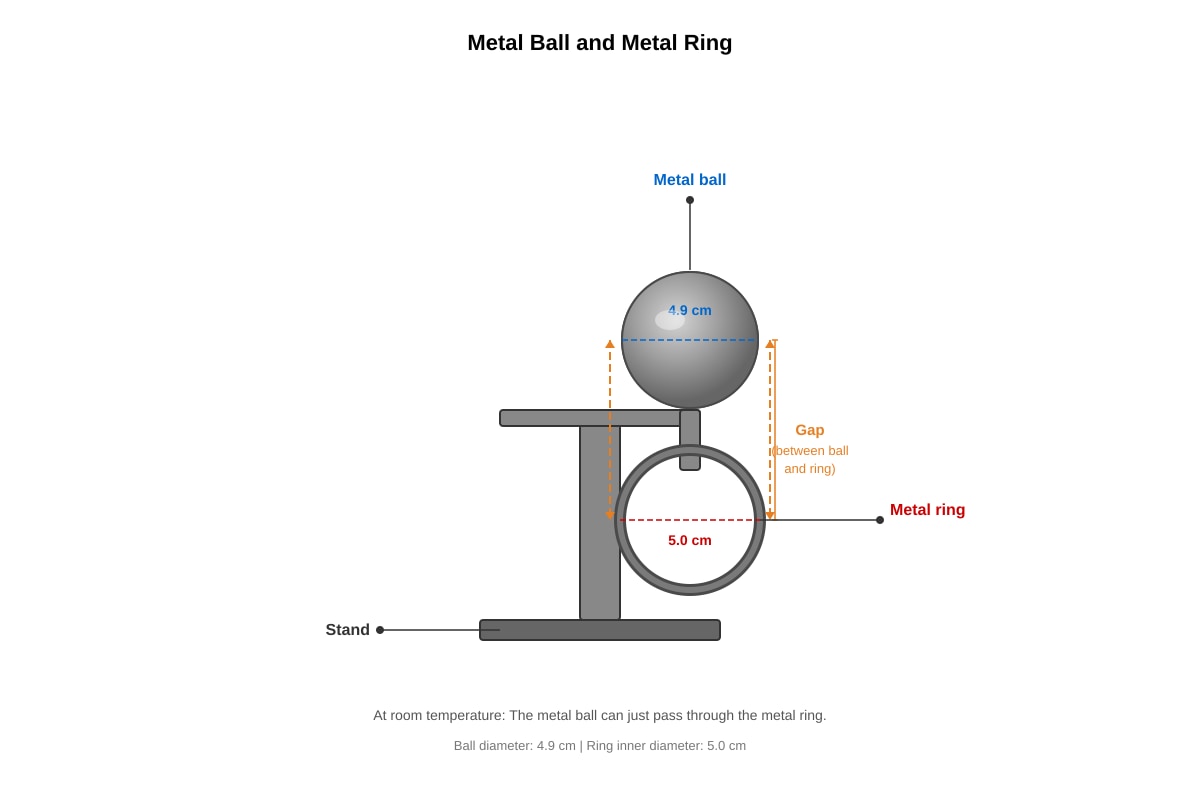
14. The diagram below shows a metal ball and a metal ring. At room temperature, the ball passes through the ring easily.
<image_placeholder> id: Q14-fig1 type: diagram linked_question: Q14 description: Two diagrams side by side. Left: Metal ball sitting on top of a metal ring, ball diameter slightly smaller than ring inner diameter. Right: Same ball and ring, but ball is heated (flame shown under ball) and now too large to pass through the ring. labels: Metal ball, metal ring, Bunsen burner/flame (right diagram), gap between ball and ring (left diagram) values: None must_show: Clear size difference before and after heating </image_placeholder>
(a) What happens to the metal ball when it is heated?
_________________________________________________________________________ [1]
(b) Why can the heated ball no longer pass through the ring?
_________________________________________________________________________ [1]
15. Sarah wants to keep her ice cream cold for as long as possible during a picnic. She has three containers made of different materials: metal, plastic, and styrofoam.
(a) Which container should she choose?
_________________________________________________________________________ [1]
(b) Give a reason for your choice.
_________________________________________________________________________ [1]
Section C: Structured / Open-Ended Questions (4 × 5 marks = 20 marks)
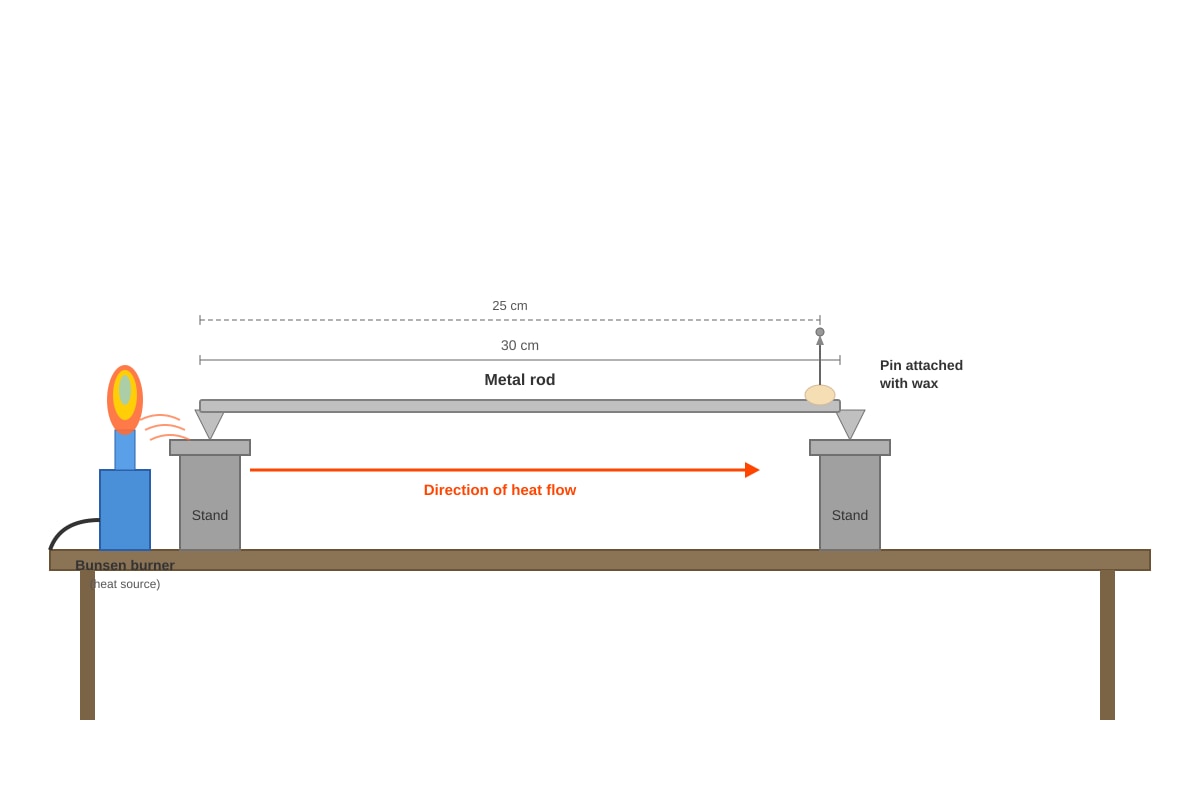
16. The diagram below shows an experiment to compare how well different materials conduct heat. Four rods made of copper, aluminium, iron, and glass are coated with wax. A thumbtack is stuck to the wax at the same distance from the heated end. The rods are heated at one end as shown.
<image_placeholder> id: Q16-fig1 type: experimental_setup linked_question: Q16 description: Four rods (copper, aluminium, iron, glass) fixed horizontally on a stand, each with a thumbtack attached by wax at 5 cm from the left end. A Bunsen burner heats the left ends of all four rods simultaneously. Stopwatch shown. labels: Copper rod, aluminium rod, iron rod, glass rod, thumbtacks, wax, Bunsen burner, stopwatch, 5 cm mark values: Distance from heated end to thumbtack: 5 cm for all rods must_show: Four rods side by side, identical setup, simultaneous heating </image_placeholder>
(a) What is the aim of this experiment?
_________________________________________________________________________ [1]
(b) Which variable is changed (independent variable) in this experiment?
_________________________________________________________________________ [1]
(c) Which variable is measured (dependent variable) in this experiment?
_________________________________________________________________________ [1]
(d) State two variables that must be kept the same (controlled variables) for a fair test.
_________________________________________________________________________ [2]
17. In Singapore, many HDB flats have metal gates and concrete walls. On a hot afternoon, the metal gate feels much hotter to touch than the concrete wall, even though both have been in the Sun for the same amount of time.
(a) Explain why the metal gate feels hotter than the concrete wall.
_________________________________________________________________________ [2]
(b) At night, the metal gate cools down faster than the concrete wall. Explain why.
_________________________________________________________________________ [2]
(c) Suggest one way to make the metal gate less hot to touch during the day.
_________________________________________________________________________ [1]
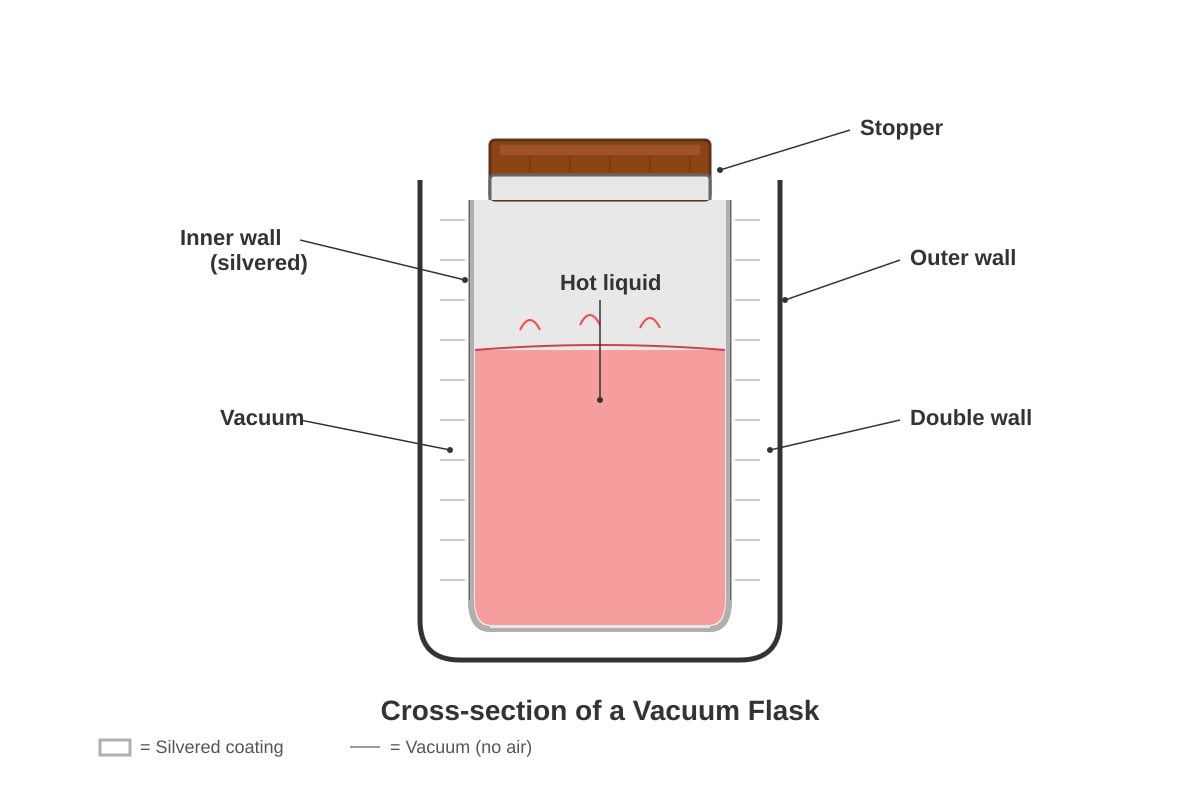
18. The diagram below shows a vacuum flask (thermos) that keeps drinks hot or cold for a long time.
<image_placeholder> id: Q18-fig1 type: diagram linked_question: Q18 description: Cross-section of a vacuum flask. Double-walled glass/plastic with vacuum between walls. Silvered inner surfaces. Plastic stopper at top. Outer casing. labels: Inner wall, outer wall, vacuum space, silvered surfaces, plastic stopper, outer casing values: None must_show: Double wall with vacuum, silvered inner surfaces, stopper </image_placeholder>
(a) Explain how the vacuum between the two walls reduces heat transfer.
_________________________________________________________________________ [2]
(b) Explain how the silvered inner surfaces help keep the drink hot.
_________________________________________________________________________ [2]
(c) Why is the stopper made of plastic instead of metal?
_________________________________________________________________________ [1]
19. Design an investigation to find out which colour of fabric (white, black, red, blue) absorbs the most heat from sunlight.
(a) State the hypothesis for your investigation.
_________________________________________________________________________ [1]
(b) List the materials you would need.
_________________________________________________________________________ [1]
(c) Describe the procedure. Include what you would measure and how often.
_________________________________________________________________________ [2]
(d) State one variable you must keep the same for a fair test.
_________________________________________________________________________ [1]
20. The diagram below shows a solar water heater on a roof in Singapore. Cold water enters the bottom of the solar panel and hot water flows out from the top to a storage tank.
<image_placeholder> id: Q20-fig1 type: diagram linked_question: Q20 description: Solar water heater system. Solar panel on roof (black, with tubes inside). Cold water inlet at bottom of panel. Hot water outlet at top of panel going to insulated storage tank. Sun rays hitting panel. labels: Solar panel, cold water inlet, hot water outlet, storage tank, Sun rays, insulated pipes values: None must_show: Cold water entering bottom, hot water leaving top, black panel, Sun </image_placeholder>
(a) Why is the solar panel painted black?
_________________________________________________________________________ [1]
(b) Explain why cold water enters at the bottom and hot water leaves at the top.
_________________________________________________________________________ [2]
(c) The storage tank is insulated. Explain why this is important.
_________________________________________________________________________ [1]
(d) On a cloudy day, the water in the storage tank is not as hot. Explain why.
_________________________________________________________________________ [1]
End of Quiz
Answers
Primary 4 Science Quiz - Heat (Answer Key)
Total Marks: 40
Section A: Multiple-Choice Questions (10 × 1 mark = 10 marks)
1. B — Burning candle
Explanation: A burning candle produces heat through combustion. An ice cube absorbs heat, a mirror reflects light, and a wooden spoon is not a heat source.
2. A — hotter, colder
Explanation: Heat always flows from a region of higher temperature (hotter object) to a region of lower temperature (colder object) until thermal equilibrium is reached.
3. C — Metal
Explanation: Metals are good conductors of heat. Plastic, wood, and rubber are insulators (poor conductors).
4. B — conducts heat away from your hand faster
Explanation: Metal is a good conductor. When you touch it, it quickly conducts heat away from your warmer hand, making it feel colder. The wooden spoon is an insulator and conducts heat slowly. Both are at room temperature.
5. B — its volume increases
Explanation: When heated, particles gain energy and vibrate more, moving further apart. This causes the object to expand (volume increases). Mass and weight stay the same; density decreases.
6. B — A metal rod heating up when one end is placed in a flame
Explanation: Conduction is heat transfer through direct contact between particles. The rod heats up along its length as particles transfer energy. Option A and C are convection/radiation; D is radiation.
7. B — insulator of heat
Explanation: Styrofoam traps air in small pockets, making it a poor conductor (good insulator). It slows down heat transfer, keeping cold things cold and hot things hot.
8. A — conduction
Explanation: The ice cube is in direct contact with the metal tray. Heat transfers from the tray to the ice cube through direct particle contact (conduction).
9. B — Temperature measures how hot or cold something is.
Explanation: Temperature is a measure of the average kinetic energy of particles (how hot/cold). Heat is energy transferred due to temperature difference, measured in joules. Heat depends on mass, temperature, and material.
10. C — White
Explanation: White surfaces reflect most sunlight and absorb less heat. Dark colours (black, dark blue, red) absorb more heat. In Singapore's hot climate, white roofs help keep buildings cooler.
Section B: Short-Answer Questions (5 × 2 marks = 10 marks)
11.
| Material | Conductor or Insulator? |
|---|---|
| Copper wire | Conductor |
| Rubber glove | Insulator |
| Aluminium foil | Conductor |
| Plastic ruler | Insulator |
| Iron nail | Conductor |
Marking: 1 mark for 3–4 correct, 2 marks for all 5 correct.
Teaching note: Metals (copper, aluminium, iron) are conductors. Non-metals (rubber, plastic) are insulators.
12.
(a) Convection [1]
Explanation: Heat transfer in fluids (liquids and gases) through the movement of the fluid itself.
(b) Hot water is less dense and rises, while cooler water sinks, creating a convection current that carries heat to the top. [1]
Explanation: When water at the bottom is heated, it expands, becomes less dense, and rises. Cooler, denser water sinks to take its place, setting up a continuous cycle.
13.
(a) Cup A [1]
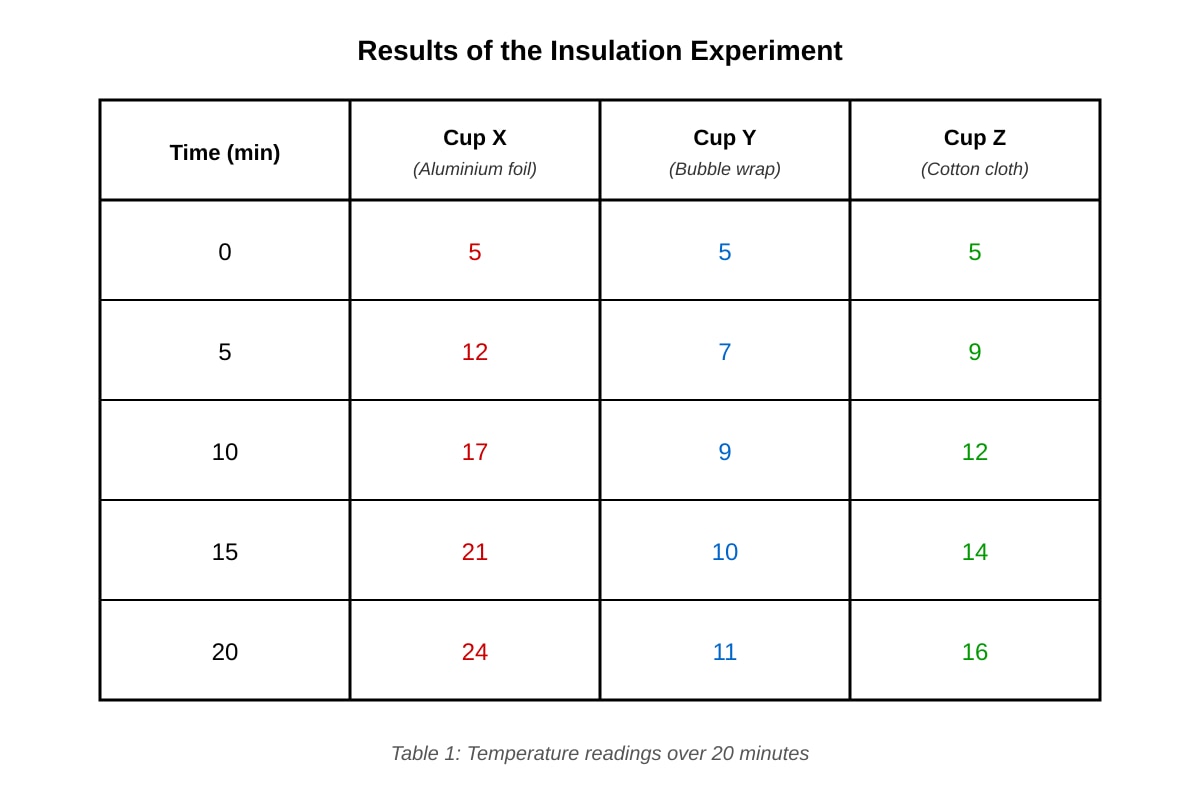
(b) The thick towel acts as an insulator, trapping air and slowing down heat loss from the hot tea to the surroundings. [1]
Explanation: Insulators reduce heat transfer. The towel reduces conduction, convection, and radiation losses. Cup B loses heat faster because it is directly exposed to the cooler air.
14.
(a) The metal ball expands (becomes larger). [1]
(b) When heated, the metal particles gain energy and vibrate more, moving further apart. This causes the ball to expand, making its diameter larger than the ring's opening. [1]
Teaching note: Thermal expansion — solids expand when heated and contract when cooled. The mass stays the same.
15.
(a) Styrofoam container [1]
(b) Styrofoam is a good insulator of heat (poor conductor). It slows down heat transfer from the warm surroundings to the cold ice cream, keeping it frozen longer. [1]
Common mistake: Saying "styrofoam keeps cold in" — cold is not a thing that moves; heat moves in. The insulator slows heat gain.
Section C: Structured / Open-Ended Questions (4 × 5 marks = 20 marks)
16.
(a) To compare how well different materials conduct heat. [1]
Or: To find out which material is the best conductor of heat.
(b) The type of material (copper, aluminium, iron, glass). [1]
Teaching note: Independent variable = what you change.
(c) The time taken for the thumbtack to fall off (or the distance heat travels in a given time). [1]
Teaching note: Dependent variable = what you measure/observe.
(d) Any two of the following:
- Length of each rod
- Thickness/cross-sectional area of each rod
- Distance of thumbtack from heated end
- Amount of wax used
- Intensity of flame / heating time
- Starting temperature of rods
[2] — 1 mark each for any two valid controlled variables.
Teaching note: Controlled variables ensure a fair test — only the material differs.
17.
(a) Metal is a better conductor of heat than concrete. It conducts heat from the Sun to your hand faster, so it feels hotter. [2]
Marking: 1 mark for identifying metal as better conductor, 1 mark for explaining faster heat transfer to hand.
(b) Metal is a better conductor of heat, so it loses heat to the cooler night air faster than concrete. [2]
Marking: 1 mark for identifying metal as better conductor, 1 mark for explaining faster heat loss.
Teaching note: Good conductors gain and lose heat quickly. Poor conductors (insulators) gain and lose heat slowly.
(c) Paint the gate a light colour (e.g., white) / Add a wooden/plastic handle cover / Install a shade over the gate. [1]
Accept any reasonable answer: Light colours reflect heat; wood/plastic are insulators; shade blocks sunlight.
18.
(a) The vacuum has no particles (or very few). Conduction and convection require particles to transfer heat, so they cannot occur across a vacuum. [2]
Marking: 1 mark for "no particles in vacuum", 1 mark for "conduction and convection need particles".
Teaching note: Heat can still transfer by radiation across a vacuum (which the silvered surfaces address).
(b) The silvered surfaces reflect heat radiation back into the flask (for hot drinks) or reflect external heat radiation away (for cold drinks), reducing heat transfer by radiation. [2]
Marking: 1 mark for "reflect heat radiation", 1 mark for direction (back in / away).
(c) Plastic is a poor conductor of heat (insulator). It reduces heat loss/gain through the stopper by conduction. [1]
Teaching note: Metal stopper would conduct heat quickly, defeating the flask's purpose.
19.
(a) Black fabric will absorb the most heat (or show the highest temperature rise) because dark colours absorb more light/heat than light colours. [1]
Accept: "Darker colours absorb more heat than lighter colours."
(b) Four identical fabric pieces (white, black, red, blue), four thermometers, four identical containers/boxes, stopwatch, sunlight/lamp, ruler. [1]
Must include: Different coloured fabrics, thermometers, timing device, light source.
(c) Procedure:
- Wrap each fabric piece around an identical container with a thermometer inside.
- Place all four setups in the same sunny location (or under the same lamp at equal distance).
- Record the starting temperature of each.
- Measure and record the temperature every 5 minutes for 30 minutes.
- Compare the temperature rise for each colour. [2]
Marking: 1 mark for logical steps, 1 mark for measuring temperature at regular intervals.
Key elements: Fair setup, regular measurements, comparison.
(d) Any one of the following:
- Size/thickness of fabric pieces
- Type of fabric material
- Distance from light source
- Starting temperature
- Volume of air in container
- Duration of exposure
[1]
Teaching note: Only the colour (independent variable) should differ.
20.
(a) Black surfaces are good absorbers of heat (radiation). The black panel absorbs maximum heat from the Sun to heat the water. [1]
Teaching note: Black absorbs all colours of light, converting to heat.
(b) Cold water is denser and sinks to the bottom. As it is heated, it expands, becomes less dense, and rises to the top (convection current). This creates a continuous flow without a pump. [2]
Marking: 1 mark for density difference (cold sinks, hot rises), 1 mark for convection current explanation.
Teaching note: This is natural convection / thermosiphon effect.
(c) The insulation reduces heat loss from the hot water in the tank to the cooler surroundings, keeping the water hot for longer. [1]
Teaching note: Without insulation, heat would escape by conduction, convection, and radiation.
(d) Clouds block/reflect sunlight, so less solar radiation reaches the solar panel. Less heat is absorbed, so the water is not heated as much. [1]
Teaching note: Solar heaters depend on direct sunlight. Cloudy days reduce energy input.
End of Answer Key