AI Generated Quiz

Primary 4 Science Heat Quiz

Free Kimi AI-generated P4 Science Heat quiz with questions, answers, and syllabus-aligned practice for Singapore students preparing for school assessments.

These static practice materials are generated from the site's syllabus and paper-generation workflow, with source and model context shown so students and parents can evaluate the material before use.

Primary 4 Science AI Generated Generated by Kimi K2.6 Free Updated 2026-06-09

Questions

<!-- TuitionGoWhere generation metadata: stage=5-1; model=moonshotai/kimi-k2.6:free; model_label=Kimi K2.6 Free; generated=2026-06-09; Sources: Stage 4-0 LLM templates, syllabus context, and Stage 2 evidence where available. -->

Primary 4 Science Quiz - Heat

Name: _________________________________ Class: _________ Date: ___________

Score: _______ / 40 marks

Duration: 40 minutes

Instructions:

  • Answer all questions.
  • Write your answers in the spaces provided.
  • For multiple choice questions, circle the correct answer.

Section A: Multiple Choice (Questions 1–10, 1 mark each)

Section A Total: 10 marks


1. Which of the following is a source of heat?

  • A) Ice cube
  • B) The Sun
  • C) A mirror
  • D) A shadow

Answer: _________________________________


2. Heat travels through solids mainly by

  • A) radiation
  • B) convection
  • C) conduction
  • D) evaporation

Answer: _________________________________


3. Which material is a good conductor of heat?

  • A) Plastic
  • B) Wood
  • C) Copper
  • D) Rubber

Answer: _________________________________


4. In a frying pan, the handle is usually made of plastic or wood because these materials are

  • A) good conductors of heat
  • B) good insulators of heat
  • C) magnetic
  • D) transparent

Answer: _________________________________


5. When you place a metal spoon in hot soup, the handle becomes warm after some time. This happens because heat is transferred by

  • A) conduction through the metal
  • B) convection in the air
  • C) radiation from the soup
  • D) evaporation of the soup

Answer: _________________________________


6. Water in a pot is heated from below. The hot water rises and cooler water sinks down. This method of heat transfer is called

  • A) conduction
  • B) convection
  • C) radiation
  • D) expansion

Answer: _________________________________


7. Which of the following statements about heat and temperature is correct?

  • A) Heat and temperature are exactly the same thing
  • B) Temperature measures how hot or cold something is
  • C) Heat flows from a colder object to a hotter object
  • D) Temperature is measured in grams

Answer: _________________________________


8. On a hot day, a metal playground slide feels hotter than a wooden bench. This is because

  • A) metal absorbs more sunlight than wood
  • B) metal is a better conductor of heat than wood
  • C) the slide is painted a darker colour
  • D) wood produces its own coldness

Answer: _________________________________


9. Which of these would be the best material to wrap around a hot flask to keep soup warm longest?

  • A) Aluminium foil
  • B) Cotton towel
  • C) Copper sheet
  • D) Steel container

Answer: _________________________________


10. Heat from the Sun reaches Earth by

  • A) conduction through space
  • B) convection through air
  • C) radiation through space
  • D) conduction through clouds

Answer: _________________________________


Section B: Fill in the Blanks and Short Answer (Questions 11–15)

Section B Total: 10 marks


11. Name three different sources of heat in everyday life. (3 marks)


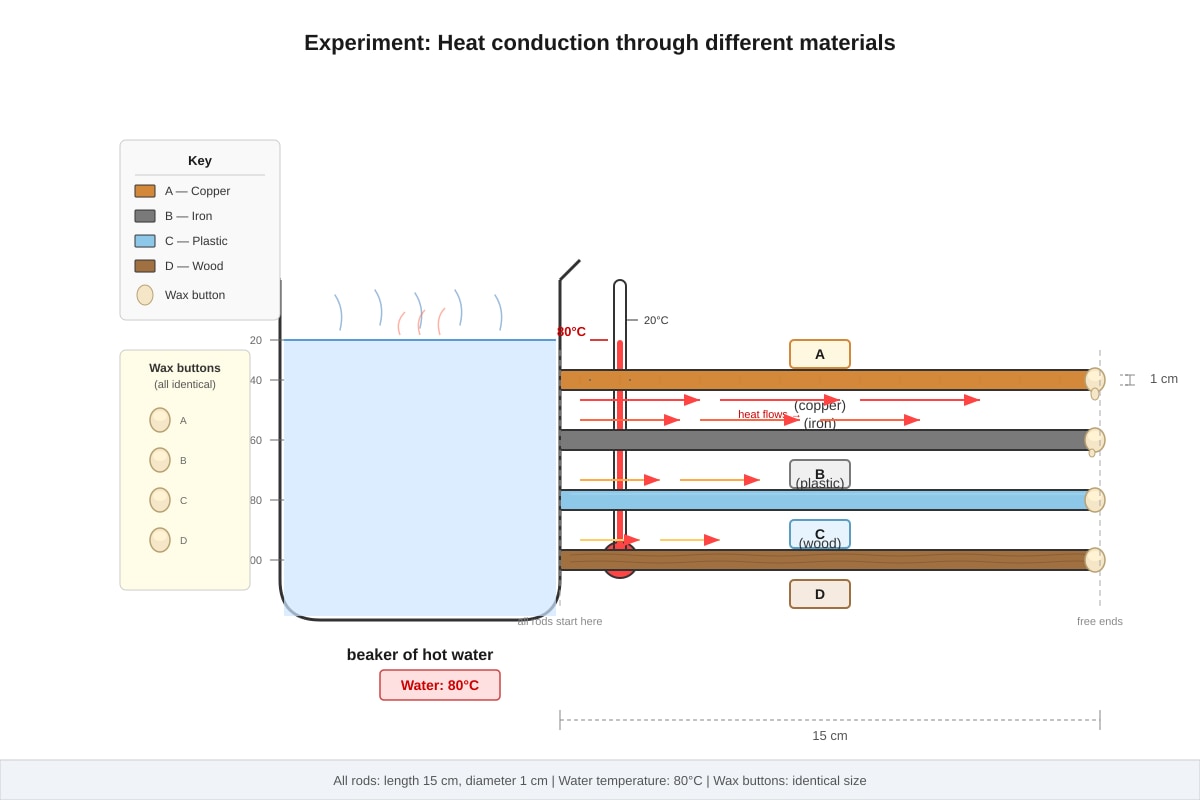
12. The diagram below shows four rods made of different materials. Each rod has a wax button at one end. The rods are placed in hot water at the same time.

<image_placeholder> id: Q12-fig1 type: experimental_setup linked_question: 12 description: Four identical rods of different materials (copper, iron, plastic, wood) arranged horizontally with one end dipped into a beaker of hot water. Each rod has a small wax button at the free end. Labels A, B, C, D mark each rod. labels: A (copper), B (iron), C (plastic), D (wood); beaker of hot water; wax buttons at free ends values: All rods same length (15 cm), same diameter (1 cm); water temperature 80°C must_show: All four rods starting from same position in water; wax buttons identical in size; clear material labels; thermometer in water showing 80°C </image_placeholder>

(a) Predict which wax button will fall off first. Explain your answer. (2 marks)


(b) Predict which wax button will stay on the longest. Explain your answer. (2 marks)


13. Explain why a woollen blanket keeps you warm on a cold night in an air-conditioned room. (2 marks)


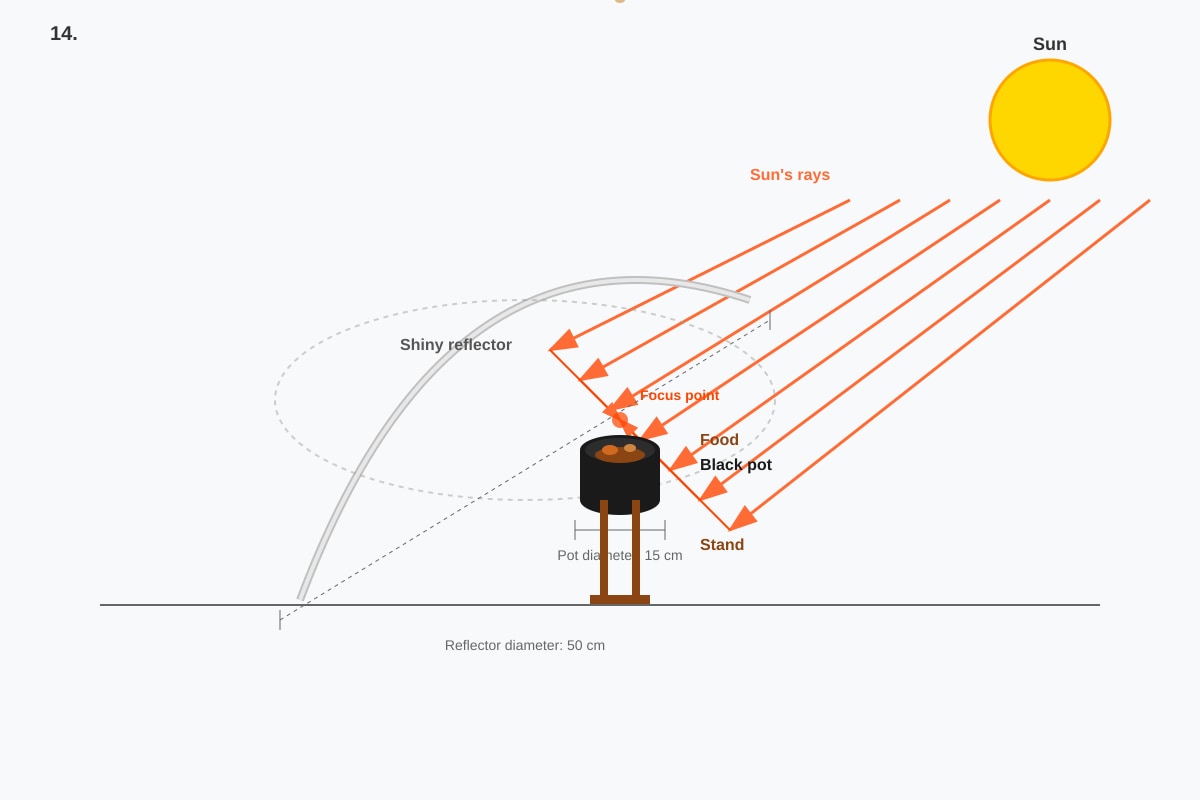
14. The diagram shows a simple solar cooker used in Singapore for an experiment.

<image_placeholder> id: Q14-fig1 type: diagram linked_question: 14 description: A solar cooker setup with a shiny metal parabolic reflector facing the Sun, with a black pot placed at the focus point. Labels show "Sun's rays," "Shiny reflector," "Black pot," "Food inside pot," and "Stand." labels: Sun's rays arrows; Shiny reflector; Black pot; Food; Stand; Focus point values: Reflector diameter 50 cm; pot diameter 15 cm must_show: Curved shiny reflector with curvature toward Sun; parallel arrows from Sun hitting reflector and converging; black pot at convergence point; label for each part </image_placeholder>

(a) The pot is painted black on the outside. Why is this colour chosen? (1 mark)


(b) The reflector is made of shiny metal. What is its purpose? (1 mark)


15. Mei Ling wants to keep her iced Milo cold during her school picnic in Singapore's hot weather. She has a plastic cup, a metal cup, and a foam cup. Which cup should she choose? Explain your choice. (2 marks)


Section C: Application and Reasoning (Questions 16–20)

Section C Total: 20 marks


16. Study the experimental setup below.

<image_placeholder> id: Q16-fig1 type: experimental_setup linked_question: 16 description: Two identical metal cups on a table. Cup A is wrapped with thick wool fabric. Cup B is left bare. Both cups contain 200 ml of hot water at 80°C. A thermometer is in each cup. Time shown as 0 minutes. Labels for Cup A, Cup B, thermometer readings, wool wrapping. labels: Cup A (wool-wrapped); Cup B (bare); Thermometer A; Thermometer B; 200 ml hot water at 80°C; Wool wrapping values: Both cups: 200 ml water, 80°C starting temperature; room temperature 28°C must_show: Two identical metal cups side by side; clear wool wrapping on Cup A only; thermometers in each cup showing 80°C; labelled volumes and starting temperature; table surface </image_placeholder>

(a) After 10 minutes, which cup of water will be hotter? Explain your answer. (2 marks)


(b) What is the variable that is changed by the experimenter? (1 mark)


(c) List two variables that must be kept the same to make this a fair test. (2 marks)


17. Rashid conducted an experiment to find out if the colour of a container affects how fast water inside it gets hot in the Sun. He used four identical metal cans painted different colours. Each can contained 100 ml of water at room temperature (28°C). He placed them in direct sunlight for 30 minutes and measured the final temperature.

<image_placeholder> id: Q17-fig1 type: experimental_setup linked_question: 17 description: Four identical metal cans in a row under sunlight, each painted a different colour. From left to right: white, light grey, dark grey, black. Each has a thermometer. Sun shown above with rays. Table below with starting temperature 28°C for all. labels: Can 1 (white), Can 2 (light grey), Can 3 (dark grey), Can 4 (black); Thermometer 1, 2, 3, 4; Sun rays; Starting temperature 28°C values: All cans: 100 ml water, 28°C starting; 30 minutes in sun; final temperatures: white 32°C, light grey 35°C, dark grey 39°C, black 44°C must_show: Four identical cans; colour differences clearly visible; thermometers with readings or in table; sun position above; equal spacing; labels for each can </image_placeholder>

(a) Write down the temperatures of the water after 30 minutes in the table below. (2 marks)

Can ColourFinal Temperature (°C)
White32
Light grey35
Dark grey?
Black?

(b) What conclusion can you draw from this experiment about dark and light colours? (2 marks)


(c) In Singapore, many buildings use light-coloured roofs. Explain how this helps keep buildings cool. (2 marks)


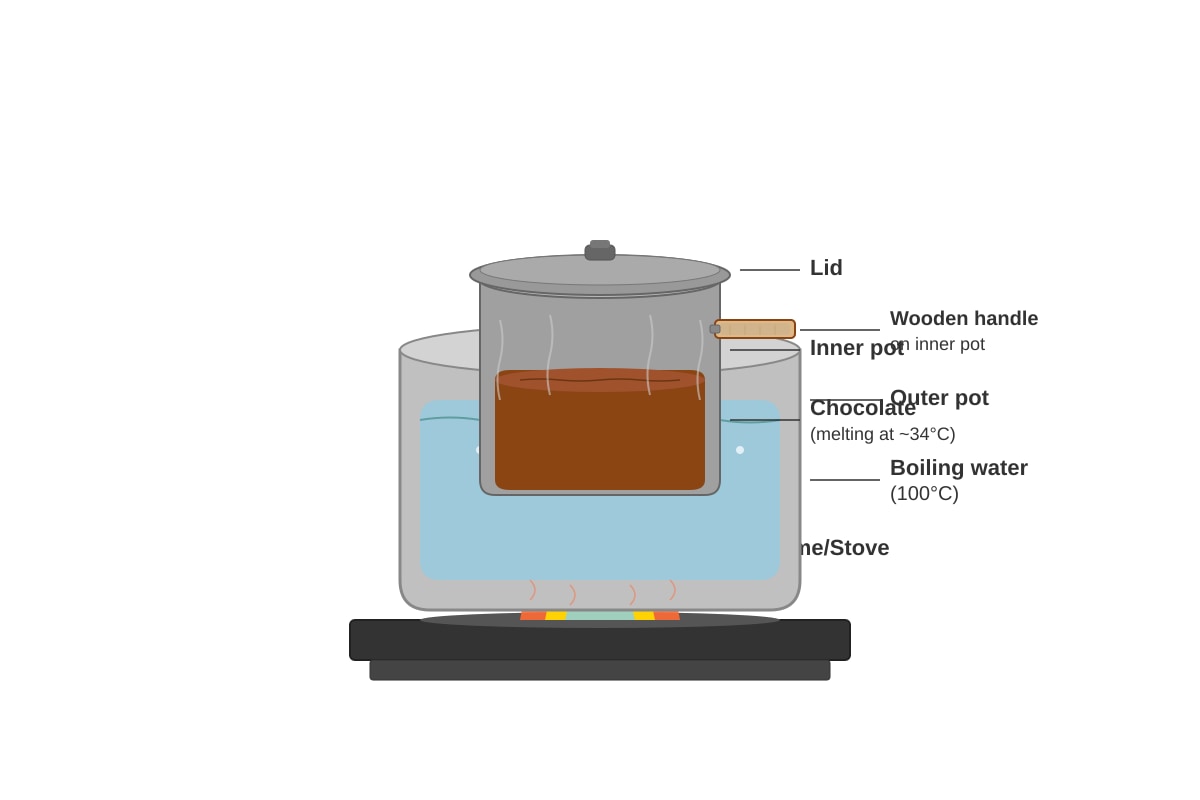
18. The diagram shows a method of cooking using a double boiler.

<image_placeholder> id: Q18-fig1 type: diagram linked_question: 18 description: A double boiler setup with a smaller pot (containing chocolate) sitting inside a larger pot containing boiling water. The larger pot is on a stove with a flame. Labels show flame, outer pot with water, inner pot with chocolate, lid on inner pot. labels: Flame/Stove; Outer pot; Boiling water (100°C); Inner pot; Chocolate; Lid; Wooden handle on inner pot values: Water boiling at 100°C; chocolate melting at about 34°C must_show: Nested pot arrangement; flame under outer pot; water level below rim of inner pot; chocolate visible in inner pot; wooden handle on inner pot; clear label for each part </image_placeholder>

(a) Why is a double boiler used instead of heating the chocolate directly over the flame? (2 marks)


(b) The inner pot has a wooden handle. Explain why this material is suitable. (2 marks)


(c) Explain how heat moves from the flame to the chocolate. Trace the path of heat transfer. (3 marks)


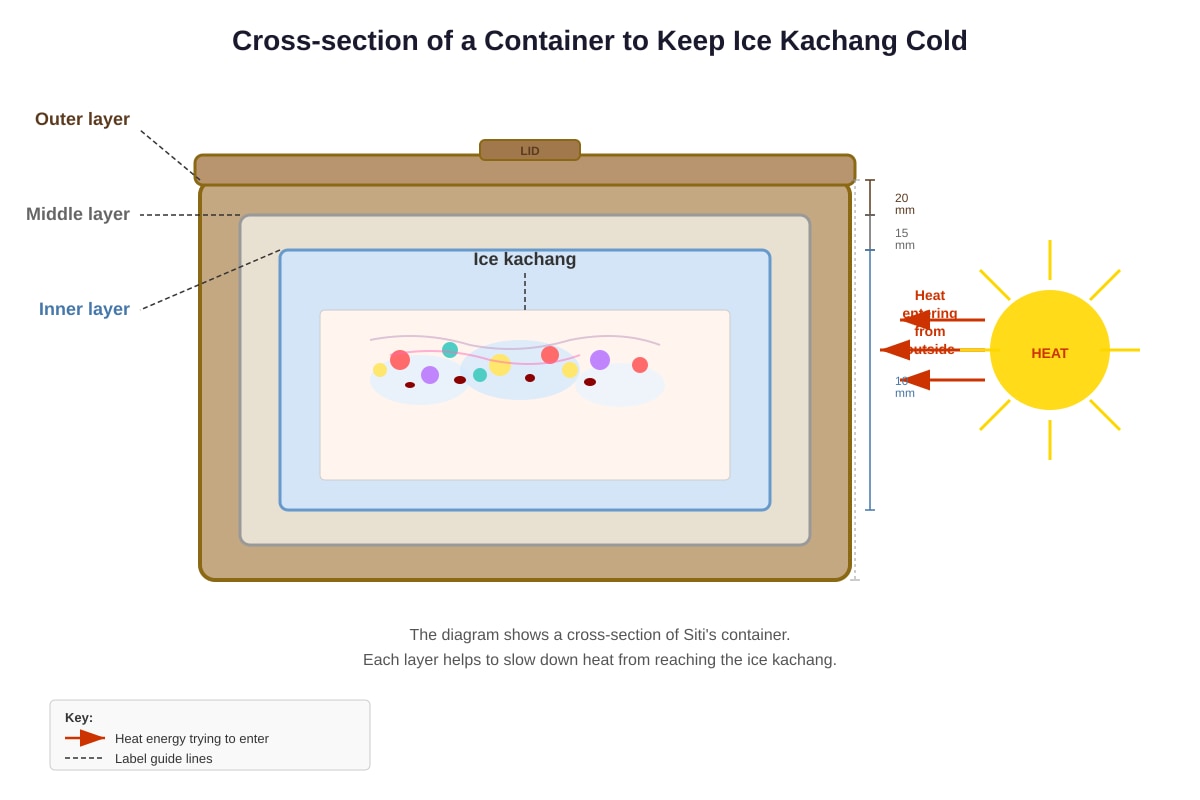
19. Siti wants to design a container to keep ice kachang (shaved ice dessert) from melting too quickly at her school carnival stall in Singapore. She has these materials available: aluminium foil, styrofoam, plastic wrap, cotton cloth, and cardboard.

<image_placeholder> id: Q19-fig1 type: diagram linked_question: 19 description: Cross-section diagram of a container designed to keep ice kachang cold. Shows multiple layers from outside to inside. Outer layer, middle layer, inner layer, with ice kachang inside. labels: Outer layer; Middle layer; Inner layer; Ice kachang; Lid values: Not specified—student must choose must_show: Layered container structure; open top with lid; ice kachang visible inside; space for three layers with labels; arrows showing heat trying to enter from outside </image_placeholder>

(a) Choose the best material for each layer of your container. Explain why each material is suitable for its position. (4 marks)

Outer layer: _________________________________ Reason: _________________________________

Middle layer: _________________________________ Reason: _________________________________

Inner layer: _________________________________ Reason: _________________________________

(b) Explain why you would NOT use aluminium foil as the main insulating layer. (1 mark)


20. Read about Ahmad's investigation below and answer the questions.

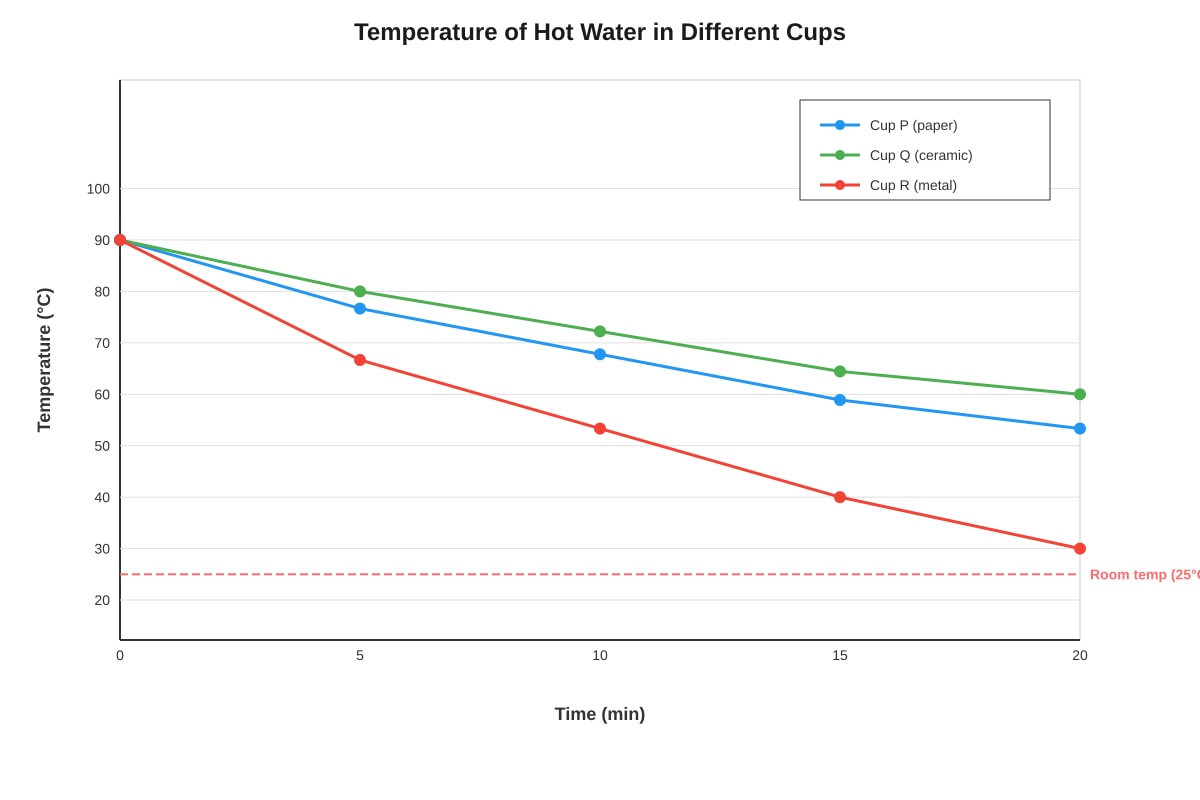
Ahmad wanted to find out which type of cup keeps a hot drink warm for the longest time. He tested three cups:

  • Cup P: Paper cup
  • Cup Q: Ceramic cup
  • Cup R: Metal cup (stainless steel)

He poured 200 ml of hot water at 90°C into each cup. He measured the temperature every 5 minutes for 20 minutes. The room temperature was 25°C.

His results are shown below:

<image_placeholder> id: Q20-fig1 type: graph linked_question: 20 description: Line graph showing temperature of water in three cups over 20 minutes. X-axis: Time (minutes) from 0 to 20. Y-axis: Temperature (°C) from 20 to 100. Three lines: Cup P (paper) starts at 90, drops to 65°C at 20 min; Cup Q (ceramic) starts at 90, drops to 70°C at 20 min; Cup R (metal) starts at 90, drops to 52°C at 20 min. labels: X-axis: Time (min); Y-axis: Temperature (°C); Legend: Cup P (paper), Cup Q (ceramic), Cup R (metal); Data points at 0, 5, 10, 15, 20 minutes values: Cup P: 90, 82, 76, 70, 65; Cup Q: 90, 84, 79, 74, 70; Cup R: 90, 78, 68, 60, 52; Room temperature 25°C marked as horizontal dashed line must_show: Three distinct lines with different colours/patterns; clear axes labels with units; legend; grid lines; data points clearly marked; room temperature reference line; title "Temperature of Hot Water in Different Cups" </image_placeholder>

(a) Which cup kept the water hottest after 20 minutes? Give the temperature. (1 mark)


(b) Calculate the total temperature drop for Cup R over the 20 minutes. Show your working. (2 marks)


(c) Explain why Cup Q performed better than Cup P at keeping water warm. (2 marks)


(d) If Ahmad wanted to keep his drink hot for even longer, suggest two changes he could make to his setup or materials. Explain each suggestion. (4 marks)

Change 1: _________________________________

Explanation: _________________________________

Change 2: _________________________________

Explanation: _________________________________


END OF QUIZ

Total Marks: 40

Answers

<!-- TuitionGoWhere generation metadata: stage=5-1; model=moonshotai/kimi-k2.6:free; model_label=Kimi K2.6 Free; generated=2026-06-09; Sources: Stage 4-0 LLM templates, syllabus context, and Stage 2 evidence where available. -->

Primary 4 Science Quiz - Heat: Answer Key


Section A: Multiple Choice (1 mark each)

1. B) The Sun

  • The Sun is a natural source of heat. Ice cubes absorb heat but are not a source; mirrors reflect light; shadows are absence of light.

2. C) conduction

  • Conduction is how heat travels through solids—particles vibrate and pass energy along. Radiation travels without particles (through space). Convection needs fluid movement.

3. C) Copper

  • Metals like copper are good conductors. Plastic, wood, and rubber are insulators—they slow down heat transfer.

4. B) good insulators of heat

  • Insulators keep heat away from your hand. If the handle conducted heat well, it would become too hot to hold.

5. A) conduction through the metal

  • Metal particles in the spoon vibrate and pass heat energy from the hot end in the soup to the handle.

6. B) convection

  • Hot water expands, becomes less dense, and rises. Cooler, denser water sinks to be heated. This creates a convection current.

7. B) Temperature measures how hot or cold something is

  • Temperature is a measurement (in °C). Heat is energy that flows from hotter to colder objects. Grams measure mass, not temperature.

8. B) metal is a better conductor of heat than wood

  • Both receive similar sunlight, but metal transfers heat to your skin quickly, so it feels hotter. Wood conducts poorly, so heat stays near the surface.

9. B) Cotton towel

  • Cotton is an insulator that traps air, slowing heat loss. Aluminium foil, copper, and steel are conductors that let heat escape quickly.

10. C) radiation through space

  • Space is mostly empty, so conduction and convection cannot occur. Electromagnetic waves (infrared) carry solar energy across space.

Section A Total: 10 marks


Section B: Fill in the Blanks and Short Answer

11. Any three of the following: (1 mark each, 3 marks total)

  • The Sun
  • Fire / flames / burning materials
  • Electric appliances (iron, kettle, heater)
  • Friction (rubbing hands together)
  • Our body (body heat)

Teaching note: Heat sources produce thermal energy. Heat is not produced by cold objects or shadows.


12. (a) The wax button on the copper rod (A) will fall off first. (1 mark) Explanation: Copper is the best conductor of heat among the four materials. It transfers heat quickly from the hot water to the wax, causing the wax to melt fastest. (1 mark)

(b) The wax button on the plastic rod (C) [or wood rod D] will stay on longest. (1 mark) Explanation: Plastic and wood are insulators. They conduct heat very slowly, so the wax takes much longer to melt. (1 mark)

Common mistake: Students may think iron falls first because it looks metallic—copper is actually a better conductor than iron.


13. A woollen blanket traps air between its fibres. (1 mark) Air is a poor conductor of heat (an insulator), so it slows down heat transfer away from your body, keeping you warm. (1 mark)

Teaching note: The blanket does not produce heat—it reduces heat loss from your body to the cooler air-conditioned room.


14. (a) Black absorbs heat better than lighter colours. (1 mark) The black surface absorbs more infrared radiation from the Sun, heating the pot and its contents more efficiently.

(b) The shiny metal reflector reflects and concentrates sunlight onto the pot. (1 mark) Its curved shape focuses more of the Sun's rays onto the cooking area, increasing the heat received.


15. She should choose the foam cup. (1 mark)

Explanation: Foam is a good insulator with trapped air pockets that slow heat transfer from the hot surroundings to the cold drink. (0.5 mark) Metal would conduct heat quickly, warming the drink fast. Plastic is better than metal but not as good as foam. (0.5 mark)


Section B Total: 10 marks


Section C: Application and Reasoning

16. (a) Cup A (the wool-wrapped cup) will be hotter. (1 mark) The wool wrapping is an insulator that slows heat loss from the hot water to the cooler surroundings. (1 mark)

(b) The variable changed: Whether the cup is wrapped in wool or not / The presence of wool wrapping. (1 mark)

(c) Any two of: (1 mark each, 2 marks total)

  • Starting temperature of the water
  • Volume/amount of water in each cup
  • Type/material of the cup
  • Room/environment temperature
  • Position/location in the room
  • Time period before measuring

Teaching note: These are "controlled variables"—kept the same so only the wrapping affects the result.


17. (a) Dark grey: 39°C; Black: 44°C (1 mark each, 2 marks total)

(b) Darker colours absorb more heat radiation than lighter colours. (1 mark) This causes water in darker containers to heat up faster and reach higher temperatures. (1 mark)

(c) Light-coloured roofs reflect more sunlight and absorb less heat. (1 mark) This reduces the amount of heat entering the building, keeping interiors cooler and reducing air-conditioning needs. (1 mark)


18. (a) Chocolate burns easily/melts unevenly when heated directly. (1 mark) The double boiler uses water to transfer gentle, even heat at 100°C maximum, preventing burning. (1 mark)

(b) Wood is a poor conductor of heat / an insulator. (1 mark) The wooden handle stays cool enough to touch safely when the pot is hot. (1 mark)

(c) Heat transfer path: (1 mark per correct step, 3 marks total)

  1. Flame → Outer pot: Conduction through contact with flame, plus radiation from flame
  2. Outer pot → Water: Conduction through metal walls; then convection currents in water distribute heat
  3. Water → Inner pot: Conduction from hot water to metal of inner pot
  4. Inner pot → Chocolate: Conduction through metal into chocolate

Note: Water limits maximum temperature to 100°C, protecting the chocolate.


19. (a) Optimal design with explanations: (4 marks total—material + reason for each layer)

LayerGood ChoiceReason
OuterCardboardProtects structure, some insulation, cheap; or light colour to reflect heat
MiddleStyrofoamExcellent insulator with trapped air; very poor conductor
InnerPlastic wrap/Plastic sheetWaterproof, easy to clean, food-safe; or thin plastic to hold ice directly

Marking: 1 mark for each appropriate material choice + valid explanation (max 4 marks). Accept variations with valid scientific reasoning.

Alternative good answer: Outer = light-coloured paint/white; Middle = styrofoam; Inner = plastic.

(b) Aluminium foil is a good conductor of heat. (1 mark) It would transfer heat quickly from the surroundings to the ice, causing faster melting.


20. (a) Cup Q (ceramic), 70°C. (1 mark) Ceramic insulates better than paper or metal.

(b) Temperature drop for Cup R: (2 marks) Temperature drop=90C52C=38C\text{Temperature drop} = 90^\circ\text{C} - 52^\circ\text{C} = 38^\circ\text{C}

Working: Starting temperature − Final temperature (1 mark); Correct subtraction and answer with unit (1 mark)

(c) Cup Q (ceramic) kept water warmer than Cup P (paper) because: (2 marks)

  • Ceramic is a better insulator than paper; ceramic has thicker walls and traps heat more effectively
  • Ceramic reflects some infrared radiation back into the drink
  • Paper is thinner and allows faster heat conduction and convection losses

Any 2 valid points: 1 mark each

*(d) Two changes with explanations: (2 marks each, 4 marks total)

Change 1: Add a lid to the cup. (1 mark) Explanation: A lid reduces heat loss through evaporation and convection from the water surface. (1 mark)

Change 2: Use a cup with thicker walls / wrap the cup in a towel or insulator / use a vacuum flask. (1 mark) Explanation: Thicker insulation creates more barrier to heat transfer; a vacuum flask has a vacuum gap that stops conduction and convection completely. (1 mark)

Accept other valid answers: Use a smaller surface area cup; place cup in warmer location; use a cup with reflective inner surface.


END OF ANSWER KEY

Total Marks: 40

Summary by Section:

  • Section A: 10 marks
  • Section B: 10 marks
  • Section C: 20 marks