AI Generated Quiz
Primary 4 Science Heat Quiz
Free P4 Science Heat quiz, HY3 AI version, with questions, answers, and syllabus-aligned practice for Singapore students.
These static practice materials are generated from the site's syllabus and paper-generation workflow, with source and model context shown so students and parents can evaluate the material before use.
Questions
Free quiz and exam paper access
Enter your details to view this paper
Your access is remembered on this device.
Answers
Primary 4 Science Quiz - Heat (Answer Key)
Total Marks: 40
Topic: Heat (Syllabus-first practice; no past-year evidence used)
Section A: Multiple Choice (1 mark each)
-
B. The Sun
Teaching note: The Sun is a natural source of heat. Wood, plastic, and rubber are not sources of heat by themselves. -
C. degree of hotness
Teaching note: Temperature tells us how hot or cold something is (its degree of hotness), not its mass or size. -
A. a form of energy
Teaching note: Heat is energy that moves from a hotter place to a colder place. It is not matter. -
B. a hotter object to a colder object
Teaching note: Heat always moves from hot to cold until temperatures become equal. -
C. Metal
Teaching note: Metals such as iron and copper let heat pass through easily, so they are good conductors. -
C. Air
Teaching note: Air, wood, plastic, and rubber are poor conductors (insulators). Metal is a good conductor. -
C. increases
Teaching note: Gaining heat usually makes an object's temperature go up. -
B. temperature
Teaching note: A thermometer measures temperature; a ruler measures length, a scale measures mass. -
A. Water turning to ice
Teaching note: Losing heat can change water (liquid) to ice (solid). This is a change of state due to heat loss. -
B. both reach the same temperature
Teaching note: Heat transfer stops when both objects have the same temperature (thermal equilibrium).
Section B: Short Answer (2 marks each)
-
Difference: Heat is a form of energy; temperature is a measurement of how hot something is. [2 marks]
Marking: 1 mark for heat = energy; 1 mark for temperature = measurement of hotness. -
Two poor conductors: Wood and plastic (or air). [2 marks]
Marking: 1 mark each, max 2. Metal is not accepted. -
Example: A metal ring expands when heated (e.g., lid of a jar loosens after running under hot water). [2 marks]
Marking: 1 mark for correct object; 1 mark for expansion due to heat gain. -
Answer: Metal is a good conductor of heat, so heat from soup travels quickly to the spoon end. Wood is a poor conductor, so it stays cooler. [2 marks]
Marking: 1 mark metal = good conductor; 1 mark wood = poor conductor / explanation. -
Two sources: Stove, oven, heater, light bulb (any two). [2 marks]
Marking: 1 mark each. -
Answer: The water's temperature decreases. Heat flows from warm water to cooler air until both reach same temperature. [2 marks]
Marking: 1 mark for temperature drops; 1 mark for heat flows to room / equal temperature.
Section C: Structured Questions
-
(a) Temperature [1 mark]
(b) Datalogger with temperature sensor [1 mark]
Teaching note: Both thermometer and datalogger measure temperature; datalogger uses sensors. -
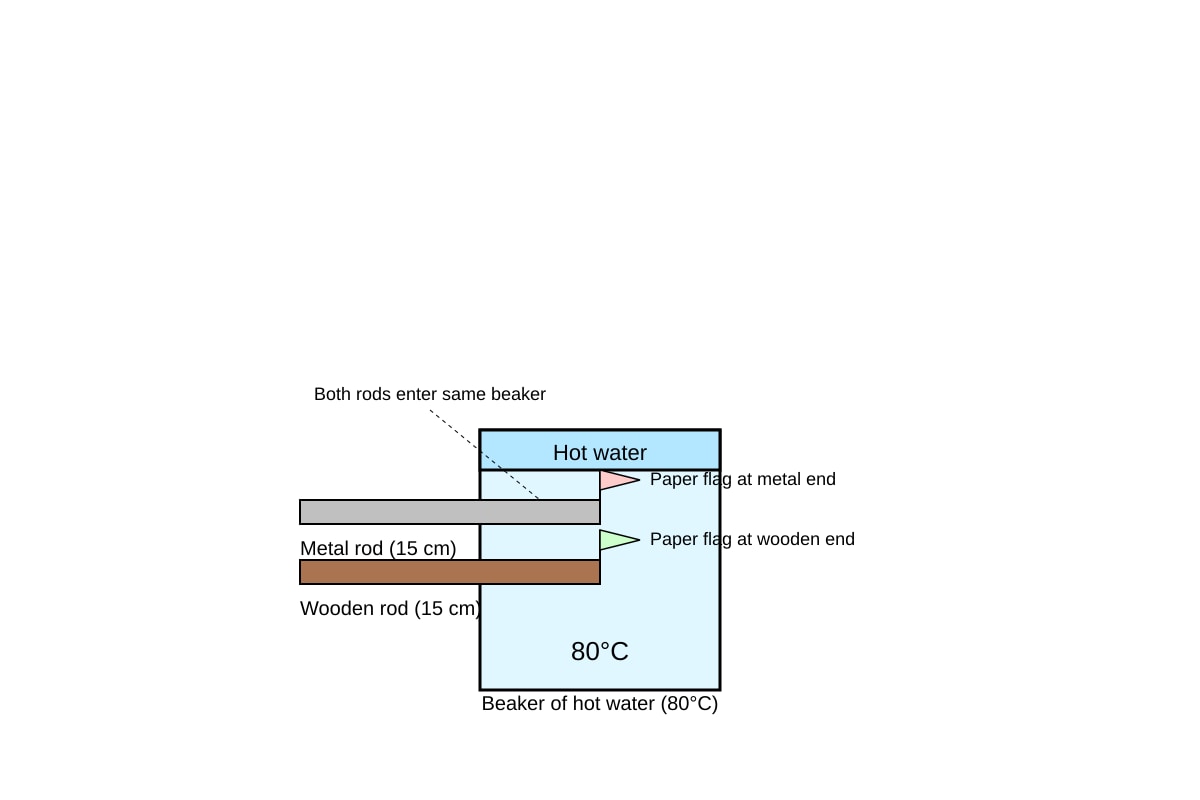
(a) Metal rod [1 mark]
(b) Metal is a good conductor of heat, so heat from hot water travels fast along the rod to the flag. Wood is a poor conductor, so heat moves slowly. [2 marks]
Marking: 1 mark metal = good conductor; 1 mark wood = poor conductor / contrast. -
(a) From porridge (70°C) to milk (10°C) [1 mark]
(b) Milk temperature rises; porridge temperature falls. They move toward the same temperature. [2 marks]
Marking: 1 mark each correct change; implied equalisation acceptable. -
(a) Cloth [1 mark]
(b) Cloth is a poor conductor, so it slows heat from outside reaching the ice pack. Metal is a good conductor, so heat would enter quickly and melt the ice. Thus cloth keeps it cold longer. [3 marks]
Marking: 1 mark cloth poor conductor; 1 mark metal good conductor; 1 mark links to slower heat flow / longer cold.