AI Generated Quiz
Primary 4 Science Heat Quiz
Free P4 Science Heat quiz, GLM5.3 AI version, with questions, answers, and syllabus-aligned practice for Singapore students.
These static practice materials are generated from the site's syllabus and paper-generation workflow, with source and model context shown so students and parents can evaluate the material before use.
Questions
Free quiz and exam paper access
Enter your details to view this paper
Your access is remembered on this device.
Answers
Primary 4 Science Quiz - Heat: Answer Key
TuitionGoWhere Practice Quiz (AI) - Version 1 of 5
Answer 1.
B. A burning candle. Burning produces heat, so a candle is a source of heat. A mirror only reflects light, and unlit objects do not give off heat. Marking note: award 2 marks for the correct letter. [2]
Answer 2.
B. Heat always flows from the hotter object to the cooler object. Cup P (80°C) is hotter than Cup Q (20°C), so heat flows from Cup P to Cup Q until both reach the same temperature. The flow stops at equal temperature — it does not continue non-stop. [2]
Answer 3.
B. Metal is a good conductor of heat, so heat from the hot soup travels up the metal spoon quickly, making its handle hot. Plastic is a poor conductor, so little heat reaches its handle. New-student note: "coldness" never flows — only heat flows. [2]
Answer 4.
B. The metal lid gains heat from the hot water and expands, so it becomes looser and easier to open. [2]
Answer 5.
C. Heat is a form of energy that flows from a hotter to a cooler object; temperature is a measurement of how hot or cold an object is. Temperature itself does not flow. [2]
Answer 6.
Any three of: gas stove/cooker, oven, kettle, toaster, microwave oven, rice cooker, air fryer. Marking note: 2 marks for three correct sources; 1 mark for two correct. [2]
Answer 7.
(a) Heat is a form of energy. [1] (b) Temperature is a measurement of the degree of hotness (how hot or cold) of an object. [1]
Answer 8.
The liquid column rises. Working: the water at 60°C is hotter than the thermometer, so heat flows from the water into the thermometer liquid; the liquid gains heat, expands, and moves up the tube. [2]
Answer 9.
Heat flows from Ali's warmer hand to the colder ice cube. As his hand loses heat, it feels cold. New-student note: the hand feels cold because it loses heat, not because coldness enters it. [2]
Answer 10.
Good conductors of heat: copper, aluminium. Poor conductors of heat: wood, rubber, air, plastic. Marking note: 2 marks if all six substances are placed correctly; 1 mark if four or five are correct. [2]
Answer 11.
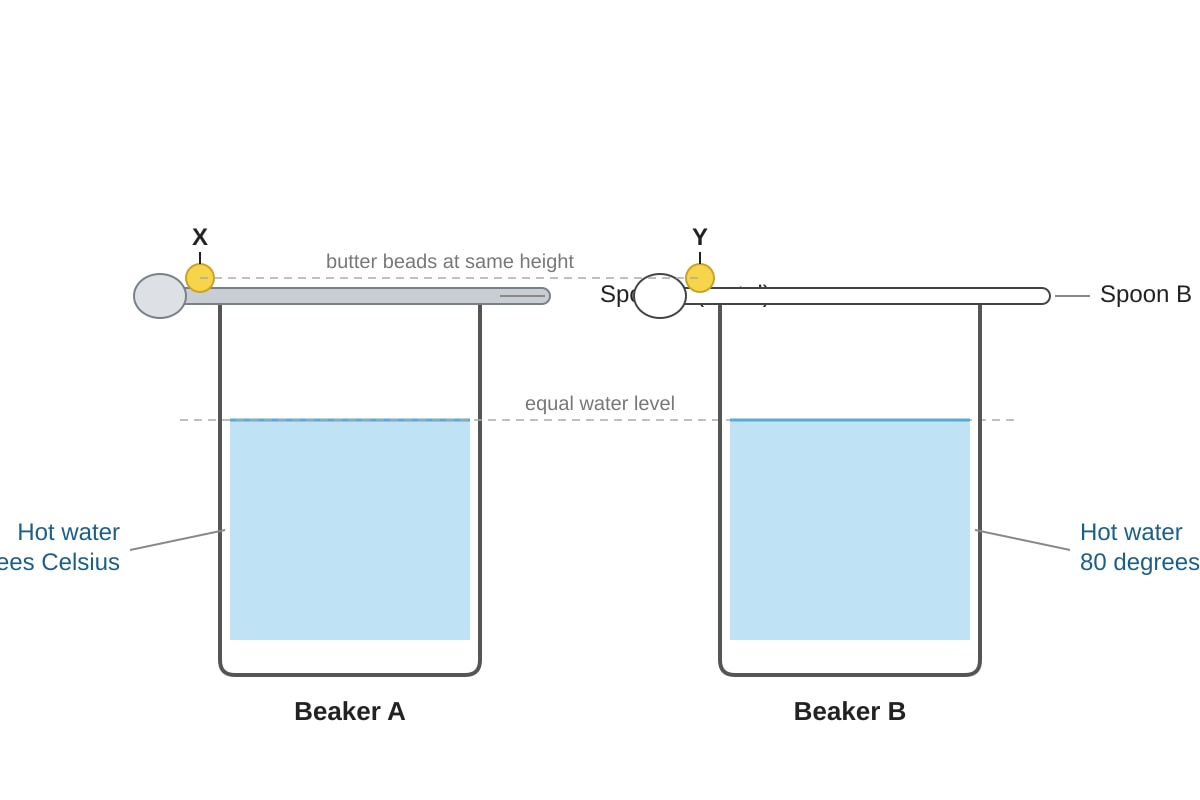
(a) Butter bead X falls off first. [1] (b) Metal is a better conductor of heat than plastic. Heat travels up Spoon A faster than up Spoon B, so bead X melts sooner and falls off first. Fair-test note: both beads start at the same height above water at the same temperature, so only the spoon material differs. [2]
Answer 12.
(a) 49°C. [1] (b) The milk lost heat. Its temperature fell from 70°C at 0 min to 31°C at 25 min. [1] (c) The milk's temperature will stop falling and settle at about 24°C. Heat flows only while there is a temperature difference; once the milk and the room reach the same temperature, heat flow stops. [1]
Answer 13.
On a hot afternoon, the cables gain heat from the sun and expand, becoming longer, so they sag. At night, the cables lose heat to the cooler surroundings and contract, becoming shorter, so they become tighter. Marking note: 1 mark for expansion on heat gain, 1 mark for contraction on heat loss, 1 mark for linking each change to sagging/tightening. [3]
Answer 14.
(a) Heat flows from the metal ball to the water. [1] (b) They finally reach the same temperature. [1] (c) The hotter ball loses heat while the cooler water gains heat. Heat flow continues until both reach the same final temperature. [1]
Answer 15.
(a) From the sun (heat passed through the car and heated the chocolate). [1] (b) The chocolate gained heat from its surroundings, so its temperature rose until it melted from a solid into a liquid. [1] (c) Any one example, e.g.: wet clothes drying in the sun; ice cream melting; a metal gate expanding on a hot day; a puddle of water evaporating. [1]
Answer 16.
(a) Any one: same amount of water; same starting temperature (80°C); same type and size of cups; same measuring time (30 minutes); same location/table. [1] (b) Wool cloth (Cup Q). [1] (c) Wool cloth is a poor conductor of heat, so the least heat escapes from the water to the surroundings, keeping it warmest. [1]
Answer 17.
(a) Wood is a poor conductor of heat, so very little heat travels from the hot pan to the hand, preventing burns. Metal would conduct heat quickly and burn the hand. [2] (b) Metal is a good conductor of heat, so heat passes quickly through the pan body to cook the food. [1]
Answer 18.
On hot days, the tracks gain heat and expand, becoming longer. At night, they lose heat and contract, becoming shorter. The gaps give space for the tracks to expand without bending or buckling. Marking note: 1 mark for expansion on heat gain, 1 mark for contraction on heat loss, 1 mark for the purpose of the gaps. [3]
Answer 19.
(a) Raju (the black T-shirt wearer) feels hotter. [1] (b) Black (dark) surfaces absorb more heat from the sun, while white surfaces reflect more heat. So Raju gains more heat and feels hotter. [2]
Answer 20.
(a) Any one: same amount/volume of water; same starting temperature (5°C); same size cups; same time (20 minutes); same location/table. [1] (b) The styrofoam cup. [1] (c) Styrofoam is the poorest conductor of heat among the three materials, so the least heat from the warm surroundings enters the water, keeping it coldest. [1]