AI Generated Quiz
Primary 4 Science Diversity Quiz
Free AI-Generated Owl Alpha Primary 4 Science Diversity quiz with questions and answers for Singapore students. This page is rendered as a direct URL so the questions and answers can be discovered without pressing in-page buttons.
These static practice materials are generated from the site's syllabus and paper-generation workflow, with source and model context shown so students and parents can evaluate the material before use.
Questions
Primary 4 Science Quiz - Diversity
Name: ___________________________
Class: ___________________________
Date: ___________________________
Score: ________ / 40
Duration: 40 minutes
Total Marks: 40
Instructions:
- Answer all questions.
- Write your answers in the spaces provided.
- For multiple-choice questions, shade the correct option clearly.
- Show your working where required.
- Read each question carefully before answering.
Section A: Multiple Choice (Questions 1–10)
Each question carries 1 mark. Choose the most suitable answer.
1. Which of the following is a living thing?
A. Rock
B. Plastic bottle
C. Grass
D. Cloud
2. Which of the following is a non-living thing?
A. Butterfly
B. Mushroom
C. River
D. Frog
3. Which characteristic is common to all living things?
A. They can fly.
B. They can grow.
C. They are green in colour.
D. They live on land.
4. A seed germinates into a seedling. This shows that living things can __________.
A. move
B. reproduce
C. grow
D. breathe
5. Which of the following is not a characteristic of living things?
A. They need food and water.
B. They respond to changes around them.
C. They are made of cells.
D. They do not need air.
6. Which of the following groups contains only living things?
A. Ant, mushroom, fern
B. Fish, water, bird
C. Grass, soil, worm
D. Crab, shell, seaweed
7. A plant bends towards sunlight. This shows that living things can __________.
A. reproduce
B. grow
C. respond to changes
D. move from place to place
8. Which of the following is a non-living thing that was once part of a living thing?
A. Wooden chair
B. Plastic bag
C. Glass bottle
D. Metal spoon
9. Which of the following is a living thing that can make its own food?
A. Cat
B. Dog
C. Rose plant
D. Earthworm
10. Which of the following statements is true?
A. All living things can move from one place to another.
B. All living things need air to survive.
C. All non-living things were once part of living things.
D. All living things are animals.
Section B: Fill in the Blanks (Questions 11–15)
Each question carries 2 marks. Write your answers in the spaces provided.
11. Complete the table below by classifying each item as a living thing or a non-living thing.
| Item | Living or Non-living? |
|---|---|
| (a) Grass | _________________ |
| (b) Table | _________________ |
| (c) Bacteria | _________________ |
| (d) Cloud | _________________ |
12. State two characteristics of living things.
(a) _______________________________________________________________
(b) _______________________________________________________________
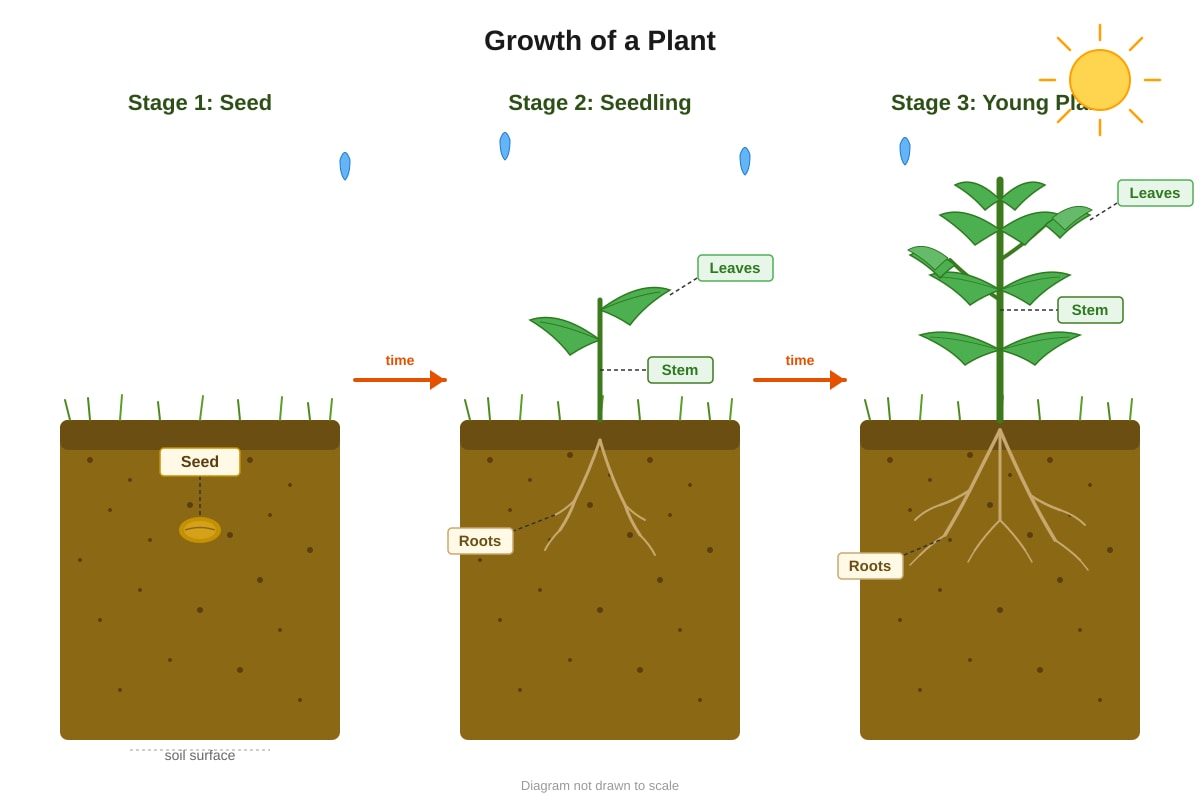
13. The diagram below shows a seed growing into a plant.
<image_placeholder> id: Q13-fig1 type: diagram linked_question: Q13 description: A three-stage diagram showing (left) a seed in soil, (middle) a small seedling with roots and two leaves emerging from soil, and (right) a larger plant with stem, leaves, and roots. Arrows point from left to right showing growth over time. labels: Stage 1: Seed, Stage 2: Seedling, Stage 3: Young Plant values: Not applicable must_show: Three clear stages of growth, arrows indicating time progression, visible roots and leaves in stages 2 and 3 </image_placeholder>
What characteristic of living things does the diagram above show?
14. Put a tick (✓) in the correct box to show whether each item is living or non-living.
| Item | Living | Non-living |
|---|---|---|
| (a) Mushroom | ||
| (b) Pencil | ||
| (c) Goldfish | ||
| (d) Fire |
15. Explain why a car is considered a non-living thing even though it can move.
Section C: Structured Questions (Questions 16–20)
Answer all questions. Write your answers in the spaces provided.
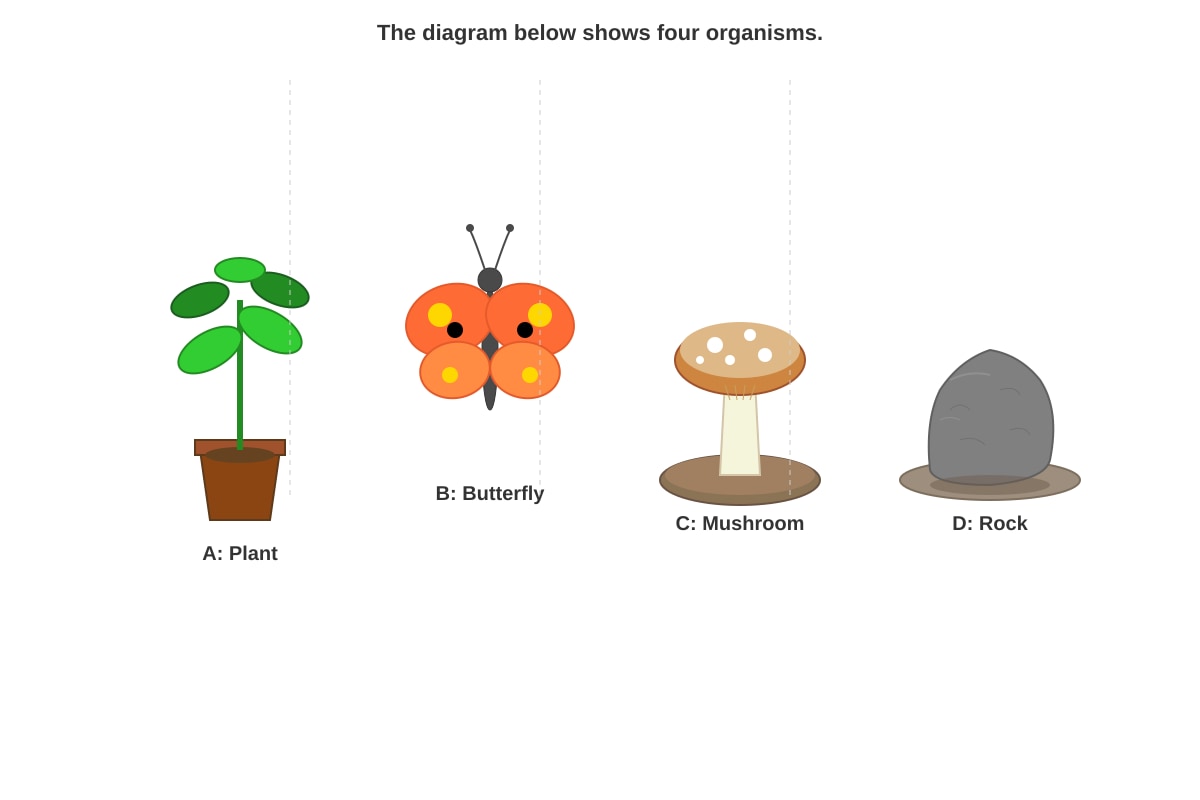
16. The diagram below shows four organisms.
<image_placeholder> id: Q16-fig1 type: diagram linked_question: Q16 description: Four illustrations arranged in a row: (A) a green potted plant with leaves, (B) a butterfly with open wings, (C) a mushroom growing on soil, and (D) a rock on the ground. Each is labelled A, B, C, D. labels: A: Plant, B: Butterfly, C: Mushroom, D: Rock values: Not applicable must_show: Clear illustrations of all four items, labels A to D visible </image_placeholder>
(a) Which of the above is/are living thing(s)? (1 mark)
(b) Give one reason why you chose your answer in (a). (1 mark)
(c) Which of the above is a non-living thing? (1 mark)
(d) Explain why the item you chose in (c) is non-living. (1 mark)
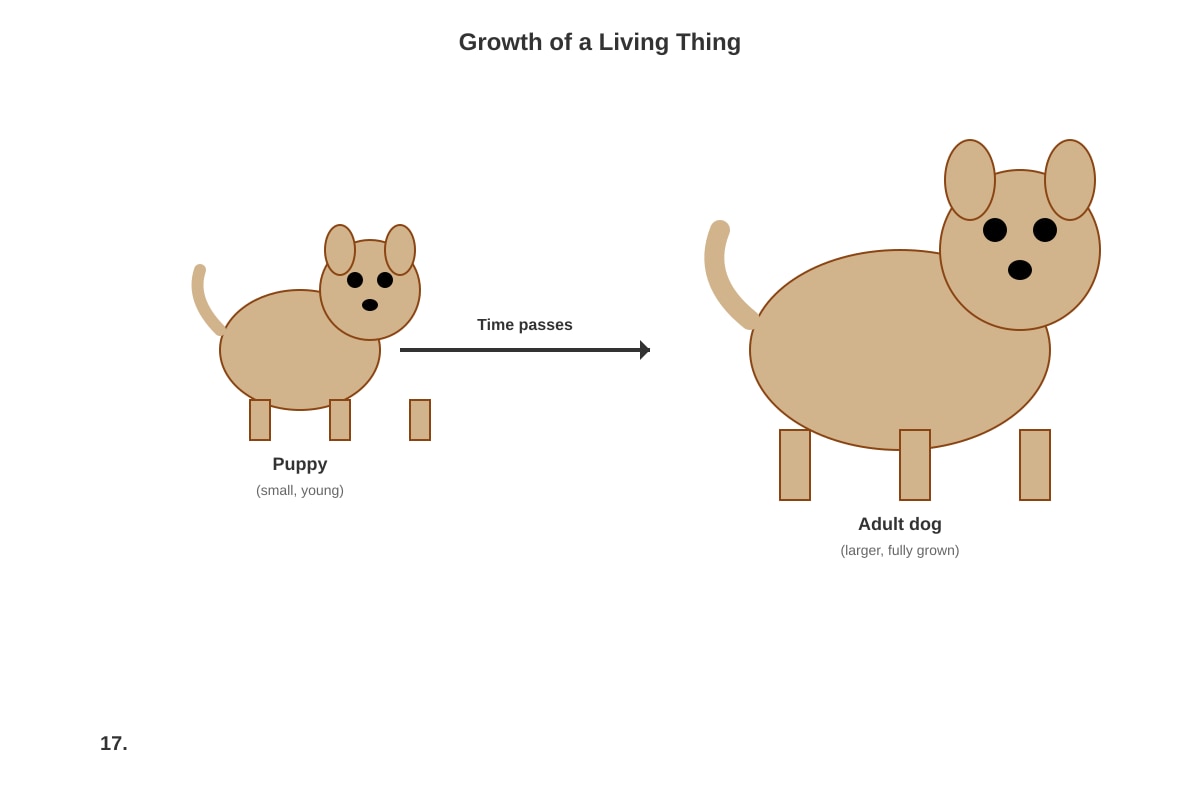
17. Study the pictures below.
<image_placeholder> id: Q17-fig1 type: diagram linked_question: Q17 description: Two side-by-side images. Left image: a small puppy. Right image: a larger adult dog of the same breed. An arrow points from the puppy to the adult dog with the label "Time passes". labels: Left: Puppy (small, young), Right: Adult dog (larger, fully grown) values: Not applicable must_show: Clear size difference between puppy and adult dog, arrow showing time progression </image_placeholder>
(a) What do the pictures show about living things? (1 mark)
(b) State one other characteristic of living things that is not shown in the pictures. (1 mark)
(c) A student says, "The puppy grew because it ate food." Is this statement correct? Explain your answer. (2 marks)
18. The table below shows some items found in a garden.
| Item | Living or Non-living? | Reason |
|---|---|---|
| Earthworm | ||
| Soil | ||
| Grass | ||
| Garden hose |
(a) Complete the table above by filling in whether each item is living or non-living and give a reason for each. (4 marks)
(b) Which item in the table is a living thing that can make its own food? (1 mark)
19. Read the following passage and answer the questions below.
A group of pupils went on a nature walk. They observed many things around them. They saw birds flying in the sky, ants crawling on the ground, and flowers blooming by the path. They also saw a stream flowing and rocks beside the stream. One pupil picked up a fallen leaf and said, "This leaf was once part of a living tree."
(a) List three living things mentioned in the passage. (1 mark)
(b) List two non-living things mentioned in the passage. (1 mark)
(c) Is the fallen leaf a living thing or a non-living thing? Explain your answer. (2 marks)
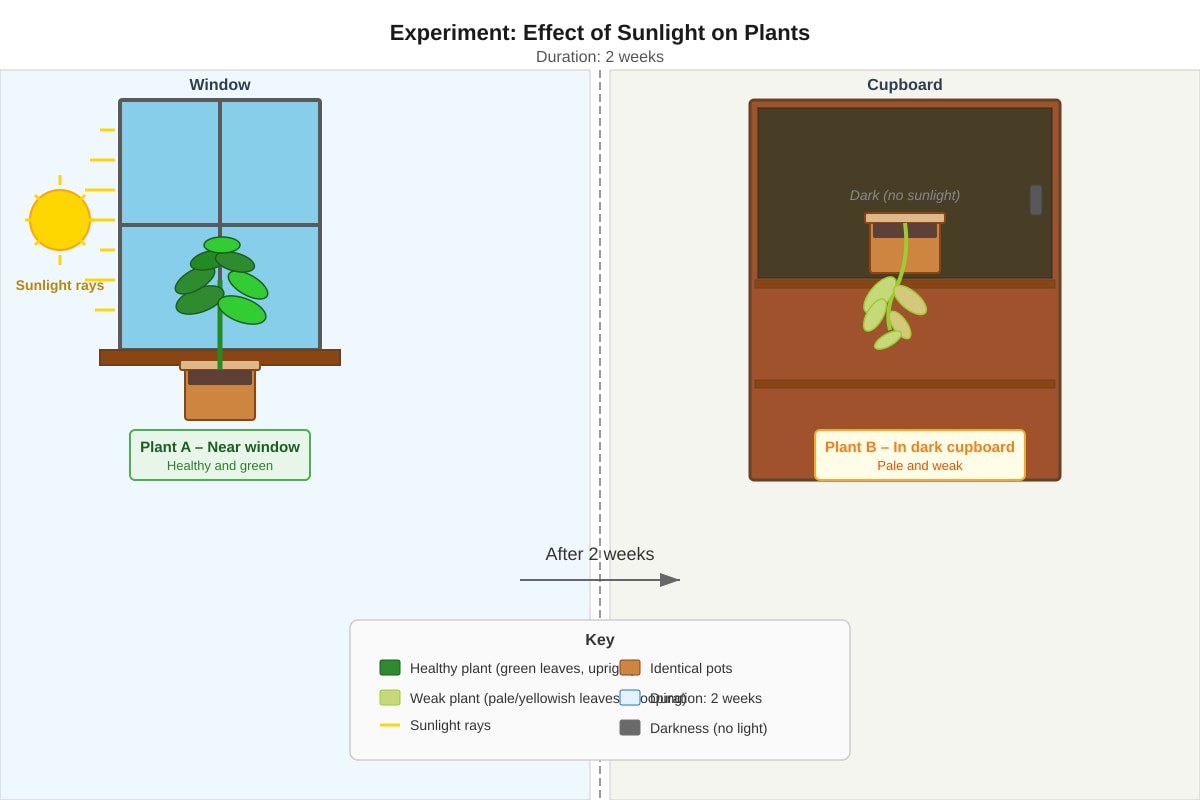
20. A student placed a potted plant near a window and another identical potted plant in a dark cupboard. After two weeks, the plant near the window was healthy and green, while the plant in the cupboard was pale and weak.
<image_placeholder> id: Q20-fig1 type: experimental_setup linked_question: Q20 description: A diagram showing two identical potted plants in separate conditions. Left: a plant on a windowsill with sunlight rays shown entering the window; label reads "Plant A – Near window". Right: a plant inside a closed dark cupboard; label reads "Plant B – In dark cupboard". Both pots are the same size and shape. After two weeks, Plant A is shown as green and upright, while Plant B is shown as pale/yellowish and drooping. labels: Plant A (near window, healthy), Plant B (in dark cupboard, pale and weak), Sunlight rays, Window, Cupboard values: Duration: 2 weeks must_show: Two plants in different conditions, sunlight shown for Plant A, darkness for Plant B, visible difference in health after 2 weeks </image_placeholder>
(a) What do living things need that the plant in the cupboard did not get enough of? (1 mark)
(b) What characteristic of living things does this experiment show? (1 mark)
(c) If the plant in the cupboard was left there for another month, what do you think would happen? Give a reason for your answer. (2 marks)
End of Quiz
Answers
Primary 4 Science Quiz - Diversity
Answer Key
Section A: Multiple Choice (1 mark each)
1. Answer: C (Grass)
Grass is a living thing because it grows, needs water and sunlight, and can make its own food. A rock, plastic bottle, and cloud do not show characteristics of living things.
2. Answer: C (River)
A river is non-living. It does not grow, reproduce, or need food. A butterfly, mushroom, and frog are all living things.
3. Answer: B (They can grow.)
All living things can grow. Not all living things can fly (e.g., plants), are green (e.g., animals), or live on land (e.g., fish). Growth is a universal characteristic of living things.
4. Answer: C (grow)
A seed germinating into a seedling shows that living things can grow. The seed increases in size and develops roots, stems, and leaves over time.
5. Answer: D (They do not need air.)
This statement is false. All living things need air (oxygen for most organisms) to survive. The other options are true characteristics of living things.
6. Answer: A (Ant, mushroom, fern)
All three are living things. Option B includes water (non-living), option C includes soil (non-living), and option D includes a shell (non-living, unless the animal is still inside).
7. Answer: C (respond to changes)
The plant bending towards sunlight shows that living things can respond to changes in their environment (in this case, light). This is called phototropism.
8. Answer: A (Wooden chair)
Wood comes from trees, which are living things. A wooden chair was once part of a living tree. Plastic bags, glass bottles, and metal spoons are made from non-living materials.
9. Answer: C (Rose plant)
Plants can make their own food through photosynthesis using sunlight, water, and carbon dioxide. Cats, dogs, and earthworms cannot make their own food.
10. Answer: B (All living things need air to survive.)
This is true. All living things need air (oxygen) for respiration. Option A is false (plants cannot move from place to place). Option C is false (e.g., rocks were never living). Option D is false (plants and fungi are also living things).
Section B: Fill in the Blanks (2 marks each)
11.
(a) Grass – Living
(b) Table – Non-living
(c) Bacteria – Living
(d) Cloud – Non-living
Marking: ½ mark each for correct classification (4 × ½ = 2 marks)
12. Any two of the following (1 mark each):
- They can grow.
- They need food and water.
- They can reproduce.
- They respond to changes in their surroundings.
- They need air to survive.
- They can move (in some way).
- They produce waste.
13. Answer: Living things can grow.
The diagram shows a seed developing into a seedling and then into a young plant. This demonstrates the characteristic of growth — living things increase in size and develop over time.
14.
(a) Mushroom – Living (✓ in Living column)
(b) Pencil – Non-living (✓ in Non-living column)
(c) Goldfish – Living (✓ in Living column)
(d) Fire – Non-living (✓ in Non-living column)
Marking: ½ mark each (4 × ½ = 2 marks)
15. Answer: A car is non-living because it cannot grow, reproduce, or make its own food. Although a car can move, it does not move on its own — it needs fuel and a driver. A car does not respond to changes in its environment the way living things do, and it does not need air, water, or food to survive.
Marking: 2 marks for a clear explanation mentioning at least two characteristics of living things that a car does not have.
Section C: Structured Questions
16.
(a) A, B, and C (the plant, butterfly, and mushroom) are living things. (1 mark)
(b) They are living because they can grow, need food and water, and/or can reproduce. (1 mark)
(c) D (Rock) is a non-living thing. (1 mark)
(d) A rock is non-living because it cannot grow, reproduce, or make its own food. It does not need air, water, or food to exist. (1 mark)
17.
(a) The pictures show that living things can grow. The puppy grows into a larger adult dog over time. (1 mark)
(b) Any one of the following: They need food/water, they can reproduce, they respond to changes, they need air, they produce waste. (1 mark)
(c) Yes, the statement is correct. Living things need food to grow. Food provides energy and materials needed for the puppy's body to increase in size and develop into an adult dog. Without food, the puppy would not be able to grow. (2 marks: 1 for correct answer, 1 for explanation)
18.
(a)
| Item | Living or Non-living? | Reason |
|---|---|---|
| Earthworm | Living | It can grow, move, and reproduce. |
| Soil | Non-living | It does not grow or reproduce on its own. |
| Grass | Living | It can grow and make its own food. |
| Garden hose | Non-living | It does not grow, reproduce, or need food. |
Marking: 1 mark each for correct classification with a valid reason (4 × 1 = 4 marks)
(b) Grass is the living thing that can make its own food through photosynthesis. (1 mark)
19.
(a) Any three of the following: birds, ants, flowers, tree (1 mark)
(b) Any two of the following: stream, rocks (1 mark)
(c) The fallen leaf is a non-living thing. Although it was once part of a living tree, once it falls off, it can no longer carry out life processes like making food, growing, or responding to changes. It will eventually decay. (2 marks: 1 for correct classification, 1 for explanation)
20.
(a) The plant in the cupboard did not get enough sunlight. (1 mark)
(b) This experiment shows that living things need sunlight (or light) to stay healthy and make their own food. (1 mark)
(c) The plant in the cupboard would likely die if left there for another month. Without sunlight, the plant cannot make its own food through photosynthesis. It would use up all the stored food in its leaves and eventually become too weak to survive. (2 marks: 1 for prediction, 1 for reason)
Total: 40 marks