From Real Exams Quiz
Primary 4 Science Systems Quiz
Free P4 Science Systems quiz, Exam version, with questions, answers, and syllabus-aligned practice for Singapore students.
These static practice materials are generated from the site's syllabus and paper-generation workflow, with source and model context shown so students and parents can evaluate the material before use.
Questions
Free quiz and exam paper access
Enter your details to view this paper
Your access is remembered on this device.
Answers
Primary 4 Science Quiz - Systems (Answer Key)
Total Marks: 40
Section A: Plant System (Questions 1 – 10)
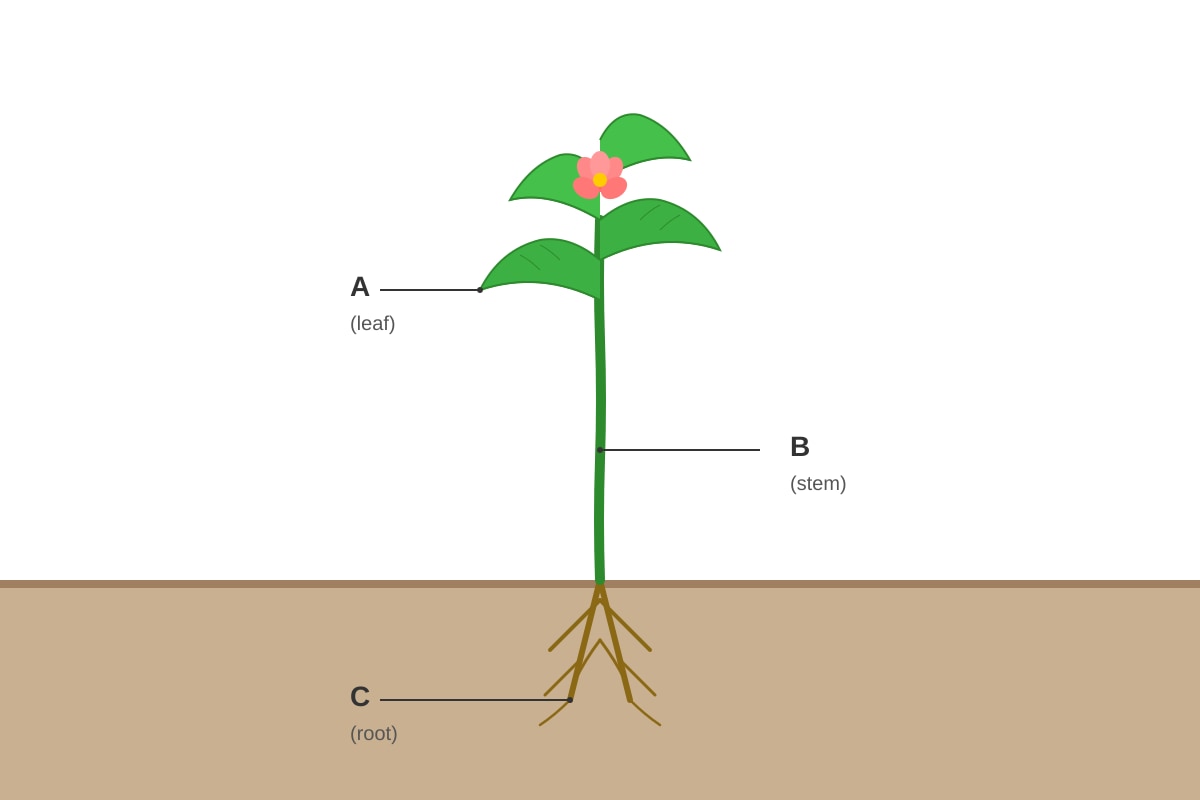
1. State the function of part C (root). [1 mark]
Answer: To absorb water and minerals from the soil. / To anchor the plant in the soil. (Accept either function.)
Marking Notes: Award 1 mark for stating either absorption or anchorage. Do not accept "to make food" or "to transport water".
Teaching Note: Roots have two main jobs: they take in water and dissolved minerals from the soil, and they hold the plant firmly in place. If a student says only "to absorb water", that is sufficient for 1 mark.
2. Which part of the plant takes in water and minerals from the soil? [1 mark]
Answer: Root(s)
Marking Notes: Accept "roots" or "root". Do not accept "stem" or "leaf".
Teaching Note: The roots are the part of the plant that grow underground. They have tiny root hairs that increase their surface area to absorb more water and minerals.
3. The stem of a plant is broken. What is one function of the stem that the plant can no longer do? [1 mark]
Answer: Transport water/food between the roots and leaves. / Support the plant upright.
Marking Notes: Accept either function. Award 1 mark for a clear statement of a stem function that is now lost.
Teaching Note: The stem has two main functions: it holds the plant up (support) and it acts like a highway, carrying water up from the roots to the leaves and food down from the leaves to the rest of the plant. If the stem is broken, both functions are affected.
4. A plant's leaves are covered with a thin layer of oil. How would this affect the plant? [1 mark]
Answer: The plant cannot make food / cannot photosynthesise. / The plant will eventually die.
Marking Notes: Accept any reasonable consequence related to the leaf's inability to function. Do not accept "the plant will dry out" unless linked to the leaf's function.
Teaching Note: Leaves are the food-making factories of the plant. They need sunlight and air to make food. If oil covers the leaves, it blocks the tiny pores (stomata) that let air in, so the plant cannot make its own food.
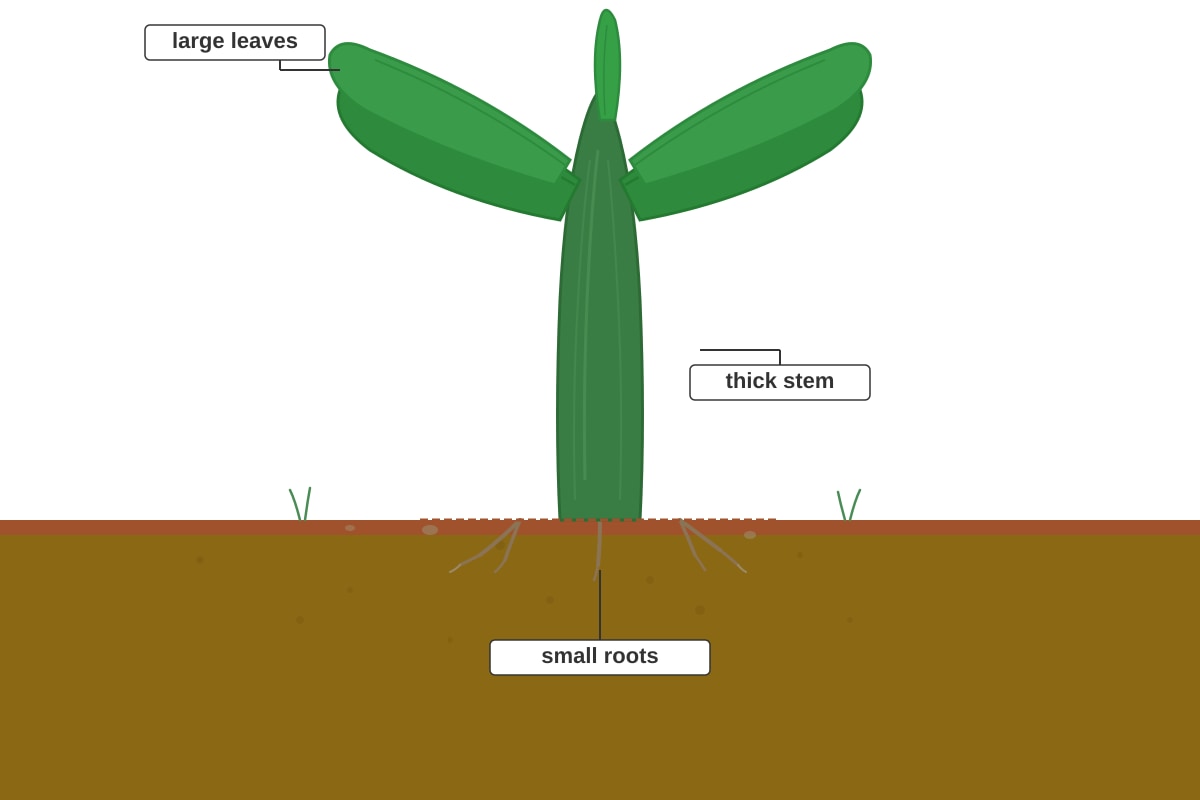
5. Give one reason why this plant has large leaves. [1 mark]
Answer: To capture more sunlight to make food. / To make more food for the plant.
Marking Notes: Accept any answer linking large leaves to increased food production or sunlight capture.
Teaching Note: Larger leaves have more surface area to catch sunlight. More sunlight means the plant can make more food through photosynthesis. This is especially useful for plants that grow in shady areas.
6. Which of the following is not a function of the root? [1 mark]
- A) To absorb water
- B) To make food for the plant
- C) To anchor the plant in the soil
- D) To absorb minerals
Answer: B) To make food for the plant
Marking Notes: 1 mark for correct answer. No half marks.
Teaching Note: Roots do not make food. Food is made in the leaves using sunlight. Roots absorb water and minerals and anchor the plant. This is a common misconception — students often think roots "eat" from the soil.
7. A plant is placed in a dark cupboard for one week. Which part of the plant will be most affected? [1 mark]
Answer: The leaves. / The leaves will turn yellow/pale and the plant cannot make food.
Marking Notes: Accept "leaves" or a description of what happens to the leaves.
Teaching Note: Leaves need light to make food. Without light, the leaves cannot photosynthesise, and they will eventually turn yellow and die. The roots and stem are less directly affected by the lack of light.
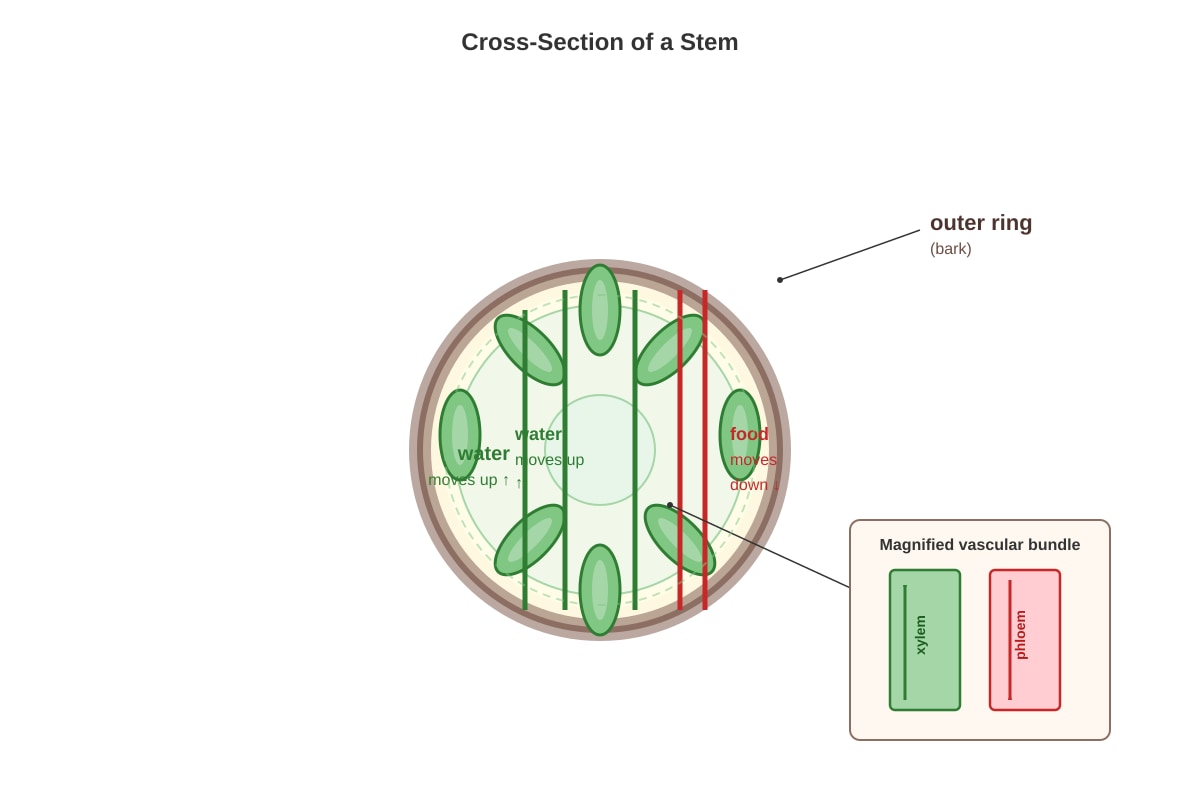
8. Name the part of the stem that transports water from the roots to the leaves. [1 mark]
Answer: The tubes / vascular bundles / xylem (Accept "xylem" if student knows the term, but "tubes" or "water-carrying tubes" is sufficient for P4.)
Marking Notes: Accept "tubes", "water tubes", "vascular bundles", or "xylem". Do not accept "stem" alone.
Teaching Note: Inside the stem are tiny tubes. Some tubes carry water up (xylem), and other tubes carry food down (phloem). For P4, it is enough to know that the stem has tubes that transport water.
9. A student removes all the leaves from a plant. What will most likely happen to the plant after a few days? [1 mark]
Answer: The plant will die / wilt because it cannot make food.
Marking Notes: Accept "the plant will die" or "the plant will wilt". Award 1 mark for a reasonable consequence.
Teaching Note: Without leaves, the plant has no way to make its own food. It will use up the food stored in its stem and roots, and eventually die. This shows how important leaves are for the plant's survival.
10. Match the plant part to its correct function. [1 mark]
| Plant Part | Function |
|---|---|
| Leaf | B) Makes food for the plant |
| Stem | C) Supports the plant and transports substances |
| Root | A) Absorbs water and minerals |
Marking Notes: Award 1 mark for all three correct matches. Award 0 marks if any match is incorrect.
Teaching Note: This is a basic recall question. Students should memorise the main function of each plant part: leaf (food), stem (support/transport), root (absorption/anchorage).
Section B: Human Digestive System (Questions 11 – 20)
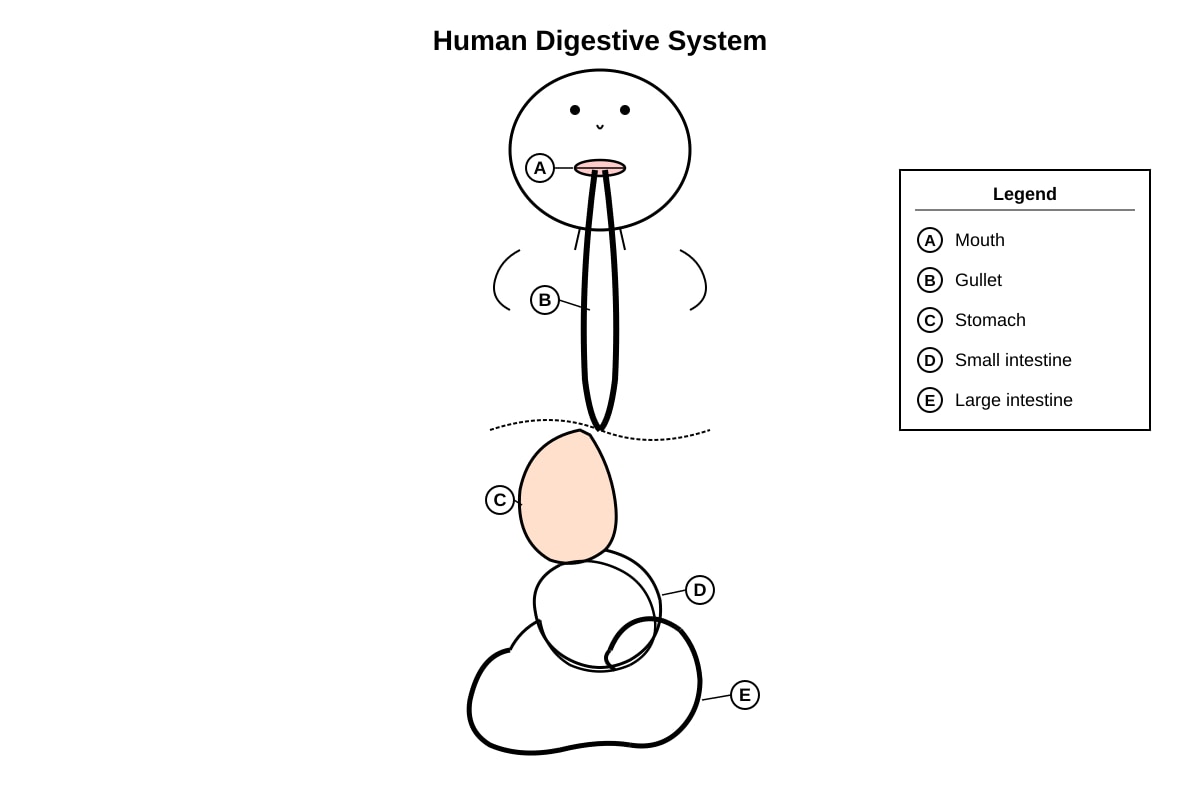
11. Name the part labelled B (gullet). [1 mark]
Answer: Gullet / Oesophagus
Marking Notes: Accept either "gullet" or "oesophagus". Do not accept "food pipe" unless it is clear.
Teaching Note: The gullet (also called the oesophagus) is the tube that connects the mouth to the stomach. It uses muscle movements to push food down.
12. What is the main function of the stomach in the digestive system? [2 marks]
Answer: To break down food further / to digest food using gastric juices / to churn and mix food with digestive juices.
Marking Notes:
- Award 2 marks for a complete answer: "It breaks down food using digestive juices/gastric juices."
- Award 1 mark for a partial answer: "It breaks down food" or "It digests food" without mentioning juices.
- Do not accept "it stores food" alone.
Teaching Note: The stomach is like a muscular bag. It churns food and mixes it with strong digestive juices (gastric juices) that help break down the food into a liquid form. This is an important step before the food moves to the small intestine.
13. After food leaves the stomach, where does it go next? [1 mark]
Answer: Small intestine
Marking Notes: Accept "small intestine" only. Do not accept "intestine" alone.
Teaching Note: The order is: mouth → gullet → stomach → small intestine → large intestine. After the stomach, the partially digested food moves into the small intestine for further digestion and absorption.
14. What is the function of the small intestine? [2 marks]
Answer: To digest food further and absorb nutrients into the bloodstream.
Marking Notes:
- Award 2 marks for mentioning both digestion and absorption.
- Award 1 mark for mentioning only one function (either digestion or absorption).
- Do not accept "to absorb water" (that is the large intestine's job).
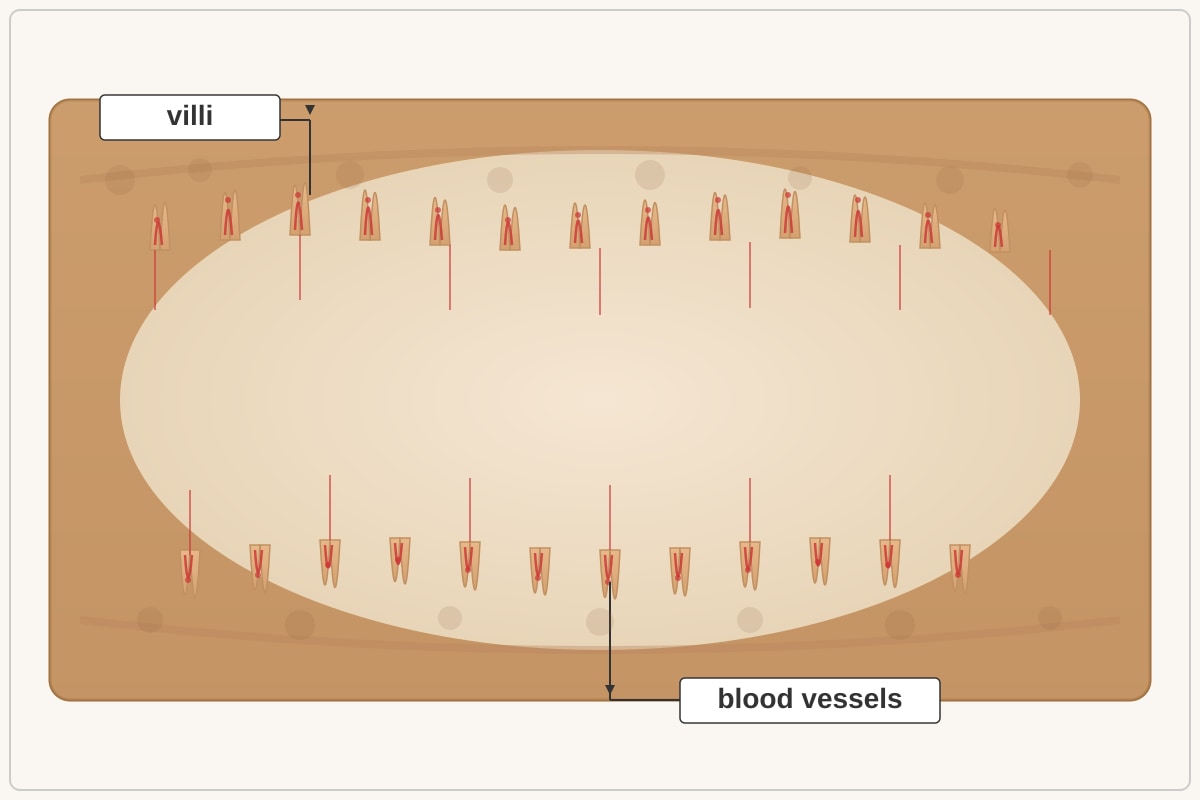
Teaching Note: The small intestine is where most of the digestion happens and where nutrients are absorbed into the blood. The tiny finger-like projections (villi) increase the surface area for absorption.
15. Which part of the digestive system absorbs water from undigested food? [1 mark]
Answer: Large intestine
Marking Notes: Accept "large intestine" only. Do not accept "intestine" alone.
Teaching Note: After the small intestine has absorbed the nutrients, the remaining material moves to the large intestine. The large intestine absorbs water from this material, making it more solid before it is removed from the body.
16. A person eats a piece of bread. In which order does the bread travel through the digestive system? [2 marks]
- A) Mouth → Stomach → Gullet → Small intestine → Large intestine
- B) Mouth → Gullet → Stomach → Small intestine → Large intestine
- C) Mouth → Gullet → Stomach → Large intestine → Small intestine
- D) Mouth → Stomach → Gullet → Small intestine → Large intestine
Answer: B) Mouth → Gullet → Stomach → Small intestine → Large intestine
Marking Notes: 2 marks for correct answer. 0 marks for any other answer.
Teaching Note: The correct order is: mouth (chewing), gullet (transport), stomach (digestion), small intestine (absorption), large intestine (water absorption). Option B is the only one with the correct sequence.
17. Why is it important for food to be chewed thoroughly in the mouth? [1 mark]
Answer: To break food into smaller pieces so it is easier to digest / to increase surface area for digestion.
Marking Notes: Accept any answer that links chewing to making digestion easier. Do not accept "to make it taste better" or "to swallow it".
Teaching Note: Chewing breaks food into smaller pieces. This increases the surface area of the food, making it easier for digestive juices to work on it. This is the first step of mechanical digestion.
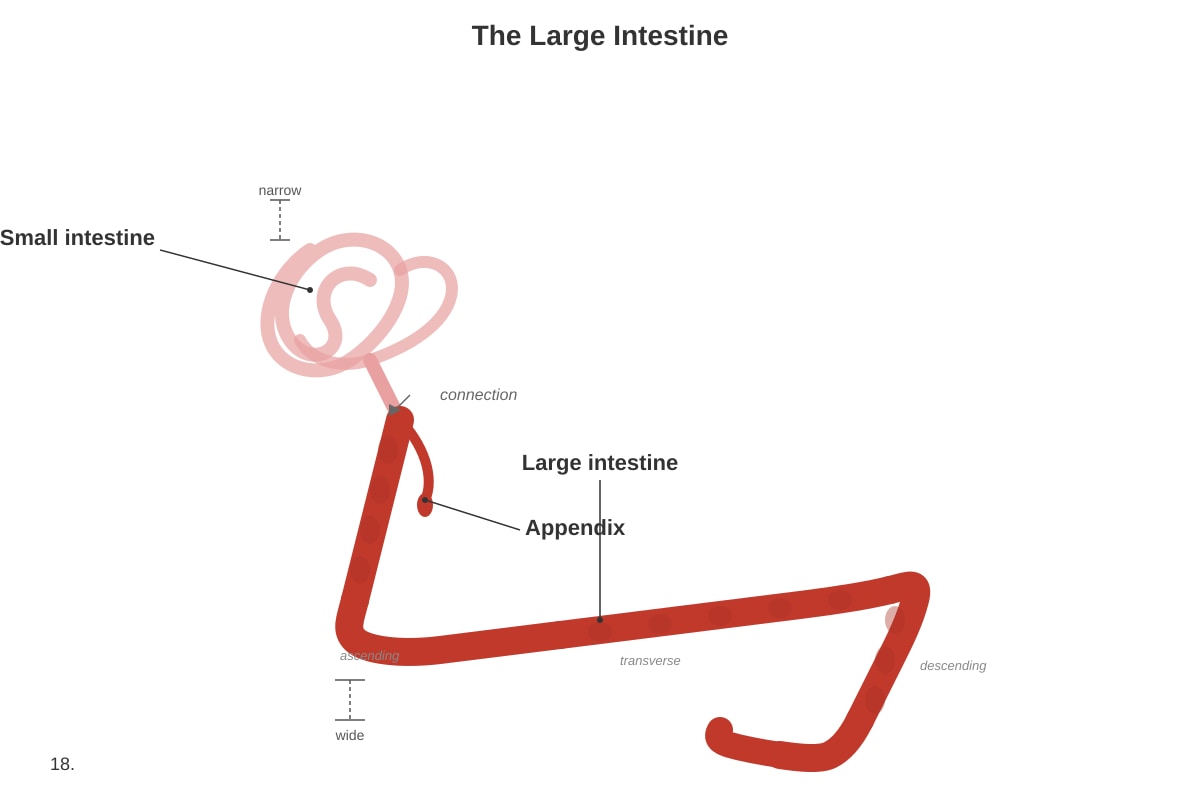
18. State one function of the large intestine. [1 mark]
Answer: To absorb water from undigested food. / To form and store faeces.
Marking Notes: Accept either function. Do not accept "to digest food".
Teaching Note: The large intestine's main job is to absorb water and minerals from the remaining undigested food. It also stores the solid waste (faeces) before it leaves the body.
19. What is the name of the tube that connects the mouth to the stomach? [1 mark]
Answer: Gullet / Oesophagus
Marking Notes: Accept either "gullet" or "oesophagus".
Teaching Note: This is a straightforward recall question. The gullet is the tube that carries food from the mouth to the stomach using wave-like muscle movements called peristalsis.
20. Explain why the digestive system is considered a system. [2 marks]
Answer: Because it is made up of different parts (organs) that work together to perform a common function (digesting food and absorbing nutrients).
Marking Notes:
- Award 2 marks for a complete answer that mentions multiple parts working together for a common purpose.
- Award 1 mark for a partial answer that mentions either multiple parts OR a common function, but not both.
- Do not accept "because it digests food" alone.
Teaching Note: A system is a group of parts that work together to perform a function. The digestive system includes the mouth, gullet, stomach, small intestine, and large intestine. Each part has a specific job, but they all work together to break down food and absorb nutrients. This is why it is called a system.
END OF ANSWER KEY