From Real Exams Quiz
Primary 4 Science Plants Quiz
Free P4 Science Plants quiz, Exam version, with questions, answers, and syllabus-aligned practice for Singapore students.
These static practice materials are generated from the site's syllabus and paper-generation workflow, with source and model context shown so students and parents can evaluate the material before use.
Questions
Free quiz and exam paper access
Enter your details to view this paper
Your access is remembered on this device.
Answers
Primary 4 Science Quiz - Plants: Answer Key
Total Marks: 20
Section A: Multiple Choice Questions (Questions 1 - 5)
Each question carries 1 mark.
1. Answer: C) Root
- Explanation: The root is the part of the plant that grows underground. Its main job is to absorb water and dissolved minerals from the soil. The leaf makes food, the stem transports water and food, and the flower is for reproduction.
- Marking: 1 mark for C.
2. Answer: D) transport water and food to different parts of the plant.
- Explanation: The stem acts like a highway for the plant. It contains tubes called xylem and phloem (though these terms are not required at P4). The xylem carries water from the roots up to the leaves, and the phloem carries food made in the leaves to other parts of the plant. The leaf makes food, the roots absorb water and anchor the plant.
- Marking: 1 mark for D.
3. Answer: B) sunlight
- Explanation: Plants need sunlight to make food through a process called photosynthesis. When a leaf is covered with black paper, it cannot receive sunlight. Without sunlight, the leaf cannot make food (chlorophyll) and it turns yellow. This shows that sunlight is necessary for food-making.
- Marking: 1 mark for B.
4. Answer: B) To make food
- Explanation: The roots are responsible for absorbing water and minerals from the soil and anchoring the plant in the ground. Making food is the function of the leaves, not the roots. The leaves contain chlorophyll which captures sunlight to make food.
- Marking: 1 mark for B.
5. Answer: C) leaf blade
- Explanation: The leaf blade is the broad, flat part of the leaf. This shape is important because it provides a large surface area to capture sunlight for photosynthesis. The vein contains tubes for transport, the stalk connects the leaf to the stem, and the midrib is the main vein in the center of the leaf.
- Marking: 1 mark for C.
Section B: Fill in the Blanks (Questions 6 - 10)
Each question carries 1 mark.
6. Answer: photosynthesis
- Explanation: Photosynthesis is the process by which plants use sunlight, water, and carbon dioxide to make their own food (glucose) and oxygen. The word comes from "photo" meaning light and "synthesis" meaning to make.
- Marking: 1 mark for "photosynthesis". Accept "photosynthesis" spelled correctly or close approximations.
7. Answer: leaf stalk / petiole
- Explanation: The leaf stalk (also called the petiole) is the small stem-like structure that attaches the leaf blade to the main stem of the plant. It helps position the leaf to receive sunlight.
- Marking: 1 mark for "leaf stalk" or "petiole".
8. Answer: carbon dioxide
- Explanation: Plants need three main things to make food: sunlight, water, and carbon dioxide. Carbon dioxide is a gas that plants take in from the air through tiny holes in their leaves called stomata.
- Marking: 1 mark for "carbon dioxide". Accept "carbon dioxide" or "CO2".
9. Answer: veins
- Explanation: The veins of a leaf are the network of tubes that run through the leaf blade. They contain xylem and phloem which transport water and food to and from the leaf. The pattern of veins can be different in different plants.
- Marking: 1 mark for "veins".
10. Answer: shoot system / stem and leaves
- Explanation: The part of the plant that grows above the ground is called the shoot system. It includes the stem, leaves, and flowers. The part below the ground is the root system.
- Marking: 1 mark for "shoot system" or "stem and leaves".
Section C: Short Answer Questions (Questions 11 - 15)
Each question carries 2 marks.
11. Answer: (a) To transport water and food to different parts of the plant. (b) To support the leaves and flowers.
- Explanation: The stem has two main functions. First, it acts as a transport system, carrying water from the roots to the leaves and food from the leaves to other parts of the plant. Second, it provides support, holding the leaves up so they can receive sunlight and holding the flowers up so they can be pollinated.
- Marking: 1 mark for each correct function. Accept any two of: transport water, transport food, support the plant, hold leaves up to sunlight.
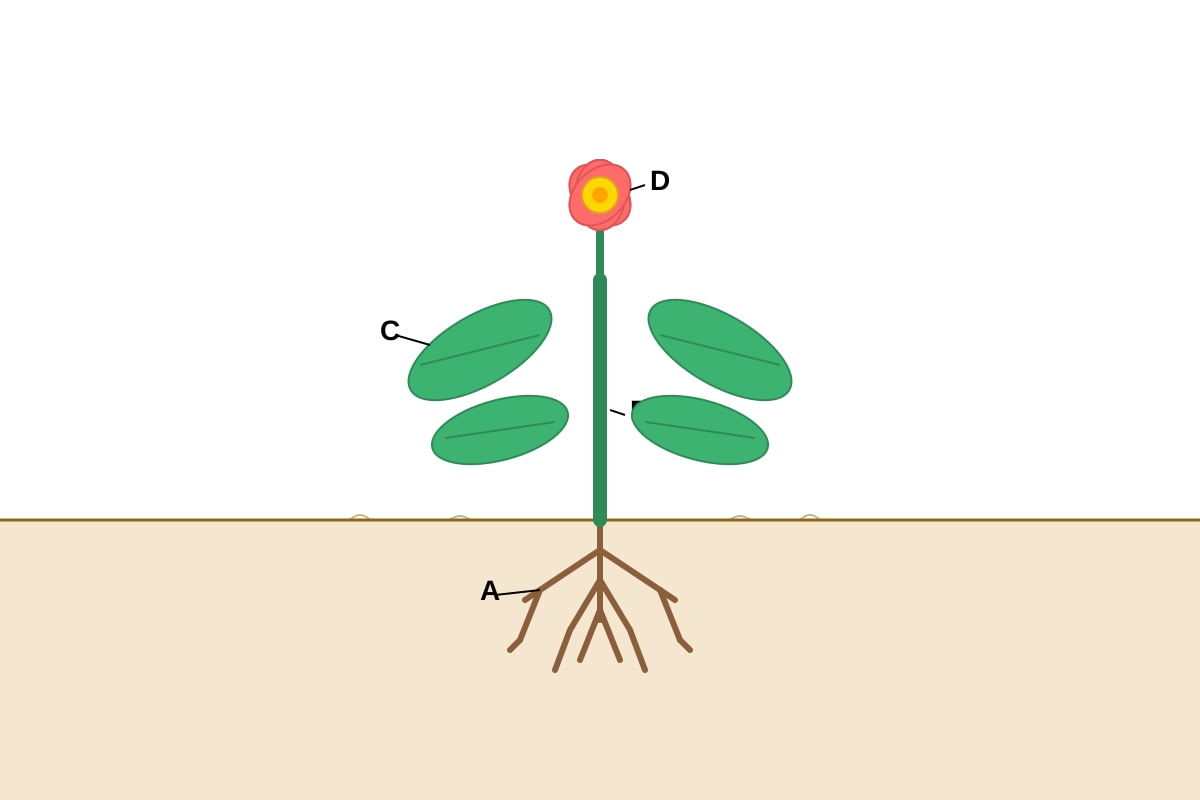
12. Answer: Part C (leaves)
- Explanation: The leaves are the food-making factories of the plant. They contain chlorophyll, a green pigment that captures sunlight energy. Using this energy, the leaves combine water and carbon dioxide to make food (glucose) through photosynthesis.
- Marking: 1 mark for "C" or "leaves".
13. Answer: The plant would become weak and its leaves would turn yellow. This is because the plant needs sunlight to make food. Without sunlight, the plant cannot make food and will eventually die.
- Explanation: Sunlight is essential for photosynthesis. If a plant is kept in the dark, it cannot produce chlorophyll (the green pigment) and the leaves will turn yellow. The plant will not be able to make its own food and will become weak and eventually die.
- Marking: 1 mark for stating the plant would become weak/yellow. 1 mark for explaining that it needs sunlight to make food.
14. Answer: Leaves are broad and flat to capture as much sunlight as possible for photosynthesis.
- Explanation: The broad, flat shape of leaves provides a large surface area. This large surface area allows the leaf to capture more sunlight, which is needed for photosynthesis. More sunlight means the plant can make more food.
- Marking: 1 mark for stating the shape captures sunlight. 1 mark for linking to food-making/photosynthesis.
15. Answer: Dust on the leaves would block sunlight from reaching the leaf. This would reduce the plant's ability to make food through photosynthesis.
- Explanation: Dust acts as a barrier, preventing sunlight from reaching the chlorophyll in the leaf cells. Without enough sunlight, the rate of photosynthesis decreases, and the plant will make less food. This can slow down the plant's growth.
- Marking: 1 mark for stating dust blocks sunlight. 1 mark for explaining that this reduces food-making/photosynthesis.
Section D: Structured Questions (Questions 16 - 20)
Each question carries 2 marks.
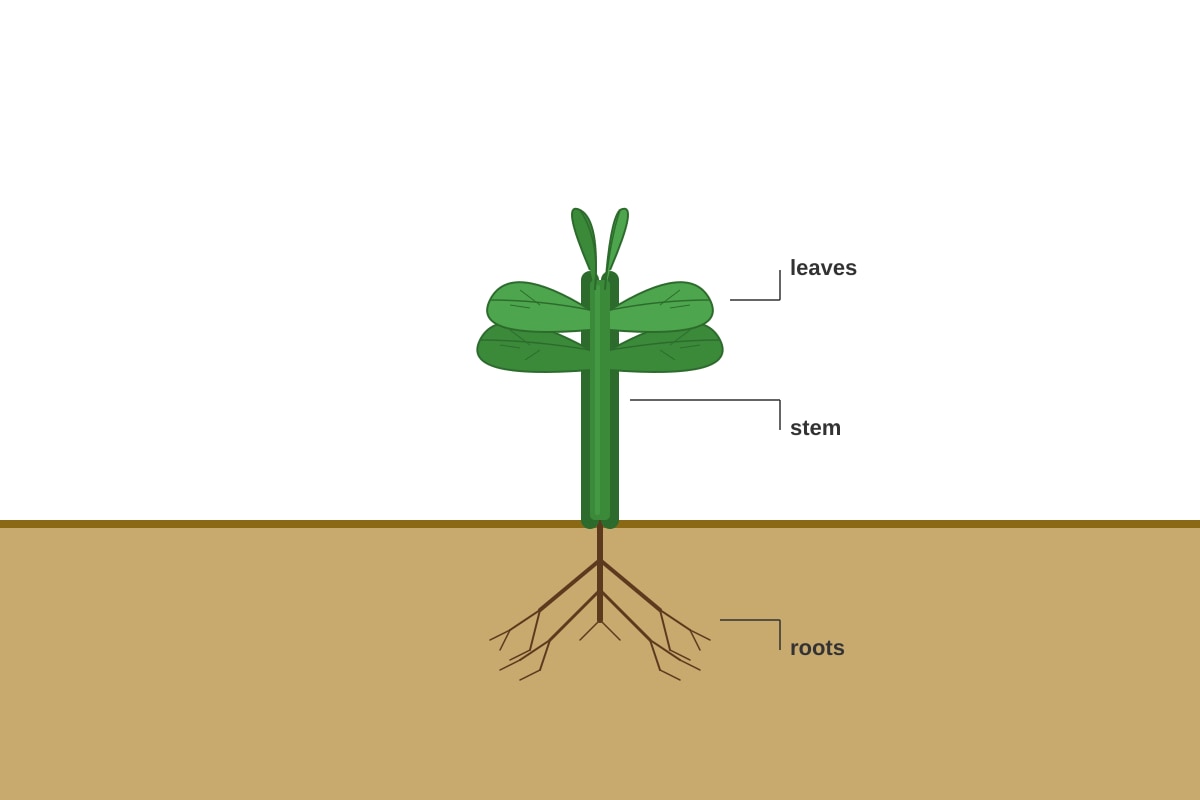
16. (a) Answer: roots
- Explanation: The part of the plant that is labelled 'roots' is the root system. It grows underground and is usually a network of thin, branching structures.
- Marking: 1 mark for "roots".
(b) Answer: To absorb water and minerals from the soil. / To anchor the plant in the ground.
- Explanation: The roots have two main functions. They absorb water and dissolved minerals from the soil, which are then transported to the rest of the plant. They also anchor the plant firmly in the ground, preventing it from being blown over by the wind.
- Marking: 1 mark for any one correct function.
17. (a) Answer: To find out if plants need water to grow.
- Explanation: The aim of the experiment is to test the hypothesis that plants need water to grow. The student is comparing a plant that gets water (Plant A) with one that does not (Plant B).
- Marking: 1 mark for stating the aim clearly.
(b) Answer: Plant B would be wilted, droopy, and its leaves would turn yellow or brown. It would not grow as well as Plant A.
- Explanation: Without water, the plant cannot carry out photosynthesis or transport nutrients. The cells will lose water and the plant will wilt. Eventually, the plant will die.
- Marking: 1 mark for describing the expected observation (wilted, droopy, yellow leaves).
18. (a) Answer: Palisade mesophyll
- Explanation: The palisade mesophyll layer is located just below the upper epidermis of the leaf. It contains many chloroplasts (the organelles where photosynthesis takes place) and is the main site of food production in the leaf.
- Marking: 1 mark for "palisade mesophyll".
(b) Answer: To allow gases (carbon dioxide and oxygen) to move in and out of the leaf.
- Explanation: Stomata are tiny openings, usually on the lower surface of the leaf. They allow carbon dioxide to enter the leaf for photosynthesis and allow oxygen (a waste product of photosynthesis) to leave the leaf.
- Marking: 1 mark for stating gas exchange.
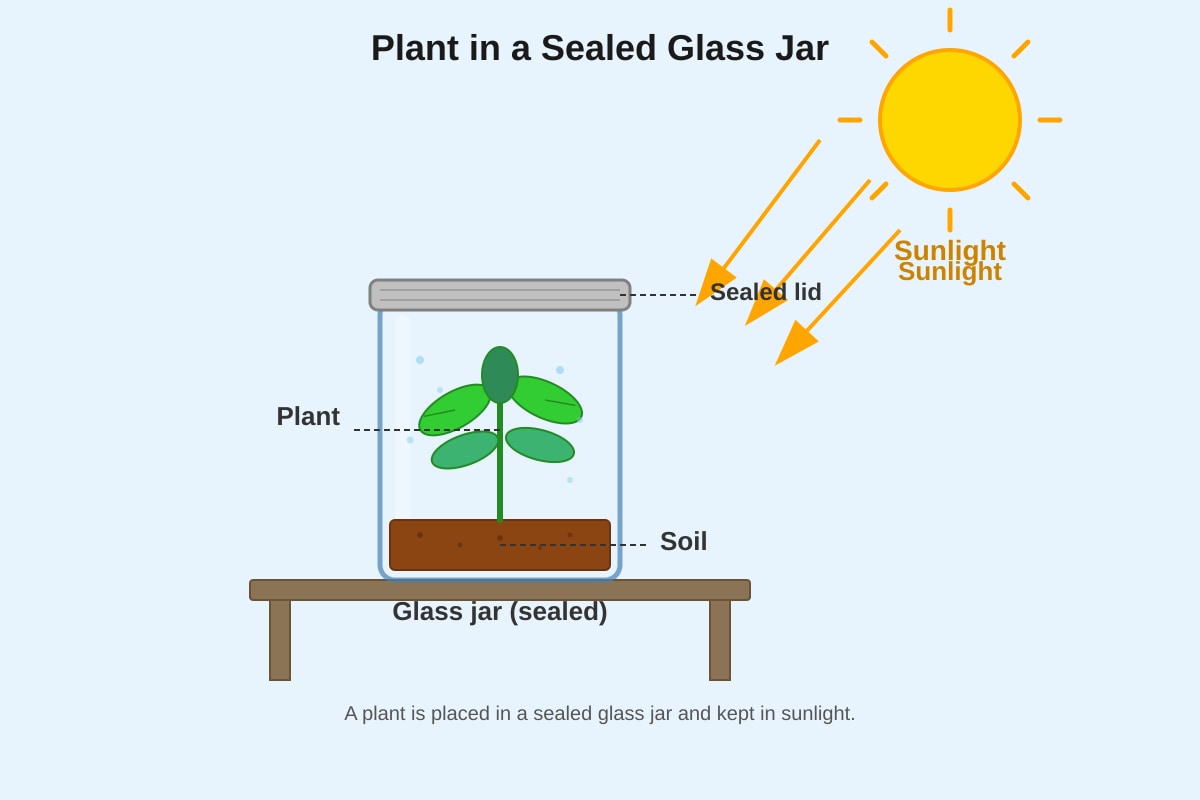
19. (a) Answer: Oxygen
- Explanation: During photosynthesis, plants use carbon dioxide and water to make food (glucose) and oxygen. The oxygen is released into the air as a byproduct.
- Marking: 1 mark for "oxygen".
(b) Answer: The amount of oxygen in the jar would increase.
- Explanation: As the plant continues to photosynthesize in sunlight, it will keep producing oxygen. Since the jar is sealed, the oxygen cannot escape, so the concentration of oxygen inside the jar will increase over time.
- Marking: 1 mark for "increase".
20. (a) Answer: The soil lacks water.
- Explanation: Dry and hard soil indicates that there is very little water available for the plants. Plants need water for photosynthesis and to transport nutrients.
- Marking: 1 mark for "lack of water" or "dry soil".
(b) Answer: The farmer should water the plants regularly.
- Explanation: To help the plants grow better, the farmer needs to provide them with water. Regular watering will make the soil moist, allowing the roots to absorb water and the plants to carry out photosynthesis.
- Marking: 1 mark for "water the plants" or "irrigate the soil".
End of Answer Key