From Real Exams Quiz
Primary 4 Science Plants Quiz
Free P4 Science Plants quiz, Exam version, with questions, answers, and syllabus-aligned practice for Singapore students.
These static practice materials are generated from the site's syllabus and paper-generation workflow, with source and model context shown so students and parents can evaluate the material before use.
Questions
Free quiz and exam paper access
Enter your details to view this paper
Your access is remembered on this device.
Answers
Answer Key: Primary 4 Science Quiz - Plants
Total Marks: 30
Section A: Multiple-Choice Questions (10 marks)
1 mark each
1. C) Root
- Explanation: Roots are the part of the plant that grow underground. Their main functions include absorbing water and dissolved minerals from the soil. Leaves make food, the stem transports materials, and the flower is for reproduction.
- Common Mistake: Students may choose 'stem' because it transports water, but the root is the part that initially absorbs it.
2. D) Transport water and food to different parts of the plant.
- Explanation: The stem acts like a highway system for the plant. It contains tubes (xylem and phloem) that carry water from the roots to the leaves and food from the leaves to other parts of the plant. Making food is the leaf's job, and holding the plant in the ground is the root's job.
3. B) Stem
- Explanation: The stem contains tubes called xylem that transport water (and the red colouring dissolved in it) from the roots up to the leaves and flowers. This demonstrates the stem's transport function.
4. A) Absorb more sunlight for photosynthesis.
- Explanation: A large, flat, and broad surface area allows a leaf to capture as much sunlight as possible. Sunlight is a key ingredient for photosynthesis, the process by which plants make their own food.
5. C) Making food
- Explanation: Making food (photosynthesis) is the primary function of the leaves, which contain chlorophyll. Roots are responsible for absorption (water and minerals) and anchorage.
6. C) Leaves
- Explanation: Leaves need sunlight to carry out photosynthesis. Without light, they cannot produce food (chlorophyll), and they will eventually turn yellow and die. The plant may also become weak and stunted.
7. B) To transport water and food within the leaf.
- Explanation: The veins of a leaf are like the leaf's own circulatory system. They are connected to the stem's transport system and carry water to the leaf cells and food (sugar) away from the leaf cells.
8. B) It will not be able to absorb enough water.
- Explanation: The roots are the primary organs for water absorption. If they are damaged, the plant cannot take in enough water to support its functions, leading to wilting and eventually death. The plant would still have leaves to make food, but the lack of water would stop photosynthesis.
9. D) Flower
- Explanation: Flowers are the reproductive organs of a plant. They contain the male (stamen) and female (pistil) parts that produce seeds for the next generation of plants.
10. B) To reduce water loss from the leaf.
- Explanation: The waxy layer, called the cuticle, is a waterproof coating on the surface of leaves. It helps prevent the leaf from losing too much water through evaporation, especially on hot or windy days.
Section B: Short-Answer Questions (12 marks)
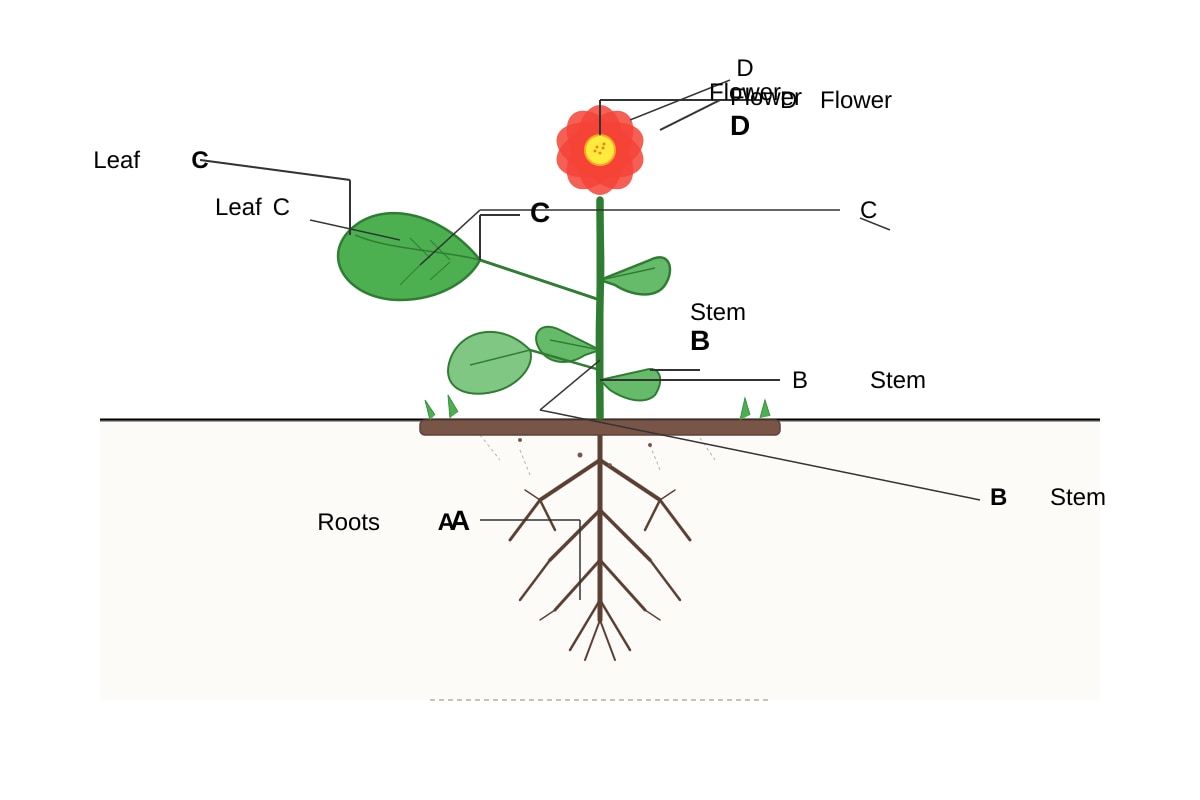
11. (a) Roots [1 mark]
- Explanation: Part A is the part of the plant that is underground. This is the root system.
(b) To transport water and food to different parts of the plant. (or similar) [1 mark]
- Explanation: Part B is the stem. Its main job is to act as a transport system, carrying water from the roots up to the leaves and food from the leaves down to the roots and other parts.
12. (a) To find out if the plant has made food. [1 mark]
- Explanation: Starch is a form of stored food that plants make during photosynthesis. Testing for starch is a way to check if photosynthesis has occurred.
(b) The plant will have little or no starch. [1 mark]
- Explanation: Without sunlight, the plant cannot carry out photosynthesis to make food (starch). It will use up any stored starch to survive, so the test will show little to no starch present.
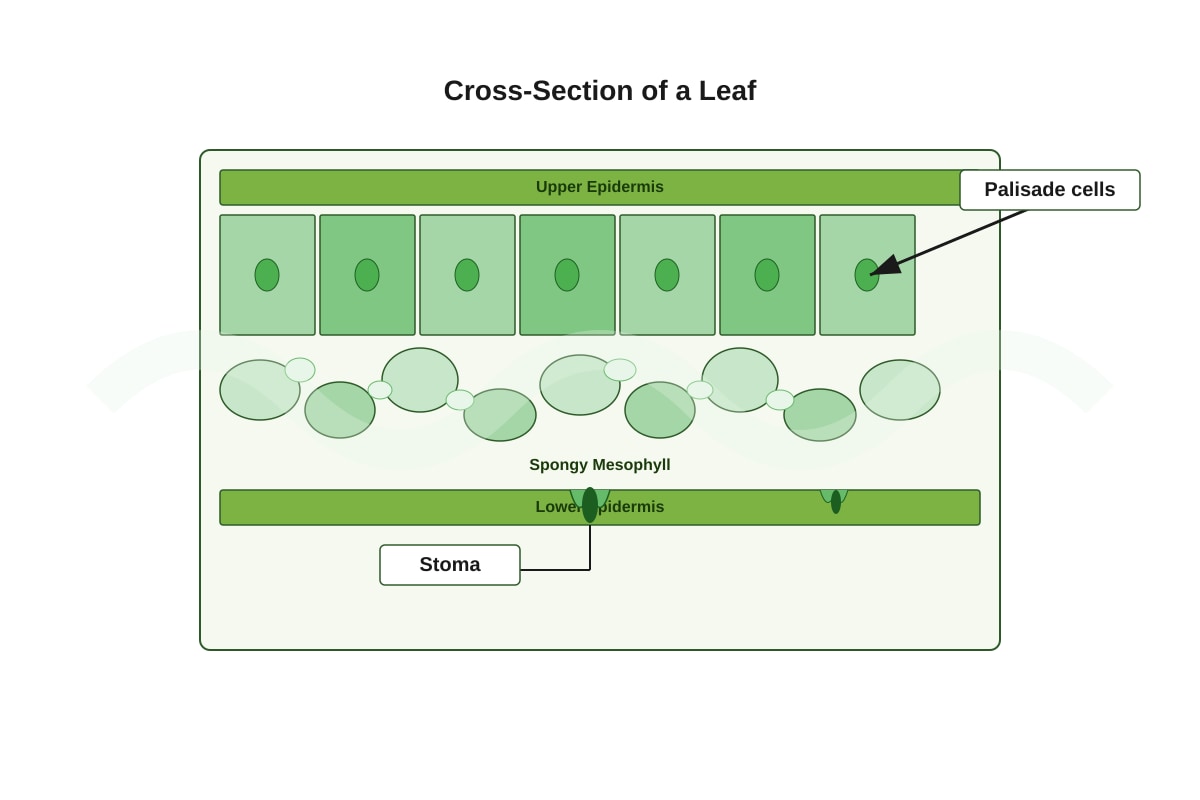
13. (a) Palisade cells [1 mark]
- Explanation: Palisade cells are located near the top of the leaf and are packed with chloroplasts. This is where most of the photosynthesis happens because they receive the most sunlight.
(b) To allow gases (carbon dioxide and oxygen) to move in and out of the leaf. [1 mark]
- Explanation: The stoma (plural: stomata) are tiny pores, usually on the underside of the leaf. They open and close to let carbon dioxide in for photosynthesis and oxygen out as a waste product.
14. (a) The plant was losing water faster than it was absorbing it, causing the cells to lose water and become soft. [1 mark]
- Explanation: On a hot day, water evaporates from the leaves (transpiration) very quickly. If the roots cannot absorb water fast enough to replace it, the plant cells lose water, become less firm, and the plant wilts.
(b) Roots [1 mark]
- Explanation: The roots are the part of the plant that absorb water from the soil. When the gardener watered the plant, the roots absorbed the water and transported it to the rest of the plant.
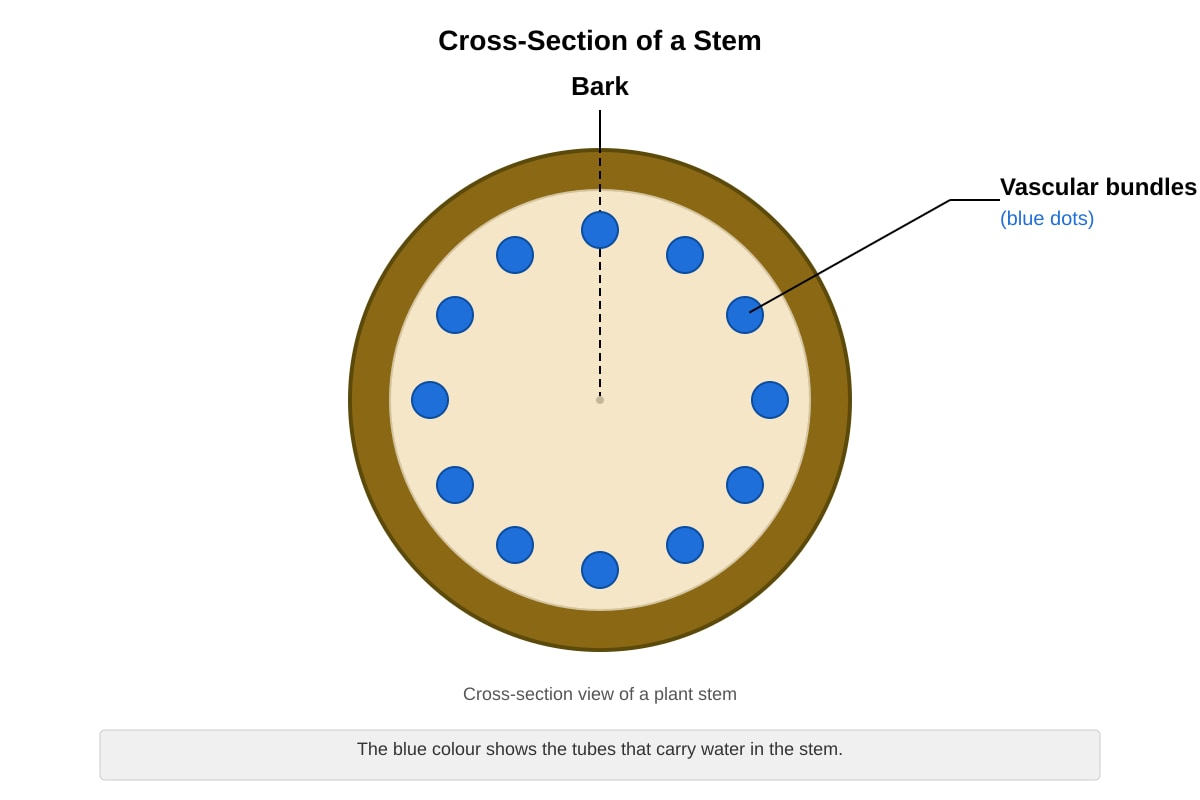
15. (a) The blue water has been transported up the stem. [1 mark]
- Explanation: The blue colour in the cross-section shows that the coloured water has been drawn up through the stem's tubes, proving that the stem transports water.
(b) Xylem (tubes) [1 mark]
- Explanation: Xylem are the specialised tubes in the stem that carry water and dissolved minerals from the roots to the leaves. (Note: The term 'xylem' is a P5 topic, so accept 'tubes' or 'water-carrying tubes'.)
16. (a) Fibrous root system [1 mark]
- Explanation: A root system with many thin, branching roots that spread out is called a fibrous root system. This is common in weeds and grass.
(b) It helps the plant absorb water from a large area of soil. (or similar) [1 mark]
- Explanation: The spreading nature of fibrous roots allows the plant to collect water and minerals from a wide area near the soil surface. It also helps to hold the soil together, preventing erosion.
Section C: Structured / Application Questions (8 marks)
17. (a) The leaves will wilt (droop) and may turn yellow or brown. [1 mark]
- Explanation: Without water, the plant cells will lose their firmness and the leaves will droop.
(b) The roots absorb water from the soil. [1 mark for function] Without water, the roots cannot absorb water to transport to the leaves. [1 mark for explanation]
- Explanation: The roots are the plant's water intake system. If Plot B is not watered, the soil is dry, and the roots cannot absorb water. The leaves then do not get the water they need to stay firm and carry out photosynthesis, causing them to wilt.
18. (a) Transpiration [1 mark]
- Explanation: Transpiration is the process by which plants lose water vapour from their leaves. The water vapour is released into the air inside the bag.
(b) Stomata (or leaves) [1 mark]
- Explanation: Water vapour exits the leaf through tiny pores called stomata. The water vapour then condenses on the cool surface of the plastic bag, forming water droplets.
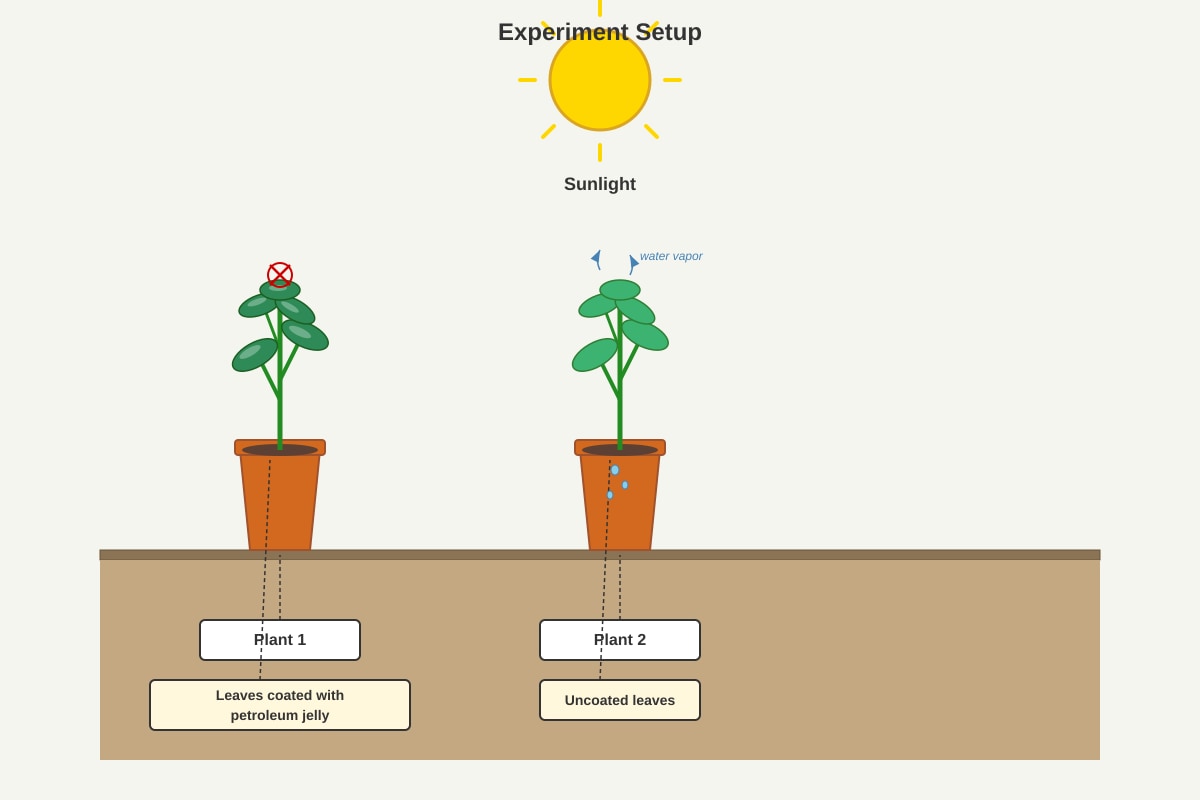
19. (a) To find out if leaves are important for the plant's survival (or to see what happens when the stomata are blocked). [1 mark]
- Explanation: The petroleum jelly blocks the stomata on the leaves, preventing gas exchange and water loss. The experiment aims to see the effect of this on the plant.
(b) Plant 1 will wilt and die, while Plant 2 will remain healthy. [1 mark for prediction] The petroleum jelly blocks the stomata, preventing the plant from taking in carbon dioxide for photosynthesis and from releasing oxygen. [1 mark for explanation]
- Explanation: The stomata are essential for the plant to get the carbon dioxide it needs to make food. By blocking them, the plant cannot photosynthesise and will eventually starve. It also cannot release water vapour, which can cause other problems.
20. (a) Spines reduce water loss from the plant. [1 mark]
- Explanation: Broad leaves have a large surface area and lose a lot of water through transpiration. By having spines (modified leaves) with a tiny surface area, the cactus drastically reduces the amount of water it loses, which is crucial for survival in a dry desert.
(b) To store water. [1 mark]
- Explanation: The thick, fleshy stem of a cactus is adapted to store large amounts of water. The plant can then use this stored water during long periods of drought.
END OF ANSWER KEY