From Real Exams Quiz
Primary 4 Science Plants Quiz
Free P4 Science Plants quiz, Exam version, with questions, answers, and syllabus-aligned practice for Singapore students.
These static practice materials are generated from the site's syllabus and paper-generation workflow, with source and model context shown so students and parents can evaluate the material before use.
Questions
Free quiz and exam paper access
Enter your details to view this paper
Your access is remembered on this device.
Answers
Primary 4 Science Quiz - Plants: Answer Key
Total Marks: 30
Section A: Multiple-Choice Questions (10 marks)
1 mark each
1. C) Root
- Explanation: Roots are the part of the plant that grow underground. Their main job is to anchor the plant and absorb water and dissolved minerals from the soil.
- Common Mistake: Students may choose the stem, but the stem's main job is transport, not absorption.
2. C) To transport water and food around the plant
- Explanation: The stem acts like a system of pipes. It contains tubes called xylem and phloem (though these terms are not required at P4). The xylem carries water and minerals from the roots up to the leaves, and the phloem carries food made in the leaves to other parts of the plant.
- Common Mistake: Students may think the stem only holds the plant up. While support is a function, transport is its primary function.
3. A) Absorbing more sunlight for photosynthesis
- Explanation: A broad, flat leaf has a large surface area. This allows it to capture more sunlight, which is needed for the plant to make its own food through photosynthesis.
- Common Mistake: Students may think it is for absorbing water. Leaves do lose water, but their primary shape is for light capture.
4. C) Making food for the plant
- Explanation: The leaves are the main food-making part of the plant. Roots are for anchorage, absorption, and sometimes storage.
- Common Mistake: Students may not realise that food-making (photosynthesis) happens in the leaves, not the roots.
5. B) The stem
- Explanation: The stem contains tubes that transport water (and the coloured dye) from the roots up to the leaves. This experiment is a classic demonstration of the stem's transport function.
- Common Mistake: Students might think the roots do the transporting, but roots only absorb; the stem transports.
6. C) To reproduce and make seeds
- Explanation: Flowers are the reproductive parts of a plant. They contain the male and female parts that, after pollination and fertilisation, develop into seeds and fruits.
- Common Mistake: Students may think flowers are for decoration or food-making.
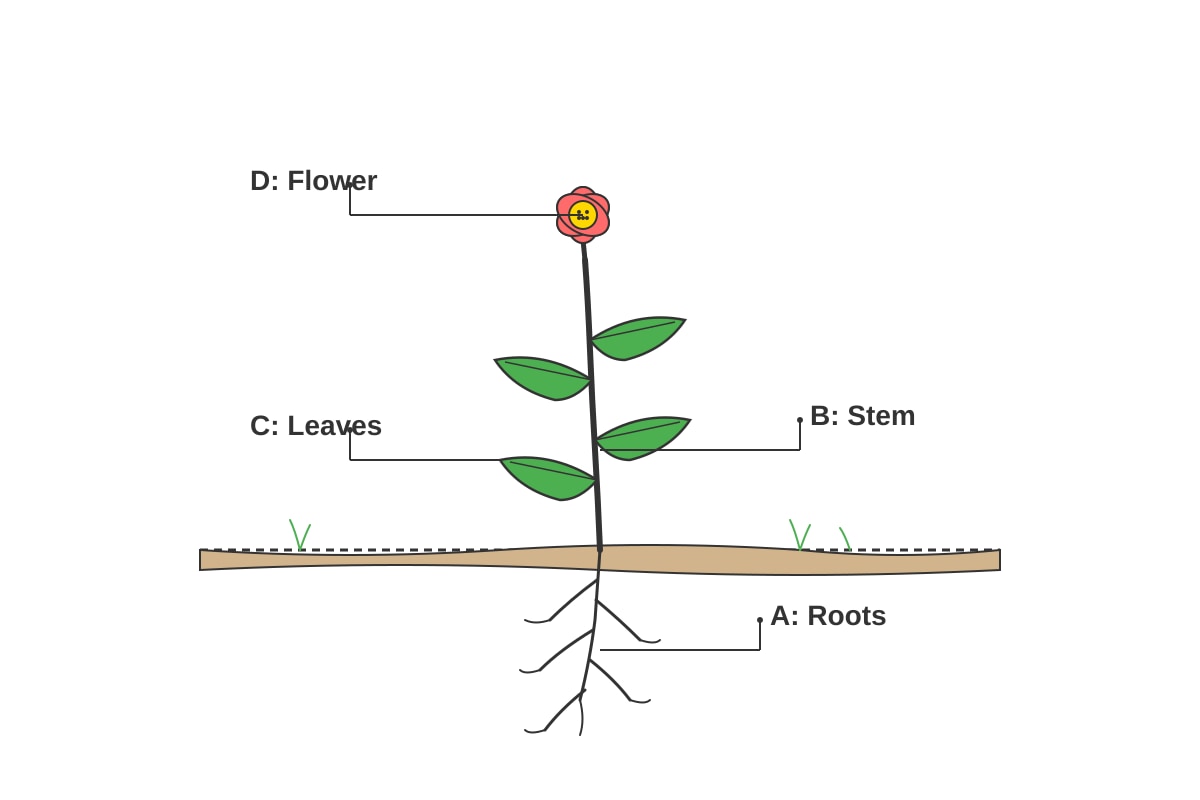
7. C) C (Leaves)
- Explanation: The leaves are the food-making factories of the plant. They contain chlorophyll, which captures sunlight energy to make food.
- Common Mistake: Students may confuse the function of the leaves with the stem or flower.
8. A) Its leaves will turn yellow and it will stop growing well.
- Explanation: Plants need light to make food (photosynthesis). Without light, the plant cannot make enough food. The chlorophyll in the leaves breaks down, causing the leaves to turn yellow (a condition called etiolation), and the plant will become weak and stop growing.
- Common Mistake: Students may think the plant will grow faster in the dark, but the opposite is true.
9. D) Flower – helps in reproduction
- Explanation: This is the correct match. The flower contains the reproductive organs (stamens and pistils) that produce seeds.
- Common Mistake: Students may confuse the functions of the stem, root, and leaf.
10. C) To reduce water loss from the leaf
- Explanation: The waxy layer, called the cuticle, is a waterproof covering on the leaf's surface. It helps to prevent the leaf from losing too much water through evaporation.
- Common Mistake: Students may think it is for protection from insects or to look shiny, but the primary function is to reduce water loss.
Section B: Open-Ended Questions (12 marks)
11. Name two functions of the roots of a plant. [2]
- Answer: (a) To anchor the plant firmly in the soil. [1]
- (b) To absorb water and minerals from the soil. [1]
- Explanation: Roots have two main jobs: they hold the plant in place so it doesn't fall over, and they drink up water and nutrients from the soil.
- Marking: Award 1 mark for each correct function. Accept "to hold the plant in place" or "to take in water". Do not accept "to make food".
12. Explain why the stem of a plant is often described as the "highway" of the plant. [2]
- Answer: The stem is like a highway because it transports water and food to different parts of the plant. [1] It carries water from the roots up to the leaves, and food from the leaves down to the rest of the plant. [1]
- Explanation: Just as a highway allows cars to travel from one place to another, the stem allows water and food to travel throughout the plant.
- Marking: Award 1 mark for identifying transport as the function. Award 1 mark for explaining what is transported (water and food) and the direction (up and down).
13. Explain why Plant Y looks wilted. [2]
- Answer: Plant Y did not get any water for two weeks. [1] Without water, the plant cells lose water and become soft, causing the leaves and stem to droop or wilt. [1]
- Explanation: Water is essential for plant cells to stay firm and turgid. When a plant does not get enough water, the cells lose their firmness, and the plant wilts.
- Marking: Award 1 mark for stating the lack of water. Award 1 mark for explaining that the cells become soft or the plant droops.
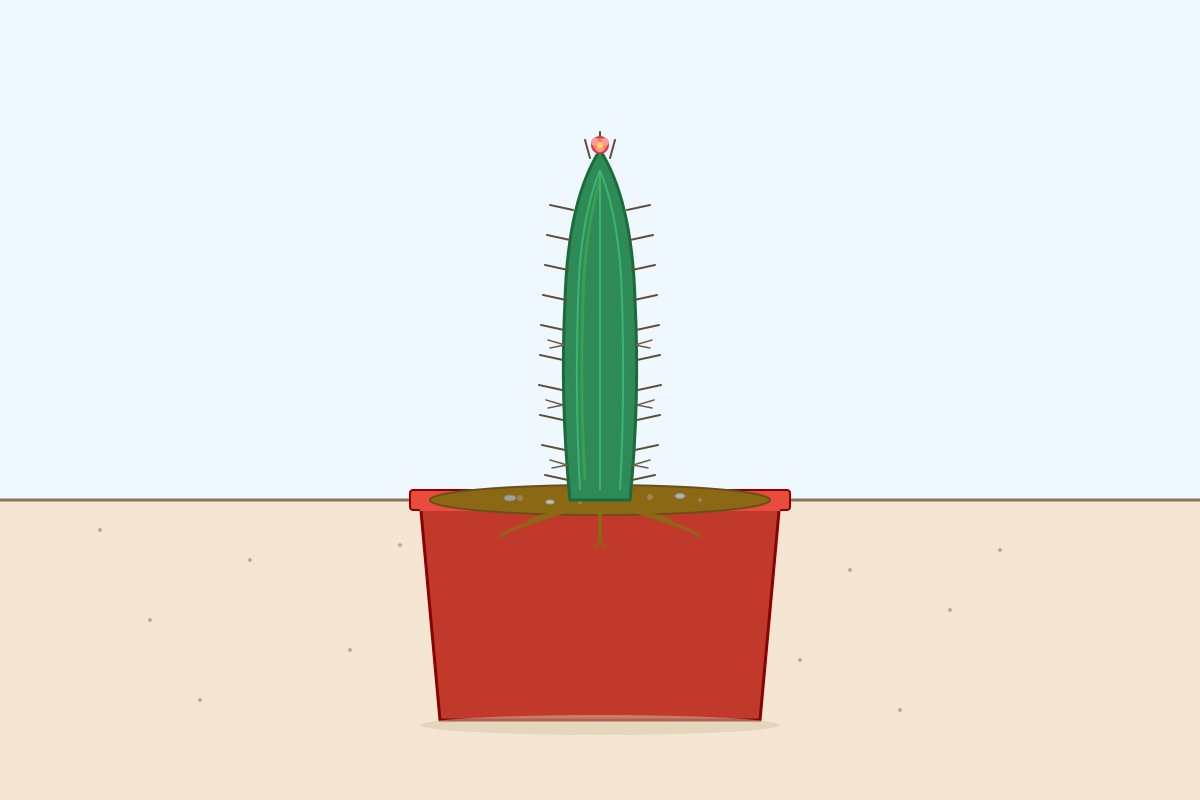
14. Describe two ways its stem and leaves are adapted to help it survive in the desert. [2]
- Answer:
- (a) Stem adaptation: The thick, fleshy stem stores water. [1]
- (b) Leaf adaptation: The leaves are small and spine-like to reduce water loss. [1]
- Explanation: In a desert, water is very scarce. A thick stem acts like a water tank. Small, spiky leaves have a very small surface area, so very little water is lost from them through evaporation.
- Marking: Award 1 mark for each correct adaptation. Accept "stem stores water" and "leaves are small/spines to save water".
15. Explain why a lack of sunlight can cause leaves to turn yellow. [2]
- Answer: Plants need sunlight to make food (photosynthesis). [1] Without enough sunlight, the plant cannot make enough chlorophyll (the green pigment), so the leaves lose their green colour and turn yellow. [1]
- Explanation: Chlorophyll is what makes leaves green and is essential for photosynthesis. When a plant is in the dark, it cannot produce new chlorophyll, and the existing chlorophyll breaks down, revealing other colours like yellow.
- Marking: Award 1 mark for stating that sunlight is needed for food-making/photosynthesis. Award 1 mark for explaining that the lack of chlorophyll causes the yellow colour.
16. Name the part of the plant that senses gravity and causes the stem to grow upwards. [1]
- Answer: The root tip (or roots).
- Explanation: The root tip contains cells that sense gravity. This causes the roots to grow downwards (towards gravity) and the stem to grow upwards (away from gravity). This is called geotropism.
- Marking: Award 1 mark for "roots" or "root tip". Do not accept "stem" or "leaves".
17. Draw a line to match each plant part to its correct function. [3]
- Answer:
- Leaf → (b) Makes food for the plant [1]
- Stem → (c) Supports the plant and transports water and food [1]
- Root → (a) Absorbs water and minerals from the soil [1]
- Explanation: This is a direct recall of the functions of the three main plant parts.
- Marking: Award 1 mark for each correct match.
Section C: Application and Higher-Order Thinking (8 marks)
18. Explain why the plants in Field A grew better. [2]
- Answer: The fertiliser in Field A provided extra minerals/nutrients to the soil. [1] Plants need these minerals (like nitrates) to grow well and produce fruits. [1]
- Explanation: Fertilisers contain essential nutrients that plants need for healthy growth, such as nitrogen, phosphorus, and potassium. These are not always available in sufficient amounts in natural soil.
- Marking: Award 1 mark for stating that fertiliser provides nutrients/minerals. Award 1 mark for explaining that these nutrients help the plant grow and produce fruit.
19. Explain why Plant 2 stopped growing. [3]
- Answer: The leaves are the part of the plant that makes food (photosynthesis). [1] By removing all the leaves from Plant 2, the student removed the plant's ability to make its own food. [1] Without food, the plant cannot get the energy it needs to grow and stay healthy, so it stopped growing and became weak. [1]
- Explanation: This question tests the understanding that leaves are the food-making factories. Without them, the plant cannot produce the energy it needs to survive and grow.
- Marking:
- Award 1 mark for stating that leaves make food.
- Award 1 mark for stating that without leaves, the plant cannot make food.
- Award 1 mark for explaining that the plant needs food for energy and growth.
20. Which part of the Venus flytrap is most likely modified to trap insects? Explain your answer. [3]
- Answer: The leaves. [1]
- Explanation: The "trap" of a Venus flytrap is actually a modified leaf. [1] Leaves are normally used for making food through photosynthesis. In the Venus flytrap, the leaves have evolved to also trap insects to get extra nutrients that are missing from the poor soil. [1]
- Explanation: This is a higher-order thinking question that requires students to apply their knowledge of plant parts. The trap looks like a mouth, but it is actually two halves of a leaf that snap shut. It still performs photosynthesis but has an additional function.
- Marking:
- Award 1 mark for identifying the leaf.
- Award 1 mark for explaining that the trap is a modified leaf.
- Award 1 mark for explaining that this helps the plant get nutrients from insects because the soil is poor.
End of Answer Key