From Real Exams Quiz

Primary 4 Science Matter Quiz

Free Exam-Derived Qwen3.7 Plus Primary 4 Science Matter quiz with questions and answers for Singapore students. This page is rendered as a direct URL so the questions and answers can be discovered without pressing in-page buttons.

These static practice materials are generated from the site's syllabus and paper-generation workflow, with source and model context shown so students and parents can evaluate the material before use.

Primary 4 Science From Real Exams Generated by Qwen3.7 Plus Updated 2026-06-04

Questions

<!-- TuitionGoWhere generation metadata: stage=3-0; model=qwen/qwen3.7-plus; model_label=Qwen3.7 Plus; generated=2026-06-04; Sources: Stage 2-1 real exam-derived templates and Stage 2-2 exam-enriched syllabus. -->

Primary 4 Science Quiz - Matter

Name: __________________________
Class: __________________________
Date: __________________________
Score: ________ / 30

Duration: 45 minutes
Total Marks: 30

Instructions:

  1. Read each question carefully.
  2. Answer all questions in the spaces provided.
  3. For multiple-choice questions, write the number of the correct option in the bracket.
  4. For open-ended questions, use complete sentences and scientific keywords where appropriate.

Section A: Multiple-Choice Questions (10 marks)

For each question from 1 to 10, four options are given. One of them is the correct answer. Make your choice and write its number (1, 2, 3 or 4) in the brackets provided.

1. Which of the following is not a state of matter? ( )

  1. Solid
  2. Liquid
  3. Gas
  4. Energy

2. Which of the following substances has a definite shape and a definite volume? ( )

  1. Oxygen
  2. Water
  3. Ice
  4. Steam

3. A student poured 50 ml of water into a measuring cylinder. He then added a stone. The water level rose to 75 ml. What is the volume of the stone? ( )

  1. 25 ml
  2. 50 ml
  3. 75 ml
  4. 125 ml

4. Which property of matter allows a balloon to be inflated? ( )

  1. Matter has mass.
  2. Matter occupies space.
  3. Matter can change state.
  4. Matter can be seen.

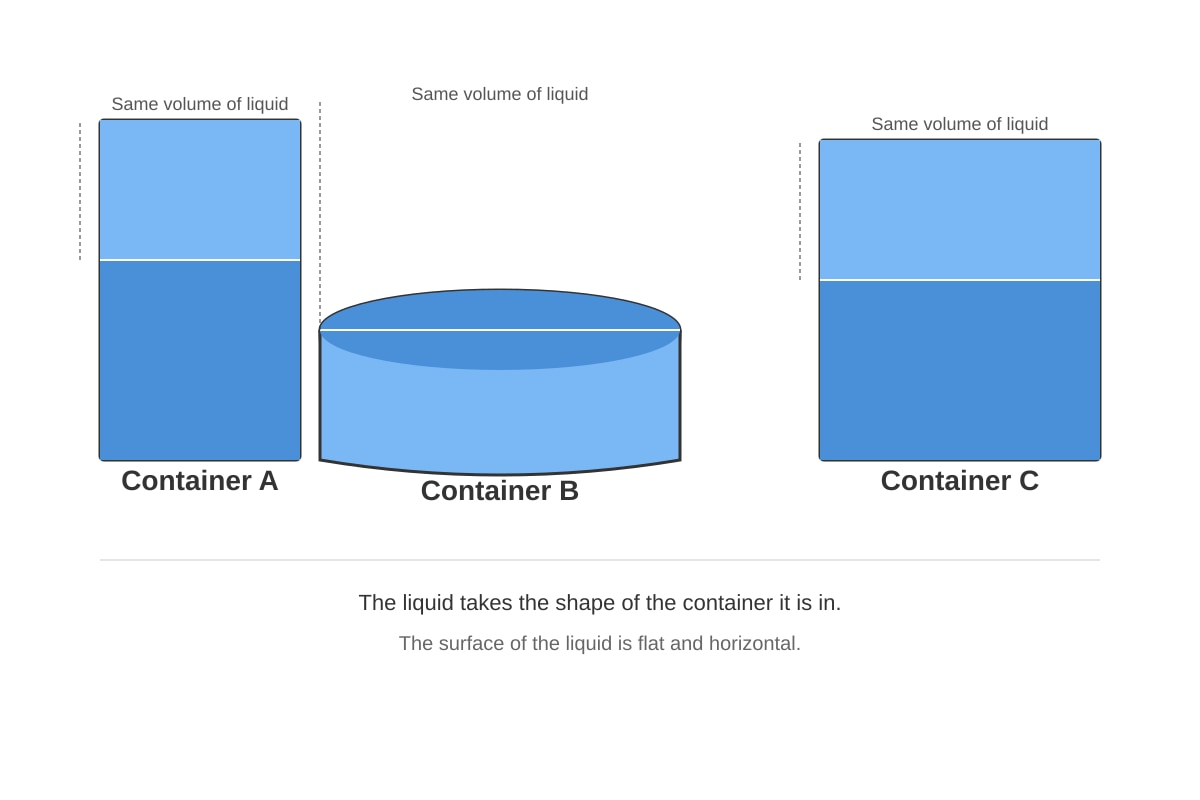
5. Look at the diagram below showing three containers with different shapes.

<image_placeholder> id: Q5-fig1 type: diagram linked_question: Q5 description: Three containers of different shapes: a tall narrow cylinder, a wide bowl, and a square box. Each contains the same amount of blue liquid. labels: Container A, Container B, Container C values: Volume of liquid is constant in all three. must_show: The liquid takes the shape of the bottom of each container. The surface of the liquid is flat and horizontal in all containers. </image_placeholder>

What can be concluded about the liquid in the containers? ( )

  1. It has a definite shape.
  2. It has no definite volume.
  3. It takes the shape of the container.
  4. It expands to fill the entire container.

6. Which of the following statements about gases is true? ( )

  1. Gases have a definite shape.
  2. Gases have a definite volume.
  3. Gases can be compressed easily.
  4. Gases cannot be seen or felt.

7. Why does a sponge appear to have no volume when squeezed? ( )

  1. The sponge is made of gas.
  2. The air inside the sponge escapes, but the sponge material still occupies space.
  3. The sponge disappears when squeezed.
  4. The sponge changes into a liquid.

8. Which of the following items is made of matter? ( )

  1. Light from a torch
  2. Sound from a bell
  3. Heat from a fire
  4. Smoke from a chimney

9. Two identical balls, X and Y, are placed on a balance scale. Ball X is solid rubber. Ball Y is an inflated rubber ball. The scale tips down on the side of Ball Y. What does this show? ( )

  1. Air has mass.
  2. Air has no mass.
  3. Rubber is heavier than air.
  4. The inflated ball is larger.

10. Which of the following best describes the arrangement of particles in a solid? ( )

  1. Particles are far apart and move freely.
  2. Particles are close together and vibrate in fixed positions.
  3. Particles are close together but can slide past one another.
  4. Particles are arranged randomly and move quickly.

Section B: Open-Ended Questions (20 marks)

Answer the following questions in the spaces provided.

11. Study the table below which lists three substances A, B, and C.

SubstanceDefinite Shape?Definite Volume?Can be Compressed?
AYesYesNo
BNoYesNo
CNoNoYes

(a) Identify the state of matter for Substance B. (1 mark)


(b) Give one example of Substance C found in the classroom. (1 mark)


(c) Explain why Substance A cannot be compressed. (2 marks)


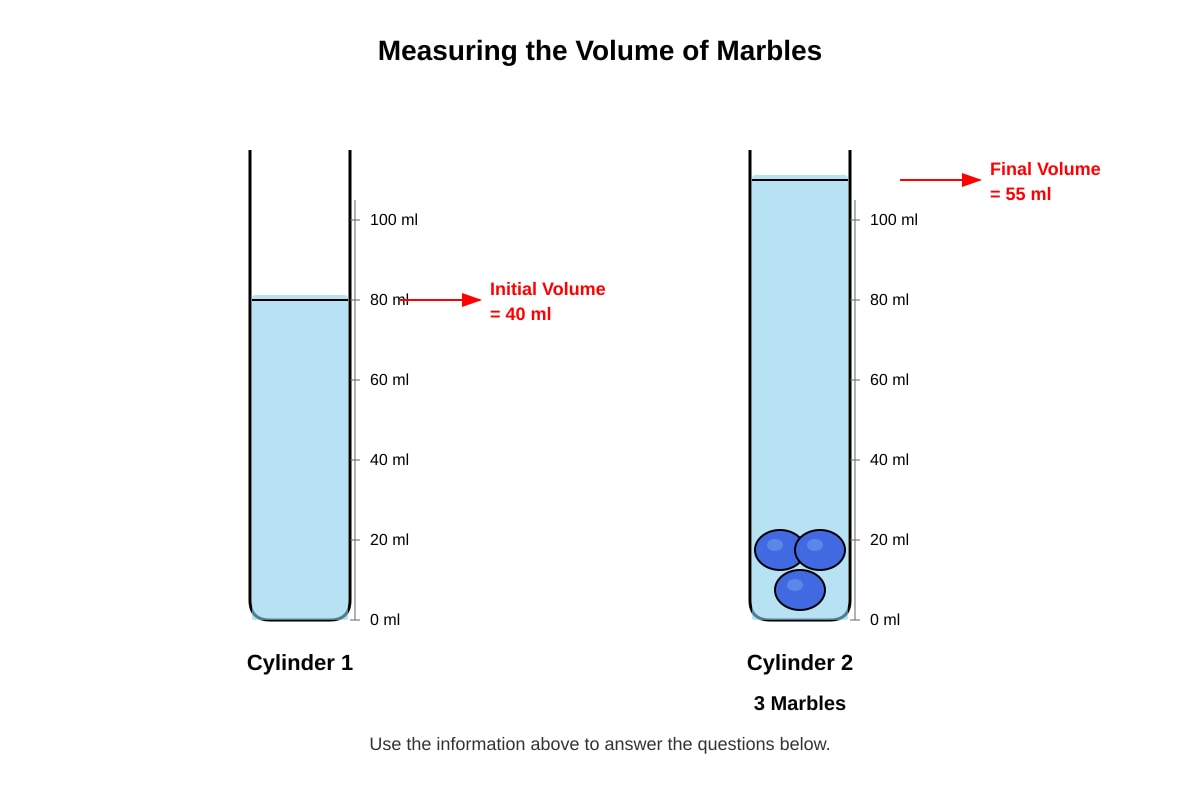
12. Jane performed an experiment to find the volume of a marble.

<image_placeholder> id: Q12-fig1 type: diagram linked_question: Q12 description: Two measuring cylinders. Cylinder 1 contains water up to the 40 ml mark. Cylinder 2 contains the same water plus three identical marbles, with the water level at 55 ml. labels: Initial Volume, Final Volume, 3 Marbles values: Initial = 40 ml, Final = 55 ml must_show: Clear meniscus lines at 40 ml and 55 ml. The marbles are fully submerged. </image_placeholder>

(a) What is the total volume of the three marbles? (1 mark)


(b) What is the volume of one marble? (1 mark)


(c) Why must the marbles be fully submerged in the water for this method to work? (1 mark)


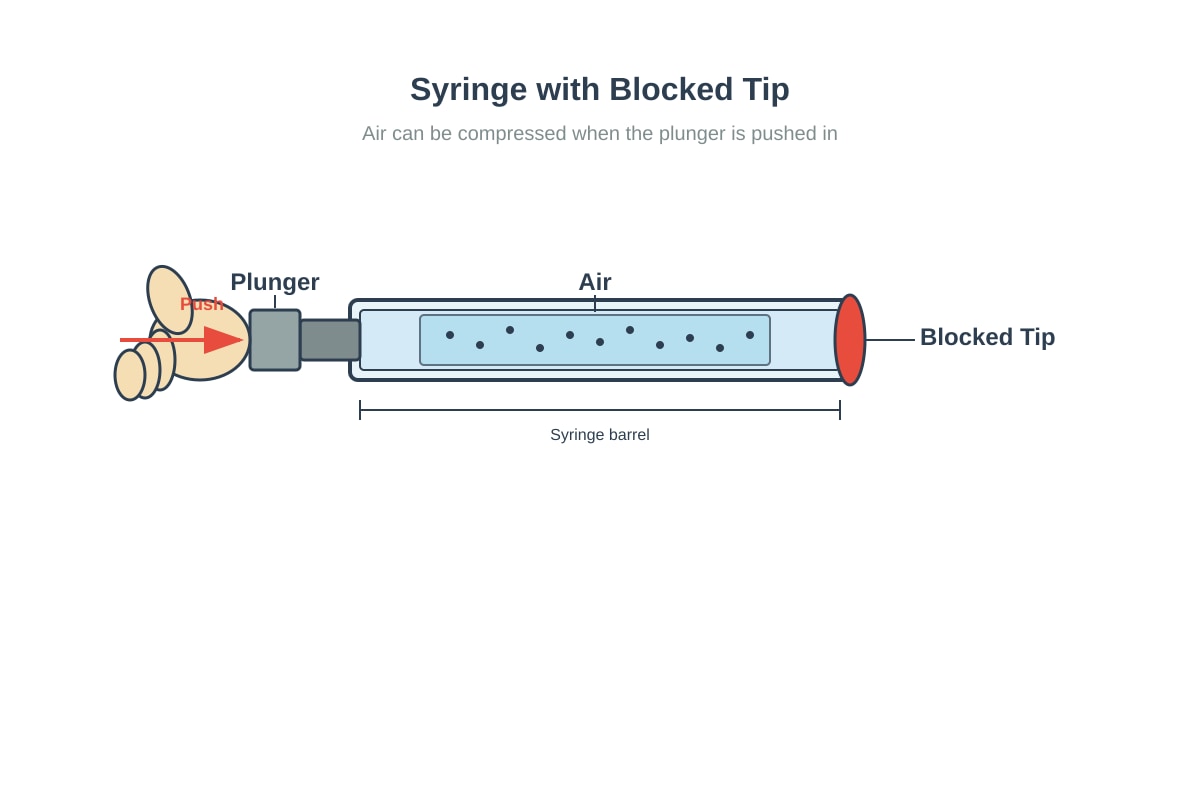
13. Tom has a syringe with its tip blocked by his finger. He pushes the plunger in as hard as he can.

<image_placeholder> id: Q13-fig1 type: diagram linked_question: Q13 description: A syringe with the tip blocked. The plunger is being pushed in by a hand. Inside the syringe is air. labels: Plunger, Air, Blocked Tip values: N/A must_show: The plunger moves in slightly, compressing the air space. </image_placeholder>

(a) What happens to the volume of the air inside the syringe when the plunger is pushed in? (1 mark)


(b) Explain why Tom can push the plunger in, but he could not do so if the syringe was filled with water. (2 marks)


14. Look at the diagram of the three states of matter below.

<image_placeholder> id: Q14-fig1 type: diagram linked_question: Q14 description: Three boxes representing particle arrangements. Box X shows particles tightly packed in rows. Box Y shows particles close but disordered. Box Z shows particles far apart and scattered. labels: Box X, Box Y, Box Z values: N/A must_show: Distinct spacing differences between the three boxes. </image_placeholder>

(a) Which box represents a gas? (1 mark)


(b) Describe the movement of particles in Box Y. (1 mark)


(c) If Box X is heated strongly, it may change into Box Y. What is this process called? (1 mark)


15. A student claims that "Air is not matter because we cannot see it."

(a) Is the student correct? Explain your answer. (2 marks)


(b) Describe a simple experiment to prove that air occupies space. (2 marks)


16. Sarah filled a glass to the brim with water. She then carefully dropped five small stones into the glass. The water overflowed.

(a) Why did the water overflow? (1 mark)


(b) If Sarah used five pieces of sponge of the same size instead of stones, would the same amount of water overflow? Explain why. (2 marks)


17. Consider the following items: Book, Milk, Oxygen, Desk, Juice, Helium.

(a) Group these items into Solids, Liquids, and Gases. (3 marks)

SolidsLiquidsGases

(b) What is one common property shared by all the items in the "Liquids" column? (1 mark)


18. Why do we say that a liquid has a definite volume but no definite shape? (2 marks)


19. A balloon is inflated and tied. It is then placed in a freezer for one hour. When taken out, the balloon appears slightly smaller.

(a) Did the amount of air inside the balloon change? (1 mark)


(b) Explain why the balloon became smaller. (2 marks)


20. Matter is defined as anything that has mass and occupies space.

(a) Does a shadow have mass? (1 mark)


(b) Is a shadow considered matter? Explain your answer. (1 mark)


Answers

<!-- TuitionGoWhere generation metadata: stage=3-0; model=qwen/qwen3.7-plus; model_label=Qwen3.7 Plus; generated=2026-06-04; Sources: Stage 2-1 real exam-derived templates and Stage 2-2 exam-enriched syllabus. -->

Primary 4 Science Quiz - Matter (Answer Key)

Section A: Multiple-Choice Questions

1. (4)

  • Reasoning: Solids, liquids, and gases are the three states of matter. Energy (such as light, heat, or sound) is not matter because it does not have mass or occupy space.

2. (3)

  • Reasoning: Ice is a solid. Solids have a definite shape and a definite volume. Oxygen is a gas, water is a liquid, and steam is a gas.

3. (1)

  • Reasoning: Volume of stone = Final volume - Initial volume. 75 ml50 ml=25 ml75 \text{ ml} - 50 \text{ ml} = 25 \text{ ml}.

4. (2)

  • Reasoning: Inflating a balloon means filling it with air. Since the balloon expands, it shows that the air inside occupies space.

5. (3)

  • Reasoning: Liquids do not have a definite shape; they take the shape of the container they are in. However, they have a definite volume (the amount of liquid stays the same).

6. (3)

  • Reasoning: Gases have no definite shape and no definite volume. They expand to fill the container. Because there is a lot of empty space between gas particles, they can be compressed easily.

7. (2)

  • Reasoning: A sponge contains many holes filled with air. When squeezed, the air escapes, allowing the sponge material to move closer together. However, the solid material of the sponge itself still occupies space and has mass. It does not disappear.

8. (4)

  • Reasoning: Smoke consists of tiny solid particles and gases suspended in the air. It has mass and occupies space. Light, sound, and heat are forms of energy, not matter.

9. (1)

  • Reasoning: The scale tips towards Ball Y, meaning Ball Y is heavier. Since both balls are made of the same rubber, the extra weight comes from the air inside Ball Y. This proves that air has mass.

10. (2)

  • Reasoning: In solids, particles are packed closely together in a regular pattern. They cannot move freely but vibrate in fixed positions.

Section B: Open-Ended Questions

11. (a) Liquid

  • Reasoning: Substance B has no definite shape (takes shape of container) but has a definite volume. This describes a liquid.

(b) Air / Oxygen / Carbon Dioxide (Any common gas)

  • Reasoning: Substance C has no definite shape, no definite volume, and can be compressed. This describes a gas. Air is the most common gas in a classroom.

(c) The particles in a solid are packed very closely together with little to no space between them. Therefore, they cannot be pushed closer together.

  • Marking Note: Must mention "particles are closely packed" or "no space between particles."

12. (a) 15 ml

  • Reasoning: 55 ml40 ml=15 ml55 \text{ ml} - 40 \text{ ml} = 15 \text{ ml}.

(b) 5 ml

  • Reasoning: Total volume of 3 marbles is 15 ml. Volume of one marble = 15 ml/3=5 ml15 \text{ ml} / 3 = 5 \text{ ml}.

(c) If the marbles are not fully submerged, the water level will not rise by the full volume of the marbles, leading to an incorrect measurement.

  • Reasoning: The displacement method only measures the volume of the part of the object that is under the water.

13. (a) The volume of the air decreases.

  • Reasoning: Pushing the plunger reduces the space available for the air.

(b) Air is a gas and can be compressed because there is space between its particles. Water is a liquid and cannot be compressed because its particles are already close together with little space between them.

  • Marking Note: 1 mark for stating air/gas can be compressed, 1 mark for stating water/liquid cannot be compressed due to particle arrangement.

14. (a) Box Z

  • Reasoning: Box Z shows particles far apart and scattered, which is characteristic of a gas.

(b) The particles can slide past one another.

  • Reasoning: Box Y represents a liquid. Liquid particles are close but not fixed, allowing them to flow.

(c) Melting

  • Reasoning: Changing from a solid (Box X) to a liquid (Box Y) by heating is called melting.

15. (a) No, the student is incorrect.

  • Reasoning: Matter is defined by having mass and occupying space, not by being visible. Many forms of matter, like air, are invisible but still exist.

(b) Push an inverted empty glass into a basin of water. The water will not enter the glass completely because the air inside occupies space.

  • Alternative Answer: Inflate a balloon. The balloon expands, showing that the air inside occupies space.
  • Marking Note: Must describe a valid method showing air occupying space.

16. (a) The stones occupy space. When added to the full glass, they displace the water, causing it to overflow.

  • Reasoning: Matter occupies space. Two objects cannot occupy the same space at the same time.

(b) No, less water would overflow (or none, depending on sponge absorption).

  • Reasoning: Sponges are porous and contain air. When placed in water, the sponge absorbs water into its holes, and the air escapes. The solid material of the sponge occupies less space than the stone of the same size, or the water fills the voids within the sponge rather than overflowing.
  • Note for P4: Accept "Sponges have air inside which escapes, so they take up less effective space than solid stones" or "Sponges absorb water." The key concept is that stones are solid/non-porous while sponges are porous.

17. (a)

  • Solids: Book, Desk
  • Liquids: Milk, Juice
  • Gases: Oxygen, Helium

(b) They take the shape of their container.

  • Alternative Answer: They have a definite volume.

18. A liquid takes the shape of the container it is in, so it has no definite shape. However, the amount of liquid (volume) remains the same regardless of the container, so it has a definite volume.

  • Marking Note: 1 mark for explaining shape aspect, 1 mark for explaining volume aspect.

19. (a) No.

  • Reasoning: The balloon is tied, so no air can enter or escape. The amount of matter (air) remains constant.

(b) When air is cooled, the particles move slower and come closer together. This causes the air to contract (take up less space), making the balloon smaller.

  • Marking Note: Must mention "particles move slower" or "particles come closer together" and "contract/take up less space."

20. (a) No.

  • Reasoning: A shadow is an absence of light. It does not have mass.

(b) No, a shadow is not matter.

  • Reasoning: Matter must have mass and occupy space. A shadow has neither mass nor volume; it is just a dark area where light is blocked.