From Real Exams Quiz
Primary 4 Science Matter Quiz
Free P4 Science Matter quiz, Exam version, with questions, answers, and syllabus-aligned practice for Singapore students.
These static practice materials are generated from the site's syllabus and paper-generation workflow, with source and model context shown so students and parents can evaluate the material before use.
Questions
Free quiz and exam paper access
Enter your details to view this paper
Your access is remembered on this device.
Answers
Primary 4 Science Quiz - Matter: Answer Key
Total Marks: 25
Section A: Multiple-Choice Questions (5 marks)
1. D) A wooden block [1 mark]
- Explanation: Matter is defined as anything that has mass and occupies space. A wooden block has both mass and volume. Heat, sound, and light are forms of energy, not matter. They do not have mass or occupy space in the same way.
- Marking: 1 mark for correct circle on D.
2. C) no fixed shape [1 mark]
- Explanation: Liquids take the shape of the container they are in because their particles can move past each other. This means they do not have a fixed shape. However, liquids do have a fixed volume for a given amount and temperature.
- Marking: 1 mark for correct circle on C. (A is false for liquid; B is false because liquid has fixed volume; D is false because liquid particles can move.)
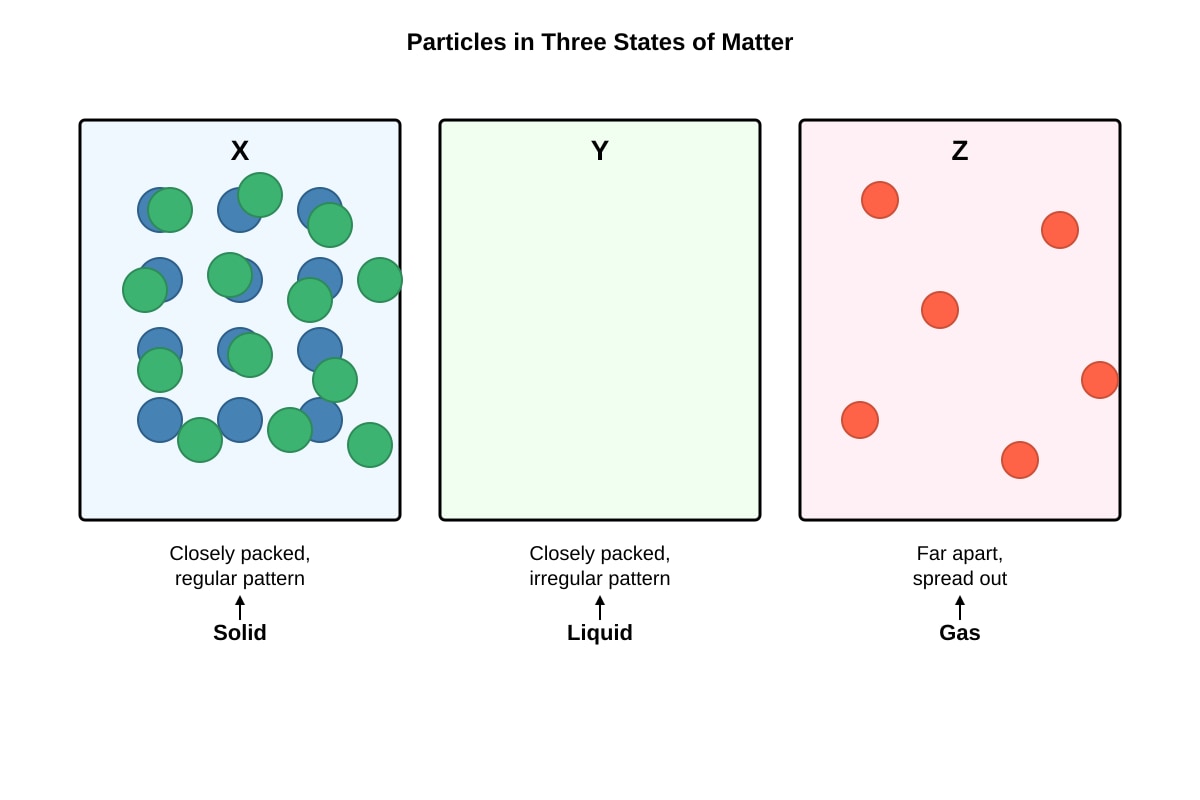
3. A) Solid (X), Liquid (Y), Gas (Z) [1 mark]
- Explanation: In X, particles are closely packed in a regular pattern, which is the arrangement for a solid. In Y, particles are closely packed but not in a regular pattern, which is for a liquid. In Z, particles are far apart and spread out, which is for a gas.
- Marking: 1 mark for correct circle on A.
4. A) It will melt into a liquid. [1 mark]
- Explanation: At room temperature, ice (solid water) will gain heat from the surroundings and melt, changing from a solid to a liquid (water). This is a change of state called melting.
- Marking: 1 mark for correct circle on A.
5. B) A measuring cylinder [1 mark]
- Explanation: A measuring cylinder is a laboratory tool specifically designed to measure the volume of a liquid accurately. A ruler measures length, a thermometer measures temperature, and a weighing scale measures mass.
- Marking: 1 mark for correct circle on B.
Section B: Short-Answer Questions (20 marks)
6. C) mass and occupies space [2 marks]
- Explanation: The definition of matter is anything that has mass and occupies space (has volume). The air inside the balloon has mass and takes up space, which is why the balloon inflates.
- Marking: 2 marks for correct circle on C. (A is false; air is a gas. B and D are false because mass and volume are both properties of matter.)
7. State two properties of a solid. [2 marks]
- Answers: Any two of the following (or similar):
- It has a fixed/definite shape.
- It has a fixed/definite volume.
- It cannot be easily compressed.
- Explanation: Solids have a fixed shape and volume because their particles are held tightly together in a fixed arrangement. They cannot flow or be compressed easily.
- Marking: 1 mark for each correct property (up to 2 marks). Accept “definite” for “fixed”.
8. Name the state of matter that has no fixed shape and no fixed volume. [2 marks]
- Answer: Gas
- Explanation: Gases have particles that are far apart and move very fast. They will spread out to fill the entire container they are in, meaning they have no fixed shape or volume.
- Marking: 1 mark for “Gas”. (1 mark for spelling if close enough.)
9. Look at the table below. State whether each description is a solid, liquid, or gas. [2 marks]
- (a) Liquid [1 mark]
- (b) Gas [1 mark]
- Explanation: (a) A liquid has a fixed volume (definite amount) but takes the shape of its container. (b) A gas can be compressed easily because its particles are far apart and have a lot of empty space between them.
- Marking: 1 mark each for correct answer in the blank.
10. Explain why both spoons feel warm. [2 marks]
- Answer: Both spoons have been left on the table at room temperature and have reached the same temperature as the room (about 25°C). The metal spoon and the wooden spoon both feel warm because heat from your hand flows into the cooler spoon, making your hand feel cold, OR because the spoon has gained heat from the room and is at a similar temperature to your hand, so it does not feel particularly cold. (Accept: Both spoons are at room temperature. The room’s heat has warmed them up.)
- Explanation: This question tests the understanding of heat flow from a hotter object to a colder one. If the spoons feel warm, it means they have gained heat from the surrounding (the room).
- Marking: 1 mark for stating both spoons are at room temperature. 1 mark for linking that to the room’s heat.
11. Does the volume of the water change? Explain your answer. [2 marks]
- Answer: No, the volume of the water does not change. / The water still has a volume of 50 ml. This is because a liquid has a fixed volume. It takes the shape of the new container but its volume stays the same.
- Explanation: This highlights the property of a liquid: it has a fixed volume. Pouring it into a different shaped container only changes its shape, not its quantity (volume).
- Marking: 1 mark for “No”. 1 mark for correct explanation (e.g., “Liquids have a fixed volume.”).
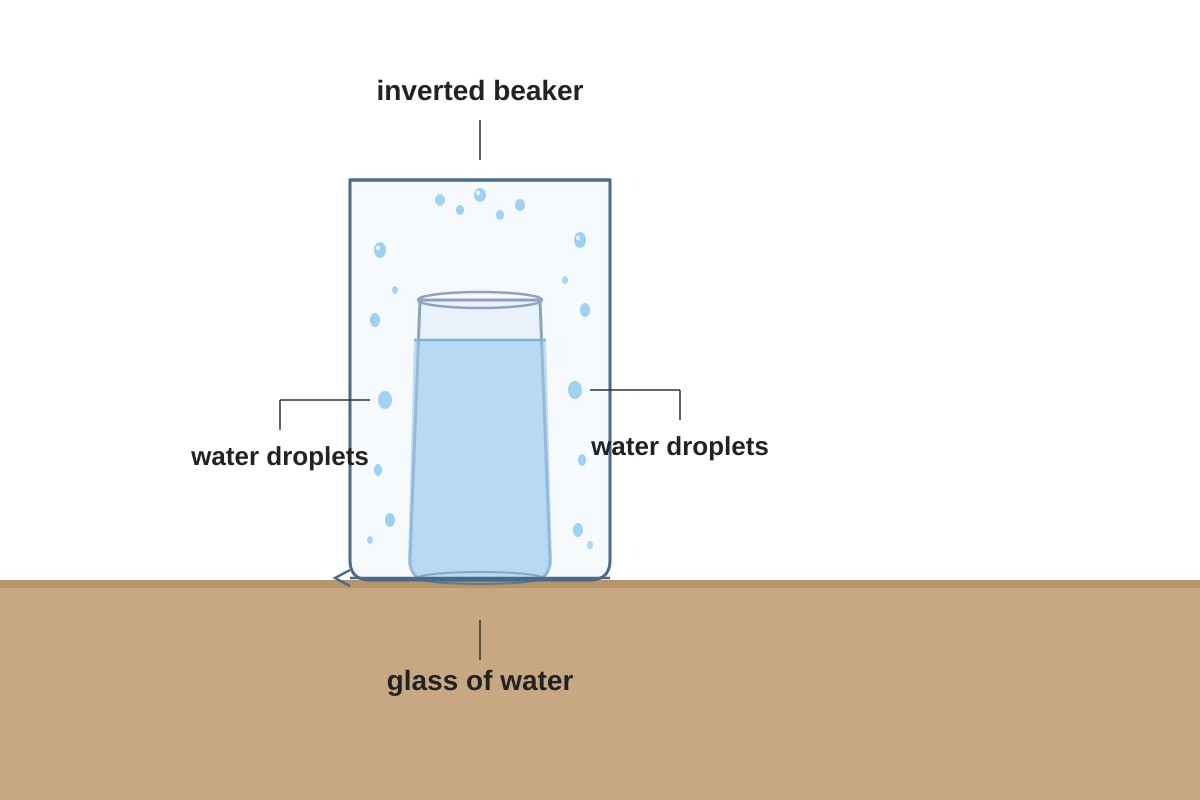
12. The diagram below shows an experiment. [2 marks]
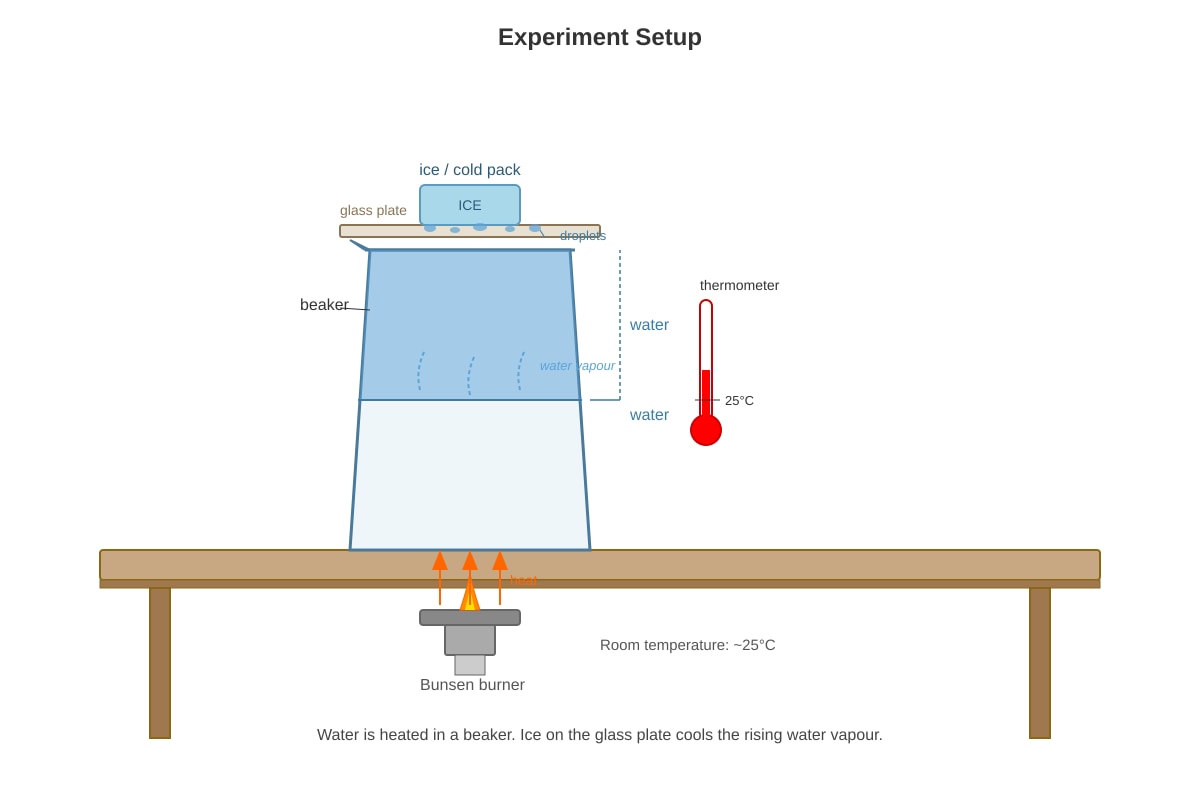
Generated diagram for this question.
- (a) Condensation [1 mark]
- (b) Water changing from a gas (water vapour) to a liquid [1 mark]
- Explanation: Water from the glass evaporates (turns into water vapour, a gas). This water vapour rises and hits the cool surface of the beaker, losing heat. It then changes back into a liquid (water droplets) – this process is called condensation.
- Marking: (a) 1 mark for “Condensation”. (b) 1 mark for “gas to liquid” or “water vapour to water droplet”.
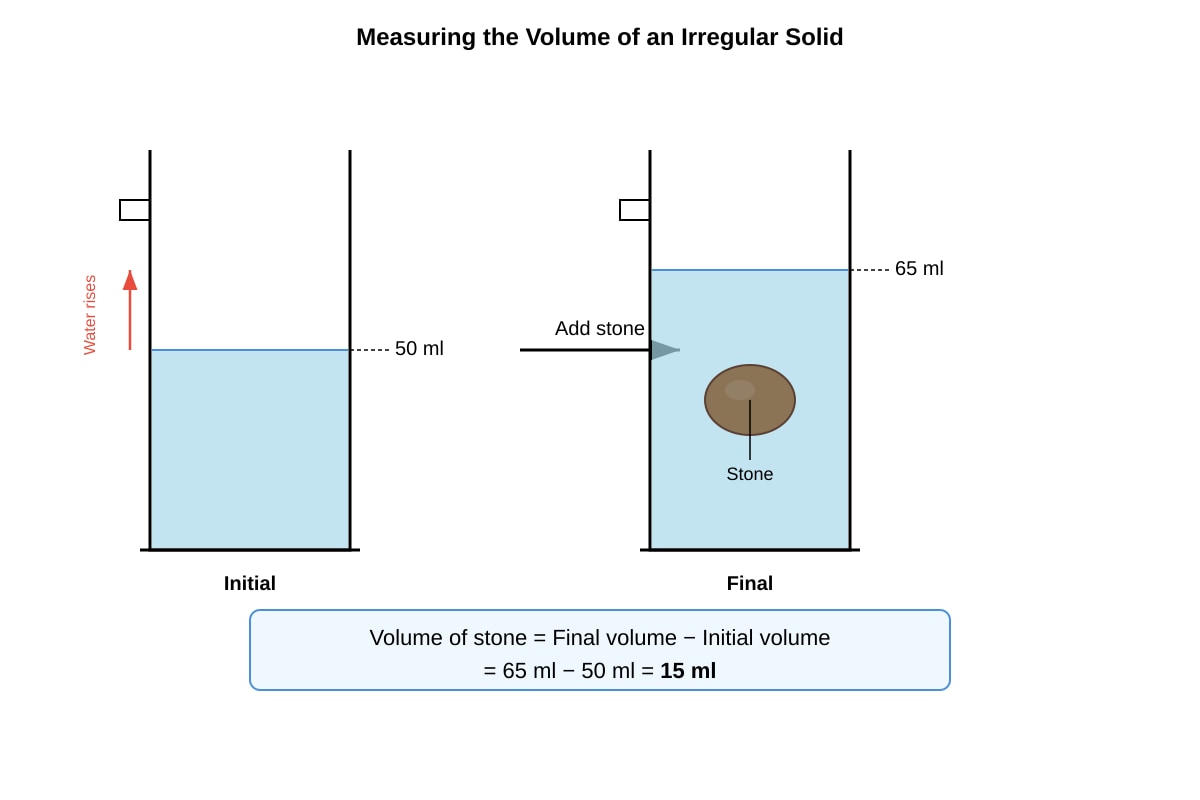
13. Describe how you would measure the volume of an irregularly-shaped stone using a measuring cylinder and water. [2 marks]
- Answer:
- Pour a known volume of water (e.g., 50 ml) into a measuring cylinder. Record the initial volume.
- Gently lower the stone into the measuring cylinder. Make sure it is fully submerged. Record the new volume.
- The volume of the stone is equal to the difference between the final and initial volumes. (e.g., if final is 65 ml and initial is 50 ml, the stone’s volume is 15 ml.)
- Explanation: This is a standard method for measuring the volume of an irregular solid using water displacement. The rise in water level is equal to the volume of the object.
- Marking: 1 mark for stating to record initial water level. 1 mark for stating to subtract initial from final water level. (Accept “water displacement” as a correct method description.)
14. When a puddle of water on the ground disappears on a hot day, what has happened to the water? Name the process involved. [2 marks]
- Answer: The water has turned into water vapour (a gas) and gone into the air. The process is called evaporation.
- Explanation: Evaporation is the process where a liquid (water) gains enough heat from the sun or surrounding to change into a gas (water vapour). It happens at the surface of the liquid.
- Marking: 1 mark for “water turns into water vapour/gas”. 1 mark for “Evaporation”.
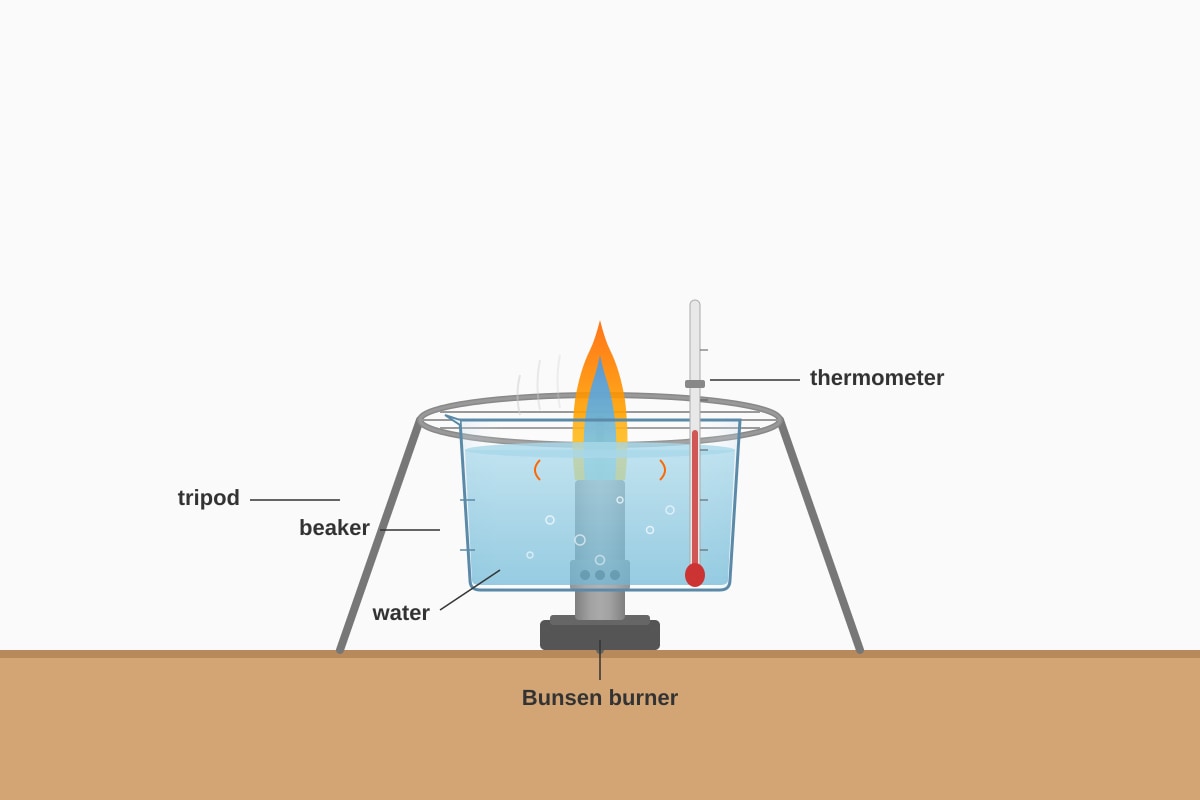
15. The diagram below shows the set-up of an experiment. [3 marks]
Generated diagram for this question.
- (a) Water vapour (gas) [1 mark]
- (b) The water has turned into water vapour and escaped into the air (evaporated/boiled away). [1 mark]
- (c) Liquid (water) → Gas (water vapour) [1 mark]
- Explanation:
- (a) When water boils, the liquid water turns into gas (water vapour). These bubbles are made of water vapour.
- (b) Boiling is a rapid form of evaporation. The water that is no longer in the beaker has changed state from liquid to gas (water vapour) and has left the beaker.
- (c) The change of state is from liquid to gas. This happens through boiling.
- Marking:
- (a) 1 mark for “water vapour/gas/steam”. (Accept “water vapour”.)
- (b) 1 mark for stating it turned to gas/vapour and escaped. (Accept “evaporated”.)
- (c) 1 mark for “Liquid to gas”. (Do not accept just “water to steam” without specifying the state change.)
Section C: Structured Questions (15 marks)
16. The table below shows the melting points and boiling points of four substances. [3 marks]
- (a) Substance Y [1 mark] Explanation: At 25°C, Y is below its melting point (35°C), so it is a solid. [1 mark]
- (b) Substance Z [1 mark] Explanation: At 25°C, Z is at its boiling point (25°C), so it is a gas. (Accept: Z is a gas because its boiling point is 25°C, which is the room temperature.)
- Marking: (a) 1 mark for Y, 1 mark for correct explanation. (b) 1 mark for Z with correct explanation.
17. Describe the particle arrangement in a solid. How does this arrangement explain why solids have a fixed shape? [3 marks]
- Answer: In a solid, particles are closely packed together in a regular, fixed pattern. They vibrate in fixed positions but do not move around. This arrangement means the particles are held tightly together, giving the solid a fixed shape that does not change unless force is applied.
- Explanation: The fixed positions of particles in a solid prevent the solid from flowing or changing shape easily.
- Marking: 1 mark for describing close packing. 1 mark for mentioning regular/fixed pattern. 1 mark for linking to fixed shape.
18. Explain why a gas can be compressed easily, but a liquid cannot. [3 marks]
- Answer: A gas can be compressed easily because its particles are far apart with a lot of empty space between them. When pressure is applied, the particles can be pushed closer together, reducing the volume. A liquid cannot be compressed easily because its particles are already closely packed together with very little empty space between them.
- Explanation: This difference is due to the spacing between particles in gases versus liquids.
- Marking: 1 mark for stating gas particles are far apart. 1 mark for stating liquid particles are close together. 1 mark for explaining compression.
19. A student places a metal spoon and a wooden spoon on a table. After one hour, both spoons feel warm. Explain why both spoons feel warm, and state which spoon would feel colder if you touched it first after taking it out of a refrigerator. Explain your answer. [3 marks]
- Answer: Both spoons feel warm because they have been on the table at room temperature and have reached the same temperature as the room. If taken out of a refrigerator, the metal spoon would feel colder because metal is a better conductor of heat than wood. It would conduct heat away from your hand faster, making it feel colder.
- Explanation: This question tests understanding of heat conduction and thermal equilibrium.
- Marking: 1 mark for stating both spoons are at room temperature. 1 mark for identifying metal spoon as colder. 1 mark for explaining metal is a better conductor.
20. Raju has 50 ml of water. He pours the water into a different-shaped container. Does the volume of the water change? Explain your answer. Then, describe what would happen if he poured the water into a container that is much wider and shallower. [3 marks]
- Answer: No, the volume of the water does not change. A liquid has a fixed volume. If he pours the water into a much wider and shallower container, the water will spread out to cover a larger area, making the depth of the water much less. However, the volume remains 50 ml.
- Explanation: This reinforces the concept that liquids have fixed volume but no fixed shape.
- Marking: 1 mark for “No”. 1 mark for explaining fixed volume. 1 mark for describing the change in shape/depth but not volume.
— End of Answer Key —