From Real Exams Quiz
Primary 4 Science Matter Quiz
Free P4 Science Matter quiz, Exam version, with questions, answers, and syllabus-aligned practice for Singapore students.
These static practice materials are generated from the site's syllabus and paper-generation workflow, with source and model context shown so students and parents can evaluate the material before use.
Questions
Free quiz and exam paper access
Enter your details to view this paper
Your access is remembered on this device.
Answers
Answer Key: Primary 4 Science Quiz - Matter
Section A: Multiple-Choice Questions
Q1. (c) Air
- Marks: 1
- Explanation: Matter is anything that has mass and occupies space. Air has mass and occupies space, so it is matter. Light, heat, and sound are forms of energy, not matter.
- Common mistake: Students often think air is not matter because they cannot see it. Remember: if it has mass and takes up space, it is matter.
Q2. (b) a definite volume but no definite shape.
- Marks: 1
- Explanation: A liquid has a definite volume because its particles are still close together, but it takes the shape of its container because its particles can move and slide past one another.
- Common mistake: Students may confuse liquids with gases. Gases have neither definite shape nor definite volume.
Q3. (b) They are packed closely together and vibrate about fixed positions.
- Marks: 1
- Explanation: In a solid, particles are packed closely together in a regular arrangement and can only vibrate about their fixed positions. This is why solids have a definite shape and volume.
- Common mistake: Students may think particles in a solid can move freely. They cannot; they only vibrate in place.
Q4. (a) 15 cm³
- Marks: 1
- Explanation: The volume of the stone is found by the water displacement method: Final water level − Initial water level = 65 cm³ − 50 cm³ = 15 cm³.
- Working: 65 − 50 = 15 cm³
- Common mistake: Students may give the final reading (65 cm³) instead of the difference.
Q5. (b) Measure the mass of the empty beaker, then measure the mass of the beaker with the liquid, and subtract the first from the second.
- Marks: 1
- Explanation: To find the mass of a liquid, you must subtract the mass of the container. This is called finding the mass by difference.
- Common mistake: Students may think placing the beaker directly on the balance gives the liquid's mass, but it gives the combined mass of the beaker and liquid.
Section B: Short-Answer Questions
Q6. Solid, liquid, and gas.
- Marks: 2 (1 mark for each correct state, up to 2)
- Explanation: These are the three states of matter. Any order is acceptable.
- Common mistake: Students may write "water" or "ice" instead of the state names.
Q7. (a) Solid
- Marks: 1
- Explanation: A solid has a definite shape because its particles are packed closely together and vibrate about fixed positions.
(b) Gas
- Marks: 1
- Explanation: A gas has no definite shape or volume. Its particles are far apart and move freely, so it fills the entire container it is in.
Q8. (a) Electronic balance (or weighing scale)
- Marks: 1
- Explanation: An electronic balance is used to measure mass.
(b) Measuring cylinder (with water displacement method) OR ruler (if it is a regular block, measuring length, width, and height)
- Marks: 1
- Explanation: For a regular block, volume = length × width × height. For an irregular object, use a measuring cylinder and water displacement.
- Marking note: Accept either answer as both are valid methods.
Q9. (a) Melting
- Marks: 1
- Explanation: Melting is the change of state from solid to liquid. This occurs when heat is gained.
(b) Reversible change
- Marks: 1
- Explanation: The change from ice to water is reversible because the water can be frozen back into ice. Reversible changes can be undone.
Q10. (a) Solid
- Marks: 1
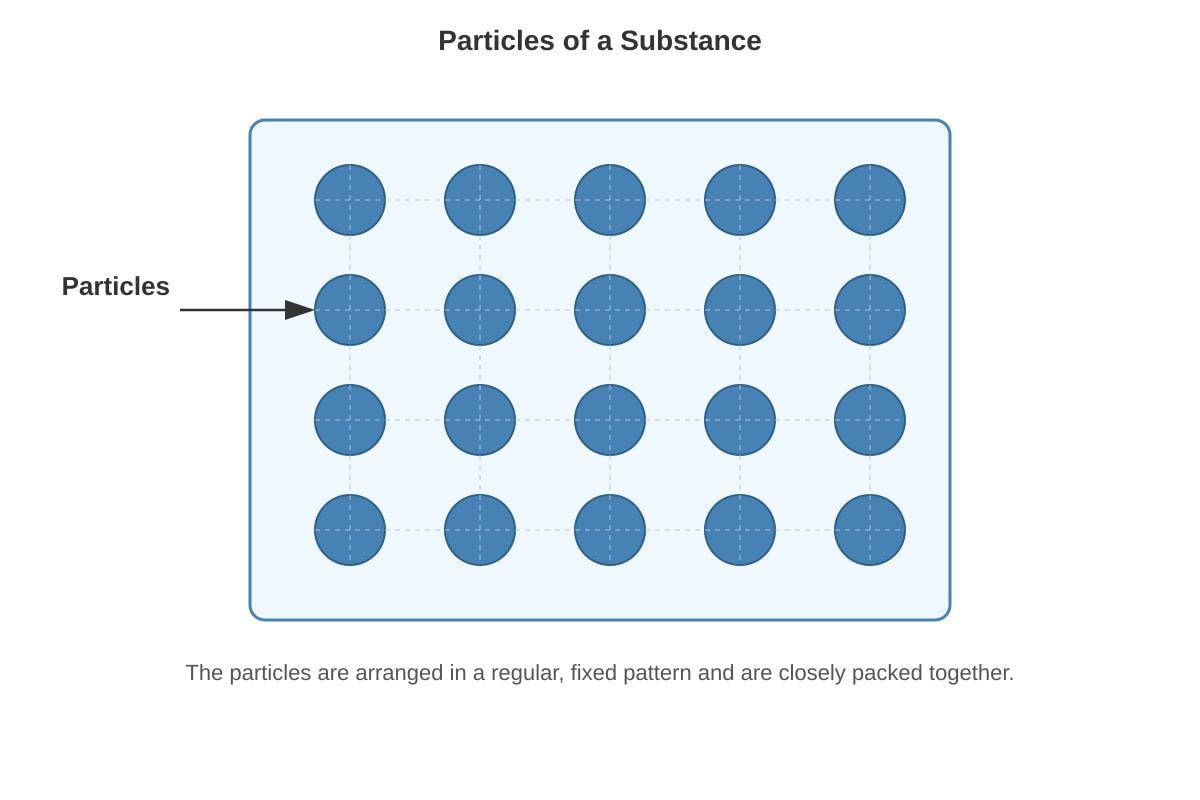
- Explanation: The particles are arranged in a regular, fixed pattern and are packed closely together.
(b) The particles are packed closely together in a regular arrangement and can only vibrate about fixed positions.
- Marks: 1
- Explanation: This arrangement gives solids their definite shape and volume.
- Marking note: Accept any answer that mentions close packing and/or regular arrangement.
Q11.
- Fill a measuring cylinder with a known volume of water (e.g., 50 cm³).
- Carefully lower the stone into the measuring cylinder using a string.
- Read the new water level (e.g., 62 cm³).
- The volume of the stone is the difference: 62 − 50 = 12 cm³.
- Marks: 2 (1 mark for the method of displacement, 1 mark for subtracting initial from final reading)
- Explanation: This is called the water displacement method. The stone pushes aside (displaces) an amount of water equal to its own volume.
- Common mistake: Students may forget to mention reading the initial water level before adding the stone.
Q12. (a) Solid
- Marks: 1
- Explanation: A solid has both a definite shape and a definite volume.
(b) Gas
- Marks: 1
- Explanation: A gas has neither a definite shape nor a definite volume. It fills the entire container it is in.
Q13. (a) Yes
- Marks: 1
- Explanation: Air is matter, and all matter has mass.
(b) Air has mass because it is made up of particles (matter). The electronic balance will show a reading that includes the mass of the air inside the balloon.
- Marks: 1
- Explanation: Even though we cannot see air, it is made of particles that have mass and occupy space.
- Common mistake: Students may say air has no mass because it is invisible. Remind them that invisible things can still be matter.
Q14. (a) Liquid to gas
- Marks: 1
- Explanation: The water changes from a liquid state to a gaseous state.
(b) Evaporation
- Marks: 1
- Explanation: Evaporation is the process where a liquid changes into a gas at its surface. This happens when the liquid gains heat from the sun.
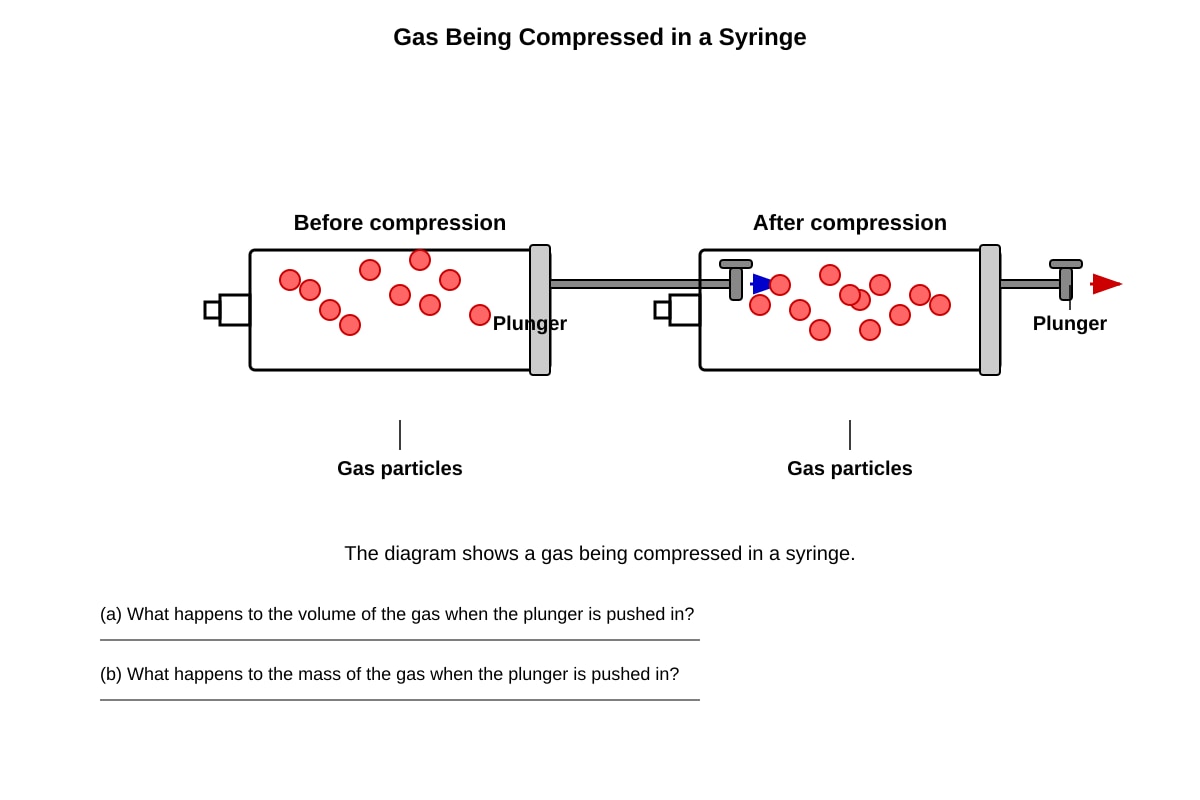
Q15. (a) The volume of the gas decreases.
- Marks: 1
- Explanation: When the plunger is pushed in, the gas particles are compressed into a smaller space, so the volume decreases.
(b) The mass of the gas stays the same.
- Marks: 1
- Explanation: The number of gas particles does not change when the gas is compressed. Mass is the amount of matter in an object, and no matter is added or removed, so the mass remains the same.
- Common mistake: Students may think mass decreases because volume decreases. Mass and volume are different properties.
Section C: Structured Questions
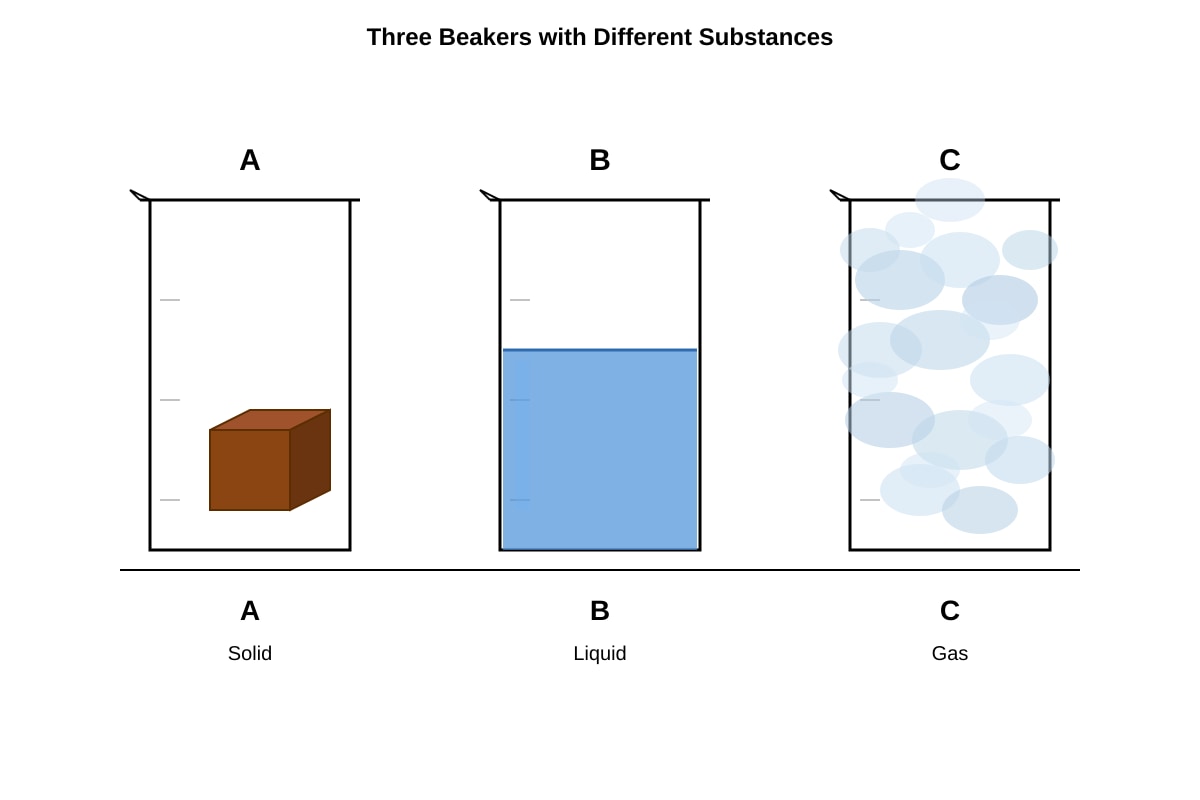
Q16. (a) Solid
- Marks: 1
- Explanation: The substance in beaker A keeps its own shape, which is a property of a solid.
(b) Gas
- Marks: 1
- Explanation: The substance in beaker C fills the entire beaker, which is a property of a gas.
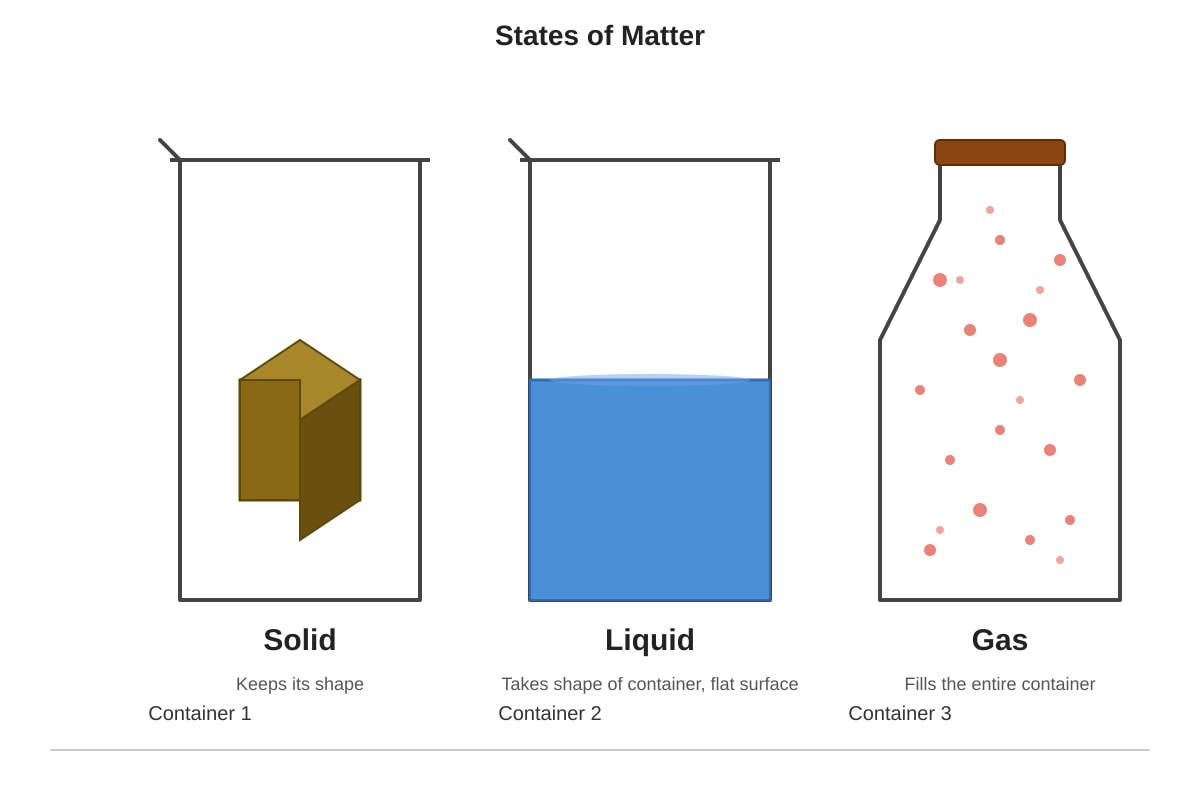
(c) It has a definite volume but no definite shape. (OR: It takes the shape of its container.)
- Marks: 1
- Explanation: A liquid has a definite volume because its particles are close together, but it takes the shape of its container because its particles can move past one another.
- Marking note: Accept either answer.
Q17. (a) Balloon 3 (sand)
- Marks: 1
- Explanation: Sand is the most dense of the three substances. For the same volume, sand has the greatest mass.
(b) Sand is a solid and its particles are packed closely together. For the same volume, sand contains more matter (has greater mass) than air or water.
- Marks: 1
- Explanation: Mass depends on how much matter is in an object. Solids are generally denser than liquids and gases.
(c) Balloon 3 (sand)
- Marks: 1
- Explanation: Sand is a solid and cannot be compressed because its particles are already packed closely together.
(d) Sand is a solid. Its particles are packed closely together and cannot be pushed closer, so it cannot be compressed. Air and water can be squeezed to a smaller size because their particles have more space between them.
- Marks: 1
- Explanation: Solids are incompressible because their particles are already touching. Gases are highly compressible because their particles are far apart. Liquids are slightly compressible but not easily.
- Marking note: Accept "Balloon 1 (air)" for (c) if the student explains that air can be compressed the most, but the question asks for the balloon that can be squeezed to the smallest size, which is the sand balloon.
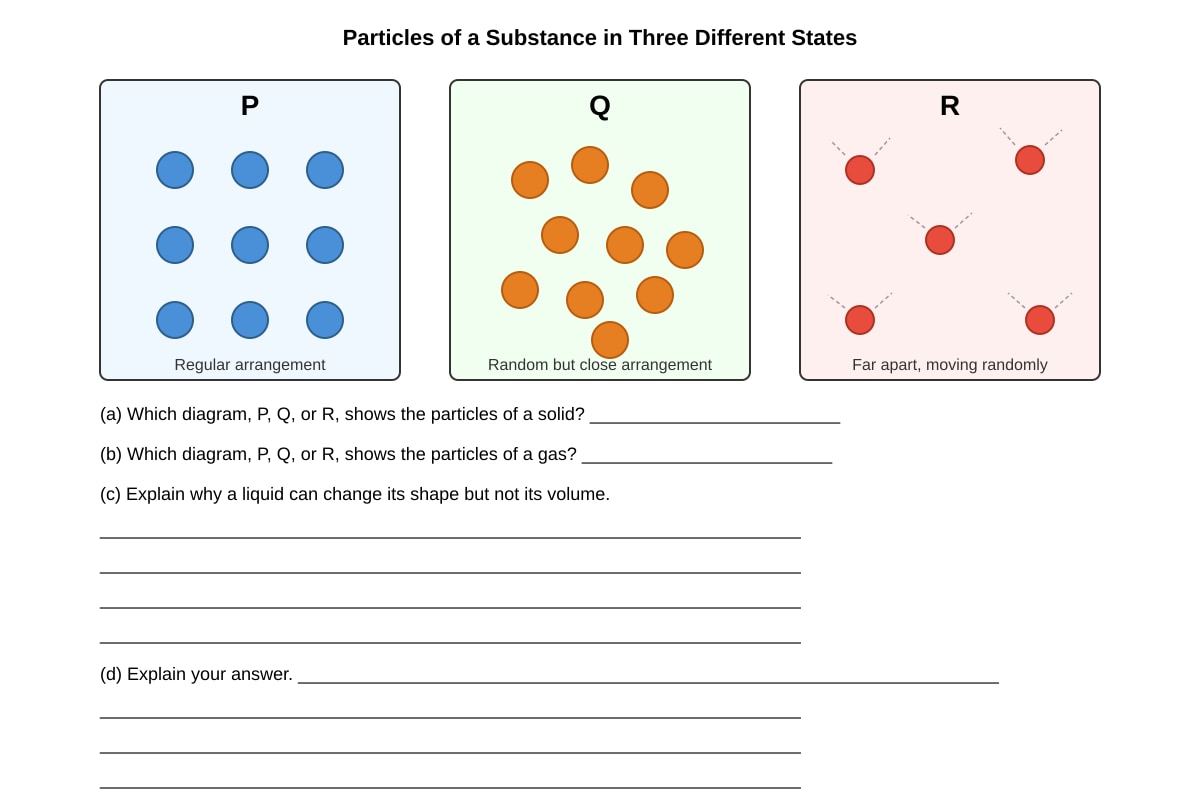
Q18. (a) P
- Marks: 1
- Explanation: Diagram P shows particles packed closely together in a regular, fixed pattern, which is the arrangement in a solid.
(b) R
- Marks: 1
- Explanation: Diagram R shows particles far apart and moving randomly, which is the arrangement in a gas.
(c) A liquid can change its shape because its particles can move and slide past one another. However, it has a definite volume because its particles are still packed closely together.
- Marks: 2 (1 mark for explaining shape change, 1 mark for explaining volume)
- Explanation: The particles in a liquid are close together (so volume is fixed) but not held in fixed positions (so it can flow and take the shape of its container).
- Marking note: Award 1 mark for "particles can move/slide past each other" and 1 mark for "particles are packed closely together."
Q19. (a) Volume = 95 − 80 = 15 cm³
- Marks: 2 (1 mark for correct working, 1 mark for correct answer with unit)
- Explanation: The water displacement method: the rise in water level equals the volume of the object.
- Working: 95 cm³ − 80 cm³ = 15 cm³
(b) Mass = 40 g ÷ 1000 = 0.04 kg
- Marks: 2 (1 mark for correct working, 1 mark for correct answer with unit)
- Explanation: 1 kg = 1000 g. To convert grams to kilograms, divide by 1000.
- Working: 40 ÷ 1000 = 0.04 kg
Q20. (a) Solid
- Marks: 1
- Explanation: Substance A has a definite shape and a definite volume, which are properties of a solid.
(b) Gas
- Marks: 1
- Explanation: Substance B has no definite shape, no definite volume, and can be compressed easily, which are properties of a gas.
(c) Liquid
- Marks: 1
- Explanation: Substance C has no definite shape but a definite volume, which are properties of a liquid.
(d) The particles of substance B (gas) are pushed closer together. The space between the particles decreases.
- Marks: 1
- Explanation: Gases can be compressed because their particles are far apart. When the container is squeezed, the particles are pushed closer together.
- Common mistake: Students may say the particles themselves get smaller. The particles do not change size; only the space between them decreases.
END OF ANSWER KEY