From Real Exams Quiz
Primary 4 Science Matter Quiz
Free P4 Science Matter quiz, Exam version, with questions, answers, and syllabus-aligned practice for Singapore students.
These static practice materials are generated from the site's syllabus and paper-generation workflow, with source and model context shown so students and parents can evaluate the material before use.
Questions
Free quiz and exam paper access
Enter your details to view this paper
Your access is remembered on this device.
Answers
Primary 4 Science Quiz - Matter: Answer Key
Total Marks: 30
Section A: Multiple-Choice Questions
Q1. C) Air
- Mark: 1
- Explanation: Matter is anything that has mass and occupies space. Air is matter because it has mass and takes up space, even though we cannot see it. Heat, light, and sound are forms of energy, not matter.
- Common mistake: Students may think air is not matter because it is invisible. Remind them that invisible things can still have mass and occupy space.
Q2. A) Solid
- Mark: 1
- Explanation: A solid has a definite shape and a definite volume. The particles in a solid are packed closely together in a fixed arrangement, which is why the shape does not change.
- Common mistake: Students may confuse solids with liquids. Liquids have a definite volume but no definite shape.
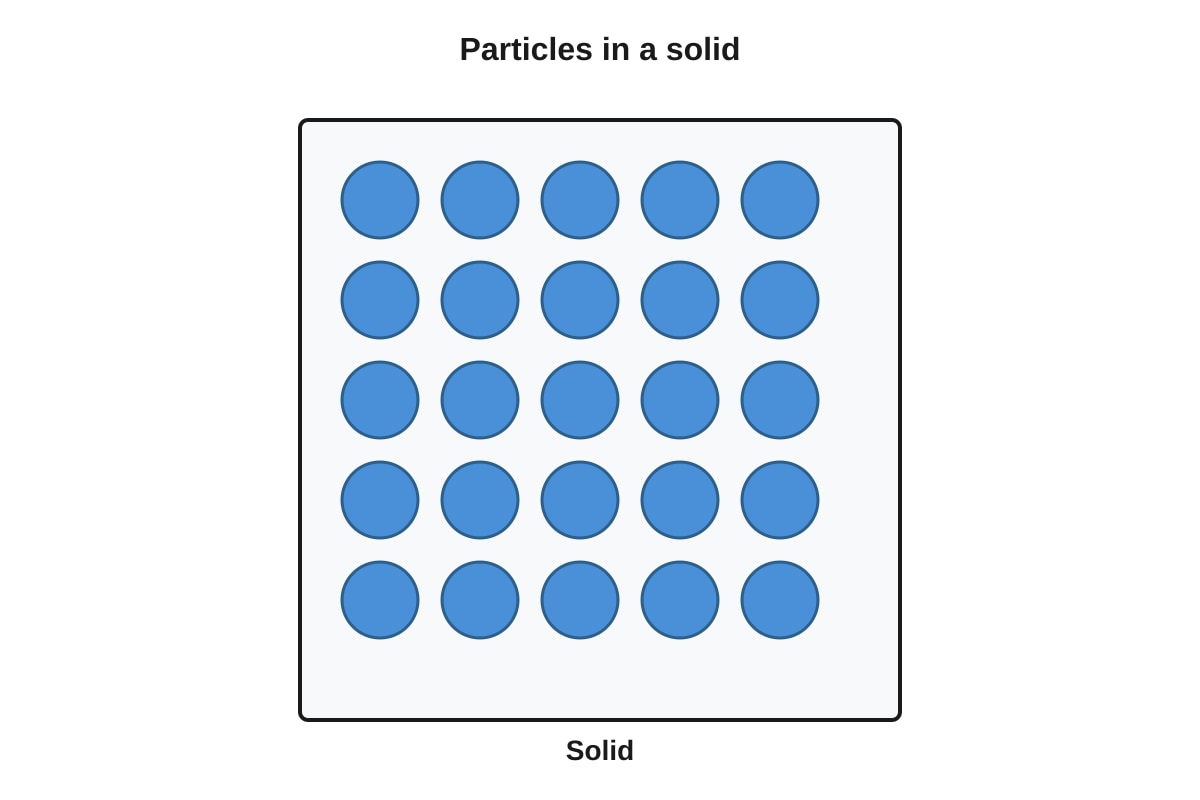
Q3. B) Particles are close together but can move past one another.
- Mark: 1
- Explanation: In a liquid, particles are close together but not in a fixed arrangement. They can slide past one another, which is why a liquid can flow and change shape.
- Common mistake: Option A describes a solid. Option C describes a gas.
Q4. C) The volume stays the same because the amount of water does not change.
- Mark: 1
- Explanation: The volume of a liquid does not change when poured into a different container. The liquid changes shape to fit the container, but the amount of liquid (and therefore its volume) remains the same.
- Common mistake: Students may think the volume changes because the shape changes. Emphasise that volume and shape are different properties.
Q5. B) Measuring cylinder
- Mark: 1
- Explanation: A measuring cylinder is used to measure the volume of a liquid accurately. A ruler measures length, a weighing scale measures mass, and a thermometer measures temperature.
- Common mistake: Students may confuse a measuring cylinder with a beaker. A beaker is less accurate for measuring volume.
Section B: Short-Answer Questions
Q6. Matter is anything that has mass and occupies space.
- Mark: 2 (1 mark for "has mass", 1 mark for "occupies space")
- Explanation: This is the definition of matter. Everything around us that takes up space and has weight is made of matter.
- Common mistake: Students may say "anything that can be seen" – this is incorrect because air is matter but cannot be seen.
Q7.
| State of Matter | Shape | Volume |
|---|---|---|
| Solid | Definite | Definite |
| Liquid | No definite | Definite |
| Gas | No definite | No definite |
- Mark: 2 (1 mark for each correct row, or ½ mark for each correct blank)
- Explanation:
- Solid: definite shape and definite volume.
- Liquid: no definite shape (takes shape of container) but definite volume.
- Gas: no definite shape and no definite volume (fills the entire container).
- Common mistake: Students may write "no definite" for liquid volume. Remind them that a liquid's volume stays the same even when poured into different containers.
Q8. Volume of stone = 65 ml – 50 ml = 15 ml
- Mark: 2 (1 mark for correct subtraction, 1 mark for correct answer with unit)
- Explanation: The stone displaces water equal to its own volume. The increase in water level (65 ml – 50 ml = 15 ml) is the volume of the stone.
- Working:
- Final water level: 65 ml
- Initial water level: 50 ml
- Volume of stone = 65 – 50 = 15 ml
- Common mistake: Students may forget to subtract the initial water level or forget the unit (ml).
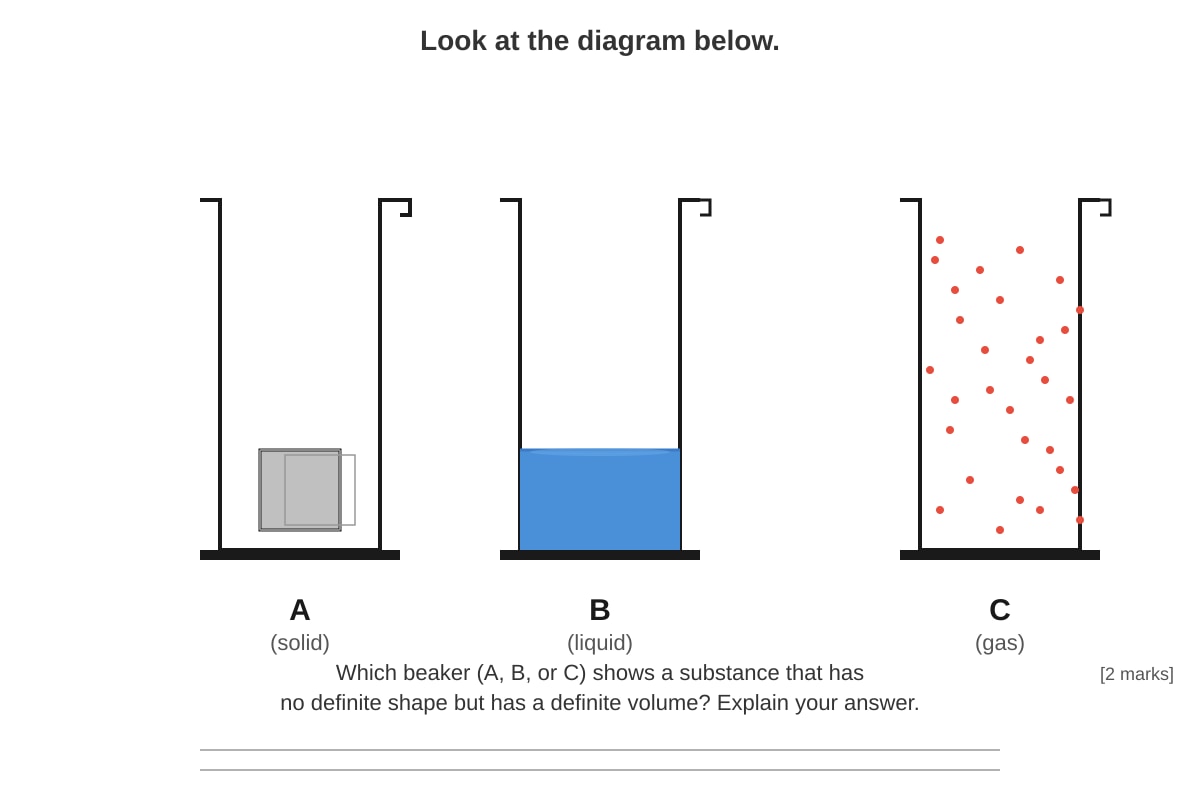
Q9. Beaker B (liquid). A liquid has no definite shape (it takes the shape of its container) but has a definite volume.
- Mark: 2 (1 mark for identifying Beaker B, 1 mark for correct explanation)
- Explanation: The liquid in Beaker B takes the shape of the beaker but its volume does not change. A solid (Beaker A) has a definite shape. A gas (Beaker C) has neither a definite shape nor a definite volume.
- Common mistake: Students may choose Beaker C because gas has no definite shape, but gas also has no definite volume.
Q10. The air inside the balloon is a gas. Gas particles are far apart and can be compressed (squeezed) into a smaller space because there is empty space between the particles.
- Mark: 2 (1 mark for identifying air as a gas, 1 mark for explaining that gas particles can be compressed / have space between them)
- Explanation: Unlike solids and liquids, gases can be compressed because their particles are far apart. Squeezing the balloon pushes the particles closer together.
- Common mistake: Students may say "the air escapes" – this is incorrect if the balloon is sealed. The air stays inside but takes up less space.
Q11. (a) Weighing scale / balance (1 mark)
(b) Kilograms (kg) or grams (g) (1 mark)
- Explanation: Mass is measured using a weighing scale or balance. The common units are kilograms (kg) for larger objects and grams (g) for smaller objects.
- Common mistake: Students may write "weight" instead of "mass" or use "litres" as a unit. Litres measure volume, not mass.
Q12. The three liquids have the same mass for the same volume (100 ml). This means they have the same density (mass per unit volume).
- Mark: 2 (1 mark for stating the liquids have the same mass, 1 mark for concluding they have the same density / mass per unit volume)
- Explanation: Since all three beakers have the same mass and contain the same volume (100 ml) of liquid, the liquids must have the same density. Density is the amount of mass in a given volume.
- Common mistake: Students may say "the liquids are the same" – this is incorrect. They are different liquids but happen to have the same density.
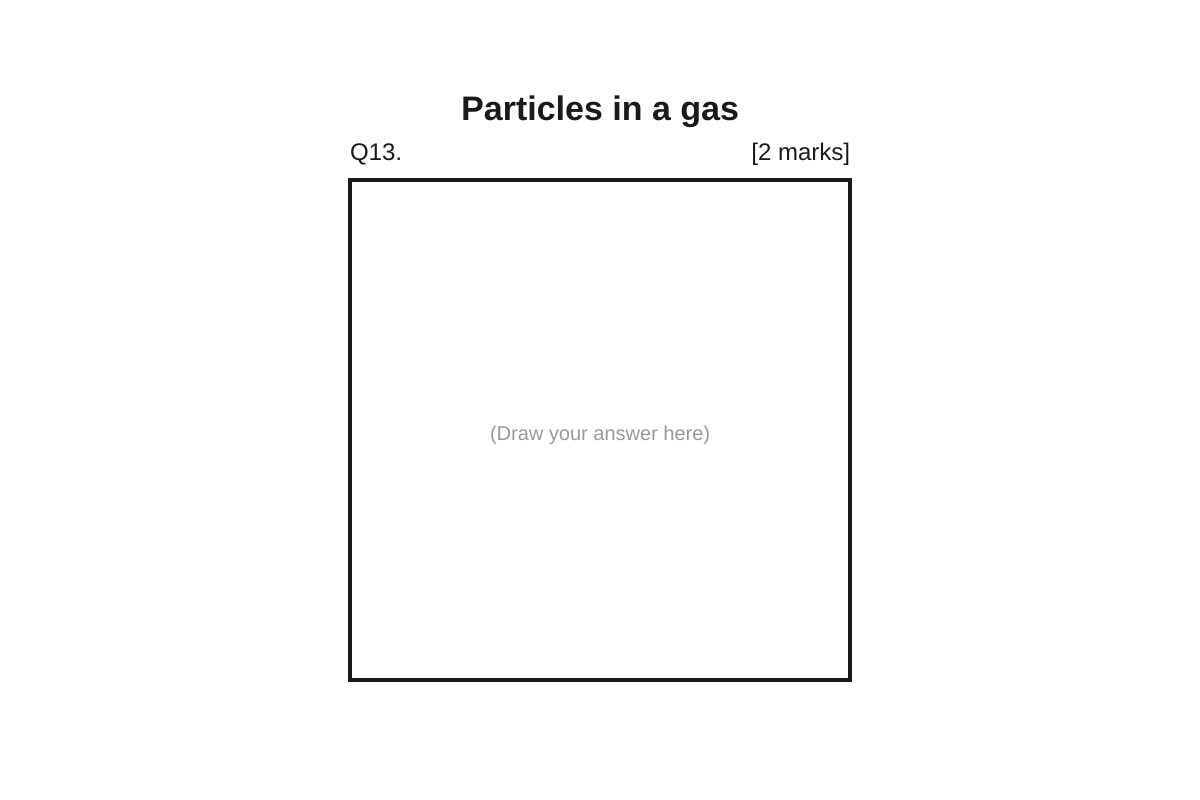
Q13. Student's diagram should show particles that are far apart and spread out to fill the entire box.
- Mark: 2 (1 mark for particles far apart, 1 mark for particles spread evenly throughout the box)
- Explanation: Gas particles are far apart from one another and move freely in all directions. They fill the entire container.
- Expected visual: The answer should show circles (particles) spread out with large spaces between them, distributed throughout the entire box.
- Common mistake: Students may draw particles close together (solid) or in a regular pattern (solid/liquid). Gas particles must be spread out.
Q14. Steps:
- Fill a measuring cylinder with a known volume of water (e.g., 50 ml).
- Record the initial water level.
- Carefully lower the object into the measuring cylinder using a string.
- Record the new water level.
- Subtract the initial water level from the new water level. The difference is the volume of the object.
- Mark: 2 (1 mark for recording initial and final water levels, 1 mark for subtracting to find the difference)
- Explanation: This is the water displacement method. The object pushes water up by an amount equal to its own volume.
- Common mistake: Students may forget to record the initial water level or may not mention subtracting the two readings.
Q15. 150 ml × 3 = 450 ml. 500 ml – 450 ml = 50 ml of juice left.
- Mark: 2 (1 mark for correct calculation of total juice used, 1 mark for correct final answer with unit)
- Working:
- Total juice in three cups = 3 × 150 ml = 450 ml
- Juice left in jug = 500 ml – 450 ml = 50 ml
- Common mistake: Students may forget to multiply 150 by 3 or may subtract incorrectly.
Section C: Open-Ended Questions
Q16. True
- Mark: 1
- Explanation: All matter has mass, including gases. Even though we cannot see air, it has mass. This can be proven by weighing a balloon before and after filling it with air.
- Common mistake: Students may think gases do not have mass because they are invisible.
Q17. No, the student is not correct. Gases have mass even though they cannot be seen. Matter is anything that has mass and occupies space, and gases are matter.
- Mark: 1
- Explanation: Visibility is not a requirement for matter. Air, for example, has mass and takes up space. A balloon filled with air weighs more than an empty balloon.
- Common mistake: Students may agree with the statement. Emphasise that invisible things can still be matter.
Q18. Accept any reasonable answers. Examples:
-
Solid: table, chair, book, pencil
-
Liquid: water, juice, ink
-
Gas: air, oxygen, carbon dioxide
-
Mark: 1 (all three correct for 1 mark; ½ mark if two correct)
-
Explanation: Students should identify common examples of each state of matter found in their surroundings.
-
Common mistake: Students may list "heat" or "light" as a gas – these are forms of energy, not matter.
Q19. Volume of metal ball = 40 ml – 30 ml = 10 ml
- Mark: 1
- Explanation: The metal ball displaces water equal to its own volume. The increase in water level (40 ml – 30 ml = 10 ml) is the volume of the ball.
- Common mistake: Students may write 40 ml instead of subtracting. The initial water level must be subtracted.
Q20. A liquid can change its shape because its particles are not held in a fixed arrangement and can move past one another. A solid cannot change its shape because its particles are packed closely together in a fixed arrangement and can only vibrate in place.
- Mark: 1
- Explanation: The arrangement of particles determines the properties of each state of matter. In a solid, particles are fixed in position. In a liquid, particles can slide past each other.
- Common mistake: Students may say "liquids are soft" – this is not a scientific explanation. The answer must refer to particle arrangement.
END OF ANSWER KEY