From Real Exams Quiz
Primary 4 Science Matter Quiz
Free P4 Science Matter quiz, Exam version, with questions, answers, and syllabus-aligned practice for Singapore students.
These static practice materials are generated from the site's syllabus and paper-generation workflow, with source and model context shown so students and parents can evaluate the material before use.
Questions
Free quiz and exam paper access
Enter your details to view this paper
Your access is remembered on this device.
Answers
Answer Key: Primary 4 Science Quiz - Matter
Total Marks: 30
Section A: Multiple-Choice Questions (5 x 1 mark = 5 marks)
1. Answer: 3) The light from a torch
- Explanation: Matter is defined as anything that has mass and occupies space. Light is a form of energy, not matter. It does not have mass and does not take up space. A wooden block, water, and air all have mass and occupy space, so they are matter.
- Marking: 1 mark for correct option.
- Common mistake: Students may think air is not matter because it is invisible. Remind them that air has mass and occupies space.
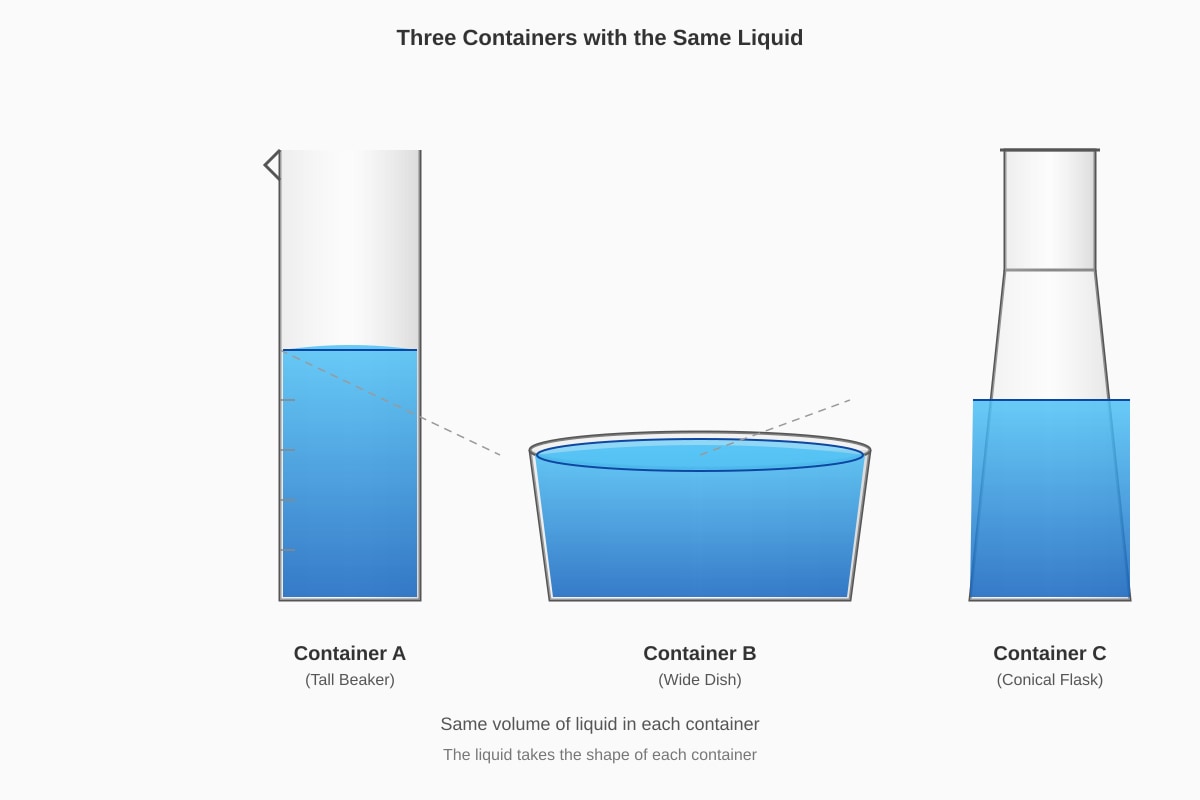
2. Answer: 1) The liquid has the same volume but different shapes.
- Explanation: A liquid has a definite volume but no definite shape. It takes the shape of its container. Since the same amount of liquid is poured into different containers, the volume stays the same, but the shape changes to match each container.
- Marking: 1 mark for correct option.
- Common mistake: Students may think the volume changes because the shape looks different. Emphasise that volume is the amount of space the matter occupies, which does not change when poured.
3. Answer: 1) 15 cm³
- Explanation: The volume of the stone is equal to the volume of water it displaces. The water level rose from 50 cm³ to 65 cm³. The increase in volume is 65 cm³ - 50 cm³ = 15 cm³. This is the volume of the stone.
- Marking: 1 mark for correct option.
- Working: 65 cm³ - 50 cm³ = 15 cm³
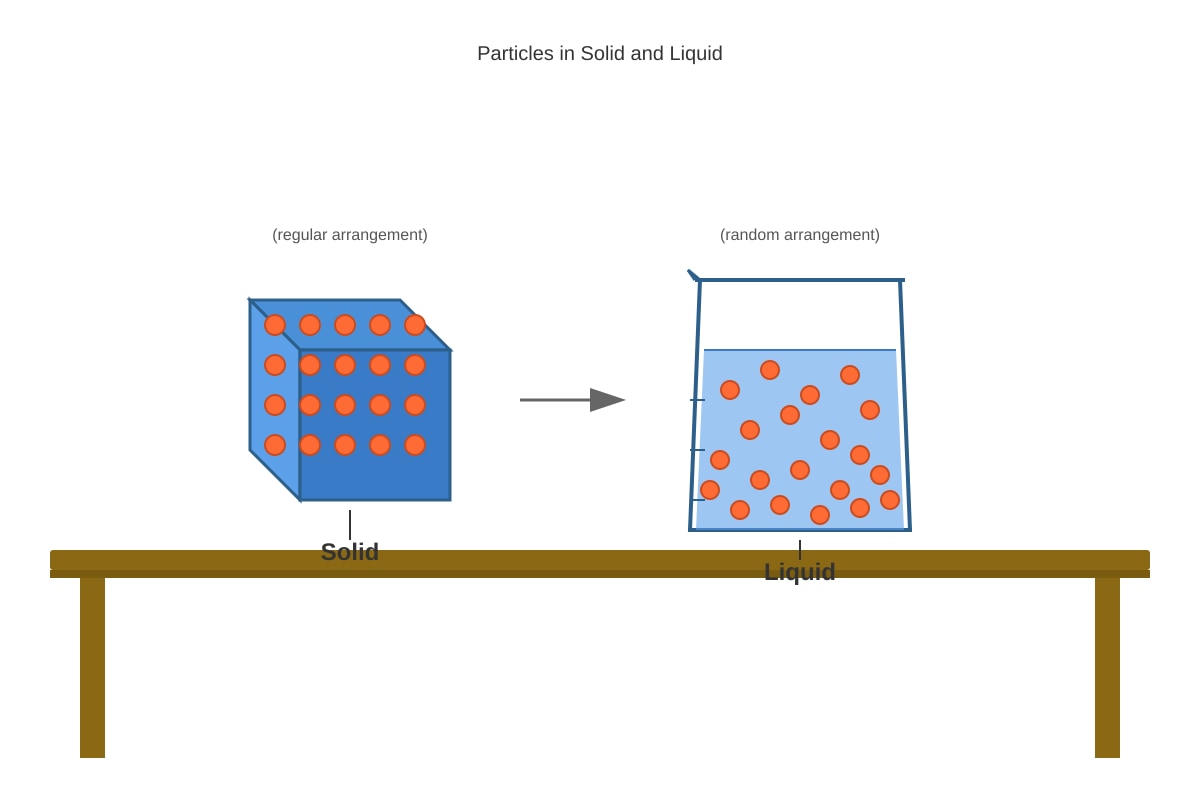
4. Answer: 2) Particles are close together and vibrate in fixed positions.
- Explanation: In a solid, the particles are packed very closely together in a regular arrangement. They cannot move around freely; they can only vibrate in their fixed positions. This gives solids a definite shape and volume.
- Marking: 1 mark for correct option.
- Common mistake: Students may confuse the particle arrangement of solids with liquids (particles slide past each other) or gases (particles are far apart).
5. Answer: 2) The balloon will shrink because the air particles move slower and take up less space.
- Explanation: When the air inside the balloon is cooled, the particles lose energy and move slower. They move closer together, causing the air to take up less volume. This makes the balloon shrink.
- Marking: 1 mark for correct option.
- Common mistake: Students may think the balloon will expand because they associate cold with contraction in some contexts. Explain that cooling causes particles to move less and come closer together, reducing volume.
Section B: Short-Answer Questions (10 x 1 mark = 10 marks)
6. Answer: Solid, liquid, gas
- Explanation: These are the three common states of matter. Each state has different properties related to shape and volume.
- Marking: 1 mark for all three states named correctly. Accept any order.
7. Answer: A gas has no definite shape / A gas has no definite volume / A gas can be compressed easily. (Accept any one correct property)
- Explanation: A solid has a definite shape and volume. A gas has neither a definite shape nor a definite volume. It will expand to fill any container.
- Marking: 1 mark for any one correct property of a gas that is different from a solid.
8. Answer: Measuring cylinder
- Explanation: A measuring cylinder is a tall, narrow container with markings (graduations) that allow for the accurate measurement of liquid volume.
- Marking: 1 mark for "measuring cylinder" or "graduated cylinder".
9. Answer: (Electronic) balance / weighing scale
- Explanation: Mass is measured using a balance or a scale. An electronic balance is commonly used in schools for accurate measurement.
- Marking: 1 mark for "balance", "electronic balance", or "weighing scale".
10. Answer: The particles change from a regular, fixed arrangement to a random arrangement. / The particles are no longer in fixed positions and can slide past each other.
- Explanation: In a solid, particles are in a fixed, regular pattern. When it melts into a liquid, the particles gain energy, break free from their fixed positions, and move around randomly while still staying close together.
- Marking: 1 mark for describing the change from fixed/regular to random/free-moving.
11. Answer: Sponge / cotton wool / rubber band / foam (Accept any correct example)
- Explanation: Most solids cannot be compressed easily because their particles are already very close together. However, some solids like sponges have air trapped in their pores, which can be squeezed out, making them compressible.
- Marking: 1 mark for a valid example of a compressible solid.
12. Answer: The particles in a liquid can slide past each other, while the particles in a solid are fixed in position and can only vibrate.
- Explanation: The ability to flow is due to the movement of particles. Liquid particles have enough energy to move and slide over one another. Solid particles are held in a rigid structure and cannot move past each other.
- Marking: 1 mark for a correct explanation comparing particle movement.
13. Answer: Yes, the sponge is a solid. It has a definite shape and volume (before squeezing). The air in the holes is being squeezed out, not the sponge itself.
- Explanation: A sponge is a solid with many air holes. When squeezed, the air is forced out, making the sponge appear smaller. The solid material of the sponge itself does not change its volume or shape permanently.
- Marking: 1 mark for stating it is a solid and giving a correct explanation.
14. Answer: Grams (g) / Kilograms (kg)
- Explanation: Mass is a measure of the amount of matter in an object. The standard units for mass are grams and kilograms.
- Marking: 1 mark for "grams (g)" or "kilograms (kg)". Accept either.
15. Answer: Cubic centimetres (cm³) / Millilitres (ml) / Litres (l)
- Explanation: Volume is the amount of space an object occupies. Common units for volume are cubic centimetres (cm³) for solids and millilitres (ml) or litres (l) for liquids.
- Marking: 1 mark for any correct unit of volume.
Section C: Structured Questions (5 x 3 marks = 15 marks)
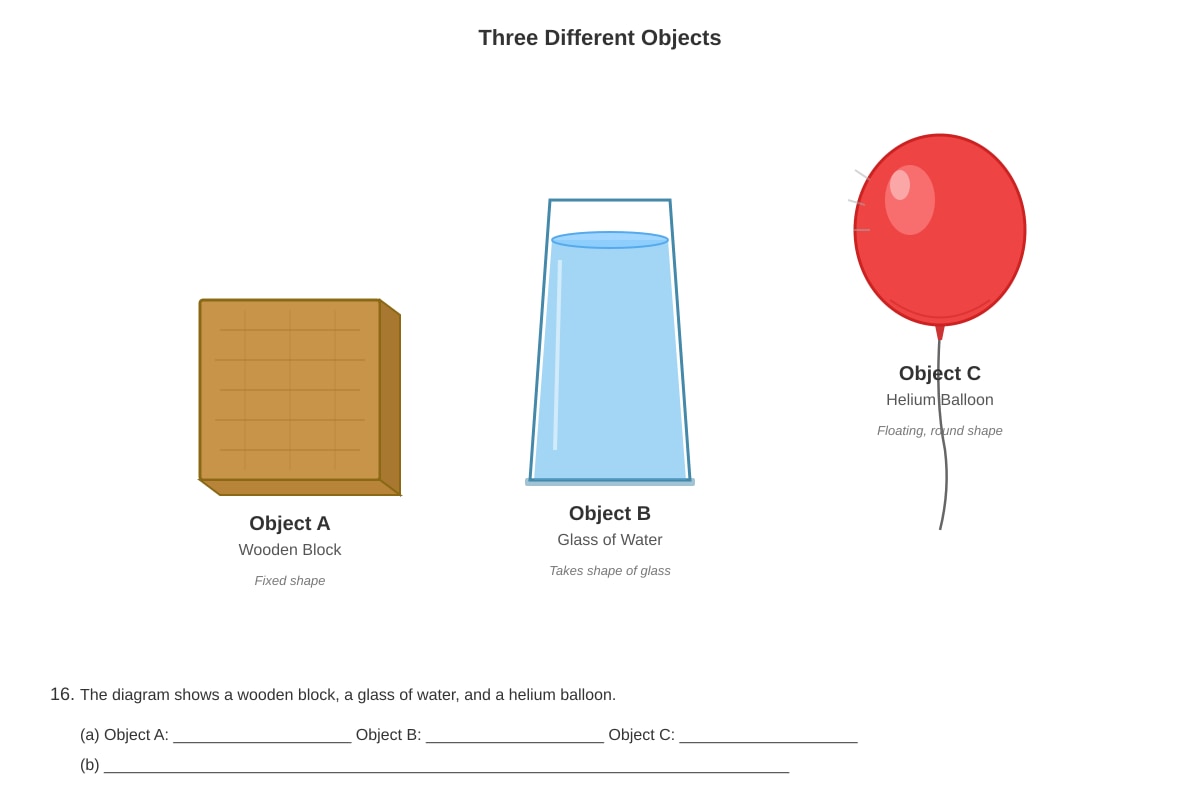
16. (a) Answer: Object A: Solid, Object B: Liquid, Object C: Gas
- Explanation: The wooden block has a fixed shape (solid). The water takes the shape of the glass (liquid). The helium gas fills the balloon and has no fixed shape (gas).
- Marking: 1 mark for all three correctly identified.
(b) Answer: The particles in a gas are very far apart and move freely in all directions. They are not held in fixed positions, so the gas can easily change its shape to fill the container (the balloon).
- Explanation: The key property of a gas is that its particles have very weak forces between them and move rapidly. This allows the gas to expand and change shape to fill any space available.
- Marking: 2 marks for a complete explanation. 1 mark for stating particles are far apart/move freely. 1 mark for linking this to the ability to change shape.
17. (a) Answer: Beaker X (water). The sand has air spaces between the grains, so 100 cm³ of sand contains less solid matter than 100 cm³ of water. Water is a liquid with particles packed closely together, so it has more matter in the same volume.
- Explanation: Although all three beakers have the same volume, the amount of matter (mass) in that volume is different. Sand is a solid with air gaps, so it is less dense. Water is a liquid with particles closely packed. Cooking oil is also a liquid but is less dense than water.
- Marking: 2 marks for a correct answer and explanation. 1 mark for identifying water without a clear explanation.
(b) Answer: Pour the sand into a measuring cylinder containing a known volume of water. The rise in water level will give the volume of the sand.
- Explanation: This is the same method used for finding the volume of an irregular solid (water displacement). The sand will settle and displace its own volume of water.
- Marking: 1 mark for describing the water displacement method.
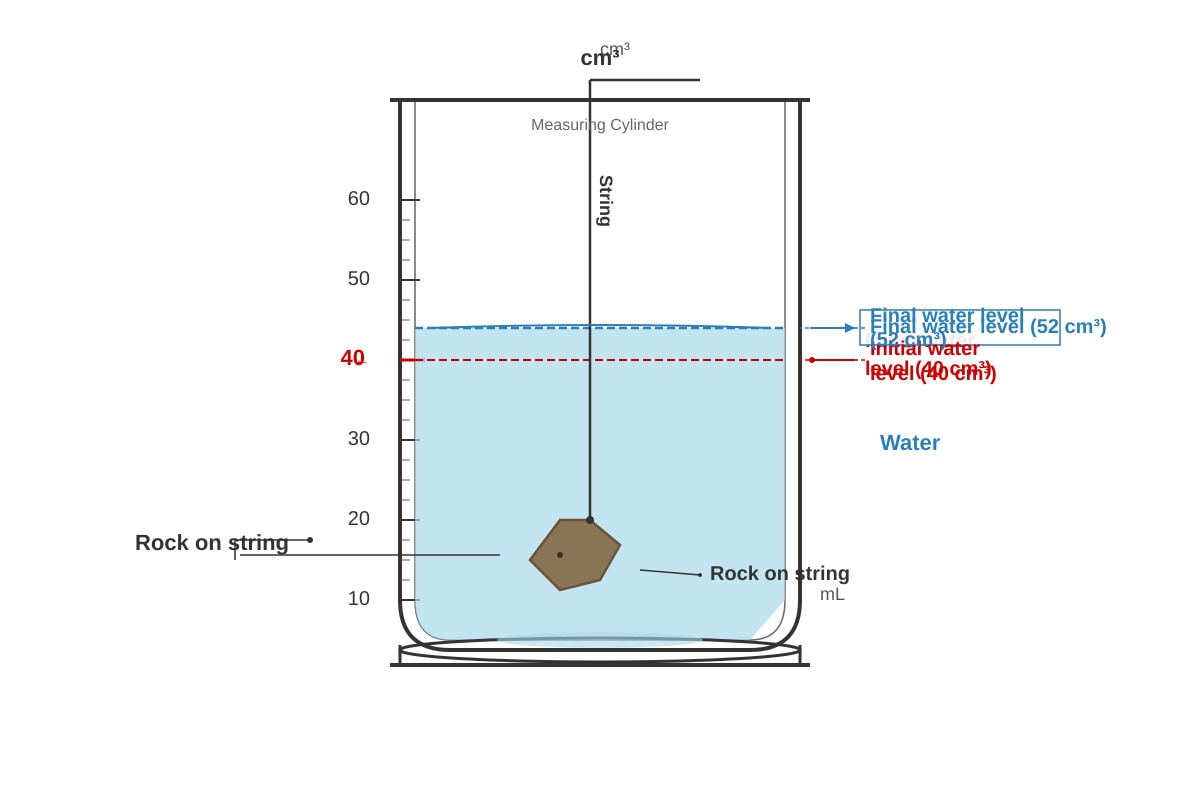
18. (a) Answer: 12 cm³
- Explanation: The volume of the rock is equal to the volume of water it displaces. Final volume (52 cm³) - Initial volume (40 cm³) = 12 cm³.
- Marking: 1 mark for the correct answer with unit.
(b) Answer: The rock takes up space (has volume). When it is placed in the water, it pushes the water aside (displaces water) to make room for itself. This causes the water level to rise.
- Explanation: This is the principle of displacement. An object submerged in a fluid pushes the fluid out of the way. The amount of fluid displaced is equal to the volume of the object.
- Marking: 2 marks for a complete explanation. 1 mark for stating the rock takes up space. 1 mark for stating it pushes the water aside/displaces water.
19. (a) Answer: P: Solid, Q: Liquid, R: Gas
- Explanation: A solid has a definite shape and volume. A liquid has a definite volume but no definite shape. A gas has no definite shape or volume and can be compressed.
- Marking: 1.5 marks (0.5 marks for each correct identification).
(b) Answer: Oxygen / Carbon dioxide / Helium / Air (Accept any correct example of a gas)
- Explanation: Substance R is a gas. Any common gas is a valid example.
- Marking: 0.5 mark for a correct example.
(c) Answer: The particles are close together but arranged randomly. They can slide past each other.
- Explanation: This describes the particle arrangement in a liquid. The particles are not in fixed positions like in a solid, but they are still close together, unlike in a gas.
- Marking: 1 mark for describing both the closeness and the random arrangement/sliding movement.
20. (a) Answer: Melting (changing from solid to liquid)
- Explanation: Ice is the solid state of water. When it is left at room temperature, it gains heat from the surroundings and melts into liquid water.
- Marking: 1 mark for "melting".
(b) Answer: The particles of the ice gain heat energy and start to vibrate faster. They overcome the forces holding them in fixed positions and begin to move around freely, sliding past each other. The regular arrangement of the particles is lost.
- Explanation: Melting is a change of state where a solid becomes a liquid. The particles gain energy, their movement increases, and the rigid structure of the solid breaks down.
- Marking: 2 marks for a complete description. 1 mark for stating particles gain energy/move faster. 1 mark for stating they break free from fixed positions/slide past each other.
- End of Answer Key -