Primary 4 Science Quiz - Materials
Name: ___________________________
Class: ___________________________
Date: ___________________________
Score: _______ / 40
Duration: 50 minutes
Total Marks: 40
Instructions:
- This quiz has 20 questions on the topic of Materials (Matter).
- Section A: 10 multiple-choice questions (1 mark each).
- Section B: 6 short-answer questions (2 marks each).
- Section C: 4 structured questions with subparts (total 8 marks).
- Write your answers clearly in the spaces provided.
Section A (Questions 1–10, 1 mark each)
-
Which of the following is an example of matter?
A. Light
B. Sound
C. A wooden chair
D. Heat
-
Which state of matter has a fixed shape and a fixed volume?
A. Solid
B. Liquid
C. Gas
D. Plasma
-
A balloon is filled with air. Which property shows that the air is matter?
A. It is invisible
B. It has mass and occupies space
C. It can move
D. It is cold
-
Which of the following is a liquid at room temperature?
A. Ice
B. Water
C. Steam
D. Wood
-
Which apparatus is used to measure the mass of an object?
A. Thermometer
B. Measuring cylinder
C. Beam balance
D. Ruler
-
A student wants to find the volume of a stone. Which method should she use?
A. Use a thermometer
B. Use a beam balance
C. Use a measuring cylinder with water displacement
D. Use a stopwatch
-
Which of the following is a poor conductor of heat?
A. Steel spoon
B. Wooden spoon
C. Copper wire
D. Aluminium foil
-
When water is heated and becomes steam, what change is taking place?
A. Change in mass
B. Change of state
C. Change in colour
D. Change in taste
-
Which of the following objects does NOT occupy space?
A. A book
B. A glass of milk
C. A smell
D. A tennis ball
-
Which statement about gas is correct?
A. It has a fixed shape
B. It has no volume
C. It takes the shape of its container and fills the space
D. It cannot be compressed
Section B (Questions 11–16, 2 marks each)
- State one way to show that a pencil is matter.
- Complete the table below for the three states of matter.
| State | Fixed shape? | Fixed volume? |
|---|
| Solid | Yes | _______ |
| Liquid | _______ | Yes |
| Gas | No | _______ |
-
Name two good conductors of heat and two poor conductors of heat.
Good: _______________ , _______________
Poor: _______________ , _______________
-
A block of butter is left on a warm plate. It melts into a liquid. State the change in shape and volume that happens.
Shape: _________________________________
Volume: ________________________________
-
Explain why a measuring cylinder is used to measure the volume of a liquid.
- Give one reason why we say heat is different from temperature.
Section C (Questions 17–20, structured)
-
(a) What is matter? [1 mark]
(b) Give two examples of matter that are gases. [1 mark]
-
A student measures the mass of a toy car using a beam balance. The weights used are: 50 g, 20 g, 5 g, and 2 g.
(a) Calculate the total mass of the toy car. [1 mark]
(b) Which apparatus would you use to measure the volume of the toy car if it does not dissolve in water? [1 mark]
-
Study the setup below.
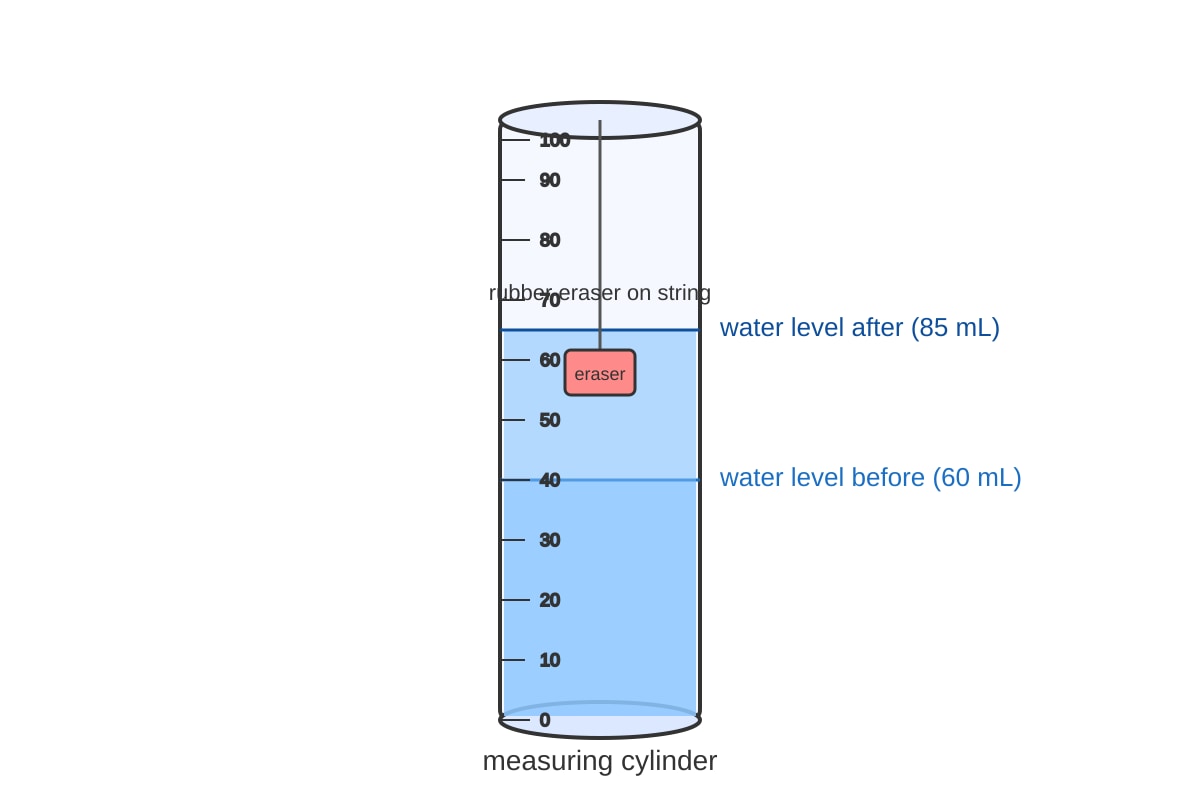
Generated experimental_setup for Q19.
(a) What is the volume of the rubber eraser? [1 mark]
_______________________________________________________
(b) Explain how you found your answer. [1 mark]
_______________________________________________________
20. (a) State whether a metal rod or a plastic rod is a better conductor of heat. [1 mark]
_______________________________________________________
(b) Give one everyday use of a poor conductor of heat. [1 mark]
_______________________________________________________
</stage3_quiz_answers_md>
Primary 4 Science Quiz - Materials (Answer Key)
Total Marks: 40
Topic: Materials (Matter)
Section A Answers (1 mark each)
-
C (A wooden chair)
Teaching note: Matter is anything that has mass and occupies space. Wood, chair, and all objects are matter. Light, sound, and heat are not matter.
-
A (Solid)
Teaching note: Solid has fixed shape and fixed volume. Liquid has no fixed shape but fixed volume. Gas has neither.
-
B (It has mass and occupies space)
Teaching note: Air is matter because it has mass (can be weighed) and occupies space (fills balloon).
-
B (Water)
Teaching note: At room temperature, water is liquid. Ice is solid, steam is gas, wood is solid.
-
C (Beam balance)
Teaching note: Mass measured by beam balance or electronic balance. Thermometer measures temperature.
-
C (Measuring cylinder with water displacement)
Teaching note: Irregular solid volume found by displacement: final − initial water level.
-
B (Wooden spoon)
Teaching note: Wood is poor conductor. Metals (steel, copper, aluminium) are good conductors.
-
B (Change of state)
Teaching note: Water → steam is liquid to gas, a change of state (not mass/colour/taste).
-
C (A smell)
Teaching note: Smell is sensation, not matter. Book, milk, ball are matter.
-
C (Takes shape of container and fills space)
Teaching note: Gas has no fixed shape/volume, expands to fill container.
Section B Answers (2 marks each)
-
It has mass and occupies space (or "we can weigh it" / "it takes up room"). [2]
Marking: 1 mark for mass, 1 mark for occupies space (or equivalent demonstration).
-
Table completed: [2 total, 0.5 each]
Solid → Yes volume; Liquid → No fixed shape; Gas → No fixed volume.
| State | Fixed shape? | Fixed volume? |
| Solid | Yes | Yes |
| Liquid| No | Yes |
| Gas | No | No |
-
Good: metal, steel, copper, aluminium (any two) [1]; Poor: wood, plastic, rubber, air (any two) [1].
-
Shape: Changes from fixed to takes shape of plate [1]; Volume: Stays about the same [1].
Note: Melting changes state, not amount of matter.
-
It has a scale to read volume in mL; liquid takes its shape so we can read level. [2]
Marking: 1 for scale/unit, 1 for liquid property.
-
Heat is a form of energy; temperature measures hotness. [2]
Marking: 1 each concept.
Section C Answers
-
(a) Anything that has mass and occupies space. [1]
(b) Oxygen, nitrogen, carbon dioxide, helium (any two). [1]
-
(a) Total mass = 50 + 20 + 5 + 2 = 77 g [1].
(b) Measuring cylinder with water displacement [1].
-
(a) Volume = 85 mL − 60 mL = 25 mL [1].
(b) Subtract initial from final water level because eraser displaces its own volume [1].
-
(a) Metal rod [1].
(b) Plastic handle on pot, wooden spoon, rubber grip (any one) [1].
</stage3_quiz_answers_md>
<stage3_quiz_md>
Primary 4 Science Quiz - Materials
Name: ___________________________
Class: ___________________________
Date: ___________________________
Score: _______ / 40
Duration: 50 minutes
Total Marks: 40
Instructions:
- This quiz has 20 questions on the topic of Materials (Matter).
- Section A: 10 multiple-choice questions (1 mark each).
- Section B: 6 short-answer questions (2 marks each).
- Section C: 4 structured questions with subparts (total 8 marks).
- Write your answers clearly in the spaces provided.
Section A (Questions 1–10, 1 mark each)
-
Which of the following is an example of matter?
A. Light
B. Sound
C. A wooden chair
D. Heat
-
Which state of matter has a fixed shape and a fixed volume?
A. Solid
B. Liquid
C. Gas
D. Plasma
-
A balloon is filled with air. Which property shows that the air is matter?
A. It is invisible
B. It has mass and occupies space
C. It can move
D. It is cold
-
Which of the following is a liquid at room temperature?
A. Ice
B. Water
C. Steam
D. Wood
-
Which apparatus is used to measure the mass of an object?
A. Thermometer
B. Measuring cylinder
C. Beam balance
D. Ruler
-
A student wants to find the volume of a stone. Which method should she use?
A. Use a thermometer
B. Use a beam balance
C. Use a measuring cylinder with water displacement
D. Use a stopwatch
-
Which of the following is a poor conductor of heat?
A. Steel spoon
B. Wooden spoon
C. Copper wire
D. Aluminium foil
-
When water is heated and becomes steam, what change is taking place?
A. Change in mass
B. Change of state
C. Change in colour
D. Change in taste
-
Which of the following objects does NOT occupy space?
A. A book
B. A glass of milk
C. A smell
D. A tennis ball
-
Which statement about gas is correct?
A. It has a fixed shape
B. It has no volume
C. It takes the shape of its container and fills the space
D. It cannot be compressed
Section B (Questions 11–16, 2 marks each)
- State one way to show that a pencil is matter.
- Complete the table below for the three states of matter.
| State | Fixed shape? | Fixed volume? |
|---|
| Solid | Yes | _______ |
| Liquid | _______ | Yes |
| Gas | No | _______ |
-
Name two good conductors of heat and two poor conductors of heat.
Good: _______________ , _______________
Poor: _______________ , _______________
-
A block of butter is left on a warm plate. It melts into a liquid. State the change in shape and volume that happens.
Shape: _________________________________
Volume: ________________________________
-
Explain why a measuring cylinder is used to measure the volume of a liquid.
- Give one reason why we say heat is different from temperature.
Section C (Questions 17–20, structured)
-
(a) What is matter? [1 mark]
(b) Give two examples of matter that are gases. [1 mark]
-
A student measures the mass of a toy car using a beam balance. The weights used are: 50 g, 20 g, 5 g, and 2 g.
(a) Calculate the total mass of the toy car. [1 mark]
(b) Which apparatus would you use to measure the volume of the toy car if it does not dissolve in water? [1 mark]
-
Study the setup below.
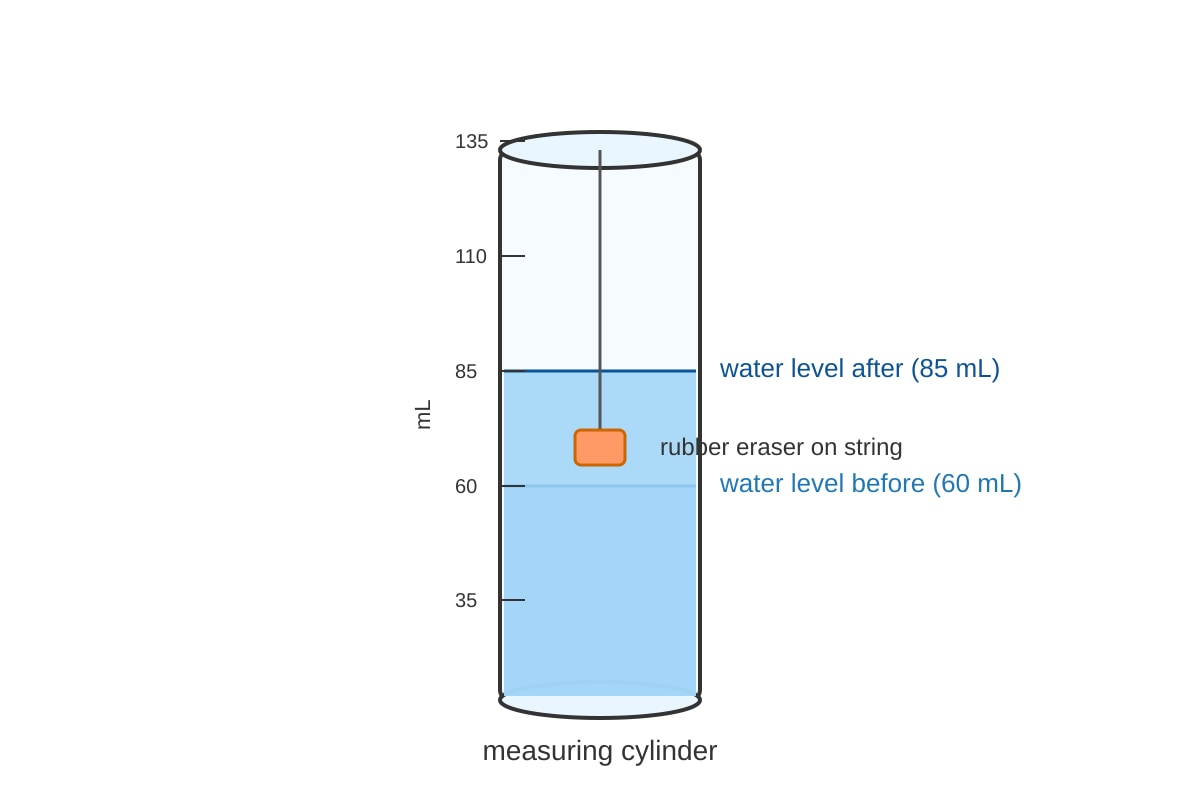
Generated experimental_setup for Q19.
(a) What is the volume of the rubber eraser? [1 mark]
_______________________________________________________
(b) Explain how you found your answer. [1 mark]
_______________________________________________________
20. (a) State whether a metal rod or a plastic rod is a better conductor of heat. [1 mark]
_______________________________________________________
(b) Give one everyday use of a poor conductor of heat. [1 mark]
_______________________________________________________