From Real Exams Quiz
Primary 4 Science Materials Quiz
Free P4 Science Materials quiz, Exam version, with questions, answers, and syllabus-aligned practice for Singapore students.
These static practice materials are generated from the site's syllabus and paper-generation workflow, with source and model context shown so students and parents can evaluate the material before use.
Questions
Free quiz and exam paper access
Enter your details to view this paper
Your access is remembered on this device.
Answers
Primary 4 Science Quiz - Materials: Answer Key
Total Marks: 20
Section A: Multiple-Choice Questions (Questions 1 – 5)
Each question carries 1 mark.
1. C) It has a definite volume.
- Explanation: A solid has a definite shape and a definite volume. It does not flow easily (B) and does not fill the container completely (D). Option A describes a liquid or gas.
- Marking: 1 mark for correct option.
2. C) Its ability to float (buoyancy)
- Explanation: The question asks what property is being tested when the wood floats. Buoyancy is the ability to float in a fluid (like water). Colour (A), hardness (B), and heat conduction (D) are not being tested here.
- Marking: 1 mark for correct option.
3. D) Plastic
- Explanation: A poor conductor of heat does not allow heat to pass through it easily. Plastic is a common poor conductor (insulator). Iron (A), copper (B), and aluminium (C) are all metals and good conductors of heat.
- Marking: 1 mark for correct option.
4. A) It should be a good conductor of heat.
- Explanation: A frying pan needs to get hot quickly and evenly to cook food. Therefore, the material must be a good conductor of heat. Transparency (B), flexibility (C), and buoyancy (D) are not important for a frying pan.
- Marking: 1 mark for correct option.
5. B) Oxygen
- Explanation: At room temperature, oxygen is a gas. Water (A) is a liquid, cooking oil (C) is a liquid, and ice (D) is a solid.
- Marking: 1 mark for correct option.
Section B: Fill in the Blanks (Questions 6 – 10)
Each question carries 1 mark.
6. mass
- Explanation: The definition of matter is anything that has mass and occupies space (volume).
- Marking: 1 mark for "mass". Accept "weight" only if the student clearly means mass in context, but "mass" is the precise scientific term.
7. volume
- Explanation: A liquid has a definite volume (it takes up a specific amount of space) but takes the shape of its container (no definite shape).
- Marking: 1 mark for "volume".
8. evaporation
- Explanation: Evaporation is the process where a liquid changes into a gas at the surface, usually at a temperature below its boiling point.
- Marking: 1 mark for "evaporation". Accept "boiling" if the context implies rapid heating, but "evaporation" is the general term for liquid to gas.
9. good
- Explanation: A good conductor allows heat (or electricity) to pass through it easily.
- Marking: 1 mark for "good".
10. poor
- Explanation: Rubber is an insulator, meaning it is a poor conductor of heat. It does not allow heat to pass through it easily.
- Marking: 1 mark for "poor". Accept "bad" or "insulator".
Section C: Short Answer Questions (Questions 11 – 15)
Each question carries 2 marks.
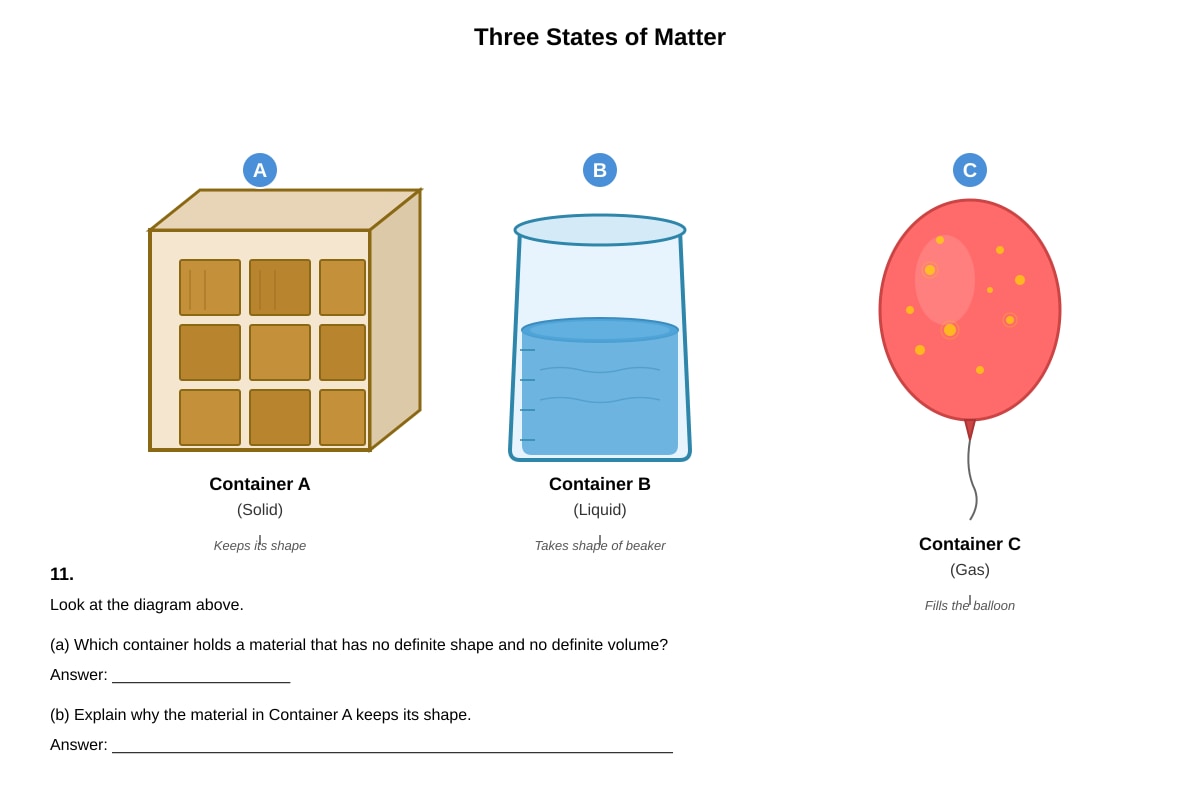
11. (a) Container C (1 mark)
- Explanation: A gas has no definite shape and no definite volume. It expands to fill the entire container. In the diagram, the gas in the balloon (Container C) takes the shape of the balloon and can be compressed.
- Marking: 1 mark for "Container C" or "C".
(b) The particles in a solid are packed closely together in a fixed arrangement, so they cannot move around freely. This gives the solid a definite shape. (1 mark)
- Explanation: The particles in a solid vibrate in place but do not move past each other. This fixed structure is why a solid keeps its shape.
- Marking: 1 mark for any explanation that mentions the particles are fixed or cannot move freely. Accept "The solid has a definite shape because its particles are held tightly together."
12. (a) Melting (1 mark)
- Explanation: Melting is the change of state from a solid (ice) to a liquid (water).
- Marking: 1 mark for "melting".
(b) The ice cube gained heat from the surroundings (the air in the room). (1 mark)
- Explanation: Heat flows from a hotter object (the air) to a colder object (the ice). This heat gain causes the ice to melt.
- Marking: 1 mark for any answer that mentions the ice gaining heat from the surroundings. Accept "The room temperature was higher than the ice, so heat from the air melted the ice."
13. (a) Metal spoon (1 mark)
- Explanation: The metal spoon feels hot because it is a good conductor of heat. Heat from the hot water travels quickly through the metal to the student's hand.
- Marking: 1 mark for "metal spoon".
(b) Wood is a poor conductor of heat. It does not allow heat to travel through it easily, so the heat from the hot water does not reach the student's hand. (1 mark)
- Explanation: Poor conductors (insulators) slow down the transfer of heat. The wooden spoon handle stays cool because heat cannot travel through it efficiently.
- Marking: 1 mark for any explanation that mentions wood is a poor conductor or an insulator. Accept "Wood does not conduct heat well."
14. The student can use a magnet to separate the iron filings from the sand. Iron is magnetic, but sand is not. The magnet will attract the iron filings, leaving the sand behind. (2 marks)
- Explanation: This question tests the understanding that different materials have different properties. The magnetic property of iron is used here.
- Marking:
- 1 mark for identifying the property (magnetism) or the method (using a magnet).
- 1 mark for explaining how to do it (the magnet attracts the iron filings).
15. Example: Glass is used to make windows because it is transparent. Another property of glass is that it is hard/strong/waterproof/does not rust. (2 marks)
- Explanation: The question asks for an example and another property. Transparency allows light to pass through so we can see outside. Other properties make it suitable for windows.
- Marking:
- 1 mark for a correct example (e.g., glass).
- 1 mark for stating another correct property (e.g., hard, strong, waterproof, brittle). Do not accept "transparent" as the other property.
Section D: Application Questions (Questions 16 – 20)
Each question carries 2 marks.
16. (a) Metal is a good conductor of heat, so the pot can get hot quickly and cook the food evenly. (1 mark)
- Explanation: The primary function of a pot is to transfer heat from the stove to the food.
- Marking: 1 mark for stating that metal is a good conductor of heat.
(b) Plastic is a poor conductor of heat, so the handle will not get hot and the user can hold it safely. (1 mark)
- Explanation: The handle needs to be safe to touch. A poor conductor prevents heat from travelling from the hot pot to the handle.
- Marking: 1 mark for stating that plastic is a poor conductor of heat (or an insulator).
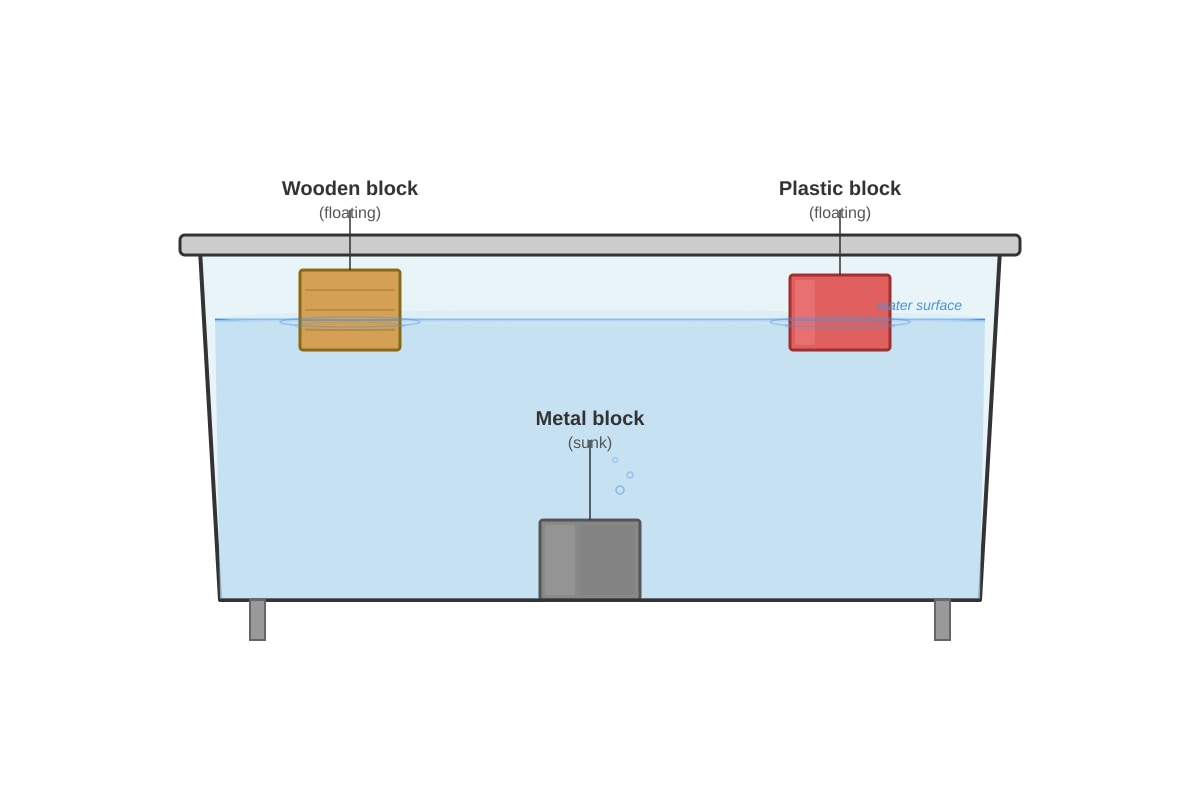
17. (a) The metal block. (1 mark)
- Explanation: Density is a measure of how much mass is in a given volume. An object that is denser than water will sink. The metal block sank, so it is the densest.
- Marking: 1 mark for "metal block".
(b) The metal block sank to the bottom, which means it is denser than water. The wooden and plastic blocks floated, which means they are less dense than water. (1 mark)
- Explanation: Objects float if they are less dense than the fluid they are in, and sink if they are denser.
- Marking: 1 mark for linking sinking to being denser than water. Accept "The metal block sank because it is denser than water."
18. (a) The water turned into water vapour and went into the air. (1 mark)
- Explanation: The water did not disappear; it changed state from a liquid to a gas (water vapour).
- Marking: 1 mark for "into the air" or "became water vapour/gas".
(b) Evaporation. (1 mark)
- Explanation: Evaporation is the process where a liquid turns into a gas at its surface.
- Marking: 1 mark for "evaporation".
19. (a) Example: Metal (e.g., zinc, aluminium) or clay tiles. (1 mark)
- Explanation: Many materials are strong and waterproof. A common answer is metal or tiles.
- Marking: 1 mark for a suitable material. Accept "metal", "tiles", "concrete", "slate".
(b) Metal is strong and can support its own weight and withstand rain and wind. It is also waterproof, so water cannot pass through it. (1 mark)
- Explanation: The explanation must link the material's properties to the requirements (strong and waterproof).
- Marking: 1 mark for an explanation that mentions both strength and waterproofing, or a clear link to one of them. Accept "It is strong and does not let water in."
20. (a) Aluminium foil is malleable (can be bent or folded into shape). (1 mark)
- Explanation: Malleability is the property of a material that allows it to be hammered or pressed into shape without breaking.
- Marking: 1 mark for "malleable" or "flexible" or "can be shaped easily".
(b) The crumpled ball will sink. This is because the shape of the ball displaces less water than the boat shape. The boat shape has a larger surface area and displaces more water, creating an upward force (buoyancy) that is greater than its weight. The ball shape displaces less water, so the buoyant force is less than its weight, causing it to sink. (1 mark)
- Explanation: This is a more advanced concept. The mass of the foil is the same, but the shape affects how much water it pushes aside (displaces). A boat shape displaces more water, creating a greater upward force.
- Marking: 1 mark for stating it will sink and a reasonable explanation involving shape or displaced water. Accept "The ball will sink because it is more compact and pushes aside less water." Do not accept "because it is heavier" as the mass is the same.