From Real Exams Quiz
Primary 4 Science Materials Quiz
Free P4 Science Materials quiz, Exam version, with questions, answers, and syllabus-aligned practice for Singapore students.
These static practice materials are generated from the site's syllabus and paper-generation workflow, with source and model context shown so students and parents can evaluate the material before use.
Questions
Free quiz and exam paper access
Enter your details to view this paper
Your access is remembered on this device.
Answers
Primary 4 Science Quiz - Materials: Answer Key
Total Marks: 20
Section A: Multiple-Choice Questions (10 Questions x 1 Mark = 10 Marks)
1. Answer: A Explanation: The three blocks have the same size (volume). Foam is the lightest material, iron is the heaviest, and wood is in between. Matter has mass, and different materials of the same size can have different masses. Marking Note: 1 mark for A.
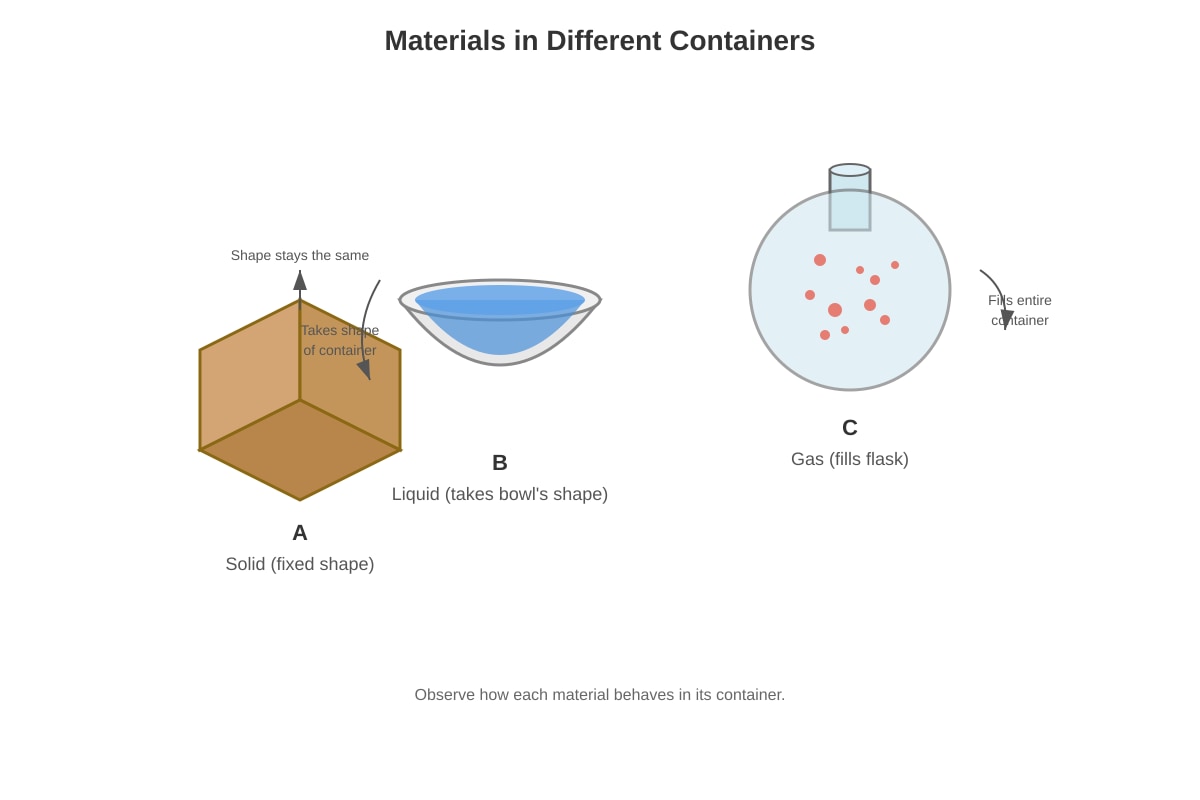
2. Answer: C Explanation: A gas does not have a fixed shape (it takes the shape of its container) and does not have a fixed volume (it can be compressed or it expands to fill the container). Gases can flow. Marking Note: 1 mark for C.
3. Answer: B Explanation:
- A pebble is a solid → fixed shape and fixed volume.
- Cooking oil is a liquid → no fixed shape (takes shape of container), fixed volume.
- Oxygen is a gas → no fixed shape, no fixed volume (fills the container). Marking Note: 1 mark for B.
4. Answer: A Explanation: When most solids (including metals like iron) are heated, they gain heat energy and expand (increase in size). This is an effect of heat gain. Marking Note: 1 mark for A.
5. Answer: C Explanation: The handle of a frying pan gets hot from the pan. You need a material that is a poor conductor of heat so that the handle does not get too hot to hold. Wood is a poor conductor of heat. Copper, iron, and silver are all metals and are good conductors of heat. Marking Note: 1 mark for C.
6. Answer: A Explanation: Sugar is a solid (a collection of small crystals). When you pour it from the bag into the bowl, the overall shape of the sugar changes to match the bowl's shape, but each sugar crystal keeps its own fixed shape. The volume and mass of the sugar do not change. The sugar does not melt into a liquid. Marking Note: 1 mark for A.
7. Answer: B Explanation: Plastic sheets are commonly used to because they are waterproof, meaning water cannot pass through them. Cotton cloth will absorb water and is not waterproof. Cotton is flexible, and plastic sheets are also flexible. Neither is necessarily stronger than the other in all ways. Marking Note: 1 mark for B.
8. Answer: B Explanation: Elasticity is the property of a material to return to its original shape and size after being stretched or squashed. A rubber band is a common example of an elastic material. Marking Note: 1 mark for B.
9. Answer: C Explanation: Water molecules are attracted to each other (cohesion) and to glass (adhesion). On glass, adhesion is stronger, so water spreads out. Wax paper is water-repellent (hydrophobic); the attraction between water molecules is stronger than their attraction to the wax paper, so the water forms round droplets. Marking Note: 1 mark for C.
10. Answer: C Explanation: Rock, metal, and glass are all solids. Oil (in A) and water (in B) are liquids. Juice (in D) is a liquid. Marking Note: 1 mark for C.
Section B: Fill-in-the-Blanks & Short-Answer Questions (10 Questions x 1 Mark = 10 Marks)
11. Answer: solid, liquid, gas Explanation: These are the three fundamental states of matter. The answer can be in any order, but "solid, liquid, gas" is the most common sequence. Marking Note: 1 mark for all three correct. Award 1 mark if any two are correct. Award 0 marks if fewer than two are correct or if the terms are mixed up.
12. Answer: solid, liquid Explanation: A solid has a fixed shape and a fixed volume. A liquid has a fixed volume but takes the shape of its container. Marking Note: 1 mark only if both blanks are filled correctly ("solid" for first, "liquid" for second). Accept "solid" and "liquid". Common Misconception: Students may write "gas" for the second blank. A gas does not have a fixed volume.
13. Answer: Use a magnet to attract the iron filings away from the sand. Explanation: Iron is a magnetic material, while sand is not. By passing a magnet through or over the mixture, the iron filings will be attracted to the magnet, leaving the sand behind. Marking Note: 1 mark for mentioning using a magnet to separate. Must mention that iron is magnetic/attracted to the magnet. Common Misconception: Students may describe adding water to float the sand, which could also work but is less direct. Accept any correct physical separation method (e.g., using a sieve if the particles are different sizes, or using a magnet). The most direct method given the equipment is using a magnet.
14. Answer: good Explanation: Steel is a metal and a good conductor of heat. When you touch the steel spoon, heat flows quickly from your (warmer) hand to the (cooler) steel spoon, making it feel cold. Marking Note: 1 mark for "good". Accept "better" if the student adds a comparison to wood (e.g., "steel is a better conductor of heat than wood").
15. Answer: evaporates Explanation: Evaporation is the process where a liquid changes into a gas. The heat from the sun causes the water in the wet towel to gain heat and change into water vapour (gas), which escapes into the air. This leaves the towel dry. Marking Note: 1 mark for "evaporates". Accept "turns into water vapour" or "changes into a gas".
16. Answer: elasticity Explanation: This is the property of an elastic material. When a force is applied (stretching), the material deforms, and when the force is removed, the material returns to its original shape. Marking Note: 1 mark for "elasticity".
17. Answer: liquid, solid (order: liquid to solid) Explanation: When water is put into a freezer, it loses heat. The temperature drops, and the water freezes, changing from a liquid state to a solid state (ice). Marking Note: 1 mark only if the order is correct (liquid → solid). Accept "water" for liquid and "ice" for solid.
18. Answer: conductor Explanation: A conductor is a material that allows energy (heat or electricity) to pass through it easily. Metals are good conductors of heat. Marking Note: 1 mark for "conductor". Accept "heat conductor".
19. Answer: solid Explanation: A brick has a fixed shape and a fixed volume, which are properties of a solid. Marking Note: 1 mark for "solid".
20. Answer: transparent Explanation: Transparent materials, like clear glass, allow light to pass through so you can see objects clearly on the other side. Opaque materials do not allow light to pass through. Marking Note: 1 mark for "transparent". Do not accept "clear" as a direct substitute, but it may show understanding. The correct scientific term is "transparent".