From Real Exams Quiz
Primary 4 Science Magnets Quiz
Free P4 Science Magnets quiz, Exam version, with questions, answers, and syllabus-aligned practice for Singapore students.
These static practice materials are generated from the site's syllabus and paper-generation workflow, with source and model context shown so students and parents can evaluate the material before use.
Questions
Free quiz and exam paper access
Enter your details to view this paper
Your access is remembered on this device.
Answers
Answer Key: Primary 4 Science Quiz - Magnets
Total Marks: 30
Section A: Multiple Choice Questions (10 x 1 mark = 10 marks)
1. C) Iron
- Explanation: Iron is a magnetic material. Magnetic materials are those that are attracted to magnets. Plastic, wood, and glass are non-magnetic materials.
- Marking: 1 mark for correct answer.
- Common Mistake: Students may think all metals are magnetic. Only iron, steel (which contains iron), nickel, and cobalt are magnetic.
2. B) Poles
- Explanation: Every magnet has two ends called poles: a north pole and a south pole. These are the points where the magnetic force is strongest.
- Marking: 1 mark for correct answer.
- Common Mistake: Students may confuse "poles" with "sides" or "tips."
3. B) They repel each other.
- Explanation: Like poles (north-north or south-south) repel each other. Unlike poles (north-south) attract each other. This is a fundamental rule of magnetism.
- Marking: 1 mark for correct answer.
- Common Mistake: Students may think all magnets attract each other.
4. B) A steel paperclip
- Explanation: Steel is made mostly of iron, so it is a magnetic material. Plastic, wood, and glass are non-magnetic and will not be attracted to a magnet.
- Marking: 1 mark for correct answer.
- Common Mistake: Students may think all shiny objects are magnetic.
5. B) 2
- Explanation: When a magnet is cut into pieces, each piece becomes a smaller magnet with its own north and south poles. So each piece will have 2 poles.
- Marking: 1 mark for correct answer.
- Common Mistake: Students may think cutting a magnet destroys its poles.
6. D) Leaving a steel bar in a box for a long time
- Explanation: Magnets can be made by stroking, using electricity (electromagnet), or by hammering in a magnetic field. Simply leaving a steel bar in a box will not make it magnetic.
- Marking: 1 mark for correct answer.
- Common Mistake: Students may think that time alone can magnetise an object.
7. D) At both poles
- Explanation: The magnetic force is strongest at the poles of a magnet. Therefore, iron filings will be most concentrated at both the north and south poles.
- Marking: 1 mark for correct answer.
- Common Mistake: Students may think the force is strongest in the middle of the magnet.
8. B) Curved lines from north to south
- Explanation: The magnetic field lines around a bar magnet are curved and they travel from the north pole to the south pole outside the magnet.
- Marking: 1 mark for correct answer.
- Common Mistake: Students may think the lines are straight or go from south to north.
9. B) A magnet
- Explanation: A magnet will attract the iron filings but not the sand. This is the most efficient way to separate the mixture. A sieve would not work because both are small particles.
- Marking: 1 mark for correct answer.
- Common Mistake: Students may choose a sieve because they think of separating by size.
10. C) A magnet can attract a steel nail.
- Explanation: Steel contains iron, so it is magnetic. Not all metals are magnetic (e.g., aluminium, copper). Magnets cannot attract all objects, only magnetic materials. Magnets do not lose their magnetism when not in use (unless they are temporary magnets).
- Marking: 1 mark for correct answer.
- Common Mistake: Students may think all metals are magnetic.
Section B: Fill in the Blanks (5 x 2 marks = 10 marks)
11. magnetism (or magnetic force)
- Explanation: Magnetism is the invisible force that magnets exert on magnetic materials. It can attract or repel other magnets.
- Marking: 1 mark for "magnetism", 1 mark for correct spelling. Accept "magnetic force".
12. repel / attract
- Explanation: Like poles (N-N or S-S) push each other away (repel). Unlike poles (N-S) pull each other together (attract).
- Marking: 1 mark for "repel" in the first blank, 1 mark for "attract" in the second blank. Both must be correct for full marks.
13. north-south (or north and south)
- Explanation: A freely suspended magnet aligns itself with the Earth's magnetic field. The north pole of the magnet points towards the Earth's geographic North Pole.
- Marking: 1 mark for "north-south", 1 mark for correct spelling. Accept "north and south".
14. magnetic field
- Explanation: The magnetic field is the region around a magnet where its magnetic force can be detected. It is invisible but can be shown using iron filings or a compass.
- Marking: 1 mark for "magnetic field", 1 mark for correct spelling.
15. electromagnet
- Explanation: An electromagnet is a temporary magnet created by passing an electric current through a coil of wire wrapped around an iron core. It can be turned on and off.
- Marking: 1 mark for "electromagnet", 1 mark for correct spelling.
Section C: Short Answer Questions (5 x 2 marks = 10 marks)
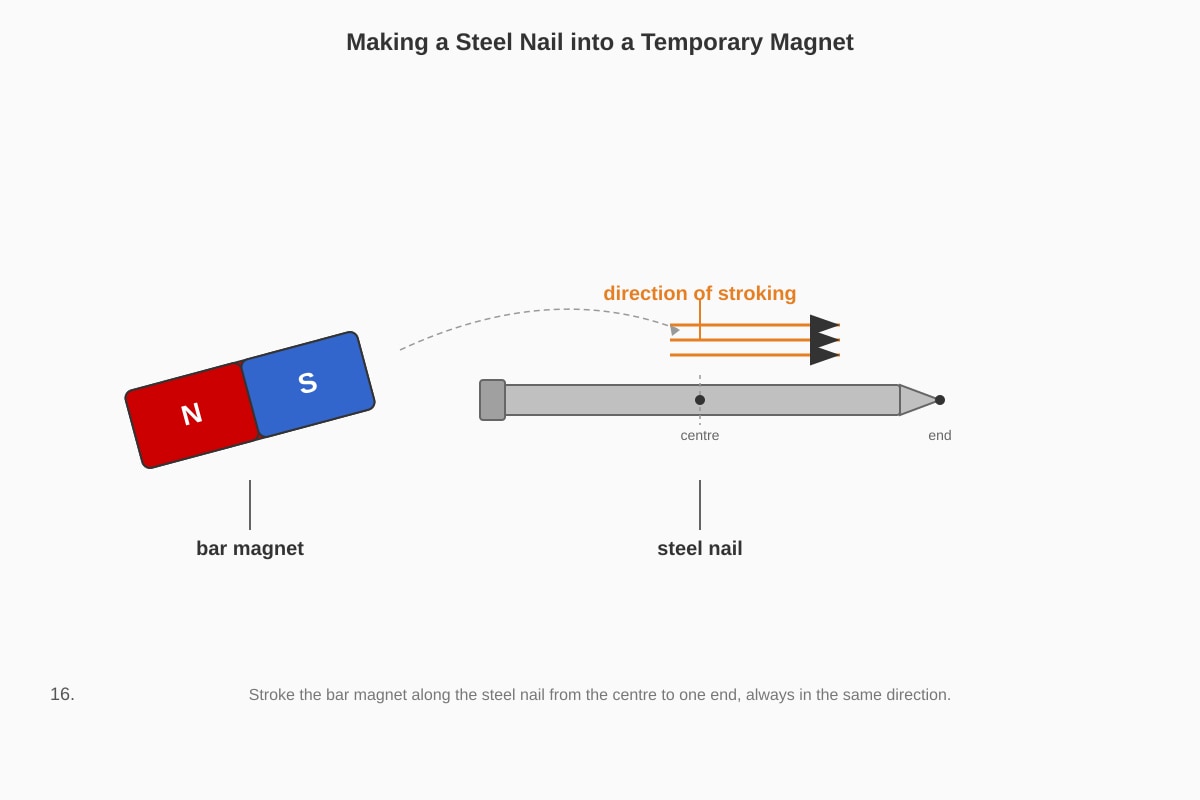
16. Answer: The student can stroke the steel nail with the bar magnet in one direction (from the middle of the nail to one end) many times. This will align the magnetic domains in the nail, making it a temporary magnet.
- Explanation: Stroking a magnetic material with a magnet in one direction aligns the tiny magnetic particles (domains) inside the material, causing it to become magnetised. The nail will be a temporary magnet because it can lose its magnetism easily.
- Marking: 1 mark for describing the stroking action, 1 mark for mentioning "one direction" or "temporary magnet". Accept any reasonable description of the stroking method.
17. Answer: A magnet can attract a steel paperclip because steel is a magnetic material (it contains iron). A plastic spoon is not attracted because plastic is a non-magnetic material.
- Explanation: Magnetic materials are those that are attracted to magnets. Steel contains iron, which is magnetic. Plastic does not contain any magnetic materials like iron, nickel, or cobalt.
- Marking: 1 mark for stating steel is magnetic, 1 mark for stating plastic is non-magnetic. Accept "steel contains iron" as a reason.
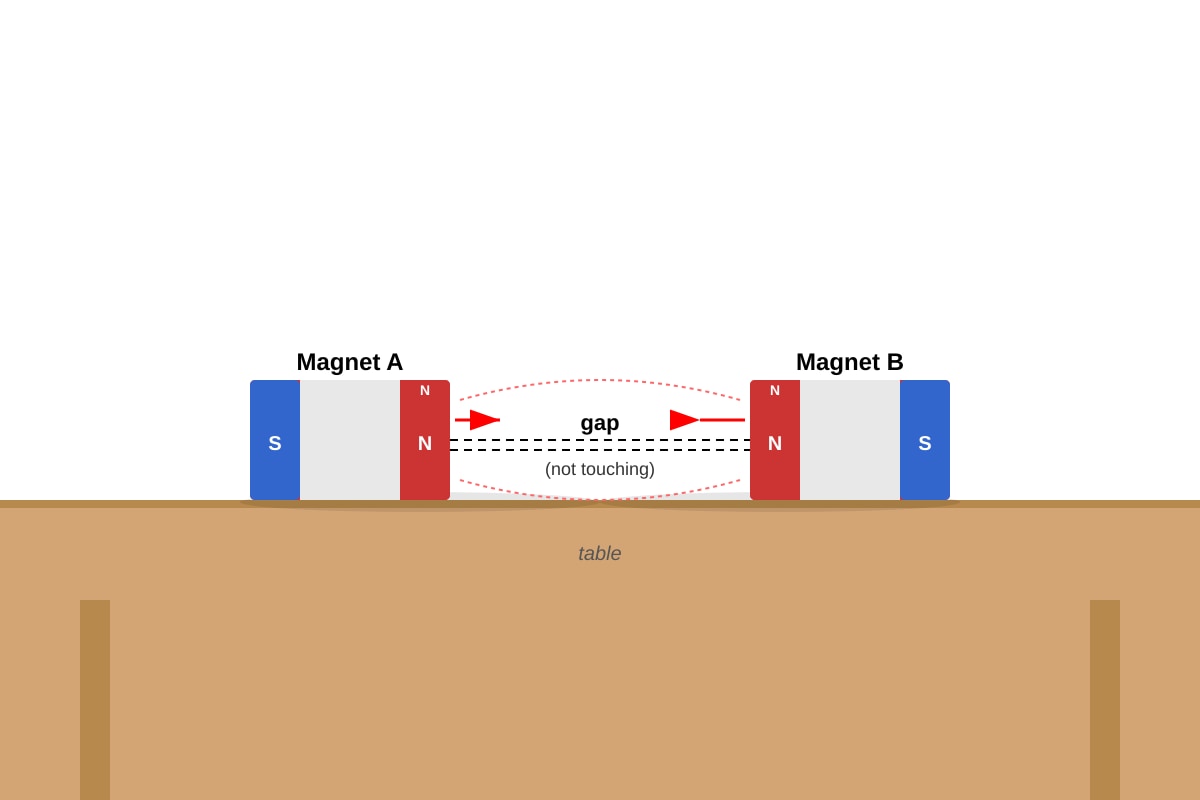
18. Answer: The magnets will repel each other and move apart. This is because like poles (north and north) repel each other.
- Explanation: When the north poles of two magnets are brought close together, they exert a repulsive force on each other. This force pushes the magnets away from each other.
- Marking: 1 mark for stating the magnets will repel/move apart, 1 mark for explaining that like poles repel. Accept "north poles repel each other".
19. Answer: The north pole of the magnet will point towards the Earth's geographic North Pole. This is because the Earth itself acts like a giant magnet, and the north pole of a freely suspended magnet is attracted to the Earth's magnetic south pole, which is near the geographic North Pole.
- Explanation: A freely suspended magnet acts as a compass. It aligns itself with the Earth's magnetic field. The north pole of the magnet points north because it is attracted to the Earth's magnetic south pole located near the geographic North Pole.
- Marking: 1 mark for stating "north" or "towards the North Pole", 1 mark for explaining that the Earth's magnetic field causes this. Accept simplified explanations like "the Earth is a magnet".
20. Answer: The iron nails and steel pins will be attracted to the magnet. The copper coins and aluminium foil will not be attracted. This is because iron and steel are magnetic materials, while copper and aluminium are non-magnetic materials.
- Explanation: Only magnetic materials are attracted to magnets. Iron and steel (which contains iron) are magnetic. Copper and aluminium are metals but they are not magnetic.
- Marking: 1 mark for correctly identifying iron nails and steel pins, 1 mark for explaining that they are magnetic materials. Accept "steel contains iron" as a reason.
End of Answer Key