From Real Exams Quiz
Primary 4 Science Magnets Quiz
Free P4 Science Magnets quiz, Exam version, with questions, answers, and syllabus-aligned practice for Singapore students.
These static practice materials are generated from the site's syllabus and paper-generation workflow, with source and model context shown so students and parents can evaluate the material before use.
Questions
Free quiz and exam paper access
Enter your details to view this paper
Your access is remembered on this device.
Answers
Primary 4 Science Quiz - Magnets: Answer Key
Total Marks: 30
Section A: Multiple-Choice Questions (10 marks)
1. B. Iron
- Marks: 1
- Explanation: Magnetic materials are those that are attracted to a magnet. Iron, steel, nickel, and cobalt are common magnetic materials. Wood, plastic, and glass are non-magnetic materials and are not attracted to magnets.
- Common Mistake: Students may think all metals are magnetic. Copper and aluminium are metals but are not magnetic.
2. D. Both the north and south poles
- Marks: 1
- Explanation: The magnetic force is strongest at the poles of a magnet. Both the north pole and the south pole attract magnetic materials equally strongly. The middle of the magnet has the weakest magnetic force.
- Key Concept: The poles are the regions of strongest magnetism.
3. B. They will repel each other.
- Marks: 1
- Explanation: Like poles repel each other. A north pole and a north pole are like poles, so they will push away from each other. Opposite poles (north and south) attract each other.
- Key Concept: Like poles repel, unlike poles attract.
4. C. The north
- Marks: 1
- Explanation: A freely suspended magnet will always come to rest pointing in a north-south direction. The north pole of the magnet points towards the Earth's geographic north. This is because the Earth itself acts like a giant magnet.
- Key Concept: A magnet can be used as a compass because it aligns with the Earth's magnetic field.
5. B. Hitting a magnet with a hammer
- Marks: 1
- Explanation: Hitting a magnet with a hammer can actually demagnetise it or weaken its magnetism. Stroking a steel rod with a magnet, placing it in a coil with electric current, and rubbing a magnet against a paper clip in one direction are all ways to create a temporary magnet.
- Key Concept: Temporary magnets can be made by stroking or using electricity, but they can be weakened or destroyed by dropping, heating, or hammering.
6. C. The magnetic field around the magnet
- Marks: 1
- Explanation: Iron filings are small pieces of a magnetic material. When sprinkled near a magnet, they align themselves along the invisible lines of the magnetic field. The pattern they form shows the shape and direction of the magnetic field.
- Key Concept: The magnetic field is the area around a magnet where its magnetic force can be felt.
7. C. A steel paper clip
- Marks: 1
- Explanation: Steel is a magnetic material because it is mostly made of iron. Copper, aluminium, and glass are non-magnetic materials and will not be attracted to a magnet.
- Key Concept: Steel is a common magnetic material used in many everyday objects.
8. C. Each piece becomes a complete magnet with its own north and south poles.
- Marks: 1
- Explanation: When a magnet is cut into two pieces, each piece becomes a smaller, complete magnet. Each new magnet will have its own north pole and south pole. It is impossible to isolate a single pole.
- Key Concept: Magnetic poles always exist in pairs (north and south). You cannot have a magnet with only one pole.
9. B. A refrigerator door seal
- Marks: 1
- Explanation: Refrigerator doors have a magnetic strip inside the rubber seal. This magnet attracts the metal frame of the refrigerator, keeping the door closed tightly. Wooden spoons, plastic bottles, and glass windows do not use magnets.
- Key Concept: Magnets have many practical uses in homes and industries.
10. A. Using a magnet to attract the iron filings
- Marks: 1
- Explanation: Iron filings are magnetic, while sand is not. A magnet can be used to attract and separate the iron filings from the sand. This is a quick and effective separation method.
- Key Concept: Magnets can be used to separate magnetic materials from non-magnetic materials in a mixture.
Section B: Short-Answer Questions (10 marks)
11. Accept any two of the following: Iron, Steel, Nickel, Cobalt
- Marks: 1 mark for each correct material (2 marks total)
- Explanation: Magnetic materials are substances that are attracted to magnets. The most common magnetic materials are iron, steel (which is mostly iron), nickel, and cobalt.
- Marking Note: Do not accept "metal" as it is too general. Accept "steel" even though it is an alloy.
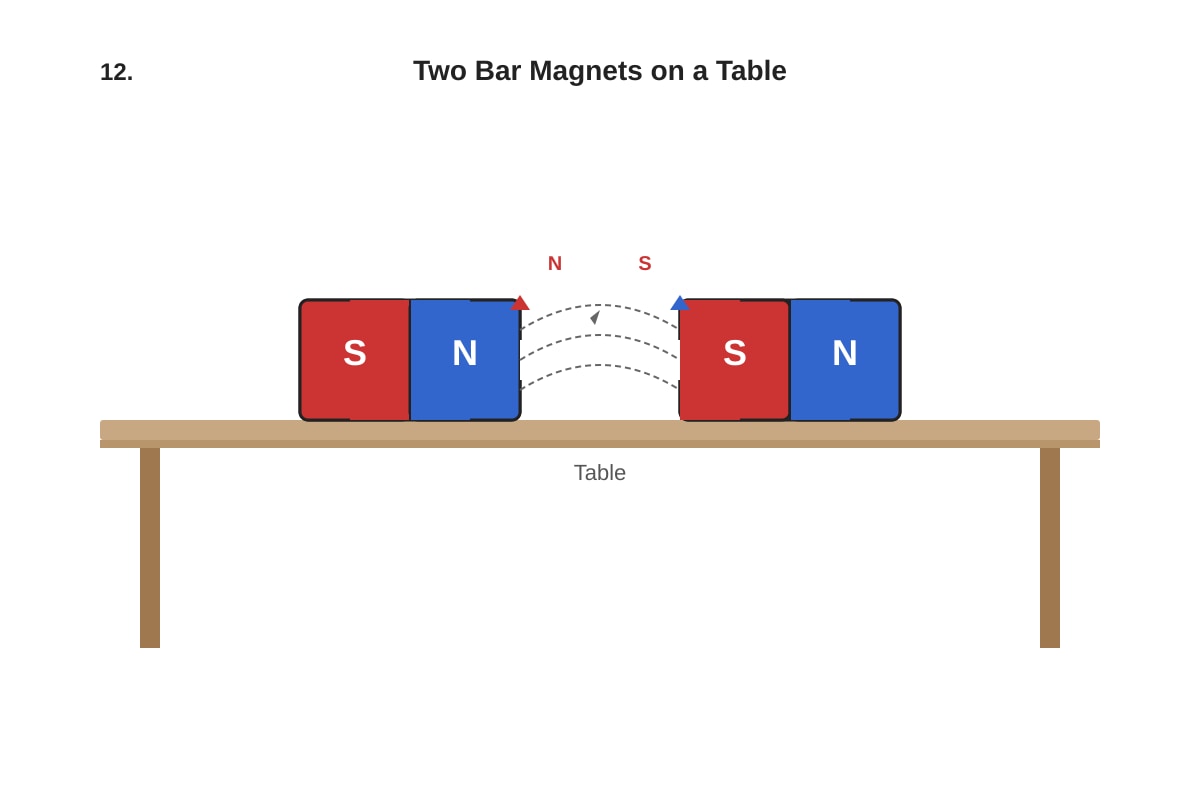
12. The two magnets will attract each other.
- Marks: 1 mark for "attract", 1 mark for correct explanation (2 marks total)
- Explanation: The north pole of the left magnet is facing the south pole of the right magnet. Opposite poles (north and south) attract each other. Therefore, the magnets will pull together.
- Key Concept: Unlike poles attract.
13. A temporary magnet.
- Marks: 1
- Explanation: When a magnetic material like steel is stroked with a magnet, it becomes magnetised. However, it is a temporary magnet because it will lose its magnetism over time or if it is dropped or heated.
- Key Concept: Temporary magnets are made by stroking or using electricity and lose their magnetism easily.
14. Accept any reasonable answer, e.g.:
- To hold notes/papers on a magnetic whiteboard.
- In a compass for navigation.
- In a science experiment.
- In a magnetic catch on a cupboard door.
- Marks: 1
- Explanation: The answer should show a clear, practical use of a magnet in a school setting.
- Marking Note: Accept any plausible example.
15. No, the student cannot conclude that both bars are magnets.
- Marks: 1 mark for "No", 1 mark for correct explanation (2 marks total)
- Explanation: A magnet will attract a magnetic material (like iron or steel) even if that material is not a magnet. Bar B and Bar C could simply be pieces of iron or steel that are attracted to the magnet. To be sure they are magnets, the student would need to test if they can also repel another magnet.
- Key Concept: Attraction can happen between a magnet and a magnetic material. Repulsion is the only sure test for magnetism because only two magnets can repel each other.
16. The temporary magnet loses its magnetism (or becomes much weaker).
- Marks: 1
- Explanation: A temporary magnet is only magnetic while it is in contact with or near a strong magnet. Once the magnetising force is removed, the magnetic domains in the material become disorganised, and it loses its magnetic properties.
- Key Concept: Temporary magnets do not retain their magnetism permanently.
17. The arrow of the compass will point towards the south pole of the bar magnet.
- Marks: 1
- Explanation: The arrow of a compass is a small magnet with a north pole. The north pole of the compass arrow is attracted to the south pole of any other magnet. Therefore, it will point towards the south pole of the bar magnet.
- Key Concept: Opposite poles attract. The north pole of one magnet is attracted to the south pole of another.
Section C: Structured Questions (10 marks)
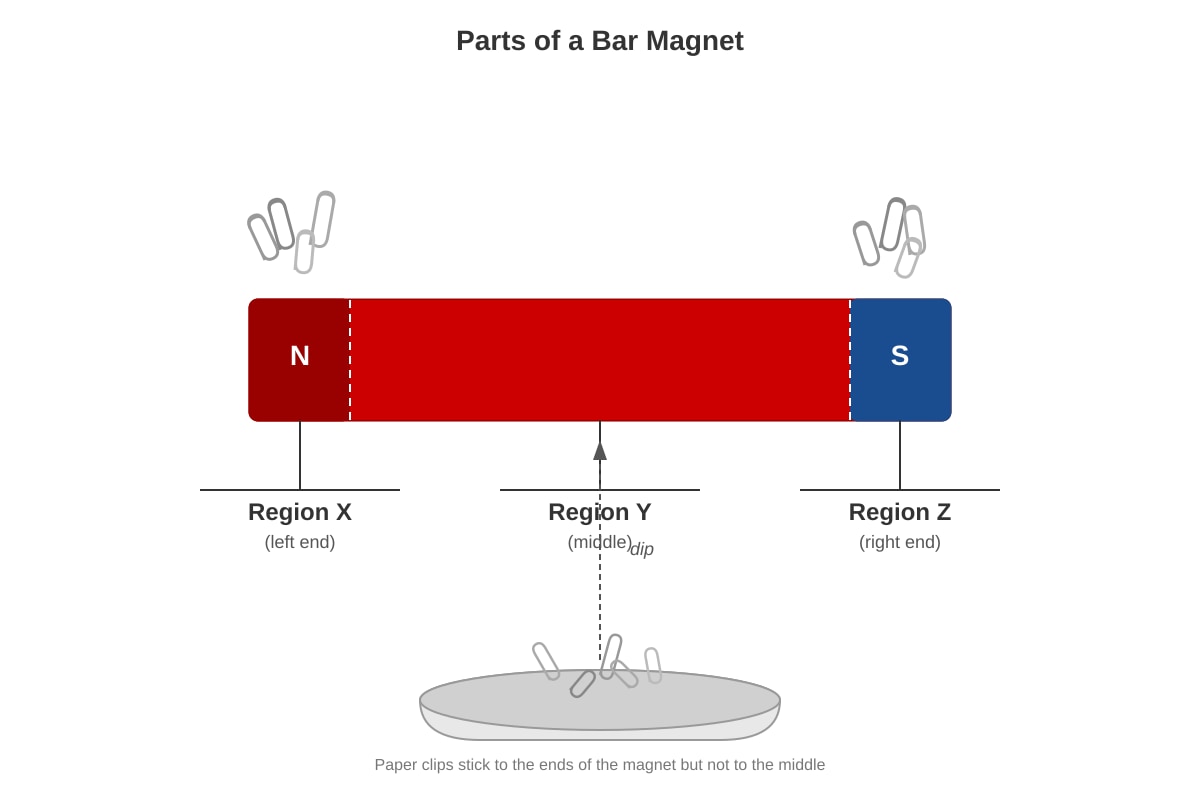
18. (a) Region X and Region Z (the ends/poles of the magnet)
- Marks: 1
- Explanation: The diagram shows paper clips sticking only to the ends of the magnet. This shows that the magnetic force is strongest at the poles.
(b) The magnetic force is strongest at the poles (ends) of the magnet.
- Marks: 2
- Explanation: The experiment shows that the ends of the magnet attract the most paper clips. This is because the magnetic field is concentrated at the poles. The middle of the magnet has a very weak magnetic field and attracts few or no paper clips.
- Marking Note: Award 1 mark for stating the poles are strongest. Award 1 mark for mentioning the middle is weakest or for explaining the evidence.
19. (a) No, the student cannot be sure.
- Marks: 1 mark for "No", 1 mark for correct explanation (2 marks total)
- Explanation: The north pole of Bar P could be attracting the south pole of Bar Q if Bar Q is a magnet. However, it could also be attracting Bar Q if Bar Q is simply a piece of magnetic material (like iron). Attraction alone is not proof that an object is a magnet.
- Key Concept: A magnet attracts both magnets and magnetic materials.
(b) The student could bring the north pole of Bar P near the north pole of Bar Q. If they repel each other, then both bars are magnets.
- Marks: 2
- Explanation: Repulsion is the only sure test for magnetism. Only two magnets can repel each other. If the student brings like poles together (e.g., north to north) and they push apart, it proves both bars are magnets. If they only attract, Bar Q could be a magnetic material.
- Marking Note: Award 1 mark for describing the test (bringing like poles together). Award 1 mark for stating that repulsion proves both are magnets.
20. (a) The Earth's magnetic field.
- Marks: 1
- Explanation: The Earth acts like a giant magnet with a north and south magnetic pole. A freely suspended magnet will align itself with the Earth's magnetic field, pointing in a north-south direction.
- Key Concept: This property is used in compasses.
(b) The magnetic force from the other magnet acts on the hanging magnet, causing it to move.
- Marks: 2
- Explanation: Magnets exert a force on other magnets and magnetic materials without touching them. This is called magnetic force. When the second magnet is brought near, its magnetic field interacts with the magnetic field of the hanging magnet, creating an attractive or repulsive force that makes the hanging magnet move.
- Marking Note: Award 1 mark for mentioning magnetic force. Award 1 mark for explaining that the force causes movement. Accept "attract" or "repel" as part of the explanation.