From Real Exams Quiz
Primary 4 Science Magnets Quiz
Free P4 Science Magnets quiz, Exam version, with questions, answers, and syllabus-aligned practice for Singapore students.
These static practice materials are generated from the site's syllabus and paper-generation workflow, with source and model context shown so students and parents can evaluate the material before use.
Questions
Free quiz and exam paper access
Enter your details to view this paper
Your access is remembered on this device.
Answers
Primary 4 Science Quiz - Magnets: Answer Key
Total Marks: 30
Section A: Multiple-Choice Questions (10 questions x 2 marks = 20 marks)
1. Answer: C) Iron
- Explanation: Iron is a magnetic material. Wood, plastic, and glass are non-magnetic materials. Magnetic materials are those that are attracted to a magnet.
- Marking: 1 mark for correct answer.
2. Answer: D) North
- Explanation: A freely suspended magnet will align itself with the Earth's magnetic field. The north pole of the magnet will point towards the Earth's geographic North Pole.
- Marking: 1 mark for correct answer.
3. Answer: B) They will attract each other.
- Explanation: Opposite poles of a magnet attract each other. The north pole of one magnet and the south pole of another magnet will attract.
- Marking: 1 mark for correct answer.
4. Answer: A) It will become a magnet.
- Explanation: Stroking a steel bar with a magnet in one direction aligns the magnetic domains in the steel, making it a temporary magnet. This is called magnetization by stroking.
- Marking: 1 mark for correct answer.
5. Answer: C) Heating a steel bar strongly.
- Explanation: Heating a steel bar strongly will destroy its magnetism, not create it. Stroking, hanging near a strong magnet, and using an electric current are all ways to make a temporary magnet.
- Marking: 1 mark for correct answer.
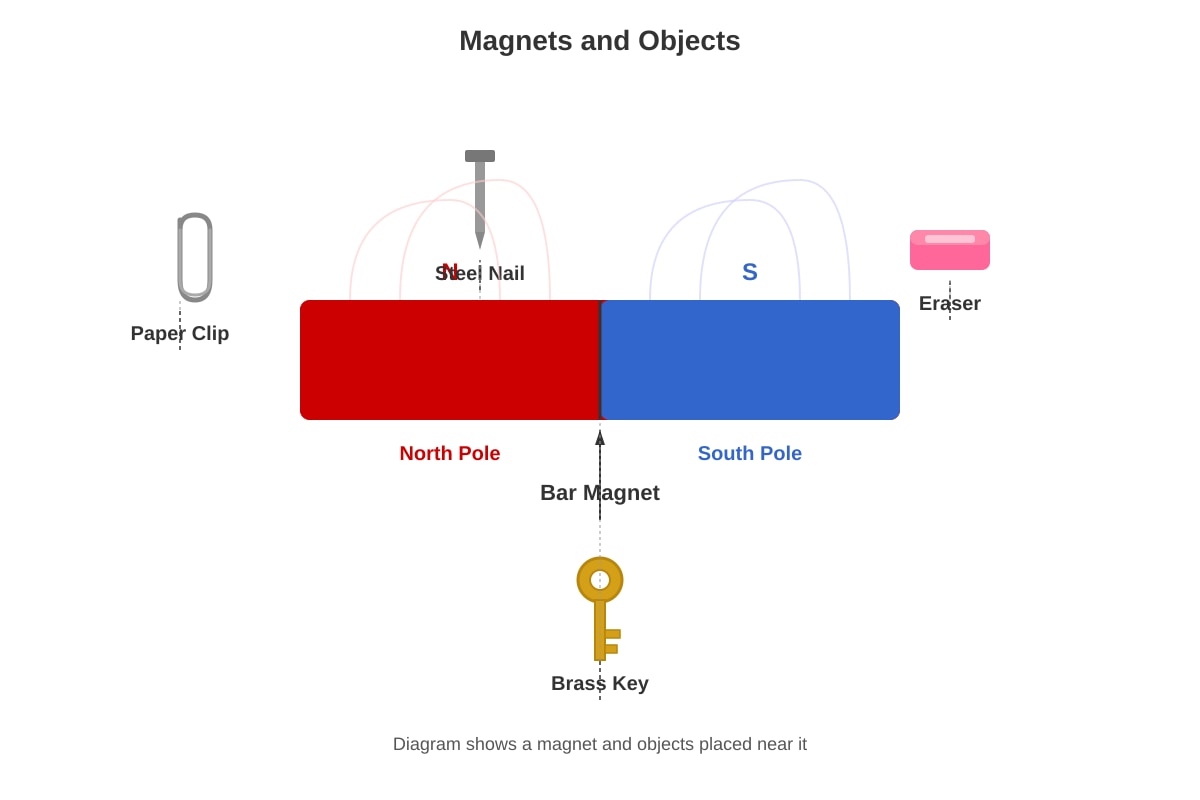
6. Answer: A) Paper clip
- Explanation: A paper clip is made of steel, which is a magnetic material. The eraser and brass key are non-magnetic. The steel nail is also magnetic, but the question asks for the object that will "most likely" be attracted, and the paper clip is the most common example.
- Marking: 1 mark for correct answer.
7. Answer: B) Each piece will become a complete magnet with both north and south poles.
- Explanation: When a magnet is cut, each piece becomes a smaller magnet with its own north and south poles. This is because the magnetic domains are still aligned within each piece.
- Marking: 1 mark for correct answer.
8. Answer: C) Nickel
- Explanation: Nickel is a magnetic material. Aluminium, copper, and silver are non-magnetic materials.
- Marking: 1 mark for correct answer.
9. Answer: B) Using a magnet
- Explanation: Iron filings are magnetic, while sand is not. A magnet can be used to attract and separate the iron filings from the sand.
- Marking: 1 mark for correct answer.
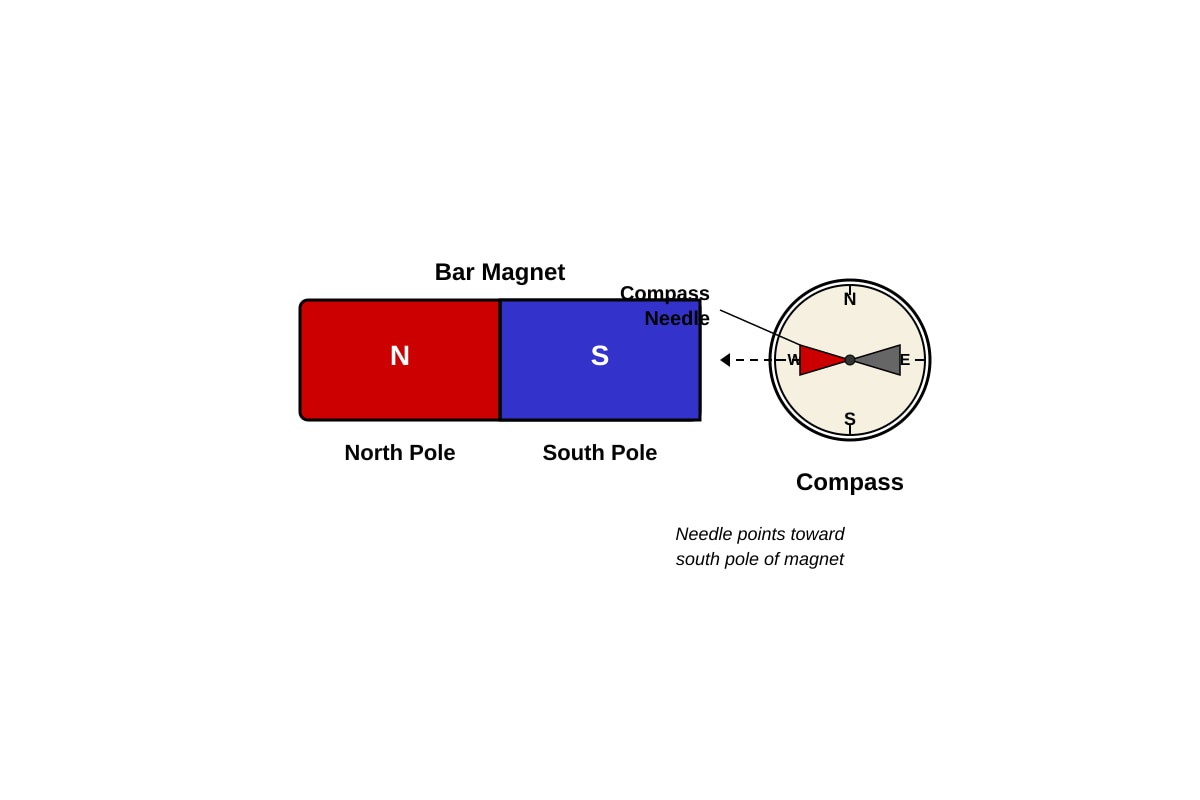
10. Answer: A) North pole
- Explanation: Opposite poles attract. The south pole of the bar magnet attracts the north pole of the compass needle. Therefore, the north pole of the compass needle is pointing towards the south pole of the bar magnet.
- Marking: 1 mark for correct answer.
Section B: Open-Ended Questions (10 questions x 1 mark each = 10 marks)
11. Answer: A magnet is an object that produces a magnetic field and attracts magnetic materials like iron, steel, nickel, and cobalt.
- Explanation: This is a basic definition. A magnet has a north pole and a south pole.
- Marking: 1 mark for a correct definition.
12. Answer: (Any one of the following) Refrigerator door, speaker, compass, magnetic catch on a cabinet door, magnetic toy.
- Explanation: Many everyday objects use magnets. The refrigerator door uses a magnet to seal shut. Speakers use magnets to produce sound.
- Marking: 1 mark for a correct example.
13. Answer: They will repel each other.
- Explanation: Like poles repel. Two north poles will push away from each other.
- Marking: 1 mark for correct answer.
14. Answer: Magnetic force.
- Explanation: The magnetic force is the force that attracts magnetic objects to a magnet. It is a non-contact force.
- Marking: 1 mark for correct answer.
15. Answer: (Any one of the following) Wood, plastic, glass, paper, aluminium, copper, brass, silver, gold.
- Explanation: Non-magnetic materials are not attracted to magnets.
- Marking: 1 mark for a correct example.
16. Answer: Stroke the steel paperclip with the bar magnet in one direction many times.
- Explanation: This process aligns the magnetic domains in the paperclip, making it a temporary magnet.
- Marking: 1 mark for a correct method.
17. Answer: A temporary magnet can lose its magnetism easily, while a permanent magnet retains its magnetism for a long time.
- Explanation: Temporary magnets are made from materials like steel that can be easily magnetized and demagnetized. Permanent magnets are made from materials like alnico or ferrite that are difficult to demagnetize.
- Marking: 1 mark for a correct difference.
18. Answer: The student can bring the metal bar near some iron filings or a paperclip. If the bar attracts the iron filings or paperclip, it is a magnet. The student can also hang the bar freely and see if it points north-south.
- Explanation: A magnet will attract magnetic materials. A freely suspended magnet will align with the Earth's magnetic field.
- Marking: 1 mark for a correct method.
19. Answer: A magnet can attract a steel nail because steel is a magnetic material. A magnet cannot attract a copper coin because copper is a non-magnetic material.
- Explanation: Only magnetic materials are attracted to magnets.
- Marking: 1 mark for a correct explanation.
20. Answer: The magnetism of a magnet will be weakened or destroyed.
- Explanation: Heating a magnet causes the magnetic domains to become misaligned, reducing or eliminating its magnetism.
- Marking: 1 mark for a correct answer.