From Real Exams Quiz
Primary 4 Science Magnets Quiz
Free P4 Science Magnets quiz, Exam version, with questions, answers, and syllabus-aligned practice for Singapore students.
These static practice materials are generated from the site's syllabus and paper-generation workflow, with source and model context shown so students and parents can evaluate the material before use.
Questions

Free quiz and exam paper access
Enter your details to view this paper
Your access is remembered on this device.
Answers
Answer Key: Primary 4 Science Quiz - Magnets
Total Marks: 40
Section A: Multiple-Choice Questions (10 marks)
Q1.
Answer: C) An iron nail
[1 mark]
Explanation: Magnets attract objects made of magnetic materials, such as iron, steel, nickel, and cobalt. Iron is a magnetic material. Wood, plastic, and glass are non-magnetic materials and will not be attracted to a magnet.
Common mistake: Choosing plastic or wood because they are common materials. Remember: only certain metals are magnetic.
Q2.
Answer: B) Each piece becomes a complete magnet with both a north and a south pole.
[1 mark]
Explanation: When a magnet is cut into two pieces, each piece becomes a smaller magnet with its own north and south pole. You cannot isolate a single pole. This is because the magnetic domains in each piece still align to create two poles.
Common mistake: Thinking that cutting a magnet destroys its magnetism or leaves only one pole. Each piece is a complete magnet.
Q3.
Answer: A) They will attract each other.
[1 mark]
Explanation: Unlike poles of magnets attract each other. The north pole of Magnet X and the south pole of Magnet Y are unlike poles, so they will pull towards each other.
Key rule: Like poles repel; unlike poles attract.
Q4.
Answer: B) Store them with unlike poles together and place a piece of iron (keeper) across the ends.
[1 mark]
Explanation: To keep magnets strong, they should be stored with unlike poles together (N next to S) and a soft iron keeper placed across the ends. This keeps the magnetic domains aligned and prevents the magnet from weakening.
Common mistake: Choosing "hit them with a hammer" – this actually weakens a magnet by disrupting the alignment of its magnetic domains.
Q5.
Answer: A) The north pole of the magnet
[1 mark]
Explanation: A freely suspended magnet will align itself with the Earth's magnetic field. The north pole of the magnet points towards the Earth's North Pole (approximately). This is the principle behind a compass.
Note: The Earth's geographic North Pole acts as a magnetic south pole, which attracts the north pole of a magnet.
Section B: Short-Answer Questions (18 marks)
Q6.
Answer:
- North pole
- South pole
[2 marks – 1 mark for each correct pole]
Explanation: Every magnet has two poles: a north pole and a south pole. These are the regions where the magnetic force is strongest.
Q7.
Answer:
(a) The steel paperclip
[1 mark]
(b) The copper coin is not attracted because copper is not a magnetic material. Only magnetic materials like iron, steel, nickel, and cobalt are attracted to magnets.
[1 mark]
Explanation: Steel is an alloy that contains iron, making it magnetic. Copper is a non-magnetic metal, so it will not be attracted to a magnet.
Marking note: Accept "copper is non-magnetic" or "copper is not a magnetic material" for the mark.
Q8.
Answer:
(a) North pole
[1 mark]
(b) South pole
[1 mark]
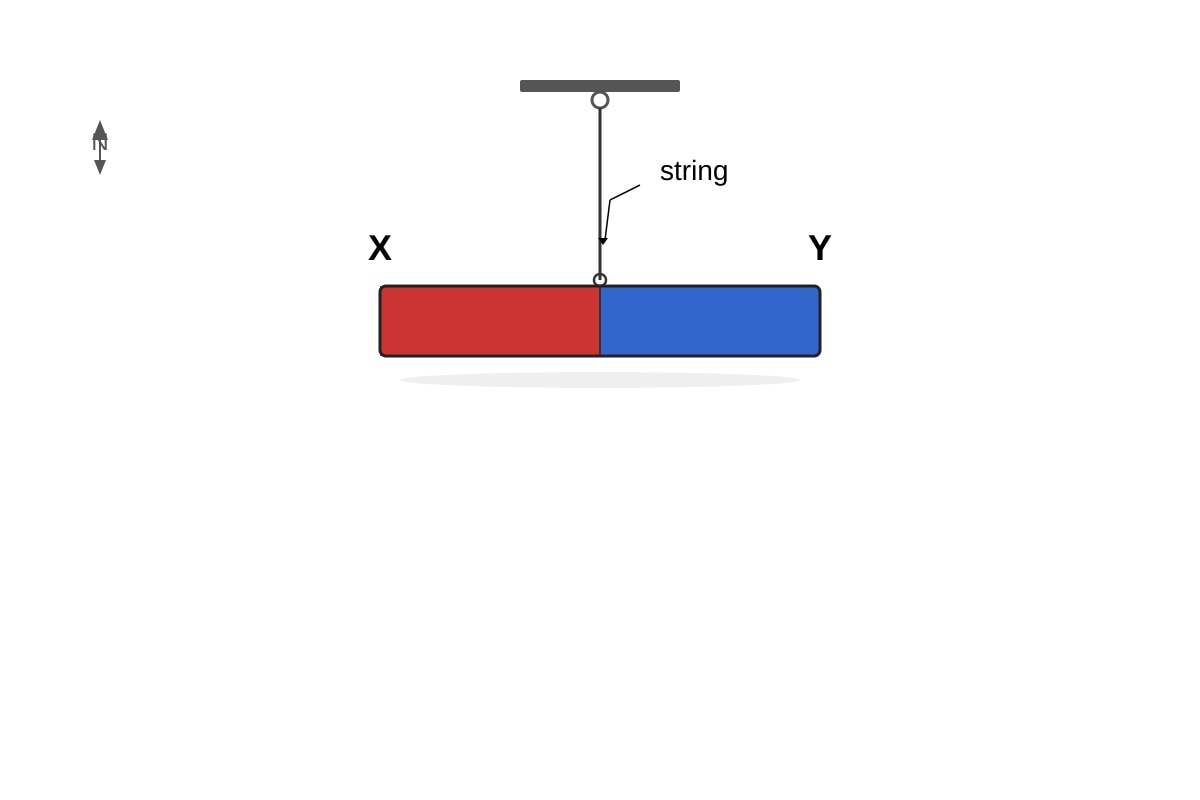
Explanation: A freely suspended magnet will align with the Earth's magnetic field. The end that points towards the Earth's North Pole is the north pole of the magnet. The opposite end is the south pole.
Marking note: If the student correctly identifies X as North and Y as South, award both marks.
Q9.
Answer:
(a) The pattern shows the magnetic field lines of the magnet.
[1 mark]
(b) The iron filings are most concentrated at the poles (the ends) of the magnet.
[1 mark]
Explanation: Iron filings align along the magnetic field lines, showing the direction and strength of the magnetic field. The field is strongest at the poles, so more iron filings gather there.
Marking note: Accept "magnetic field" or "lines of force" for part (a). Accept "at the poles" or "at the ends" for part (b).
Q10.
Answer:
(a) 1. Iron nails 2. Steel pins
[2 marks – 1 mark for each correct material]
(b) A magnet attracts magnetic materials (iron and steel are magnetic materials).
[1 mark]
Explanation: Iron and steel are magnetic materials. Aluminium and plastic are non-magnetic and will not be attracted.
Marking note: The order of answers does not matter. Both iron and steel must be named for full marks.
Q11.
Answer:
Test: Bring one end of Bar A near the middle of Bar B.
[1 mark]
Observation: If Bar A is the magnet, it will attract Bar B (because the magnet attracts the unmagnetised iron). If Bar A is the unmagnetised iron, it will NOT attract Bar B (because the middle of a magnet has very weak magnetic force).
[2 marks – 1 mark for correct test, 1 mark for correct observation and conclusion]
Explanation: The middle of a magnet (the neutral region) has almost no magnetic force. So, if you bring the end of one bar near the middle of the other:
- If the end attracts the middle, the bar in your hand is the magnet.
- If there is no attraction, the bar in your hand is the unmagnetised iron.
Alternative acceptable test: Slide one bar along the other. If there is a change in attraction (stronger at ends, weaker at middle), the bar being moved is the magnet.
Marking note: Award marks for any valid test that correctly distinguishes the magnet from the iron bar.
Q12.
Answer:
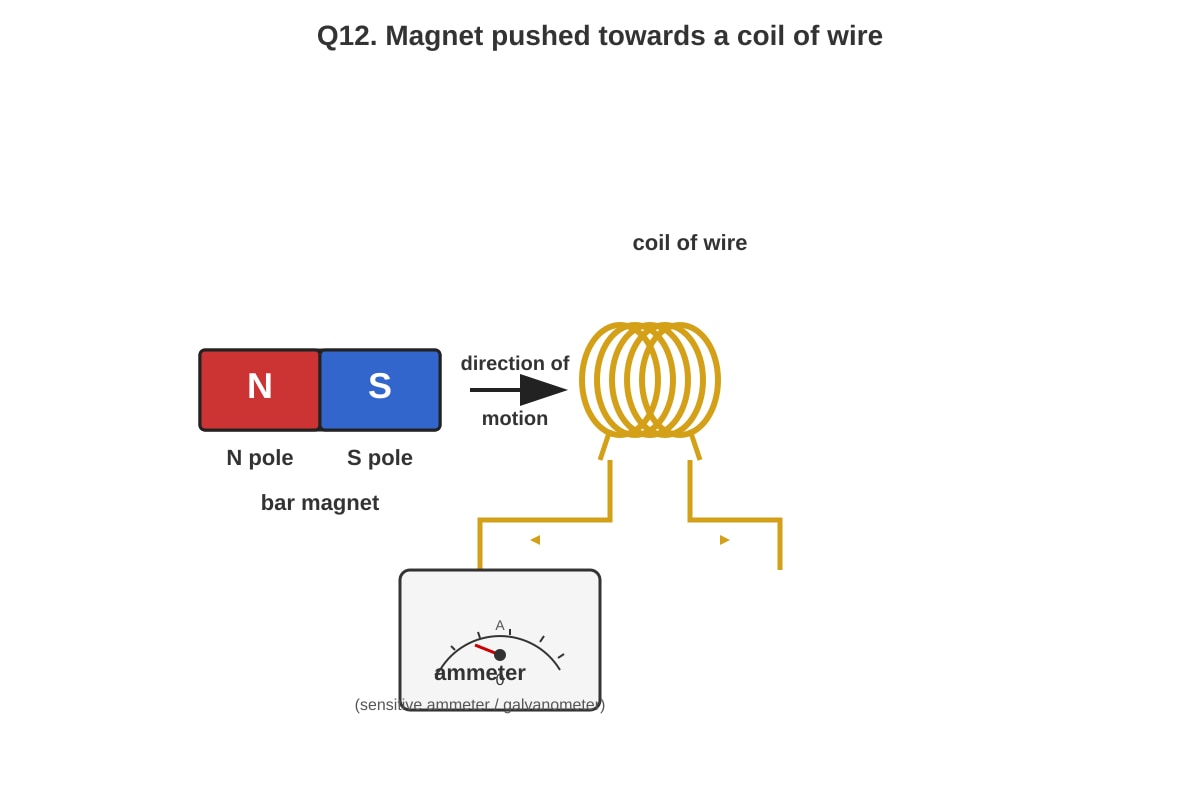
(a) The ammeter needle will deflect (move), showing that a current is flowing in the coil.
[1 mark]
(b) The reading on the ammeter will be larger (the needle deflects more).
[1 mark]
Explanation: When a magnet moves near a coil of wire, it induces an electric current in the wire (electromagnetic induction). Moving the magnet faster induces a larger current, so the ammeter reading increases.
Note for teachers: This question introduces the concept of electromagnetic induction, which is a higher-level application. For P4, the key idea is that a moving magnet near a coil produces electricity.
Marking note: Accept "the needle moves" or "the ammeter shows a reading" for part (a). Accept "the reading increases" or "the needle deflects more" for part (b).
Q13.
Answer: The magnet attracts the iron block, pulling it upwards. This upward pull on the iron block means the iron block is also pulling the magnet downwards (by Newton's Third Law). This extra downward force increases the reading on the spring balance.
[2 marks – 1 mark for identifying the attraction between magnet and iron, 1 mark for explaining the effect on the spring balance reading]
Explanation: As the magnet gets closer to the iron block, the magnetic force of attraction becomes stronger. The iron block is pulled up towards the magnet, and the magnet is pulled down towards the iron block. This downward pull adds to the weight of the magnet, increasing the spring balance reading.
Marking note: Accept "the magnet attracts the iron, pulling it up, so the iron pulls the magnet down" or similar reasoning.
Section C: Application and Reasoning Questions (12 marks)
Q14.
Answer:
(a) Rod B is definitely a magnet because it repels the north pole of the suspended magnet. Only a magnet can repel another magnet. Unmagnetised materials can only be attracted, never repelled.
[2 marks – 1 mark for identifying Rod B, 1 mark for the explanation]
(b) Rod A could be a magnet (with its south pole facing the magnet) OR it could be a piece of unmagnetised magnetic material (like iron), because magnets attract magnetic materials.
[1 mark]
(c) Rod C is made of a non-magnetic material (like wood or plastic), because it has no effect on the magnet.
[1 mark]
Explanation:
- Repulsion is the only sure test for magnetism. If an object repels a known magnet, it must itself be a magnet.
- Attraction is not a sure test because magnets attract both other magnets AND unmagnetised magnetic materials.
- No effect means the material is non-magnetic.
Marking note: For part (b), accept "Rod A could be a magnet or a magnetic material" for the mark.
Q15.
Answer:
(a) The paperclips will be attracted to the nail (the nail will pick up the paperclips).
[1 mark]
(b) Electromagnet
[1 mark]
(c) Any ONE of the following:
- Add more turns of wire around the nail.
- Increase the number of batteries (increase the current).
- Use a larger iron nail.
[1 mark]
Explanation: An electromagnet is a magnet that works only when electric current flows through a coil of wire wrapped around an iron core. The strength of an electromagnet can be increased by increasing the number of coils, increasing the current, or using a bigger iron core.
Marking note: Accept any valid method that increases the strength of the electromagnet.
Q16.
Answer:
(a) Position 3 (near the S pole)
[1 mark]
(b) The compass needle aligns with the magnetic field around the magnet. The direction of the magnetic field is different at different positions, so the needle points in different directions. The needle always points towards the south pole of the magnet (or away from the north pole).
[2 marks – 1 mark for identifying the magnetic field, 1 mark for explaining that the field direction changes with position]
Explanation: A compass needle is a small magnet. It aligns with the magnetic field lines. The field lines curve from the north pole to the south pole of the magnet. At Position 3, the field lines point towards the magnet (towards the S pole), so the needle points towards the magnet.
Marking note: For part (a), accept "Position 3" or "near the S pole". For part (b), accept "the magnetic field is different at different places" or "the needle follows the magnetic field lines".
Q17.
Answer:
(a) Dropping the magnet on a hard floor jars the magnetic domains (tiny magnetic regions inside the magnet) out of alignment. When the domains are no longer aligned, the magnet becomes weaker.
[1 mark]
(b) Any ONE of the following:
- Heating the magnet strongly.
- Hammering the magnet.
- Allowing the magnet to age over a long time.
[1 mark]
Explanation: Magnets can lose their magnetism when their internal magnetic domains are disturbed. Dropping, hammering, or heating a magnet causes the domains to become misaligned, reducing the magnet's strength.
Marking note: Accept "heating it" or "hammering it" for part (b).
Q18.
Answer:
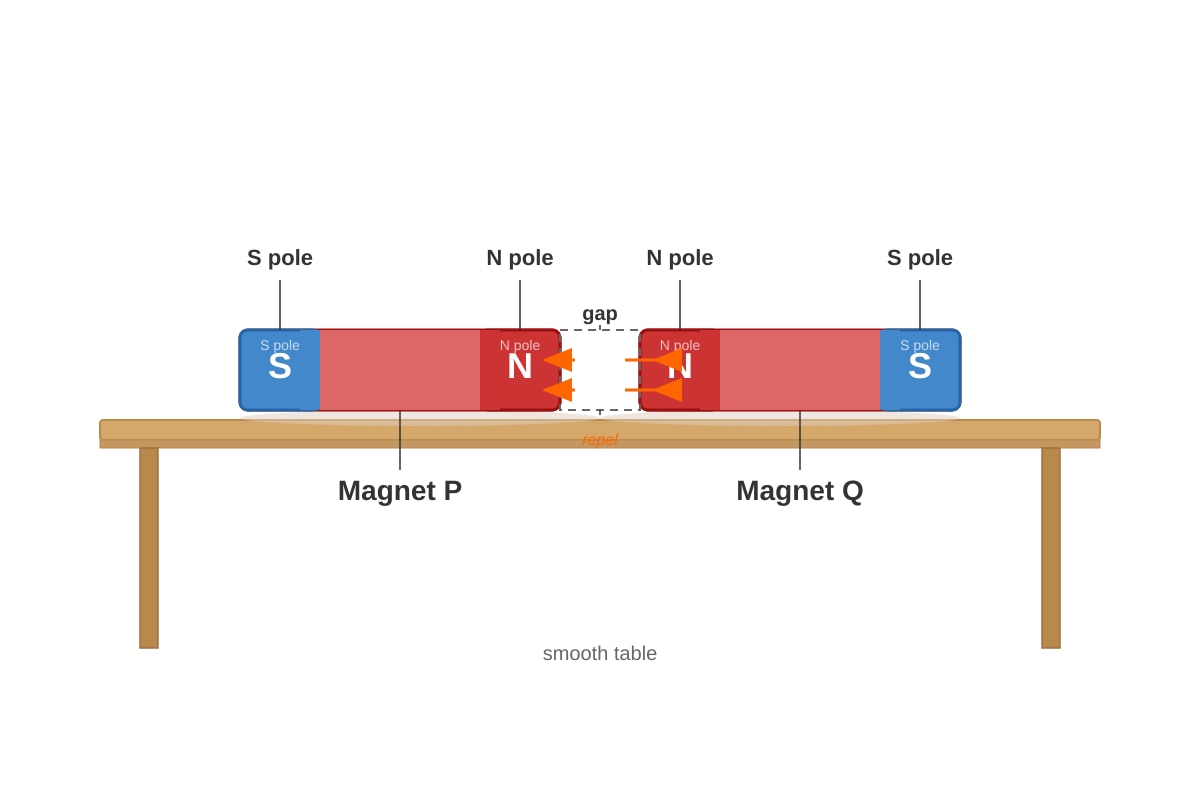
(a) The magnets will move apart (repel each other).
[1 mark]
(b) Like poles (north and north) repel each other. The two north poles facing each other will push each other away.
[1 mark]
Explanation: This is a fundamental rule of magnetism: like poles repel, unlike poles attract. Since both magnets have their north poles facing each other, they will repel and move apart.
Marking note: Accept "they push away from each other" for part (a).
Q19.
Answer:
(a) The needle will point in a north-south direction (one end will point towards the Earth's North Pole).
[1 mark]
(b) The Earth acts like a giant magnet. The magnetised needle aligns with the Earth's magnetic field, so it points north-south.
[1 mark]
Explanation: A freely suspended or floating magnet will align with the Earth's magnetic field. The north-seeking end of the needle points towards the Earth's geographic North Pole. This is how a compass works.
Marking note: Accept "the needle points north and south" for part (a). Accept "the Earth is a magnet" or "the needle aligns with the Earth's magnetic field" for part (b).
Q20.
Answer:
(a) Magnetic metals, such as iron and steel.
[1 mark]
(b) An electromagnet can be switched on and off. When the scrap metal needs to be lifted, the electromagnet is switched on. When the metal needs to be dropped, the electromagnet is switched off, and the metal falls. A permanent magnet cannot be switched off, so it would be very difficult to release the scrap metal.
[1 mark]
Explanation: The key advantage of an electromagnet over a permanent magnet is that its magnetism can be controlled. This makes it ideal for lifting and dropping heavy loads of scrap metal.
Marking note: Accept "it can be turned on and off" or "the magnetism can be controlled" for part (b).
END OF ANSWER KEY