From Real Exams Quiz
Primary 4 Science Living Together Quiz
Free P4 Science Living Together quiz, Exam version, with questions, answers, and syllabus-aligned practice for Singapore students.
These static practice materials are generated from the site's syllabus and paper-generation workflow, with source and model context shown so students and parents can evaluate the material before use.
Questions
Free quiz and exam paper access
Enter your details to view this paper
Your access is remembered on this device.
Answers
Answer Key - Primary 4 Science Quiz - Living Together
Section A: Multiple Choice Questions (Q1 - Q5)
| Question | Answer | Marks | Explanation |
|---|---|---|---|
| 1 | C) population | 1 | A population is a group of the same kind of living things living in the same area at the same time. All the rabbits in the forest are one population because they are all the same type of animal. A community (A) includes many different populations living together. A habitat (B) is the place where they live. An ecosystem (D) includes both the living and non-living things in an area. Common mistake: Students may confuse population with community. |
| 2 | C) Sunlight shining on a garden | 1 | Non-living things are things that have never been alive. Sunlight is a form of energy, not a living thing. Options A, B, and D are all living things (a bird, a fish, a caterpillar). Sunlight is an important abiotic factor (non-living part) of a habitat. |
| 3 | B) A ladybird that eats aphids | 1 | The ladybird is a consumer that cannot make its own food. It depends on other living things (aphids) for food. Options A (grass), C (rosebush), and D (mushroom) are producers or decomposers that obtain energy in other ways. |
| 4 | C) host | 1 | The plant provides food and shelter for the caterpillars. In this relationship, the plant is the host. The caterpillar is the consumer or predator, but the question asks for what the plant is called in this specific relationship. Common mistake: Students may choose "prey" because the caterpillar eats it. However, "host" is the more accurate scientific term for an organism that provides resources to another organism that lives on or in it. |
| 5 | C) They do not have chlorophyll. | 1 | Chlorophyll is the green pigment in plants that allows them to use sunlight to make their own food through photosynthesis. Animals, including humans, do not have chlorophyll, so they cannot make their own food. They must eat other living things to get energy. Options A, B, and D are characteristics that some animals may or may not have, but they are not the fundamental reason animals cannot make food. |
Section B: Fill in the Blanks (Q6 - Q10)
| Question | Answer | Marks | Explanation |
|---|---|---|---|
| 6 | habitat | 1 | A habitat is the natural home or environment of a living thing. It provides everything the living thing needs to survive, such as food, water, shelter, and space. |
| 7 | abiotic / non-living | 1 | The non-living parts of a habitat are called abiotic factors. These include sunlight, water, air, temperature, soil, and rocks. |
| 8 | predator | 1 | A predator is an animal that hunts, kills, and eats other animals. The animal that is hunted and eaten is called the prey. |
| 9 | producer / green plant | 1 | A producer is a living thing that can make its own food using sunlight, water, and carbon dioxide. Green plants are the main producers in most food chains. They are always at the beginning of a food chain because they provide the energy for all other living things in the chain. |
| 10 | compete | 1 | Competition happens when two or more living things need the same limited resource, such as food, water, space, or sunlight. This is a common interaction between living things sharing a habitat. |
Section C: Short Answer Questions (Q11 - Q15)
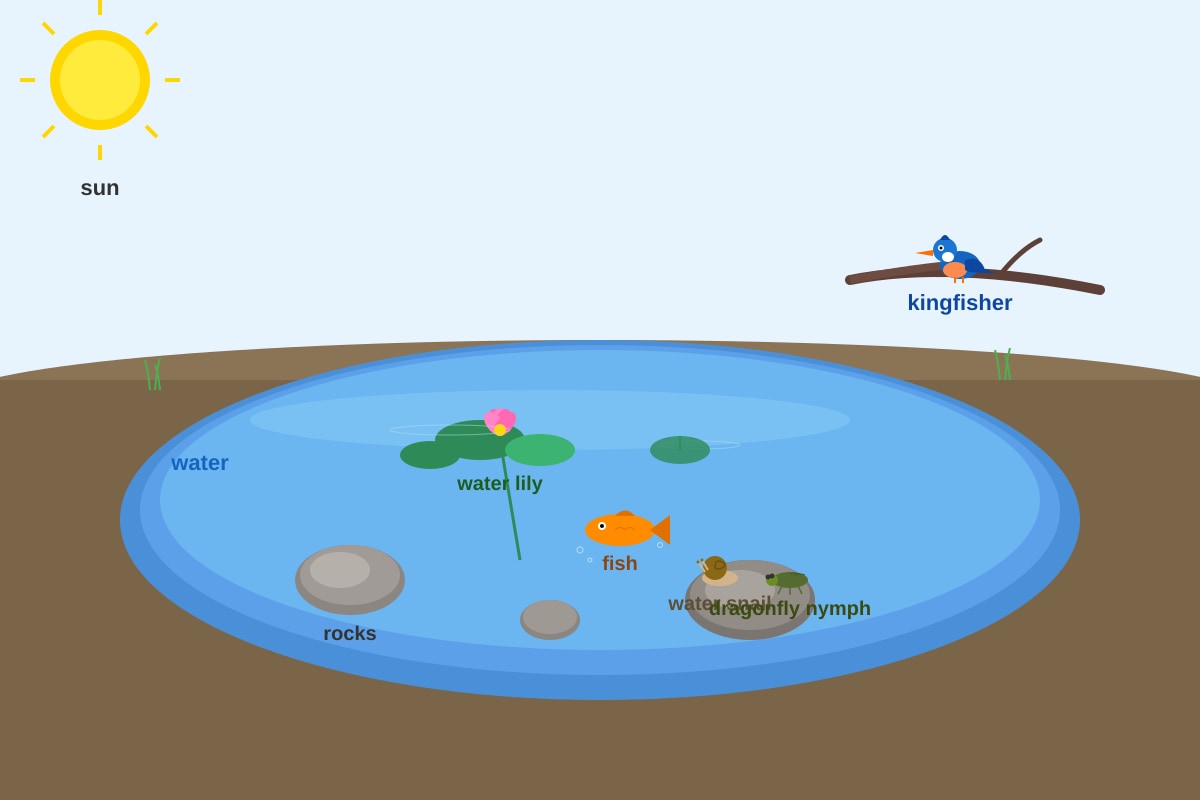
11. Living thing (any one): fish, water lily, water snail, dragonfly nymph, kingfisher Non-living thing (any one): sun, water, rocks [2 marks: 1 mark for correct living thing, 1 mark for correct non-living thing]
Teaching note: Remind students that a living thing must be something that was once alive or is alive now. A rock was never alive. Water is also non-living.
12. Water lily → Water snail → Fish → Kingfisher [2 marks: 1 mark for correct order, 1 mark for correct arrows pointing towards the consumer]
Teaching note: The arrows in a food chain always show the direction of energy flow. The arrow points from the food to the eater. Water lily (producer) is eaten by water snail, which is eaten by fish, which is eaten by kingfisher. Common mistake: Students may draw the arrows backwards or list the animals in random order.
13.
- Effect 1: The birds that eat caterpillars will have less food, so their population may decrease or they may leave the garden.
- Effect 2: The cabbage plants will grow better / will not be eaten as much. [2 marks: 1 mark for each valid effect. Accept any logical effect based on the removal of caterpillars.]
Teaching note: Encourage students to think about the food chain. Removing one living thing affects others. The caterpillars are the prey of some birds. Also, the caterpillars were eating the cabbage, so removing them helps the cabbage.
14. They are competitors because they both need the same limited resource (insects). They will compete with each other for food. [2 marks: 1 mark for identifying the relationship (competition), 1 mark for the correct explanation referencing the shared resource.]
Teaching note: Competition can be between different species or the same species. When two different species need the same food source in the same habitat, they compete. This can affect their populations.
15. By laying many eggs, the turtle ensures that even if many baby turtles are eaten by predators, some will still survive to reach the sea and grow up. This helps the turtle population to continue. [2 marks: 1 mark for recognising that not all eggs will survive, 1 mark for linking to the survival of the population.]
Teaching note: This is an example of how living things have adaptations to ensure their species survives. The "many eggs" strategy increases the chance that at least some offspring will survive to reproduce. Common mistake: Students may think this is only to feed other animals. The primary reason is for the survival of the population.
Section D: Applied Thinking (Q16 - Q20)
16. The squirrel population will decrease. This is because the squirrels rely on acorns as a food source. If many acorns are taken by people, there will be less food for the squirrels, so some may not survive or have fewer babies. [2 marks: 1 mark for stating the population will decrease/drop, 1 mark for explaining the link to less food.]
Teaching note: This is an example of humans affecting a habitat. The removal of a resource (food) leads to competition among squirrels for what is left, which can lower their population.
17. No, the student is not correct. Spiders are not insects. They belong to a different group called arachnids. Unlike insects, spiders have eight legs (insects have six) and have two body parts (insects have three). [2 marks: 1 mark for saying "no" or "not correct", 1 mark for any valid difference (number of legs or body parts) or mentioning "arachnids".]
Teaching note: This is a common misconception. Students need to know the key differences. A good memory aid: "Insects have six legs" (they are hexapods) and "Spiders have eight legs" (they are arachnids).
18. The animals living in the forest would be greatly affected. If the only type of tree dies, the animals that depend on that tree for food or shelter will have nothing. They will need to move away or they may die. [2 marks: 1 mark for stating a negative effect (animals will die/move away), 1 mark for explaining with a valid reason (e.g., loss of food/shelter).]
Teaching note: This highlights the concept of biodiversity. A habitat with only one type of plant is very fragile because if that plant is wiped out, the entire food web collapses. A habitat with many different plants is more stable.
19. This is a commensalism relationship. The small fish benefits by getting food. The shark is not helped or harmed. In commensalism, one organism benefits and the other is neither helped nor harmed. [2 marks: 1 mark for stating "commensalism", 1 mark for explaining that one benefits and the other is not affected.]
Teaching note: There are three main types of symbiotic relationships: mutualism (both benefit), commensalism (one benefits, one unaffected), and parasitism (one benefits, one harmed). This is a classic example of commensalism.
20. The strawberry plants will produce fewer strawberries or no strawberries. This is because bees are needed to pollinate the strawberry flowers. If the net blocks the bees, the flowers will not be pollinated, and they cannot develop into fruit. [2 marks: 1 mark for stating a negative effect on the strawberry yield, 1 mark for explaining the need for pollination by bees.]
Teaching note: This question links the need for interaction between living things (pollination) to a practical application (farming). It tests whether students understand that plants often rely on animals for reproduction. Common mistake: Students may think the plant will just grow without bees and produce fruit normally.