From Real Exams Quiz
Primary 4 Science Living Together Quiz
Free P4 Science Living Together quiz, Exam version, with questions, answers, and syllabus-aligned practice for Singapore students.
These static practice materials are generated from the site's syllabus and paper-generation workflow, with source and model context shown so students and parents can evaluate the material before use.
Questions
Free quiz and exam paper access
Enter your details to view this paper
Your access is remembered on this device.
Answers
Answer Key: Primary 4 Science Quiz - Living Together
Total Marks: 40
Section A: Multiple-Choice Questions (5 × 2 = 10 marks)
1. Answer: B) Photosynthesis Marks: 2 Explanation: Photosynthesis is the process where plants use sunlight, carbon dioxide, and water to make their own food (sugar) and oxygen. Respiration (A) is how living things release energy from food. Germination (C) is when a seed starts to grow. Digestion (D) is the breakdown of food in the body. Common Mistake: Students may confuse respiration with photosynthesis. Remind students that photo means light.
2. Answer: C) A lion hunting and eating a zebra. Marks: 2 Explanation: A predator-prey relationship is when one animal (the predator) hunts and kills another animal (the prey) for food. The lion is the predator and the zebra is the prey. Option A shows mutualism, B shows a consumer eating a producer, and D shows a habitat relationship. Common Mistake: Students may think any interaction between animals is predation. The key is that the prey is killed and eaten.
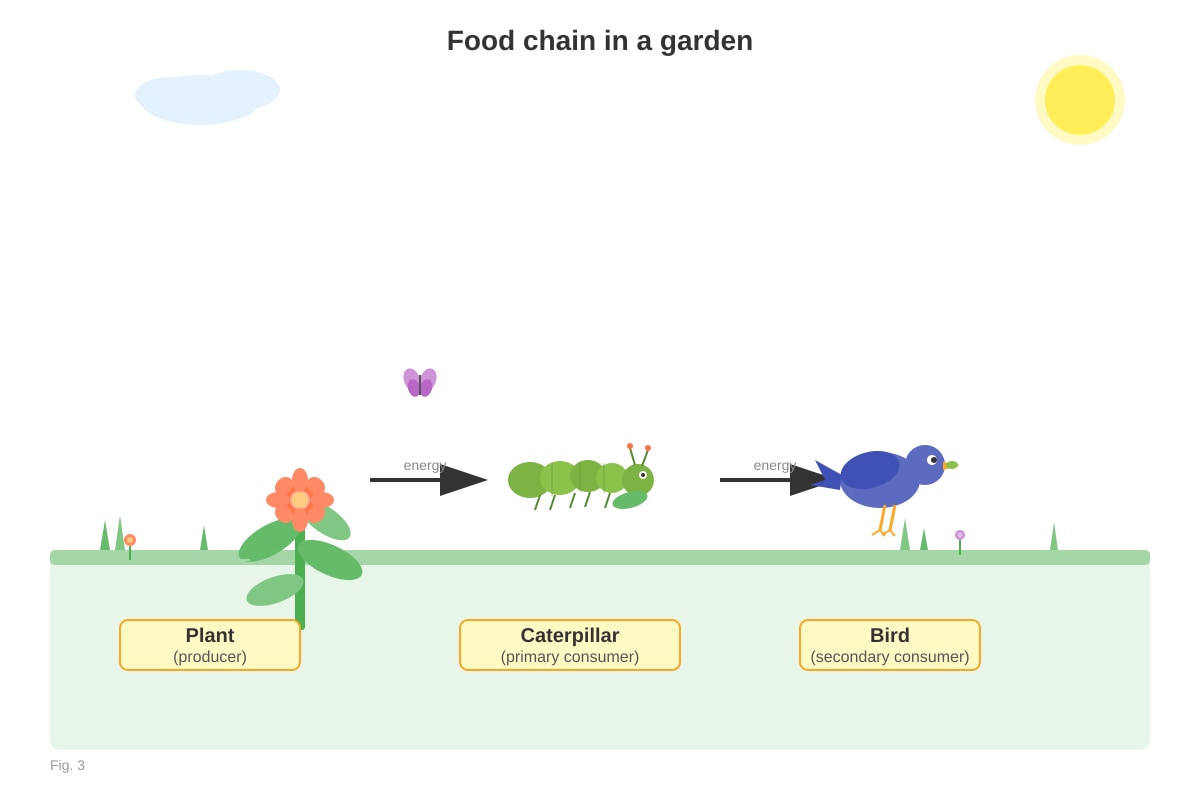
3. Answer: B) The flow of energy from the organism being eaten to the eater. Marks: 2 Explanation: In a food chain, arrows always point from the food (the organism being eaten) to the eater. This shows the direction in which energy moves. The plant gets energy from the sun, the caterpillar eats the plant and gets energy, then the bird eats the caterpillar.
4. Answer: C) The larger fish is a predator of the small fish. Marks: 2 Explanation: The larger fish eats the small fish, so it is a predator. The small fish are prey. Water plants are producers because they make their own food. The small fish are consumers. There is a clear feeding relationship, so D is incorrect. Common Mistake: Students may think "predator" only refers to large land animals. Any organism that hunts and eats another is a predator.
5. Answer: B) Mutualism Marks: 2 Explanation: Mutualism is a relationship where both organisms benefit. The tree provides shelter for the bird, and the bird helps the tree by spreading its seeds. Competition (A) is when organisms fight for the same resource. Parasitism (C) is when one benefits and the other is harmed. Predation (D) is when one eats the other.
Section B: Short-Answer Questions (3 + 3 + 3 + 3 + 3 = 15 marks)
6. (a) Answer: Mutualism (1 mark) (b) Answers:
- The hummingbird benefits because it gets food (nectar) to eat. (1 mark)
- The flower benefits because the hummingbird carries pollen from one flower to another, helping the flower to reproduce (make seeds). (1 mark) (Accept any correct explanation showing how each benefits.)
Explanation: This is a classic example of mutualism. The bird gets energy from the nectar, and the plant gets pollinated. Both species benefit from the interaction.
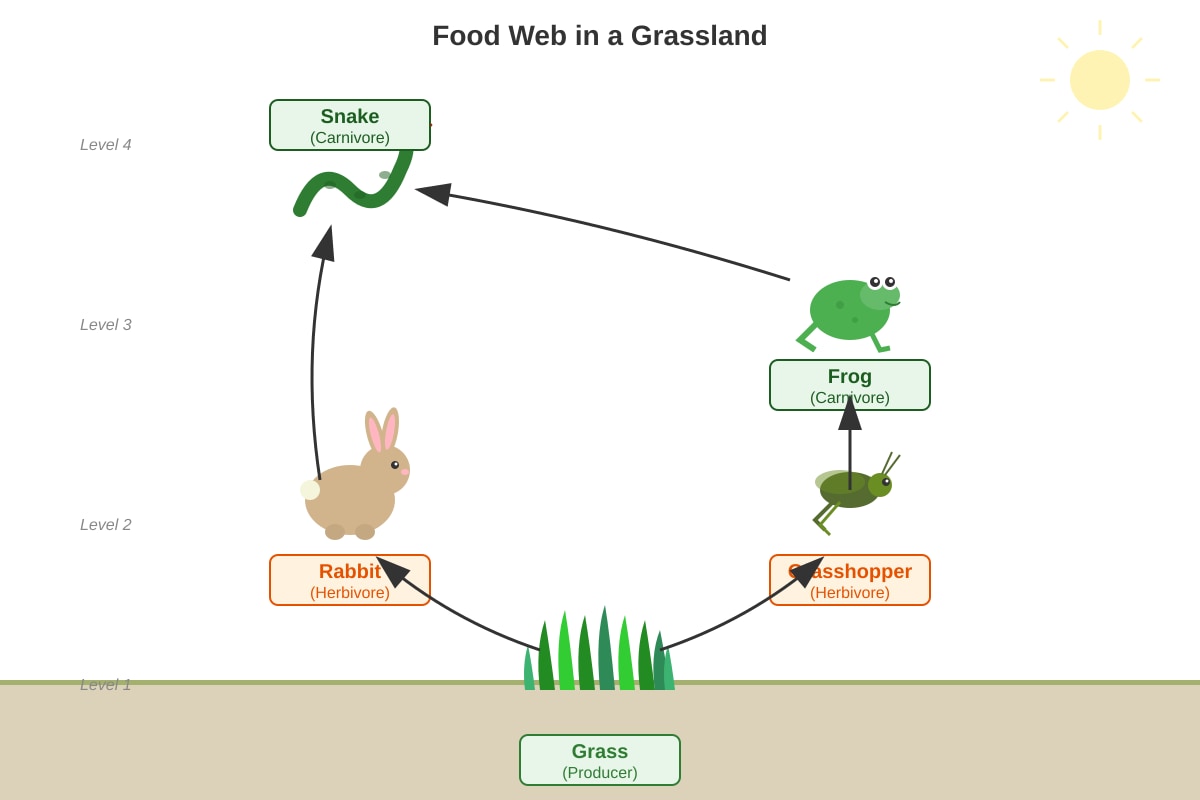
7. (a) Answer: 3 food chains (1 mark) The three food chains are:
- Grass → Rabbit → Snake
- Grass → Grasshopper → Frog → Snake
- Grass → Grasshopper → Frog (if we stop at frog, but the food web can be read as partial chains too. The standard answer for this specific web is 3, assuming we follow complete chains to the top predator. Some mark schemes accept 2 or 3; the safest answer here is 3.)
(b) Answer: The number of grasshoppers would increase. (1 mark) Explanation: The frogs eat grasshoppers. If the frogs are removed, there is no predator to eat the grasshoppers. With fewer grasshoppers being eaten, more of them will survive and reproduce, so their population will increase. (1 mark)
Common Mistake: Students might say the number of grasshoppers will decrease because frogs are gone. They need to understand that predators control prey populations.
8. (a) Answer: Predator-prey relationship (OR "Predation") (1 mark)
(b) Answer: The number of caterpillars will decrease. (1 mark) Explanation: Ladybugs eat caterpillars. With more ladybugs (predators) in the garden, more caterpillars will be eaten. This will cause the caterpillar population to go down. (1 mark) (Accept: "drop", "reduce", "go down")
9. Answer: If there is a large variety of plants and animals (biodiversity), the forest ecosystem is more stable and can recover from changes. For example, if one type of food plant dies out, animals can eat other plants. (3 marks) Marking Scheme:
- 1 mark: Recognises that plants/animals rely on each other or that variety provides more food options.
- 2 marks: Links variety to food chains or habitat needs.
- 3 marks: Explains that a loss of one species won't cause the whole ecosystem to collapse, OR describes a specific example (e.g., "If caterpillars run out, birds can eat berries instead."). (Accept any reasonable explanation showing understanding of interdependence and stability.)
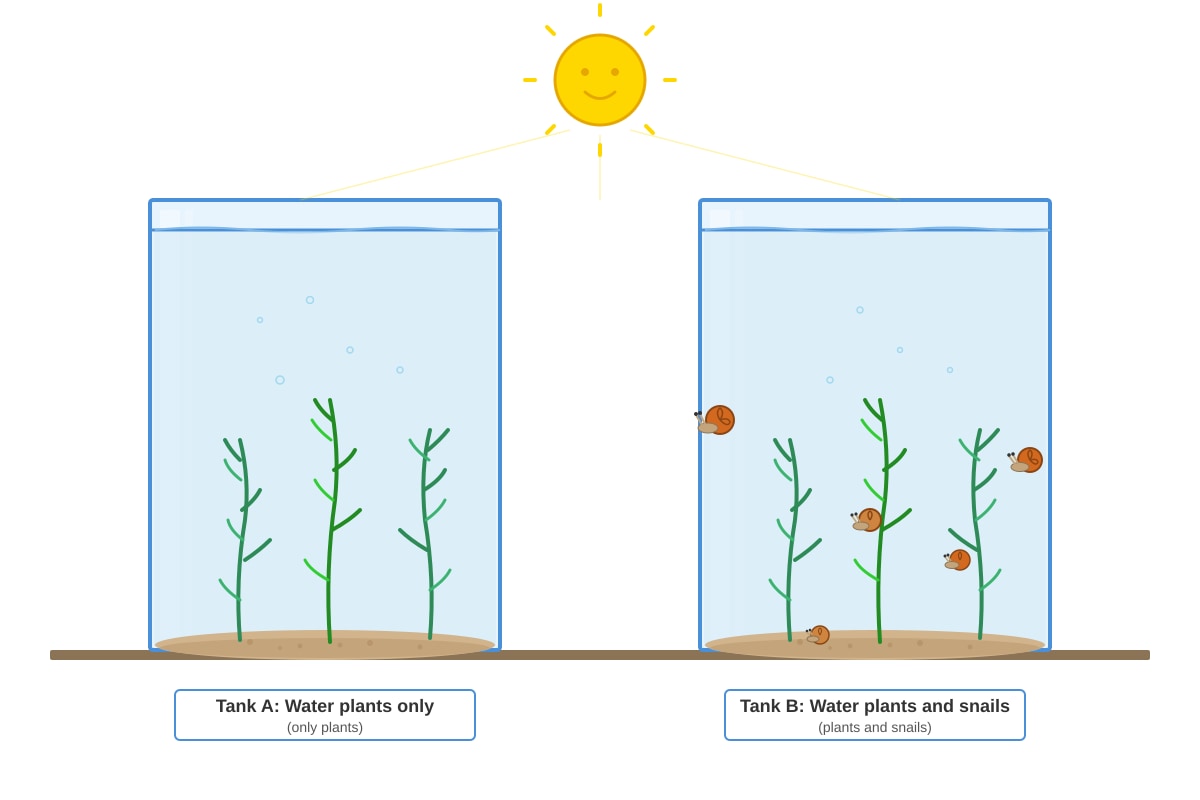
10. Answer: The bubbles are made of oxygen gas (1 mark) produced by the water plants during photosynthesis. There are more bubbles in Tank A because Tank A has only plants and no snails. In Tank B, the snails breathe in oxygen and release carbon dioxide. The plants in Tank B use some of the oxygen they produce for themselves and some is used by the snails. (2 marks)
Explanation: Plants photosynthesize and produce oxygen as a waste product. In Tank A, all the oxygen released by plants forms bubbles. In Tank B, snails are consumers that respire, so they take in oxygen from the water. This means less oxygen is available to form bubbles. Common Mistake: Students may think snails "eat" the bubbles. Explain that snails need oxygen to breathe, just like fish, and they take it from the water.
Section C: Structured Questions (1 × 10 = 10 marks for questions 11-20, plus 5 extra marks from questions 18, 19, 20 = 15 total)
11. Answer: Producers (OR Plants) [1 mark] Explanation: Producers are organisms that make their own food through photosynthesis, using sunlight.
12. Answer: Grass → Cow → Human [1 mark] Explanation: The grass is the producer, the cow (herbivore) eats the grass, and the human (omnivore) eats the cow. The arrow shows the direction of energy flow.
13. Answer: False [1 mark] Explanation: A carnivore is an animal that eats only other animals (meat). An omnivore eats both plants and animals. A herbivore eats only plants.
14. Answer: Any herbivore e.g., Cow, Deer, Rabbit, Grasshopper, Horse. [1 mark] Explanation: A herbivore is an animal that eats only plants.
15. Answer: The Sun [1 mark] Explanation: Sunlight is the primary source of energy for almost all life on Earth. Plants use it for photosynthesis, and then animals eat plants (or eat other animals that ate plants).
16. Answer: Parasitism (OR Parasite-host relationship) [1 mark] Explanation: The tick benefits by getting food (blood), but the dog is harmed (it loses blood and may get an infection). This is parasitism. The tick is the parasite, the dog is the host.
17. Answer: Prey [1 mark] Explanation: The prey is the animal that is hunted and eaten. The predator is the hunter.
18. Answer: Any correct 3-organism food chain with arrows pointing the right way. Example: Sun → Grass → Rabbit → Fox (For a 3-organism chain without sun: Grass → Rabbit → Fox). Marking Scheme:
- 1 mark: Correct organisms (producer + consumer + another consumer).
- 1 mark: Arrows pointing in the correct direction (from the food to the eater). (Do not deduct for including the sun arrow if the chain is still 3 steps, unless the question specified "three organisms". Acceptable answers include Sun→Plant→Rabbit or Plant→Rabbit→Fox.)
19. (a) Answer: Algae [1 mark] (b) Answer: Big Fish [1 mark] Explanation: The producer is always the first organism (Algae, makes its own food). The secondary consumer is the third organism in the chain. Here: Algae (producer) → Small Fish (primary consumer) → Big Fish (secondary consumer) → Human (tertiary consumer).
20. (a) Answer: The young fish are safe because the mangrove roots provide hiding places from predators (larger fish). [1 mark]
(b) Answer: The mangrove trees might be harmed/start to decline. (1 mark) Explanation: The fish help keep the water clean by eating waste material that could harm the trees. If the fish are removed, waste material will build up, which could damage the mangrove trees. (1 mark) (Accept explanation that the mutualistic relationship is broken; both organisms would suffer or the system becomes unbalanced.)
- End of Answer Key -