From Real Exams Quiz
Primary 4 Science Living Together Quiz
Free P4 Science Living Together quiz, Exam version, with questions, answers, and syllabus-aligned practice for Singapore students.
These static practice materials are generated from the site's syllabus and paper-generation workflow, with source and model context shown so students and parents can evaluate the material before use.
Questions


Free quiz and exam paper access
Enter your details to view this paper
Your access is remembered on this device.
Answers
Primary 4 Science Quiz - Living Together: Answer Key
Total Marks: 30
Section A: Multiple-Choice Questions (5 questions x 2 marks = 10 marks)
1. B) Living things depend on each other for food.
- Explanation: The observations show a sequence of eating events: caterpillar eats leaf, bird eats caterpillar, cat chases bird. This demonstrates a food chain, where each living thing depends on another for food. Option A is incorrect because the observation doesn't mention sunlight. Option C is incorrect because there is no competition shown. Option D is incorrect because the animals are not helping each other; they are eating or chasing each other.
- Marks: 1 mark for correct answer.
2. C) A rock
- Explanation: A rock is a non-living thing because it does not grow, reproduce, need food, or respond to its environment. A water lily, a tadpole, and a water snail are all living things.
- Marks: 1 mark for correct answer.
3. B) The flow of energy from one living thing to another
- Explanation: In a food chain, arrows always show the direction in which energy flows. The arrow points from the organism being eaten (the food) to the organism that eats it. For example, the arrow from Grass to Grasshopper means the grasshopper gets energy by eating the grass.
- Marks: 1 mark for correct answer.
4. C) Photosynthesis
- Explanation: Photosynthesis is the process by which plants use sunlight, water, and carbon dioxide (from the air) to make their own food (glucose). Respiration is how living things get energy from food. Digestion is how food is broken down. Reproduction is how living things create offspring.
- Marks: 1 mark for correct answer.
5. C) A fern
- Explanation: A producer is a living thing that can make its own food using sunlight. Plants like ferns, grass, and trees are producers. A mushroom is a decomposer. A deer and a tiger are consumers (they cannot make their own food).
- Marks: 1 mark for correct answer.
Section B: Fill in the Blanks (5 questions x 1 mark = 5 marks)
6. habitat
- Explanation: A habitat is the natural home or environment of a living thing. It provides food, water, shelter, and space for the organism to survive.
- Marks: 1 mark for correct spelling and word.
7. herbivores
- Explanation: Herbivores are animals that eat only plants. Examples include cows, rabbits, and deer. Carnivores eat only other animals. Omnivores eat both plants and animals.
- Marks: 1 mark for correct spelling and word.
8. food chain
- Explanation: A food chain is a linear sequence showing how energy and nutrients pass from one living thing to another. It always starts with a producer (like a plant) and ends with a top consumer.
- Marks: 1 mark for correct spelling and word.
9. ecosystem
- Explanation: An ecosystem includes all the living things (plants, animals, microorganisms) in an area and the non-living things (water, soil, air, sunlight) they interact with.
- Marks: 1 mark for correct spelling and word.
10. omnivores
- Explanation: Omnivores are animals that eat both plants and other animals. Examples include humans, bears, and pigs.
- Marks: 1 mark for correct spelling and word.
Section C: Short Answer Questions (5 questions x 2 marks = 10 marks)
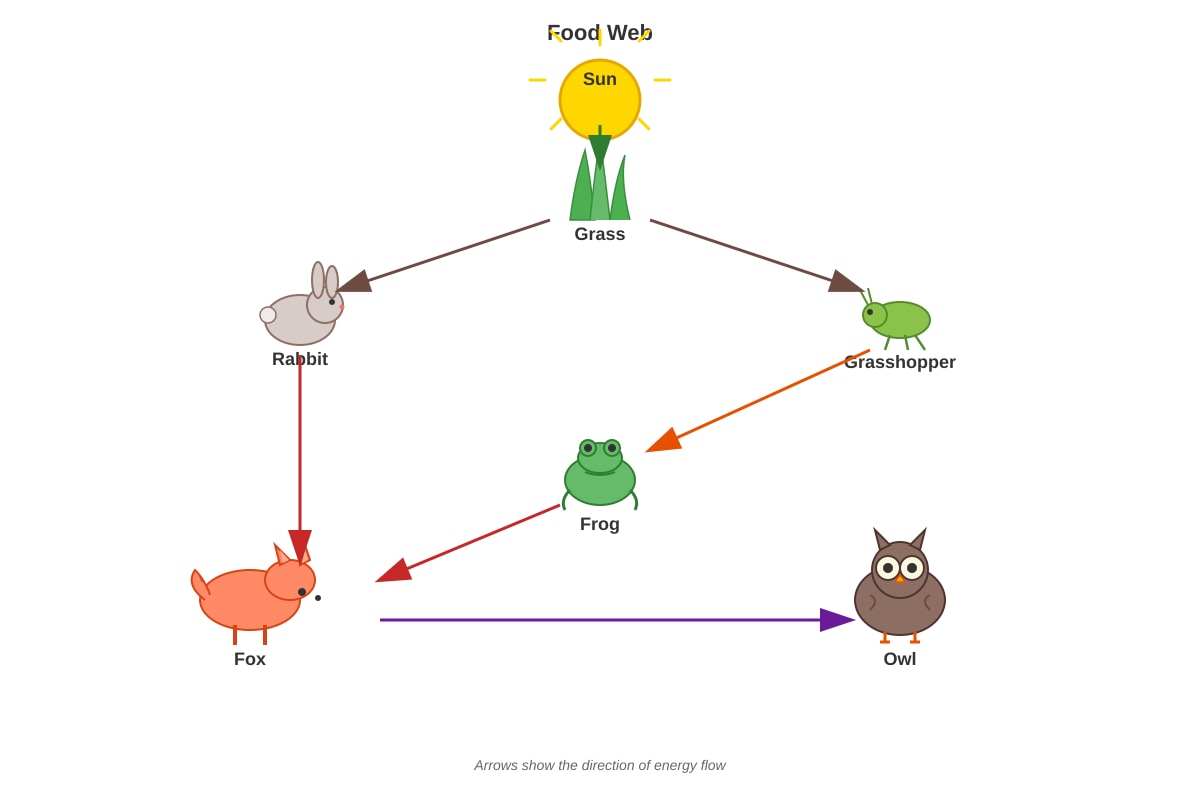
11. (a) Grass (or any plant-like organism in the food web)
- Explanation: A producer is an organism that can make its own food. In this food web, the grass is the only producer because it uses sunlight to make food through photosynthesis.
- Marks: 1 mark for naming a correct producer.
(b) Frog or Fox or Owl
- Explanation: A secondary consumer is an animal that eats primary consumers (herbivores). The grasshopper is a primary consumer (eats grass). The frog eats the grasshopper, so the frog is a secondary consumer. The fox eats the rabbit (primary consumer) and the frog (secondary consumer), so the fox is also a secondary consumer. The owl eats the fox, so the owl is a tertiary consumer.
- Marks: 1 mark for naming a correct secondary consumer.
12. The leaves turned yellow because the plant could not get sunlight to carry out photosynthesis. Without sunlight, the plant could not make its own food, and the green pigment (chlorophyll) in the leaves broke down, causing the leaves to turn yellow.
- Explanation: Sunlight is essential for photosynthesis. When a plant is kept in the dark, it cannot produce chlorophyll, and the existing chlorophyll breaks down. The plant also cannot produce food, which leads to the leaves turning yellow and eventually dying.
- Marks: 1 mark for stating that the plant could not get sunlight. 1 mark for explaining that the plant could not carry out photosynthesis or that the chlorophyll broke down.
13. (a) Fish (or frog, dragonfly, lily pad - any living thing shown)
- Explanation: A living thing is an organism that grows, reproduces, needs food, and responds to its environment.
- Marks: 1 mark for naming a correct living thing.
(b) Water (or rocks - any non-living thing shown)
- Explanation: A non-living thing does not have the characteristics of life. Water and rocks are non-living components of the habitat.
- Marks: 1 mark for naming a correct non-living thing.
14. The number of caterpillars will decrease.
- Explanation: The birds are predators that eat the caterpillars. When the birds are introduced, they will prey on the caterpillars, reducing their population. This is an example of how predators can control the population of their prey.
- Marks: 1 mark for stating that the number of caterpillars will decrease. 1 mark for explaining that the birds will eat the caterpillars.
15. Plants are important in a food chain because they are producers. They can make their own food using sunlight, water, and air through photosynthesis. All other living things in the food chain depend on plants, either directly or indirectly, for energy.
- Explanation: Without plants, there would be no food for herbivores. Without herbivores, there would be no food for carnivores. Therefore, plants form the base of almost all food chains.
- Marks: 1 mark for stating that plants are producers. 1 mark for explaining that other living things depend on plants for food/energy.
Section D: Structured Questions (5 questions x 1 mark = 5 marks)
16. Sunlight (or the Sun)
- Explanation: The Sun is the primary source of energy for almost all life on Earth. Plants use sunlight to make food through photosynthesis. This energy then flows through the food chain.
- Marks: 1 mark for correct answer.
17. Mushroom (or fungus, bacteria, worm)
- Explanation: Decomposers are living things that break down dead plants and animals, returning nutrients to the soil. Examples include mushrooms, bacteria, and earthworms.
- Marks: 1 mark for naming a correct decomposer.
18. Planting more trees (or not littering, reducing pollution, creating a nature reserve, etc.)
- Explanation: Humans can protect habitats by reducing pollution, conserving water, planting native species, and not disturbing wildlife. Any reasonable action that helps protect the environment is acceptable.
- Marks: 1 mark for a reasonable and correct example.
19. Predator
- Explanation: A predator is an animal that hunts, kills, and eats other animals. The animal that is hunted is called the prey.
- Marks: 1 mark for correct answer.
20. For food (or for water, for space, for sunlight, for mates)
- Explanation: Living things in the same habitat often compete for limited resources like food, water, space, and sunlight. Competition helps to control population sizes.
- Marks: 1 mark for a reasonable and correct example of competition.
--- End of Answer Key ---