From Real Exams Quiz

Primary 4 Science Light Quiz

Free Exam-Derived NVIDIA Nemotron 3 Ultra 550B A55B Free Primary 4 Science Light quiz with questions and answers for Singapore students. This page is rendered as a direct URL so the questions and answers can be discovered without pressing in-page buttons.

These static practice materials are generated from the site's syllabus and paper-generation workflow, with source and model context shown so students and parents can evaluate the material before use.

Primary 4 Science From Real Exams Generated by NVIDIA Nemotron 3 Ultra 550B A55B Free Updated 2026-06-06

Questions

<!-- TuitionGoWhere generation metadata: stage=3-0; model=nvidia/nemotron-3-ultra-550b-a55b:free; model_label=NVIDIA Nemotron 3 Ultra 550B A55B Free; generated=2026-06-05; Sources: Stage 2-1 real exam-derived templates and Stage 2-2 exam-enriched syllabus. -->

Primary 4 Science Quiz - Light

Name: ___________________________
Class: Primary 4 _______
Date: ___________________________
Score: _______ / 40

Duration: 45 minutes
Total Marks: 40

Instructions:

  1. Answer all questions.
  2. For Section A, choose the correct option and write its number (1, 2, 3, or 4) in the brackets provided.
  3. For Section B and C, write your answers in the spaces provided.
  4. The number of marks for each question is shown in brackets [ ].

Section A: Multiple-Choice Questions (10 × 1 mark = 10 marks)

1. Which of the following is a source of light? [1]

(1) Moon
(2) Mirror
(3) Sun
(4) White paper

Answer: (_____)

2. Light travels in a __________. [1]

(1) curved line
(2) straight line
(3) zigzag line
(4) circular path

Answer: (_____)

3. A shadow is formed when __________. [1]

(1) light passes through an object
(2) an object blocks light
(3) light bends around an object
(4) an object reflects light

Answer: (_____)

4. Which of the following materials allows most light to pass through? [1]

(1) Wood
(2) Frosted glass
(3) Clear glass
(4) Cardboard

Answer: (_____)

5. The diagram below shows a torch shining on a ball. A shadow is formed on the screen.

<image_placeholder> id: Q5-fig1 type: diagram linked_question: Q5 description: A torch on the left shines light rays towards a ball in the middle. A screen is on the right. The shadow of the ball appears on the screen. labels: Torch, Ball, Screen, Light rays (straight lines with arrows), Shadow on screen values: Distance from torch to ball: 20 cm; Distance from ball to screen: 30 cm must_show: Straight light rays from torch, blocked by ball, forming a sharp shadow on screen </image_placeholder>

What happens to the size of the shadow if the ball is moved closer to the torch? [1]

(1) The shadow becomes smaller.
(2) The shadow becomes larger.
(3) The shadow remains the same size.
(4) The shadow disappears.

Answer: (_____)

6. Which of the following objects will NOT form a shadow when light shines on it? [1]

(1) A metal spoon
(2) A clear glass cup
(3) A wooden block
(4) A ceramic mug

Answer: (_____)

7. Ravi stands under the Sun at noon. His shadow is very short. At 5 p.m., his shadow is much longer. Why does the length of his shadow change? [1]

(1) The Sun changes its brightness.
(2) The position of the Sun in the sky changes.
(3) Ravi grows taller during the day.
(4) The ground becomes uneven.

Answer: (_____)

8. Four materials are tested to see how much light passes through. The results are shown below.

MaterialAmount of light passing through
AMost
BSome
CVery little
DNone

Which material is most likely a transparent material? [1]

(1) A
(2) B
(3) C
(4) D

Answer: (_____)

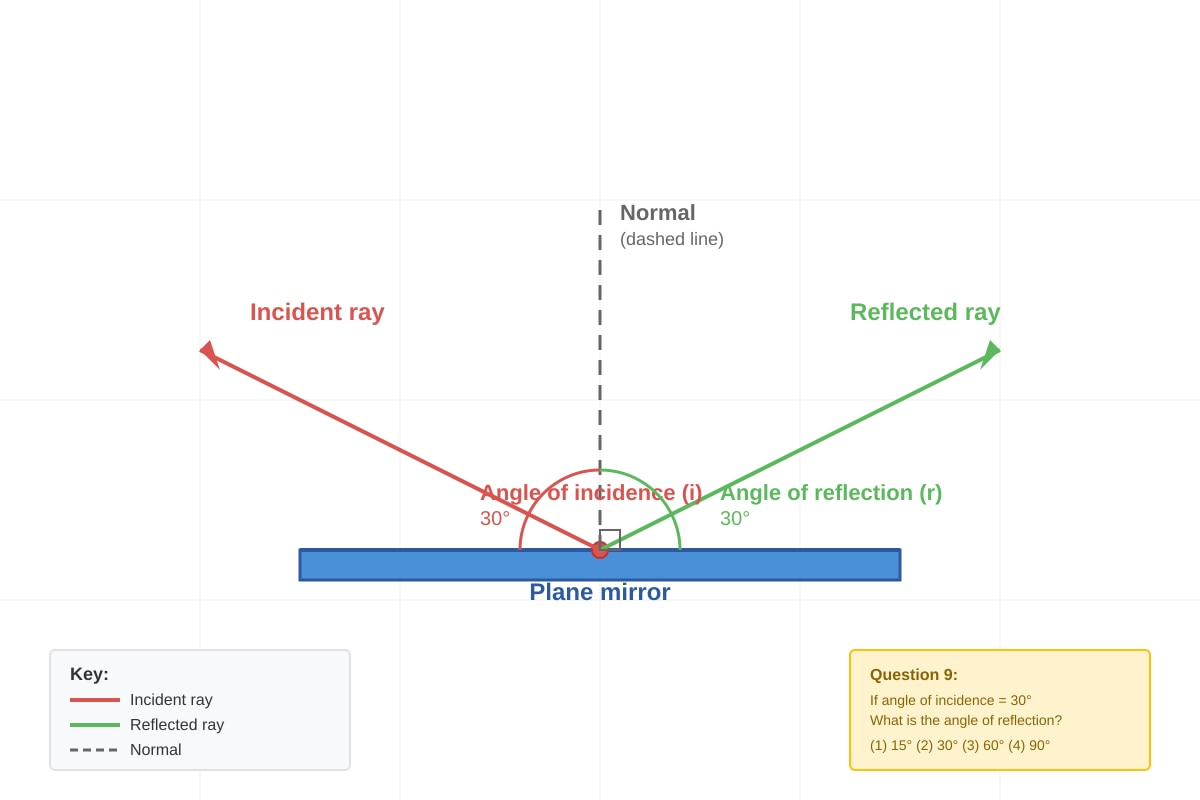
9. The diagram below shows light from a torch hitting a plane mirror.

<image_placeholder> id: Q9-fig1 type: diagram linked_question: Q9 description: A torch shines a light ray at a plane mirror. The incident ray and reflected ray are shown with arrows. The normal line is drawn perpendicular to the mirror surface. labels: Torch, Incident ray, Reflected ray, Plane mirror, Normal line (dashed), Angle of incidence (i), Angle of reflection (r) values: Angle of incidence = 30° must_show: Incident ray hitting mirror, reflected ray bouncing off, normal line, equal angles i and r marked </image_placeholder>

Which of the following statements about the reflection of light is correct? [1]

(1) The angle of incidence is greater than the angle of reflection.
(2) The angle of incidence is smaller than the angle of reflection.
(3) The angle of incidence is equal to the angle of reflection.
(4) The reflected ray travels along the normal line.

Answer: (_____)

10. Mei Ling wants to see over a high wall without climbing it. She uses a periscope. Which property of light allows the periscope to work? [1]

(1) Light can be bent.
(2) Light travels in straight lines.
(3) Light can be reflected.
(4) Light travels very fast.

Answer: (_____)


Section B: Short-Answer Questions (6 × 2 marks = 12 marks)

11. Classify the following objects into light sources and non-light sources. [2]

Sun, Mirror, Candle flame, Moon, Firefly, Torchlight

Light SourcesNon-Light Sources

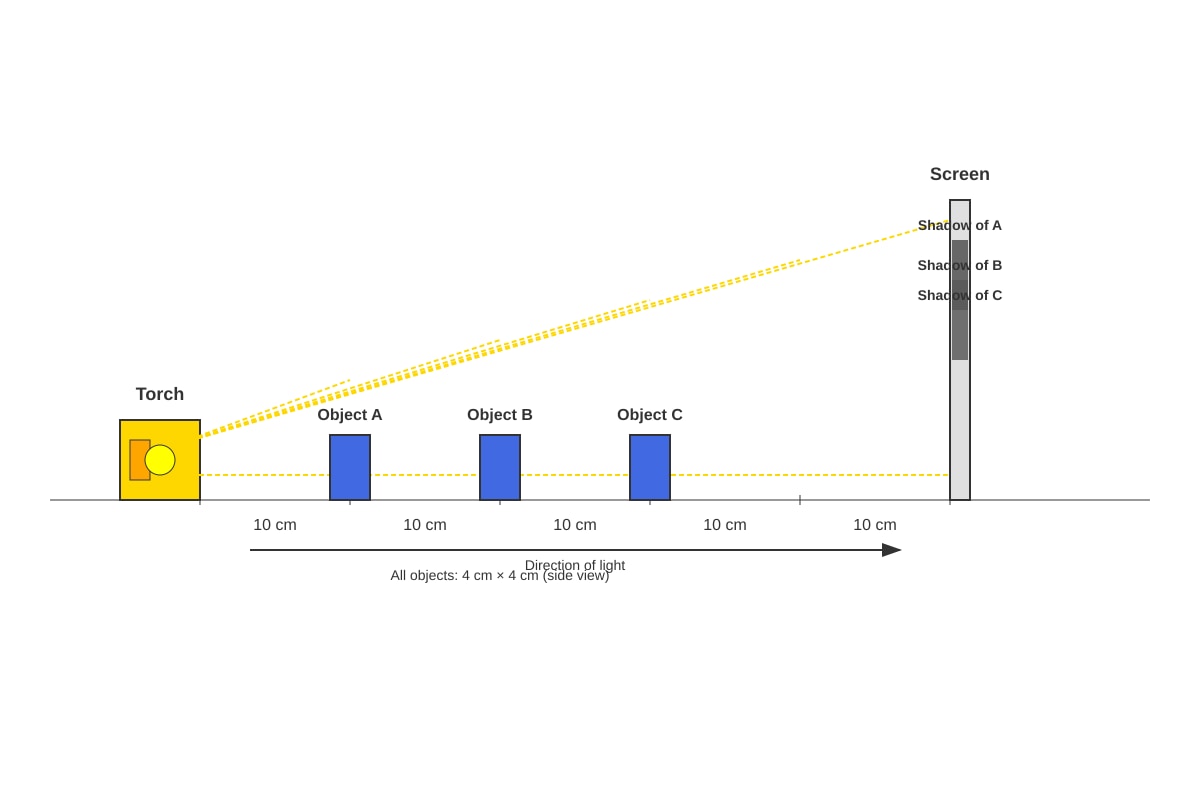
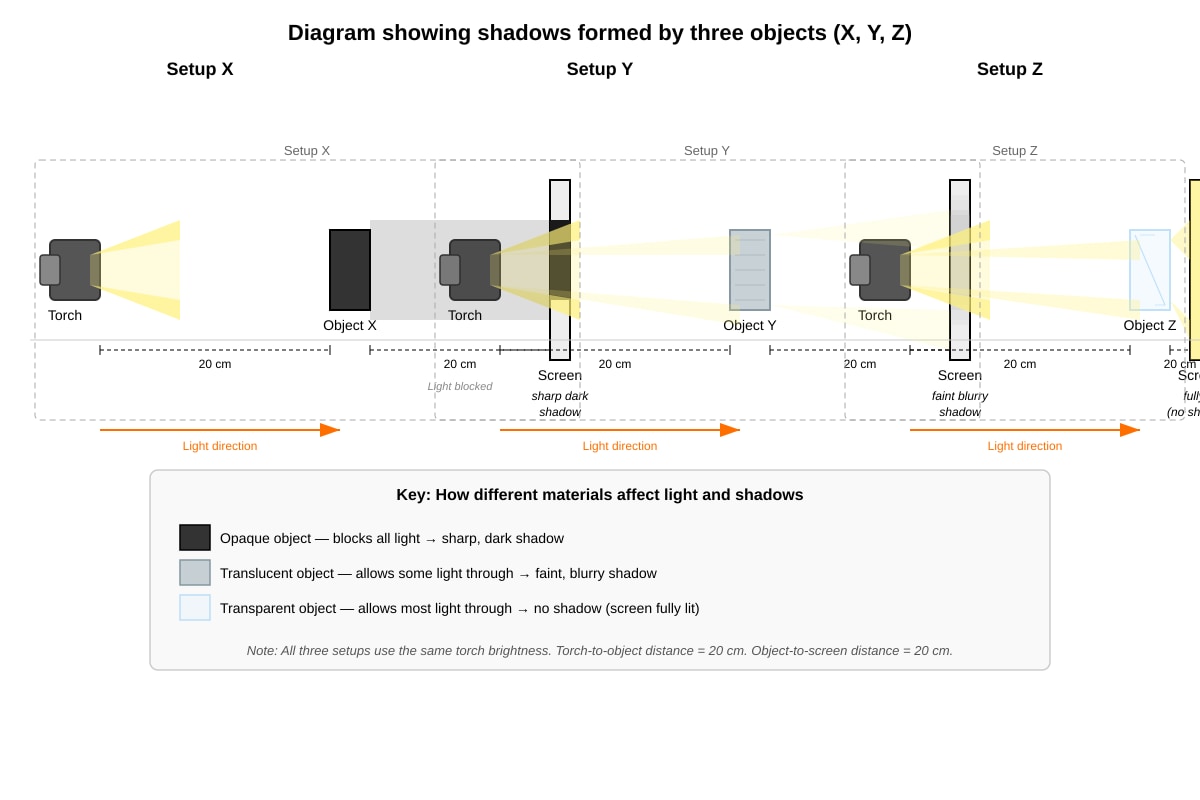
12. The diagram below shows three objects (A, B, and C) placed between a torch and a screen. The torch is switched on.

<image_placeholder> id: Q12-fig1 type: diagram linked_question: Q12 description: A torch on the left shines light towards three objects placed at different positions. A screen is on the right. Object A is opaque (wooden block), Object B is transparent (clear glass), Object C is translucent (frosted glass). labels: Torch, Object A (opaque), Object B (transparent), Object C (translucent), Screen values: All objects same size (5 cm × 5 cm). Distances: Torch to A = 15 cm, A to B = 10 cm, B to C = 10 cm, C to Screen = 15 cm. must_show: Light rays hitting each object. Sharp shadow for A, no shadow for B, faint blurry shadow for C on screen. </image_placeholder>

(a) Which object(s) will form a sharp, dark shadow on the screen? [1]


(b) Which object(s) will form a faint, blurry shadow on the screen? [1]


13. Complete the following sentences using the words in the box. Each word can be used only once. [2]

opaquetransparenttranslucentshadow

(a) A _______________ object allows most light to pass through so we can see clearly through it.

(b) A _______________ is formed when light is blocked by an opaque or translucent object.

14. The diagram below shows a stick placed vertically on the ground at different times of the day. The Sun's position is shown.

<image_placeholder> id: Q14-fig1 type: diagram linked_question: Q14 description: Three diagrams showing a vertical stick on flat ground with the Sun at different positions. Diagram 1: Sun high overhead (noon). Diagram 2: Sun lower in the sky (3 p.m.). Diagram 3: Sun near horizon (6 p.m.). Shadows cast by the stick are shown. labels: Stick, Sun position, Shadow, Ground, Time labels (12 p.m., 3 p.m., 6 p.m.) values: Stick height = 1 m. Shadow lengths: 12 p.m. = 0.2 m, 3 p.m. = 1 m, 6 p.m. = 5 m (approx). must_show: Changing shadow length and direction as Sun moves from overhead to horizon </image_placeholder>

(a) At which time is the shadow shortest? [1]


(b) Explain why the shadow length changes throughout the day. [1]


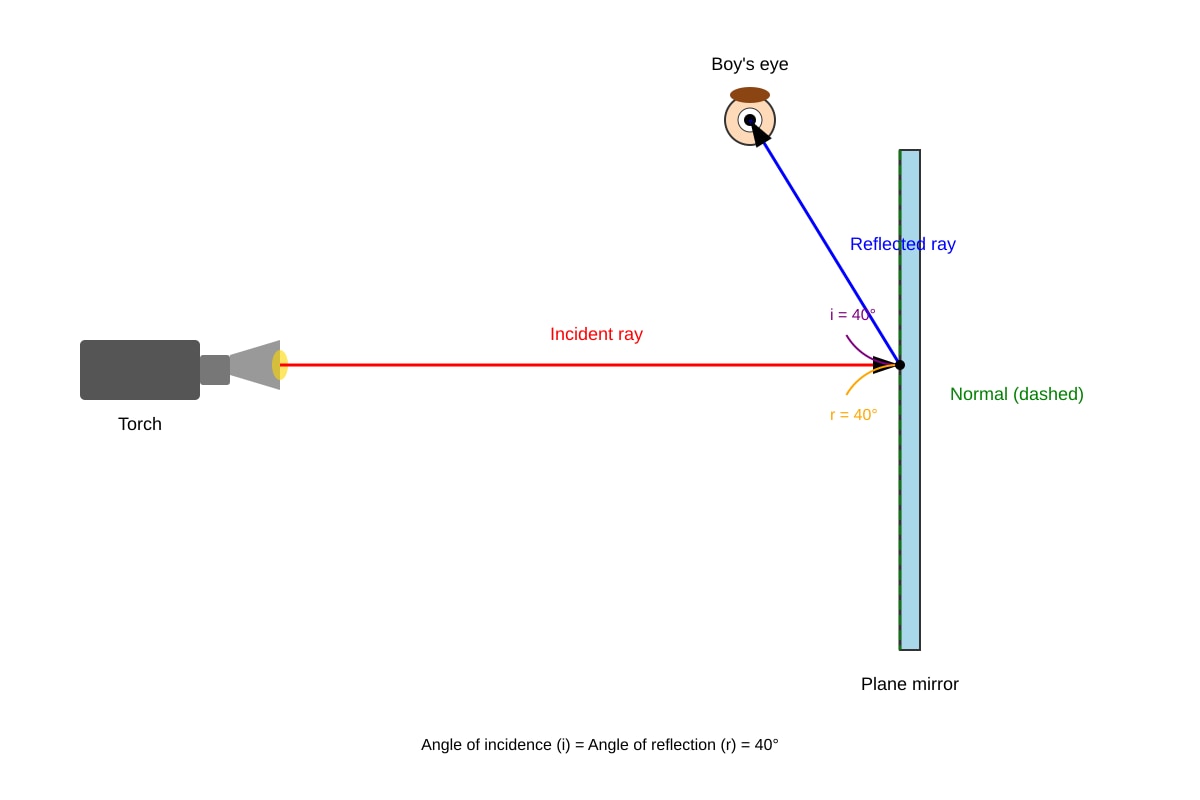
15. Ali shines a torch at a plane mirror in a dark room. He sees a bright spot of light on the wall opposite the mirror.

(a) Draw the path of the light ray from the torch to the mirror and then to the wall. Use a ruler and arrows. [1]

<image_placeholder> id: Q15-fig1 type: diagram linked_question: Q15 description: A torch on the left, a plane mirror vertical in the middle, a wall on the right. The torch is aimed at the mirror. Student must draw incident and reflected rays. labels: Torch, Plane mirror, Wall, Incident ray (to be drawn), Reflected ray (to be drawn), Normal line (dashed, to be drawn) values: Angle of incidence = 40° must_show: Incident ray from torch to mirror, normal at point of incidence, reflected ray from mirror to wall, angle i = angle r </image_placeholder>

(b) If Ali tilts the mirror so that the angle of incidence increases, what happens to the angle of reflection? [1]


16. The table below shows the properties of four materials, W, X, Y, and Z.

MaterialAllows light to pass through?Can you see clearly through it?
WYesYes
XYesNo (blurry)
YNoNo
ZYesYes

(a) Which material(s) is/are transparent? [1]


(b) Which material is translucent? [1]


Section C: Structured / Open-Ended Questions (4 × 4 marks = 16 marks)

17. Siti conducts an experiment to find out how the distance between the object and the screen affects the size of the shadow. She uses a torch, a wooden block (object), and a screen. The torch is kept at a fixed position.

<image_placeholder> id: Q17-fig1 type: experimental_setup linked_question: Q17 description: Torch fixed on left. Wooden block can be moved. Screen on right. Ruler measuring distance between block and screen. labels: Torch (fixed), Wooden block (movable), Screen, Ruler measuring distance (d) between block and screen, Shadow on screen values: Torch to block distance fixed at 20 cm. Block-to-screen distance (d) varied: 10 cm, 20 cm, 30 cm, 40 cm. must_show: Setup with movable block, ruler, screen, and shadow outline </image_placeholder>

She records the height of the shadow on the screen for different distances.

Distance between block and screen (cm)Height of shadow (cm)
106
208
3010
4012

(a) What is the relationship between the distance between the block and the screen and the height of the shadow? [1]


(b) Based on the results, predict the height of the shadow when the distance is 50 cm. [1]


(c) Siti wants to make the shadow smaller without moving the torch or the screen. What should she do? [1]


(d) Explain why the shadow becomes larger when the block is moved closer to the screen. [1]


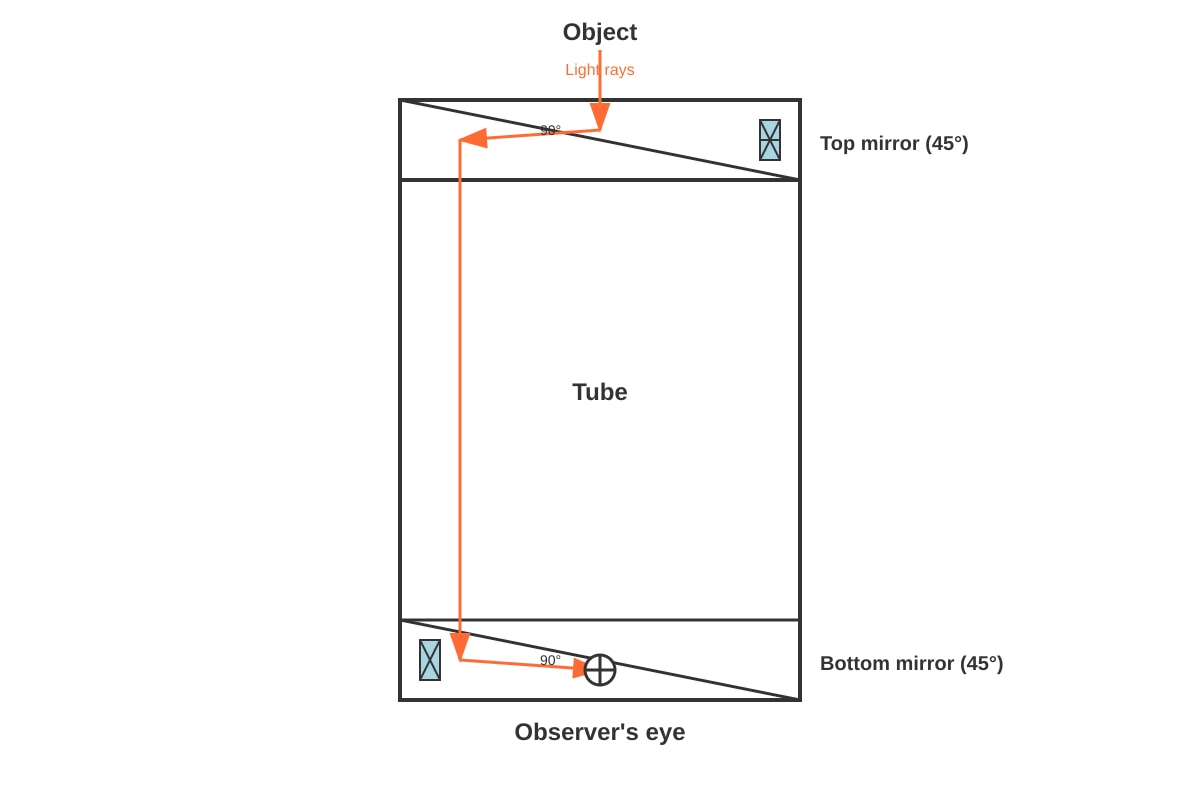
18. The diagram below shows a periscope made from a cardboard tube and two plane mirrors.

<image_placeholder> id: Q18-fig1 type: diagram linked_question: Q18 description: A periscope: long vertical tube with a mirror at the top angled at 45° facing down, and a mirror at the bottom angled at 45° facing up. An eye at the bottom looks in. An object (tree) is at the top. labels: Top mirror (45°), Bottom mirror (45°), Eye, Object (tree), Light rays from object to top mirror, to bottom mirror, to eye values: Mirrors at 45° to horizontal. Tube height = 30 cm. must_show: Light path: object → top mirror → bottom mirror → eye. Arrows on rays. 45° angles marked. </image_placeholder>

(a) On the diagram, draw the path of light from the tree to the eye. Use arrows to show the direction. [2]

(b) Why must the mirrors be placed at a 45° angle? [1]


(c) If the bottom mirror is removed, what will the person see? [1]


19. Ahmad wants to choose a material to make a bathroom window. The window must allow light to enter but not allow people outside to see clearly inside.

<image_placeholder> id: Q19-fig1 type: diagram linked_question: Q19 description: A bathroom window frame. Three material samples: clear glass, frosted glass, wooden board. Arrows showing light from outside passing through (or not). labels: Clear glass, Frosted glass, Wooden board, Light rays, Person outside, Person inside (silhouette) values: N/A must_show: Clear glass: clear view. Frosted glass: light passes, blurry view. Wooden board: no light, no view. </image_placeholder>

(a) Which material should Ahmad choose? [1]


(b) Explain your choice using the terms transparent, translucent, or opaque. [2]


(c) State one other use of the material you chose in (a). [1]


20. The diagram below shows an experiment. A torch shines light through a narrow slit in a piece of cardboard. The light falls on a screen. Some smoke is introduced between the torch and the screen.

<image_placeholder> id: Q20-fig1 type: experimental_setup linked_question: Q20 description: Torch on left, cardboard with narrow vertical slit, smoke in the space between cardboard and screen, screen on right. A straight beam of light is visible in the smoke. labels: Torch, Cardboard with narrow slit, Smoke particles, Screen, Light beam (straight line in smoke) values: Slit width = 0.5 cm. Distance from slit to screen = 50 cm. must_show: Straight narrow beam of light visible in smoke, hitting screen as a bright line </image_placeholder>

(a) What does the straight beam of light in the smoke show about how light travels? [1]


(b) If the cardboard slit is made wider, what will happen to the beam of light on the screen? [1]


(c) The torch is moved closer to the cardboard slit. The slit width stays the same. What happens to the brightness of the beam on the screen? [1]


(d) Suggest one way to make the beam of light more visible in the smoke without changing the torch or the slit. [1]


End of Quiz

Answers

<!-- TuitionGoWhere generation metadata: stage=3-0; model=nvidia/nemotron-3-ultra-550b-a55b:free; model_label=NVIDIA Nemotron 3 Ultra 550B A55B Free; generated=2026-06-05; Sources: Stage 2-1 real exam-derived templates and Stage 2-2 exam-enriched syllabus. -->

Primary 4 Science Quiz - Light (Answer Key)

Total Marks: 40


Section A: Multiple-Choice Questions (10 marks)

1. Answer: (3)
Explanation: The Sun is a natural light source. It produces its own light. The Moon and mirrors only reflect light; white paper reflects light but does not produce it.

2. Answer: (2)
Explanation: Light travels in straight lines. This is a fundamental property of light. Shadows are sharp because light cannot bend around objects.

3. Answer: (2)
Explanation: A shadow is formed when an opaque or translucent object blocks the path of light. Light travels in straight lines, so it cannot reach the area behind the object, creating a dark patch.

4. Answer: (3)
Explanation: Clear glass is transparent — it allows most light to pass through. Wood and cardboard are opaque (block all light). Frosted glass is translucent (allows some light but scatters it).

5. Answer: (2)
Explanation: When the object (ball) is moved closer to the light source (torch), it blocks more of the spreading light rays, casting a larger shadow on the screen. This is because the light rays diverge from the source.

6. Answer: (2)
Explanation: A clear glass cup is transparent — it allows almost all light to pass through, so it does not form a noticeable shadow. The metal spoon, wooden block, and ceramic mug are opaque and will form sharp shadows.

7. Answer: (2)
Explanation: The Sun's position in the sky changes throughout the day due to Earth's rotation. At noon, the Sun is overhead → short shadow. In the evening, the Sun is low → long shadow. The Sun's brightness and Ravi's height do not change significantly.

8. Answer: (1)
Explanation: Transparent materials allow most light to pass through (e.g., clear glass, clean water). Material A allows "Most" light through, so it is transparent. B is translucent, C is nearly opaque, D is opaque.

9. Answer: (3)
Explanation: Law of Reflection: The angle of incidence (angle between incident ray and normal) is always equal to the angle of reflection (angle between reflected ray and normal). This holds for plane mirrors.

10. Answer: (3)
Explanation: A periscope uses two plane mirrors to reflect light from an object down to the observer's eye. The key property is that light can be reflected (and the angle of incidence equals angle of reflection, allowing 90° turns with 45° mirrors).


Section B: Short-Answer Questions (12 marks)

11. [2 marks — ½ mark each correct classification]

Light SourcesNon-Light Sources
Sun, Candle flame, Firefly, TorchlightMirror, Moon

Explanation:

  • Light sources produce their own light (Sun = nuclear fusion, Candle = combustion, Firefly = bioluminescence, Torch = electrical energy → light).
  • Non-light sources do not produce light. The Moon reflects sunlight. A mirror reflects light but produces none.

Common mistake: Classifying the Moon as a light source. It only reflects light.


12.
(a) Object A (the wooden block / opaque object) [1 mark]
(b) Object C (the frosted glass / translucent object) [1 mark]

Explanation:

  • Opaque objects (A) block all light → sharp, dark shadow.
  • Transparent objects (B) allow almost all light through → no shadow (or very faint).
  • Translucent objects (C) allow some light but scatter it → faint, blurry shadow.

13.
(a) transparent [1 mark]
(b) shadow [1 mark]

Explanation:

  • Transparent materials (e.g., clear glass, water, air) let light pass through with minimal scattering → clear vision.
  • A shadow is the dark area formed when light is blocked by an opaque or translucent object.

14.
(a) 12 p.m. (noon) [1 mark]
(b) The position of the Sun in the sky changes throughout the day. When the Sun is higher (noon), the shadow is shorter. When the Sun is lower (morning/evening), the shadow is longer. [1 mark]

Explanation:

  • At noon, Sun is nearly overhead → light rays hit the stick from above → short shadow.
  • As Earth rotates, Sun appears lower → light rays hit at a shallower angle → longer shadow.
  • The stick's height and the ground stay the same; only the light direction changes.

15.
(a) [1 mark — for correct ray diagram]
Expected drawing:

  • Incident ray from torch to mirror (straight line, arrow pointing to mirror).
  • Normal line (dashed) perpendicular to mirror at point of incidence.
  • Reflected ray from mirror to wall (straight line, arrow pointing away from mirror).
  • Angle of incidence (i) = Angle of reflection (r) = 40° (marked).

(b) The angle of reflection will also increase (and remain equal to the angle of incidence). [1 mark]

Explanation: Law of Reflection: ∠i = ∠r always. If the mirror is tilted, the normal tilts, so the angle of incidence changes. The reflected ray adjusts so ∠r = ∠i.


16.
(a) W and Z [1 mark]
(b) X [1 mark]

Explanation:

  • Transparent: Allows light through AND clear vision → W and Z (both "Yes, Yes").
  • Translucent: Allows light through BUT blurry vision → X ("Yes, No").
  • Opaque: Blocks all light → Y ("No, No").

Section C: Structured / Open-Ended Questions (16 marks)

17.
(a) As the distance between the block and the screen increases, the height of the shadow increases. [1 mark]
(Accept: "The further the block from the screen, the larger the shadow.")

(b) 14 cm [1 mark]
Working: The shadow height increases by 2 cm for every 10 cm increase in distance (6→8→10→12). At 50 cm (10 cm more than 40 cm), height = 12 + 2 = 14 cm.

(c) Move the wooden block closer to the torch (further from the screen). [1 mark]
(Accept: "Decrease the distance between the block and the torch.")

(d) When the block is closer to the screen, it blocks a wider spread of the diverging light rays from the torch, so the shadow on the screen is larger. [1 mark]
Key concept: Light rays spread out (diverge) from the source. Near the screen, the blocked "cone" of light is wider.


18.
(a) [2 marks — 1 mark for correct path with arrows, 1 mark for correct reflection angles at both mirrors (45°)]
Expected path:
Tree → (straight down) → Top mirror (reflects 90° horizontally) → Bottom mirror (reflects 90° vertically down) → Eye.
Arrows must show direction: Tree → Eye.

(b) To reflect the light through a 90° angle (change its direction from vertical to horizontal, or horizontal to vertical) so it travels down the tube to the eye. [1 mark]
Explanation: Angle of incidence = 45° → Angle of reflection = 45° → Total turn = 90°. Two 90° turns = 180° reversal (down → across → down).

(c) The person will see the inside of the tube / the bottom mirror / nothing useful (no image of the tree). [1 mark]
Explanation: Without the bottom mirror, light reflects off the top mirror horizontally across the tube and hits the side/end, not the eye. The light path is incomplete.


19.
(a) Frosted glass [1 mark]

(b) Frosted glass is translucent. It allows light to pass through (so the bathroom is bright) but scatters the light, so people outside cannot see clearly inside (blurry view). Clear glass is transparent (clear view), and wooden board is opaque (no light). [2 marks]
Mark breakdown:

  • Identifies frosted glass as translucent: 1 mark
  • Explains "allows light but not clear view": 1 mark

(c) Any one: Lampshades, shower screens, privacy partitions, decorated windows, light diffusers in photography. [1 mark]


20.
(a) Light travels in straight lines. [1 mark]
Explanation: The smoke particles scatter the light, making the invisible beam visible. The straight beam shows the path of light is straight.

(b) The beam of light on the screen will become wider (broader). [1 mark]
Explanation: A wider slit lets more light rays through at different angles, creating a wider beam.

(c) The brightness of the beam on the screen will increase (become brighter). [1 mark]
Explanation: Light intensity follows the inverse square law (simplified for P4: closer = more concentrated light energy per unit area). Moving the torch closer increases the light energy hitting the slit and screen.

(d) Add more smoke / use a darker room / use a more powerful torch (but torch is fixed per question) → "Add more smoke particles" or "Make the room darker". [1 mark]
Explanation: More smoke = more scattering = more visible beam. Darker room = better contrast.


End of Answer Key