From Real Exams Quiz
Primary 4 Science Light Quiz
Free P4 Science Light quiz, Kimi2.6 Exam version, with questions, answers, and syllabus-aligned practice for Singapore students.
These static practice materials are generated from the site's syllabus and paper-generation workflow, with source and model context shown so students and parents can evaluate the material before use.
Questions
Free quiz and exam paper access
Enter your details to view this paper
Your access is remembered on this device.
Answers
Primary 4 Science Quiz - Light: ANSWER KEY
Total Marks: 40
Section A: Multiple Choice (Questions 1–8)
1. B. A glowing firefly [1]
Explanation: A source of light produces its own light. A firefly produces light through a chemical reaction in its body (bioluminescence). A mirror reflects light but does not produce it. The Moon reflects sunlight. A shadow is the absence of light, not a source.
Common mistake: Students often think the Moon is a light source because it appears bright in the sky.
2. C. Air [1]
Explanation: Light travels fastest through air because air is a gas with particles far apart. Light slows down in denser materials like water and glass (liquids and solids). Wood blocks light completely (it is opaque). The speed of light is approximately 300,000 km/s in air.
3. B. Her left hand [1]
Explanation: A plane mirror creates a laterally inverted image—left becomes right and right becomes left. When you raise your right hand, your reflection appears to raise its left hand. This is why the word "AMBULANCE" is written backwards on emergency vehicles, so drivers see it correctly in their rear-view mirrors.
4. B. Light from the Sun reflects off the book into our eyes. [1]
Explanation: We see non-luminous objects (objects that do not produce their own light) when light from a source reflects off them and enters our eyes. The book reflects some sunlight in all directions. Some of this reflected light reaches our eyes, allowing us to see the book.
Common misconception: Some students think our eyes "send out" light to see objects. Our eyes only detect light that enters them.
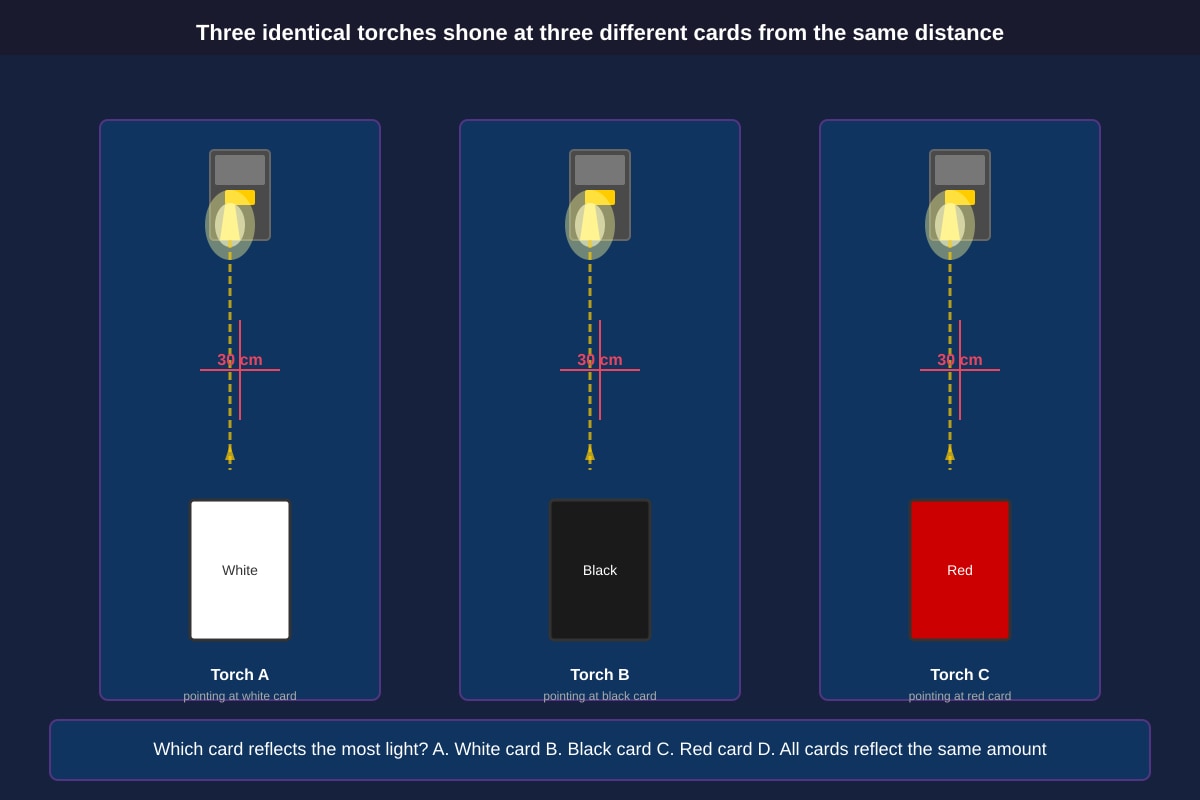
5. A. The white card [1]
Explanation: White surfaces reflect all colours of light that fall on them. Black surfaces absorb (take in) most light. Coloured surfaces like red reflect their own colour but absorb other colours. Therefore, the white card reflects the most light and would appear brightest.
Teaching note: This links to why we wear light-coloured clothes in sunny Singapore—white reflects heat and light, keeping us cooler.
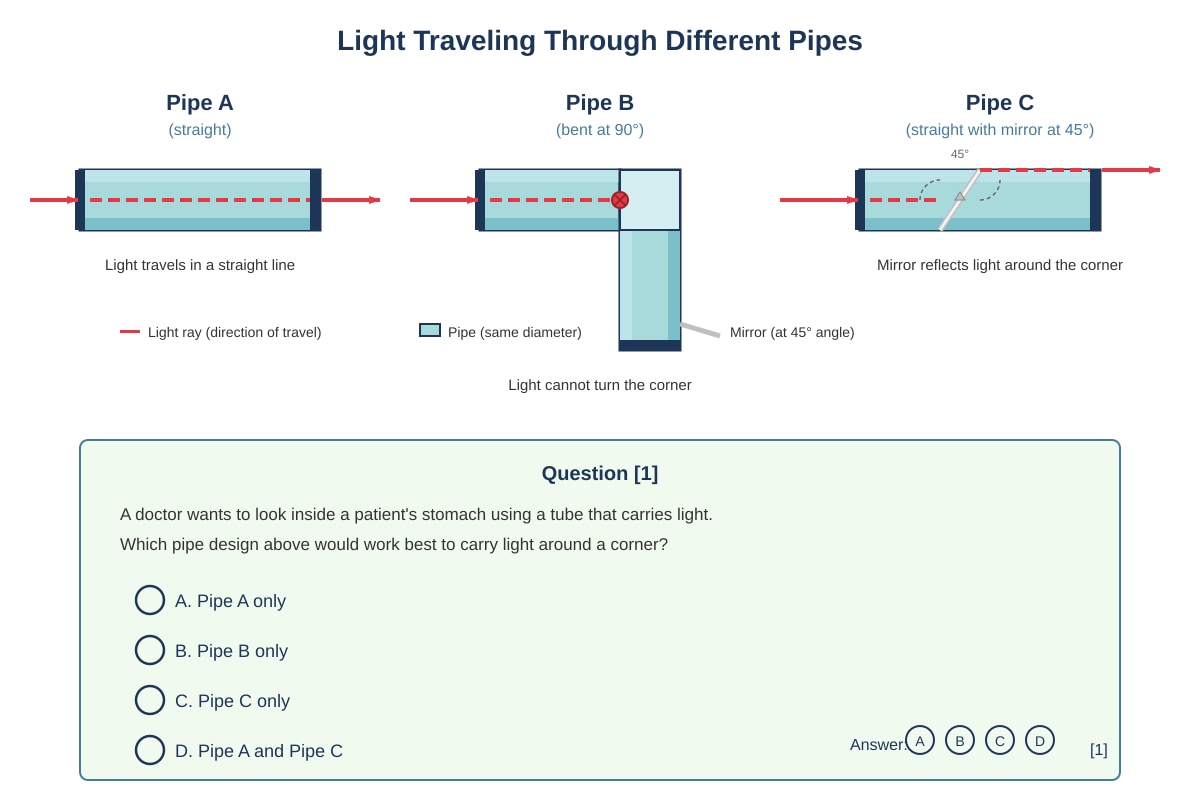
6. A. Pipe A and Pipe C [1]
Explanation:
- Pipe A (straight) works for straight-line light travel in a straight tube.
- Pipe C (with mirror at 45°) uses reflection to direct light around the corner. The mirror reflects light at the same angle it hits (angle of incidence = angle of reflection), changing the light's direction by 90°.
- Pipe B (bent without mirror) blocks light because light travels in straight lines and cannot bend around the corner by itself.
Real-world connection: This is how endoscopes and fibre optic cables work in medicine—using reflection to see inside the body.
**7. D. Nearer and smaller [1]
Explanation:
- Nearer: When the light source is closer to the object, the shadow is larger because the light rays spread out more from a closer point.
- Smaller source: A smaller light source (like a small torch bulb rather than a large fluorescent tube) creates sharper, more defined shadows because the light comes from a more precise direction. A large source creates fuzzy shadows with partial darkness (penumbra).
8. D. Light travels in straight lines. [1]
Explanation: This is a fundamental property of light. Light travels in straight lines in a uniform medium. It cannot bend around corners by itself (A is wrong). It does not travel in curved lines (B is wrong)—it only appears to bend when refracted at boundaries between materials. Light cannot pass through opaque materials like wood or metal (C is wrong).
Section B: Fill in the Blanks and Short Answer (Questions 9–14)
9. (a) produces [1]
(b) reflects ... absorbs [2] (1 mark each, order matters)
(c) travels [1]
Explanations:
- (a) The Sun is a natural source of light; it produces light through nuclear reactions.
- (b) A green leaf appears green because it reflects green light into our eyes. It absorbs (takes in) other colours like red and blue light, using their energy for photosynthesis.
- (c) Light travels in straight lines from the object to our eyes—this is why we can trace a straight path from what we see back to the source.
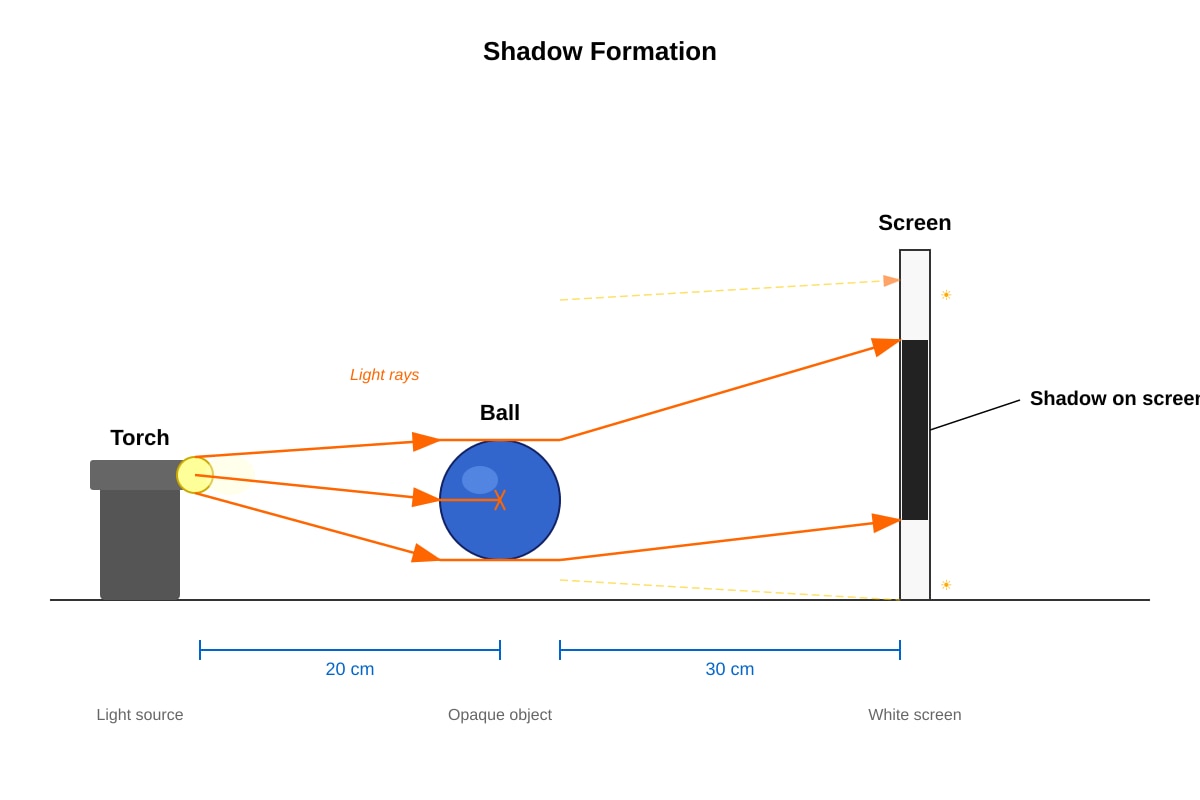
10. (a) Any two straight light rays drawn from torch, passing over/under the sides of the ball, continuing to the screen edges of the shadow region. [2] (1 mark per correctly drawn ray)
Expected drawing: Two straight lines from the torch bulb, grazing the top and bottom edges of the ball, continuing straight to the screen to define the shadow edges.
(b) The shadow is dark because the ball blocks (stops) light from reaching that area of the screen. No light reflects off the screen in the shadow region to enter our eyes. [1]
(c) Move the torch closer to the ball (or move the screen further from the ball). [1]
Explanation for (c): Moving the torch closer makes light rays spread more from the source, increasing the shadow size. Moving the screen further also increases shadow size because the rays continue diverging over a longer distance.
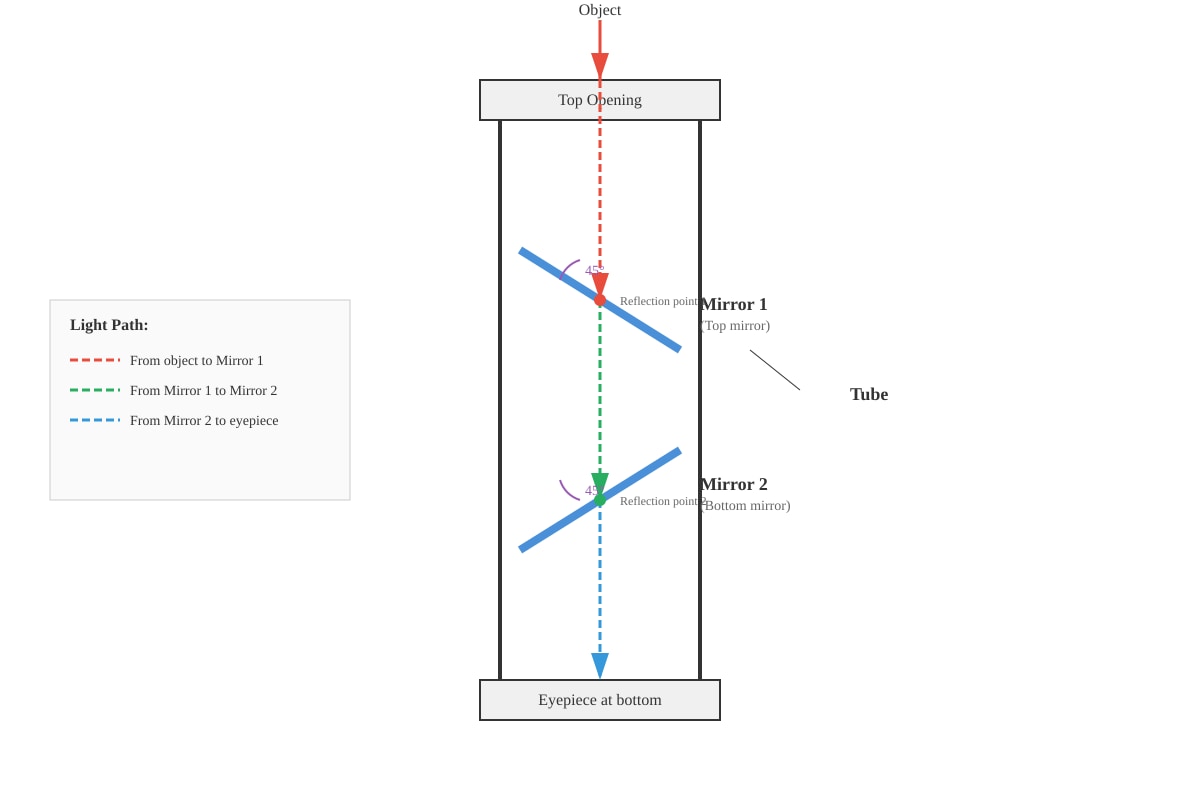
11. (a) A dashed line drawn perpendicular (at 90°) to Mirror 1 at the point where the light ray hits it. [1]
(b) 45° [1]
Explanation: The angle of reflection always equals the angle of incidence. If light hits the mirror at 45° to the normal, it reflects at 45° to the normal on the other side.
(c) The first reflection flips the image left-to-right. The second reflection flips it back again (left-to-right once more). Two flips return the image to its original orientation, so the sailor sees the object the right way up. [2]
Marking breakdown:
- 1 mark: Mention that two reflections cancel out the flipping (or equivalent explanation)
- 1 mark: Explain each mirror causes one left-right reversal
12. (a) The metal spoon feels hottest. Metal is a good conductor of heat, so it absorbs and conducts heat quickly to your hand. Wood is a poor conductor (insulator), and glass conducts heat more slowly than metal. [2]
Marking breakdown:
- 1 mark: Correct object identified (metal spoon)
- 1 mark: Explanation involving conduction and material properties
*b) The glass of water (or just "glass") [1]
Explanation: Glass is transparent—it allows light to pass through so you can see objects clearly on the other side. Wood is opaque (blocks light). Metal is opaque.
13. (a) Blue light (or "blue") [1]
Explanation: A blue shirt reflects blue wavelengths of light and absorbs other colours. Under white light (which contains all colours), the reflected blue light enters our eyes and we see blue.
(b) The shirt would appear black (or very dark). [2]
Explanation: Under red light only, there is no blue light available to reflect. The blue shirt absorbs red light (since red is a different colour from blue). With no blue light to reflect and the red light absorbed, little light reaches our eyes from the shirt, so it appears dark or black.
Marking breakdown:
- 1 mark: Correct colour prediction (black/dark)
- 1 mark: Explanation that no blue light is available to reflect / the shirt absorbs red light
Common misconception: Students often predict the shirt would appear red because red light shines on it. Emphasise: objects reflect their own colour, not the colour of light falling on them.
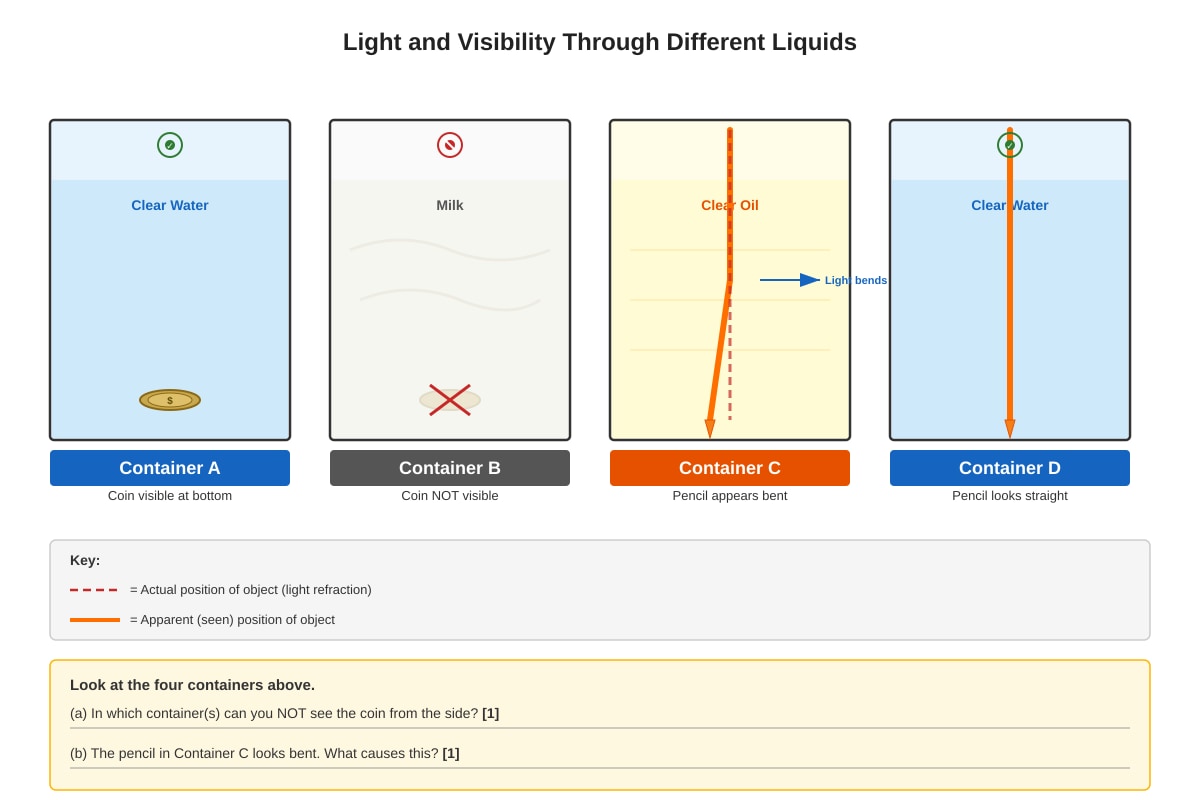
14. (a) Container B [1]
(b) Refraction (light bending) [1]
Explanation: Light travels at different speeds in water and air. When light from the pencil passes from water to air, it bends (refracts) away from the normal. Our brain assumes light travels straight, so the pencil appears to be in a different position—making it look bent at the water surface.
(c) Milk [1]
Explanation: Milk is not transparent; it contains fats and proteins that scatter and block light. You cannot see through milk because it is translucent or opaque (depending on concentration).
Section C: Longer Answer and Application (Questions 15–20)
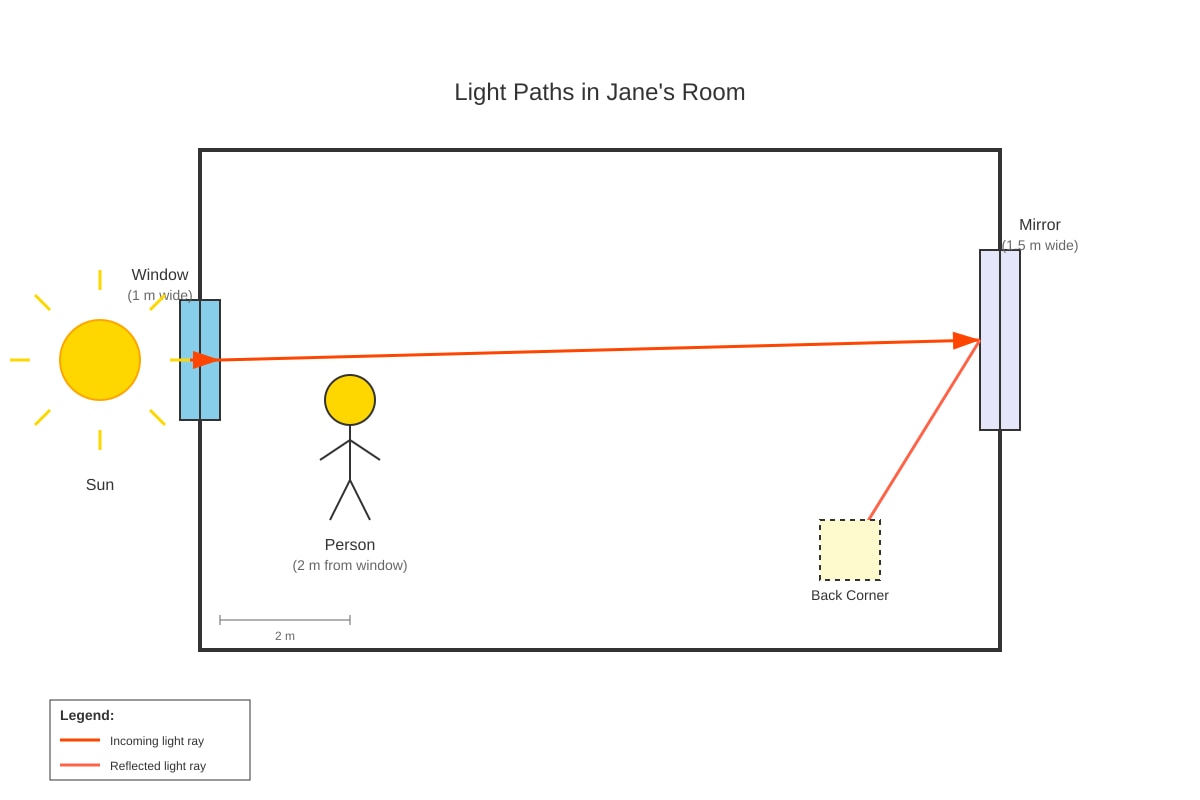
15. (a) Two arrows needed on diagram: [2]
- Arrow 1: From window, hitting the mirror at some point
- Arrow 2: From mirror reflection point to back corner of room
Both arrows must show straight lines with direction, obeying law of reflection (angle in = angle out).
(b) The mirror reflects light that would otherwise spread out and miss the back corner. By reflecting, the mirror redirects more light into the dark corner, making it brighter than it would be with only direct light from the window. [2]
Marking breakdown:
- 1 mark: Mirror reflects/re-directs light
- 1 mark: More light reaches the back corner (compared to no mirror)
(c) The back corner becomes darker/duller. The dark cloth absorbs most light instead of reflecting it. Less light is redirected to the back corner, so less light reaches there. [2]
Marking breakdown:
- 1 mark: Correct brightness change (darker)
- 1 mark: Explanation that dark cloth absorbs light / prevents reflection
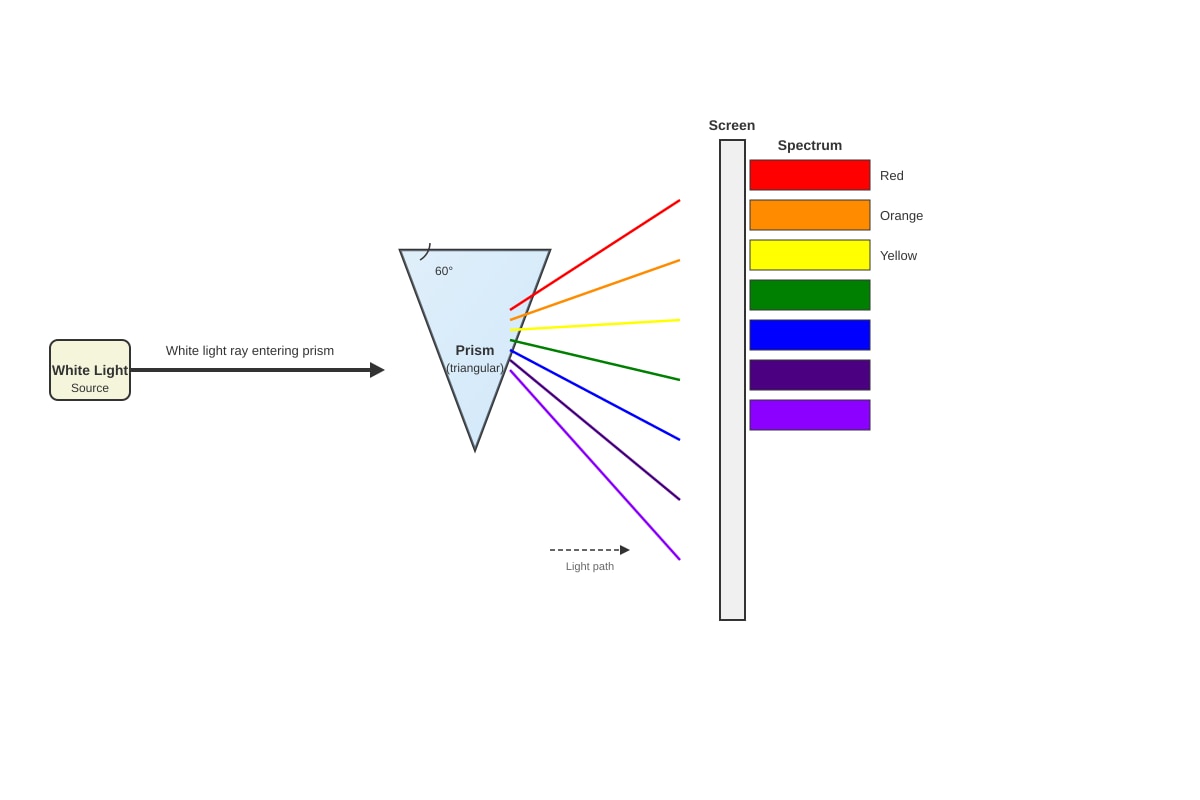
16. (a) Red, orange, yellow, green, blue, indigo, violet (or "ROY G BIV") [2]
Marking breakdown:
- 2 marks: All seven in correct order
- 1 mark: Five or six correct in order, or all correct but one transposition
(b) Different colours of light bend (refract) by different amounts when they pass through the glass. Violet light bends the most, red bends the least. This separates the white light into its component colours. [2]
Marking breakdown:
- 1 mark: Different colours bend by different amounts / white light splits into colours
- 1 mark: Mention of refraction/bending in the prism
(c) Violet [1]
(d) Only red light would appear on the screen. A red filter only allows red light to pass through. Since only red light enters the prism, there are no other colours to separate. [2]
Marking breakdown:
- 1 mark: Only red appears
- 1 mark: Filter blocks other colours / only transmits red
17. (a) Any two from: [2] (1 mark each)
- Distance from lamp to paper
- Size of paper squares
- Type/wattage of lamp used
- Time of exposure (10 minutes)
- Starting temperature of papers
- Angle of lamp to paper
(b) Temperature of the paper (or "how hot the paper gets") [1]
(c) The black paper will have the highest temperature. [2]
Explanation: Dark/black surfaces absorb more light and heat than light-coloured surfaces. Black absorbs most wavelengths of light, converting the light energy into heat energy. White reflects most light and stays cooler.
Marking breakdown:
- 1 mark: Correct prediction (black)
- 1 mark: Explanation about absorption of light/heat
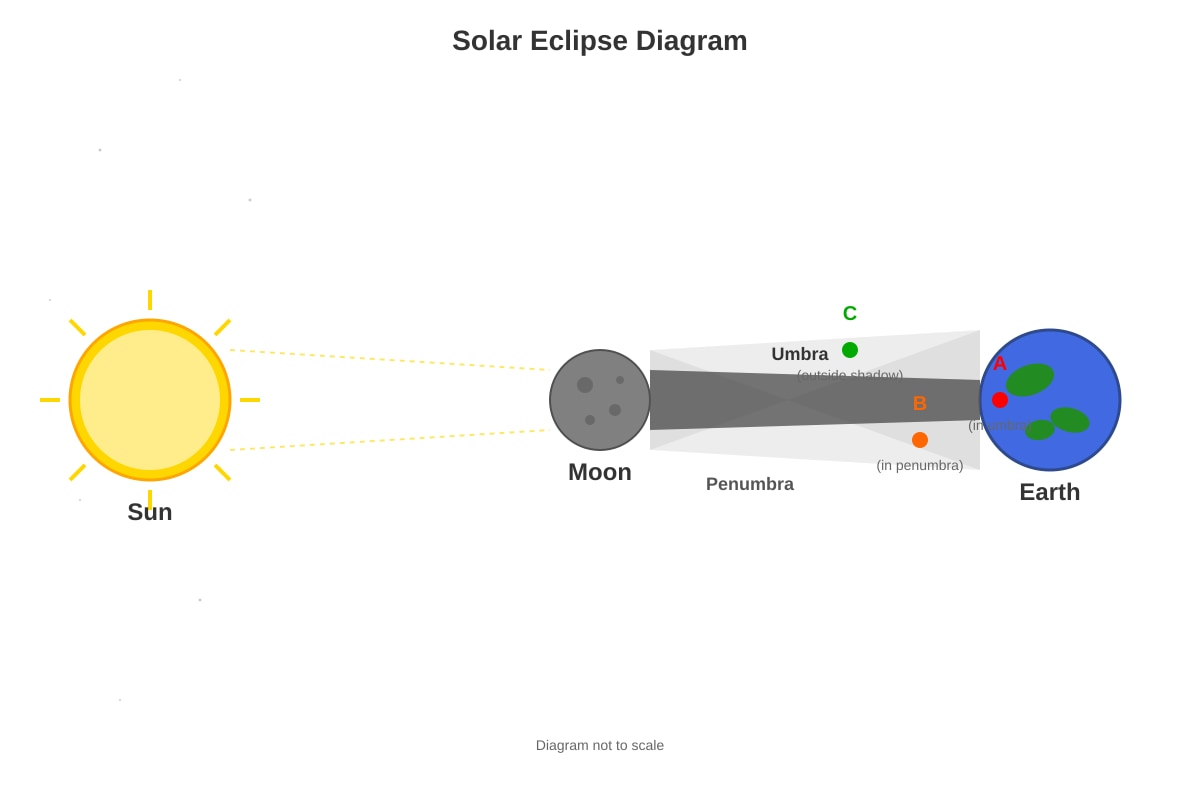
18. (a) The Moon must be between the Sun and Earth because the Moon blocks sunlight from reaching Earth. The Moon is opaque (does not let light through), so it casts a shadow on Earth. Only in this alignment can the Moon's shadow fall on Earth. [2]
Marking breakdown:
- 1 mark: Moon blocks sunlight
- 1 mark: Shadow cast on Earth / alignment required
(b) Position A is in the umbra—the darkest, central part of the Moon's shadow where all direct sunlight is blocked. This causes a total eclipse. Position B is in the penumbra—the lighter, outer part where only some sunlight is blocked. This causes a partial eclipse. [2]
Marking breakdown:
- 1 mark: A in umbra/total darkness, B in penumbra/partial darkness
- 1 mark: Explanation of shadow types and corresponding eclipse
(c) The Moon's orbit is tilted, so it usually passes above or below the Sun-Earth line. The Moon only aligns directly between them a few times per year. [1]
Alternative accepted answer: The Moon's orbit is not in the same plane as Earth's orbit around the Sun.
19. (a) 6 m [1]
Explanation: In a plane mirror, the image appears as far behind the mirror as the object is in front. Ravi is 3 m in front; his image is 3 m behind. Total distance = 3 + 3 = 6 m.
(b) 1.4 m (same as Ravi's height) [1]
Explanation: Plane mirrors produce images that are the same size as the object, virtual, upright, and laterally inverted.
(c) 4 m [2]
Working:
- Ravi's new distance from mirror: 3 m – 1 m = 2 m
- Image's distance behind mirror: 2 m
- Total distance Ravi to image: 2 + 2 = 4 m
Marking breakdown:
- 1 mark: Correct working showing both distances
- 1 mark: Correct final answer
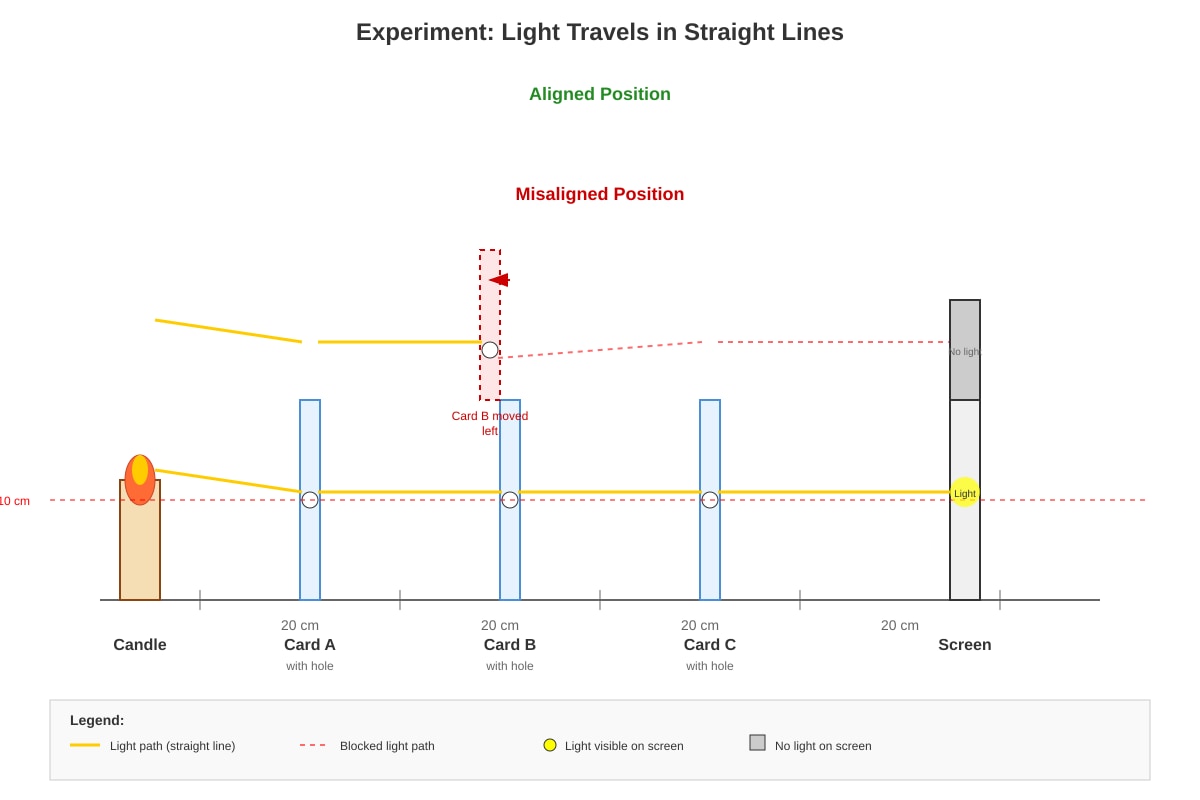
20. (a) A bright spot of light (the image of the candle flame) appears on the screen. [1]
(b) No light appears on the screen (or a much dimmer spot). The hole in Card B is no longer in line with the others, so light travelling in straight lines from the candle cannot pass through all three holes to reach the screen. The light is blocked by Card B. [2]
Marking breakdown:
- 1 mark: Correct observation (no light / dark)
- 1 mark: Explanation about straight-line travel being blocked
(c) A candle flame produces light in all directions, making it easier to see the beam path. A torch produces a more directional beam that might not spread enough to show the effect clearly, or the candle shows that even light spreading in all directions follows straight paths. [1]
Alternative accepted: The candle is a point source, making the straight-line effect clearer with sharp shadows.
(d) No, the student is not correct. [2]
Explanation: This experiment only shows light travels in straight lines. Sound travels as vibrations through materials and can bend around corners (diffraction). You can hear someone talking around a corner even though you cannot see them, proving sound does not only travel in straight lines.
Marking breakdown:
- 1 mark: Correct judgment (not correct)
- 1 mark: Explanation of sound diffraction / sound can bend around corners (with example)