Primary 4 Science Quiz - Light
Name: ___________________________
Class: _________
Date: ____________
Score: _______ / 20
Duration: 40 minutes
Total Marks: 20
Instructions:
- This quiz has 20 questions on the topic of Light.
- Section A: 10 multiple-choice questions (1 mark each).
- Section B: 6 short-answer questions (1 mark each).
- Section C: 4 structured questions with subparts (total 4 marks).
- Write your answers clearly in the spaces provided.
Section A: Multiple Choice (1 mark each, Q1–Q10)
-
Which of the following is a source of light?
A) A wooden table
B) The Sun
C) A school bag
D) A brick wall
-
We can see a red apple on a table because the apple __________.
A) makes its own light
B) reflects light from another source into our eyes
C) is transparent
D) absorbs all light
-
Light travels in __________.
A) curved lines
B) straight lines
C) circles
D) zig-zag lines
-
A shadow is formed when light is __________.
A) turned on
B) completely or partially blocked by an object
C) reflected by a mirror
D) absorbed by air
-
Ali places a ball between a torch and a wall. What will he see on the wall?
A) A bright patch
B) A shadow of the ball
C) Nothing changes
D) A rainbow
-
If the object is moved closer to the light source but stays the same distance from the screen, the shadow becomes __________.
A) smaller
B) larger
C) the same size
D) invisible
-
Which of the following will NOT form a shadow?
A) A book
B) A chair
C) Clear air
D) A bicycle
-
The shape of a shadow is most affected by the __________.
A) colour of the wall
B) shape of the object blocking the light
C) temperature of the room
D) size of the torch batteries
-
Siti uses a small torch and a big cardboard cut-out of a star. She sees a star shadow on the screen. This shows that light __________.
A) bends around objects
B) travels in straight lines and is blocked by the object
C) passes through all objects
D) is made by the screen
-
Which statement is correct about seeing objects?
A) All objects can be seen only if they make light.
B) An object can be seen if it is a light source or reflects light.
C) Shadows help us see better.
D) Light does not travel.
Section B: Short Answer (1 mark each, Q11–Q16)
- Name one natural source of light.
- Name one man-made source of light.
- State one reason why a shadow is formed.
- What happens to the size of a shadow when the object is moved farther from the screen but the light source stays fixed?
- Fill in the blank: Light travels in ________________ lines.
- An object that does not make light but can be seen is visible because it ________________ light.
Section C: Structured Questions (Q17–Q20, 1 mark per subpart)
- (a) What is a source of light?
(b) Give one example of a source of light.
- (a) Why do we see a non-luminous object such as a pencil?
(b) What must happen to light for a shadow to appear?
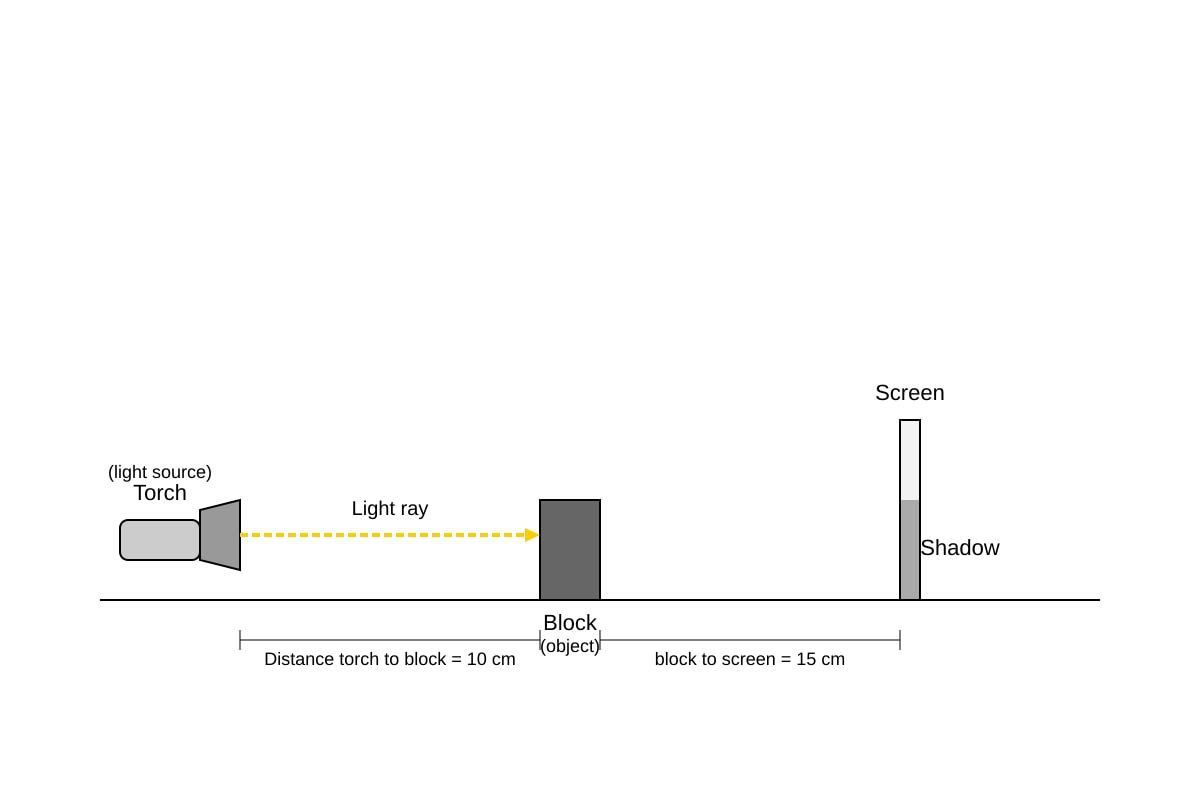
- Study the setup below.
Generated experimental_setup for Q19.
(a) What is used as the screen in this setup?
(b) What blocks the light from reaching the screen?
- (a) State what happens to the shadow when the object is moved closer to the light source.
(b) State what happens to the shadow when the object is moved closer to the screen.
</stage3_quiz_answers_md>
<stage3_quiz_answers_md>
Primary 4 Science Quiz - Light (Answer Key)
Total Marks: 20
Topic: Light (P4 Energy Forms and Uses)
Section A: Multiple Choice (1 mark each)
-
B) The Sun [1]
Teaching note: A source of light is an object that gives out light. The Sun is a natural light source. A table, bag, and wall do not make light; they are seen by reflected light.
-
B) reflects light from another source into our eyes [1]
Teaching note: A red apple is not a light source. It is seen because it reflects light (from the Sun or a lamp) into our eyes.
-
B) straight lines [1]
Teaching note: Light travels in straight lines. This is why shadows have sharp edges when light is blocked.
-
B) completely or partially blocked by an object [1]
Teaching note: A shadow forms when an object blocks light. If light is not blocked, no shadow is formed.
-
B) A shadow of the ball [1]
Teaching note: The ball blocks the torch light, so a shadow appears on the wall behind it.
-
B) larger [1]
Teaching note: When the object is closer to the light source, it blocks a wider cone of light, so the shadow on the screen becomes larger.
-
C) Clear air [1]
Teaching note: Air does not block light noticeably, so it does not form a shadow. Solid objects like books and chairs do.
-
B) shape of the object blocking the light [1]
Teaching note: The shadow takes the shape of the object that blocks the light.
-
B) travels in straight lines and is blocked by the object [1]
Teaching note: The star shape appears because light travels straight and the cardboard blocks light in that shape.
-
B) An object can be seen if it is a light source or reflects light. [1]
Teaching note: We see light sources directly, and we see other objects because they reflect light into our eyes.
Section B: Short Answer (1 mark each)
-
Sun / stars / firefly (any one natural source) [1]
Teaching note: Natural sources are found in nature, not made by humans.
-
Torch / lamp / bulb / candle (any one man-made) [1]
Teaching note: Man-made sources are created by people.
-
Light is blocked by an object (or similar) [1]
Teaching note: Shadow needs light and an object to block it.
-
Smaller [1]
Teaching note: Farther from screen = shadow narrower; closer to screen = shadow closer to object size.
-
straight [1]
Teaching note: Core concept: light path is straight.
-
reflects [1]
Teaching note: Non-luminous objects are visible through reflection.
Section C: Structured (1 mark per subpart)
-
(a) An object that gives out light [1]
(b) Sun / torch / lamp (any one) [1]
Teaching note: Define then example reinforces understanding.
-
(a) It reflects light from a source into our eyes [1]
(b) Light must be blocked by an object [1]
Teaching note: Links seeing objects and shadow formation.
-
(a) White screen (or screen as labelled) [1]
(b) The block / rectangular block [1]
Visual check: Image shows screen on right, block in middle blocking ray.
-
(a) Shadow becomes larger [1]
(b) Shadow becomes smaller [1]
Teaching note: Closer to source → larger shadow; closer to screen → smaller shadow. Common mistake: reversing the two.
Common mistakes to flag:
- Thinking all visible objects make light.
- Reversing shadow size change with distance.
- Using terms not in P4 syllabus (e.g. transparent) — not needed.
</stage3_quiz_answers_md>
<stage3_quiz_md>
Primary 4 Science Quiz - Light
Name: ___________________________
Class: _________
Date: ____________
Score: _______ / 20
Duration: 40 minutes
Total Marks: 20
Instructions:
- This quiz has 20 questions on the topic of Light.
- Section A: 10 multiple-choice questions (1 mark each).
- Section B: 6 short-answer questions (1 mark each).
- Section C: 4 structured questions with subparts (total 4 marks).
- Write your answers clearly in the spaces provided.
Section A: Multiple Choice (1 mark each, Q1–Q10)
-
Which of the following is a source of light?
A) A wooden table
B) The Sun
C) A school bag
D) A brick wall
-
We can see a red apple on a table because the apple __________.
A) makes its own light
B) reflects light from another source into our eyes
C) is transparent
D) absorbs all light
-
Light travels in __________.
A) curved lines
B) straight lines
C) circles
D) zig-zag lines
-
A shadow is formed when light is __________.
A) turned on
B) completely or partially blocked by an object
C) reflected by a mirror
D) absorbed by air
-
Ali places a ball between a torch and a wall. What will he see on the wall?
A) A bright patch
B) A shadow of the ball
C) Nothing changes
D) A rainbow
-
If the object is moved closer to the light source but stays the same distance from the screen, the shadow becomes __________.
A) smaller
B) larger
C) the same size
D) invisible
-
Which of the following will NOT form a shadow?
A) A book
B) A chair
C) Clear air
D) A bicycle
-
The shape of a shadow is most affected by the __________.
A) colour of the wall
B) shape of the object blocking the light
C) temperature of the room
D) size of the torch batteries
-
Siti uses a small torch and a big cardboard cut-out of a star. She sees a star shadow on the screen. This shows that light __________.
A) bends around objects
B) travels in straight lines and is blocked by the object
C) passes through all objects
D) is made by the screen
-
Which statement is correct about seeing objects?
A) All objects can be seen only if they make light.
B) An object can be seen if it is a light source or reflects light.
C) Shadows help us see better.
D) Light does not travel.
Section B: Short Answer (1 mark each, Q11–Q16)
- Name one natural source of light.
- Name one man-made source of light.
- State one reason why a shadow is formed.
- What happens to the size of a shadow when the object is moved farther from the screen but the light source stays fixed?
- Fill in the blank: Light travels in ________________ lines.
- An object that does not make light but can be seen is visible because it ________________ light.
Section C: Structured Questions (Q17–Q20, 1 mark per subpart)
- (a) What is a source of light?
(b) Give one example of a source of light.
- (a) Why do we see a non-luminous object such as a pencil?
(b) What must happen to light for a shadow to appear?
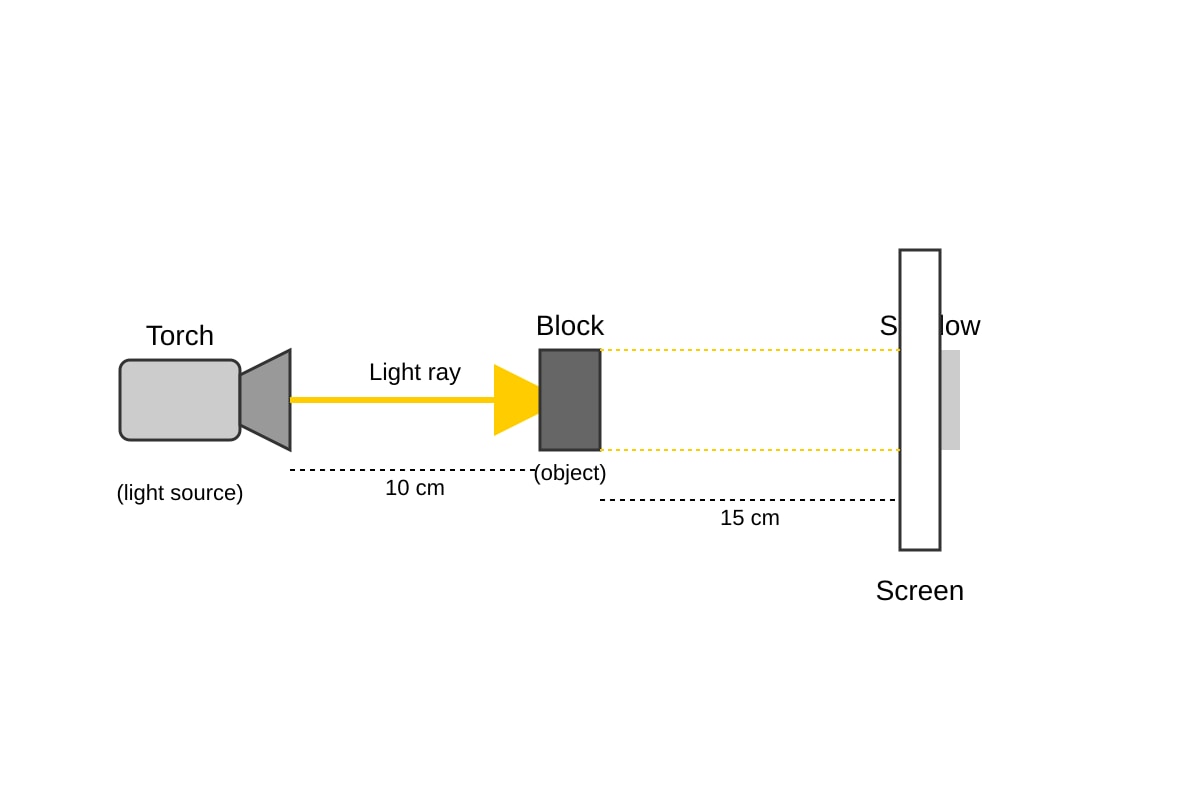
- Study the setup below.
Generated experimental_setup for Q19.
(a) What is used as the screen in this setup?
(b) What blocks the light from reaching the screen?
- (a) State what happens to the shadow when the object is moved closer to the light source.
(b) State what happens to the shadow when the object is moved closer to the screen.