From Real Exams Quiz
Primary 4 Science Life Cycles Quiz
Free Exam-Derived NVIDIA Nemotron 3 Ultra 550B A55B Free Primary 4 Science Life Cycles quiz with questions and answers for Singapore students. This page is rendered as a direct URL so the questions and answers can be discovered without pressing in-page buttons.
These static practice materials are generated from the site's syllabus and paper-generation workflow, with source and model context shown so students and parents can evaluate the material before use.
Questions
Primary 4 Science Quiz - Life Cycles
Name: ___________________________
Class: Primary 4 ______
Date: _______________
Score: ______ / 40
Duration: 45 minutes
Total Marks: 40
Instructions:
- Answer all questions.
- Write your answers in the spaces provided.
- For multiple-choice questions, write the letter (A, B, C, or D) in the brackets provided.
- For open-ended questions, write your answers in complete sentences.
- Diagrams are not drawn to scale unless stated.
Section A: Multiple-Choice Questions (10 × 1 mark = 10 marks)
For each question, choose the correct answer and write its letter in the brackets provided.
1. Which of the following animals undergoes complete metamorphosis?
A. Grasshopper
B. Cockroach
C. Butterfly
D. Chicken
[ ]
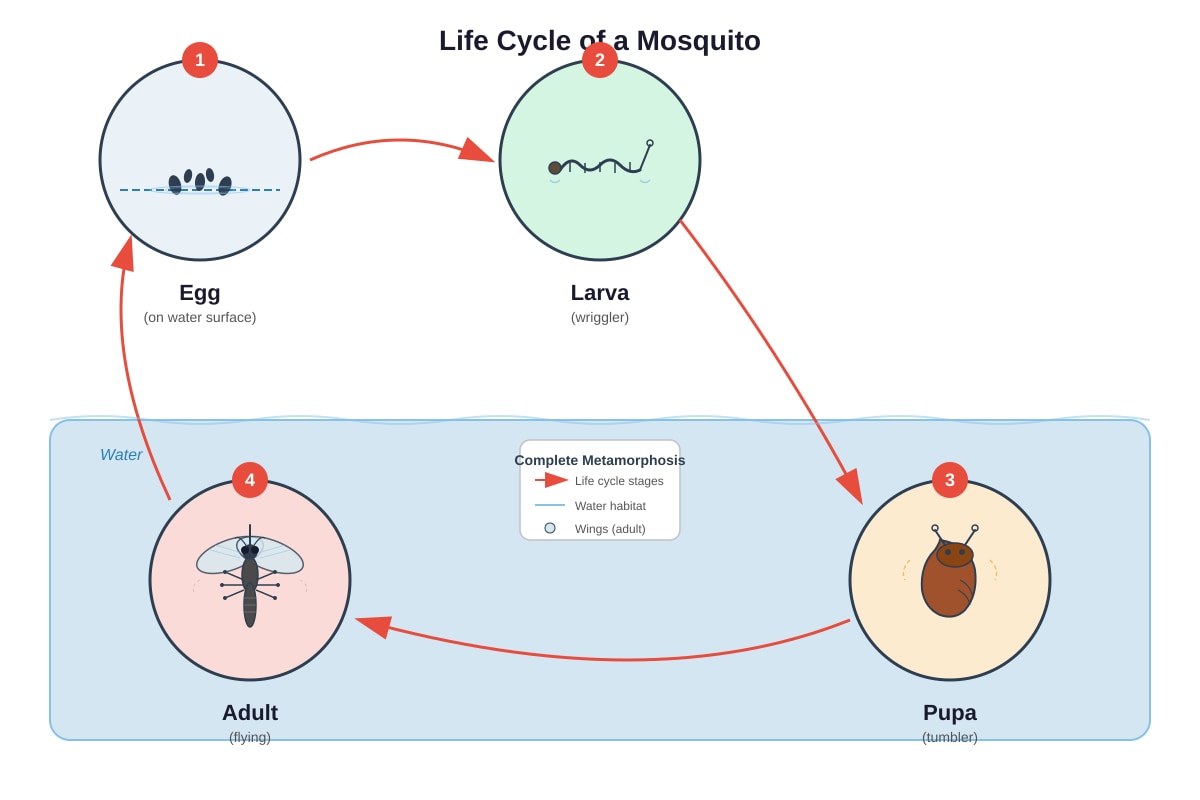
2. The diagram below shows the life cycle of a mosquito.
<image_placeholder> id: Q1-fig1 type: diagram linked_question: Q1 description: Life cycle of a mosquito showing four stages arranged in a cycle with arrows. Stage 1: Egg raft on water surface. Stage 2: Larva (wriggler) hanging at water surface with breathing tube. Stage 3: Pupa (tumbler) comma-shaped at water surface. Stage 4: Adult mosquito resting on water surface. Arrows connect Egg → Larva → Pupa → Adult → Egg. labels: Egg, Larva, Pupa, Adult values: None must_show: Four distinct stages in correct cyclic order with arrows; aquatic environment indicated for egg, larva, pupa; adult with wings </image_placeholder>
At which stage does the mosquito not feed?
A. Egg
B. Larva
C. Pupa
D. Adult
[ ]
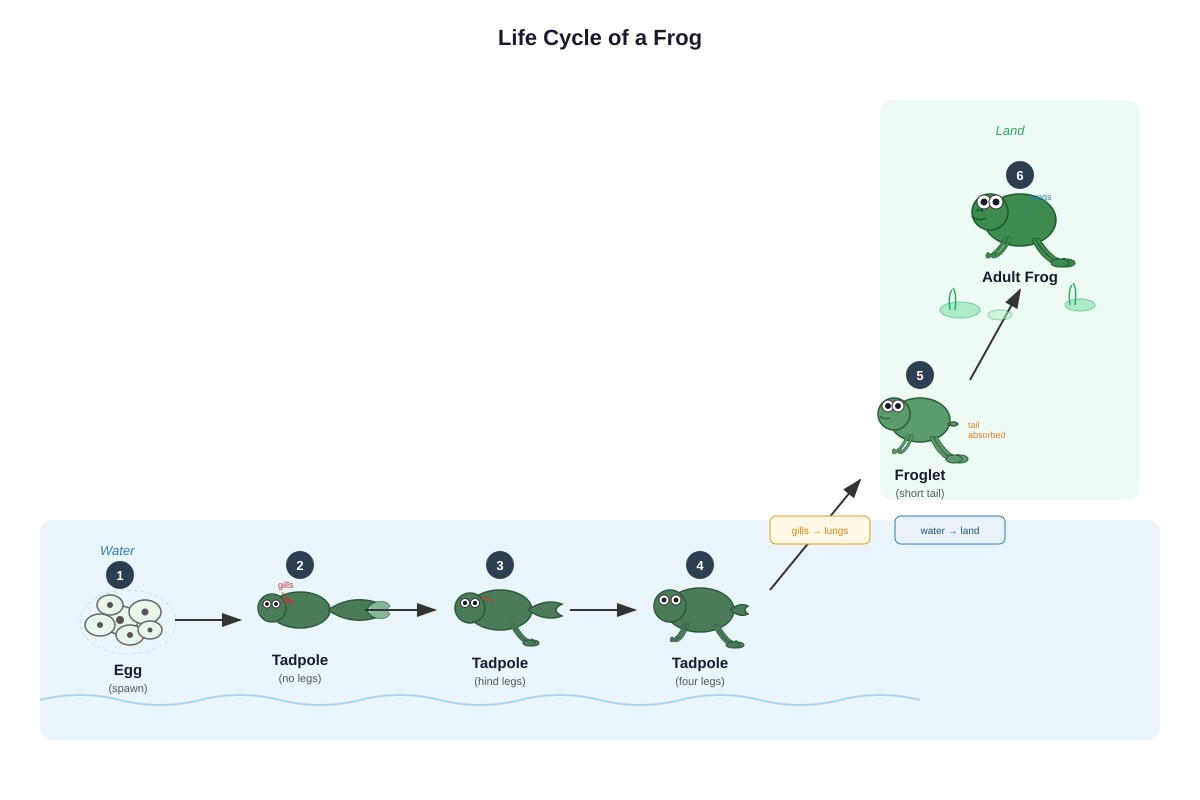
3. Study the life cycle of a frog below.
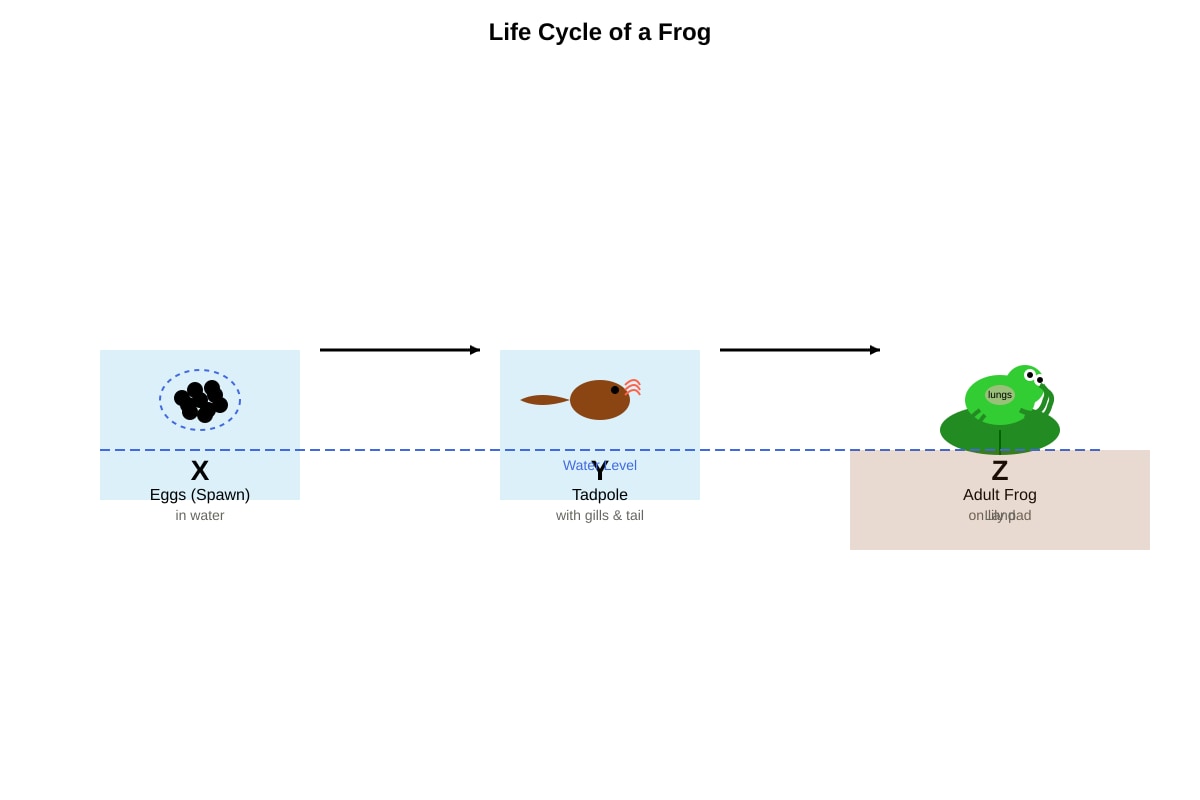
<image_placeholder> id: Q3-fig1 type: diagram linked_question: Q3 description: Life cycle of a frog showing five stages. Stage 1: Frog eggs (jelly-like mass) in water. Stage 2: Tadpole with gills and tail, no legs. Stage 3: Tadpole with hind legs. Stage 4: Tadpole with four legs and tail. Stage 5: Adult frog with no tail, lungs, four legs. Arrows show progression. labels: Egg, Tadpole (no legs), Tadpole (hind legs), Tadpole (four legs), Adult Frog values: None must_show: Five stages in sequence; clear changes in legs and tail; aquatic environment for early stages </image_placeholder>
Which statement about the frog's life cycle is correct?
A. The tadpole breathes through lungs.
B. The adult frog lays eggs on land.
C. The tadpole develops hind legs before front legs.
D. The young resembles the adult from the beginning.
[ ]
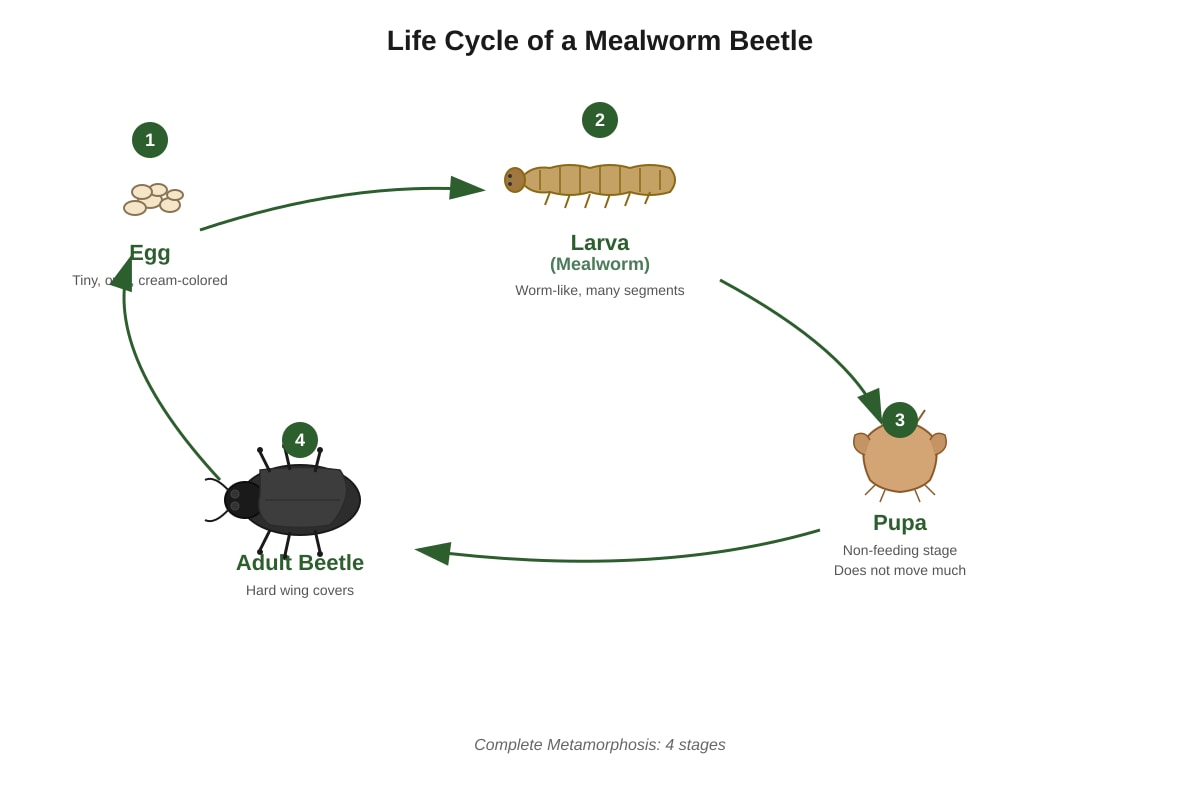
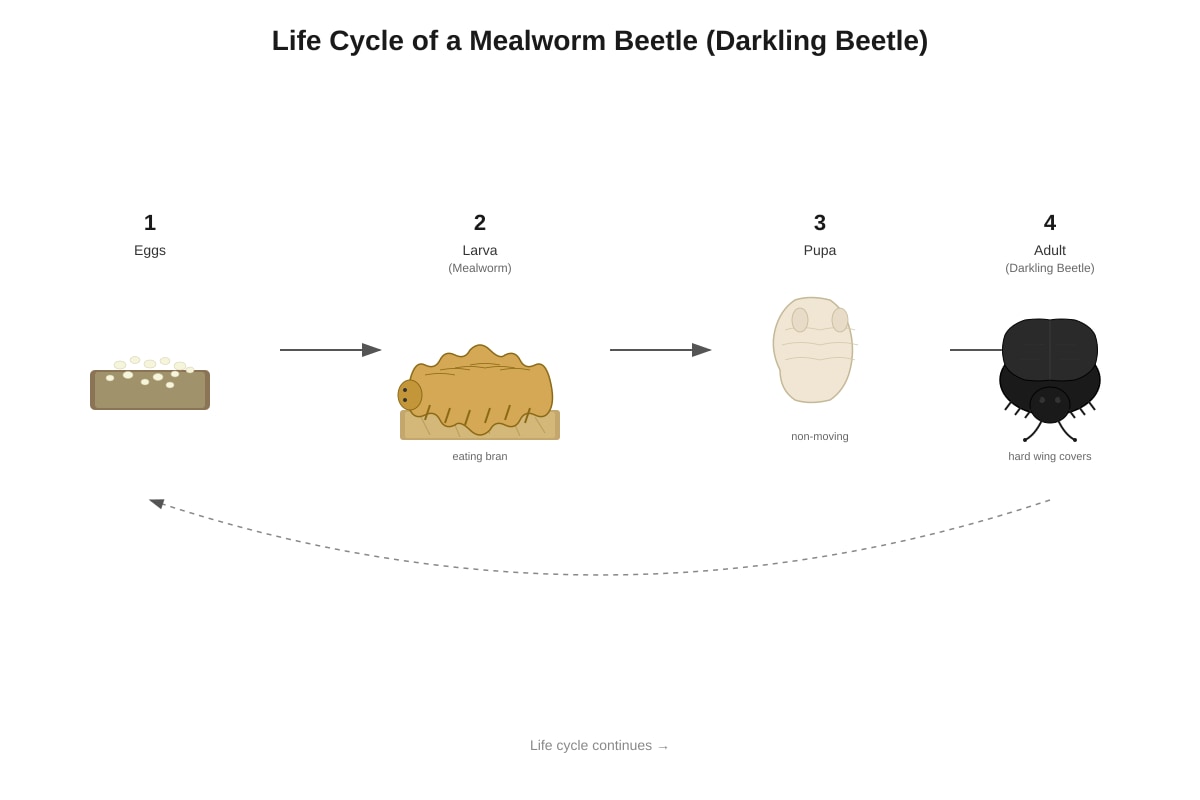
4. A mealworm beetle goes through four stages in its life cycle: egg → larva → pupa → adult.
Which stage is the feeding and growing stage?
A. Egg
B. Larva
C. Pupa
D. Adult
[ ]
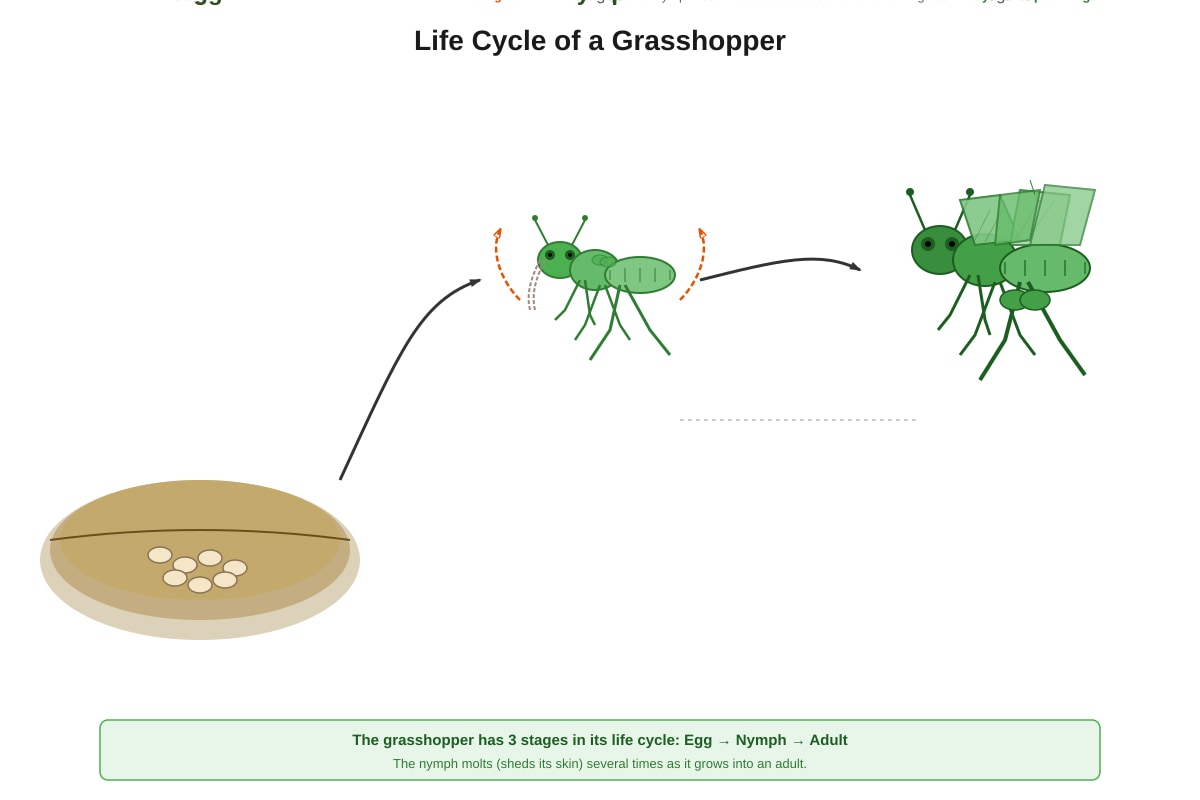
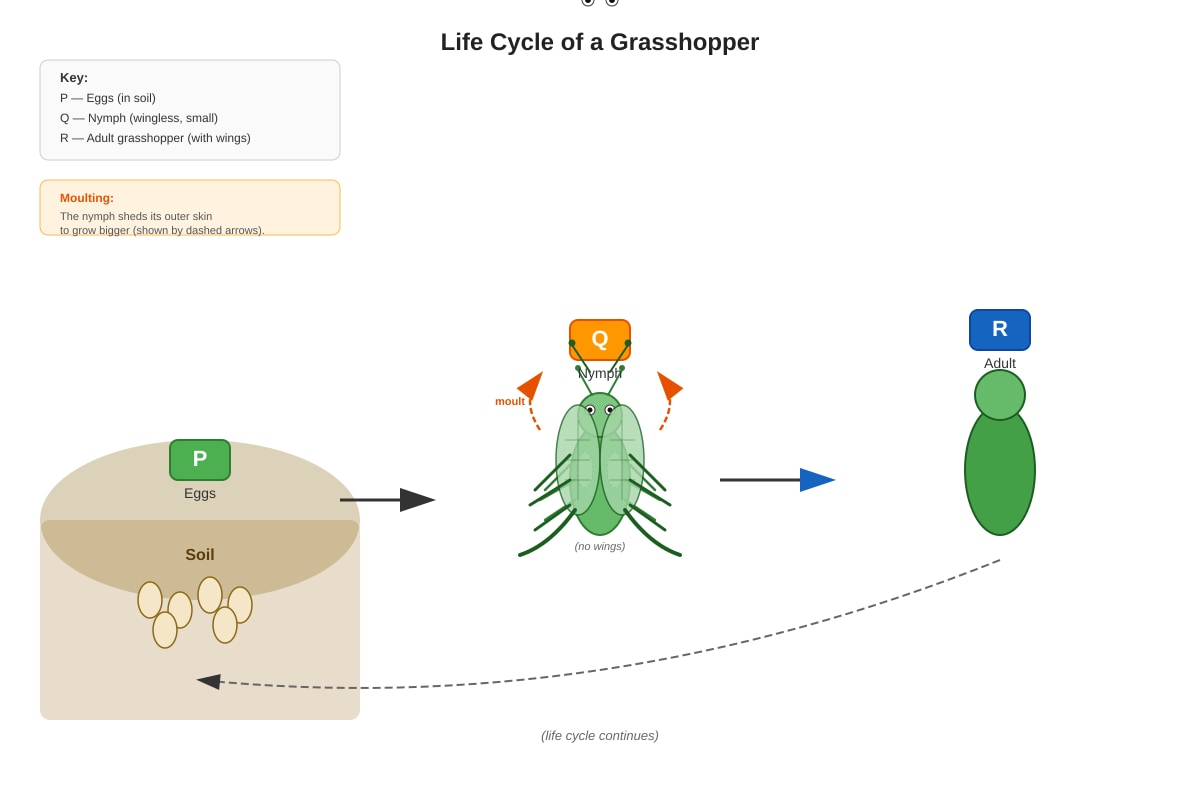
5. The diagram below shows a grasshopper nymph and an adult grasshopper.
<image_placeholder> id: Q5-fig1 type: diagram linked_question: Q5 description: Two side-by-side diagrams. Left: Grasshopper nymph - wingless, smaller, body segments visible. Right: Adult grasshopper - fully developed wings covering abdomen, larger, same body structure. Both shown from lateral view. labels: Nymph (wingless), Adult (winged) values: None must_show: Clear difference in wing development; similar body structure; size difference </image_placeholder>
What is the main difference between the nymph and the adult grasshopper?
A. The nymph has six legs but the adult has eight legs.
B. The nymph has no wings but the adult has wings.
C. The nymph lives in water but the adult lives on land.
D. The nymph eats plants but the adult eats meat.
[ ]
6. Which of the following pairs of animals both undergo incomplete metamorphosis?
A. Butterfly and mosquito
B. Grasshopper and cockroach
C. Frog and butterfly
D. Mealworm beetle and mosquito
[ ]
7. The diagram below shows the life cycle of a flowering plant.
<image_placeholder> id: Q7-fig1 type: diagram linked_question: Q7 description: Life cycle of a flowering plant (bean plant) showing five stages in a cycle. Stage 1: Seed. Stage 2: Germination - root and shoot emerging. Stage 3: Seedling with first true leaves. Stage 4: Adult plant with flowers. Stage 5: Fruit with seeds. Arrows connect in cycle. labels: Seed, Germination, Seedling, Adult Plant (flowering), Fruit with seeds values: None must_show: Five stages in correct order; seed to seed cycle; flowering and fruiting visible </image_placeholder>
At which stage does the plant first make its own food?
A. Seed
B. Germination
C. Seedling
D. Adult Plant
[ ]
8. A student observed an animal that hatched from an egg. The young looked like a smaller version of the adult but without wings. It moulted several times before becoming an adult.
Which animal is it most likely to be?
A. Mosquito
B. Butterfly
C. Grasshopper
D. Frog
[ ]
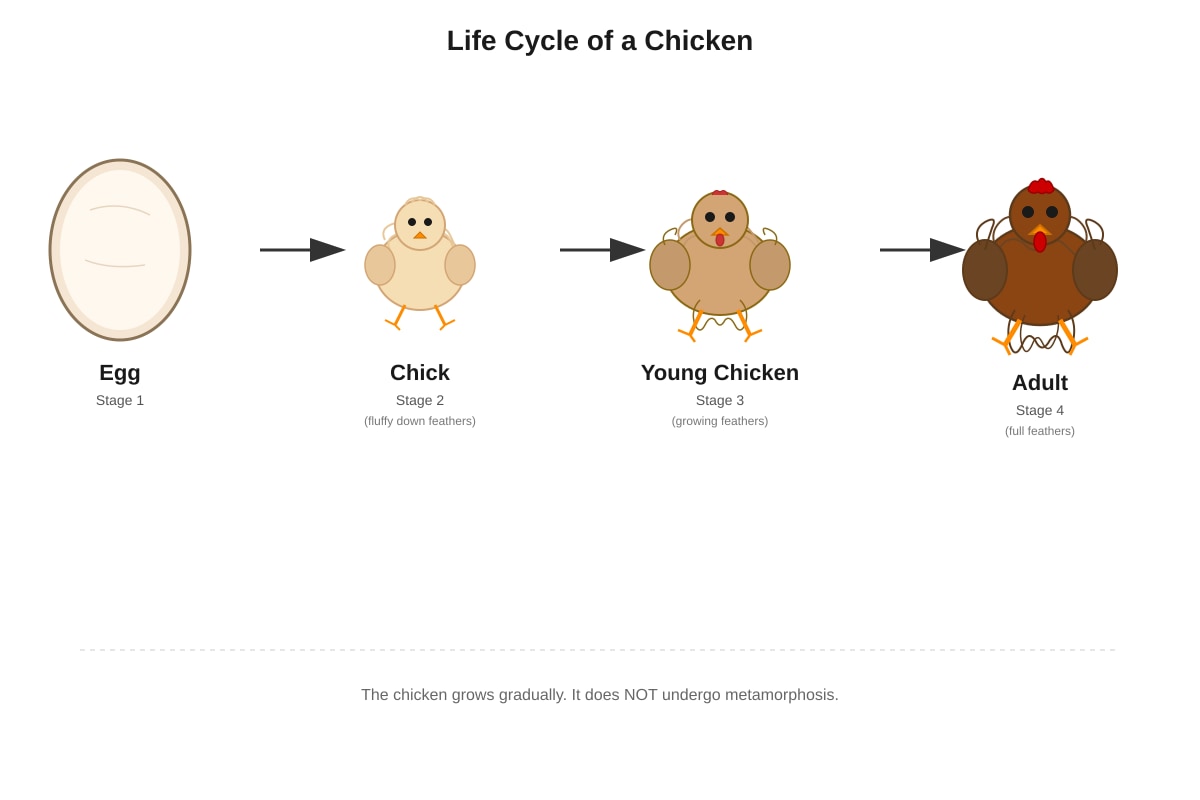
9. In the life cycle of a chicken, which stage comes immediately after the egg?
A. Adult
B. Chick
C. Pullet
D. Rooster
[ ]
10. Which of the following is true about the pupa stage in complete metamorphosis?
A. It is the feeding stage.
B. It is the stage where the animal lays eggs.
C. It is a resting stage where the body changes completely.
D. It is the stage that hatches from the egg.
[ ]
Section B: Structured Questions (5 × 2 marks = 10 marks)
Answer the questions in the spaces provided.
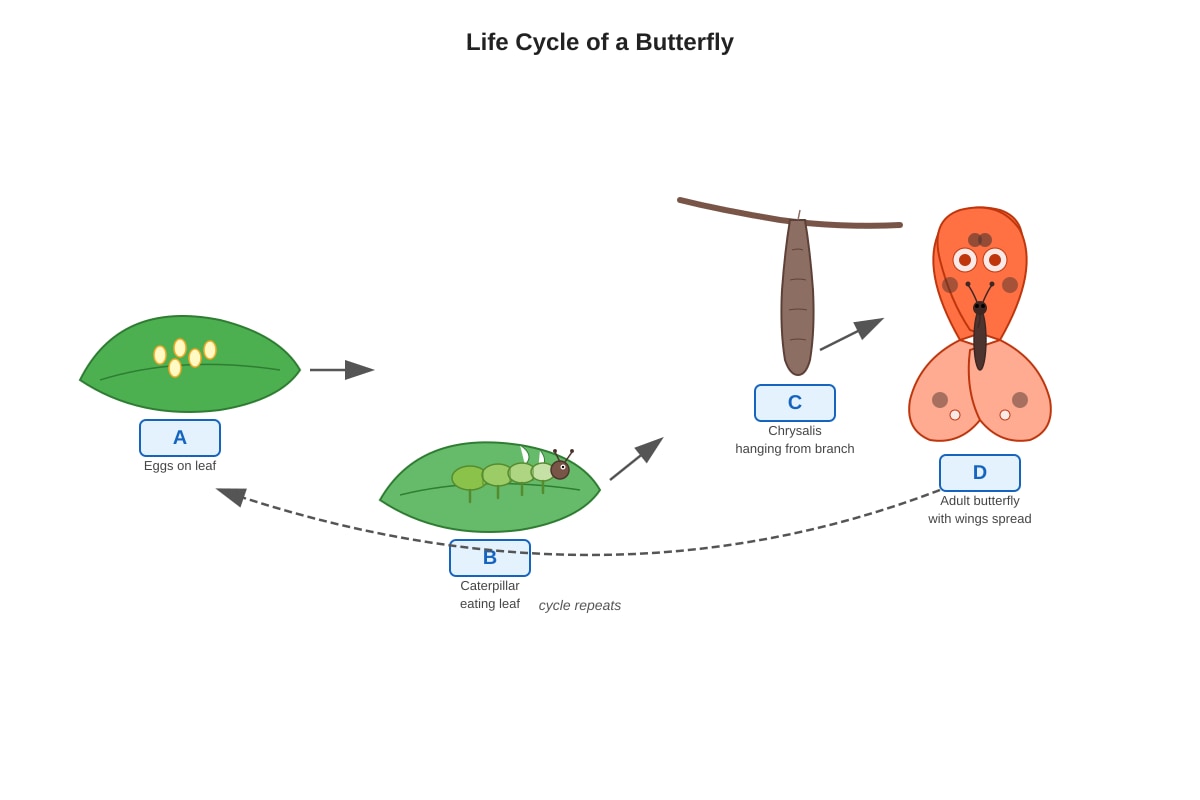
11. The diagram below shows the life cycle of a butterfly.
<image_placeholder> id: Q11-fig1 type: diagram linked_question: Q11 description: Life cycle of a butterfly with four stages in a cycle. Stage 1: Eggs on leaf underside. Stage 2: Caterpillar (larva) eating leaf. Stage 3: Chrysalis (pupa) attached to twig. Stage 4: Adult butterfly with wings. Arrows show Egg → Caterpillar → Chrysalis → Adult → Egg. labels: Egg, Caterpillar (Larva), Chrysalis (Pupa), Adult Butterfly values: None must_show: Four distinct stages; caterpillar eating leaf; chrysalis hanging; adult with wings; cyclic arrows </image_placeholder>
(a) Name the stage labelled X in the diagram.
______________________________________________________________________________ [1]
(b) State one difference between the caterpillar and the adult butterfly.
______________________________________________________________________________ [1]
12. The table below shows the number of days each stage of a mosquito's life cycle lasts under favourable conditions.
| Stage | Number of Days |
|---|---|
| Egg | 2 |
| Larva | 7 |
| Pupa | 3 |
| Adult | 30 |
(a) How many days does it take for a mosquito to develop from an egg to an adult?
______________________________________________________________________________ [1]
(b) Why is it important to remove stagnant water to prevent mosquitoes from breeding?
______________________________________________________________________________ [1]
13. The diagram below shows a young and an adult cockroach.
<image_placeholder> id: Q13-fig1 type: diagram linked_question: Q13 description: Two diagrams side by side. Left: Young cockroach (nymph) - wingless, smaller, pale colour. Right: Adult cockroach - fully developed wings covering abdomen, larger, darker colour. Both from dorsal view. labels: Nymph (young), Adult values: None must_show: Wingless nymph vs winged adult; size difference; similar body shape </image_placeholder>
(a) Does the cockroach undergo complete or incomplete metamorphosis?
______________________________________________________________________________ [1]
(b) Explain your answer in (a) using the diagram.
______________________________________________________________________________ [1]
14. A student wants to find out if mealworms prefer a damp or dry environment.
He sets up the experiment as shown below.
<image_placeholder> id: Q14-fig1 type: experimental_setup linked_question: Q14 description: A rectangular container divided into two equal halves by a removable central partition. Left half: Damp soil with pieces of carrot. Right half: Dry soil with pieces of carrot. 20 mealworms (larvae) placed along the partition line. Partition removed. Observation after 10 minutes. labels: Damp side, Dry side, Partition, Mealworms, Carrot pieces values: 20 mealworms, 10 minutes must_show: Clear division of damp/dry; equal food on both sides; mealworms at centre start; container with lid </image_placeholder>
(a) What is the aim of this experiment?
______________________________________________________________________________ [1]
(b) State one variable that must be kept the same to ensure a fair test.
______________________________________________________________________________ [1]
15. The diagram below shows the life cycle of a frog.
<image_placeholder> id: Q15-fig1 type: diagram linked_question: Q15 description: Life cycle of a frog with five stages. Stage 1: Eggs in water (jelly mass). Stage 2: Tadpole with external gills and tail. Stage 3: Tadpole with hind legs. Stage 4: Tadpole with four legs, tail shortening. Stage 5: Adult frog on lily pad, no tail, lungs. Arrows connect sequentially. labels: Egg, Tadpole (gills), Tadpole (hind legs), Tadpole (four legs), Adult Frog values: None must_show: Five stages; gills to lungs transition; leg development sequence; tail absorption; habitat change water to land </image_placeholder>
(a) At which stage does the frog first breathe through lungs?
______________________________________________________________________________ [1]
(b) State one way the young tadpole is different from the adult frog.
______________________________________________________________________________ [1]
Section C: Open-Ended Questions (5 × 4 marks = 20 marks)
Answer the questions in the spaces provided. Write in complete sentences.
16. The diagram below shows the life cycles of a butterfly and a grasshopper.
<image_placeholder> id: Q16-fig1 type: diagram linked_question: Q16 description: Two life cycles side by side. Left: Butterfly - Egg → Caterpillar (Larva) → Chrysalis (Pupa) → Adult Butterfly. Right: Grasshopper - Egg → Nymph (wingless, moults 5 times) → Adult Grasshopper (winged). Both shown as cycles with arrows. labels: Butterfly: Egg, Larva, Pupa, Adult; Grasshopper: Egg, Nymph (moults), Adult values: 5 moults for grasshopper nymph must_show: Clear contrast: 4 stages vs 3 stages; pupa present vs absent; nymph resembles adult vs larva different from adult </image_placeholder>
(a) State one similarity between the life cycles of the butterfly and the grasshopper.
______________________________________________________________________________ [1]
(b) State two differences between the life cycles of the butterfly and the grasshopper.
Difference 1: _________________________________________________________________ [1]
Difference 2: _________________________________________________________________ [1]
(c) The grasshopper nymph moults several times. Explain why moulting is necessary.
______________________________________________________________________________ [1]
17. The diagram below shows the life cycle of a flowering plant (bean plant).
<image_placeholder> id: Q17-fig1 type: diagram linked_question: Q17 description: Life cycle of a bean plant with six stages. 1: Seed. 2: Germination (radicle and plumule emerge). 3: Seedling with cotyledons and first true leaves. 4: Young plant growing taller. 5: Adult plant with flowers. 6: Pods (fruit) with seeds. Arrows form a cycle. labels: Seed, Germination, Seedling, Young Plant, Adult Plant (flowering), Fruit with seeds values: None must_show: Complete cycle seed-to-seed; cotyledons visible on seedling; flowers and pods on adult </image_placeholder>
(a) Name the process that occurs at stage 2.
______________________________________________________________________________ [1]
(b) The seedling uses the food stored in the cotyledons (seed leaves) before it can make its own food.
State the two things the seedling needs to make its own food.
______________________________________________________________________________ [2]
(c) How are the seeds in the pod dispersed?
______________________________________________________________________________ [1]
18. A group of students observed the life cycle of a mealworm beetle over several weeks. They recorded their observations in the table below.
| Week | Observation |
|---|---|
| 1 | Small white eggs seen in the container. |
| 3 | Tiny worm-like larvae (mealworms) hatched. They ate bran and grew. |
| 8 | Mealworms stopped eating and became still. They turned into white pupae. |
| 10 | Adult beetles emerged from the pupae. They were white at first, then turned brown. |
| 12 | Adult beetles laid eggs. |
(a) Based on the table, how many stages are there in the life cycle of a mealworm beetle?
______________________________________________________________________________ [1]
(b) Which stage is the pupa stage? Describe what happens during this stage.
______________________________________________________________________________ [2]
(c) The students noticed that the mealworms (larvae) moulted several times.
Why do mealworms moult?
______________________________________________________________________________ [1]
19. The diagram below shows a mosquito larva and a mosquito pupa.
<image_placeholder> id: Q19-fig1 type: diagram linked_question: Q19 description: Two diagrams side by side. Left: Mosquito larva (wriggler) - elongated, segmented, hanging at water surface with breathing tube (siphon) at rear. Right: Mosquito pupa (tumbler) - comma-shaped, larger thorax, two breathing trumpets on thorax, at water surface. Both in water. labels: Larva: breathing tube (siphon), segmented abdomen; Pupa: breathing trumpets, comma shape, developing wings/legs visible under cuticle values: None must_show: Distinct shapes; breathing structures at surface; aquatic environment; pupa shows developing adult features </image_placeholder>
(a) Both the larva and pupa live in water. State one similarity in how they breathe.
______________________________________________________________________________ [1]
(b) State one difference in appearance between the larva and the pupa.
______________________________________________________________________________ [1]
(c) The pupa does not eat. Explain why it does not need to eat.
______________________________________________________________________________ [1]
(d) What will the pupa develop into?
______________________________________________________________________________ [1]
20. A farmer wants to reduce the number of pests (grasshoppers) eating his crops. He learns that grasshoppers undergo incomplete metamorphosis.
(a) Explain what incomplete metamorphosis means.
______________________________________________________________________________ [1]
(b) The farmer finds grasshopper eggs in the soil. At which stage should he take action to most effectively reduce the grasshopper population? Explain your answer.
______________________________________________________________________________ [2]
(c) State one reason why removing adult grasshoppers alone may not solve the pest problem in the long term.
______________________________________________________________________________ [1]
End of Quiz
Answers
Primary 4 Science Quiz - Life Cycles (Answer Key)
Total Marks: 40
Section A: Multiple-Choice Questions (10 × 1 mark = 10 marks)
1. C
Explanation: Butterflies undergo complete metamorphosis with four distinct stages: egg → larva (caterpillar) → pupa (chrysalis) → adult. Grasshoppers and cockroaches undergo incomplete metamorphosis (egg → nymph → adult). Chickens do not undergo metamorphosis; the young (chick) resembles the adult.
2. C
Explanation: The pupa stage (tumbler) is a non-feeding, resting stage where the mosquito undergoes complete transformation. Eggs, larvae (wrigglers), and adults all feed or have feeding structures. Larvae feed on microorganisms in water; adults feed on nectar (and blood for females).
3. C
Explanation: In a frog's life cycle, the tadpole develops hind legs first, then front legs, while the tail is gradually absorbed. Tadpoles breathe through gills (not lungs), adult frogs lay eggs in water (not on land), and the young (tadpole) looks very different from the adult frog.
4. B
Explanation: The larva (mealworm) is the feeding and growing stage. It eats continuously (bran, vegetables) and moults several times to grow. The egg and pupa do not feed. The adult beetle feeds but the main growth occurs in the larval stage.
5. B
Explanation: In incomplete metamorphosis, the nymph resembles the adult but is smaller and lacks wings. Wings develop gradually through successive moults. Both nymph and adult have six legs, live on land, and eat plants.
6. B
Explanation: Grasshoppers and cockroaches both undergo incomplete metamorphosis (egg → nymph → adult, no pupal stage). Butterflies and mosquitoes undergo complete metamorphosis. Frogs have a different life cycle (amphibian metamorphosis). Mealworm beetles undergo complete metamorphosis.
7. C
Explanation: The seedling stage is when the first true leaves appear and photosynthesis begins. The seed contains stored food. During germination, the seedling uses stored food in the cotyledons. The adult plant makes food but the seedling is the first stage to do so.
8. C
Explanation: The description matches incomplete metamorphosis: young resembles adult but lacks wings, and moults several times. Mosquitoes and butterflies have larvae that look nothing like adults. Frogs have aquatic tadpoles with gills.
9. B
Explanation: The chicken life cycle: Egg → Chick → Pullet/Young hen → Adult hen/rooster. The chick hatches directly from the egg.
10. C
Explanation: The pupa is a resting, non-feeding stage where dramatic internal reorganisation occurs (histolysis and histogenesis) to transform the larva into the adult. It does not feed, lay eggs, or hatch from the egg.
Section B: Structured Questions (5 × 2 marks = 10 marks)
11.
(a) Chrysalis / Pupa [1]
Marking note: Accept "chrysalis" or "pupa". The diagram shows the stage attached to a twig where the caterpillar transforms.
(b) Any one valid difference, e.g.:
- The caterpillar has a long, segmented body with many legs (prolegs); the adult butterfly has three body parts (head, thorax, abdomen), six legs, and two pairs of wings.
- The caterpillar crawls and eats leaves; the adult butterfly flies and feeds on nectar.
- The caterpillar has chewing mouthparts; the adult butterfly has a proboscis for sucking nectar. [1]
Marking note: Must be a clear, observable difference. "One has wings, the other doesn't" is acceptable.
12.
(a) 12 days [1]
Working: Egg (2) + Larva (7) + Pupa (3) = 12 days. The adult stage is not part of development time from egg to adult emergence.
(b) Mosquitoes lay eggs in stagnant water. The larvae and pupae develop in water. Removing stagnant water removes their breeding ground. [1]
Marking note: Must mention water is needed for egg-laying and/or larval/pupal development.
13.
(a) Incomplete metamorphosis [1]
(b) The young (nymph) looks like the adult but is smaller and has no wings. There is no pupa stage. [1]
Marking note: Must reference the diagram evidence: wingless nymph vs winged adult, similar body shape, no pupa shown.
14.
(a) To find out whether mealworms prefer a damp or a dry environment. [1]
Marking note: Must state the aim as a question or "to find out/investigate" the preference.
(b) Any one valid controlled variable, e.g.:
- Number of mealworms on each side at the start (10 each side / all at centre)
- Type and amount of food (carrot pieces) on each side
- Temperature / light conditions for both sides
- Size of each compartment
- Time of observation (10 minutes) [1]
Marking note: "Amount of food" or "type of food" is the most direct answer from the diagram.
15.
(a) Adult frog stage / Stage 5 [1]
Marking note: Tadpoles have gills. Lungs develop during metamorphosis; the adult frog breathes through lungs (and skin).
(b) Any one valid difference, e.g.:
- The tadpole lives in water and breathes through gills; the adult frog lives on land and breathes through lungs.
- The tadpole has a tail and no legs; the adult frog has four legs and no tail.
- The tadpole eats algae/plants; the adult frog eats insects (carnivore). [1]
Section C: Open-Ended Questions (5 × 4 marks = 20 marks)
16.
(a) Both life cycles begin with an egg stage. / Both have an adult stage that can reproduce. / Both involve growth and development through stages. [1]
Marking note: Any one valid similarity.
(b) Difference 1: The butterfly has four stages (egg, larva, pupa, adult) — complete metamorphosis; the grasshopper has three stages (egg, nymph, adult) — incomplete metamorphosis. [1]
Difference 2: The butterfly has a pupa stage where it does not feed and undergoes complete change; the grasshopper has no pupa stage, the nymph moults to become adult. [1]
OR: The butterfly larva (caterpillar) looks very different from the adult; the grasshopper nymph resembles the adult but is smaller and wingless. [1]
Marking note: Two distinct differences required. Stage count and presence/absence of pupa are the clearest.
(c) The grasshopper has a hard exoskeleton that cannot stretch. Moulting allows the nymph to shed its old exoskeleton and grow a larger one. [1]
Marking note: Must mention exoskeleton and growth.
17.
(a) Germination [1]
(b) Water and light (or "sunlight") [2]
Marking note: 1 mark each. Carbon dioxide is also needed but at P4 level, "water and light/sunlight" are the expected answers for photosynthesis requirements. Chlorophyll is in the leaves.
(c) The pod dries up and splits open (explosive action), scattering the seeds. / By splitting of the fruit (pod). [1]
Marking note: Accept "explosive dispersal" or "splitting of pod". Do not accept wind/animal/water unless specified for that plant.
18.
(a) Four stages [1]
Marking note: Egg, larva, pupa, adult.
(b) The pupa stage is Week 8–10 (when mealworms turned into white pupae). During this stage, the pupa does not eat or move much. Inside, the larva's body breaks down and reorganises into the adult beetle. [2]
Marking note: 1 mark for identifying the stage (Week 8–10 / pupa), 1 mark for describing it as a non-feeding, transformation stage.
(c) Mealworms have a hard exoskeleton that does not grow. They moult to shed the old exoskeleton so their body can grow larger. [1]
Marking note: Same concept as Q16(c).
19.
(a) Both breathe air from the water surface using breathing tubes/trumpets. / Both come to the water surface to breathe. [1]
Marking note: Both have specialised structures to access atmospheric oxygen while submerged.
(b) The larva is long and worm-like with a breathing tube at the rear; the pupa is comma-shaped with two breathing trumpets on the thorax. [1]
Marking note: Any clear visual difference: shape (elongated vs comma), position of breathing structures (rear vs thorax), segmentation.
(c) The pupa does not eat because it uses energy stored from the larval stage. Its body is undergoing complete reorganisation (metamorphosis) into the adult. [1]
Marking note: Must mention stored energy/food from larva and transformation.
(d) Adult mosquito [1]
20.
(a) Incomplete metamorphosis is a life cycle with three stages: egg, nymph, and adult. The nymph resembles the adult but is smaller and lacks wings. There is no pupa stage. [1]
Marking note: Must include: three stages, nymph resembles adult, no pupa.
(b) He should take action at the egg stage. Destroying eggs prevents them from hatching into nymphs, which would grow into many adults. Each female lays many eggs, so removing eggs stops the population at the source. [2]
Marking note: 1 mark for "egg stage", 1 mark for explanation (prevents hatching, stops population growth, many eggs per female).
(c) Adult grasshoppers have already laid eggs in the soil. The eggs will hatch into nymphs that grow into new adults, continuing the cycle. [1]
Marking note: Must mention eggs already laid / life cycle continues.
End of Answer Key