From Real Exams Quiz

Primary 4 Science Heat Quiz

Free Exam-Derived NVIDIA Nemotron 3 Ultra 550B A55B Free Primary 4 Science Heat quiz with questions and answers for Singapore students. This page is rendered as a direct URL so the questions and answers can be discovered without pressing in-page buttons.

These static practice materials are generated from the site's syllabus and paper-generation workflow, with source and model context shown so students and parents can evaluate the material before use.

Primary 4 Science From Real Exams Generated by NVIDIA Nemotron 3 Ultra 550B A55B Free Updated 2026-06-06

Questions

<!-- TuitionGoWhere generation metadata: stage=3-0; model=nvidia/nemotron-3-ultra-550b-a55b:free; model_label=NVIDIA Nemotron 3 Ultra 550B A55B Free; generated=2026-06-05; Sources: Stage 2-1 real exam-derived templates and Stage 2-2 exam-enriched syllabus. -->

Primary 4 Science Quiz - Heat

Name: ___________________________
Class: Primary 4 _______
Date: _______________
Score: _______ / 40

Duration: 45 minutes
Total Marks: 40

Instructions:

  1. Answer all questions.
  2. For Section A, choose the correct answer and write its number (1, 2, 3, or 4) in the brackets provided.
  3. For Section B and C, write your answers in the spaces provided.
  4. The number of marks for each question is shown in brackets [ ] at the end of each question.

Section A: Multiple-Choice Questions (10 × 1 mark = 10 marks)

1. Which of the following is a source of heat?
(1) A glowing light bulb
(2) A mirror reflecting sunlight
(3) A block of ice
(4) A wooden ruler
[1]

2. Heat always flows from a __________ region to a __________ region.
(1) cooler, hotter
(2) hotter, cooler
(3) darker, lighter
(4) lighter, darker
[1]

3. Which of the following materials is the best conductor of heat?
(1) Plastic
(2) Wood
(3) Copper
(4) Rubber
[1]

4. The diagram below shows a metal spoon placed in a cup of hot tea.
<image_placeholder> id: Q4-fig1 type: diagram linked_question: Q4 description: A ceramic cup filled with hot tea. A metal spoon rests in the tea with its handle sticking out. The tea is labelled "hot tea (80°C)". The spoon handle is labelled "handle". An arrow points from the tea to the spoon handle. labels: hot tea (80°C), metal spoon, handle values: tea temperature 80°C, room temperature 28°C must_show: Heat flow direction from tea to spoon handle </image_placeholder>
After a few minutes, the handle of the spoon becomes hot. This is because __________.
(1) heat travels from the handle to the hot tea
(2) heat travels from the hot tea to the handle
(3) the spoon produces its own heat
(4) the handle absorbs heat from the air
[1]

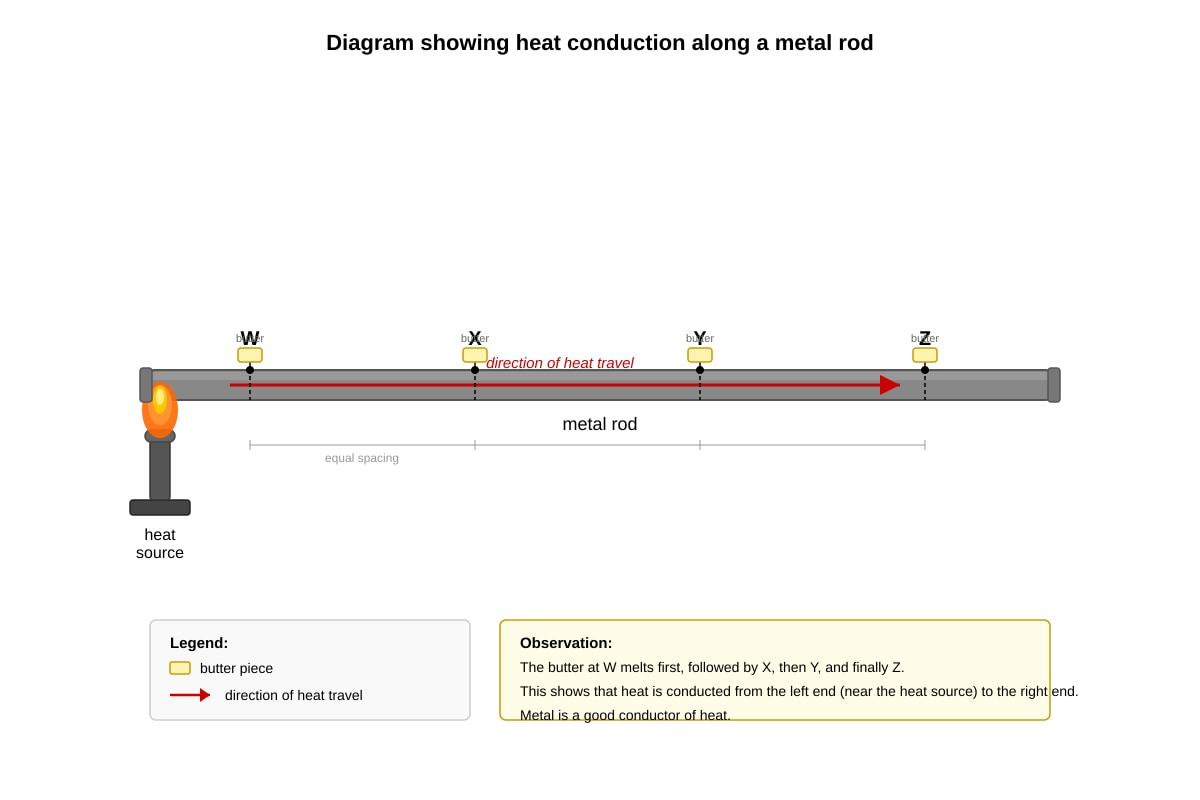
5. Four rods made of different materials (W, X, Y, Z) are coated with wax and heated at one end. The time taken for the wax to melt completely on each rod is recorded below.

RodTime taken for wax to melt (seconds)
W15
X45
Y30
Z60

Which rod is the best conductor of heat?
(1) W
(2) X
(3) Y
(4) Z
[1]

6. Why are cooking pots often made of metal but have plastic or wooden handles?
(1) Metal is a good conductor of heat; plastic and wood are poor conductors of heat.
(2) Metal is a poor conductor of heat; plastic and wood are good conductors of heat.
(3) Metal and plastic are both good conductors of heat.
(4) Metal and wood are both poor conductors of heat.
[1]

7. John places a metal key and a plastic ruler on a table in an air-conditioned room (20°C). After 10 minutes, he touches both objects. Which statement is correct?
(1) The metal key feels colder than the plastic ruler because metal loses heat to his hand faster.
(2) The plastic ruler feels colder than the metal key because plastic loses heat to his hand faster.
(3) Both feel equally cold because they are at the same temperature.
(4) The metal key feels warmer than the plastic ruler because metal gains heat from his hand faster.
[1]

8. The diagram below shows an experiment set-up.
<image_placeholder> id: Q8-fig1 type: experimental_setup linked_question: Q8 description: Three identical containers (A, B, C) each contain 100 ml of water at 80°C. Container A is wrapped with aluminium foil. Container B is wrapped with cotton wool. Container C is wrapped with bubble wrap. A thermometer is inserted through the lid of each container to measure water temperature. labels: Container A (aluminium foil), Container B (cotton wool), Container C (bubble wrap), thermometer, water 80°C, 100 ml values: initial water temperature 80°C, volume 100 ml each, room temperature 28°C must_show: Three containers with different wrappings, thermometers inserted, equal water volume </image_placeholder>
The temperature of the water in each container is recorded every 5 minutes for 20 minutes. Which container will show the slowest drop in temperature?
(1) Container A
(2) Container B
(3) Container C
(4) All will drop at the same rate
[1]

9. When a metal ball is heated, it expands and cannot pass through a metal ring. When cooled, it contracts and can pass through the ring. This shows that __________.
(1) heat causes matter to change state
(2) heat causes matter to expand and contract
(3) metal is a poor conductor of heat
(4) the mass of the ball changes when heated
[1]

10. Which of the following actions reduces heat loss from a hot drink in a cup?
(1) Blowing on the drink
(2) Placing a lid on the cup
(3) Stirring the drink with a metal spoon
(4) Pouring the drink into a wider cup
[1]


Section B: Structured Questions (5 × 2 marks = 10 marks)

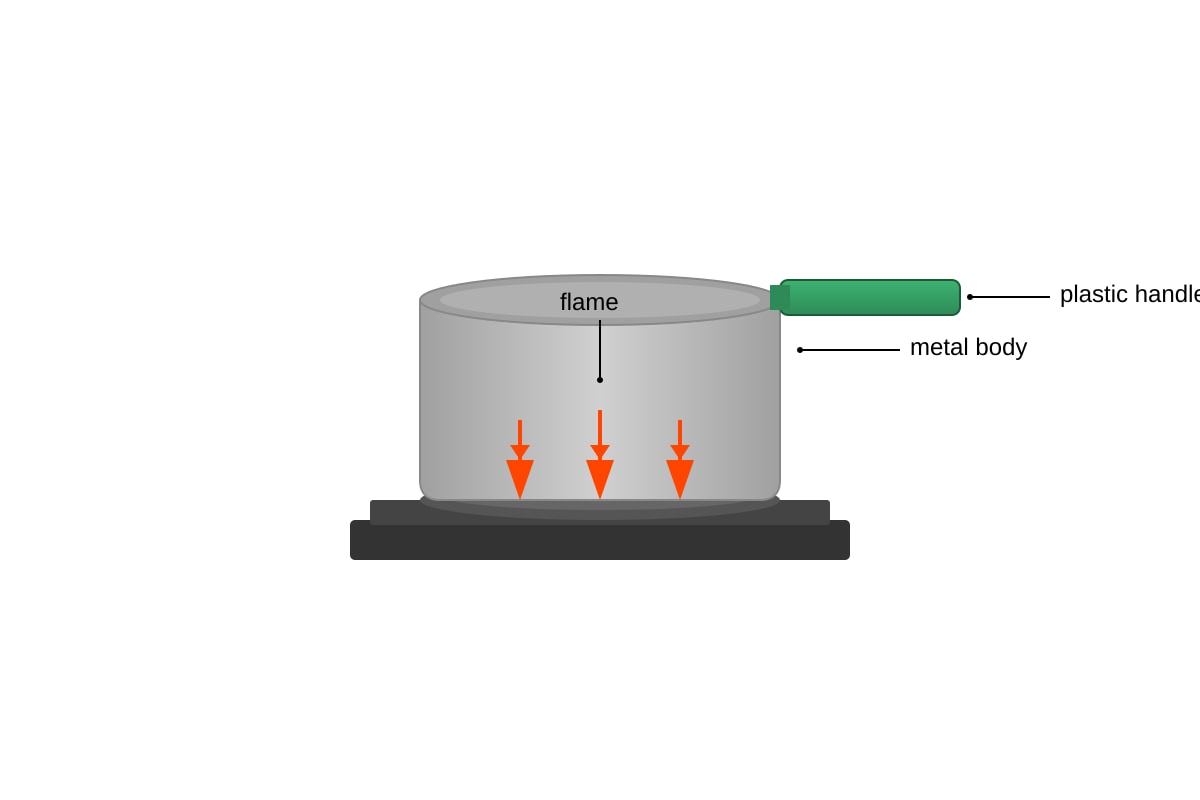
11. The diagram below shows a frying pan.
<image_placeholder> id: Q11-fig1 type: diagram linked_question: Q11 description: A frying pan with a metal base and a plastic handle. The base is labelled "metal base". The handle is labelled "plastic handle". An arrow points from a stove flame to the base labelled "heat". labels: metal base, plastic handle, heat from stove values: stove temperature ~200°C must_show: Frying pan with distinct metal base and plastic handle, heat source below base </image_placeholder>
(a) The base of the frying pan is made of metal. Explain why metal is a suitable material for the base. [1]
(b) The handle is made of plastic. Explain why plastic is a suitable material for the handle. [1]

12. Sarah conducted an experiment to compare how well different materials conduct heat. She placed identical ice cubes on four different plates (metal, glass, plastic, wood) at room temperature (28°C) and recorded the time taken for each ice cube to melt completely.

Plate materialTime taken for ice to melt (minutes)
Metal8
Glass15
Plastic25
Wood30

(a) Which plate material is the best conductor of heat? [1]
(b) Explain why the ice cube on the metal plate melted the fastest. [1]

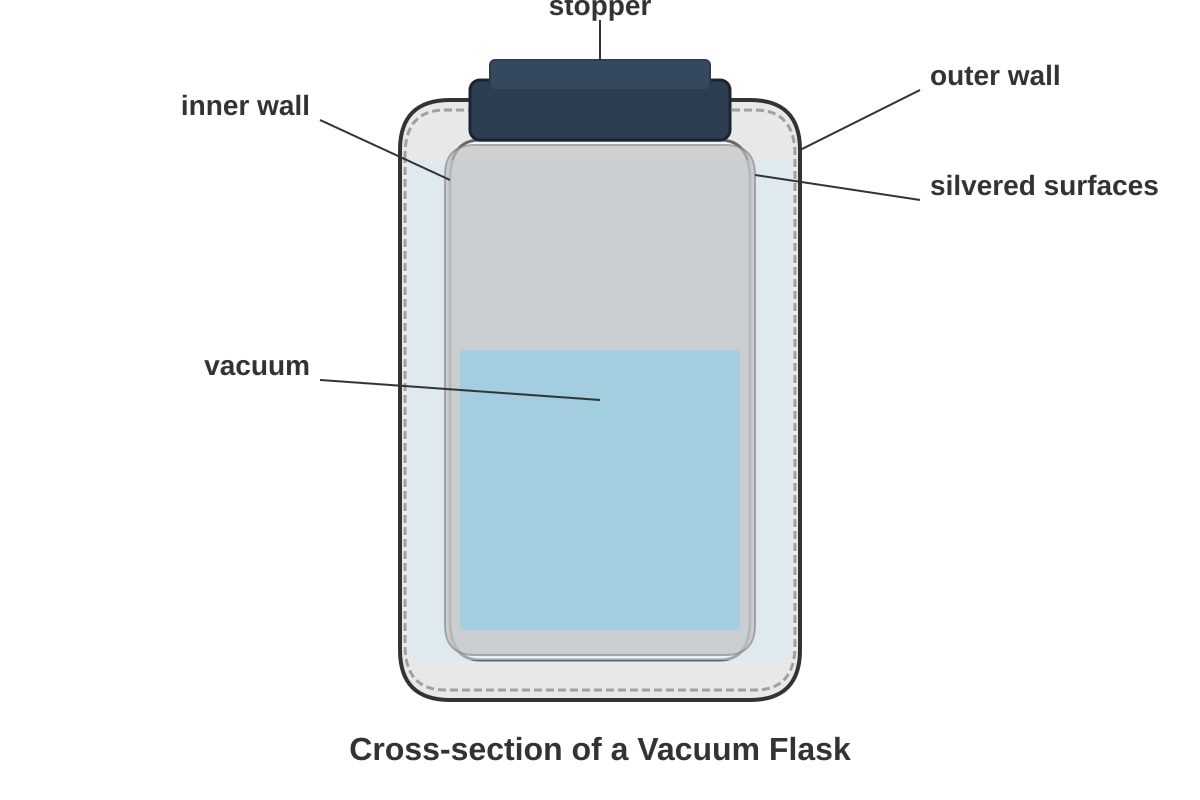
13. The diagram below shows a thermos flask.
<image_placeholder> id: Q13-fig1 type: diagram linked_question: Q13 description: Cross-section of a thermos flask showing double-walled glass vessel with vacuum between walls. Inner wall is silvered. Stopper is made of plastic. Outer casing is plastic. Hot soup is inside. labels: silvered inner wall, vacuum, double-walled glass, plastic stopper, outer casing, hot soup values: vacuum between walls, silvered surface must_show: Vacuum layer, silvered walls, plastic stopper, double-wall construction </image_placeholder>
(a) The space between the double walls is a vacuum. Explain how the vacuum reduces heat loss. [1]
(b) The inner walls are silvered. Explain how the silvered walls reduce heat loss. [1]

14. David wants to keep his cold drink cold for as long as possible during a picnic. He has three containers: a metal can, a plastic bottle, and a vacuum flask.
(a) Which container should he choose? [1]
(b) Give a reason for your answer in (a). [1]

15. The diagram below shows a bimetallic strip at room temperature and when heated.
<image_placeholder> id: Q15-fig1 type: diagram linked_question: Q15 description: Two diagrams side by side. Left: bimetallic strip straight at room temperature, made of metal A (top) and metal B (bottom). Right: same strip bent when heated, curving towards metal A side. Metal A expands more than Metal B. labels: Metal A (expands more), Metal B (expands less), room temperature, heated values: not to scale must_show: Straight strip at room temp, bent strip when heated, two distinct metals labelled </image_placeholder>
(a) Why does the bimetallic strip bend when heated? [1]
(b) Name one everyday appliance that uses a bimetallic strip. [1]


Section C: Application Questions (5 × 4 marks = 20 marks)

16. The diagram below shows an experiment to compare the conductivity of four metals (copper, aluminium, iron, brass).
<image_placeholder> id: Q16-fig1 type: experimental_setup linked_question: Q16 description: Four metal rods (copper, aluminium, iron, brass) of same length and diameter are fixed on a stand. One end of each rod is heated equally by a Bunsen burner. A thumbtack is attached to the other end of each rod using wax. A stopwatch is used to time how long until each thumbtack falls off. labels: copper rod, aluminium rod, iron rod, brass rod, Bunsen burner, thumbtack, wax, stopwatch values: rod length 30 cm, diameter 1 cm, equal heating must_show: Four rods heated at one end, thumbtacks at far end attached with wax, stopwatch </image_placeholder>
The table below shows the results.

Metal rodTime for thumbtack to fall (seconds)
Copper25
Aluminium40
Iron65
Brass50

(a) Which metal is the best conductor of heat? [1]
(b) Which metal is the poorest conductor of heat among the four? [1]
(c) Explain why the thumbtack falls off after some time. [1]
(d) State one variable that must be kept the same to ensure a fair test. [1]

17. Mrs Tan wants to install new flooring in her bedroom. She wants the floor to feel warm under her feet on cold mornings. She is choosing between ceramic tiles and wooden flooring.
(a) Which flooring should she choose? [1]
(b) Explain your answer in (a) using the concept of heat conduction. [2]
(c) State one other advantage of the chosen flooring material besides feeling warm. [1]

18. The diagram below shows a solar water heater.
<image_placeholder> id: Q18-fig1 type: diagram linked_question: Q18 description: Solar water heater on a roof. Black metal pipes inside a glass-covered box. Cold water enters at bottom, hot water exits at top. Sun rays hit the glass cover. Insulation at back and sides. labels: black metal pipes, glass cover, cold water inlet, hot water outlet, insulation, sun rays values: sun provides heat energy must_show: Black pipes, glass cover, insulation, water flow direction, sun rays </image_placeholder>
(a) Why are the metal pipes painted black? [1]
(b) Why is the box covered with glass? [1]
(c) Why is insulation placed at the back and sides of the box? [1]
(d) Explain why cold water enters at the bottom and hot water exits at the top. [1]

19. An experiment is conducted to find out how the thickness of an insulating material affects heat loss. Three identical cans are filled with 200 ml of hot water at 80°C. Each can is wrapped with a different thickness of the same insulating material. The temperature of the water is measured after 20 minutes.

CanThickness of insulation (cm)Temperature after 20 min (°C)
A0.552
B1.060
C2.068

(a) What is the relationship between the thickness of the insulation and the temperature of the water after 20 minutes? [1]
(b) Explain why thicker insulation keeps the water hotter for longer. [2]
(c) Predict the temperature of the water in Can C after 40 minutes. Will it be higher than, lower than, or equal to 68°C? [1]

20. The diagram below shows a pot of boiling soup. A metal ladle rests in the soup.
<image_placeholder> id: Q20-fig1 type: diagram linked_question: Q20 description: A metal pot on a stove with boiling soup. A metal ladle rests in the pot with its handle above the soup. Steam rises from the soup. Stove flame heats the pot bottom. labels: metal pot, boiling soup (100°C), metal ladle, handle, steam, stove flame values: soup temperature 100°C, room temperature 28°C must_show: Pot on stove, boiling soup, ladle in soup, handle above soup level, steam </image_placeholder>
(a) The handle of the ladle becomes hot after a while. Name the process by which heat travels through the solid ladle. [1]
(b) The soup at the bottom of the pot is heated first. It rises, and cooler soup sinks to take its place. Name this process of heat transfer in fluids. [1]
(c) Steam rises from the soup. State one difference between heat transfer by the process in (b) and heat transfer by steam rising. [1]
(d) If a wooden ladle is used instead of a metal ladle, the handle will not become as hot. Explain why. [1]


End of Quiz

Answers

<!-- TuitionGoWhere generation metadata: stage=3-0; model=nvidia/nemotron-3-ultra-550b-a55b:free; model_label=NVIDIA Nemotron 3 Ultra 550B A55B Free; generated=2026-06-05; Sources: Stage 2-1 real exam-derived templates and Stage 2-2 exam-enriched syllabus. -->

Primary 4 Science Quiz - Heat (Answer Key)

Total Marks: 40


Section A: Multiple-Choice Questions (10 marks)

1. Answer: (1) A glowing light bulb
Marks: 1
Explanation: A glowing light bulb produces both light and heat energy. A mirror only reflects light, a block of ice absorbs heat, and a wooden ruler at room temperature is not a heat source.

2. Answer: (2) hotter, cooler
Marks: 1
Explanation: Heat energy always flows from a region of higher temperature (hotter) to a region of lower temperature (cooler) until thermal equilibrium is reached.

3. Answer: (3) Copper
Marks: 1
Explanation: Copper is a metal and an excellent conductor of heat. Plastic, wood, and rubber are insulators (poor conductors of heat).

4. Answer: (2) heat travels from the hot tea to the handle
Marks: 1
Explanation: The hot tea (80°C) is at a higher temperature than the spoon handle (initially at room temperature ~28°C). Heat flows from the hot tea through the metal spoon (conduction) to the handle.

5. Answer: (1) W
Marks: 1
Explanation: The rod that melts the wax in the shortest time (15 seconds) conducts heat the fastest from the heated end to the wax. Rod W is the best conductor.

6. Answer: (1) Metal is a good conductor of heat; plastic and wood are poor conductors of heat.
Marks: 1
Explanation: The metal base conducts heat quickly from the stove to the food. The plastic/wooden handle does not conduct heat well, so it stays cool enough to hold safely.

7. Answer: (1) The metal key feels colder than the plastic ruler because metal loses heat to his hand faster.
Marks: 1
Explanation: Both objects are at room temperature (20°C). Metal is a good conductor, so it conducts heat away from John's warmer hand (≈37°C) quickly, making it feel colder. Plastic is a poor conductor, so heat leaves his hand more slowly.

8. Answer: (2) Container B
Marks: 1
Explanation: Cotton wool is a good insulator (traps air), so it reduces heat loss from the hot water most effectively. Aluminium foil is a conductor, and bubble wrap is a moderate insulator but less effective than thick cotton wool.

9. Answer: (2) heat causes matter to expand and contract
Marks: 1
Explanation: When heated, the metal ball gains heat and expands (particles move further apart). When cooled, it loses heat and contracts (particles move closer together). This demonstrates thermal expansion and contraction.

10. Answer: (2) Placing a lid on the cup
Marks: 1
Explanation: A lid reduces heat loss by convection (traps hot air/steam) and evaporation. Blowing increases convection/evaporation, stirring with a metal spoon conducts heat away, and a wider cup increases surface area for heat loss.


Section B: Structured Questions (10 marks)

11. (a) Metal is a good conductor of heat, so it transfers heat quickly and evenly from the stove to the food. [1]
(b) Plastic is a poor conductor of heat (insulator), so the handle stays cool and safe to hold. [1]
Total: 2 marks

12. (a) Metal [1]
(b) Metal is the best conductor of heat among the four materials. It conducts heat from the surroundings (room at 28°C) to the ice cube fastest, causing it to melt in the shortest time (8 minutes). [1]
Total: 2 marks

13. (a) A vacuum has no particles (or very few), so heat cannot be transferred by conduction or convection. This reduces heat loss from the hot soup. [1]
(b) The silvered (shiny) surface reflects radiant heat back into the flask, reducing heat loss by radiation. [1]
Total: 2 marks

14. (a) Vacuum flask [1]
(b) A vacuum flask has a double-walled container with a vacuum between the walls, which prevents heat transfer by conduction and convection. The silvered walls also reflect radiant heat. This keeps cold drinks cold (and hot drinks hot) for the longest time. [1]
Total: 2 marks

15. (a) The two metals expand at different rates when heated. Metal A expands more than Metal B, causing the strip to bend towards the side of Metal A (the metal that expands less). [1]
(b) Electric iron / thermostat / fire alarm / thermometer (accept any correct appliance using a bimetallic strip). [1]
Total: 2 marks


Section C: Application Questions (20 marks)

16. (a) Copper [1]
(b) Iron [1]
(c) Heat travels by conduction from the heated end of the rod to the cooler end where the thumbtack is attached. The wax melts when it gains enough heat, causing the thumbtack to fall off. [1]
(d) Length of rods / diameter of rods / amount of heating (distance from Bunsen burner) / size of thumbtack / amount of wax (any one valid controlled variable). [1]
Total: 4 marks

17. (a) Wooden flooring [1]
(b) Wood is a poor conductor of heat (insulator). It does not conduct heat away from Sarah's feet quickly, so her feet do not lose much heat to the floor, making it feel warm. Ceramic tiles are good conductors and would draw heat from her feet rapidly, feeling cold. [2]
(c) Wooden flooring is softer/more comfortable to walk on / safer (less slippery when wet) / warmer appearance / better sound insulation (accept any reasonable advantage). [1]
Total: 4 marks

18. (a) Black surfaces are good absorbers of heat (radiation). Painting the pipes black allows them to absorb more heat from the sun. [1]
(b) The glass cover allows sunlight (short-wave radiation) to enter but traps heat (long-wave radiation) inside, creating a greenhouse effect. It also reduces heat loss by convection (wind). [1]
(c) Insulation reduces heat loss from the back and sides of the box by conduction and convection, keeping more heat focused on the pipes. [1]
(d) Hot water is less dense than cold water. When the water in the pipes is heated, it expands, becomes less dense, and rises to the top (hot water outlet). Cooler, denser water sinks to the bottom (cold water inlet), creating a natural convection current that circulates water without a pump. [1]
Total: 4 marks

19. (a) As the thickness of the insulation increases, the temperature of the water after 20 minutes increases (thicker insulation → slower heat loss → higher final temperature). [1]
(b) Thicker insulation contains more trapped air pockets. Air is a poor conductor of heat. The thicker layer provides a longer path for heat to travel through the insulating material, slowing down heat loss by conduction and convection from the hot water to the surroundings. [2]
(c) Lower than 68°C. The water will continue to lose heat to the surroundings over the next 20 minutes, so its temperature will drop further. [1]
Total: 4 marks

20. (a) Conduction [1]
(b) Convection [1]
(c) Convection in (b) is heat transfer by the movement of the fluid (soup) itself due to density differences. Steam rising transfers heat by the movement of water vapour (gas) carrying latent heat from the phase change (evaporation/boiling), not just density-driven circulation of the same fluid. [1]
Alternative acceptable answer: Convection occurs within the liquid soup; steam rising involves a change of state (liquid to gas) and carries latent heat.
(d) Wood is a poor conductor of heat (insulator), while metal is a good conductor. Heat travels much more slowly through the wooden handle, so it stays cooler. [1]
Total: 4 marks


End of Answer Key