From Real Exams Quiz
Primary 4 Science Heat Quiz
Free Kimi AI-generated P4 Science Heat quiz with questions, answers, and syllabus-aligned practice for Singapore students preparing for school assessments.
These static practice materials are generated from the site's syllabus and paper-generation workflow, with source and model context shown so students and parents can evaluate the material before use.
Questions
Primary 4 Science Quiz - Heat
Name: _________________________________ Class: _______ Date: _______
Duration: 40 minutes
Total Marks: 40 marks
Instructions:
- Answer all questions.
- Write your answers in the spaces provided.
- For multiple choice questions, circle the correct answer.
Section A: Multiple Choice (Questions 1–8) [8 marks]
Choose the correct answer and circle it. Each question carries 1 mark.
1. Which of the following is a source of heat?
<table> <tr><td>A)</td><td>Ice cube</td></tr> <tr><td>B)</td><td>Freezer</td></tr> <tr><td>C)</td><td>Lit candle</td></tr> <tr><td>D)</td><td>Water in a pond</td></tr> </table>Answer: _________________________________________ [1]
2. Heat travels from a ____________ object to a ____________ object.
<table> <tr><td>A)</td><td>hotter, cooler</td></tr> <tr><td>B)</td><td>cooler, hotter</td></tr> <tr><td>C)</td><td>smaller, bigger</td></tr> <tr><td>D)</td><td>bigger, smaller</td></tr> </table>Answer: _________________________________________ [1]
3. A metal spoon and a wooden spoon are placed in hot soup. After 2 minutes, which spoon feels hotter to touch?
<table> <tr><td>A)</td><td>Wooden spoon</td></tr> <tr><td>B)</td><td>Metal spoon</td></tr> <tr><td>C)</td><td>Both feel the same</td></tr> <tr><td>D)</td><td>Neither feels hot</td></tr> </table>Answer: _________________________________________ [1]
4. Which material is the best insulator?
<table> <tr><td>A)</td><td>Copper</td></tr> <tr><td>B)</td><td>Aluminium</td></tr> <tr><td>C)</td><td>Cotton wool</td></tr> <tr><td>D)</td><td>Iron</td></tr> </table>Answer: _________________________________________ [1]
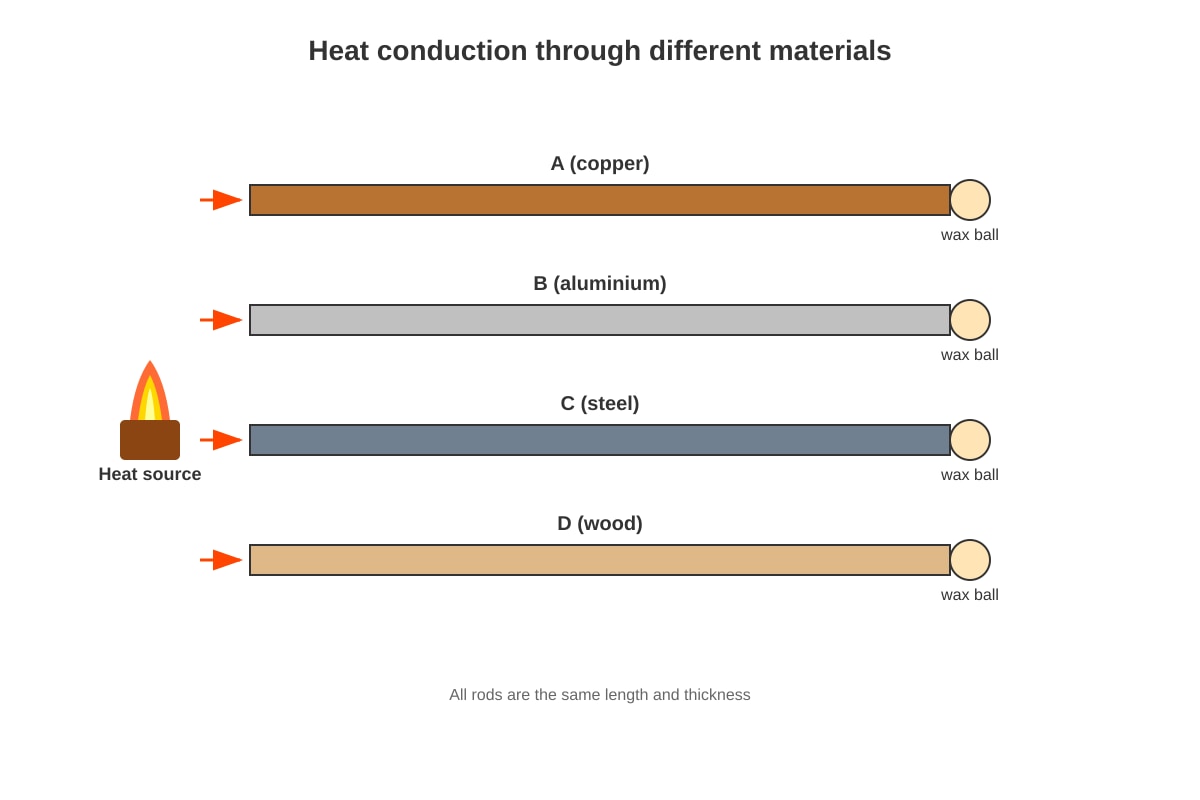
5. The diagram below shows four metal rods of the same size made of different materials. Wax balls are placed at one end of each rod. The other ends are heated.
<image_placeholder> id: Q5-fig1 type: diagram linked_question: Q5 description: Four identical metal rods (A, B, C, D) arranged horizontally, each with a wax ball at the right end. Left ends are above a heat source (flame). Rods labelled: A-copper, B-aluminium, C-steel, D-wood. labels: A (copper), B (aluminium), C (steel), D (wood); wax balls at end; flame symbol at left end values: Rods are same length and thickness must_show: Four parallel rods with material labels, wax balls at identical positions, heat source at opposite end </image_placeholder>
Which wax ball will fall off first?
<table> <tr><td>A)</td><td>A (copper)</td></tr> <tr><td>B)</td><td>B (aluminium)</td></tr> <tr><td>C)</td><td>C (steel)</td></tr> <tr><td>D)</td><td>D (wood)</td></tr> </table>Answer: _________________________________________ [1]
6. Why do we wear woollen clothes in cold weather?
<table> <tr><td>A)</td><td>Wool produces heat.</td></tr> <tr><td>B)</td><td>Wool stops cold from entering our body.</td></tr> <tr><td>C)</td><td>Wool traps air and reduces heat loss from our body.</td></tr> <tr><td>D)</td><td>Wool absorbs heat from the surroundings.</td></tr> </table>Answer: _________________________________________ [1]
7. In which direction does heat from the Sun travel to reach Earth?
<table> <tr><td>A)</td><td>Only upward</td></tr> <tr><td>B)</td><td>Only sideways</td></tr> <tr><td>C)</td><td>In all directions</td></tr> <tr><td>D)</td><td>Only through air</td></tr> </table>Answer: _________________________________________ [1]
8. The table below shows the time taken for ice cubes to melt completely in four different containers.
| Container | Material | Time for ice to melt |
|---|---|---|
| P | Metal | 15 minutes |
| Q | Plastic | 45 minutes |
| R | Glass | 35 minutes |
| S | Styrofoam | 60 minutes |
Which container is the best for keeping ice cream cold for a long time?
<table> <tr><td>A)</td><td>P</td></tr> <tr><td>B)</td><td>Q</td></tr> <tr><td>C)</td><td>R</td></tr> <tr><td>D)</td><td>S</td></tr> </table>Answer: _________________________________________ [1]
Section B: Fill in the Blanks (Questions 9–12) [8 marks]
Complete each sentence with the correct word or phrase. Each blank carries 1 mark.
9. Heat is a form of _________________________________ that makes things hotter.
When we touch a hot object, heat travels to our hand through _______________________________.
Answer: _________________________________________________ [2]
10. Materials that allow heat to pass through them easily are called _______________________________.
Materials that do not allow heat to pass through them easily are called _______________________________.
Answer: _________________________________________________ [2]
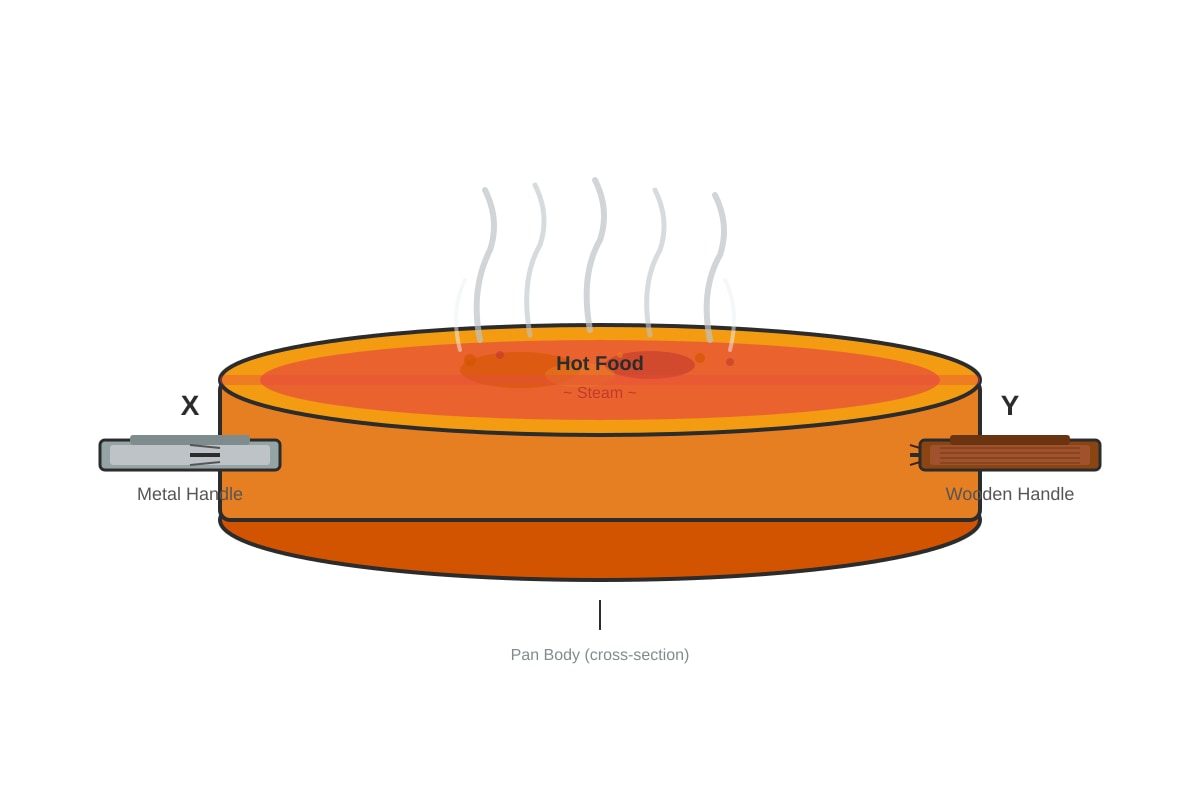
11. A frying pan has a metal handle and a wooden handle as shown.
<image_placeholder> id: Q11-fig1 type: diagram linked_question: Q11 description: Cross-section of a frying pan showing two handles extending from the pan body. Left handle is metallic (labelled X), right handle is wooden (labelled Y). Pan body contains hot food with steam rising. labels: X (metal handle), Y (wooden handle), hot food/steam values: None must_show: Pan with two distinct handles, clear material difference, indication that pan is hot (steam) </image_placeholder>
When cooking, handle __________________ (X/Y) feels hotter because _______________________________ is a better conductor of heat than _______________________________.
Answer: _________________________________________________ [3]
12. The _________________________________ from the Sun travels through _______________________________ to reach us. We can feel this heat even though there is _________________________________ between the Sun and Earth.
Answer: _________________________________________________ [3]
Section C: Matching and Classification (Questions 13–14) [6 marks]
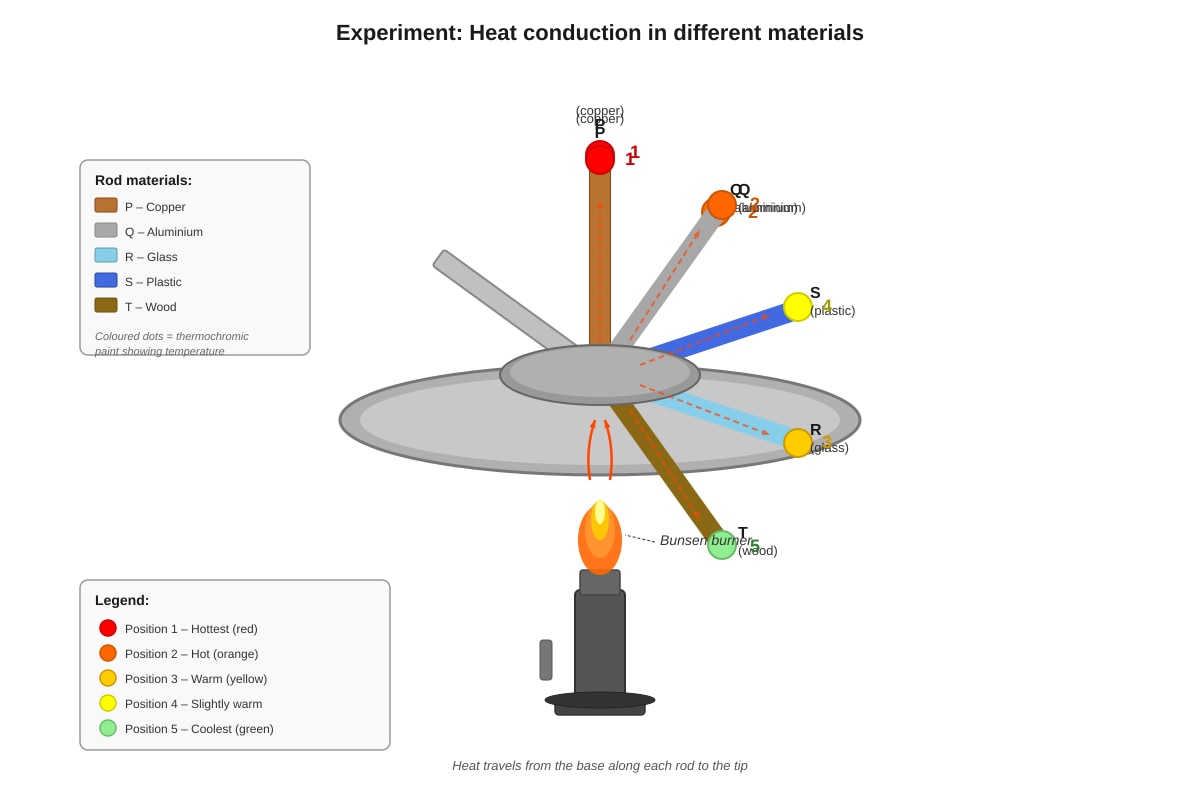
13. The diagram below shows an experiment with five rods made of different materials.
<image_placeholder> id: Q13-fig1 type: experimental_setup linked_question: Q13 description: Five identical rods (P, Q, R, S, T) mounted on a metal base, arranged radially like spokes. Base is heated from below by a Bunsen burner. Rods are labelled with materials: P-copper, Q-aluminium, R-glass, S-plastic, T-wood. Small coloured dots at tips of rods to show temperature change (thermochromic paint or wax). labels: P (copper), Q (aluminium), R (glass), S (plastic), T (wood); Bunsen burner flame below; numbered positions 1-5 for tips (position 1 hottest, position 5 coolest) values: Same dimensions for all rods must_show: Five labelled rods, heat source below, number sequence 1-5 showing order of heating, clear material labels </image_placeholder>
Write the letters P, Q, R, S, and T in the boxes below to show the order in which the tips of the rods become hot. The first one has been done for you.
Hottest tip first: P (copper) → _______ → _______ → _______ → _______ (coolest tip last) [3]
14. Classify the items below as good conductors or good insulators of heat. Write each item in the correct column. [3]
| Copper coin | Wooden chopstick | Iron nail | Plastic spoon | Silver ring | Cotton cloth |
| Good Conductors | Good Insulators |
|---|---|
Section D: Short Answer (Questions 15–17) [10 marks]
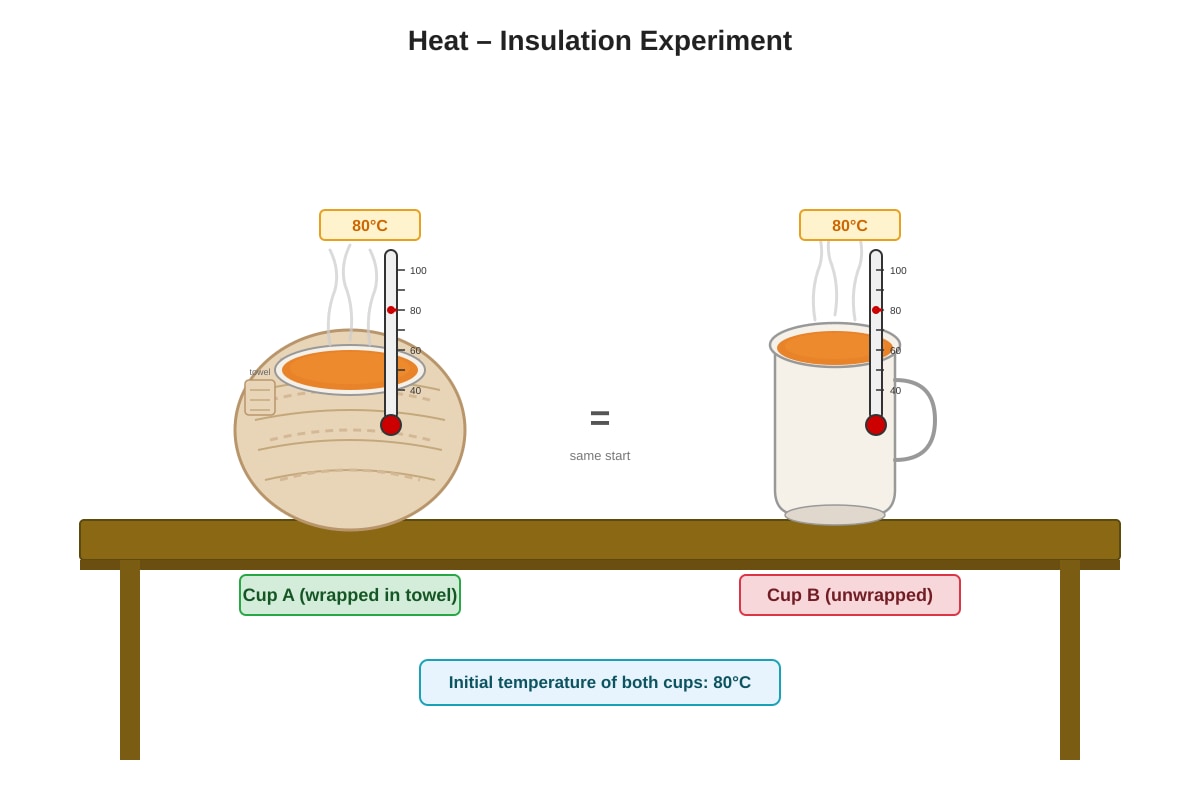
15. Mei Ling fills two identical cups with hot soup at the same temperature. She wraps one cup with a towel and leaves the other cup unwrapped.
<image_placeholder> id: Q15-fig1 type: experimental_setup linked_question: Q15 description: Two identical cups side by side on a table, both containing hot soup with steam rising. Left cup (Cup A) is wrapped in a thick towel. Right cup (Cup B) is unwrapped, just the ceramic cup. Thermometer in each cup showing initial temperature 80°C. Labels: Cup A (wrapped), Cup B (unwrapped). labels: Cup A (wrapped in towel), Cup B (unwrapped); both with thermometers showing 80°C; steam from hot soup values: Initial temperature 80°C for both must_show: Two identical cups, one wrapped one not, thermometers, equal starting conditions </image_placeholder>
(a) After 10 minutes, which cup of soup will be hotter? [1]
(b) Explain your answer. [2]
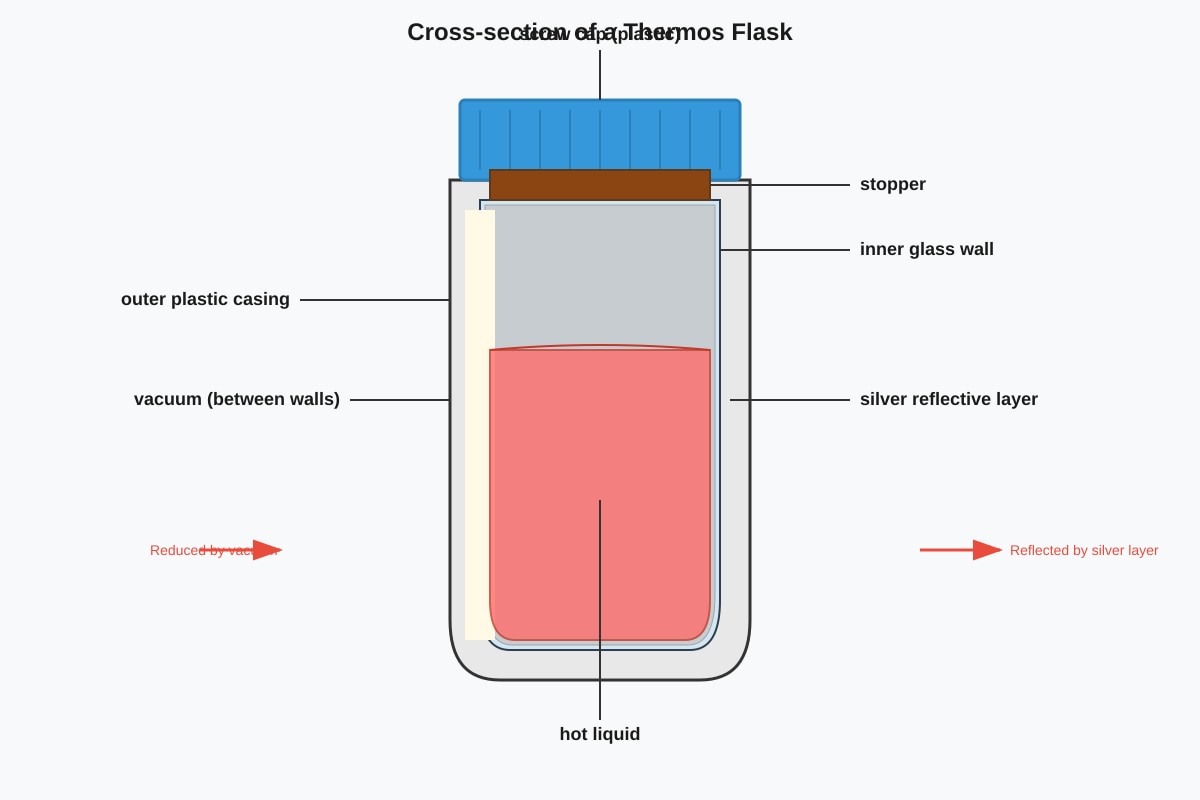
16. The diagram below shows a thermos flask designed to keep drinks hot or cold.
<image_placeholder> id: Q16-fig1 type: diagram linked_question: Q16 description: Cross-section diagram of a thermos flask showing vacuum between inner and outer walls, silver reflective surfaces, plastic screw cap, plastic outer casing. Hot liquid (labelled) inside inner glass wall. labels: vacuum (between walls); silver reflective layer; inner glass wall; outer plastic casing; screw cap (plastic); hot liquid; stopper values: None must_show: Cutaway view, vacuum gap clearly labelled, silver lining, plastic cap, layered structure </image_placeholder>
(a) Name two features of the thermos flask that help to reduce heat transfer. [2]
(b) For each feature you named in (a), explain how it helps to keep the drink hot. [2]
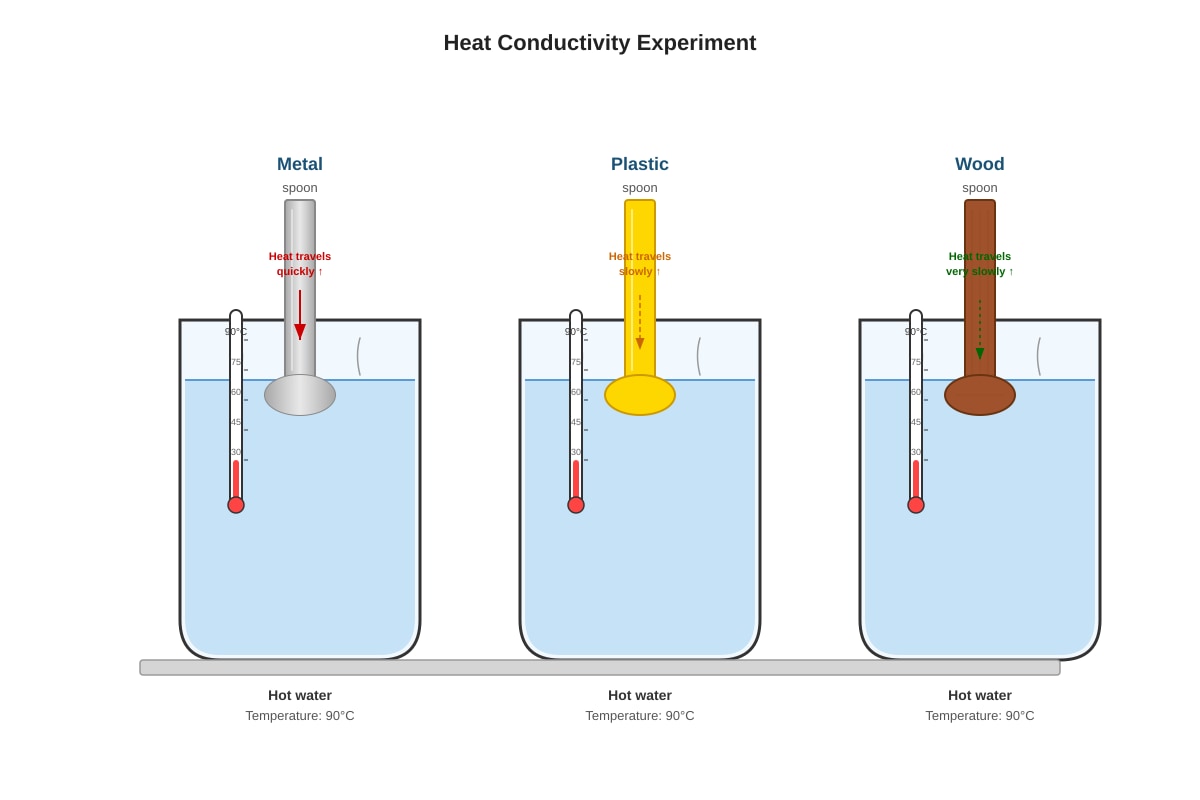
17. Jason places a metal spoon, a plastic spoon, and a wooden spoon in a cup of hot water for 5 minutes.
<image_placeholder> id: Q17-fig1 type: experimental_setup linked_question: Q17 description: Three identical cups arranged side by side, each containing hot water at 90°C. A different spoon stands in each cup: left cup has metal spoon, middle has plastic spoon, right has wooden spoon. Thermometers show water temperature. Small labels above each: Metal, Plastic, Wood. labels: Metal spoon, Plastic spoon, Wooden spoon; hot water; temperature 90°C in each cup values: Water temperature 90°C, same depth of spoons submerged must_show: Three cups with different spoon materials, equal conditions, clear labels </image_placeholder>
(a) Which spoon will feel hottest when Jason touches the handle? [1]
(b) Explain why the other two spoons do not feel as hot. [2]
Section E: Application and Synthesis (Questions 18–20) [8 marks]
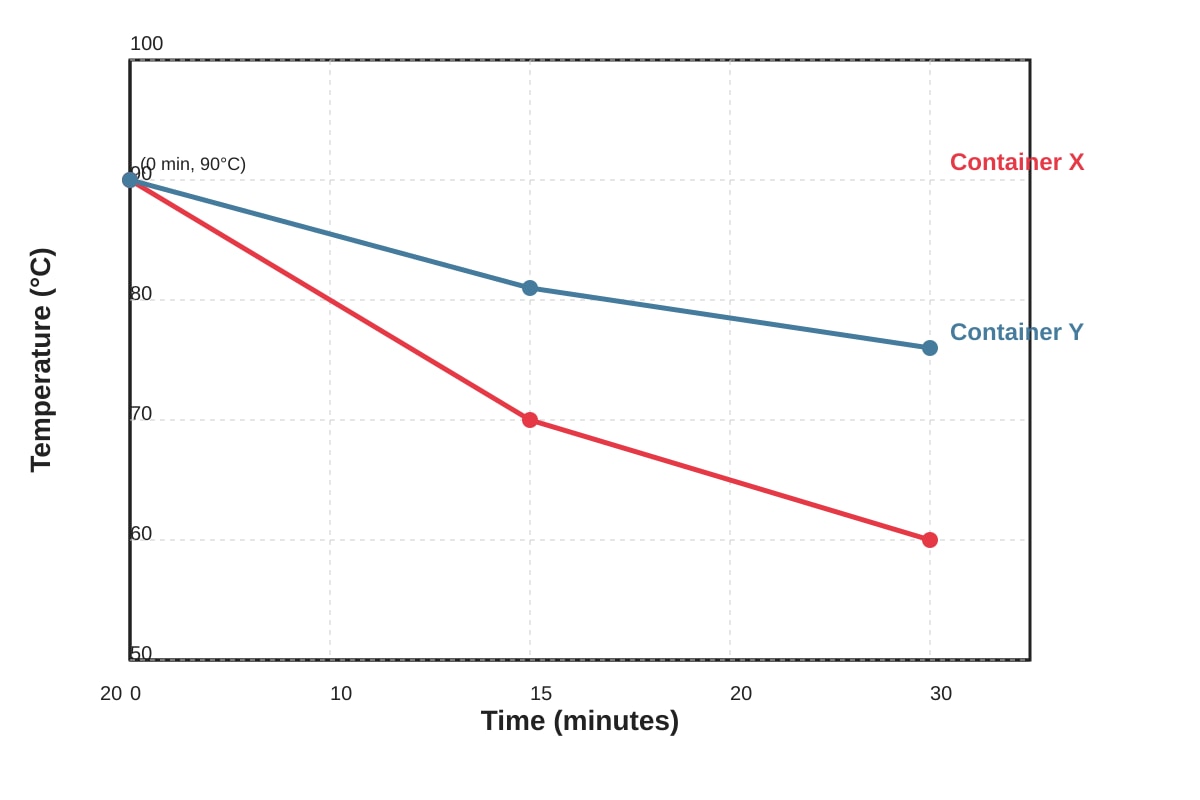
18. Study the graph below showing how the temperature of water in two containers changes over time.
<image_placeholder> id: Q18-fig1 type: graph linked_question: Q18 description: Line graph with time (minutes) on x-axis (0-30) and temperature (°C) on y-axis (20-100). Two lines: Container X starts at 90°C, steep decline to 40°C at 30 min. Container Y starts at 90°C, gradual decline to 70°C at 30 min. Both labelled. labels: x-axis: Time (minutes); y-axis: Temperature (°C); Container X (steep line), Container Y (gradual line); starting point (0 min, 90°C) for both values: X: (0,90), (15,60), (30,40); Y: (0,90), (15,78), (30,70) must_show: Two labelled lines with different slopes, clear axes with units, starting point marked, legend </image_placeholder>
(a) At the start, both containers have water at the same temperature. What is this temperature? [1]
(b) Which container loses heat faster? [1]
(c) Suggest one reason why one container loses heat faster than the other. [2]
19. Mrs Tan wants to design a lunch box to keep her son's food warm until recess time at 10 a.m. She tests three different lunch box designs by filling each with hot rice at 8 a.m. and measuring the temperature at 10 a.m.
| Lunch Box | Material of walls | Special feature | Temperature at 10 a.m. |
|---|---|---|---|
| A | Plastic only | None | 45°C |
| B | Metal | Shiny inner surface | 50°C |
| C | Plastic with foam layer | Tight-fitting lid | 65°C |
(a) Which lunch box should Mrs Tan choose? [1]
(b) Using evidence from the table, explain why the other two lunch boxes are less suitable. [2]
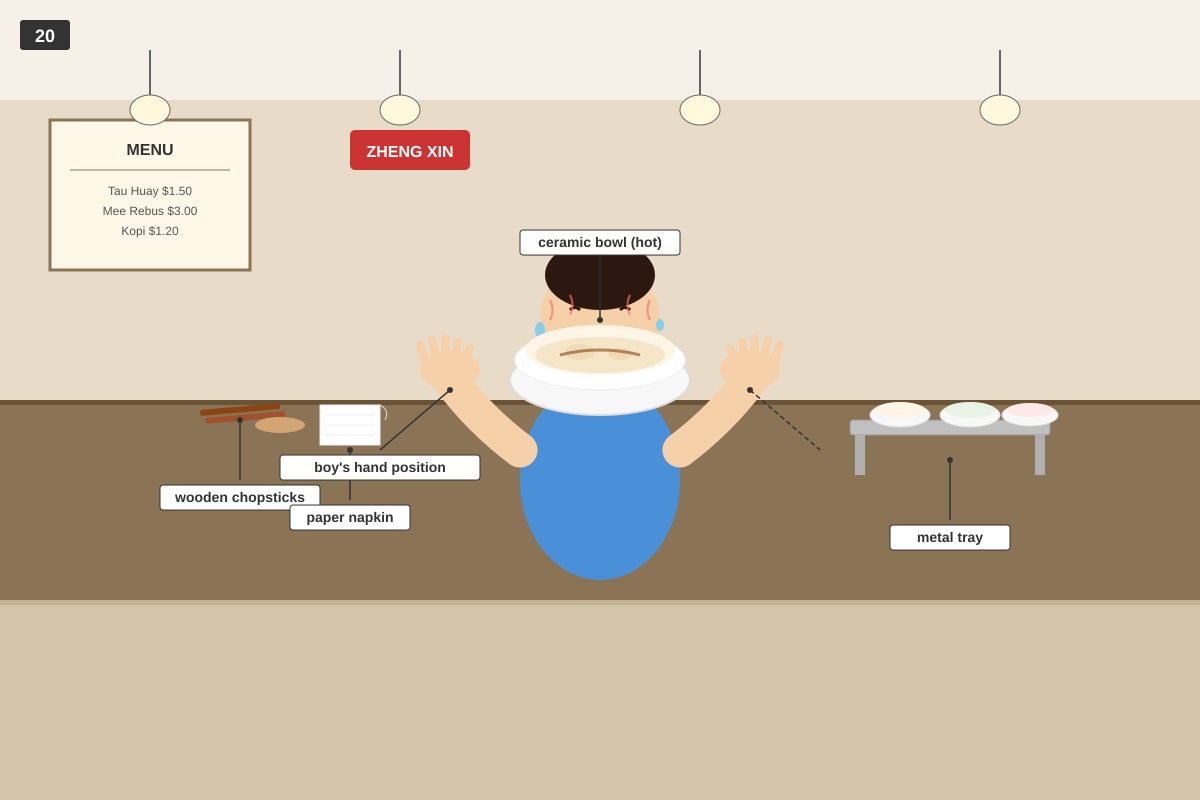
20. The picture below shows a boy at a hawker centre holding a bowl of hot tau huay (soybean pudding).
<image_placeholder> id: Q20-fig1 type: diagram linked_question: Q20 description: Scene at hawker centre showing boy holding bowl of hot tau huay. Bowl is white ceramic with no handle. Boy's fingers touching the hot bowl surface, uncomfortable expression. Nearby: metal tray with other bowls, wooden chopsticks, paper napkin. labels: ceramic bowl (hot), metal tray, wooden chopsticks, paper napkin, boy's hand position values: None must_show: Hand position on hot bowl, nearby objects (tray, chopsticks, napkin), hawker centre context </image_placeholder>
Suggest two ways the boy could hold or carry the bowl of hot tau huay without burning his fingers. Explain how each method works to protect his hand from heat. [4]
END OF QUIZ
Answers
Primary 4 Science Quiz - Heat: Answer Key
Total Marks: 40 marks
Section A: Multiple Choice
1. C) Lit candle [1]
- Teaching note: A lit candle produces heat through burning. Ice cubes, freezers, and pond water are cold or cool objects that absorb heat rather than produce it. Sources of heat include the Sun, fire, and electrical appliances when switched on.
2. A) hotter, cooler [1]
- Teaching note: Heat always flows from a region of higher temperature to a region of lower temperature. This is a fundamental rule of heat transfer. Students often confuse this direction; remember that heat "moves away from hot and toward cold."
3. B) Metal spoon [1]
- Teaching note: Metal is a good conductor of heat, so it transfers heat quickly from the hot soup to your hand. Wood is an insulator, so heat does not travel through it easily. Even though both spoons are in the same hot soup, the metal spoon conducts heat to your fingers much faster.
4. C) Cotton wool [1]
- Teaching note: Cotton wool traps air between its fibres. Air is a poor conductor of heat, making cotton wool an excellent insulator. Copper, aluminium, and iron are all metals and good conductors of heat.
5. A) A (copper) [1]
- Teaching note: Copper is the best conductor of heat among the materials listed. Heat travels fastest through copper, so the wax ball melts and falls off first. The order of conductivity from best to worst is: copper > aluminium > steel > wood. Copper conducts heat approximately twice as fast as aluminium.
6. C) Wool traps air and reduces heat loss from our body. [1]
- Teaching note: Woollen clothes keep us warm by trapping air (a poor conductor) close to our skin. This reduces heat loss from our body to the cold surroundings. Wool does not produce heat (A is wrong), nor does it "stop cold from entering" (B is vague and incorrect — cold is the absence of heat, not something that enters). D is incorrect because wool does not absorb heat from surroundings.
7. C) In all directions [1]
- Teaching note: Heat from the Sun travels as infrared radiation, which can travel in all directions and does not need a medium (it can travel through the vacuum of space). This is why we can feel the Sun's heat even though space between Sun and Earth is empty.
8. D) S [1]
- Teaching note: Styrofoam is the best insulator because it took the longest time (60 minutes) for ice to melt. A longer melting time means less heat entered the container from the surroundings. Metal container P is the worst for keeping things cold — ice melts fastest (15 minutes) because metal conducts heat into the container quickly.
Section B: Fill in the Blanks
9. Heat is a form of energy that makes things hotter. [1]
When we touch a hot object, heat travels to our hand through conduction. [1]
- Teaching note: Heat is one form of energy. Conduction is the transfer of heat through direct contact between particles. When you touch a hot object, vibrating particles in the object collide with particles in your hand, passing energy along.
10. Materials that allow heat to pass through them easily are called conductors. [1]
Materials that do not allow heat to pass through them easily are called insulators. [1]
- Teaching note: Examples of conductors: metals (copper, aluminium, iron, silver). Examples of insulators: wood, plastic, rubber, styrofoam, cotton, air. The key difference is how freely the particles (especially electrons in metals) can transfer kinetic energy.
11. Handle X feels hotter because metal is a better conductor of heat than wood. [3]
- Teaching note: Handle X is metal. Metals contain free electrons that move quickly and carry heat energy rapidly through the material. Wood has no free electrons and its structure traps air, making it a poor conductor. This is why cooking utensils often have wooden or plastic handles — to protect your hand from heat conducted from the hot pan.
Common mistake: Students sometimes answer "metal is hotter" — metal is not hotter; it conducts heat to your skin faster, so your skin senses more heat.
12. The heat from the Sun travels through space to reach us. We can feel this heat even though there is no air/a vacuum between the Sun and Earth. [3]
- Teaching note: This demonstrates radiation — heat transfer that does not require any medium. Unlike conduction (needs contact) or convection (needs fluid movement), radiation can travel through empty space. The Sun's energy reaches Earth as electromagnetic radiation, including infrared (heat) radiation.
Section C: Matching and Classification
13. Hottest tip first: P (copper) → Q (aluminium) → R (glass) → S (plastic) → T (wood) [3]
- Marking: One mark for Q in correct position; one mark for R and S in correct relative order; one mark for T last and complete sequence correct.
- Teaching note:
- Metals (copper, aluminium) are the best conductors. Copper conducts better than aluminium.
- Glass is a poor conductor (though better than plastic/wood).
- Plastic and wood are insulators. Plastic may conduct slightly better than wood due to density, but both are very poor conductors.
- Expected visual: Position 1 = P, 2 = Q, 3 = R, 4 = S, 5 = T.
14.
| Good Conductors | Good Insulators |
|---|---|
| Copper coin | Wooden chopstick |
| Iron nail | Plastic spoon |
| Silver ring | Cotton cloth |
[3 marks: 1 mark for each correct column with all three items, or 0.5 per item if marking partially]
- Teaching note: Metals (copper coin, iron nail, silver ring) have free electrons that carry heat energy. Non-metals (wood, plastic, cotton) have tightly bound electrons and trap air, preventing heat flow. Silver is actually the best conductor of all common metals, even better than copper.
Section D: Short Answer
15. (a) Cup A (the wrapped cup) [1]
(b) The towel is an insulator / poor conductor of heat. [1]
It traps air and reduces heat loss from the hot soup to the cooler surroundings. [1]
- Teaching note: Air trapped between towel fibres is the actual insulating material. The towel's thickness and texture create many small air pockets. Heat escapes from Cup B much faster by conduction (through cup walls), convection (air movement over surface), and radiation. The wrapped cup loses heat mainly through the top opening only.
16. (a) Any two from:
- Vacuum between the walls [1]
- Silver reflective surfaces [1]
- Plastic screw cap / stopper [1]
- Plastic outer casing [1]
(b) Vacuum: Heat cannot travel by conduction or convection through a vacuum because there are no particles to transfer energy. [1]
Silver surface: Reflects heat radiation back into the flask, reducing heat loss by radiation. [1]
- Alternative acceptable answers:
- Plastic cap: Plastic is a poor conductor, reducing heat loss by conduction through the lid.
- Stopper: Prevents hot air (convection) and steam from escaping; traps heat inside.
17. (a) The metal spoon [1]
(b) Plastic and wood are insulators / poor conductors of heat. [1]
They do not allow heat to pass through them easily, so heat from the hot water does not travel quickly to the handle. [1]
- Teaching note: The metal spoon handle becomes hot because metal conducts heat efficiently from the water up the handle. Plastic and wood resist this heat flow. Note: The water in all three cups remains at similar temperatures (heat conducts INTO the water from hotter source, not relevant here), but the key difference is how much heat reaches your hand at the top.
Section E: Application and Synthesis
18. (a) 90°C [1]
(b) Container X [1]
(c) Container X could be made of metal / a better conductor / thinner walls / placed in a cooler environment / not covered / larger surface area. [1]
OR Container Y could have insulation / be made of plastic / have thicker walls / be covered. [1]
-
Acceptable explanations: Container X loses heat faster due to poorer insulation, better conduction through walls, greater exposure to air movement, or any valid physical difference that increases rate of cooling.
-
Teaching note: The steeper gradient of X's line indicates faster temperature change. In real experiments, this difference could be caused by: material of container, presence of lid, colour (black radiates more), thickness, or surrounding air flow.
19. (a) Lunch Box C [1]
(b) Lunch Box A (plastic only): Plastic provides some insulation but less than foam layer; temperature drops to 45°C, which is too cool for warm food. [1]
Lunch Box B (metal with shiny surface): Metal conducts heat away from food quickly despite shiny surface; 50°C is only slightly better than A, still not warm enough. [1]
- Teaching note: The foam layer in C creates trapped air spaces, providing excellent insulation. Metal's high conductivity outweighs the benefit of the shiny surface (which only reduces radiation). The tight-fitting lid also reduces heat loss through convection of steam and warm air.
20.
| Suggested method | Explanation of how it works |
|---|---|
| Use the wooden chopsticks to hold/carry the bowl [1] | Wood is an insulator/poor conductor, so heat does not travel to his fingers [1] |
| Use the paper napkin as a grip/holder [1] | Paper traps air and is a poor conductor, reducing heat transfer to fingers [1] |
| Let the metal tray carry the bowl [1] | Though metal is a conductor, this avoids direct hand contact; or could accept "place bowl on tray and carry tray edges" if explained [1] |
- Accept other reasonable answers with valid scientific explanation.
- Not accepted: "Wait for it to cool" (avoids problem rather than solving it), "use wet cloth" (dangerous — steam burns), "hold with fingertips" (still burns).
END OF ANSWER KEY