From Real Exams Quiz
Primary 4 Science Diversity Quiz
Free Kimi AI-generated P4 Science Diversity quiz with questions, answers, and syllabus-aligned practice for Singapore students preparing for school assessments.
These static practice materials are generated from the site's syllabus and paper-generation workflow, with source and model context shown so students and parents can evaluate the material before use.
Questions
Primary 4 Science Quiz - Diversity
Name: _________________________ Class: _________ Date: ___________
Duration: 45 minutes
Total Marks: 40 marks
Instructions:
- Answer ALL questions.
- Write your answers in the spaces provided.
- For multiple-choice questions, circle the correct answer.
Section A: Multiple Choice (Questions 1–10)
2 marks each. Circle the correct answer.
1. Which of the following groups contains only living things?
| A | B | C | D |
|---|---|---|---|
| Rock, water, air | Frog, mushroom, grass | Plastic cup, rubber band, paper | Gold, silver, copper |
Answer: _________________________
2. Animals that have a backbone are called _______.
| A | B | C | D |
|---|---|---|---|
| invertebrates | vertebrates | amphibians | molluscs |
Answer: _________________________
3. Which adaptation helps a camel survive in the hot desert?
| A | B | C | D |
|---|---|---|---|
| Thick fur for warmth | Humps that store fat | Gills for breathing | Webbed feet for swimming |
Answer: _________________________
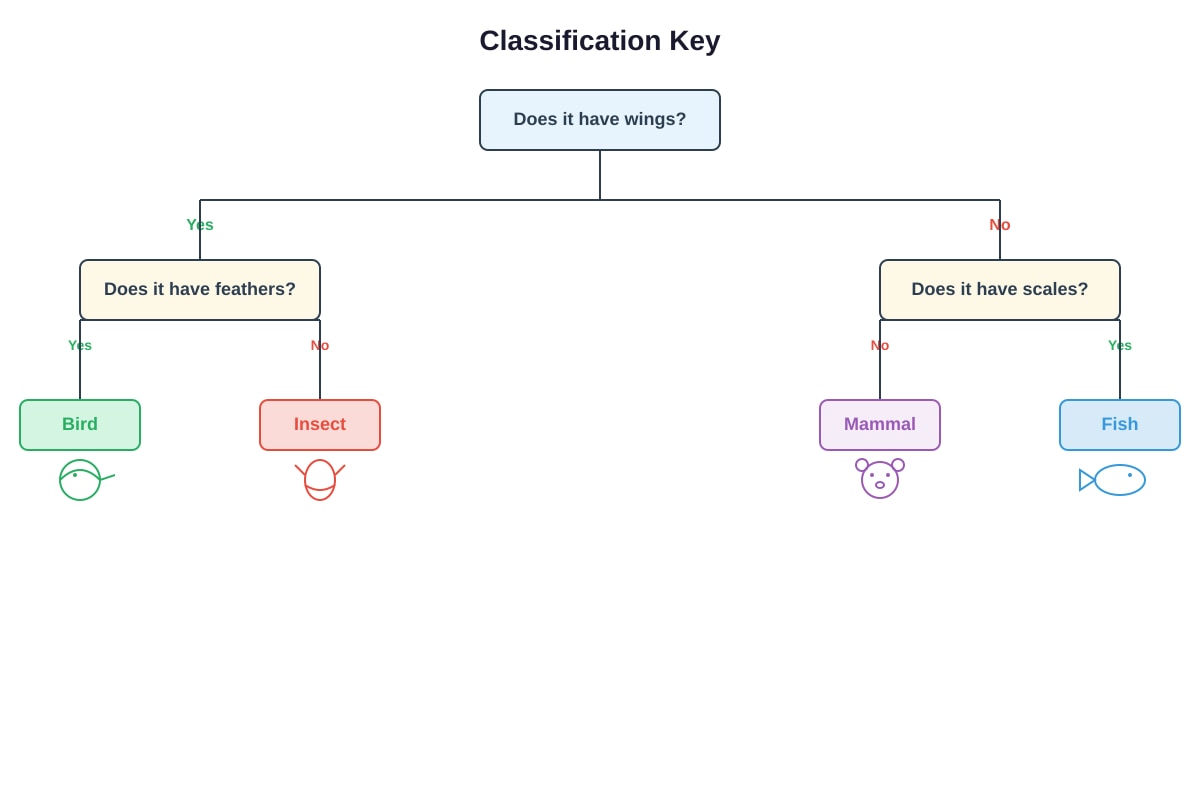
4. Look at the classification key below.
<image_placeholder> id: Q4-fig1 type: diagram linked_question: Q4 description: A simple branching classification key (dichotomous key) with 3 levels. Level 1 asks "Does it have wings?" with two branches. Branch "Yes" leads to Level 2 "Does it have feathers?" with "Yes" leading to bird and "No" leading to insect. Branch "No" leads to Level 2 "Does it have scales?" with "Yes" leading to fish and "No" leading to mammal. labels: Level 1: "Does it have wings?", Level 2 left: "Does it have feathers?", Level 2 right: "Does it have scales?", End points: bird, insect, fish, mammal values: none must_show: Clear branching structure, yes/no labels at each decision point, all four animal groups at endpoints </image_placeholder>
What type of animal would you get if you followed: Has wings → Does NOT have feathers?
| A | B | C | D |
|---|---|---|---|
| Bird | Insect | Fish | Mammal |
Answer: _________________________
5. Plants make their own food using a process called _______.
| A | B | C | D |
|---|---|---|---|
| respiration | photosynthesis | digestion | germination |
Answer: _________________________
6. Which of these is NOT a characteristic of all living things?
| A | B | C | D |
|---|---|---|---|
| They can grow | They can reproduce | They can move from place to place | They respond to stimuli |
Answer: _________________________
7. A mushroom is classified as a _______ because it cannot make its own food and absorbs nutrients from dead matter.
| A | B | C | D |
|---|---|---|---|
| plant | fungus | bacteria | protist |
Answer: _________________________
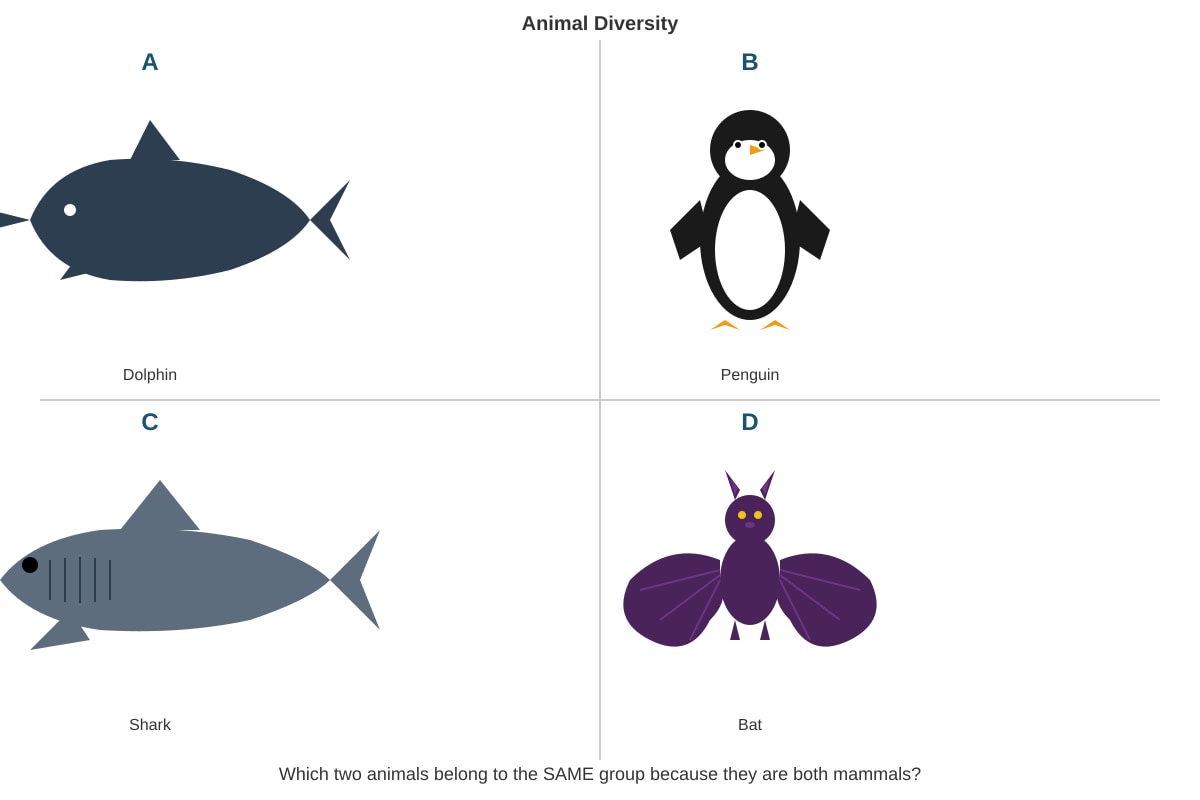
8. Look at the animals below.
<image_placeholder> id: Q8-fig1 type: diagram linked_question: Q8 description: Four animal silhouettes arranged in a 2x2 grid. Top-left: dolphin (marine mammal with streamlined body, dorsal fin, flippers). Top-right: penguin (bird standing upright, flipper-like wings, black and white coloring). Bottom-left: shark (fish with pointed dorsal fin, gill slits visible, triangular teeth showing). Bottom-right: bat (mammal with wings formed from stretched skin membrane, visible ears, hanging posture). labels: A (dolphin), B (penguin), C (shark), D (bat) values: none must_show: Distinct silhouettes showing key features - dolphin's beak and flippers, penguin's upright posture and flipper wings, shark's gill slits and triangular dorsal fin, bat's wing membrane structure and ear shape </image_placeholder>
Which two animals belong to the SAME group because they are both mammals?
| A | B | C | D |
|---|---|---|---|
| A and B | A and D | B and C | C and D |
Answer: _________________________
9. Seeds are dispersed by wind, water, animals, and splitting action. Which seed structure is BEST suited for wind dispersal?
| A | B | C | D |
|---|---|---|---|
| Fleshy and juicy | Hook-like structures | Light and feathery wings | Hard and smooth |
Answer: _________________________
10. Which statement about bacteria is TRUE?
| A | B | C | D |
|---|---|---|---|
| Bacteria are plants that can make their own food | All bacteria are harmful to humans | Bacteria are too small to see without a microscope | Bacteria have many cells like animals |
Answer: _________________________
Section B: Short Answer (Questions 11–16)
3 marks each. Write your answers in the spaces provided.
11. (a) Name two characteristics that ALL living things share.
____________________________________________________________________ [1]
(b) Give ONE example of how a plant shows one of these characteristics.
____________________________________________________________________
____________________________________________________________________ [2]
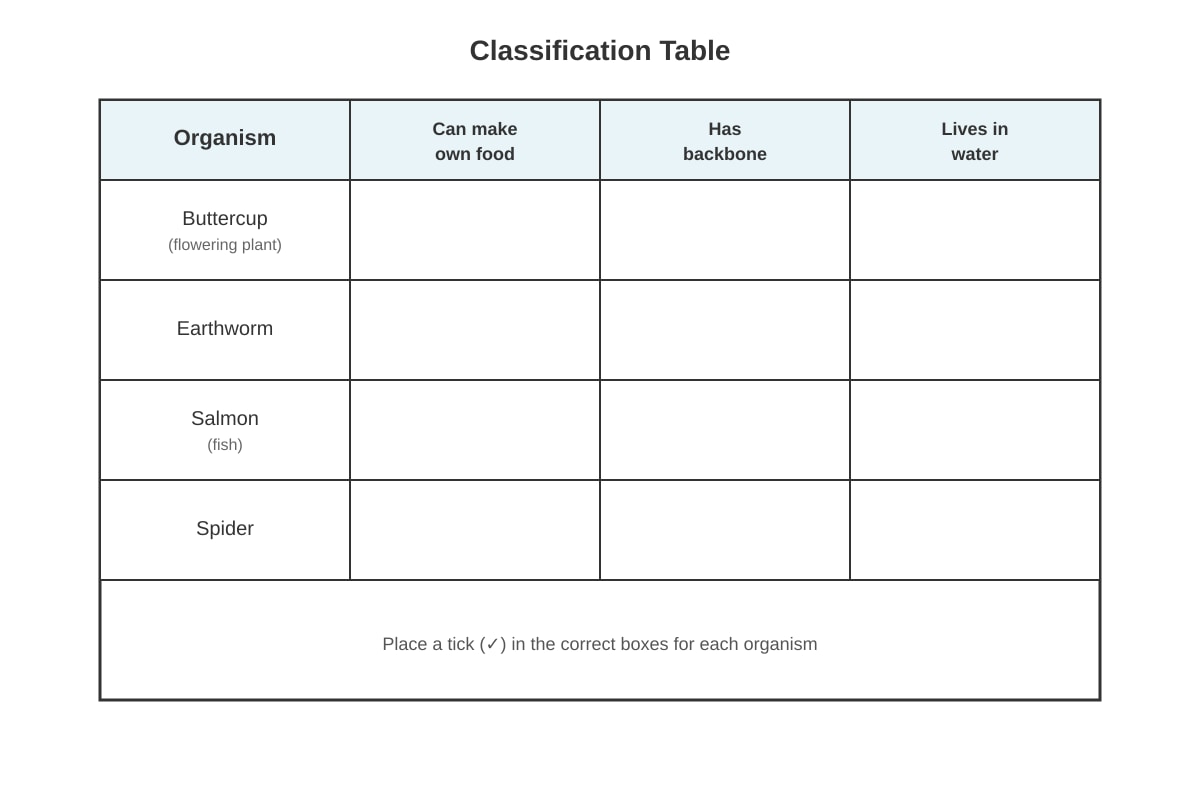
12. The table below shows four organisms. Complete the table by placing a tick (✓) in the correct boxes.
<image_placeholder> id: Q12-fig1 type: table linked_question: Q12 description: A table with 5 rows and 4 columns. First column lists organisms: Buttercup (flowering plant), Earthworm, Salmon (fish), Spider. The next three columns are headers: "Can make own food", "Has backbone", "Lives in water". Students must place ticks in appropriate cells. labels: Rows: Buttercup, Earthworm, Salmon, Spider. Columns: Organism, Can make own food, Has backbone, Lives in water values: none (student fills in) must_show: Clear grid structure with all four organisms listed, three feature columns with correct headers, empty cells for student response </image_placeholder>
[3]
13. (a) What is the main difference between vertebrates and invertebrates?
____________________________________________________________________
____________________________________________________________________ [1]
(b) Name one example of an invertebrate.
____________________________________________________________________ [1]
(c) Explain why a human is classified as a mammal.
____________________________________________________________________
____________________________________________________________________ [1]
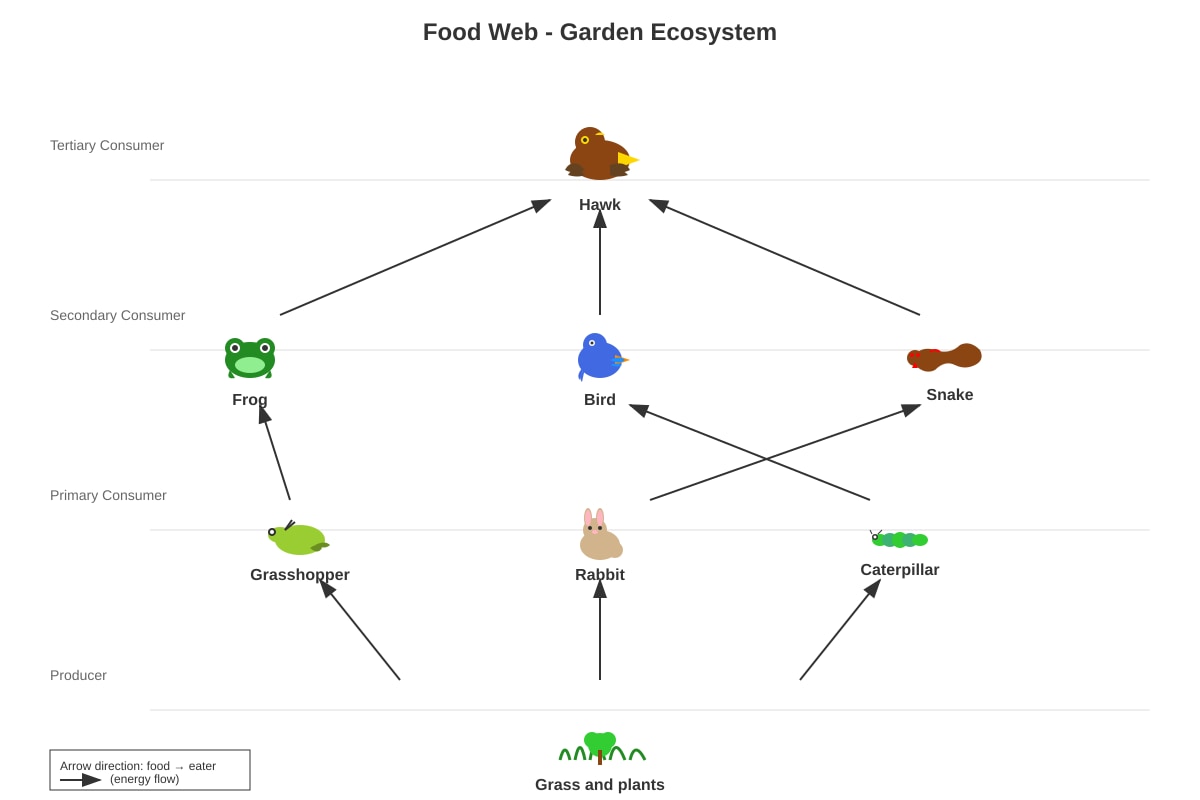
14. Look at the food web below.
<image_placeholder> id: Q14-fig1 type: diagram linked_question: Q14 description: A simple food web diagram showing connections between organisms in a garden ecosystem. At the bottom: grass and plants (producers). Primary consumers: grasshopper, rabbit, and caterpillar all shown eating plants. Secondary consumers: frog eating grasshopper; bird eating caterpillar; snake eating rabbit. Tertiary consumer: hawk eating both snake and bird. Arrows point from food to eater showing energy flow direction. labels: Grass and plants, Grasshopper, Rabbit, Caterpillar, Frog, Bird, Snake, Hawk. Arrows with direction clearly shown. values: none must_show: All eight organisms clearly labeled, arrows showing correct feeding relationships, producer level at bottom, three consumer levels above, no crossed arrows that create ambiguity </image_placeholder>
(a) Name the producer in this food web.
____________________________________________________________________ [1]
(b) Write down the food chain that contains the frog.
____________________________________________________________________ [1]
(c) What would happen to the grasshopper population if all the frogs were removed? Explain your answer.
____________________________________________________________________
____________________________________________________________________
____________________________________________________________________ [1]
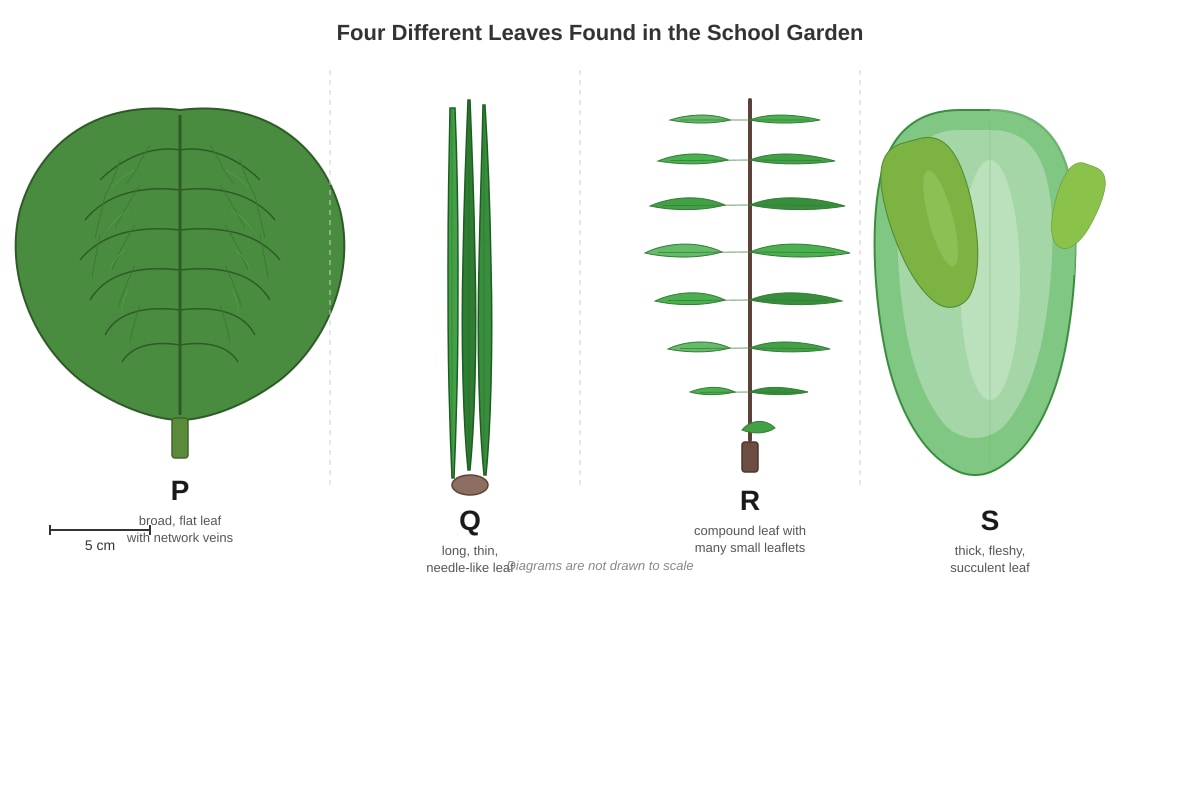
15. Sarah found four different leaves in her school garden. She recorded her observations.
<image_placeholder> id: Q15-fig1 type: diagram linked_question: Q15 description: Four leaves labeled P, Q, R, and S arranged horizontally. Leaf P: large, broad, flat leaf with visible network veins (dicot). Leaf Q: long, thin, needle-like leaf (conifer/pine). Leaf R: compound leaf with many small leaflets arranged along a central stalk (pinnate). Leaf S: thick, fleshy, succulent leaf with smooth edges. labels: P, Q, R, S below each leaf values: none must_show: Distinct leaf shapes clearly differentiated - broad flat blade with net-like vein pattern for P, needle shape for Q, multiple leaflets on central rachis for R, thick water-storing tissue appearance for S </image_placeholder>
(a) Which leaf (P, Q, R, or S) is most likely from a plant that lives in a dry habitat? Explain your choice.
____________________________________________________________________
____________________________________________________________________
____________________________________________________________________ [2]
(b) Suggest one way Leaf P is suited for growing in a shady area with little wind.
____________________________________________________________________
____________________________________________________________________ [1]
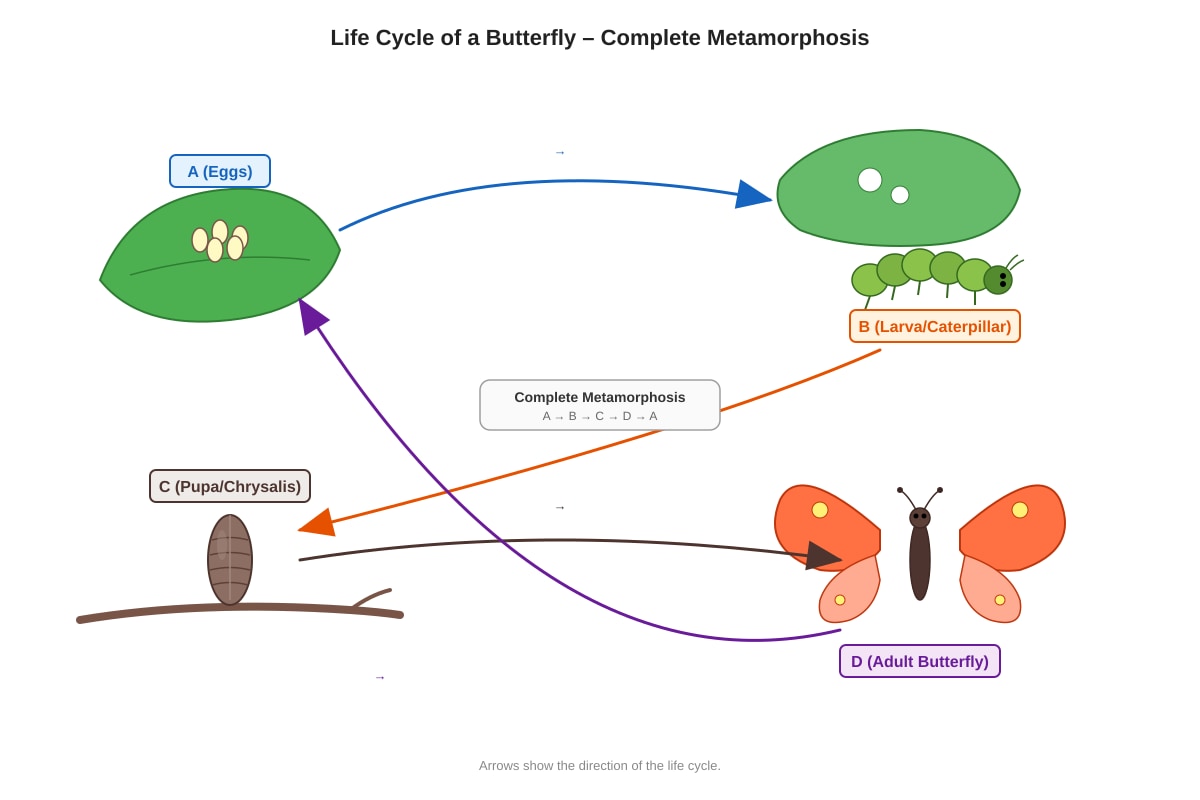
16. Look at the life cycle diagram below.
<image_placeholder> id: Q16-fig1 type: diagram linked_question: Q16 description: Complete metamorphosis life cycle shown in a circular sequence with four stages connected by arrows. Stage A: small cluster of oval eggs on a leaf. Stage B: caterpillar (larva) with segmented body eating leaf. Stage C: chrysalis/pupa hanging from branch, brown oval case. Stage D: adult butterfly with large colorful wings. Arrows show progression A→B→C→D→A. labels: A (Eggs), B (Larva/Caterpillar), C (Pupa/Chrysalis), D (Adult Butterfly) values: none must_show: All four stages clearly depicted with visual differences, arrows showing cycle direction, labels A-D, leaf context for eggs and caterpillar, branch for pupa, open-wing posture for adult butterfly </image_placeholder>
(a) Name the animal that undergoes this type of life cycle.
____________________________________________________________________ [1]
(b) Name stage C.
____________________________________________________________________ [1]
(c) Explain why this is called "complete metamorphosis."
____________________________________________________________________
____________________________________________________________________ [1]
Section C: Structured Questions (Questions 17–20)
5 marks each.
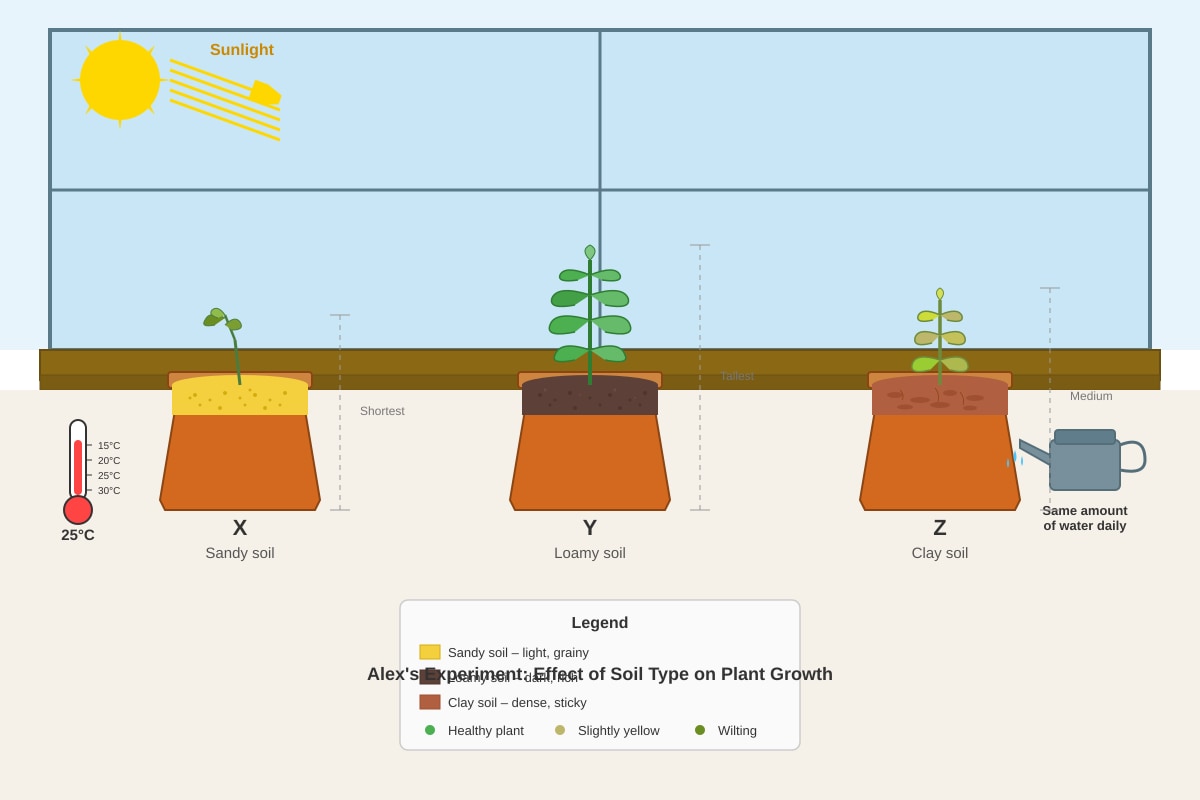
17. Alex set up an experiment to find out if different types of soil affect plant growth. He used the same type of plant seed and the same amount of water for each pot.
<image_placeholder> id: Q17-fig1 type: experimental_setup linked_question: Q17 description: Diagram showing three identical plant pots labeled X, Y, and Z on a windowsill with sunlight arrows from left. Each pot contains soil with a young plant. Pot X: sandy soil, plant looks small and wilting. Pot Y: loamy soil, plant looks healthy and tall. Pot Z: clay soil, plant looks medium height, slightly yellow leaves. Watering can shown with "Same amount of water daily" label. Thermometer shows 25°C near pots. labels: Pots X, Y, Z; Sandy soil (X), Loamy soil (Y), Clay soil (Z); Sunlight arrows; Watering can; Temperature 25°C values: Plant heights visually indicated: X shortest, Y tallest, Z medium must_show: Three clearly differentiated soil types in identical pots, visual difference in plant health/height, consistent lighting and watering labels, temperature reading, plant appearance matching soil type (stunted in sand, healthy in loam, moderate in clay) </image_placeholder>
(a) What is the aim of Alex's experiment?
____________________________________________________________________ [1]
(b) Name TWO things Alex kept the same in his experiment to make it fair.
____________________________________________________________________
____________________________________________________________________ [2]
(c) Which type of soil is BEST for plant growth? Use evidence from the diagram to explain your answer.
____________________________________________________________________
____________________________________________________________________
____________________________________________________________________ [2]
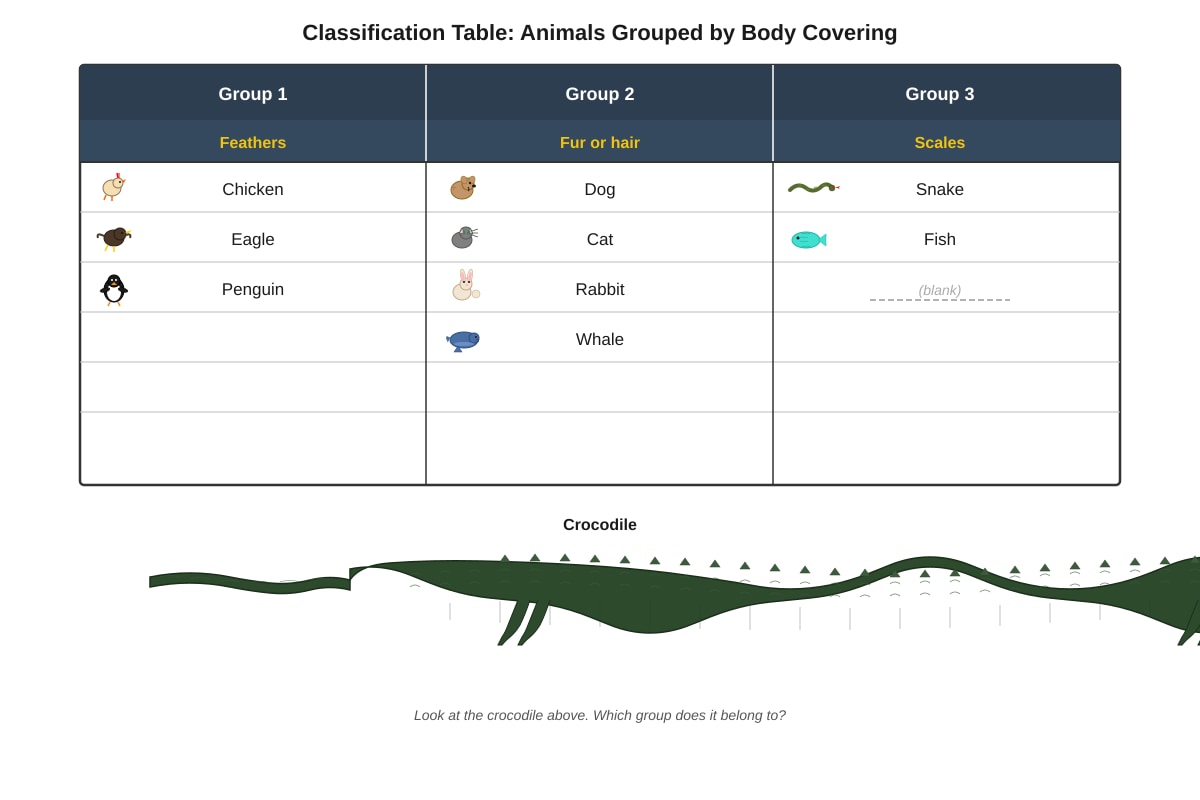
18. The classification table below shows how some animals are grouped.
<image_placeholder> id: Q18-fig1 type: table linked_question: Q18 description: Classification table with three main groups. Group 1 labeled "Animals with feathers" contains chicken, eagle, penguin. Group 2 labeled "Animals with fur or hair" contains dog, cat, rabbit, whale. Group 3 labeled "Animals with scales" is partially filled, containing snake and fish, with one blank row at the bottom. Below the table is a silhouette of a crocodile. labels: Group 1, Group 2, Group 3; Feathers, Fur or hair, Scales; Chicken, Eagle, Penguin, Dog, Cat, Rabbit, Whale, Snake, Fish; Crocodile image below table values: none must_show: All existing animal names clearly listed under correct groups, blank row in Group 3 indicated by empty cell or underline, crocodile silhouette with visible scales and distinctive snout shape </image_placeholder>
(a) To which group should the crocodile belong?
____________________________________________________________________ [1]
(b) Name the feature that is used to decide which group an animal belongs to.
____________________________________________________________________ [1]
(c) A student says, "A whale should not be in Group 2 because it lives in water like fish." Do you agree? Explain your answer.
____________________________________________________________________
____________________________________________________________________
____________________________________________________________________
____________________________________________________________________ [3]
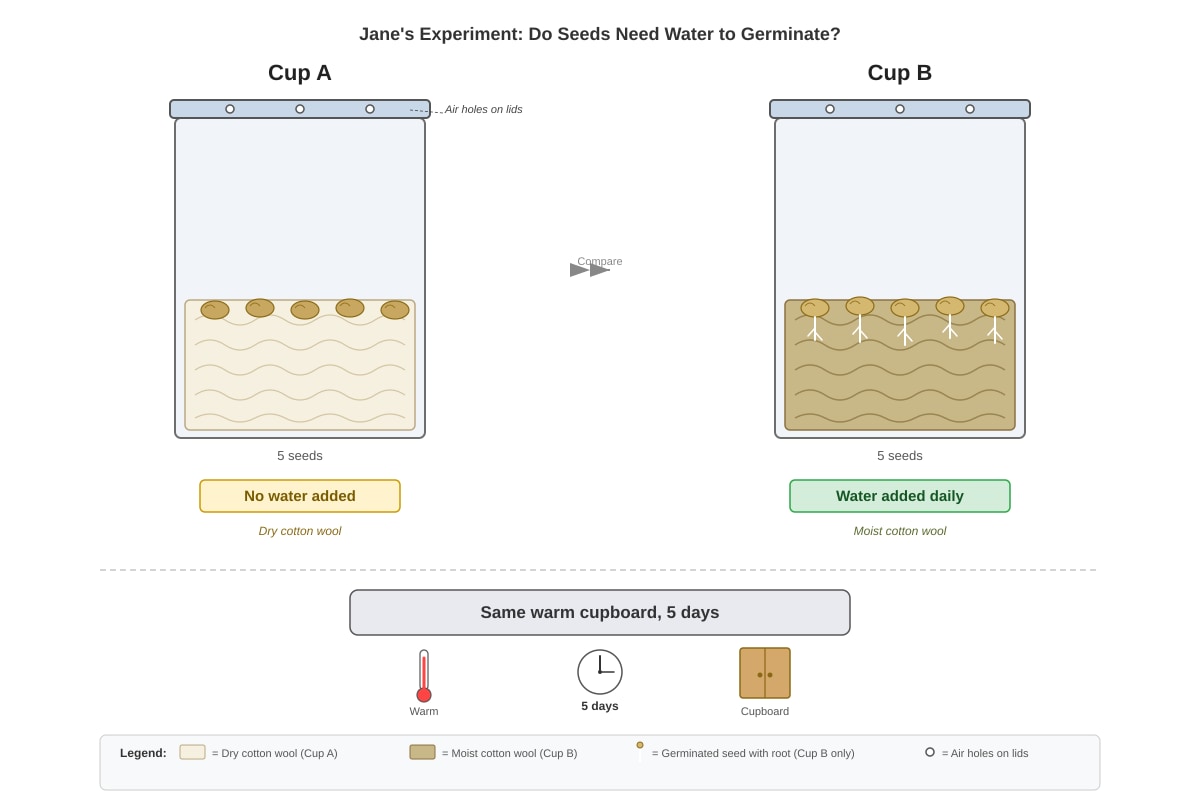
19. Jane wanted to find out if seeds need water to germinate. She set up two pots as shown below.
<image_placeholder> id: Q19-fig1 type: experimental_setup linked_question: Q19 description: Two identical clear plastic cups shown side by side, each containing cotton wool and five bean seeds arranged in a row. Cup A: cotton wool is dry, seeds appear shriveled/unchanged. Label "No water added." Cup B: cotton wool is moist/darkened, small white roots emerging from seeds. Label "Water added daily." Both cups have lids with small air holes. Label "Same warm cupboard, 5 days" at bottom. labels: Cup A, Cup B; No water added (A), Water added daily (B); Air holes on lids; Same warm cupboard, 5 days values: 5 seeds in each cup, 5 days duration, warm cupboard conditions must_show: Visual difference in cotton wool moisture (dry vs damp), germinated roots visible only in Cup B seeds, identical cup and seed arrangement, air holes on lids indicated, clear time and condition labels </image_placeholder>
(a) What is changed in Jane's experiment? (The variable)
____________________________________________________________________ [1]
(b) Write down TWO things that Jane kept the same.
____________________________________________________________________
____________________________________________________________________ [2]
(c) What conclusion can Jane make from her results?
____________________________________________________________________
____________________________________________________________________ [2]
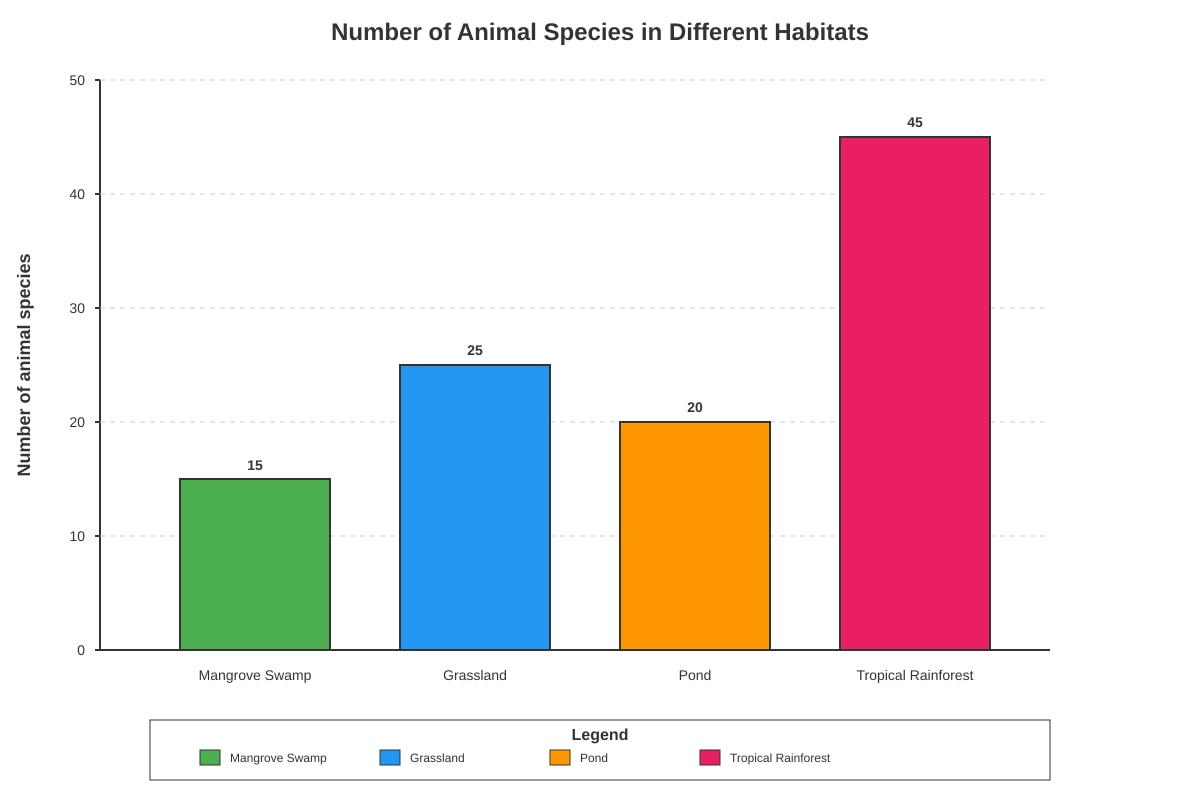
20. The bar graph below shows the number of different types of animals found in four different habitats.
<image_placeholder> id: Q20-fig1 type: graph linked_question: Q20 description: Bar graph with four habitats on x-axis: Mangrove Swamp, Grassland, Pond, Tropical Rainforest. Y-axis labeled "Number of animal species" with scale 0 to 50 in intervals of 10. Bars show: Mangrove Swamp ~15 species, Grassland ~25 species, Pond ~20 species, Tropical Rainforest ~45 species. Each bar is a different color with legend. labels: X-axis: Mangrove Swamp, Grassland, Pond, Tropical Rainforest. Y-axis: Number of animal species. Scale: 0, 10, 20, 30, 40, 50. values: Mangrove Swamp: 15, Grassland: 25, Pond: 20, Tropical Rainforest: 45 must_show: All four bars with correct heights matching values, clear axis labels, numerical scale on y-axis, color differentiation between bars, legend or bar labels for identification </image_placeholder>
(a) Which habitat has the greatest variety of animal species?
____________________________________________________________________ [1]
(b) Based on the data, suggest why the tropical rainforest has more animal species than the grassland.
____________________________________________________________________
____________________________________________________________________
____________________________________________________________________ [2]
(c) A scientist wants to study how pollution affects animal life. Should she choose the pond or the tropical rainforest? Explain your choice.
____________________________________________________________________
____________________________________________________________________
____________________________________________________________________ [2]
END OF QUIZ
Answers
Primary 4 Science Quiz - Diversity (Answer Key)
Total Marks: 40 marks
Section A: Multiple Choice (2 marks each)
1. B — Frog, mushroom, grass
Explanation: Living things can grow, reproduce, respond to stimuli, and need food. Rocks, water, plastic, rubber, and metals are non-living things. A mushroom is a fungus (living), while frogs and grass are clearly living things. (2 marks)
2. B — vertebrates
Explanation: Vertebrates are animals with a backbone (also called a spinal column or spine). Invertebrates do NOT have a backbone. Amphibians are a type of vertebrate, and molluscs are invertebrates. (2 marks)
3. B — Humps that store fat
Explanation: Camels live in hot deserts where food and water are scarce. Their humps store fat, which can be converted to energy and water when needed. Thick fur would cause overheating; gills and webbed feet are for aquatic life. (2 marks)
4. B — Insect
Explanation: Following the key: "Does it have wings?" → Yes → "Does it have feathers?" → No → leads to insect. Birds have feathers; insects have wings but no feathers. (2 marks)
5. B — photosynthesis
Explanation: Photosynthesis is the process by which plants use sunlight, water, and carbon dioxide to make their own food (glucose). Respiration releases energy; digestion breaks down food; germination is when a seed begins to grow. (2 marks)
6. C — They can move from place to place
Explanation: While many animals move, not all living things can move from place to place. Plants are living things but they cannot move around. All living things can grow, reproduce, and respond to stimuli. (2 marks)
7. B — fungus
Explanation: Mushrooms are fungi. They cannot make their own food like plants do. Instead, they absorb nutrients from dead or decaying matter. This makes them decomposers in the ecosystem. (2 marks)
8. B — A and D
Explanation: The dolphin (A) and the bat (D) are both mammals. Dolphins are marine mammals that breathe air through lungs and give birth to live young. Bats are the only mammals that can truly fly. Penguins are birds (have feathers, lay eggs); sharks are fish (have scales, gills). (2 marks)
9. C — Light and feathery wings
Explanation: Seeds with light, wing-like structures (e.g., seeds of lallang or saga tree) can be carried long distances by wind. Fleshy/juicy seeds attract animals for animal dispersal; hooks attach to animal fur; hard smooth seeds may be dispersed by water or splitting. (2 marks)
10. C — Bacteria are too small to see without a microscope
Explanation: Bacteria are single-celled microorganisms (microbes) that are invisible to the naked eye. Not all bacteria are harmful—some help with digestion and make food (like yogurt); bacteria are not plants; they have only one cell, unlike multicellular animals. (2 marks)
Section B: Short Answer (3 marks each)
11. (a) Any TWO from: can grow, can reproduce, need food/nutrients, respond to stimuli, breathe/respire, excrete waste [1]
(b) Example: A seed germinates and grows into a plant / A plant grows bigger and produces more leaves / A plant bends toward light [2]
Marking notes: [1 mark for naming characteristic; 2 marks for specific example with explanation of the characteristic shown]
12. Completed table:
| Organism | Can make own food | Has backbone | Lives in water |
|---|---|---|---|
| Buttercup | ✓ | ||
| Earthworm | |||
| Salmon | ✓ | ✓ | |
| Spider |
[3 marks]
Marking notes: [1 mark per correct row; must have all three ticks correctly placed for full marks]
13. (a) Vertebrates have a backbone; invertebrates do not have a backbone [1]
(b) Any one: ant, spider, worm, snail, butterfly, cockroach, jellyfish, crab [1]
(c) Humans are mammals because they have hair/fur (even if little), give birth to live young, and female humans produce milk to feed their babies [1]
Marking notes: Any two mammal characteristics accepted for [1 mark]
14. (a) Grass and plants [1]
(b) Grass → Grasshopper → Frog [1] (accept: Plants → Grasshopper → Frog)
(c) The grasshopper population would increase/get larger because there would be no frogs to eat them [1]
Marking notes: For (c), must mention increase in grasshoppers AND reason (no predator/frog to eat them)
15. (a) S [1]; It is thick and fleshy, which helps store water [1]
(b) It has a large, broad surface to capture more sunlight in shady conditions / The broad flat shape is not easily damaged in low wind [1]
Marking notes: For (a), must identify correct leaf AND give correct explanation about water storage. For (b), must link broad flat shape to either capturing more light OR stability in low wind.
16. (a) Butterfly (or moth) [1]
(b) Pupa (or chrysalis) [1]
(c) It is called complete metamorphosis because the animal goes through four very different stages (egg, larva, pupa, adult), and the adult looks completely different from the larva [1]
Marking notes: For (c), mention of "four stages" OR "adult looks different from young" acceptable. Must show understanding of dramatic change in form.
Section C: Structured Questions (5 marks each)
17. (a) To find out if different types of soil affect plant growth / To find out which type of soil is best for plant growth [1]
(b) Any TWO from: same type of plant seed, same amount of water, same size pot, same temperature/location (25°C), same amount of sunlight [2 marks: 1 each]
(c) Loamy soil (Y) [1]; The plant in loamy soil is the tallest/healthiest-looking compared to the plant in sandy soil (smallest/wilting) and clay soil (medium/slightly yellow) [1]
Marking notes: For (c), must identify correct soil AND use evidence from diagram comparing plant appearance in at least one other soil type.
18. (a) Group 3 — Animals with scales [1]
(b) Body covering (or type of outer covering/skin) [1]
(c) Agree or disagree accepted if well-reasoned. [3 marks]
Agree with reasoning correction: I do not agree with the student's reason. [1] While whales live in water, they breathe air through lungs, have hair (tiny bristles), and give birth to live young — these are mammal features. [1] Fish have scales and breathe through gills. [1]
OR
I agree that the student's REASON is not good, but the whale IS correctly placed in Group 2. [1] Where an animal lives is not the best way to classify it. [1] We should use body features like having fur/hair and feeding babies with milk, which whales do. [1]
Marking notes: Must address both the habitat argument AND the correct classification basis (body covering/reproduction method). Maximum [1] if only states disagreement without explanation.
19. (a) Water / Presence of water [1]
(b) Any TWO from: same type of seed, same number of seeds (five), same type of container/cup, same location/warm cupboard, same duration (5 days), same amount of cotton wool, same air holes in lids [2 marks: 1 each]
(c) Seeds need water to germinate [1]; The seeds with water (Cup B) germinated/had roots growing, but seeds without water (Cup A) did not germinate [1]
Marking notes: For (c), must state conclusion AND provide evidence from the diagram comparing both cups.
20. (a) Tropical Rainforest [1]
(b) The tropical rainforest has more layers/canopy/vegetation, providing more food sources and habitats/shelter for different animals [2 marks: 1 for food sources, 1 for shelter/habitat variety]
(c) The pond [1]; The tropical rainforest already has very high diversity (45 species), so changes from pollution may be harder to detect. The pond has fewer species (20), so changes would be more obvious/easier to measure [1]
Alternative accepted: Tropical rainforest [1]; It has the greatest variety of species, so scientists can see how pollution affects many different types of animals and compare which are most sensitive [1]
Marking notes: For (c), must give valid scientific reasoning for whichever habitat chosen. "Easier to see changes" or "more species to study" are both acceptable lines of reasoning.
END OF ANSWER KEY