AI Generated Exam Paper

Primary 4 Science Practice Paper 4

Free AI-Generated NVIDIA Nemotron 3 Ultra 550B A55B Free Primary 4 Science Practice Paper 4 practice paper with questions and answers for Singapore students. This page is rendered as a direct URL so the questions and answers can be discovered without pressing in-page buttons.

These static practice materials are generated from the site's syllabus and paper-generation workflow, with source and model context shown so students and parents can evaluate the material before use.

Primary 4 Science AI Generated Generated by NVIDIA Nemotron 3 Ultra 550B A55B Free Updated 2026-06-07

Questions

<!-- TuitionGoWhere generation metadata: stage=5-2; model=nvidia/nemotron-3-ultra-550b-a55b:free; model_label=NVIDIA Nemotron 3 Ultra 550B A55B Free; generated=2026-06-05; Sources: Stage 4-0 LLM templates, syllabus context, and Stage 2 evidence where available. -->

TuitionGoWhere Practice Paper - Science Primary 4

TuitionGoWhere Practice Paper (AI) - Version 4

Subject: Science
Level: Primary 4
Paper: Practice Paper - Diversity
Duration: 45 minutes
Total Marks: 50

Name: ________________________
Class: Primary 4 _______
Date: ________________________


Instructions to Candidates

  1. Do not open this booklet until you are told to do so.
  2. Follow all instructions carefully.
  3. Answer all questions.
  4. For Section A, shade your answers on the Optical Answer Sheet (OAS) provided.
  5. For Section B and C, write your answers in the spaces provided in this booklet.
  6. The number of marks is given in brackets [ ] at the end of each question or part question.
  7. The total marks for this paper is 50.

Section A: Multiple-Choice Questions (20 marks)

For each question from 1 to 10, four options are given. One of them is the correct answer. Make your choice (1, 2, 3 or 4) and shade the correct oval on the OAS. [20 marks]

Question 1 [2 marks]

Which of the following groups contains only living things?

(1) Mushroom, moss, rock
(2) Bacteria, yeast, mould
(3) Cloud, river, soil
(4) Seed, wooden table, plastic bottle

Question 2 [2 marks]

Study the classification chart below.

                    Things
                   /      \
              Living    Non-living
             /    \      /      \
        Plants  Animals  Man-made  Natural

Which of the following is correctly placed under "Natural" non-living things?

(1) Glass bottle
(2) Metal spoon
(3) River water
(4) Paper bag

Question 3 [2 marks]

Four pupils made the following statements about living things:

  • Ali: All living things can move from place to place.
  • Bala: All living things need air, food and water.
  • Cindy: All living things reproduce by laying eggs.
  • Devi: All living things grow and become bigger.

Which pupil made the correct statement?

(1) Ali
(2) Bala
(3) Cindy
(4) Devi

Question 4 [2 marks]

<image_placeholder> id: Q4-fig1 type: diagram linked_question: Q4 description: A flowchart showing classification of organisms into plants, animals, fungi, and bacteria. Four organisms (A, B, C, D) are placed at the end of branches with their characteristics described in boxes. labels: Organism A: Makes its own food, has green leaves; Organism B: Cannot make its own food, has fur, gives birth to young alive; Organism C: Reproduces by spores, grows on decaying matter; Organism D: Single-celled, reproduces by binary fission values: None must_show: Clear branching flowchart with four end branches labeled A, B, C, D and characteristic boxes for each </image_placeholder>

Based on the flowchart above, which organism is most likely a bacterium?

(1) Organism A
(2) Organism B
(3) Organism C
(4) Organism D

Question 5 [2 marks]

Which of the following is a characteristic of fungi but NOT of plants?

(1) Reproduce by spores
(2) Have cell walls
(3) Cannot make their own food
(4) Are living things

Question 6 [2 marks]

Study the table below.

OrganismMakes own foodReproduces by sporesBody made of hyphae
MushroomNoYesYes
FernYesYesNo
BacteriaNoNoNo
MossYesYesNo

Which organism is correctly matched to its group?

(1) Mushroom - Plant
(2) Fern - Fungi
(3) Bacteria - Fungi
(4) Moss - Plant

Question 7 [2 marks]

<image_placeholder> id: Q7-fig1 type: diagram linked_question: Q7 description: A dichotomous key for classifying five animals (W, X, Y, Z, P) based on observable features. labels: Question 1: Has wings? Yes -> Question 2; No -> Question 3. Question 2: Has feathers? Yes -> W; No -> X. Question 3: Lives in water? Yes -> Y; No -> Question 4. Question 4: Has scales? Yes -> Z; No -> P. values: None must_show: Clear dichotomous key with yes/no branches leading to five animals W, X, Y, Z, P </image_placeholder>

Using the dichotomous key above, which animal is most likely a snake?

(1) W
(2) X
(3) Y
(4) Z

Question 8 [2 marks]

Which of the following statements about bacteria is correct?

(1) All bacteria are harmful to humans.
(2) Bacteria can only be seen with a microscope.
(3) Bacteria reproduce by spores.
(4) Bacteria make their own food using sunlight.

Question 9 [2 marks]

A pupil observed an organism with the following characteristics:

  • It is green in colour.
  • It grows in damp, shady places.
  • It reproduces by spores.
  • It does not have true roots, stems or leaves.

Which group does this organism most likely belong to?

(1) Fungi
(2) Bacteria
(3) Mosses
(4) Flowering plants

Question 10 [2 marks]

Study the classification table below.

GroupExamples
AYeast, mould, mushroom
BMoss, fern, hibiscus
CBacteria, blue-green algae
DLion, eagle, frog

Which group represents fungi?

(1) A
(2) B
(3) C
(4) D


Section B: Structured Questions (20 marks)

Write your answers in the spaces provided. [20 marks]

Question 11 [4 marks]

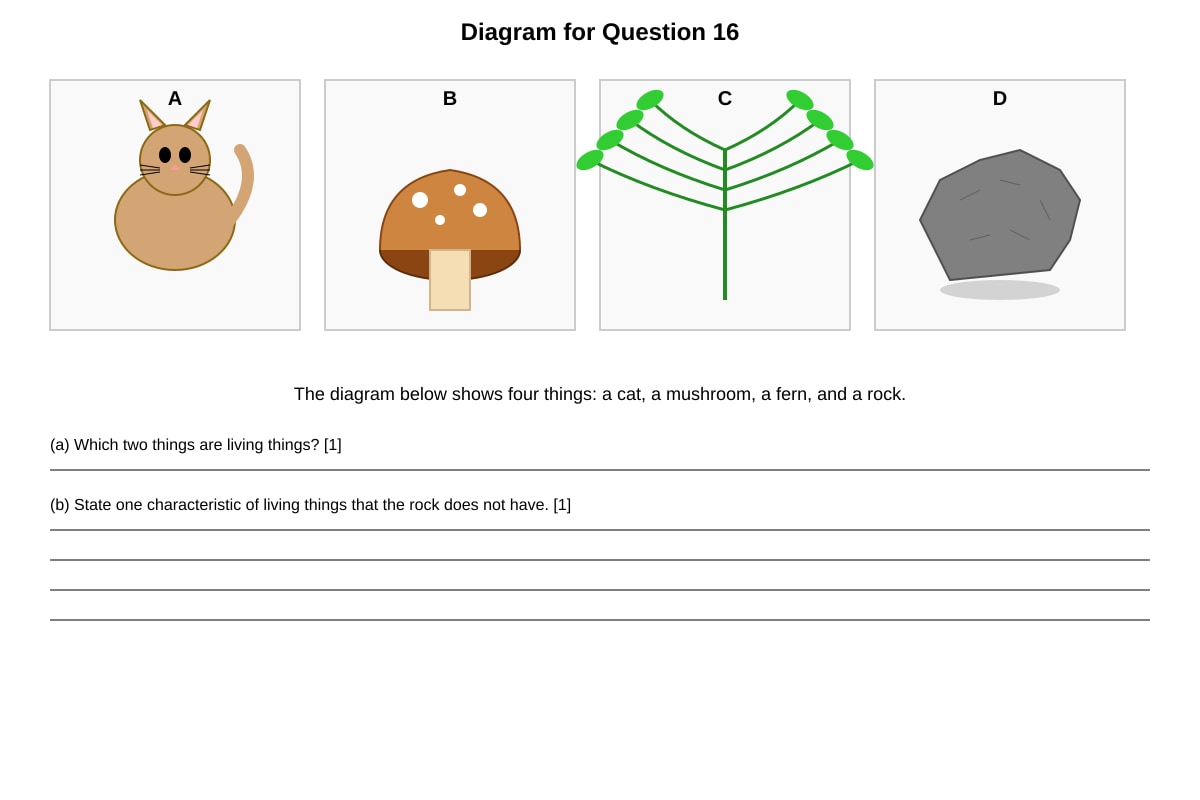
The diagram below shows four organisms.

<image_placeholder> id: Q11-fig1 type: diagram linked_question: Q11 description: Four separate diagrams showing: (a) A mushroom with visible cap, gills, and stem growing on a log; (b) A fern plant with fronds and roots; (c) A rod-shaped bacterium drawn to scale with cell wall and flagella labeled; (d) A yeast cell budding, showing parent cell and smaller bud labels: Mushroom: cap, gills, stem; Fern: frond, root, stem; Bacterium: cell wall, flagella, cytoplasm; Yeast: parent cell, bud, nucleus values: Scale bar for bacterium: 1 µm must_show: Four clear, labeled diagrams side by side or in a 2x2 grid with distinguishing features visible </image_placeholder>

(a) State the group that each organism belongs to.

Organism (a): ________________________________________ [1]

Organism (b): ________________________________________ [1]

Organism (c): ________________________________________ [1]

Organism (d): ________________________________________ [1]

(b) Choose one organism from (a) that reproduces by spores. State the organism and explain how spores help it reproduce.

Organism: ________________________________________ [1]

Explanation: ________________________________________________________________________________ [1]


Question 12 [4 marks]

The table below shows some characteristics of four organisms P, Q, R and S. A tick (✓) means the organism has the characteristic.

CharacteristicPQRS
Makes its own food
Reproduces by seeds
Reproduces by spores
Body made of hyphae
Single-celled
Reproduces by binary fission

(a) Which organism(s) is/are plant(s)? ________________________________________ [1]

(b) Which organism is a fungus? ________________________________________ [1]

(c) Which organism is a bacterium? ________________________________________ [1]

(d) State one difference between organism P and organism R in terms of how they reproduce.

______________________________________________________________________________________________ [1]


Question 13 [4 marks]

A group of pupils went on a nature walk and observed the following organisms:

  • Organism X: Green, growing on tree bark, reproduces by spores, no flowers
  • Organism Y: Microscopic, found in pond water, single-celled, reproduces by binary fission
  • Organism Z: White, powdery growth on bread, reproduces by spores, body made of thread-like structures

(a) Classify each organism into the correct group: Plant, Fungi, or Bacteria.

Organism X: ________________________________________ [1]

Organism Y: ________________________________________ [1]

Organism Z: ________________________________________ [1]

(b) Organism Z is harmful when it grows on food. Explain why it grows on bread.

______________________________________________________________________________________________ [1]


(c) State one way to prevent organism Z from growing on bread.

______________________________________________________________________________________________ [1]

Question 14 [4 marks]

<image_placeholder> id: Q14-fig1 type: diagram linked_question: Q14 description: A classification chart with missing labels. Main branches: Living Things and Non-living Things. Living Things branches to Plants, Animals, Fungi, Bacteria. Each group has 2-3 empty boxes for characteristics. Non-living Things branches to Natural and Man-made with empty boxes for examples. labels: Living Things, Non-living Things, Plants, Animals, Fungi, Bacteria, Natural, Man-made values: None must_show: Clear hierarchical classification chart with blank boxes for students to fill in characteristics and examples </image_placeholder>

Complete the classification chart above by filling in the blanks.

(a) Write two characteristics of plants in the boxes under "Plants". [2]

Characteristic 1: ________________________________________

Characteristic 2: ________________________________________

(b) Write one example each of a natural non-living thing and a man-made non-living thing. [2]

Natural: ________________________________________

Man-made: ________________________________________

Question 15 [4 marks]

The diagram below shows a dichotomous key used to classify five plants.

<image_placeholder> id: Q15-fig1 type: diagram linked_question: Q15 description: A dichotomous key for plants with questions and branches. Start: Does it bear flowers? Yes -> Does it have woody stem? Yes -> Plant A; No -> Plant B. No -> Does it reproduce by spores? Yes -> Does it have true roots, stems, leaves? Yes -> Plant C; No -> Plant D. No -> Plant E. labels: Plant A, Plant B, Plant C, Plant D, Plant E values: None must_show: Complete dichotomous key with all questions and five plant outcomes clearly labeled </image_placeholder>

(a) Based on the key, which plant(s) is/are flowering plant(s)? ________________________________________ [1]

(b) Which plant is most likely a moss? ________________________________________ [1]

(c) State one difference between Plant C and Plant D.

______________________________________________________________________________________________ [1]


(d) Plant E does not bear flowers and does not reproduce by spores. What group of plants does Plant E most likely belong to?

______________________________________________________________________________________________ [1]


Section C: Open-Ended Questions (10 marks)

Write your answers in the spaces provided. [10 marks]

Question 16 [5 marks]

Scientists discovered a new organism in a deep-sea vent. It has the following characteristics:

  • It is single-celled.
  • It does not have a nucleus.
  • It obtains energy from chemicals in the vent (chemosynthesis).
  • It reproduces by binary fission.
  • It lives in extremely hot water (above 80°C).

(a) Which group of living things does this organism most likely belong to? ________________________________________ [1]

(b) Give two reasons for your answer in (a).

Reason 1: ________________________________________________________________________________ [1]


Reason 2: ________________________________________________________________________________ [1]


(c) State one difference between this organism and a typical plant cell.

______________________________________________________________________________________________ [1]


(d) Explain why this organism is considered a living thing even though it lives in extreme conditions.

______________________________________________________________________________________________ [1]


Question 17 [5 marks]

A pupil wants to classify the following items into living and non-living things:

Mushroom, river water, metal key, moss, plastic ruler, yeast, cloud, fern, wooden chopstick, bacterium

<image_placeholder> id: Q17-fig1 type: table linked_question: Q17 description: A two-column table with headers "Living Things" and "Non-living Things". Ten empty rows for students to fill in the items. labels: Living Things, Non-living Things values: 10 items to classify: Mushroom, river water, metal key, moss, plastic ruler, yeast, cloud, fern, wooden chopstick, bacterium must_show: Clear two-column table with 10 empty rows for classification </image_placeholder>

(a) Complete the table above by classifying all 10 items. [5]

(b) The pupil classified "wooden chopstick" as a living thing because it came from a tree. Explain why this classification is incorrect.

______________________________________________________________________________________________ [1]


End of Paper

Answers

<!-- TuitionGoWhere generation metadata: stage=5-2; model=nvidia/nemotron-3-ultra-550b-a55b:free; model_label=NVIDIA Nemotron 3 Ultra 550B A55B Free; generated=2026-06-05; Sources: Stage 4-0 LLM templates, syllabus context, and Stage 2 evidence where available. -->

TuitionGoWhere Practice Paper - Science Primary 4 (Answer Key)

TuitionGoWhere Practice Paper (AI) - Version 4

Subject: Science
Level: Primary 4
Paper: Practice Paper - Diversity
Total Marks: 50


Section A: Multiple-Choice Questions (20 marks)

Question 1 [2 marks]

Answer: (2) Bacteria, yeast, mould

Explanation:

  • Bacteria, yeast, and mould are all microorganisms and are living things.
  • Option (1): Rock is non-living.
  • Option (3): Cloud, river, soil are non-living things (water, air, minerals).
  • Option (4): Wooden table and plastic bottle are man-made non-living things; a seed is living but the group contains non-living things.

Marking: 2 marks for correct option.


Question 2 [2 marks]

Answer: (3) River water

Explanation:

  • Natural non-living things are things found in nature that are not alive. River water is a natural non-living thing.
  • Glass bottle, metal spoon, and paper bag are all man-made objects.

Marking: 2 marks for correct option.


Question 3 [2 marks]

Answer: (2) Bala

Explanation:

  • Bala is correct: All living things need air (oxygen for respiration), food (for energy and growth), and water (for life processes). This is a fundamental characteristic of life.
  • Ali is incorrect: Plants are living things but cannot move from place to place (they only move parts like leaves turning to sunlight).
  • Cindy is incorrect: Not all living things lay eggs. Mammals give birth to live young; plants reproduce by seeds/spores; bacteria divide by binary fission.
  • Devi is incorrect: While living things grow, "become bigger" is not always true (e.g., bacteria grow in number, not necessarily individual size; some organisms shrink in certain life stages).

Marking: 2 marks for correct option.


Question 4 [2 marks]

Answer: (4) Organism D

Explanation:

  • Organism D is described as "single-celled, reproduces by binary fission" — these are key characteristics of bacteria.
  • Organism A makes its own food and has green leaves → Plant.
  • Organism B has fur and gives birth to young alive → Mammal (Animal).
  • Organism C reproduces by spores and grows on decaying matter → Fungus.

Marking: 2 marks for correct option.


Question 5 [2 marks]

Answer: (3) Cannot make their own food

Explanation:

  • Fungi are heterotrophs — they cannot make their own food (no chlorophyll). They obtain nutrients by absorption from decaying matter or living hosts.
  • Option (1): Some plants (ferns, mosses) also reproduce by spores.
  • Option (2): Both fungi and plants have cell walls (fungi: chitin; plants: cellulose).
  • Option (4): Both are living things.

Marking: 2 marks for correct option.


Question 6 [2 marks]

Answer: (4) Moss - Plant

Explanation:

  • Moss is a non-flowering plant that makes its own food, reproduces by spores, and does not have hyphae. This matches the table.
  • Mushroom is a fungus (not a plant) — it has hyphae and does not make its own food.
  • Fern is a plant (not fungi) — it makes its own food and has no hyphae.
  • Bacteria are neither fungi nor plants — they are single-celled, no spores, no hyphae.

Marking: 2 marks for correct option.


Question 7 [2 marks]

Answer: (4) Z

Explanation: Using the dichotomous key:

  • Snake: No wings → Question 3: Does not live in water → Question 4: Has scales → Z
  • W: Has wings + feathers → Bird
  • X: Has wings + no feathers → Insect (e.g., butterfly)
  • Y: No wings + lives in water → Fish/amphibian
  • P: No wings + no water + no scales → Mammal (e.g., rat)

Marking: 2 marks for correct option.


Question 8 [2 marks]

Answer: (2) Bacteria can only be seen with a microscope.

Explanation:

  • Bacteria are microscopic single-celled organisms. Individual bacteria cannot be seen with the naked eye; a microscope is needed.
  • (1) is false: Many bacteria are beneficial (e.g., gut bacteria, decomposers, used in food production).
  • (3) is false: Bacteria reproduce by binary fission, not spores (though some form endospores for survival, this is not their main reproduction).
  • (4) is false: Bacteria do not photosynthesize (except photosynthetic bacteria, but this is not a general characteristic taught at P4).

Marking: 2 marks for correct option.


Question 9 [2 marks]

Answer: (3) Mosses

Explanation:

  • The organism is green (has chlorophyll), grows in damp shady places, reproduces by spores, and lacks true roots, stems, leaves — these are characteristics of mosses (bryophytes).
  • Fungi: Not green, no chlorophyll.
  • Bacteria: Microscopic, not visible as green growth.
  • Flowering plants: Have true roots, stems, leaves; reproduce by seeds.

Marking: 2 marks for correct option.


Question 10 [2 marks]

Answer: (1) A

Explanation:

  • Group A: Yeast, mould, mushroom — all are fungi.
  • Group B: Moss, fern, hibiscus — all are plants.
  • Group C: Bacteria, blue-green algae (cyanobacteria) — bacteria/prokaryotes.
  • Group D: Lion, eagle, frog — all are animals.

Marking: 2 marks for correct option.


Section B: Structured Questions (20 marks)

Question 11 [4 marks]

(a) [4 marks — 1 mark each]

  • Organism (a): Fungi (or Mushroom / Fungus)
  • Organism (b): Plants (or Fern / Plant)
  • Organism (c): Bacteria (or Bacterium / Prokaryote)
  • Organism (d): Fungi (or Yeast / Fungus)

(b) [2 marks — 1 mark for organism, 1 mark for explanation]

  • Organism: Mushroom (or Fern, or Yeast — any one that reproduces by spores)
  • Explanation: Spores are tiny, lightweight reproductive units that can be dispersed by wind/water to new locations. When conditions are favourable (moisture, nutrients), spores germinate and grow into new organisms. This allows the organism to reproduce and spread without needing a mate.

Marking notes:

  • Accept any organism from (a) that reproduces by spores (mushroom, fern, yeast).
  • Explanation must mention dispersal and germination/growth under suitable conditions.

Question 12 [4 marks]

(a) [1 mark] Organism P (and possibly R — but P is the only one that reproduces by seeds, a plant characteristic; R makes food and reproduces by spores → fern/moss, also a plant). Accept: P and R or P only if only seed plants considered. Best answer: P and R (both make own food = plants).

(b) [1 mark] Organism Q (reproduces by spores, body made of hyphae, does not make own food → fungus)

(c) [1 mark] Organism S (single-celled, reproduces by binary fission → bacterium)

(d) [1 mark]

  • P reproduces by seeds (flowering plant), while R reproduces by spores (non-flowering plant like fern/moss).
  • OR: P produces seeds after flowering; R produces spores on the underside of fronds/leaves.

Marking notes:

  • For (a), award 1 mark if both P and R are identified as plants. If only P given, still award 1 mark (seed plants are clearer at P4 level).
  • For (d), must contrast seed vs spore reproduction.

Question 13 [4 marks]

(a) [3 marks — 1 mark each]

  • Organism X: Plant (green, reproduces by spores, no flowers → moss/fern)
  • Organism Y: Bacteria (microscopic, single-celled, binary fission)
  • Organism Z: Fungi (spores, thread-like hyphae, grows on bread → mould)

(b) [1 mark] Organism Z (mould) grows on bread because bread provides moisture and nutrients (carbohydrates) that the mould needs for growth. Mould spores land on the bread, germinate in the presence of moisture, and the hyphae absorb nutrients from the bread.

(c) [1 mark] Any one valid method:

  • Keep bread dry (store in airtight container / refrigerate to reduce moisture).
  • Preservatives (e.g., calcium propionate in commercial bread).
  • Freeze the bread (low temperature slows mould growth).
  • Consume quickly before spores germinate.

Marking notes:

  • (b) must mention moisture AND nutrients.
  • (c) accept any reasonable prevention method.

Question 14 [4 marks]

(a) [2 marks — 1 mark each] Any two correct characteristics of plants:

  • Make their own food (photosynthesis) / Have chlorophyll / Green
  • Reproduce by seeds or spores
  • Have true roots, stems, leaves (except mosses)
  • Have cell walls made of cellulose
  • Cannot move from place to place
  • Respond to stimuli (light, gravity, touch)

(b) [2 marks — 1 mark each]

  • Natural non-living thing: Water / Air / Sunlight / Soil / Rock / Minerals / River / Sea (any one)
  • Man-made non-living thing: Plastic bottle / Metal spoon / Glass cup / Paper / Table / Clothes / Toy (any one)

Marking notes:

  • Characteristics must be specific to plants (not shared by all living things like "need air, food, water").
  • Examples must be clearly natural vs man-made.

Question 15 [4 marks]

(a) [1 mark] Plant A and Plant B (both follow the "Yes → bears flowers" branch)

(b) [1 mark] Plant D (No flowers → reproduces by spores → No true roots/stems/leaves → moss)

(c) [1 mark]

  • Plant C has true roots, stems, and leaves (fern), while Plant D does not have true roots, stems, leaves (moss).
  • OR: Plant C is a fern; Plant D is a moss.

(d) [1 mark] Algae (or "non-flowering, non-spore-bearing plants" / "simple plants like algae") — Plant E does not bear flowers, does not reproduce by spores → likely algae (reproduce by fragmentation/cell division) or possibly conifers (but conifers bear seeds in cones, not flowers — however at P4, "flowering" often means seed-bearing; algae is safer). Accept: Algae or "simple aquatic plants".

Marking notes:

  • (a) both A and B needed for 1 mark.
  • (d) Algae is the expected P4 answer for non-flowering, non-spore plants.

Section C: Open-Ended Questions (10 marks)

Question 16 [5 marks]

(a) [1 mark] Bacteria (or Prokaryotes / Monera)

(b) [2 marks — 1 mark each]

  • Reason 1: It is single-celled and does not have a nucleus (prokaryotic cell structure), which is a defining characteristic of bacteria.
  • Reason 2: It reproduces by binary fission, which is the asexual reproduction method of bacteria.

(c) [1 mark]

  • The organism does not have a nucleus (prokaryotic), while a typical plant cell has a nucleus (eukaryotic).
  • OR: The organism does not have chloroplasts (does not photosynthesize; uses chemosynthesis), while a plant cell has chloroplasts for photosynthesis.
  • OR: The organism's cell wall is made of peptidoglycan, while a plant cell's wall is made of cellulose.

(d) [1 mark] It is considered a living thing because it carries out all life processes: it respires (obtains energy from chemicals), reproduces (binary fission), responds to its environment, grows, and requires nutrients — even though it lives in extreme conditions.

Marking notes:

  • (b) Any two distinct reasons from: no nucleus, binary fission, single-celled, chemosynthesis (unique but not defining).
  • (c) Any one clear structural/functional difference.
  • (d) Must reference life processes (MRS GREN / characteristics of life).

Question 17 [5 marks]

(a) [5 marks — 0.5 mark per correct classification, but typically 1 mark per 2 correct; here 5 marks total for all 10]

Living ThingsNon-living Things
MushroomRiver water
MossMetal key
YeastPlastic ruler
FernCloud
BacteriumWooden chopstick

Marking: 0.5 mark per correct item (5 marks total). Deduct for each misclassification.

(b) [1 mark] The wooden chopstick is dead material — it was once part of a living tree, but it has been cut, processed, and dried. It no longer carries out life processes (does not grow, reproduce, respire, respond, or need food/water/air). It is a man-made object made from a once-living material, but it is not alive itself.

Marking notes:

  • Key point: Once-living ≠ living. Must explain that life processes have ceased.
  • Common misconception: "Came from a tree so it's living" — address this directly.

End of Answer Key