AI Generated Exam Paper
Primary 4 Science Practice Paper 4
Free P4 Science Practice Paper 4, Kimi2.6 AI version, with questions, answers, and syllabus-aligned practice for Singapore students.
These static practice materials are generated from the site's syllabus and paper-generation workflow, with source and model context shown so students and parents can evaluate the material before use.
Questions
Free quiz and exam paper access
Enter your details to view this paper
Your access is remembered on this device.
Answers
TuitionGoWhere Practice Paper - Science Primary 4
Answer Key — Version 4
Section A: Multiple Choice (20 marks)
1. Answer: C) They can rust [2 marks]
Explanation: Living things share seven characteristics: they can move, respire, grow, reproduce, excrete, respond to stimuli, and need nutrition. Rusting is a chemical reaction that happens to non-living metals like iron when exposed to water and air. It is not a process that living things do. Rocks and metal objects can rust, but they are not alive.
2. Answer: B) Whether they have a backbone [2 marks]
Explanation: The presence or absence of a backbone (vertebrae) is a fundamental way to classify animals. Vertebrates (animals with backbones) include fish, amphibians, reptiles, birds, and mammals. Invertebrates (animals without backbones) include insects, worms, spiders, and crustaceans. While colour, size, and habitat can vary within a group and are less reliable for classification, the backbone feature clearly separates animals into two major groups that share important structural and functional similarities.
3. Answer: C) Mammal [2 marks]
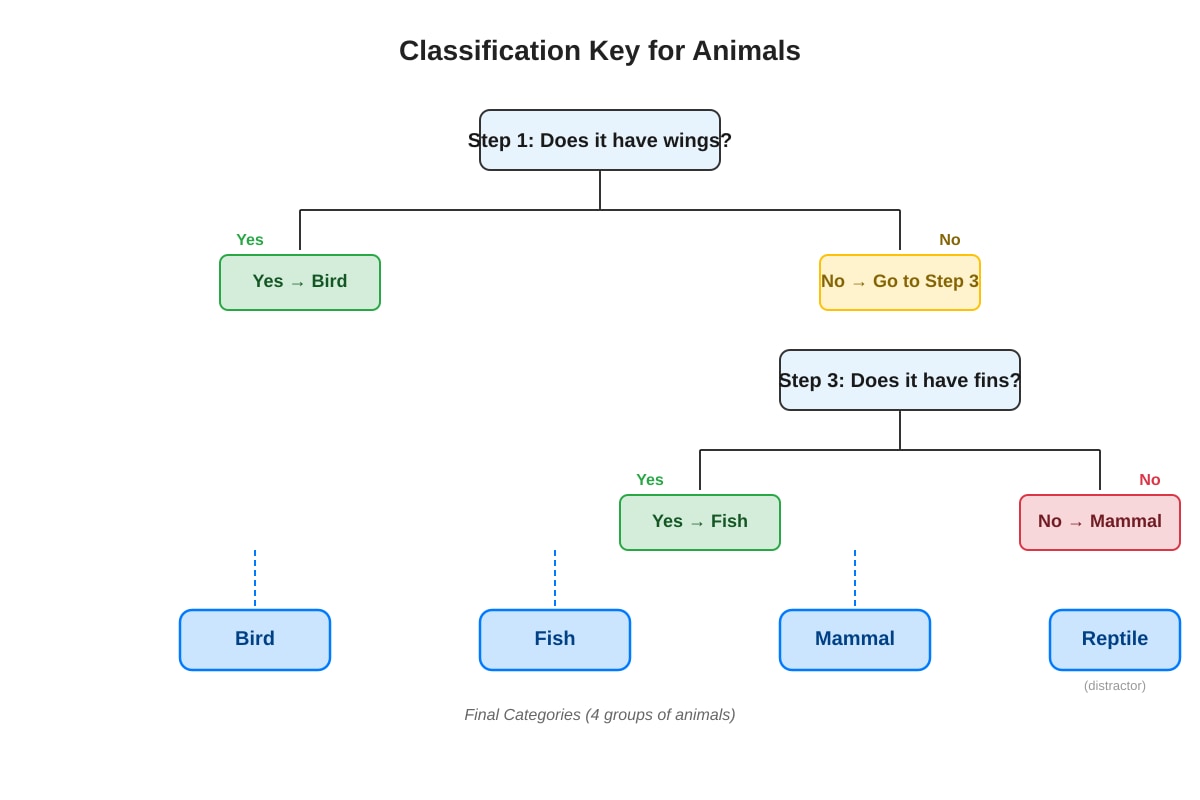
Explanation: Following the dichotomous key step by step: Step 1 asks "Does it have wings?" → The animal does NOT have wings, so follow "No" to Step 3. Step 3 asks "Does it have fins?" → The animal does NOT have fins, so follow "No" to the conclusion "Mammal." Birds have wings, fish have fins, and mammals (like dogs, cats, humans) typically have neither wings nor fins. Note: While bats are mammals with wings, this simple key places winged animals in the Bird category for basic classification purposes.
4. Answer: B) Water, air, plastic bottle [2 marks]
Explanation: Non-living things do not have any of the life characteristics. Water and air are natural non-living substances; a plastic bottle is a man-made object. Option A includes bacteria (living). Option C includes a seed (living, as it can germinate). Option D includes mushroom, moss, and mushroom spore (all living or capable of becoming living).
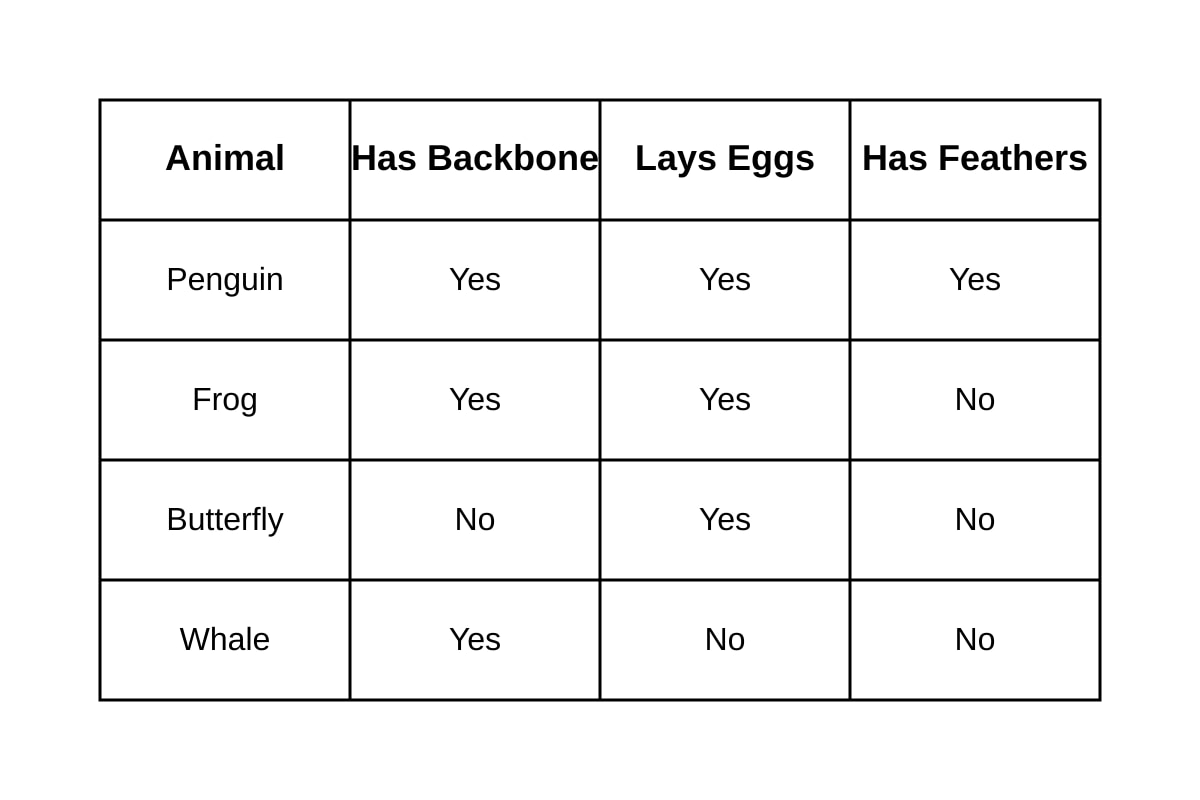
5. Answer: C) The butterfly is the only animal without a backbone. [2 marks]
Explanation: Checking each statement against the table:
- A is incorrect: The whale has a backbone but does not lay eggs (it gives birth to live young).
- B is incorrect: The frog, butterfly, and penguin all lay eggs, but only the penguin has feathers.
- C is correct: Penguin (yes), frog (yes), whale (yes), butterfly (no) — the butterfly is indeed the only invertebrate.
- D is incorrect: The table does not show information about body temperature, but whales are warm-blooded mammals, not cold-blooded.
6. Answer: B) Kingdom → Phylum → Class → Order → Family → Genus → Species [2 marks]
Explanation: Biological classification follows a hierarchical system from the largest, most inclusive group to the smallest, most specific group. The order is: Kingdom (e.g., Animalia), Phylum (e.g., Chordata), Class (e.g., Mammalia), Order (e.g., Primates), Family (e.g., Hominidae), Genus (e.g., Homo), Species (e.g., sapiens). This system was developed by Carl Linnaeus and helps scientists organize the diversity of life. Options A and D have incorrect ordering; C is completely reversed.
7. Answer: C) Fleshy fruit — water dispersal [2 marks]
Explanation: Fleshy fruits are typically dispersed by animals (including birds and humans). Animals eat the fleshy part and either discard the seeds or pass them out in droppings, often far from the parent plant. Water-dispersed seeds usually have adaptations like air spaces or fibrous husks that allow them to float (e.g., coconut). Wings (A), hooked hairs (B), and explosive pods (D) are all correctly matched to their dispersal methods.
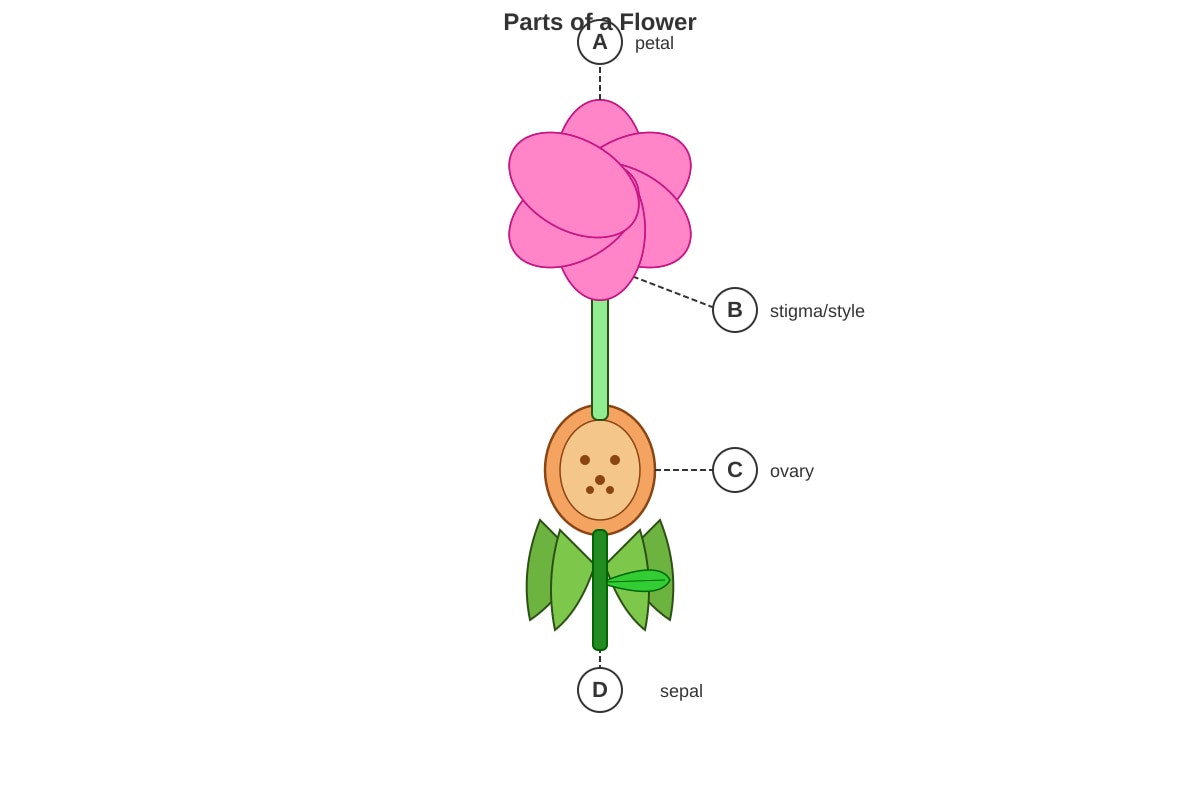
8. Answer: C) Part C [2 marks]
Explanation: In the flower diagram, Part C is the ovary. After pollination (when pollen reaches the stigma, Part B), the fertilized egg cells develop into seeds inside the ovary. The ovary itself develops into the fruit that contains and protects the seeds. Part A (petal) attracts pollinators; Part B (stigma/style) receives pollen; Part D (sepal) protects the flower bud before it opens.
9. Answer: C) measure the leaves and record where each was found [2 marks]
Explanation: To investigate a possible relationship between leaf shape and sunlight, Mei Ling needs to collect systematic data — measuring the leaves (quantitative data about shape/size) and recording their location (sunlight exposure as a variable). This allows her to look for patterns or correlations. Asking friends (A) is not scientific evidence; looking at one leaf (B) gives insufficient data; only collecting from sunny places (D) makes it impossible to compare with shaded areas.
10. Answer: C) Eagle and penguin [2 marks]
Explanation: Eagles and penguins are both birds — they share the same class (Aves) in biological classification. They both have feathers, beaks, lay hard-shelled eggs, and are warm-blooded vertebrates. Option A: rose (plant, Kingdom Plantae) and mushroom (fungus, Kingdom Fungi) are in different kingdoms. Option B: bacteria (Kingdom Bacteria/Monera) and amoeba (Kingdom Protozoa/Protista) are different kingdoms. Option D: grass (plant) and grasshopper (animal) are in different kingdoms.
Section B: Short Answer Questions (24 marks)
11. (a)
| Living | Non-living |
|---|---|
| Worm | Stone |
| Water | |
| Plastic toy |
Marking: [2 marks] — 1 mark for correct living item; 1 mark for all three non-living items correct.
Explanation: The worm is living because it moves, respires, grows, reproduces, needs food, responds to stimuli, and excretes waste. The stone, water, and plastic toy do not show any life characteristics.
(b) Answer: The worm can move / needs food / can reproduce / grows / responds to stimuli. [1 mark]
Accept any valid life characteristic with brief explanation. Example: "The worm needs food to stay alive and grows bigger over time, which shows it is living."
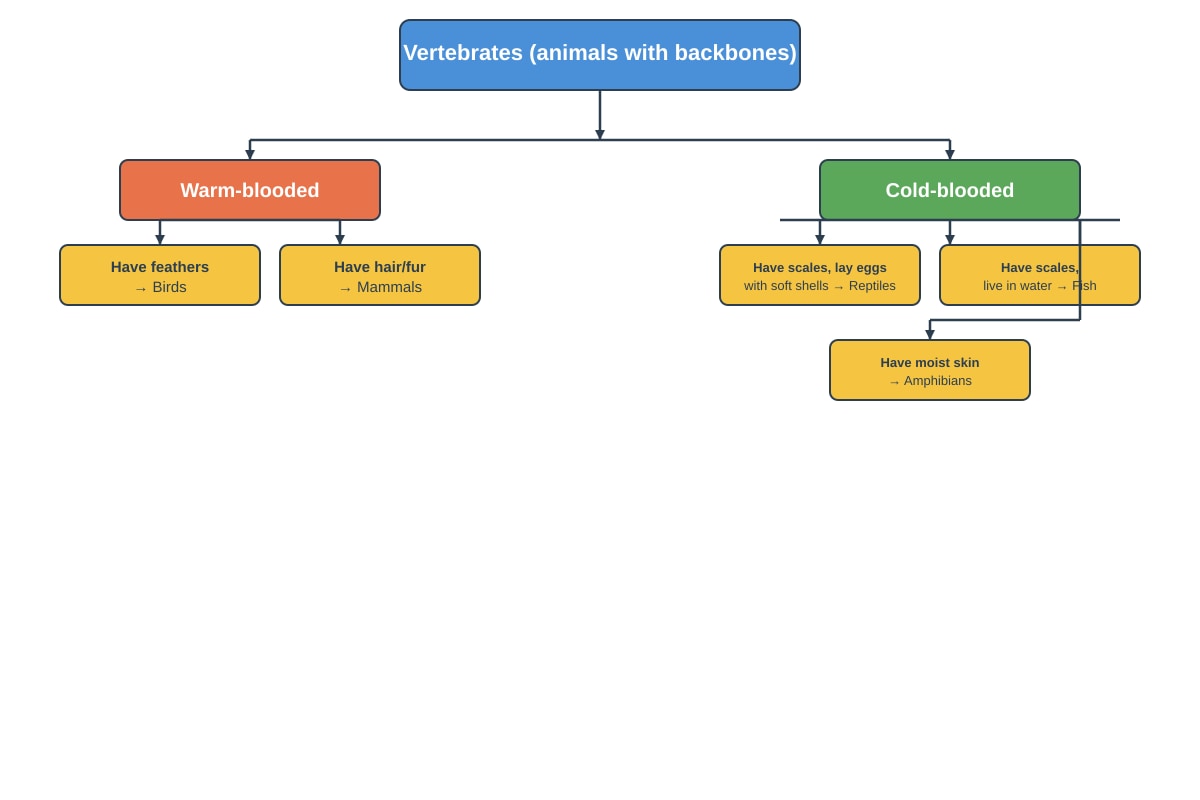
12. (a) Answer: A snake is cold-blooded, has scales, and lays eggs with soft shells. [2 marks]
Marking breakdown:
- 1 mark: Mentions TWO correct features from the diagram (cold-blooded, has scales, lays eggs with soft shells)
- 1 mark: States these features match the reptile branch of the diagram
Explanation: Following the classification diagram from "Vertebrates," the snake is cold-blooded (does not maintain constant body temperature), so we follow the "Cold-blooded" branch. Among cold-blooded animals, the snake has scales and lays eggs with soft shells — this matches the "Reptiles" branch, not fish (live in water) or amphibians (moist skin).
(b) Answer: The student is incorrect. [1 mark] Not all cold-blooded animals live in water. [1 mark]
Explanation: According to the diagram, cold-blooded animals include reptiles, fish, AND amphibians. While fish live in water, reptiles (like snakes and lizards) and amphibians (like frogs) can live on land. Cold-bloodedness means their body temperature changes with the environment, not that they must live in water.
13. (a) Answer: The type of seed / kind of seed (bean, corn, or sunflower). [1 mark]
Explanation: The independent variable is what the experimenter deliberately changes. Mei Ling is testing three different types of seeds, so this is the variable she changes to see if it affects germination.
(b) Answer: Any TWO from: [2 marks]
- Amount of water given to each seed
- Temperature of the environment
- Type/amount of soil used
- Size of container
- Amount of light
Explanation: For a fair test, only ONE variable (the type of seed) should be changed. All other conditions must be kept constant so that any differences in germination can be attributed to the seed type, not to other factors.
(c) Answer: Height of seedling / number of leaves / mass of seedling / length of root [1 mark]
Explanation: Beyond simply recording whether germination occurred (yes/no), quantitative measurements allow better comparison. Height is the most practical measurement for young seedlings.
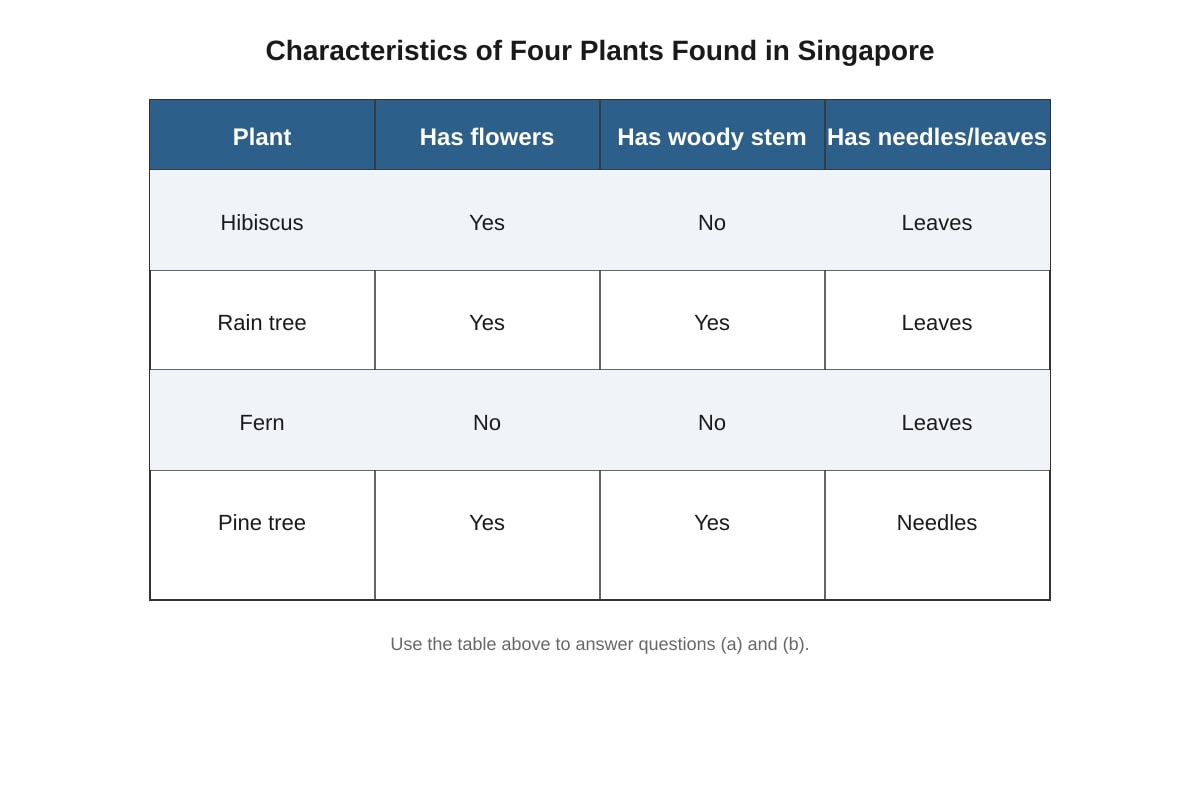
14. (a) Answer: Hibiscus [1 mark]
Explanation: Looking at the table, only the hibiscus has "Yes" for flowers and "No" for woody stem.
(b) Answer: Group by whether they have flowers or not. [1 mark]
Explanation: Flowering plants (hibiscus, rain tree, pine tree) all have "Yes" in the flowers column; non-flowering plant (fern) has "No." This separates the plants into two clear groups: angiosperms/gymnosperms (flowering/seed-producing) and spore-producing plants.
(c) Answer: The rain tree has leaves; the pine tree has needles. [1 mark]
Explanation: Both have woody stems and flowers, but their leaf types differ. Rain trees have broad, flat leaves typical of flowering trees; pine trees have needle-like leaves, an adaptation to reduce water loss.
(d) Answer: Because it does not produce flowers. [1 mark]
Explanation: Ferns reproduce using spores, not seeds or flowers. They are classified as non-flowering plants (pteridophytes) in the plant kingdom.
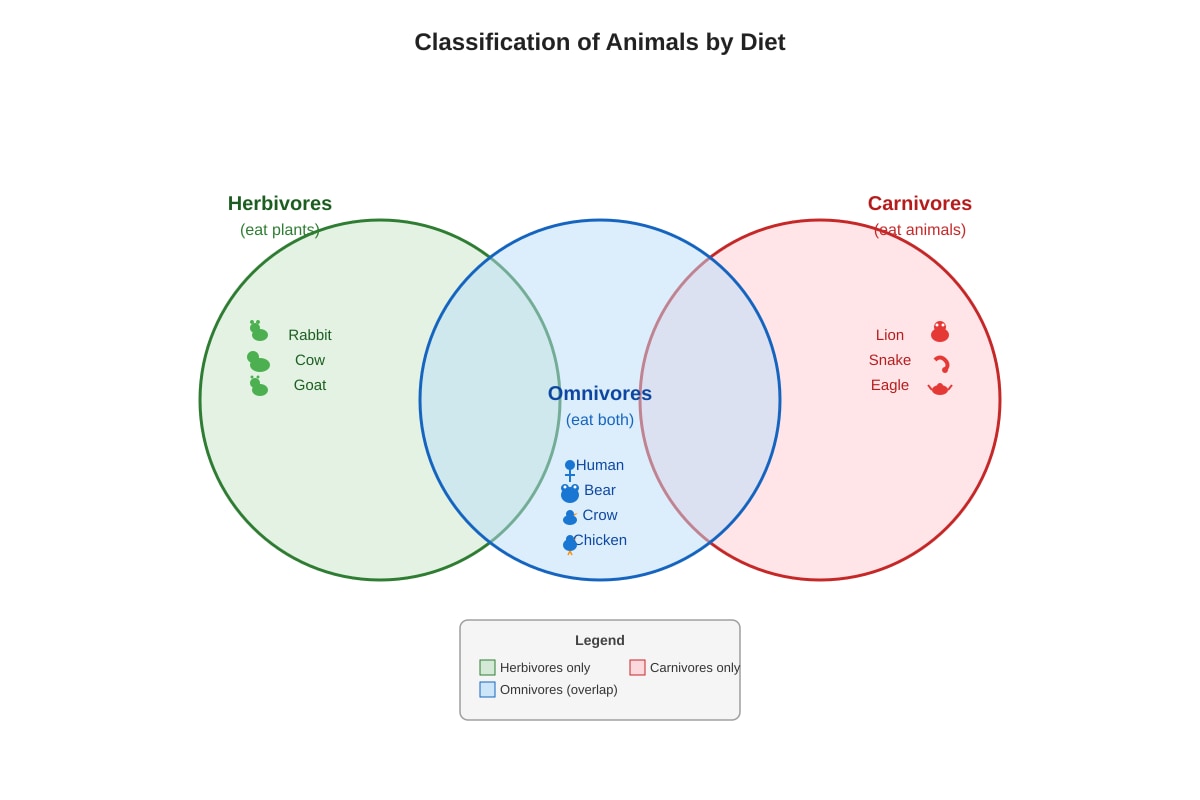
15. (a) Answer: Human / bear / crow / chicken [1 mark]
Accept any one correct answer.
<image_placeholder_interpretation> Expected visual: The Venn diagram shows human, bear, crow, and chicken in the overlapping region between herbivores and carnivores, labeled as "Omnivores (eat both)." </image_placeholder_interpretation>
(b) Answer: The student is incorrect because crows are in the overlapping region. [1 mark] This means crows eat BOTH plants and animals, making them omnivores, not carnivores. [1 mark]
Explanation: Looking at the Venn diagram, carnivores (lion, snake, eagle) are located only in the "Carnivores" circle. Crows appear in the intersection/overlap between herbivores and carnivores, which represents omnivores — animals that consume both plant and animal matter. While crows may eat insects (animals), they also eat grains, fruits, and seeds (plants).
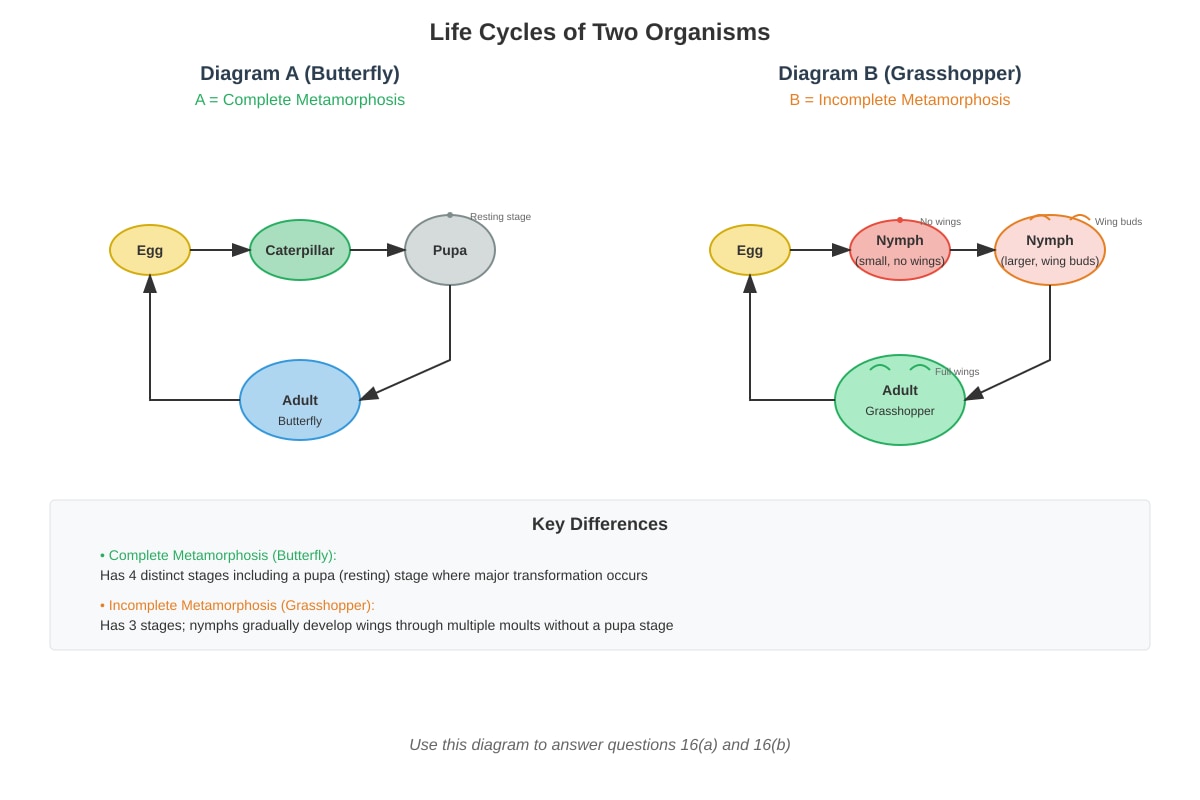
16. (a) Answer: In complete metamorphosis, there is a pupa stage where the young looks completely different from the adult. [1 mark] In incomplete metamorphosis, there is no pupa; the young looks like a small adult and gradually develops wings. [1 mark]
Explanation: The key distinction is the presence or absence of a pupal/chrysalis stage. Complete metamorphosis (holometabolism): egg → larva (e.g., caterpillar, looks nothing like adult) → pupa (resting/transforming stage) → adult. Incomplete metamorphosis (hemimetabolism): egg → nymph (resembles adult but smaller, wingless or with wing buds) → adult (wings fully developed). The nymph molts several times, growing larger each time.
(b) Answer: Incomplete metamorphosis. [1 mark] The young looks like a small adult but has no wings, which matches the nymph stage in incomplete metamorphosis. [1 mark]
Explanation: This describes exactly what happens in incomplete metamorphosis — nymphs resemble miniature adults but lack fully developed wings (they have wing buds that grow with each molt). In complete metamorphosis, the larva looks completely different from the adult (e.g., caterpillar vs. butterfly), so "looks like a small adult" rules out complete metamorphosis.
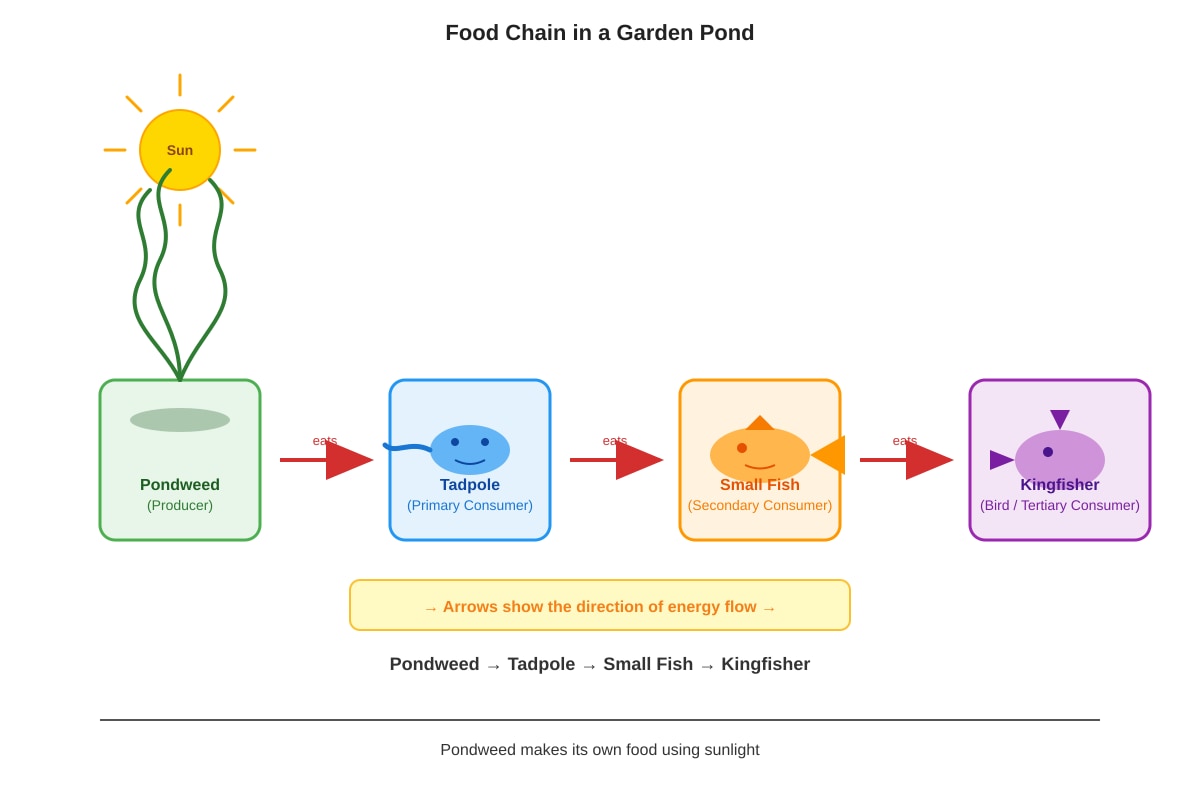
17. (a) Answer: Pondweed [1 mark]
Explanation: Producers are organisms that make their own food through photosynthesis, using sunlight energy. The diagram notes "Pondweed makes its own food using sunlight." Pondweed is a green plant that contains chlorophyll and can perform photosynthesis. All other organisms in the food chain are consumers that must eat other organisms to obtain energy.
(b) Answer: The tadpole is eaten by the small fish. / Energy passes from tadpole to small fish. [1 mark]
Explanation: Arrows in food chains show the direction of energy flow, pointing from the food source to the consumer. The arrow from tadpole to small fish indicates that the small fish eats the tadpole, thereby obtaining energy from it.
(c) Answer: The small fish population would decrease. [1 mark] Because there would be no food for the tadpoles, so tadpoles would die; then small fish would have no tadpoles to eat. [1 mark]
Explanation: Food chains show interdependence. If the producer (pondweed) dies, the primary consumers (tadpoles) have no food source and will die. Without tadpoles, the secondary consumers (small fish) lose their food source and will also decrease in number. This demonstrates how removing one level affects all other levels in a food chain.
Section C: Application Questions (16 marks)
18. (a)
| Plant Description | Likely Group | Reason |
|---|---|---|
| Tall tree with cones | Conifer / Gymnosperm | Has cones instead of flowers; woody |
| Small plant with colourful flowers | Flowering plant / Angiosperm | Has flowers and soft stem |
| Plant with large divided leaves, no flowers | Fern / Non-flowering plant | Reproduces by spores, not flowers |
Marking: [3 marks] — 1 mark per correct row (group and reason must match)
Explanation:
- Conifers (gymnosperms) have naked seeds in cones, not enclosed in fruits. They are woody plants with needle-like or scale-like leaves.
- Angiosperms (flowering plants) produce seeds enclosed in fruits, developed from flowers. They may be woody or herbaceous (soft-stemmed).
- Ferns are seedless vascular plants that reproduce via spores, not flowers or seeds.
(b) Answer: Some plants look very similar / some plants have features of more than one group / new plants are discovered that don't fit existing groups / classification systems keep changing as we learn more. [1 mark]
Accept any reasonable suggestion.
(c) Answer: Select plants with stems of different thicknesses. [1 mark] Water them equally and place them in the same conditions; measure how much water is lost (by weighing) over the same time period. [1 mark]
Explanation: This is a controlled experiment. The changed variable (independent) is stem thickness. Measured variable is water loss. Controlled variables: amount of water given initially, temperature, light, humidity, time period, and possibly leaf area (to ensure comparison is fair — same leaf area means the stem thickness is the true difference being tested).
19. (a) Answer: Diversity means having many different types or kinds of living things in a place. [1 mark]
Explanation: Biodiversity refers to the variety of life forms — different species, genetic differences within species, and the variety of ecosystems. In this context, it means counting how many different species or types of organisms are present.
(b) Answer: The pond with plants would have the most diversity. [1 mark] Because ponds have water, plants for food, shelter for small animals, and support many different needs of living things. [1 mark]
Explanation: Ponds provide multiple habitats (water surface, underwater, bottom mud, edges with plants) and resources (water, food, shelter, breeding places). Living things need water, food, air, and shelter to survive. A grassy field has fewer microhabitats; a concrete playground lacks most resources living things need, especially producers (plants) that form the base of food chains.
(c) Answer: 3 + 2 + 1 + 4 = 10 types [1 mark]
Explanation: "Types" means different species. Add: 3 (ants) + 2 (grasses) + 1 (beetle) + 4 (birds) = 10 different types of living things. This is a species richness count.
(d) Answer: Concrete does not provide food / water / shelter / soil for plants to grow. [1 mark]
Explanation: Concrete is an impermeable, artificial surface. It prevents soil and plant growth, eliminating producers from the habitat. Without producers, there is no energy entering the food chain, so few consumers can survive there either. Limited water absorption and high temperatures also make concrete inhospitable.
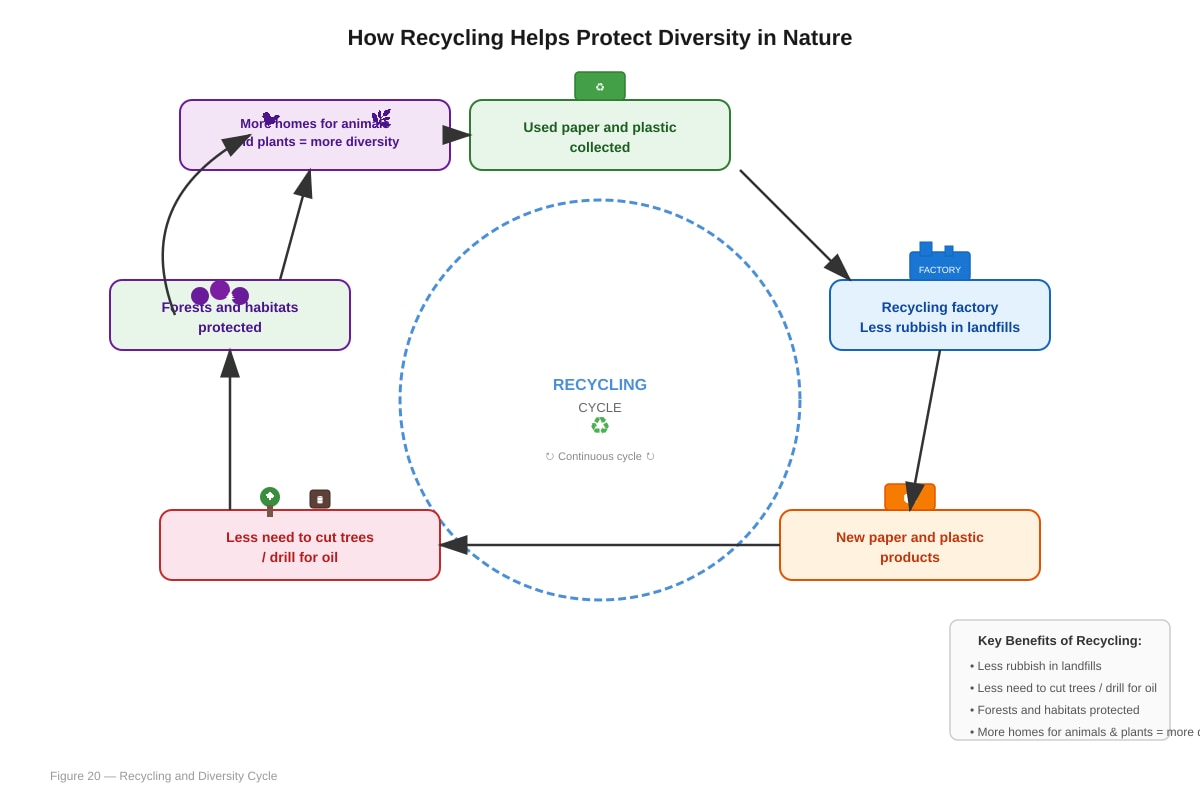
20. (a) Answer: Recycling means less rubbish in landfills, [1 mark] which means less need to cut trees or drill for oil, so forests and habitats stay protected. [1 mark]
Explanation: Following the cycle diagram: recycling reduces waste → less demand for raw materials → less habitat destruction → protected forests. The key chain of reasoning is understanding how reducing raw material extraction directly preserves natural habitats.
(b) Answer: Forests provide homes/shelter for many animals and plants. [1 mark] If forests are protected, more different species can survive there, maintaining diversity. [1 mark]
Explanation: Forests are complex ecosystems with multiple layers (canopy, understory, forest floor) that provide diverse niches — food sources, nesting sites, protection from predators, and microclimates. Destroying forests removes these resources, causing species to die out or migrate, reducing diversity. Protection maintains these habitats and the species that depend on them.
(c) Answer: Any ONE reasonable action: use less plastic / reuse containers / compost food waste / save water / use both sides of paper / plant more plants / don't litter. [1 mark]
Explanation: The action should logically reduce environmental impact and thereby help protect habitats and diversity. Practical home actions that reduce resource consumption or waste production are most relevant.
Total Marks: 60 ✓
End of Answer Key