AI Generated Exam Paper
Primary 4 Science Practice Paper 4
Free P4 Science Practice Paper 4, HY3 AI version, with questions, answers, and syllabus-aligned practice for Singapore students.
These static practice materials are generated from the site's syllabus and paper-generation workflow, with source and model context shown so students and parents can evaluate the material before use.
Questions
Free quiz and exam paper access
Enter your details to view this paper
Your access is remembered on this device.
Answers
TuitionGoWhere Practice Paper - Science Primary 4 (Answers)
Version 4 — Topic: Diversity
Syllabus-first generated content. No past-year exam evidence used.
Section A Answers (10 marks)
1. B (1 mark)
Teaching note: A mosquito is an insect and is a living thing. Wooden chair, plastic cup, and stone do not eat, grow, or reproduce, so they are non-living.
2. C (1 mark)
Teaching note: Living things are not "made of metal" — that is a property of some non-living objects. Living things need food, can move (most), and reproduce.
3. B (1 mark)
Teaching note: Only the butterfly is alive. A robot is built by humans and does not grow or reproduce; it is non-living.
4. B (1 mark)
Teaching note: Rock, water, and air are all non-living. The other groups contain plants or animals.
5. B (1 mark)
Teaching note: Growth and reproduction are signs of life. Colour or being in a pot does not prove a thing is alive.
6. B (1 mark)
Teaching note: Adult frogs breathe with lungs. Fish and tadpoles/larvae use gills or skin.
7. C (1 mark)
Teaching note: Scientists group living things as plants or animals (and other groups like fungi). Colour/size alone is not a science grouping.
8. C (1 mark)
Teaching note: Mushroom is a fungus, not a plant or animal. (P4 level: recognise fungus as a different group.)
9. A (1 mark)
Teaching note: Cloud is natural and non-living. Cat, bacteria, leaf are from living things.
10. B (1 mark)
Teaching note: Grouping helps us study characteristics. It is a science skill, not for neatness only.
Section B Answers (12 marks)
11. (2 marks — 1 mark per characteristic)
Accepted: needs food, grows, reproduces, responds to surroundings, breathes, excretes.
Teaching note: Living things share these features; name any two.
12. (2 marks — 1 mark each)
Living: e.g., student, plant, insect. Non-living: e.g., desk, book, eraser.
Teaching note: Must be from classroom context.
13. (2 marks)
Car can move but is not alive because it does not eat, grow, or reproduce (1 mark); it is made by humans and needs fuel from outside, not food (1 mark).
Common mistake: saying "it moves" is enough — movement alone does not mean living.
14. (2 marks — 1 mark per group+example)
e.g., Plants — rose; Animals — cat.
Teaching note: Group name + correct example.
15. (2 marks)
Snail is living because it grows and reproduces (1 mark); bicycle is non-living because it is made by humans and does not grow (1 mark).
Marking: contrast needed.
16. (2 marks)
We can protect them and their homes (1 mark); we can learn how they help us (e.g., plants give oxygen) (1 mark).
Teaching note: Diversity means many kinds of life; knowing them helps responsibility.
Section C Answers (8 marks)
17. (3 marks)
(a) Living: Eagle, Grass, Earthworm (2 marks — all three needed; deduct 1 mark if one missing)
(b) Non-living because they do not eat/grow/reproduce (1 mark; e.g., table, phone, sunlight are objects or energy)
Teaching note: Sunlight is non-living natural energy.
18. (2 marks)
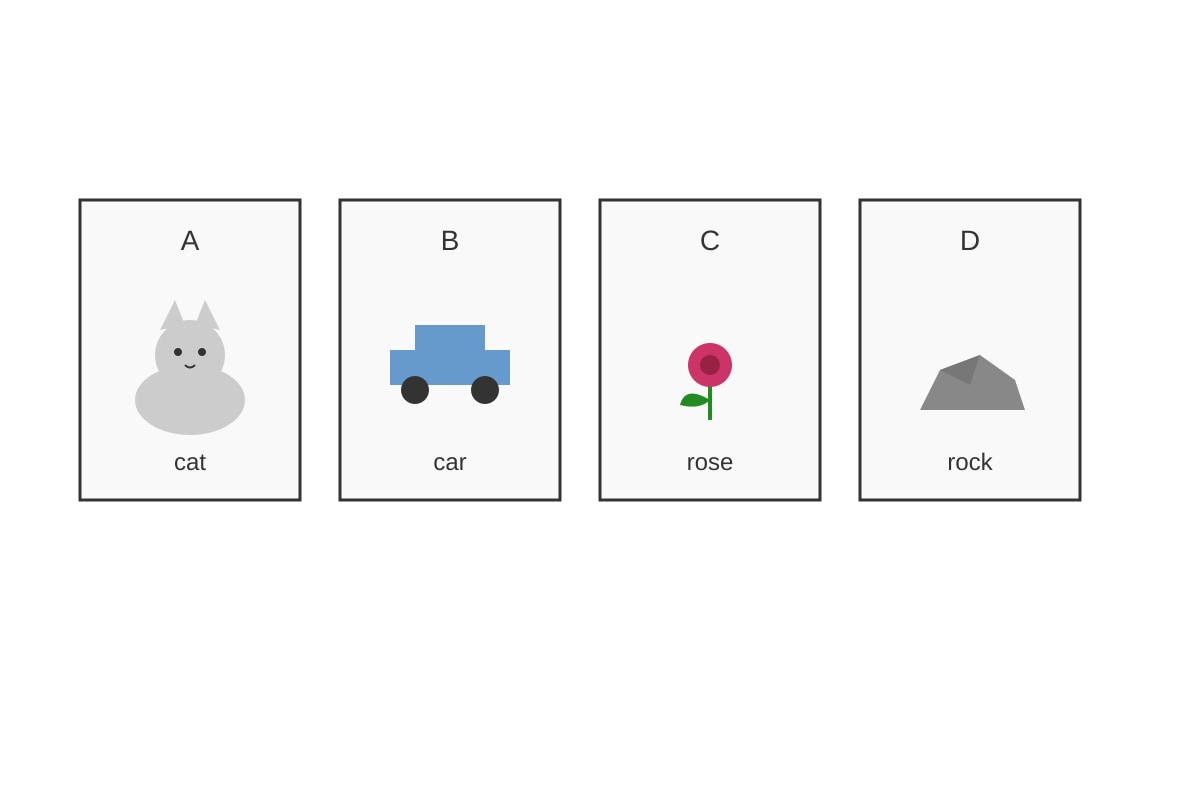
(a) A (cat) and C (rose) (1 mark)
(b) D (rock) (1 mark)
Image note: Card A cat = animal living; C rose = plant living; D rock = non-living natural.
19. (2 marks)
Cow — Living — eats, grows, reproduces (1 mark)
Book — Non-living — made by humans, no life processes (1 mark)
Teaching note: Table format acceptable with clear reason.
20. (2 marks)
Wrong because a small ant is living and a big mountain is non-living (1 mark for two correct examples); size does not decide life (1 mark).
Common mistake: only one example given = 1 mark max.
Total Marks: 40 — matches paper.