AI Generated Exam Paper
Primary 4 Science Practice Paper 3
Free Kimi AI-generated P4 Science Practice Paper 3 with questions, answers, and syllabus-aligned practice for Singapore students preparing for exams.
These static practice materials are generated from the site's syllabus and paper-generation workflow, with source and model context shown so students and parents can evaluate the material before use.
Questions
TuitionGoWhere Practice Paper - Science Primary 4
TuitionGoWhere Practice Paper (AI)
| Subject: | Science | | Level: | Primary 4 | | Paper: | Practice Paper Version 3 | | Duration: | 1 hour 30 minutes | | Total Marks: | 60 |
Name: _________________________________ Class: _______ Date: ________________
Instructions
- Answer all questions.
- Write your answers in the spaces provided.
- For multiple-choice questions, shade or circle the correct answer.
- Read each question carefully before answering.
- Show your working where required.
- Use a pencil for diagrams and a pen for writing.
Section A: Multiple Choice (Questions 1–20: 20 marks)
Answer all questions. Each question carries 1 mark.
-
Which of the following is not a characteristic of all living things?
- A. They can reproduce
- B. They can respire
- C. They can move from place to place
- D. They can grow
Answer: _________________________________________________________________
-
A student places a potted plant in a dark cupboard for two weeks. What will most likely happen to the plant?
- A. It will grow taller quickly
- B. It will become yellow and weak
- C. It will produce more flowers
- D. It will develop thicker stems
Answer: _________________________________________________________________
-
Look at the classification key below:
<image_placeholder> id: Q3-fig1 type: diagram linked_question: Q3 description: A simple branching dichotomous key for classifying four animals: butterfly, earthworm, fish, and bird labels: "Has backbone?" (top), "Yes" branch leads to "Has wings?" with "Yes→Bird" and "No→Fish"; "No" branch leads to "Has legs?" with "Yes→Butterfly" and "No→Earthworm" values: None must_show: Clear branching structure, four endpoint boxes with animal names, yes/no decision points clearly labeled </image_placeholder>
Using the key, which question would help you tell apart a fish from a bird?
- A. Does it have a backbone?
- B. Does it have wings?
- C. Does it have legs?
- D. Does it live in water?
Answer: _________________________________________________________________
-
Which group do animals with hair or fur and feed their young with milk belong to?
- A. Birds
- B. Reptiles
- C. Mammals
- D. Amphibians
Answer: _________________________________________________________________
-
The table below shows some features of four different animals:
Animal Has Feathers Has Scales Has Fur Lays Eggs P ✓ ✗ ✗ ✓ Q ✗ ✓ ✗ ✓ R ✗ ✗ ✓ ✗ S ✗ ✓ ✗ ✗ Which animal is most likely a mammal?
- A. Animal P
- B. Animal Q
- C. Animal R
- D. Animal S
Answer: _________________________________________________________________
-
Which of the following is not an example of a non-living thing?
- A. A cloud in the sky
- B. A moving robot
- C. A growing mushroom
- D. A flowing river
Answer: _________________________________________________________________
-
Seeds are dispersed in different ways. Which plant is most likely to have seeds dispersed by water?
- A. Dandelion with fluffy seeds
- B. Coconut with a hard, waterproof shell
- C. Touch-me-not with exploding pods
- D. Maple with winged seeds
Answer: _________________________________________________________________
-
What is the main function of the flower in a plant?
- A. To make food for the plant
- B. To absorb water and minerals
- C. To attract insects for reproduction
- D. To support the plant upright
Answer: _________________________________________________________________
-
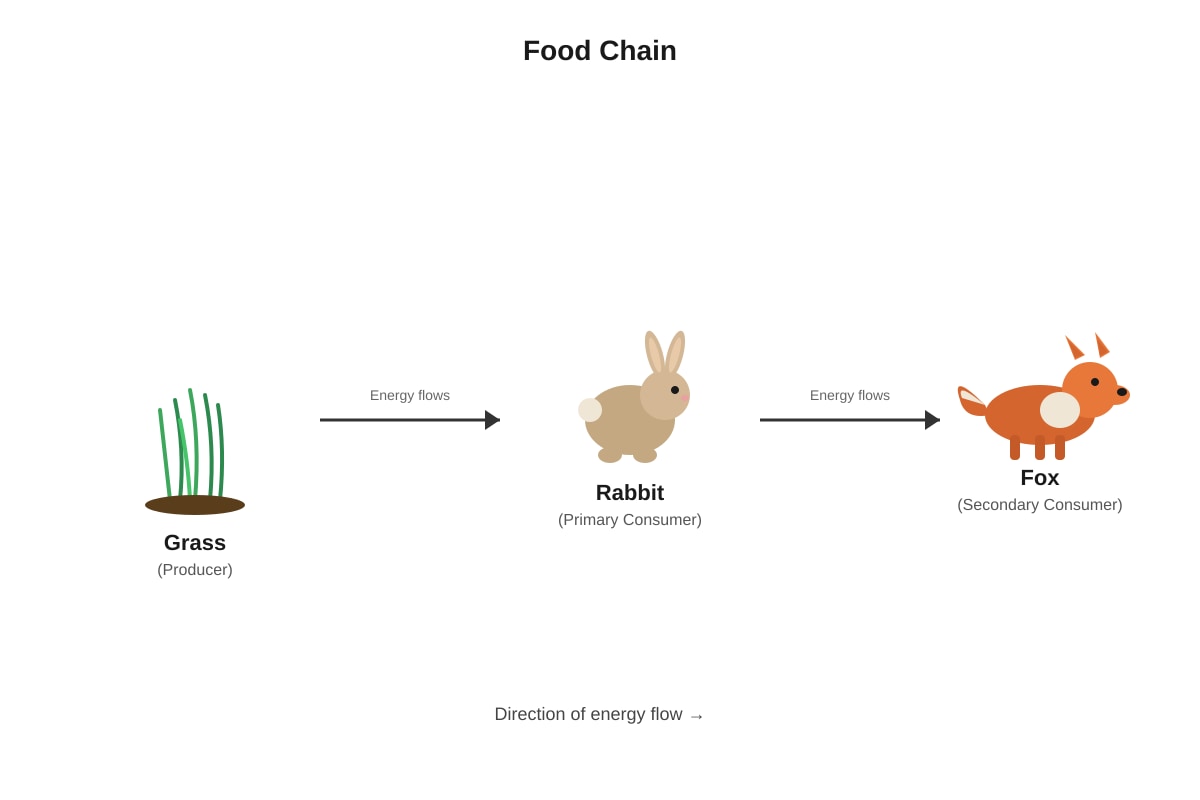
Look at the food chain below:
<image_placeholder> id: Q9-fig1 type: diagram linked_question: Q9 description: A simple food chain diagram showing grass → rabbit → fox labels: "Grass" (producer, left), "Rabbit" (primary consumer, middle), "Fox" (secondary consumer, right); arrows pointing right showing energy flow values: None must_show: Three organisms in sequence, arrows between them, labels for each organism </image_placeholder>
If all the rabbits in this food chain were removed, what would most likely happen first?
- A. The grass population would decrease
- B. The fox population would decrease
- C. The fox population would increase
- D. More plants would start growing
Answer: _________________________________________________________________
-
Which of the following shows the correct life cycle of a butterfly?
- A. Egg → Pupa → Larva → Adult
- B. Egg → Larva → Pupa → Adult
- C. Egg → Nymph → Adult
- D. Larva → Egg → Pupa → Adult
Answer: _________________________________________________________________
-
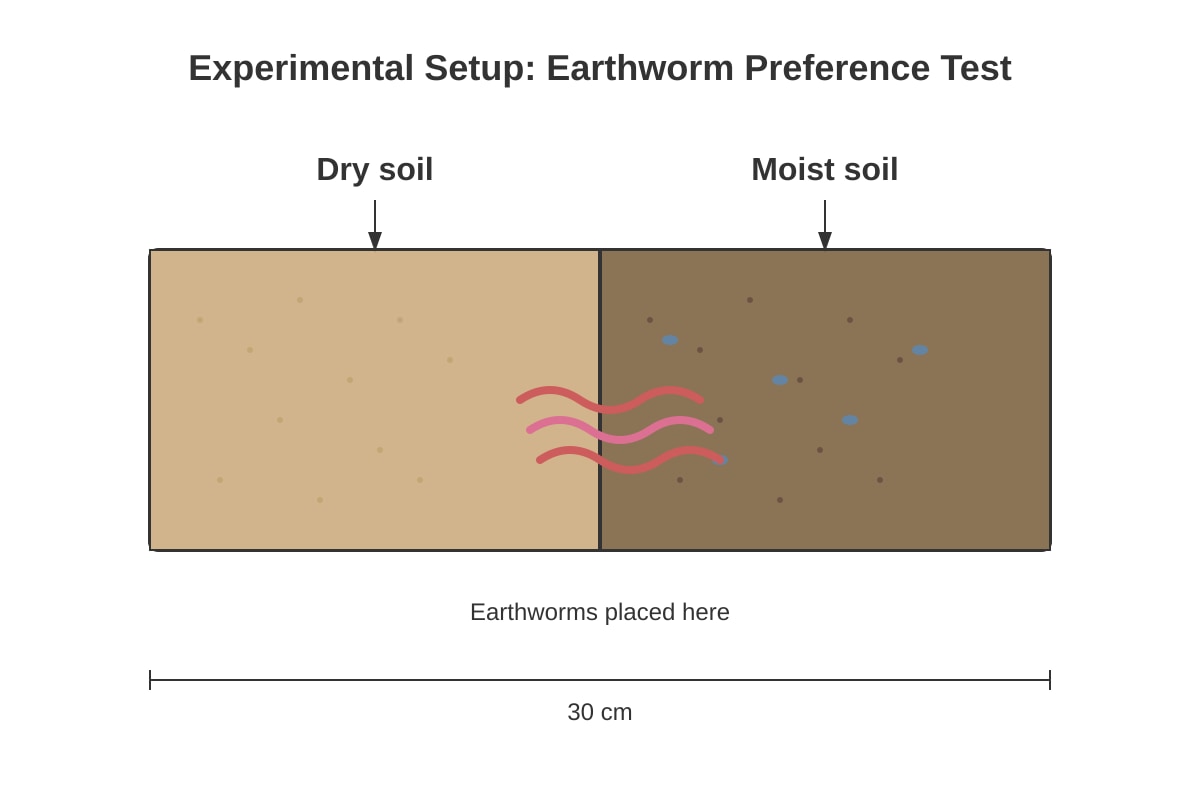
A student wants to find out if earthworms prefer dry or moist places. She sets up the experiment shown below:
<image_placeholder> id: Q11-fig1 type: diagram linked_question: Q11 description: An experimental setup with a long container divided into two equal sections: left side labeled "Dry soil" and right side labeled "Moist soil"; earthworms placed in the middle labels: "Dry soil", "Moist soil", "Earthworms placed here" (middle), container edges values: Container approximately 30 cm long, divided equally must_show: Clear division between dry and moist sections, labeled soil types, indication of where earthworms are placed </image_placeholder>
What must she keep the same to make this a fair test?
- A. The number of earthworms and the amount of light
- B. The amount of water in both sections
- C. The type of soil in both sections
- D. The temperature of the room
Answer: _________________________________________________________________
-
Which of the following is a producer in a food chain?
- A. Rabbit
- B. Grass
- C. Frog
- D. Snake
Answer: _________________________________________________________________
-
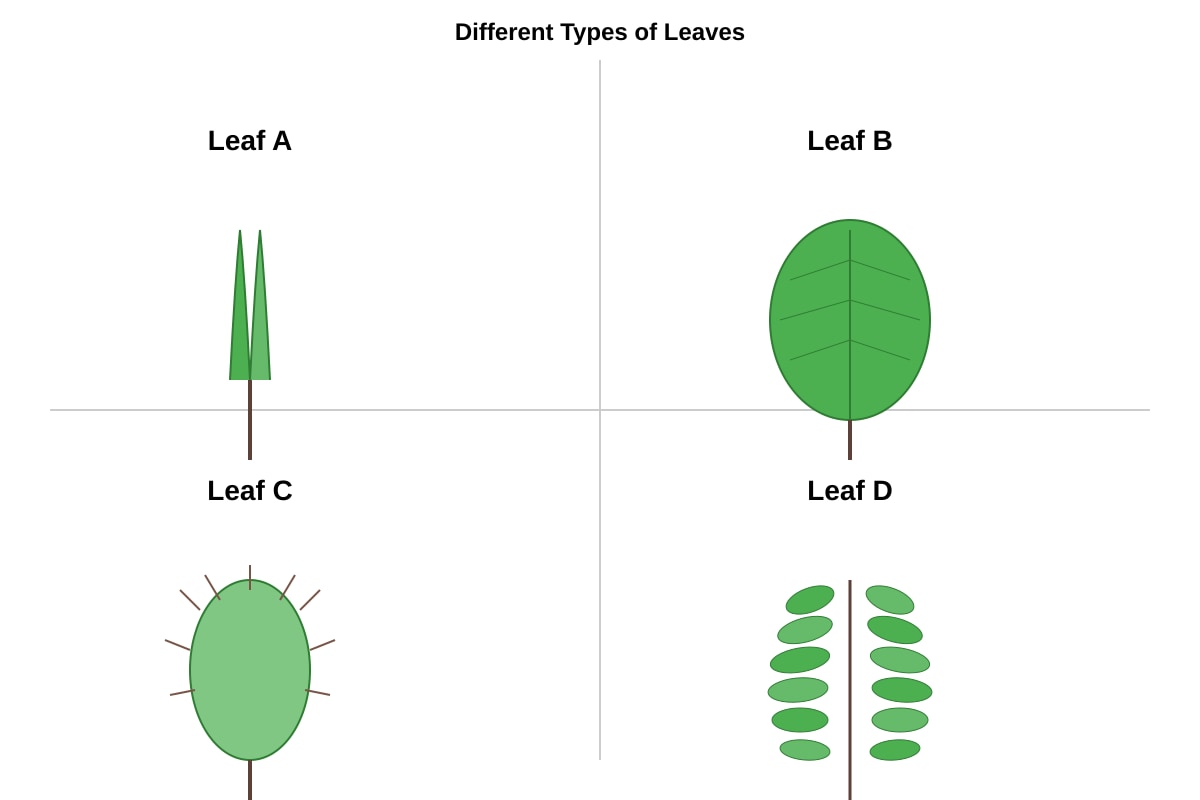
The diagram below shows different types of leaves:
<image_placeholder> id: Q13-fig1 type: diagram linked_question: Q13 description: Four different leaf shapes arranged in a grid: A narrow and long, B broad and flat, C thick and fleshy with spines, D divided into many small leaflets labels: Leaf A, Leaf B, Leaf C, Leaf D values: None must_show: Four distinctly different leaf morphologies, clearly labeled A-D </image_placeholder>
Which leaf (A, B, C, or D) is most likely from a plant that lives in a dry, desert environment?
- A. Leaf A
- B. Leaf B
- C. Leaf C
- D. Leaf D
Answer: _________________________________________________________________
-
What do all fungi have in common?
- A. They can make their own food
- B. They do not have chlorophyll
- C. They have flowers and seeds
- D. They can only grow in water
Answer: _________________________________________________________________
-
Which of the following is not a seed dispersal method?
- A. Dispersal by wind
- B. Dispersal by water
- C. Dispersal by roots
- D. Dispersal by splitting/explosion
Answer: _________________________________________________________________
-
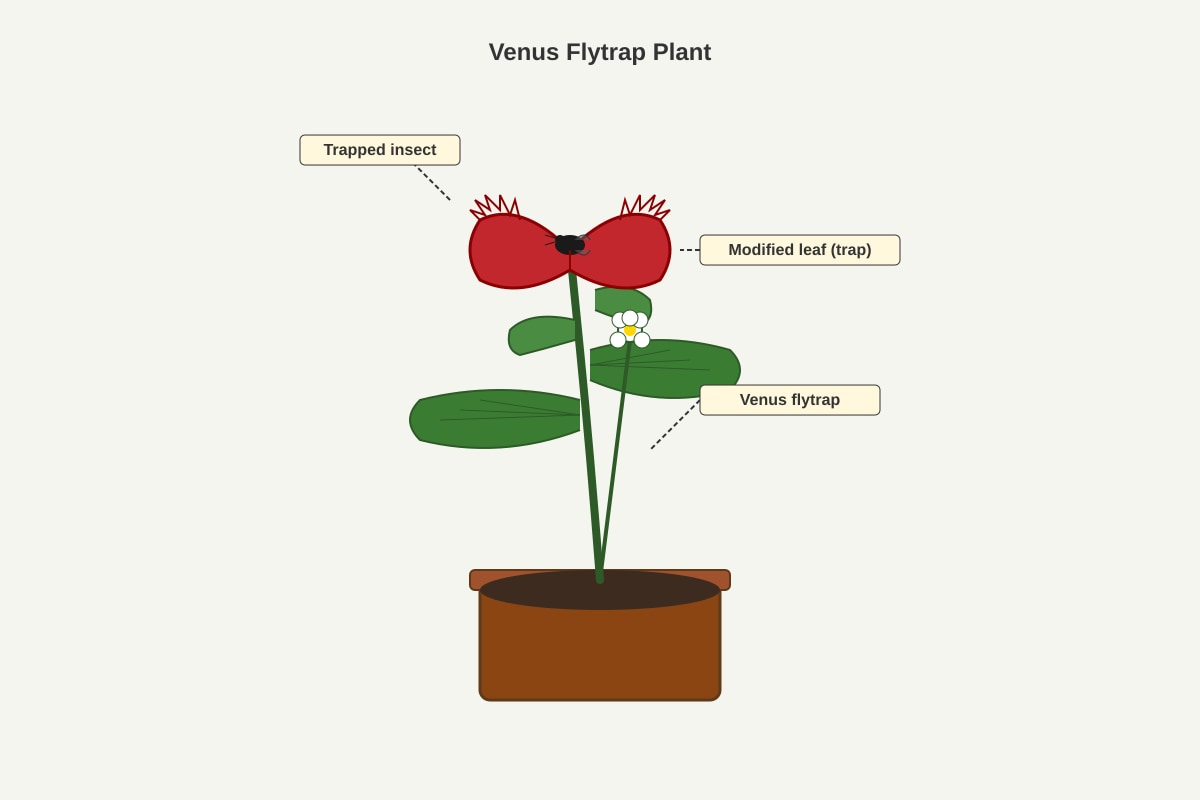
The picture shows a Venus flytrap catching an insect:
<image_placeholder> id: Q16-fig1 type: diagram linked_question: Q16 description: A Venus flytrap plant with its trap closed around a small fly, showing the modified leaf structure labels: "Venus flytrap", "Trapped insect", "Modified leaf (trap)" values: None must_show: Venus flytrap with two lobes closed, visible insect inside, clear label pointing to the trap structure </image_placeholder>
Why does the Venus flytrap trap insects?
- A. To protect itself from predators
- B. To get nutrients that are missing from the soil
- C. To pollinate its flowers
- D. To scare away other plants
Answer: _________________________________________________________________
-
Which of these animals breathes through gills?
- A. Dog
- B. Bird
- C. Fish
- D. Frog
Answer: _________________________________________________________________
-
A group of students made the following observations about an object:
Observation Result Does it move by itself? No Does it need food? No Does it grow? No Does it reproduce? No What could this object be?
- A. A seed
- B. A rock
- C. A caterpillar
- D. A mushroom
Answer: _________________________________________________________________
-
In a garden ecosystem, which of the following shows correctly how energy flows?
- A. Sun → Caterpillar → Cabbage leaf → Bird
- B. Sun → Cabbage leaf → Caterpillar → Bird
- C. Cabbage leaf → Sun → Caterpillar → Bird
- D. Bird → Caterpillar → Cabbage leaf → Sun
Answer: _________________________________________________________________
-
Which statement about the diversity of living things is true?
- A. All plants reproduce in the same way
- B. Different animals can have similar features based on where they live
- C. All living things need the same amount of water to survive
- D. Fungi and plants both make their own food using sunlight
Answer: _________________________________________________________________
Section B: Short Answer (Questions 21–28: 20 marks)
Answer all questions in the spaces provided.
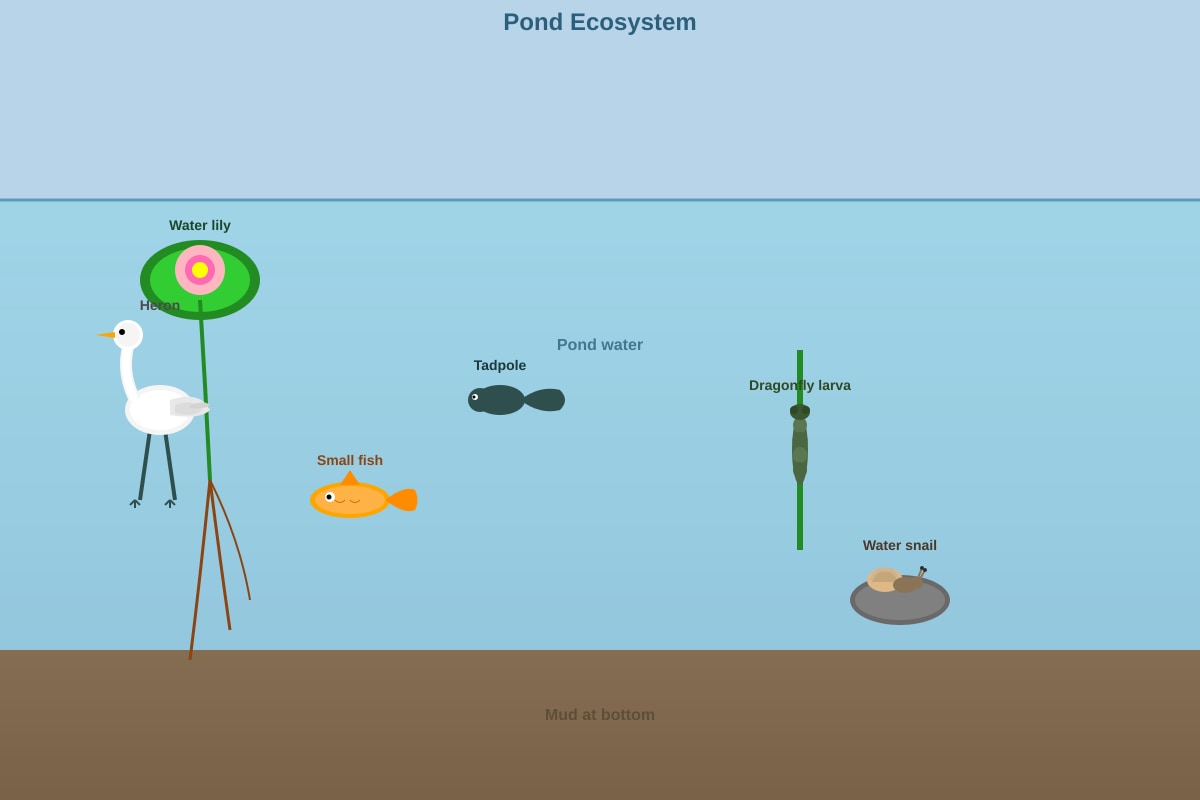
21. Look at the picture below and answer the questions that follow.
<image_placeholder> id: Q21-fig1 type: diagram linked_question: Q21 description: A pond ecosystem showing various organisms: water lily with roots in mud, tadpole swimming, dragonfly larva on plant stem, small fish, water snail on rock, and a heron standing at the water's edge labels: "Water lily", "Tadpole", "Dragonfly larva", "Small fish", "Water snail", "Heron", "Pond water", "Mud at bottom" values: None must_show: All six organisms clearly visible and labeled, pond environment with water surface and bottom mud, arrows not needed but organisms in natural positions </image_placeholder>
(a) Name one producer in this pond ecosystem. [1]
(b) Name one consumer in this pond ecosystem. [1]
(c) The heron eats the small fish. What is the relationship between the heron and the small fish? [1]
(d) Explain what would happen to the small fish population if all the herons were removed from this pond. [2]
22. The table below shows information about four different vertebrates.
| Feature | Animal W | Animal X | Animal Y | Animal Z |
|---|---|---|---|---|
| Has hair or fur | ✓ | ✗ | ✗ | ✗ |
| Has feathers | ✗ | ✓ | ✗ | ✗ |
| Has moist skin | ✗ | ✗ | ✓ | ✗ |
| Has dry, scaly skin | ✗ | ✗ | ✗ | ✓ |
| Lays eggs with hard shells | ✗ | ✓ | ✗ | ✓ |
| Gives birth to live young | ✓ | ✗ | ✗ | ✗ |
(a) Which animal is a mammal? [1]
(b) Which animal is a reptile? [1]
(c) Which two animals are most similar to each other based on their features? Explain your answer. [2]
(d) Name Animal Y and explain one feature that helps you identify it. [2]
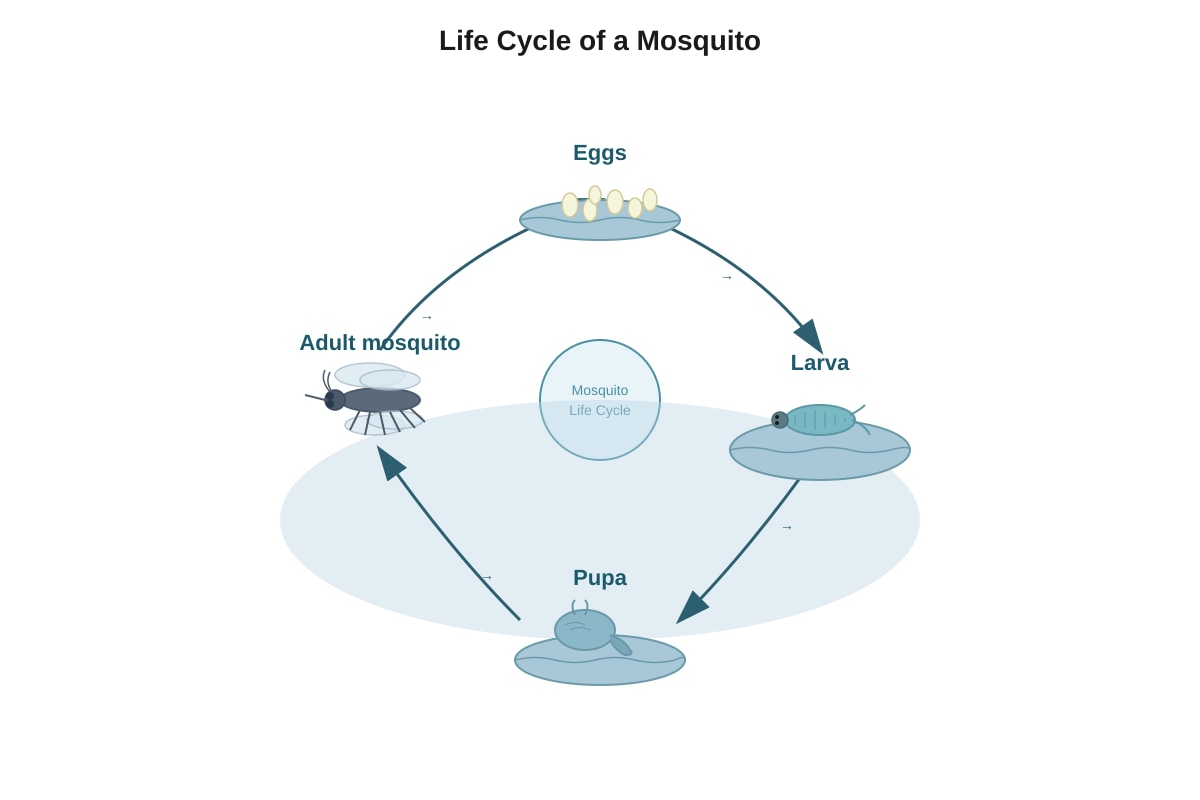
23. Study the life cycle diagram below and answer the questions.
<image_placeholder> id: Q23-fig1 type: diagram linked_question: Q23 description: A circular diagram showing the life cycle of a mosquito with four stages: eggs floating on water surface, larva in water, pupa in water, and adult mosquito flying labels: "Eggs" (top), "Larva" (right), "Pupa" (bottom), "Adult mosquito" (left); arrows connecting stages in clockwise direction values: None must_show: Four distinct stages with clear drawings, circular arrangement with directional arrows, all stages labeled, aquatic environment for eggs/larva/pupa </image_placeholder>
(a) Name the four stages of the mosquito's life cycle in order. [2]
(b) Is this life cycle an example of complete or incomplete metamorphosis? [1]
(c) Explain one way this life cycle helps mosquitoes survive in their environment. [2]
24. Rahim conducted an experiment to find out which material was the best insulator. He wrapped four identical beakers with different materials and poured the same amount of hot water into each beaker. He measured the temperature after 15 minutes.
| Beaker | Material | Starting temperature (°C) | Temperature after 15 minutes (°C) |
|---|---|---|---|
| A | Cotton | 80 | 65 |
| B | Paper | 80 | 58 |
| C | Felt | 80 | 62 |
| D | None (bare) | 80 | 45 |
(a) What is the aim of Rahim's experiment? [1]
(b) Which material was the best insulator? Explain your answer using the data. [2]
(c) What was the purpose of Beaker D in this experiment? [1]
(d) Suggest one thing Rahim should keep the same in this experiment, besides the starting temperature and amount of water. [1]
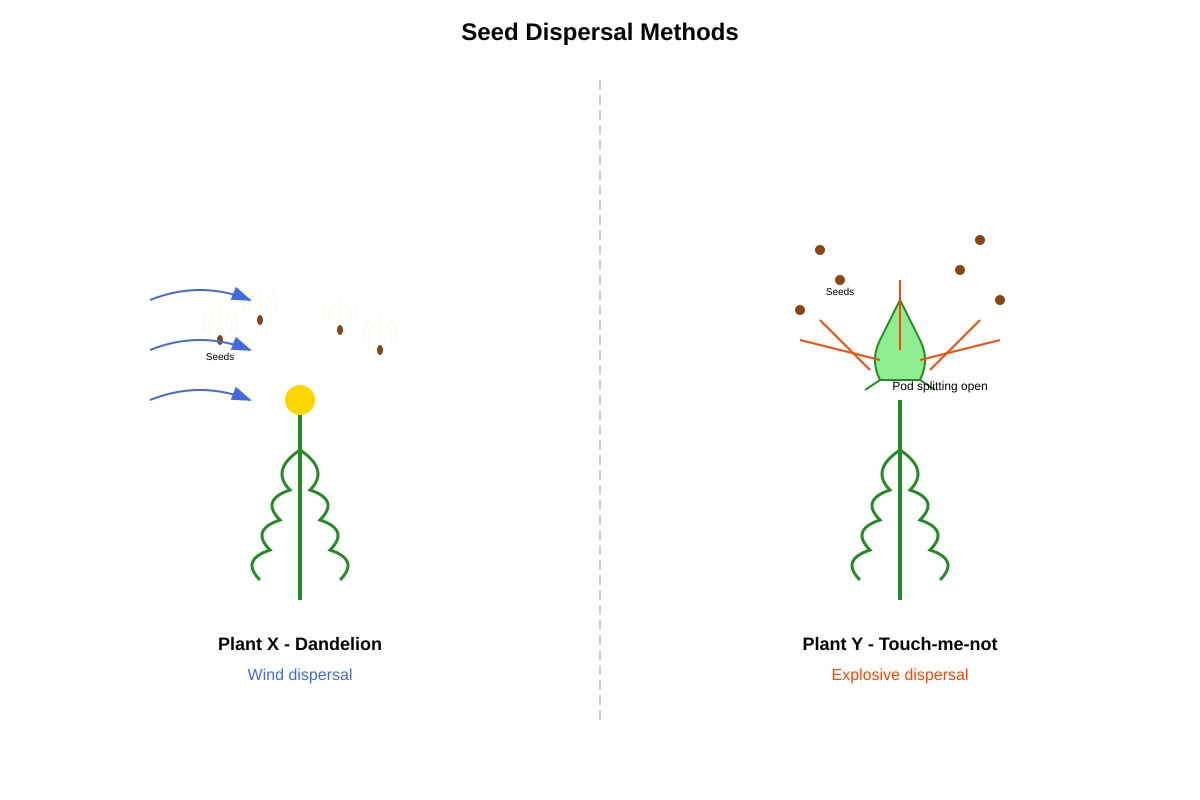
25. The diagram below shows how seeds from two different plants are dispersed.
<image_placeholder> id: Q25-fig1 type: diagram linked_question: Q25 description: Two seed dispersal methods side by side: Left shows a dandelion with feathery parachute-like structures on seeds being carried by wind; Right shows a pod of a plant with seeds being ejected explosively labels: "Plant X - Dandelion", "Wind dispersal", "Plant Y - Touch-me-not", "Explosive dispersal", "Seeds", "Pod splitting open" values: None must_show: Two distinct plants with their seed structures, wind shown with curved arrows for dandelion, explosive action shown with seeds flying outward from splitting pod </image_placeholder>
(a) State one difference between how Plant X and Plant Y disperse their seeds. [1]
(b) Explain how the structure of the dandelion seed helps it to be dispersed by wind. [2]
(c) Suggest one advantage for a plant to disperse its seeds far away from the parent plant. [2]
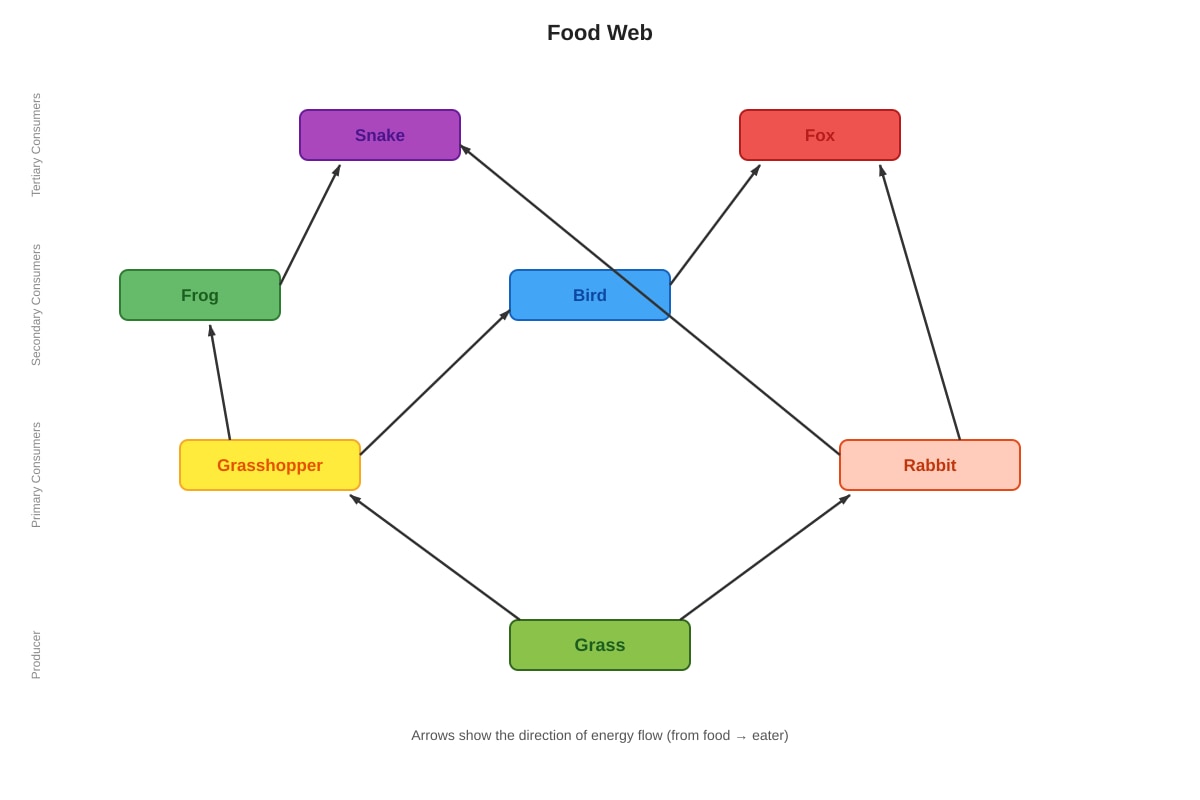
26. Study the food web below.
<image_placeholder> id: Q26-fig1 type: diagram linked_question: Q26 description: A food web showing grass eaten by grasshopper and rabbit; grasshopper eaten by frog and bird; frog eaten by snake; rabbit eaten by fox and snake; bird eaten by fox labels: "Grass", "Grasshopper", "Rabbit", "Frog", "Bird", "Snake", "Fox"; arrows showing directions of energy flow (who eats whom) values: None must_show: All seven organisms with multiple connecting arrows showing feeding relationships, clear arrow direction from food to eater </image_placeholder>
(a) How many food chains can you find in this food web? [1]
(b) Name one animal that is both a predator and prey in this food web. [1]
(c) If a disease killed most of the grasshoppers, explain what would happen to: (i) The frog population: [1] _________________________________________________________________
(ii) The grass population: [1]
_________________________________________________________________
(d) Explain why a food web is a better model than a single food chain for showing feeding relationships in an ecosystem. [2]
27. Classify the following items into living things or non-living things. Write your answers in the table below.
Items: apple tree, robot, river, mushroom, cloud, goldfish, bicycle, bacteria
| Living things | Non-living things |
|---|---|
[4 marks]
28. A class of students went on a nature walk in a park in Singapore. They recorded the organisms they saw:
| Organism | Where found | Moving? | Growing? | Needs food? |
|---|---|---|---|---|
| Butterfly | On flower | Yes | Yes | Yes |
| Moss | On tree trunk | No | Yes | No (makes own food) |
| Ant | On ground | Yes | Yes | Yes |
| Mushroom | On rotting log | No | Yes | No (absorbs nutrients) |
(a) The students disagreed about whether the moss was a living thing. Based on the table, is moss a living thing? Give two reasons from the table to support your answer. [2]
(b) The mushroom does not make its own food and does not move. Explain why it is still considered a living thing. [2]
Section C: Application and Open-Ended (Questions 29–30: 20 marks)
Answer all questions in the spaces provided.
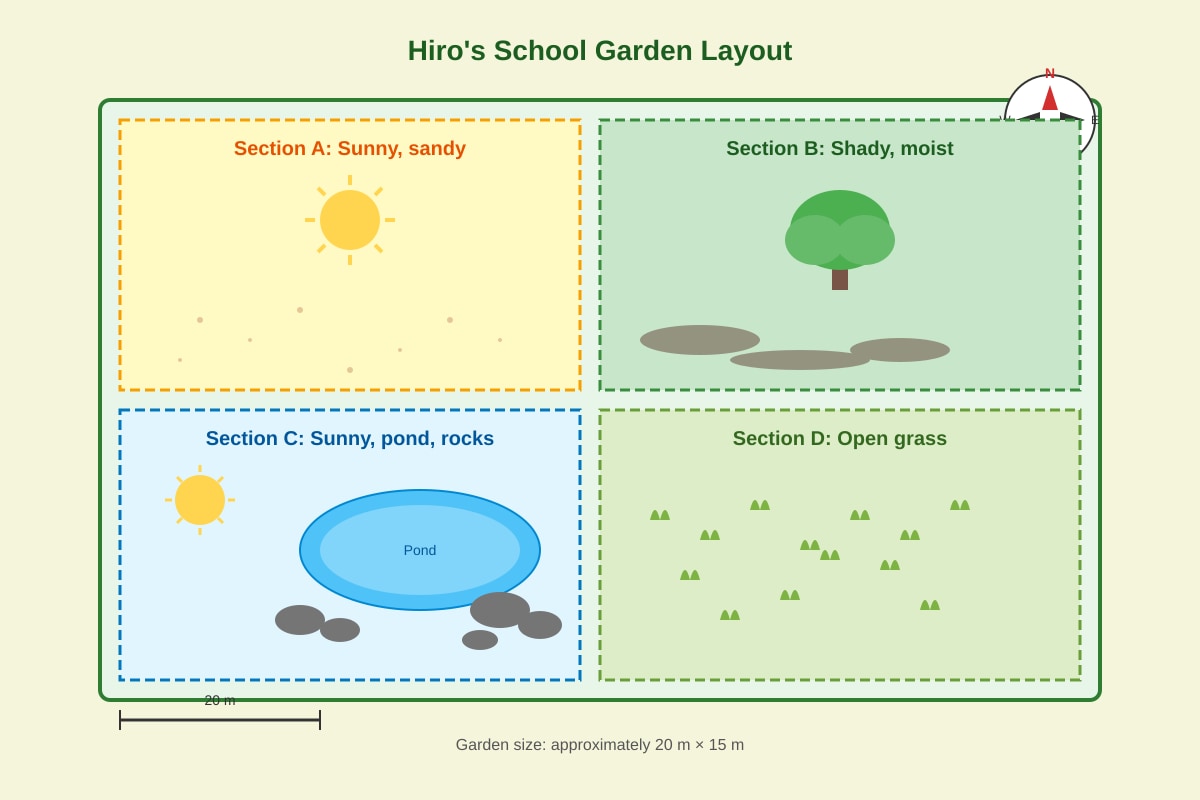
29. Hiro is designing a new garden for his school. He wants to create a garden that attracts many different types of living things.
<image_placeholder> id: Q29-fig1 type: diagram linked_question: Q29 description: A planned school garden layout with four sections: Section A sunny with sandy soil, Section B shady with moist soil, Section C sunny with pond and rocks, Section D open grassy area labels: "Section A: Sunny, sandy", "Section B: Shady, moist", "Section C: Sunny, pond, rocks", "Section D: Open grass", compass rose showing North values: Garden approximately 20m x 15m, pond about 3m x 2m must_show: Four clearly separated sections with distinct features, labels describing each section's conditions, pond with water in Section C </image_placeholder>
(a) Hiro wants to plant sunflowers in one section. Which section (A, B, C, or D) would be most suitable? Explain your answer. [2]
(b) Hiro observes that earthworms are found in Section B but not in Section A. Explain why this is so. [2]
(c) Hiro wants to attract butterflies to his garden. Suggest two things he could plant or add to the garden, and explain why each would attract butterflies. [4]
(d) A student suggests that Hiro should use pesticides to kill all insects in the garden. Explain whether this is a good idea, considering the garden ecosystem. [3]
30. Mei Ling read an article about deforestation in Southeast Asia. She learned that many forests are being cleared for palm oil plantations.
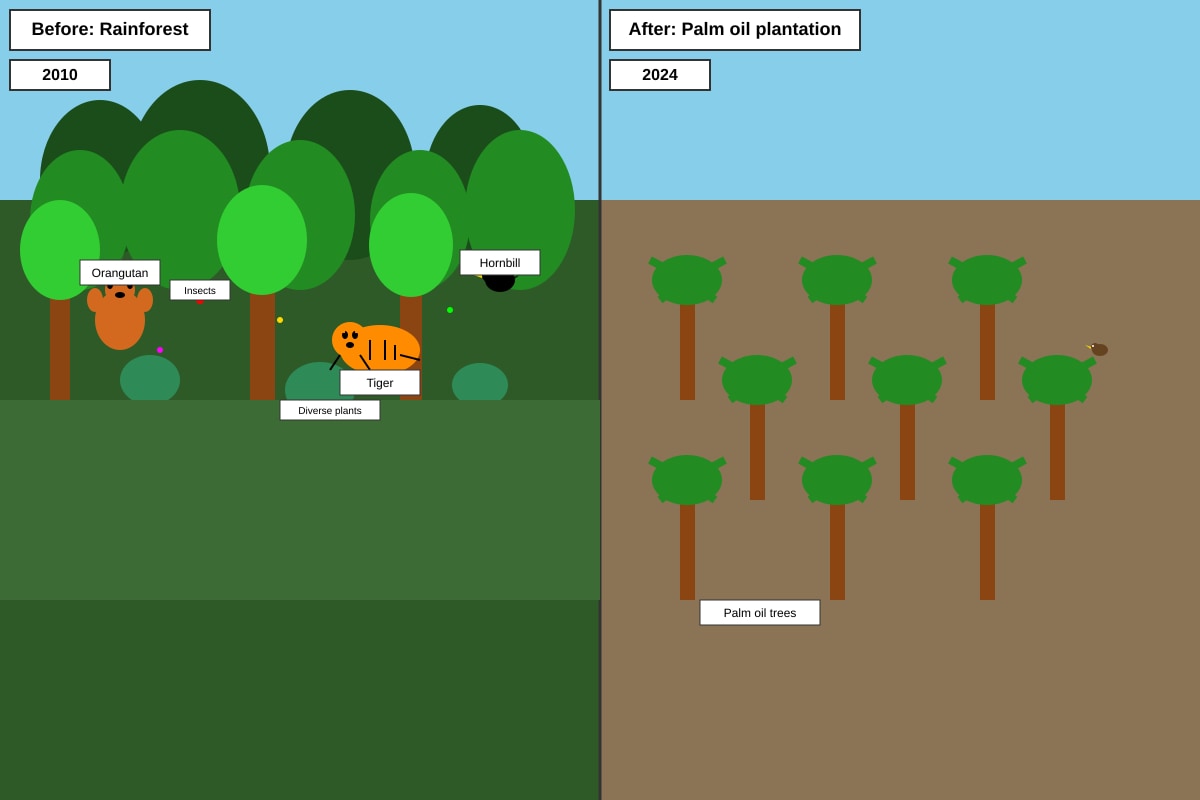
<image_placeholder> id: Q30-fig1 type: diagram linked_question: Q30 description: Before and after comparison of a forest area: Left side shows dense tropical rainforest with layers of vegetation, orangutan, tiger, hornbill, insects, and diverse plants; Right side shows cleared land with evenly spaced palm oil trees, few animals visible labels: "Before: Rainforest", "After: Palm oil plantation", "Orangutan", "Palm oil trees", years indicated as "2010" and "2024" values: None must_show: Clear contrast between dense diverse forest and monoculture plantation, some animals shown only on left side, similar landscape shape for direct comparison </image_placeholder>
(a) Using the diagram, describe two differences between the rainforest and the palm oil plantation. [2]
(b) Explain why the orangutan and other animals might not survive in the palm oil plantation. [2]
(c) The article states that clearing forests affects the water cycle. Explain how removing trees would affect the amount of water vapor in the air and the temperature of the area. [3]
(d) Mei Ling wants to help protect forests. Suggest two actions she can take in Singapore to reduce the demand for products that cause deforestation. Explain how each action helps. [4]
END OF PAPER
Check your work before handing in your paper.
Section Marks:
- Section A: ______ / 20
- Section B: ______ / 20
- Section C: ______ / 20
- Total: ______ / 60
Answers
TuitionGoWhere Practice Paper - Science Primary 4: Answer Key
Version 3
Section A: Multiple Choice (20 marks)
| Question | Answer | Explanation |
|---|---|---|
| 1 | C | All living things can reproduce, respire, and grow. However, not all living things can move from place to place—plants are living but generally rooted in one place. They show movement in other ways (growing toward light, roots growing down), but cannot relocate. |
| 2 | B | Plants need light to make food through photosynthesis. Without light, the plant cannot produce food, so it will become yellow (due to lack of chlorophyll production) and weak. |
| 3 | B | Following the key: both fish and bird have backbones (first question: Yes). To distinguish them, the next question is "Has wings?"—birds have wings, fish do not. |
| 4 | C | Mammals are defined by having hair/fur and feeding their young with milk. This distinguishes them from birds (feathers), reptiles (scales), and amphibians (moist skin). |
| 5 | C | Animal R has fur (mammal feature), does NOT lay eggs (most mammals give live birth), matching mammal characteristics. Animal P is a bird (feathers, lays eggs), Q is a reptile (scales, lays eggs), S is unusual (scales, no eggs—could be a snake that gives live birth, but fur is the clearest mammal indicator). |
| 6 | C | A growing mushroom is a living thing (fungus). Clouds, robots, and rivers are non-living. |
| 7 | B | Coconut seeds have a hard, waterproof shell and can float, making them adapted for water dispersal. Dandelion uses wind, touch-me-not uses explosion, maple uses wind. |
| 8 | C | Flowers attract insects (and other animals) to help with pollination, which leads to reproduction and seed formation. Leaves make food, roots absorb water, stems provide support. |
| 9 | B | If rabbits are removed, foxes lose their food source, so the fox population would decrease first. Grass would likely increase without rabbits eating it. |
| 10 | B | Butterfly undergoes complete metamorphosis: egg → larva (caterpillar) → pupa (chrysalis) → adult. This is the only correct sequence. |
| 11 | A | For a fair test, only ONE variable should change. The changed variable is moisture (dry vs. moist). She must keep number of earthworms and light the same. The amount of water differs by design; soil type should be the same but isn't listed as an option that matches both requirements. Actually, re-reading: she needs to keep multiple things same, but option A specifically names things that must be identical. |
| 12 | B | Producers make their own food (usually through photosynthesis). Grass is a plant producer. All others are consumers. |
| 13 | C | Thick, fleshy leaves with spines (Leaf C) describe a cactus or similar desert plant. The fleshy tissue stores water, and spines reduce water loss and protect from herbivores. |
| 14 | B | Fungi lack chlorophyll and cannot make their own food. They absorb nutrients from decaying matter. They do not have flowers/seeds and do not require water to grow. |
| 15 | C | Roots are plant parts that anchor and absorb; they do NOT disperse seeds. The four main seed dispersal methods are wind, water, animals, and splitting/explosion. |
| 16 | B | Venus flytraps live in nutrient-poor soil (low nitrogen). They trap insects to obtain nutrients—particularly nitrogen—that they cannot get from the soil. |
| 17 | C | Fish breathe through gills, which extract oxygen from water. Dogs and birds use lungs. Frogs use lungs and skin (as adults) or gills (as tadpoles). |
| 18 | B | A rock shows none of the characteristics of living things. A seed would grow, a caterpillar would move and need food, a mushroom would grow. |
| 19 | B | Energy flows: Sun → producer (cabbage leaf) → primary consumer (caterpillar) → secondary consumer (bird). Arrows must point from food source to eater. |
| 20 | B | Different animals can evolve similar features when living in similar environments (convergent evolution), such as streamlined bodies in dolphins and sharks. Plants reproduce differently (seeds, spores, etc.); living things have different water needs; fungi don't photosynthesize. |
Section B: Short Answer (20 marks)
21. Pond Ecosystem (5 marks)
(a) Water lily (or any plant/algae in the diagram) [1 mark]
Teaching note: Producers are organisms that make their own food through photosynthesis. In a pond, these are plants or algae.
(b) Tadpole / small fish / water snail / dragonfly larva / heron (any consumer) [1 mark]
Teaching note: Consumers cannot make their own food and must eat other organisms. The heron is a consumer (eats fish), even though it's at the edge.
(c) The heron is a predator and the small fish is its prey / Predator-prey relationship [1 mark]
Teaching note: The eater is the predator; the one being eaten is the prey.
(d) The small fish population would increase (at first) because there would be no herons eating them. [1 mark] However, without predators, the small fish might overpopulate and eat too much food (or produce too much waste), eventually causing problems. [1 mark]
Alternative: If the fish have no food shortage, they increase. If they run out of food, they decrease. Mark for trend + mark for reasoning.
22. Vertebrate Classification (6 marks)
(a) Animal W [1 mark] Has fur, gives live birth—classic mammal features.
(b) Animal Z [1 mark] Has dry scaly skin, lays eggs with hard shells—classic reptile features.
(c) Animals X and Z (bird and reptile) are most similar. [1 mark] Both lay eggs with hard shells, both have dry covering (feathers/scales), neither has fur or moist skin. [1 mark]
Alternative acceptable answer: Animals Y and Z if student identifies them as both being poikilotherms/ectotherms or "cold-blooded," but eggs with hard shells is the clearest shared feature between X and Z.
(d) Animal Y is an amphibian [1 mark] It has moist skin (amphibians need to keep skin wet for gas exchange/breathing) and does not lay hard-shelled eggs. [1 mark]
23. Mosquito Life Cycle (5 marks)
(a) Four stages in order: [2 marks, 0.5 each]
- Egg
- Larva
- Pupa
- Adult mosquito
(b) Complete metamorphosis [1 mark] The larva and pupa look completely different from the adult, and there is a resting/changing stage (pupa).
(c) Aquatic stages (egg, larva, pupa) allow mosquitoes to develop in water, which is abundant in tropical Singapore. [1 mark] The pupa stage protects the developing mosquito during transformation. / Many eggs can be laid in water, ensuring survival of species. [1 mark]
Teaching note: Emphasize adaptation—life cycle matches environment.
24. Insulator Experiment (5 marks)
(a) To find out which material is the best insulator / To compare how well different materials keep heat in. [1 mark]
(b) Cotton was the best insulator. [1 mark] The temperature dropped from 80°C to only 65°C (a drop of 15°C), which is the smallest temperature change. [1 mark] This means cotton kept the most heat in.
Alternatively: Felt (drop of 18°C) is second best. Award marks for correct material + correct data use.
(c) Beaker D acts as a control / for comparison [1 mark] It shows what happens with NO insulation, helping us see if the materials actually made a difference.
(d) Any one: Type/thickness of material, size of beaker, room temperature, time period, covering method [1 mark]
25. Seed Dispersal (5 marks)
(a) Plant X uses wind while Plant Y uses explosive/splitting force [1 mark] Accept any clear comparison of the two methods.
(b) The dandelion seed has a feathery/parachute-like structure [1 mark] This increases air resistance/surface area, allowing wind to catch it and carry it far away. [1 mark]
(c) Reduces competition for sunlight, water, and nutrients [1 mark] If seeds fall near the parent, they compete for limited resources. Spreading out gives offspring better chance to survive and grow. [1 mark]
Alternative: Colonize new areas, avoid diseases/pests concentrated near parent.
26. Food Web (5 marks)
(a) 4 food chains [1 mark] Grass→Grasshopper→Frog→Snake; Grass→Grasshopper→Bird→Fox; Grass→Rabbit→Fox; Grass→Rabbit→Snake
(b) Snake (eats frog/rabbit, eaten by none shown—but wait, check diagram) / Frog (eats grasshopper, eaten by snake) / Bird (eats grasshopper, eaten by fox) / Rabbit (eats grass, eaten by fox and snake) [1 mark]
Best answer: Snake or Bird or Frog or Rabbit—all fit depending on interpretation. Snake: is it preyed upon? In this web, no arrow from snake to another predator, so snake is only predator. Frog: predator (eats grasshopper) and prey (eaten by snake).
(c) (i) Frog population would decrease (lose food source) [1 mark] (ii) Grass population would increase (less grasshoppers eating it) [1 mark]
(d) A food web shows multiple feeding relationships / interconnected food chains [1 mark] In reality, most animals eat MORE than one type of food and are eaten by multiple predators. A single chain is too simple and doesn't show these complex connections. [1 mark]
27. Classification Table (4 marks)
| Living things | Non-living things |
|---|---|
| Apple tree | Robot |
| Mushroom | River |
| Goldfish | Cloud |
| Bacteria | Bicycle |
[0.5 mark per correct placement; 8 items × 0.5 = 4 marks]
Teaching note: Mushroom and bacteria are living (fungi and bacteria are microorganisms). River and cloud are non-living (water is non-living, movement is not self-directed).
28. Nature Walk Data (4 marks)
(a) Yes, moss is a living thing. [1 mark] Evidence from table: It is growing (grows over time) / It makes its own food (photosynthesis, indicated by "No (makes own food)" showing it produces its own nutrition) [1 mark for any correct reason]
(b) Mushroom is living because it grows [1 mark] and it absorbs nutrients from its surroundings to survive / it can reproduce (produces spores) [1 mark] Living things don't need to move or make their own food. Fungi like mushrooms obtain nutrients by absorption, which is a valid life process.
Section C: Application and Open-Ended (20 marks)
29. School Garden Design (11 marks)
(a) Section A (Sunny, sandy) or Section D (Open grass) [1 mark] Sunflowers need plenty of sunlight to grow and make food. Section A is specifically described as sunny. [1 mark] Section D is acceptable but less specific about soil. Section B is too shady.
(b) Section B has moist soil while Section A has dry sandy soil [1 mark] Earthworms need moist conditions to breathe through their skin—they will dry out and die in dry soil. [1 mark]
(c) Two suggestions with explanations: [4 marks: 2 marks each]
Suggestion 1: Plant nectar-rich flowers [1 mark] Butterflies feed on nectar, so flowers with bright colours and sweet nectar will attract them. [1 mark]
Suggestion 2: Add a muddy puddle area / water source [1 mark] Butterflies need water and minerals; they "puddle" at damp spots to get salts. [1 mark]
Alternative acceptable:
- Caterpillar food plants: Caterpillars need specific plants to eat; butterflies lay eggs on these.
- Sunny spot: Butterflies are cold-blooded and need warmth to fly.
(d) This is NOT a good idea. [1 mark] Pesticides kill ALL insects, including helpful ones like pollinators (bees, butterflies). [1 mark] This would disrupt the garden ecosystem—without pollinators, flowers won't produce seeds/fruit. [1 mark] Alternative points: Pesticides could harm birds that eat insects; chemicals might pollute the pond in Section C.
30. Deforestation Article (9 marks)
(a) Two differences: [2 marks, 1 each]
- The rainforest has many different types of plants/species while the plantation has only one type of tree (monoculture).
- The rainforest has many animals (orangutan, tiger, hornbill, insects) while the plantation has few or no animals.
- The rainforest has dense/layered vegetation while the plantation has evenly spaced, single-layer trees.
(b) Orangutans lose their habitat/home when forest is cleared [1 mark] They need specific trees for food (fruits, leaves) and shelter/nesting. The palm oil plantation doesn't provide these resources. [1 mark]
(c) Trees release water vapor through transpiration; removing trees means less water vapor in the air [1 mark] With fewer trees, less water returns to the atmosphere, potentially reducing rainfall [1 mark] Without tree shade, temperature increases (exposed ground heats up more); also less evapotranspiration cooling effect [1 mark]
(d) Two actions with explanations: [4 marks, 2 each]
Action 1: Check product labels and choose palm-oil-free or certified sustainable products [1 mark] If consumers buy less unsustainable palm oil, companies have less reason to clear more forest. [1 mark]
Action 2: Spread awareness / educate others about deforestation [1 mark] More informed consumers can make better choices, creating pressure for sustainable practices. [1 mark]
Alternative actions: Reduce/reuse paper products (less demand); support conservation organizations; write to companies.
Marking Summary
| Section | Marks Available |
|---|---|
| Section A (Q1–20) | 20 |
| Section B (Q21–28) | 20 |
| Section C (Q29–30) | 20 |
| Total | 60 |