AI Generated Exam Paper
Primary 4 Science Practice Paper 3
Free P4 Science Practice Paper 3, HY3 AI version, with questions, answers, and syllabus-aligned practice for Singapore students.
These static practice materials are generated from the site's syllabus and paper-generation workflow, with source and model context shown so students and parents can evaluate the material before use.
Questions
TuitionGoWhere Practice Paper - Science Primary 4
TuitionGoWhere Practice Paper (AI) — Version 3
Subject: Science
Level: Primary 4
Paper: Practice Paper (Topic: Diversity)
Duration: 45 minutes
Total Marks: 40
Name: ______________________
Class: _________
Date: ___________
Instructions:
- This practice paper has 20 questions on the topic of Diversity.
- Section A: 10 multiple-choice questions (1 mark each).
- Section B: 6 short-answer questions (2 marks each).
- Section C: 4 structured questions (total 8 marks as shown).
- Write your answers clearly in the spaces provided.
- This paper is syllabus-first and not derived from past-year exams.
Section A (10 marks)
Answer all questions. Each question carries 1 mark.
1. Which of the following is a living thing?
A) A wooden chair
B) A plastic cup
C) A mango tree
D) A stone
2. Which of these is NOT a characteristic of a living thing?
A) Needs food
B) Can move from place to place
C) Made of metal
D) Reproduces
3. A mushroom is classified as a —
A) Plant
B) Animal
C) Fungus
D) Non-living thing
4. Which group do birds, fish, and reptiles belong to?
A) Plants
B) Animals
C) Fungi
D) Materials
5. Which of the following is a non-living natural material?
A) Cotton
B) Sand
C) Leaf
D) Cat
6. Materials can be grouped by their —
A) Colour only
B) Properties such as hardness and flexibility
C) Price only
D) Smell only
7. Which of these animals lays eggs?
A) Dog
B) Cow
C) Chicken
D) Human
8. Which plant part is mainly responsible for making food?
A) Root
B) Stem
C) Leaf
D) Flower
9. Which of the following is a good way to group living things?
A) By whether they can breathe
B) By their size only
C) By their colour only
D) By the shop they come from
10. A lizard and a frog are both —
A) Plants
B) Animals
C) Fungi
D) Non-living
Section B (12 marks)
Answer all questions. Each question carries 2 marks.
11. Name two characteristics that all living things share.
12. State one difference between a plant and an animal.
13. List two non-living things found in a classroom.
14. Give two examples of materials that are flexible.
15. Why is a car classified as non-living?
16. Name two groups of living things and one example for each.
Section C (18 marks)
Answer all questions. Marks shown per question.
17. (a) Classify the following into living or non-living: rose, rock, dog, book. [2]
(b) Give a reason why one of the living things is alive. [1]
18. (a) Name three groups of living things. [3]
(b) Give one example of each group named. [3]
19. (a) State two properties used to group materials. [2]
(b) Group the following materials: rubber band, wooden spoon, steel spoon, plastic bag. [2]
Flexible: ______________________
Rigid: ______________________
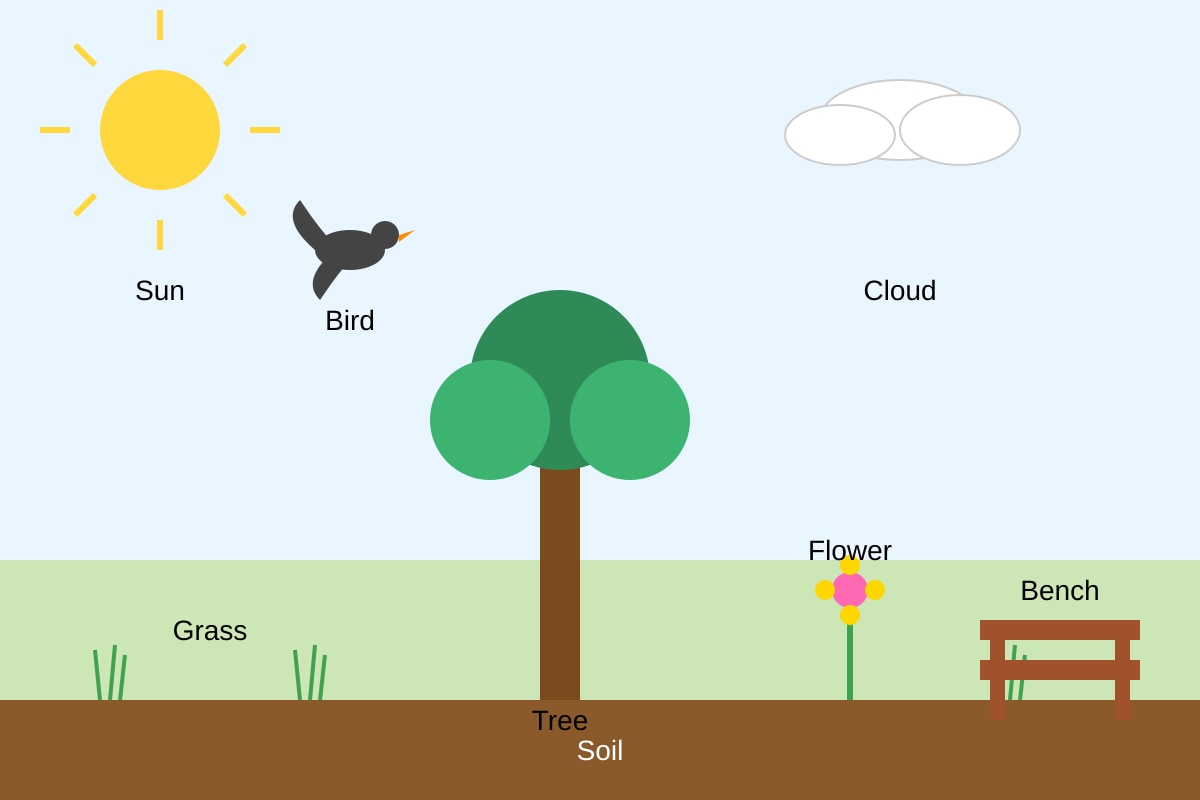
20. Study the picture of a garden.
Image pending generation: diagram for Q20.
(a) List two living things shown. [1]
(b) List two non-living things shown. [1]
(c) Explain why the tree is a living thing. [3]
End of Paper
Answers
TuitionGoWhere Practice Paper - Science Primary 4 (Answers)
Version 3 — Topic: Diversity
Section A (10 marks)
- C (1 mark) — A mango tree is a living thing because it grows, needs water, and can make food.
- C (1 mark) — Living things are not made of metal; that is a property of some materials.
- C (1 mark) — Mushroom is a fungus, not a plant or animal.
- B (1 mark) — Birds, fish, reptiles are all animals.
- B (1 mark) — Sand is non-living natural material.
- B (1 mark) — Materials grouped by properties like hardness/flexibility.
- C (1 mark) — Chicken (bird) lays eggs.
- C (1 mark) — Leaf makes food by photosynthesis (P4: leaf function).
- A (1 mark) — Breathing is a life characteristic.
- B (1 mark) — Both are animals.
Section B (12 marks)
- Any two: needs food, grows, reproduces, breathes, responds. (2 marks: 1 mark each)
- Difference: e.g., plants make their own food, animals do not; plants do not move about, animals do. (2 marks)
- Two non-living: desk, book, chair, pencil. (2 marks: 1 each)
- Flexible materials: rubber band, cloth, plastic bag. (2 marks: 1 each)
- Reason: Car does not grow, reproduce, or need food; it is made by humans. (2 marks)
- Groups & examples: Plants–rose; Animals–cat; Fungi–mushroom. (2 marks: 1+1)
Section C (18 marks)
-
(a) Living: rose, dog; Non-living: rock, book. [2]
(b) Reason: Dog is alive because it breathes/eats/moves. [1] -
(a) Three groups: Plants, Animals, Fungi. [3: 1 each]
(b) Examples: Plant–tree; Animal–fish; Fungus–mushroom. [3: 1 each] -
(a) Properties: hardness, flexibility, waterproof, transparent (any 2). [2]
(b) Flexible: rubber band, plastic bag. Rigid: wooden spoon, steel spoon. [2] -
(a) Living: Tree, Grass, Bird, Flower (any 2). [1]
(b) Non-living: Sun, Soil, Bench, Cloud (any 2). [1]
(c) Tree is living because it grows, needs water/sunlight, makes food, reproduces. [3: 1 mark each for any 3 valid points]
Total: 40 marks
Free quiz and exam paper access
Enter your details to view this paper
Your access is remembered on this device.