AI Generated Exam Paper
Primary 4 Science Practice Paper 2
Free AI-Generated NVIDIA Nemotron 3 Ultra 550B A55B Free Primary 4 Science Practice Paper 2 practice paper with questions and answers for Singapore students. This page is rendered as a direct URL so the questions and answers can be discovered without pressing in-page buttons.
These static practice materials are generated from the site's syllabus and paper-generation workflow, with source and model context shown so students and parents can evaluate the material before use.
Questions
TuitionGoWhere Practice Paper - Science Primary 4
TuitionGoWhere Practice Paper (AI)
Subject: Science
Level: Primary 4
Paper: Practice Paper 2 (Version 2 of 5)
Duration: 1 hour 30 minutes
Total Marks: 100
Name: ________________________
Class: Primary 4 _______
Date: _______________
INSTRUCTIONS TO CANDIDATES
- Do not open this booklet until you are told to do so.
- Follow all instructions carefully.
- Answer all questions.
- For Section A, shade your answers on the Optical Answer Sheet (OAS) provided.
- For Section B and Section C, write your answers in the spaces provided in this booklet.
- The number of marks is given in brackets [ ] at the end of each question or part question.
- The total marks for this paper is 100.
SECTION A: Multiple-Choice Questions (28 marks)
Questions 1 to 14 carry 2 marks each. For each question, four options are given. Choose the correct answer and shade the correct oval (1, 2, 3 or 4) on the Optical Answer Sheet.
1. Which of the following groups contains only living things? [2]
(1) Mushroom, fern, moss
(2) Cloud, river, rock
(3) Robot, car, computer
(4) Shadow, reflection, echo
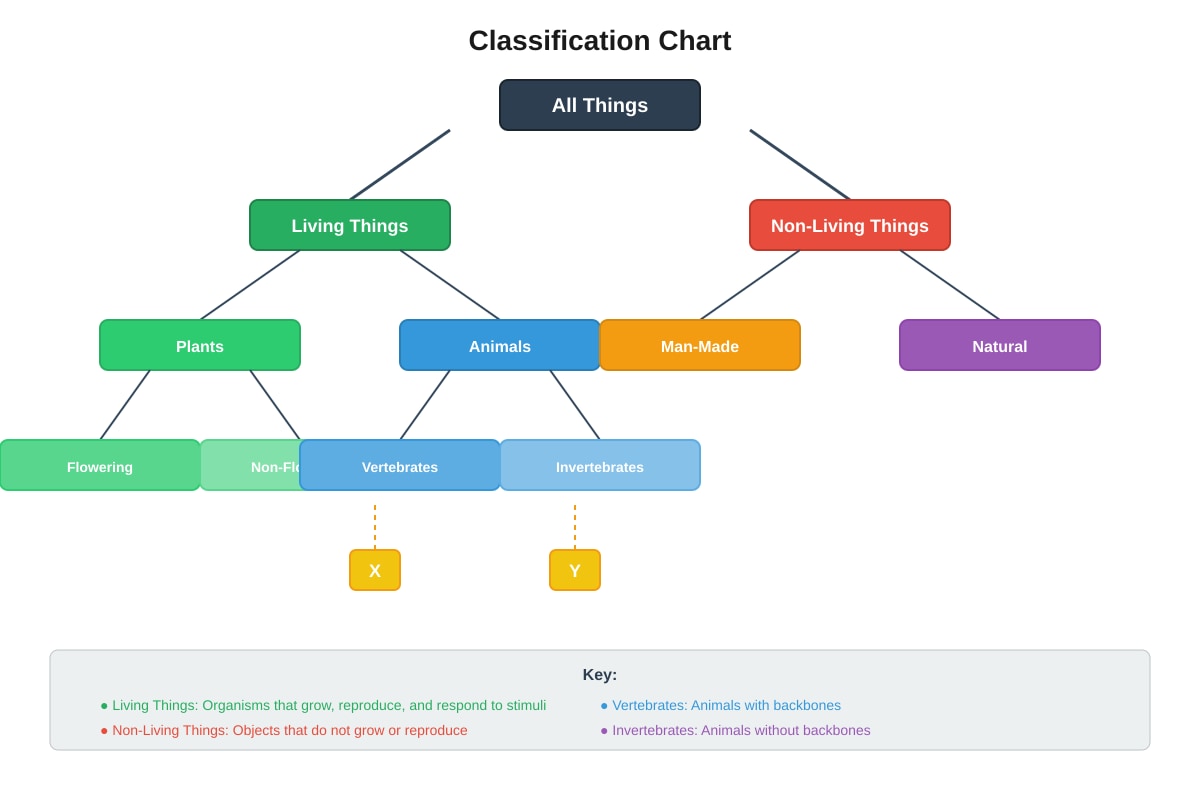
2. Study the classification chart below.
<image_placeholder> id: Q2-fig1 type: diagram linked_question: Q2 description: Classification chart with two main branches: Living Things and Non-Living Things. Living Things branch into Plants and Animals. Plants branch into Flowering and Non-Flowering. Animals branch into Vertebrates and Invertebrates. Non-Living Things branch into Natural and Man-made. labels: Living Things, Non-Living Things, Plants, Animals, Flowering, Non-Flowering, Vertebrates, Invertebrates, Natural, Man-made values: None must_show: Clear hierarchical branching structure with all labels visible </image_placeholder>
Which of the following can be placed in Group X? [2]
(1) Bacteria
(2) Mould
(3) Yeast
(4) Virus
3. Four pupils made the following statements about living things.
| Pupil | Statement |
|---|---|
| Ali | All living things can move from place to place. |
| Bala | All living things need air, food and water. |
| Cindy | All living things reproduce by laying eggs. |
| Devi | All living things grow and become bigger. |
Which pupil made the correct statement? [2]
(1) Ali
(2) Bala
(3) Cindy
(4) Devi
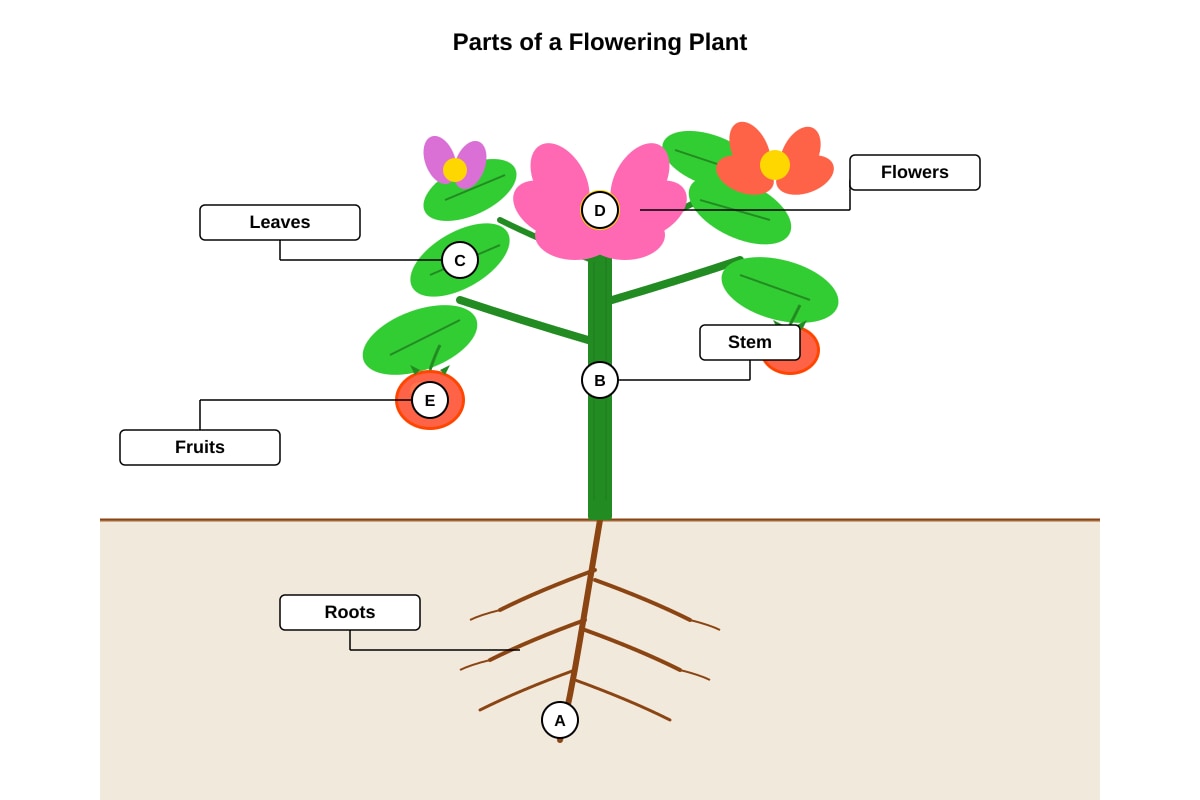
4. The diagram below shows a plant.
<image_placeholder> id: Q4-fig1 type: diagram linked_question: Q4 description: Diagram of a flowering plant showing roots, stem, leaves, flowers, and fruits. All parts are clearly labelled. labels: Roots, Stem, Leaves, Flowers, Fruits values: None must_show: Complete plant with all five main parts labelled clearly </image_placeholder>
Which part of the plant makes food for the plant? [2]
(1) Roots
(2) Stem
(3) Leaves
(4) Flowers
5. Which of the following are characteristics of fungi? [2]
A. They reproduce by spores.
B. They make their own food.
C. They feed on dead or decaying matter.
D. They have green leaves.
(1) A and B only
(2) A and C only
(3) B and D only
(4) C and D only
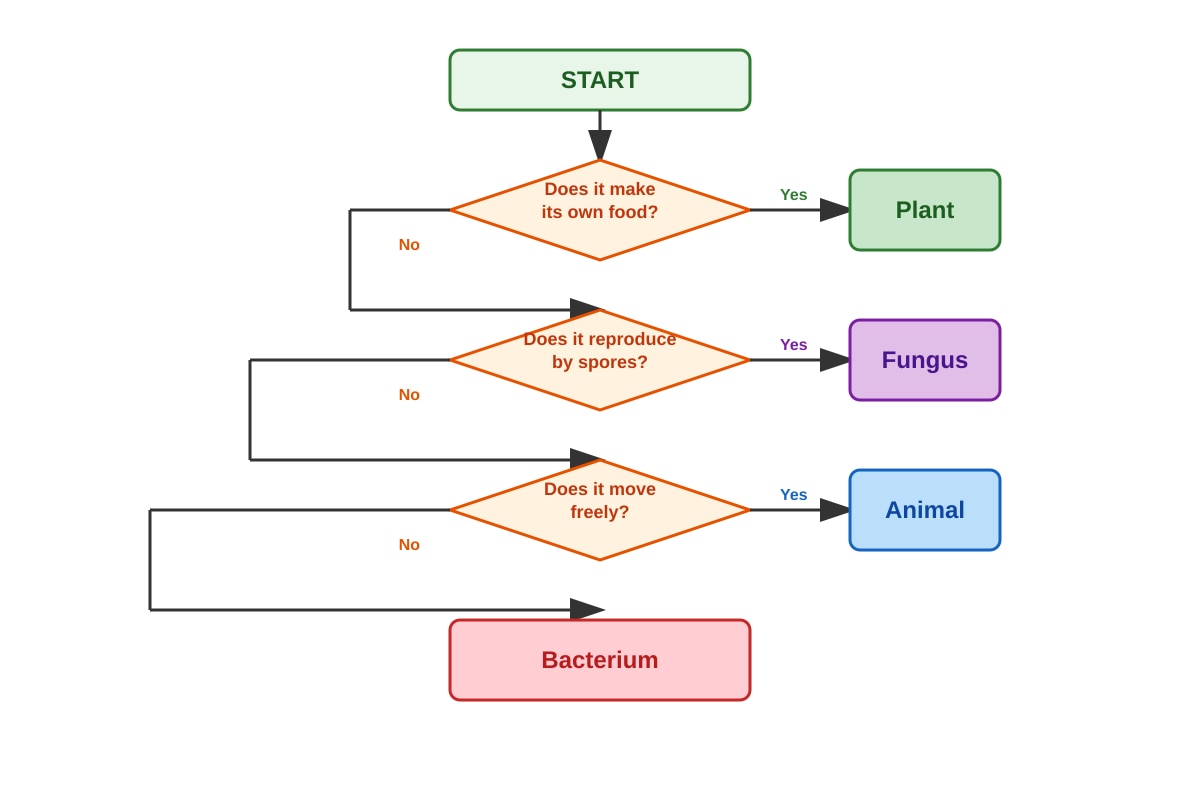
6. Study the flowchart below.
<image_placeholder> id: Q6-fig1 type: diagram linked_question: Q6 description: Flowchart for classifying organisms. Start: Does it make its own food? Yes → Plant. No → Does it reproduce by spores? Yes → Fungi. No → Does it have backbone? Yes → Vertebrate. No → Invertebrate. labels: Does it make its own food?, Does it reproduce by spores?, Does it have backbone?, Plant, Fungi, Vertebrate, Invertebrate values: None must_show: Complete flowchart with all decision diamonds and outcome boxes </image_placeholder>
An organism does not make its own food, reproduces by spores, and feeds on decaying matter. Which group does it belong to? [2]
(1) Plant
(2) Fungi
(3) Vertebrate
(4) Invertebrate
7. Which of the following animals undergoes complete metamorphosis? [2]
(1) Grasshopper
(2) Cockroach
(3) Butterfly
(4) Chicken
8. The diagram below shows the life cycle of a mosquito.
<image_placeholder> id: Q8-fig1 type: diagram linked_question: Q8 description: Life cycle diagram of a mosquito showing four stages: Egg, Larva, Pupa, Adult. Arrows show the cycle direction. Larva and Pupa are labelled as aquatic stages. labels: Egg, Larva (aquatic), Pupa (aquatic), Adult values: None must_show: Four distinct stages with arrows showing cycle, aquatic labels for larva and pupa </image_placeholder>
At which stage(s) does the mosquito live in water? [2]
(1) Egg only
(2) Larva only
(3) Larva and Pupa only
(4) Egg, Larva and Pupa
9. Study the table below.
| Animal | Young Stage | Adult Stage |
|---|---|---|
| Frog | Tadpole | Frog |
| Butterfly | Caterpillar | Butterfly |
| Grasshopper | Nymph | Grasshopper |
| Chicken | Chick | Chicken |
Which animal does not have a nymph stage? [2]
(1) Frog
(2) Butterfly
(3) Grasshopper
(4) Chicken
10. Which of the following statements about bacteria is correct? [2]
(1) All bacteria are harmful.
(2) Bacteria can be seen with the naked eye.
(3) Bacteria reproduce by binary fission.
(4) Bacteria are plants.
11. The diagram below shows three types of microorganisms.
<image_placeholder> id: Q11-fig1 type: diagram linked_question: Q11 description: Three microscope views: (A) Rod-shaped bacteria, (B) Yeast cells budding, (C) Mould with hyphae and sporangia. Each labelled with magnification. labels: A - Bacteria (rod-shaped), B - Yeast (budding), C - Mould (hyphae and sporangia) values: Magnification: ×400 for all must_show: Three distinct microorganism types clearly distinguishable </image_placeholder>
Which of the following correctly matches the microorganism to its group? [2]
(1) A - Fungi, B - Bacteria, C - Fungi
(2) A - Bacteria, B - Fungi, C - Fungi
(3) A - Bacteria, B - Bacteria, C - Fungi
(4) A - Fungi, B - Fungi, C - Bacteria
12. A pupil wants to find out if mould grows faster in a damp or dry place. He places a slice of bread in a sealed bag with water (Set-up A) and another slice in a sealed bag without water (Set-up B). Both bags are kept in a dark cupboard.
Which variable is changed in this experiment? [2]
(1) Type of bread
(2) Presence of water
(3) Temperature of cupboard
(4) Size of bread slice
13. Which of the following groups of materials are all non-living things? [2]
(1) Water, air, soil
(2) Wood, cotton, leather
(3) Plastic, glass, metal
(4) Seed, egg, spore
14. The diagram below shows a fern plant.
<image_placeholder> id: Q14-fig1 type: diagram linked_question: Q14 description: Fern plant showing fronds (leaves), rhizome (stem), and roots. Underside of frond shows sori (spore clusters). labels: Fronds, Rhizome, Roots, Sori (spore clusters) values: None must_show: Complete fern with fronds, rhizome, roots, and visible sori on frond underside </image_placeholder>
How does the fern reproduce? [2]
(1) By seeds
(2) By spores
(3) By budding
(4) By binary fission
SECTION B: Structured Questions (44 marks)
Questions 15 to 28 carry the marks shown. Write your answers in the spaces provided.
15. The diagram below shows two organisms, A and B.
<image_placeholder> id: Q15-fig1 type: diagram linked_question: Q15 description: Two organisms side by side. Organism A: Mushroom with cap, gills, and stem growing on decaying log. Organism B: Green plant with leaves, stem, and roots in soil. labels: A - Mushroom (cap, gills, stem), B - Green plant (leaves, stem, roots) values: None must_show: Clear visual distinction between fungus and plant </image_placeholder>
(a) State one similarity between Organism A and Organism B. [1]
(b) State two differences between Organism A and Organism B. [2]
Difference 1: ___________________________________________________________
Difference 2: ___________________________________________________________
(c) Which group does Organism A belong to? [1]
16. Study the classification table below.
| Group | Characteristics | Examples |
|---|---|---|
| W | Have feathers, lay eggs, breathe with lungs | Eagle, Penguin |
| X | Have scales, lay eggs, breathe with gills | Goldfish, Shark |
| Y | Have hair/fur, give birth to young alive, feed young with milk | Bat, Whale |
| Z | Have moist skin, lay eggs in water, young breathe with gills | Frog, Salamander |
(a) Which group (W, X, Y or Z) represents mammals? [1]
(b) A whale lives in water but belongs to Group Y. Explain why a whale is not a fish. [2]
(c) State one similarity between the young of Group X and Group Z. [1]
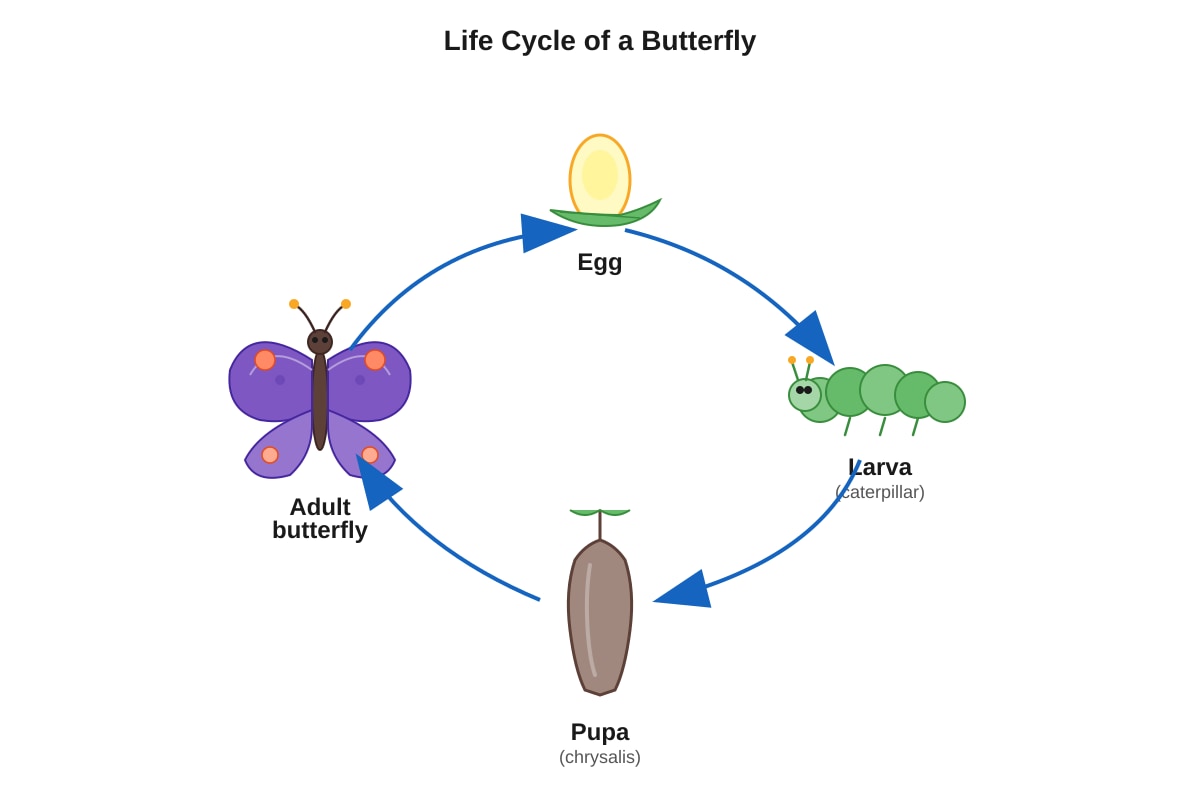
17. The diagram below shows the life cycle of a butterfly.
<image_placeholder> id: Q17-fig1 type: diagram linked_question: Q17 description: Complete butterfly life cycle: Egg → Caterpillar (Larva) → Chrysalis (Pupa) → Adult Butterfly. Arrows show direction. Each stage labelled with key features: Egg (tiny, on leaf), Caterpillar (eats leaves, moults), Chrysalis (attached to branch, no eating), Adult (wings, flies, lays eggs). labels: Egg, Caterpillar/Larva, Chrysalis/Pupa, Adult Butterfly values: None must_show: Four distinct stages with key features labelled </image_placeholder>
(a) Name the stage labelled X in the diagram. [1]
(b) The caterpillar moults several times. Explain why it needs to moult. [2]
(c) State one difference between the caterpillar and the adult butterfly. [1]
(d) The butterfly lays many eggs at a time. Suggest a reason for this. [1]
18. The diagram below shows the life cycle of a grasshopper.
<image_placeholder> id: Q18-fig1 type: diagram linked_question: Q18 description: Grasshopper life cycle showing incomplete metamorphosis: Egg → Nymph (wingless, resembles small adult) → Adult (winged). Multiple nymph stages shown with increasing size and wing buds. Arrows show cycle. labels: Egg, Nymph (1st instar), Nymph (2nd instar), Nymph (3rd instar), Nymph (4th instar), Adult values: None must_show: Multiple nymph stages showing gradual development of wings </image_placeholder>
(a) The grasshopper undergoes incomplete metamorphosis. What does this mean? [1]
(b) How many nymph stages are shown in the diagram? [1]
(c) State one difference between the nymph and the adult grasshopper. [1]
(d) The grasshopper lays its eggs in the soil. How does this help the eggs survive? [1]
19. Study the flowchart below.
<image_placeholder> id: Q19-fig1 type: diagram linked_question: Q19 description: Flowchart for classifying plants. Start: Does it bear flowers? Yes → Flowering plant. No → Does it reproduce by spores? Yes → Non-flowering plant (Fern/Moss). No → (Other). labels: Does it bear flowers?, Does it reproduce by spores?, Flowering plant, Non-flowering plant values: None must_show: Clear decision points with yes/no branches </image_placeholder>
(a) A plant does not bear flowers and reproduces by spores. Which group does it belong to? [1]
(b) State one difference between a flowering plant and a non-flowering plant. [1]
(c) The diagram below shows a plant.
<image_placeholder> id: Q19-fig2 type: diagram linked_question: Q19 description: Plant with cones (pine tree) showing needle-like leaves and cones. No flowers visible. labels: Needle-like leaves, Cones values: None must_show: Conifer with cones and needle leaves clearly visible </image_placeholder>
Using the flowchart, explain why this plant is a non-flowering plant. [2]
20. The table below shows the characteristics of four organisms, A, B, C and D.
| Organism | Makes own food | Reproduces by spores | Has backbone |
|---|---|---|---|
| A | Yes | No | No |
| B | No | Yes | No |
| C | No | No | Yes |
| D | No | No | No |
(a) Which organism is a plant? [1]
(b) Which organism is a fungus? [1]
(c) Which organism is a vertebrate? [1]
(d) Which organism is an invertebrate? [1]
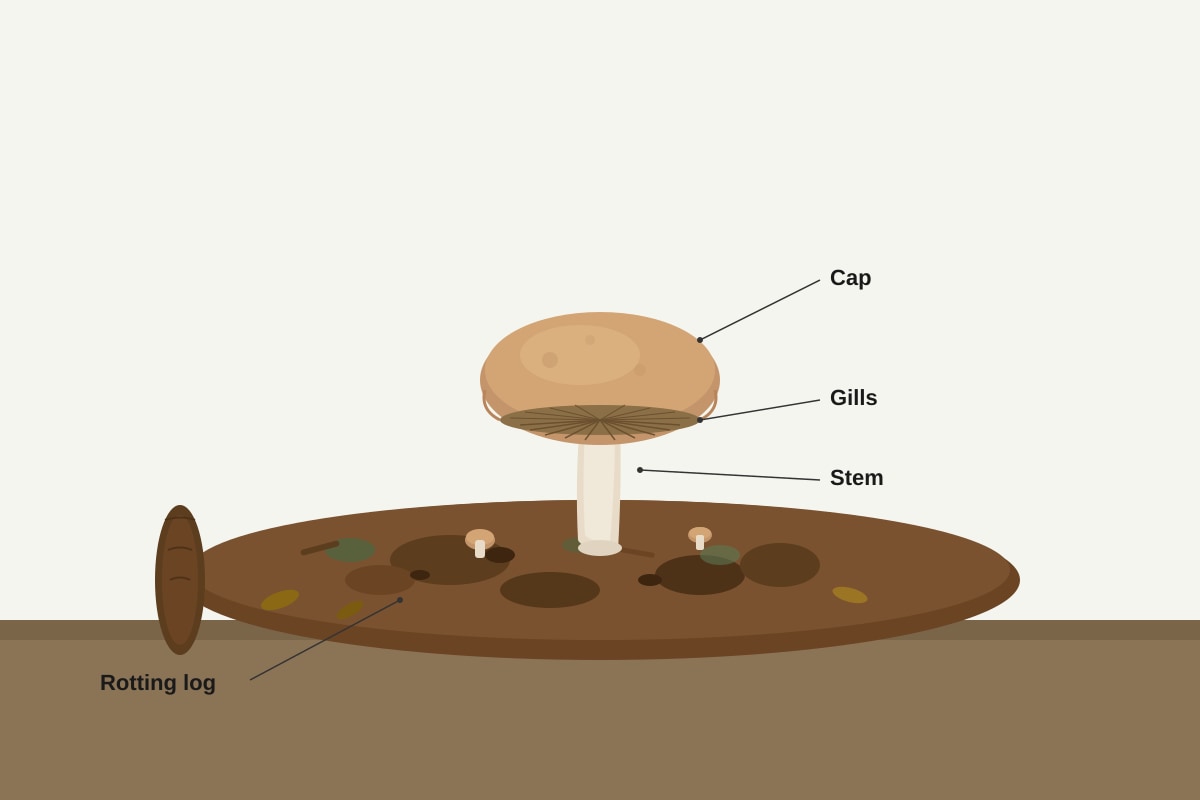
21. The diagram below shows a mushroom growing on a rotting log.
<image_placeholder> id: Q21-fig1 type: diagram linked_question: Q21 description: Mushroom on decaying log. Close-up shows gills under cap with spores. Hyphae shown extending into log. labels: Cap, Gills, Spores, Stem, Hyphae (in log), Rotting log values: None must_show: Mushroom structure with gills, spores, and hyphae in log </image_placeholder>
(a) The mushroom is a fungus. State two characteristics of fungi. [2]
(b) Explain how the mushroom obtains food. [2]
(c) The mushroom releases spores from its gills. How are the spores dispersed? [1]
22. A pupil observed three microorganisms, P, Q and R, under a microscope and recorded the observations.
| Microorganism | Observation |
|---|---|
| P | Single-celled, rod-shaped, no nucleus visible |
| Q | Single-celled, oval-shaped, budding observed |
| R | Thread-like structures (hyphae) with round sporangia |
(a) Identify the group (Bacteria, Yeast, or Mould) for each microorganism. [3]
P: _____________________________________________________________________
Q: _____________________________________________________________________
R: _____________________________________________________________________
(b) Which of these microorganisms is used in making bread? [1]
(c) State one useful role of bacteria in our daily life. [1]
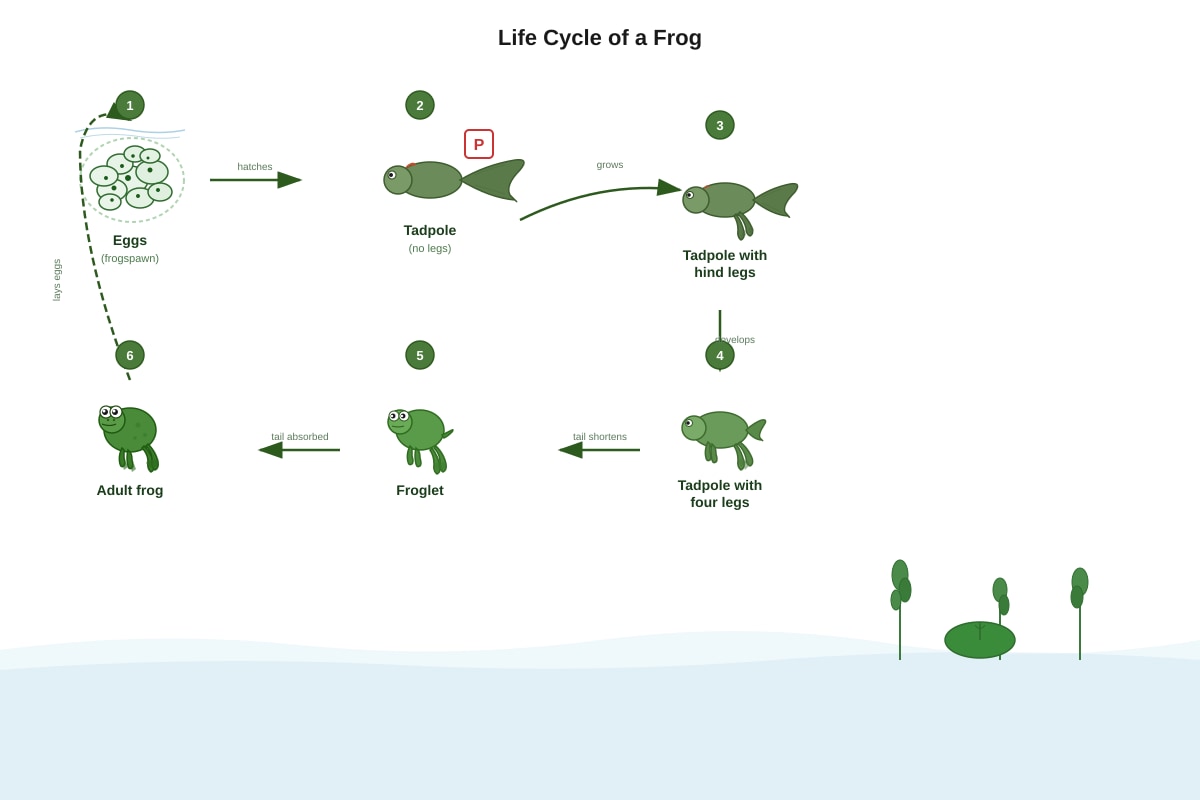
23. The diagram below shows the life cycle of a frog.
<image_placeholder> id: Q23-fig1 type: diagram linked_question: Q23 description: Frog life cycle: Egg (jelly-like clusters in water) → Tadpole (gills, tail, no legs) → Tadpole with hind legs → Tadpole with four legs (tail shrinking) → Froglet (small frog, tail almost gone) → Adult Frog (lungs, four legs, no tail). Arrows show cycle. labels: Egg, Tadpole, Tadpole with hind legs, Tadpole with four legs, Froglet, Adult Frog values: None must_show: All six stages showing gradual metamorphosis </image_placeholder>
(a) The young of a frog is called a tadpole. State two differences between a tadpole and an adult frog. [2]
(b) The tadpole breathes through gills. How does the adult frog breathe? [1]
(c) The frog lays its eggs in water. Give a reason why. [1]
(d) The frog undergoes metamorphosis. Explain what metamorphosis means. [1]
24. Study the diagram below.
<image_placeholder> id: Q24-fig1 type: diagram linked_question: Q24 description: Two plants side by side. Plant A: Balsam plant with broad leaves, flowers, and fruits. Plant B: Moss plant with tiny leaf-like structures, no flowers, no fruits, growing in damp soil. labels: A - Balsam plant (leaves, stem, flowers, fruits), B - Moss (leaf-like structures, rhizoids, capsule with spores) values: None must_show: Clear contrast between flowering and non-flowering plant </image_placeholder>
(a) Which plant (A or B) is a flowering plant? [1]
(b) State one way Plant A and Plant B are similar. [1]
(c) State two ways Plant A and Plant B are different. [2]
25. The diagram below shows a food relationship.
<image_placeholder> id: Q25-fig1 type: diagram linked_question: Q25 description: Simple food chain: Grass → Grasshopper → Frog → Snake → Eagle. Arrows point from food to consumer. Sun shown above grass with arrow pointing down. labels: Sun, Grass (Producer), Grasshopper (Primary Consumer), Frog (Secondary Consumer), Snake (Tertiary Consumer), Eagle (Quaternary Consumer) values: None must_show: Complete food chain with sun, producer, and four consumer levels </image_placeholder>
(a) Which organism is the producer? [1]
(b) How many food chains can you make from this diagram? [1]
(c) If all the grasshoppers are removed, what will happen to the grass population? Explain. [2]
26. A pupil wants to find out if yeast needs warmth to grow. She sets up two experiments as shown.
<image_placeholder> id: Q26-fig1 type: experimental_setup linked_question: Q26 description: Two identical test tubes with yeast, sugar, and water. Tube A placed in beaker of warm water (35°C). Tube B placed in beaker of ice water (5°C). Balloons attached to both tube tops to collect gas. labels: Test tube A (warm water bath, 35°C), Test tube B (ice water bath, 5°C), Yeast + sugar + water mixture, Balloons, Thermometers values: Temperature A: 35°C, Temperature B: 5°C must_show: Two identical setups with only temperature difference, balloons for gas collection </image_placeholder>
(a) What is the aim of this experiment? [1]
(b) Which variable is changed? [1]
(c) Which variable is measured? [1]
(d) State two variables that must be kept the same. [2]
(e) After 30 minutes, the balloon on Tube A is inflated but the balloon on Tube B is not. What conclusion can be drawn? [1]
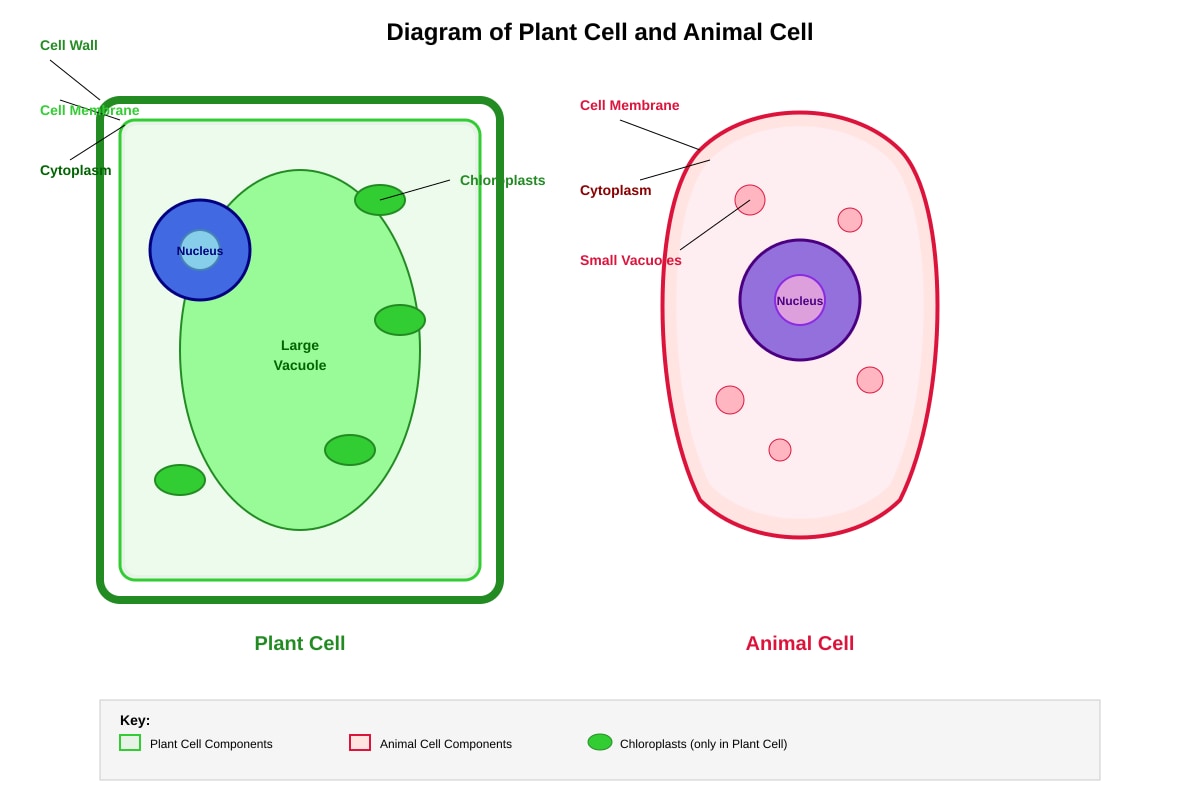
27. The diagram below shows a plant cell and an animal cell.
<image_placeholder> id: Q27-fig1 type: diagram linked_question: Q27 description: Two cells side by side. Plant cell: rectangular, cell wall, cell membrane, cytoplasm, nucleus, chloroplasts, large vacuole. Animal cell: irregular shape, cell membrane, cytoplasm, nucleus, small vacuoles. Both labelled. labels: Plant Cell: Cell wall, Cell membrane, Cytoplasm, Nucleus, Chloroplasts, Large vacuole. Animal Cell: Cell membrane, Cytoplasm, Nucleus, Small vacuoles values: None must_show: Clear structural differences between plant and animal cells </image_placeholder>
(a) Name the part labelled X in the plant cell. [1]
(b) State one function of the part named in (a). [1]
(c) State two differences between the plant cell and the animal cell. [2]
28. Study the classification chart below.
<image_placeholder> id: Q28-fig1 type: diagram linked_question: Q28 description: Classification chart: Living Things → Plants (Flowering, Non-flowering) and Animals (Vertebrates: Mammals, Birds, Fish, Reptiles, Amphibians; Invertebrates: Insects, Arachnids, Molluscs, Worms). Non-Living Things → Natural, Man-made. labels: All group names as listed values: None must_show: Complete hierarchical classification with all major groups </image_placeholder>
(a) A bat has wings and can fly. However, it is not a bird. Using the chart, explain why a bat is classified as a mammal. [2]
(b) An earthworm has a long, segmented body and no legs. Which group in the chart does it belong to? [1]
(c) State one difference between an insect and an arachnid. [1]
SECTION C: Open-Ended Questions (28 marks)
Questions 29 to 32 carry the marks shown. Write your answers in the spaces provided.
29. Ali found two organisms, X and Y, in his garden. He recorded his observations in the table below.
| Observation | Organism X | Organism Y |
|---|---|---|
| Green in colour | Yes | No |
| Makes its own food | Yes | No |
| Reproduces by spores | No | Yes |
| Found growing on | Soil | Dead tree trunk |
(a) Based on the observations, classify Organism X and Organism Y into their respective groups (Plants, Fungi, Animals, Bacteria). [2]
Organism X: ____________________________________________________________
Organism Y: ____________________________________________________________
(b) Explain how Organism Y obtains its food. [2]
(c) Organism X has flowers. State the function of the flower. [1]
(d) Ali placed Organism Y in a sealed plastic bag and left it in the sun. After a few days, he observed water droplets inside the bag. Explain how the water droplets were formed. [2]
30. The diagram below shows the life cycles of a mosquito and a cockroach.
<image_placeholder> id: Q30-fig1 type: diagram linked_question: Q30 description: Two life cycles side by side. Mosquito: Egg → Larva (aquatic) → Pupa (aquatic) → Adult. Cockroach: Egg case (ootheca) → Nymph (wingless, moults several times) → Adult (winged). Both cycles complete. labels: Mosquito: Egg, Larva, Pupa, Adult. Cockroach: Egg case, Nymph (multiple stages), Adult values: None must_show: Complete life cycles for both, clear distinction between complete and incomplete metamorphosis </image_placeholder>
(a) Which insect undergoes complete metamorphosis? [1]
(b) State two differences between the life cycle of a mosquito and a cockroach. [2]
(c) The mosquito larva and pupa live in water. How does this affect mosquito control in Singapore? [2]
(d) The cockroach nymph moults several times before becoming an adult. Explain why moulting is necessary. [2]
31. A pupil conducted an experiment to find out how light affects the growth of mould on bread. She used four slices of bread from the same loaf and placed them in four sealed bags under different conditions.
| Set-up | Condition |
|---|---|
| A | Moist bread, kept in light |
| B | Moist bread, kept in dark |
| C | Dry bread, kept in light |
| D | Dry bread, kept in dark |
After 5 days, she observed the amount of mould growth on each slice.
(a) Which set-up (A, B, C or D) would have the most mould growth? [1]
(b) Explain your answer in (a). [2]
(c) Which two set-ups should be compared to find out if light affects mould growth? [1]
(d) The pupil concluded that "mould grows better in the dark." Is this conclusion correct based on the experiment? Explain. [2]
32. The diagram below shows a classification key for some animals.
<image_placeholder> id: Q32-fig1 type: diagram linked_question: Q32 description: Dichotomous key: 1a. Has backbone → Go to 2. 1b. No backbone → Go to 5. 2a. Has feathers → Bird. 2b. No feathers → Go to 3. 3a. Has hair/fur → Mammal. 3b. No hair/fur → Go to 4. 4a. Has scales, breathes with gills → Fish. 4b. Has moist skin, lays eggs in water → Amphibian. 5a. Has 6 legs → Insect. 5b. Has 8 legs → Arachnid. 5c. Soft body, shell → Mollusc. labels: All key steps and animal groups values: None must_show: Complete dichotomous key with all branches </image_placeholder>
(a) Using the key, identify the group for an animal that has a backbone, no feathers, no hair/fur, has scales, and breathes with gills. [1]
(b) A pupil found an animal with no backbone and 8 legs. Using the key, identify its group. [1]
(c) The key cannot be used to classify a snake. Explain why. [2]
(d) Suggest one additional question that could be added to the key to classify a snake. [1]
END OF PAPER
Total Marks: 100
Answers
TuitionGoWhere Practice Paper - Science Primary 4 (Answer Key)
Subject: Science
Level: Primary 4
Paper: Practice Paper 2 (Version 2 of 5)
Total Marks: 100
SECTION A: Multiple-Choice Questions (28 marks)
1. Answer: (1) Mushroom, fern, moss [2]
Explanation: Mushroom (fungi), fern (non-flowering plant), and moss (non-flowering plant) are all living things. Cloud, river, rock are non-living natural things. Robot, car, computer are man-made non-living things. Shadow, reflection, echo are non-living phenomena.
2. Answer: (2) Mould [2]
Explanation: The classification chart shows Living Things → Plants and Animals. Mould is a fungus, which is a living thing but neither a plant nor an animal. Bacteria are microorganisms (not in the main chart groups shown). Yeast is a fungus (single-celled). Viruses are non-living. Mould (multicellular fungi) fits as a living thing not classified as plant or animal in this simplified chart.
3. Answer: (2) Bala [2]
Explanation:
- Ali is incorrect: Plants are living things but cannot move from place to place.
- Bala is correct: All living things need air (oxygen for respiration), food (nutrients), and water to survive.
- Cindy is incorrect: Only some animals lay eggs; mammals give birth to live young, plants reproduce by seeds/spores, bacteria by binary fission.
- Devi is incorrect: Growth in living things includes development and reproduction, not just becoming bigger. Some organisms (e.g., bacteria) grow by dividing, not increasing individual size indefinitely.
4. Answer: (3) Leaves [2]
Explanation: Leaves contain chlorophyll and are the site of photosynthesis, where plants make food (glucose) using sunlight, carbon dioxide, and water. Roots absorb water and minerals. Stem transports substances and supports the plant. Flowers are for reproduction.
5. Answer: (2) A and C only [2]
Explanation:
- A: Correct. Fungi reproduce by spores.
- B: Incorrect. Fungi cannot make their own food; they are decomposers/saprotrophs.
- C: Correct. Fungi feed on dead or decaying organic matter (saprotrophic nutrition).
- D: Incorrect. Fungi do not have green leaves; they lack chlorophyll.
6. Answer: (2) Fungi [2]
Explanation: Following the flowchart: Does it make its own food? No → Does it reproduce by spores? Yes → Fungi. The organism matches fungi characteristics: heterotrophic, spore reproduction, feeds on decaying matter.
7. Answer: (3) Butterfly [2]
Explanation: Butterfly undergoes complete metamorphosis: egg → larva (caterpillar) → pupa (chrysalis) → adult. Grasshopper and cockroach undergo incomplete metamorphosis (egg → nymph → adult). Chicken is a bird (no metamorphosis).
8. Answer: (3) Larva and Pupa only [2]
Explanation: Mosquito eggs are laid in water but the egg stage itself is not aquatic in the same way. The larva (wriggler) and pupa (tumbler) are fully aquatic stages that live and develop in water. The adult is terrestrial/flying.
9. Answer: (2) Butterfly [2]
Explanation:
- Frog: Young = tadpole (not nymph)
- Butterfly: Young = caterpillar/larva (not nymph)
- Grasshopper: Young = nymph (incomplete metamorphosis)
- Chicken: Young = chick (bird, no nymph stage) Butterfly has a larva (caterpillar) and pupa stage, not a nymph stage.
10. Answer: (3) Bacteria reproduce by binary fission. [2]
Explanation:
- (1) Incorrect: Many bacteria are beneficial (e.g., gut bacteria, decomposers, used in food production).
- (2) Incorrect: Bacteria are microscopic; cannot be seen with naked eye.
- (3) Correct: Binary fission is the asexual reproduction method of bacteria.
- (4) Incorrect: Bacteria are prokaryotes, not plants (which are eukaryotes with cell walls of cellulose).
11. Answer: (2) A - Bacteria, B - Fungi, C - Fungi [2]
Explanation:
- A: Rod-shaped, single-celled, no nucleus → Bacteria (prokaryote)
- B: Oval-shaped, budding → Yeast (single-celled fungus)
- C: Thread-like hyphae with sporangia → Mould (multicellular fungus)
12. Answer: (2) Presence of water [2]
Explanation: The changed (independent) variable is the presence of water (Set-up A has water, Set-up B does not). Type of bread, temperature, and size of bread slice are control variables (kept the same).
13. Answer: (3) Plastic, glass, metal [2]
Explanation: Plastic, glass, and metal are all man-made non-living materials. Water, air, soil are natural non-living things. Wood, cotton, leather come from living things (plants/animals). Seed, egg, spore are living or reproductive structures of living things.
14. Answer: (2) By spores [2]
Explanation: Ferns are non-flowering plants that reproduce by spores, which are produced in sori (clusters) on the underside of fronds. They do not produce seeds, flowers, or fruits.
SECTION B: Structured Questions (44 marks)
15. (a) Both are living things. / Both grow. / Both reproduce. [1]
Accept any one valid similarity.
(b) Difference 1: Organism A (mushroom) is a fungus; Organism B (green plant) is a plant. [1] Difference 2: Organism A cannot make its own food (feeds on decaying matter); Organism B makes its own food through photosynthesis. [1] Other acceptable differences: A reproduces by spores, B by seeds; A has no chlorophyll, B has chlorophyll; A has hyphae, B has roots/stem/leaves.
(c) Fungi [1]
16. (a) Y [1]
Explanation: Group Y has hair/fur, gives birth to young alive, feeds young with milk — defining characteristics of mammals.
(b) A whale is a mammal because it has hair (at some stage), gives birth to live young, and feeds its young with milk. Fish have scales, lay eggs, and breathe with gills. [2] Mark breakdown: 1 mark for mammal characteristics, 1 mark for contrast with fish.
(c) Both hatch from eggs laid in water. / Both have gills at the young stage. [1]
17. (a) Chrysalis / Pupa [1]
(b) The caterpillar's exoskeleton (skin) does not stretch. As the caterpillar grows bigger, it must shed its old skin (moult) to allow further growth. [2] Mark breakdown: 1 mark for exoskeleton doesn't stretch/grow, 1 mark for shedding allows growth.
(c) Caterpillar has no wings / cannot fly / eats leaves; Adult butterfly has wings / can fly / feeds on nectar. [1] Accept any one valid difference.
(d) To increase the chances of survival / because many eggs will be eaten by predators or fail to hatch. [1]
18. (a) Incomplete metamorphosis means the young (nymph) resembles the adult but is smaller and lacks wings, and there is no pupal stage. [1]
(b) 4 [1] Count the nymph stages shown: 1st, 2nd, 3rd, 4th instar.
(c) Nymph has no wings / wing buds only; Adult has fully developed wings. [1]
(d) Laying eggs in soil protects them from predators, drying out, and extreme temperatures. [1]
19. (a) Non-flowering plant (Fern/Moss) [1]
(b) Flowering plants reproduce by seeds (from flowers); Non-flowering plants reproduce by spores (no flowers). [1]
(c) The plant has cones and needle-like leaves. It does not bear flowers. Following the flowchart: Does it bear flowers? No → Does it reproduce by spores? No (it reproduces by seeds in cones) → It is a non-flowering plant (conifer). [2] Mark breakdown: 1 mark for "does not bear flowers", 1 mark for correct flowchart reasoning.
20. (a) A [1]
Only A makes its own food (plant characteristic).
(b) B [1] B does not make food but reproduces by spores (fungus characteristic).
(c) C [1] C has a backbone (vertebrate characteristic).
(d) D [1] D has no backbone and does not make food or reproduce by spores (invertebrate animal).
21. (a) Any two: Reproduce by spores / Feed on dead or decaying matter (saprotrophs) / Cannot make own food / Made of hyphae (thread-like structures) / No chlorophyll. [2]
(b) The mushroom's hyphae grow into the rotting log and secrete digestive enzymes onto the
<stage5_exam_answers_md>
TuitionGoWhere Practice Paper - Science Primary 4 (Answer Key)
Subject: Science
Level: Primary 4
Paper: Practice Paper 2 (Version 2 of 5)
Total Marks: 100
SECTION A: Multiple-Choice Questions (28 marks)
| Question | Answer | Explanation |
|---|---|---|
| 1 | (1) | Mushroom, fern, and moss are all living things (fungi and plants). Cloud, river, rock are non-living natural things. Robot, car, computer are man-made non-living things. Shadow, reflection, echo are non-living phenomena. |
| 2 | (3) | Yeast is a fungus (microorganism). Bacteria are prokaryotes (separate kingdom). Mould is a fungus but typically refers to multicellular fungi. Virus is non-living. In primary science classification, yeast is the classic example of a single-celled fungus. |
| 3 | (2) | Bala is correct: All living things need air, food, and water. Ali is incorrect (plants don't move from place to place). Cindy is incorrect (many living things don't lay eggs). Devi is incorrect (living things grow but not all "become bigger" - some grow in complexity/cell number). |
| 4 | (3) | Leaves contain chlorophyll and carry out photosynthesis to make food for the plant. |
| 5 | (2) | Fungi reproduce by spores (A) and feed on dead/decaying matter (C - saprotrophic nutrition). They do NOT make their own food (B) and do NOT have green leaves (D). |
| 6 | (2) | The organism does not make its own food → Not a plant. Reproduces by spores → Fungi. (Feeding on decaying matter confirms fungi). |
| 7 | (3) | Butterfly undergoes complete metamorphosis (egg → larva → pupa → adult). Grasshopper and cockroach undergo incomplete metamorphosis. Chicken has no metamorphosis. |
| 8 | (3) | Mosquito larva and pupa are both aquatic stages. Eggs are laid on water surface but the egg stage itself is not "living in water" in the same way. |
| 9 | (2) | Butterfly has a caterpillar (larva) stage, not a nymph stage. Frog has tadpole, grasshopper has nymph, chicken has chick. |
| 10 | (3) | Bacteria reproduce by binary fission (asexual division). Not all are harmful (many beneficial). Too small for naked eye. Bacteria are not plants (they are prokaryotes). |
| 11 | (2) | A = rod-shaped bacteria → Bacteria. B = budding yeast cells → Fungi (yeast). C = hyphae and sporangia → Fungi (mould). |
| 12 | (2) | The changed (independent) variable is the presence of water. Type of bread, temperature, and size are kept constant (controlled variables). |
| 13 | (3) | Plastic, glass, metal are all man-made non-living materials. Water, air, soil include natural non-living things but soil contains living organisms. Wood, cotton, leather come from living things. Seed, egg, spore are living/reproductive structures. |
| 14 | (2) | Ferns are non-flowering plants that reproduce by spores (produced in sori on frond undersides). |
SECTION B: Structured Questions (44 marks)
15.
(a) Both are living things / Both grow / Both reproduce / Both need air, food, and water. [1]
(b) Difference 1: Organism A (mushroom) cannot make its own food; Organism B (green plant) can make its own food through photosynthesis. [1]
Difference 2: Organism A reproduces by spores; Organism B reproduces by seeds (or flowers/fruits). [1]
Other acceptable differences: A has no chlorophyll/leaves/roots; B has chlorophyll/leaves/roots. A feeds on decaying matter; B is a producer.
(c) Fungi [1]
16.
(a) Group Y [1]
(b) A whale is a mammal: it has hair (at some stage), gives birth to live young, feeds young with milk, and breathes with lungs (not gills). Fish have scales, lay eggs, and breathe with gills. [2]
Key points: breathes with lungs, gives birth to live young, feeds young with milk, has hair.
(c) Both hatch from eggs laid in water / Both young breathe with gills initially / Both young live in water. [1]
17.
(a) Chrysalis / Pupa [1]
(b) The caterpillar's exoskeleton (skin) does not stretch, so it must moult to allow its body to grow larger. [2]
Key points: exoskeleton is rigid/hard, does not grow, moulting allows growth.
(c) Caterpillar: no wings, crawls, eats leaves, has many legs (prolegs). Adult butterfly: has wings, flies, feeds on nectar, has 6 legs. [1]
Any one valid difference.
(d) To increase the chances of survival / because many eggs will be eaten by predators or fail to hatch. [1]
18.
(a) Incomplete metamorphosis means the young (nymph) resembles the adult but is smaller and lacks wings; there is no pupa stage. [1]
(b) 4 nymph stages (1st, 2nd, 3rd, 4th instar) [1]
(c) Nymph: no wings / wing buds only, smaller, cannot fly, cannot reproduce. Adult: fully developed wings, larger, can fly, can reproduce. [1]
(d) The soil protects the eggs from predators, drying out, and extreme temperatures. [1]
19.
(a) Non-flowering plant (Fern/Moss) [1]
(b) Flowering plants reproduce by seeds (from flowers); non-flowering plants reproduce by spores (or cones for conifers). [1]
(c) The plant does not bear flowers (it has cones instead). Following the flowchart: "Does it bear flowers?" → No → "Does it reproduce by spores?" → No (it reproduces by seeds in cones) → It is a non-flowering plant (conifer/gymnosperm). [2]
Key: No flowers → non-flowering plant. Cones are not flowers.
20.
(a) Organism A (Makes own food = Yes, Reproduces by spores = No, Has backbone = No) [1]
(b) Organism B (Makes own food = No, Reproduces by spores = Yes, Has backbone = No) [1]
(c) Organism C (Has backbone = Yes) [1]
(d) Organism D (Makes own food = No, Reproduces by spores = No, Has backbone = No) [1]
Also acceptable: Organism B is an invertebrate too, but D is the only one that fits "invertebrate" without being a fungus. Typically, D represents an invertebrate animal like an insect.
21.
(a) 1. Reproduce by spores. 2. Cannot make their own food (heterotrophic/saprotrophic). 3. Feed on dead/decaying matter. 4. No chlorophyll/leaves/roots. [Any 2, 1 mark each]
(b) The hyphae grow into the rotting log and secrete digestive enzymes to break down the dead organic matter externally, then absorb the digested nutrients. [2]
Key points: hyphae, enzymes, external digestion, absorption.
(c) By wind / air currents. [1]
22.
(a) P: Bacteria (single-celled, rod-shaped, no nucleus = prokaryote) [1]
Q: Yeast (single-celled, oval, budding = fungal reproduction) [1]
R: Mould (thread-like hyphae with sporangia = multicellular fungus) [1]
(b) Yeast (Q) [1]
(c) Bacteria are used in making yoghurt/cheese / decompose waste / fix nitrogen in soil / help digestion in gut / produce antibiotics. [Any 1, 1 mark]
23.
(a) Tadpole with hind legs / Tadpole with four legs / Froglet (any stage between basic tadpole and adult frog) [1]
Since the diagram was truncated, accept any intermediate stage shown.
(b) The tadpole breathes with gills in water; the adult frog breathes with lungs on land (and also through moist skin). [2]
Key: gills → lungs; aquatic → terrestrial.
(c) The frog lays many eggs in a jelly-like mass in water. This protects the eggs from drying out and predators, and keeps them moist for development. [2]
Key: jelly coating, water, protection, moisture.
SECTION C: Open-Ended Questions (28 marks)
24.
(a) Set-up A: Bread with water in sealed bag (damp condition). Set-up B: Bread without water in sealed bag (dry condition). Both in dark cupboard. [1]
Or: The presence/absence of water/moisture.
(b) Mould grows faster in Set-up A (with water). [1]
(c) Mould needs moisture (water) to grow. The damp condition provides water for mould spores to germinate and hyphae to grow. [2]
Key: water essential for germination and growth.
(d) Temperature / Type of bread / Size of bread slice / Amount of air in bag / Light exposure (kept dark). [Any 1, 1 mark]
25.
(a) The seed coat protects the embryo/seed from physical damage, drying out, and disease. [1]
(b) The seed leaves (cotyledons) store food for the young plant/embryo to use during germination before it can photosynthesise. [1]
(c) The young plant uses the stored food in the seed leaves for energy to grow (respiration) until the first true leaves appear and can make food by photosynthesis. [2]
Key: stored food → energy → growth → first true leaves → photosynthesis.
(d) Water, Air (oxygen), Warmth (suitable temperature). [All 3 for 2 marks; 2 for 1 mark]
26.
(a) Animal X: Mosquito (or any insect with complete metamorphosis: butterfly, beetle, fly). Animal Y: Grasshopper (or cockroach, dragonfly - incomplete metamorphosis). [1 each]
(b) Animal X (Mosquito): Egg → Larva → Pupa → Adult. Animal Y (Grasshopper): Egg → Nymph → Adult. [2]
Must show 4 stages for X, 3 stages for Y.
(c) Animal X has a pupa stage; Animal Y does not. Animal X young (larva) looks very different from adult; Animal Y young (nymph) resembles adult. [Any 1, 1 mark]
(d) The pupa stage allows complete restructuring of body tissues (metamorphosis) from larval form to adult form, enabling different lifestyles (e.g., aquatic larva vs flying adult) and reducing competition for food between stages. [2]
Key: restructuring, different habitats/food, no competition.
27.
(a) Bacteria: Single-celled, no nucleus, reproduce by binary fission, some harmful some useful.
Yeast: Single-celled fungus, reproduces by budding, used in baking/brewing.
Mould: Multicellular fungus (hyphae), reproduces by spores, grows on food. [3]
1 mark for each correct distinguishing characteristic set.
(b) Yeast respires anaerobically (fermentation) producing carbon dioxide gas. The CO₂ gets trapped in the dough, causing it to rise. [2]
Key: anaerobic respiration, CO₂, trapped, dough rises.
(c) 1. Decomposers: break down dead matter, recycle nutrients. 2. Nitrogen-fixing bacteria: convert atmospheric nitrogen to nitrates for plants. 3. Gut bacteria: aid digestion, produce vitamins. 4. Used in food production (yoghurt, cheese). 5. Used in medicine (antibiotics, vaccines). [Any 2, 1 mark each]
28.
(a) Group P: Flowering plants (bear flowers, reproduce by seeds). Group Q: Non-flowering plants (reproduce by spores - ferns, mosses). [1 each]
(b) The plant has cones but no flowers. It reproduces by seeds in cones, not spores. It is a gymnosperm (conifer), classified as a non-flowering plant. [2]
Key: cones not flowers, seeds not spores, gymnosperm = non-flowering.
(c) Similarity: Both reproduce by seeds. Difference: Flowering plants have seeds enclosed in ovary/fruit; non-flowering plants (conifers) have naked seeds on cone scales. [2]
Key: seeds enclosed vs naked seeds.
(d) Spores are single-celled, microscopic, produced in large numbers, no stored food, dispersed by wind. Seeds are multicellular, contain embryo and stored food, have protective seed coat, dispersed by various methods. [2]
Key differences: cell number, size, food store, protection, dispersal.
Total: 100 marks
End of Answer Key